Synthesis and Flame Retardant Improvement of PU Coatings Containing Trichloro Modified
Polyester/IPDI Isocyanurate
Ji Hyun Kim․Jang Hyoun Keun
*․Choong Ho Jung
**․Seung Jin Kim
***Young Geun Kim
***․Seong Kil Kim
****․Hong Soo Park
Department of Chemical Engineering, Myongji University, Yongin 449 728, Korea
*
Suji High School, Yongin 448 171, Korea
**
Korea Institute of Ceramic Engineering and Technology, Icheon 467 843, Korea
***
Korea Institute of Construction Materials, 1465 4, Seoul 137 707, Korea
****
B&B Korea Co., Pocheon 487 811, Korea (Received May 1, 2008 ; Accepted August 26, 2008)
Abstract : Two component polyurethane (PU) flame retardant coatings were prepared by blending trichloro modified polyesters (TCMPs) and isophorone diisocyanate isocyanurate.
TCMPs were synthesized by polycondensation of trichlorobenzoic acid (TCBA), a flame retardant component, with adipic acid, 1,4 butanediol, and trimethylolpropane. The content of TCBA was varied in 10, 20, and 30 wt% for the reaction. Theses new flame retardant coatings showed various properties comparable to other non flame retardant coatings.
Moreover, we carried out the combustion test and the flammability test for our flame retardant coatings. The results of vertical burning test for the coatings containing more than 20 wt% of TCBA were determined as no burn. The results of flammability test for the coatings with 20 wt% and 30 wt% of TCBA contents indicated the limiting oxygen index (LOI) values of 26% and 29% respectively, which implied relatively good flame retardancy.
Keywords : trichloro modified polyester, IPDI isocyanurate, PU coatings, combustion, flammability, vertical burning test, LOI method.
1. Introduction
Flame retardant coatings are noncombustible materials, which prevent or delay flash over from the coating surface of combustibles. Recently, interest has been growing in developing flame retardant
✝
Corresponding author (e-mail : [email protected])
coatings[1 3] of two component polyurethane (PU), because they have many advantages such as good cross hatch adhesion, resistance against abrasion, weathering, and chemicals, and curing at ambient temperature.
It is the purpose of this article to present
the synthesis of flame retardant two
component PU coatings and to characterize
the physical properties and the flammability
of the prepared coatings. First we
polycondensed trichloro group containing
aromatic carboxylic acid and polyol to synthesize chlorinated modified polyester prepolymers. Two component PU flame retardant coatings were then prepared by blending these polyester prepolymers with isocyanate, wetting agent and pigment. The prepared coatings were characterized in terms of physical properties [4], combustion [5], and flammability [6] test results.
2. Experimental 2.1. Materials
Trimethylolpropane (TMP) and trichlorobenzoic acid (TCBA) were purchased from Tokyo Kasei Inc., and adipic acid (AA) and 1,4 butanediol (1,4 BD) were from Sigma Chemical Inc. and used as received. Our isocyanate was isophorone diisocyanate (IPDI) isocyanurate (Desmodur Z 4470, solid content 70%, NCO content 12%, Viscosity of 1600 mPa s at 23℃) from Bayer Leverkusen Co.
TiO
2(Britisch Titan Co.) was used as a white pigment, BYK P 104S (BYK Mallinckrodt) was a wetting agent, and Dow Corning 11 (Dow Corning Chemicals) was a flowing agent.
2.2. Synthesis of Trichloro Modified Polyesters
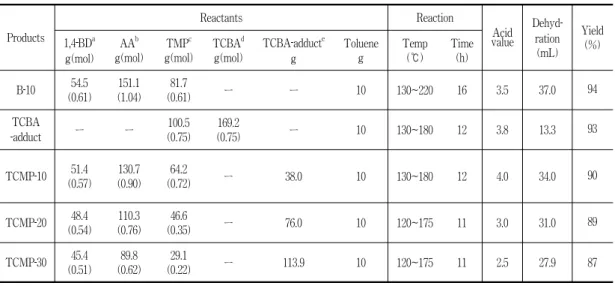
TCBA/TMP Intermediate : The reaction conditions for the synthesis of TCBA/TMP intermediate are given in Table 1. The reaction procedure is the same as that of modified polyester (B 10). Reaction products were purified by precipitation with excess n hexane and the transparent TCBA adduct, which is a TCBA/TMP intermediate, was obtained by vacuum drying at 50℃ and 7 mmHg.
Trichloro Modified Polyesters : The polymerization conditions for the synthesis of polyester containing 10 wt% TCBA are given in row TCMP 10 of Table 1. Unreacted 1,4 BD and AA were removed by distilled water
and the remaining TMP was then removed by n hexane precipitation resulting in a transparent polyester prepolymer with 10 wt% TCBA (TCMP 10). Rows TCMP 20 and TCMP 30 in Table 1 are the conditions for the synthesis of polyester containing 20 wt%
(TCMP 20) and 30 wt% (TCMP 30) TCBA, respectively.
2.3. Instrumental Analyses
An FTIR was carried out with a Digilab FTS 40 from Bio Rad and 1H NMR with a Gemini 200 from Varian. A GPC R 410 from Waters was used to determine molecular weights and their distribution.
2.4. Preparation of Two Component PU Flame Retardant Coatings
The modified polyester produced (110g) was mixed with 40 g each of cellosolve acetate, ethyl acetate, butyl acetate, and toluene. To prepare polyester resin solution, TiO
288g white pigment, 0.4g dispersant BYK P 104S, and 0.5g flowing agent Dow Coring 11 were blended with the mixture. Isocyanate resin curing solution was prepared by adding 25g each of cellosolve acetate and xylene to 150g of IPDI isocyanurate.
Two component PU Coatings were prepared by blending 359g of polyester resin and 200g of isocyanate resin curing solution at the time of film formation. Resulting blends of TCMP 10/IPDI, TCMP 20/IPDI, and TCMP 30/IPDI were named TCPU 10, TCPU 20, TCPU 30, respectively. The blend of B 10/IPDI was named BPU 10.
2.5. Tests of General Properties for Flame Retardant Coatings
Preparation of Specimens : Three types of
specimens were prepared. When cold rolled
carbon steel sheets (KS D 3512) were used,
steel sheets were prepared according to the
KS M 5000 1111 manual and coatings were
painted with a thickness of 0.076mm. Coated
samples were dried at 50% relative humidity
and 23℃ for 7 days. Tin sheets (KS D 3516) were prepared according to the KS M 5000 1112 manual. After polishing and cleaning, 0.076mm coatings were made by a Doctor film applicator and dried at the same conditions as cold rolled carbon steel sheets.
When glass sheets were used, 200×150×5mm glass sheets were coated with the same products as the tin sheets.
Methods for Property Examination : The Krebs Stormer viscometer 80328 from Pacific Scientific Co. was used to determine viscosity. Fineness of grind was estimated with a fineness gauge from Precisions Gauge
& Tool. Measurement of drying time was carried out by the dry hard method. Pot life was measured based upon the degree of curing at which the viscosity reachs maximum, 140 KU. Hardness was determined by the Sward hardness method. Flexibility was measured according to the KS M 5000 3331 manual for the tin sheets. Impact resistance was determined according to JIS K 5400 for the cold rolled carbon steel sheets.
KS M 5000 3312 was followed to determine 60 specular gloss and FS 141 6152 to determine abrasion resistance. Cross adhesion tests were carried out to determine the strength of adhesion of the tin sheets. A xenon Weather ometer (model Ci65A) from Atlas Electric Devices was used to examine the accelerated weathering resistance and a spectrocolorimeter (model SZ ∑80) from Nippon Denshoku Kogyo was used to determine yellowness. Lightness index differences were measured according to the KS M 5000 3031 manual.
2.6. Flame Retardancy Tests
In order to test flame retardancy of flame retardant coatings, TCPU, the combustibility and flammability of the specimens coated by the coatings were measured. The combustibility was measured by a vertical test (ASTM D568 77) and a horizontal test (ASTM D635 88)[7], and the flammability
(ASTM D568 77, with A type specimen) was measured by the limiting oxygen index method (LOI method) using a combustion tester (ON 1, Yoyo Rika Co.).
3. Results and Discussion
3.1. Identification of Trichloro Modified Polyesters
Formerly, Kashyap et al. [8] prepared fast drying and chemicals resistant coatings by using benzoic modified polyester resins.
Recently, Shin et al. [9] prepared a modified polyester by using 3,5,5 trimethylhexanoic and used it to prepare polyurethane coatings.
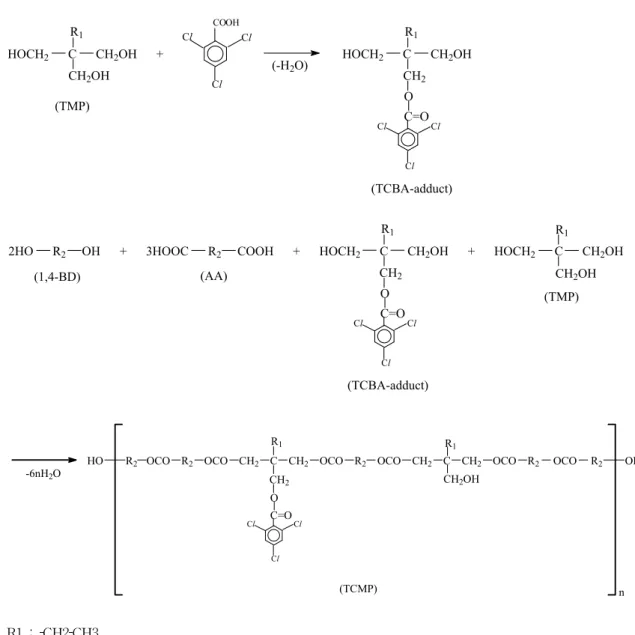
We here carried out polycondensation of AA, TMP, and 1,4 BD by introducing monobasic acid, TCBA, to improve polymer properties and flame retardancy. We carried out two step synthetic method. First, an intermediate, TCBA adduct was synthesized by the esterification of TMP and TCBA to eliminate unreacted free acid. Next the TCBA adduct was used in the polycondensation reaction with 1,4 BD, AA, and TMP. The chemical structure and the reaction condition for the synthesis of TCBA adduct are shown Fig. 1 and Table 1.
The results of absorption peaks of FTIR
spectrum and the chemical shifts of 1H NMR
spectrum are summarized in Table 2. The
observed peaks are coincident with theoretical
peaks of TCBA adduct. The observed chlorine
contents in TCBA adduct are in good
agreement with the calculated result as
shown in Table 3. No catalyst is used in the
synthesis of TCMP because the existence of
catalyst tends to reduce pot life when it is
blended with isocyanate. Sufficient
dehydration occurred during the reaction and
the acid value was maintained below 5. The
results of FTIR spectrum and 1H NMR
spectrum in Table 2 may identify modified
chlorine containing polyester as the structure
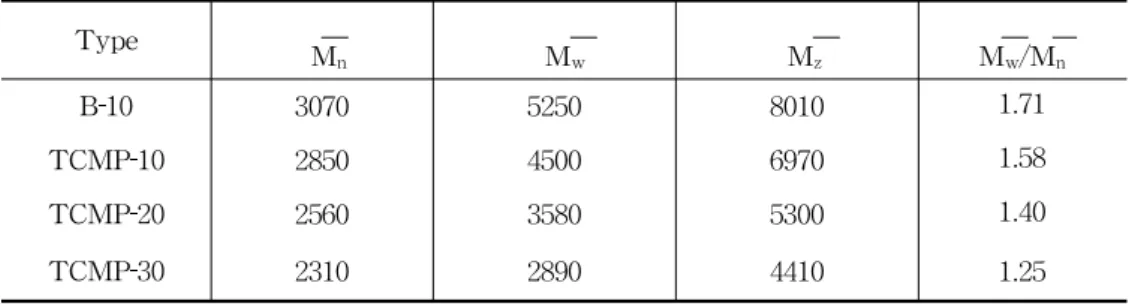
of TCMP 10 as shown in Fig. 1. Table 4
HOCH
2C CH
2OH +
COOH Cl Cl
CH
2OH
ClR
1(-H
2O) HOCH
2C CH
2OH CH
2R
1O C=O
ClCl
(TCBA-adduct)
Cl
(TMP)
2HO R
2OH + 3HOOC R
2COOH + HOCH
2C CH
2OH + HOCH
2C CH
2OH CH
2R
1O C=O
ClCl
(TCBA-adduct)
Cl
(1,4-BD) (AA)
(TMP) CH
2OH R
1HO R2 OCO R2 OCO CH2 C CH2 OCO R2 OCO CH2 C CH2 OCO R2 OCO R2 OH CH2
R1
O C=OCl
Cl Cl
n CH2OH
R1 -6nH2O
(TCMP)
R1 : CH2 CH3 R2 : (CH2)4
Fig. 1. Synthesis of TCBA adduct and TCMP.
Products
Reactants Reaction
Acid value
Dehyd ration (mL)
Yield 1,4 BD
a(%)
g(mol) AA
bg(mol)
TMP
cg(mol)
TCBA
dg(mol)
TCBA adduct
eg
Toluene g
Temp (
℃)
Time (h)
B 10 54.5
(0.61) 151.1 (1.04)
81.7
(0.61)
ㅡ ㅡ10 130
~220 16 3.5 37.0 94
TCBA
adduct
ㅡ ㅡ100.5 (0.75)
169.2
(0.75)
ㅡ10 130
~180 12 3.8 13.3 93
TCMP 10 51.4
(0.57) 130.7 (0.90)
64.2
(0.72)
ㅡ38.0 10 130
~180 12 4.0 34.0 90
TCMP 20 48.4
(0.54) 110.3 (0.76)
46.6
(0.35)
ㅡ76.0 10 120
~175 11 3.0 31.0 89
TCMP 30 45.4
(0.51) 89.8 (0.62)
29.1
(0.22)
ㅡ113.9 10 120
~175 11 2.5 27.9 87
a1,4 BD : 1,4 Butanediol bAA : Adipic acid
cTMP : Trimethylolpropane dTCBA : Trichlorobenzoic acid
eTCBA adduct : TCBA/TMP intermediate
Table 1. Molar Ratios of the Reactants and Reaction Conditions for Modified Polyester, TCBA/TMP Intermediate, and Trichloro Modified Polyesters
Products FTIR (KBr, cm
1) 1H NMR (200MHz, CDCl
3, ∂ in ppm)
TCBA adduct
2980 : CH
30.9 (CH
3C)
3380 : OH 1.6 (C CH
2C)
1470 : CH
23.4 (R OH)
1750 : C=O 3.7 (C CH
2O )
1580 : C=O of Ar 4.4 (C CH
2OCO ) 1060 : OH of pri alcohol 7.4~7.7 ( CH=CH of Ar)
TCMP 10
2970 : CH
30.9 (CH
3C)
3520 : OH 1.5 ( CH
2C)
1470 : CH
21.7 (C CH
2C)
1740 : C=O 2.4 (C CH
2CO )
1180 : C O 3.6 (C CH
2O )
1060 : OH of pri alcohol 4.2 (C CH
2OCO )
7.4~7.7 ( CH=CH of Ar)
Table 2. FTIR and 1H NMR Chemical Shifts of TCBA adduct and TCMP 10
Type Molecular
formula Mw
Cl content
aCalcd Observed
TCBA adduct C
13H
16O
4C
l3342.5 31.09 30.09
Table 3. Chlorine Content for TCBA adduct a Measured by reforming combustion flask method at 25℃.
Type M
nM
wM
zM
w/M
nB 10 3070 5250 8010 1.71
TCMP 10 2850 4500 6970 1.58
TCMP 20 2560 3580 5300 1.40
TCMP 30 2310 2890 4410 1.25
Table 4. Molecular Weight Distribution Data for B 10 and TCMPs Determined by GPC
lists the molecular weight characteristics of modified chlorine containing polyesters. The presence of TCBA adduct increases the content of hydroxyl group in TCMP, which reduces the reactivity of TCMP. This is the reason that the molecular weight and the polydispersity tend to decrease with increasing chlorine contents.
3.2. Physical Properties of Flame Retardant Coatings
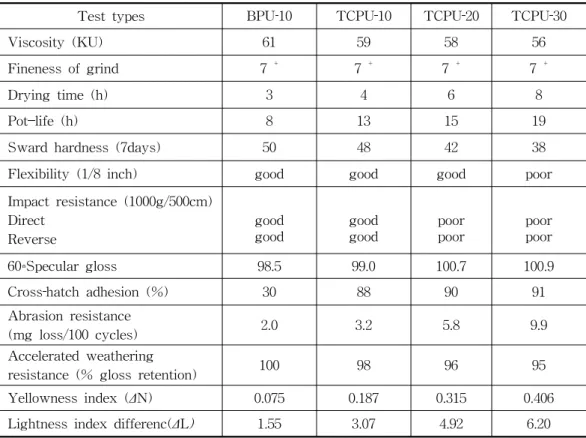
The synthesized trichloro modified polyesters were blended with IPDI isocyanurate to prepare flame retardant coatings. Table 5 summarizes the physical properties of coated films depending on the TCBA content. Viscosity, fineness of grind, hardness, 60°specular gloss, and accelerated weathering resistance of flame retardant TCPUs were comparable to those of non flame retardant coatings BPU 10. TCPUs showed better pot life and cross hatch adhesion but drying time, flexibility, impact resistance, abrasion resistance, yellowness index, and lightness index difference than
BPU 10. The pot life of TCPUs was 13~19 h, which belong to the long pot life coatings.
3.3. Combustion and Flammability of Coatings
Flame retardant coatings should have slow combustion and self extinguishing properties.
Decomposition gases of flame retardant coatings suppress flaming combustion and thus stop nonflaming combustion [10,11].
Chlorine compounds usually have low flammability in the gaseous state. The presence of chlorine affects the chemical reactions during combustion, and thus suppresses the access of oxygen and heat transfer by generating chlorine containing heavy gases.
Table 6 shows the results of flame retardant tests with the synthesized coatings.
In vertical test, BPU 10, TCPU 5, TCPU 10, and TCPU 15 took 101, 130, 151, and 218s, respectively, for the complete combustion.
Flame of TCPU 20 was extinguished right
after ignition. In horizontal test with TCPUs,
flames were soon extinguished after ignition.
Test types BPU 10 TCPU 10 TCPU 20 TCPU 30
Viscosity (KU) 61 59 58 56
Fineness of grind 7
+7
+7
+7
+Drying time (h) 3 4 6 8
Pot life (h) 8 13 15 19
Sward hardness (7days) 50 48 42 38
Flexibility (1/8 inch) good good good poor
Impact resistance (1000g/500cm) Direct
Reverse
good good
good good
poor poor
poor poor
60 Specular gloss 98.5 99.0 100.7 100.9
Cross hatch adhesion (%) 30 88 90 91
Abrasion resistance
(mg loss/100 cycles) 2.0 3.2 5.8 9.9
Accelerated weathering
resistance (% gloss retention) 100 98 96 95
Yellowness index (ΔN) 0.075 0.187 0.315 0.406
Lightness index differenc(ΔL) 1.55 3.07 4.92 6.20
Table 5. Physical Properties of TCMP/IPDI PU Flame Retardant Coatings
Testing methods
BPU 10 (s)
TCPU 5
a(s)
TCPU 10 (s)
TCPU 15
a(s)
TCPU 20 (s)
TCPU 30 (s) Vertical
Horizontal
101
b190
130 240
151 SE
218 SE
SE
cSE
SE SE aThe blends of TCMP 5/IPDI and TCMP 15/IPDI were named TCPU 5 and TCPU 15, respectively.
bThe average value obtained from the result of five independent tests.
cSE : It denotes self extinguishing property.
Table 6. Flame Retardancy Test of the Synthesized Coatings
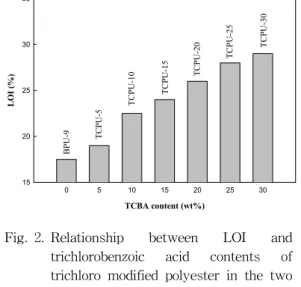
Fig. 2 shows the distribution of LOI values of TCPU with various TCBA content. The LOI value of a non flame retardant coating, BPU 10, was 17%, whereas the LOI values of flame retardant coatings, TCPUs, were increased with increasing TCBA content,
becoming 29% at 30% TCBA.
Results in Table 6 and Fig. 2 suggest that
flame retardancy increases as chlorine content
increases. This may be because chlorine
containing gases such as HCl generated from
thermal decomposition block the access of
oxygen and consequently suppress the flammable combustion of PU coatings.
TCBA content (wt%)
0 5 10 15 20 25 30
LOI (%)
15 20 25 30 35
BPU-9 TCPU-5 TCPU-10 TCPU-25
TCPU-20
TCPU-15 TCPU-30