2005, Vol. 16, No. 4, pp. 1159∼1165
Minimum Hellinger Distance Estimation and Minimum Density Power Divergence Estimation in Estimating
Mixture Proportions
Ro Jin Pak
1)Abstract
Basu et al. (1998) proposed a new density-based estimator, called the minimum density power divergence estimator (MDPDE), which avoid the use of nonparametric density estimation and associated complication such as bandwidth selection. Woodward et al. (1995) examined the minimum Hellinger distance estimator (MHDE), proposed by Beran (1977), in the case of estimation of the mixture proportion in the mixture of two normals. In this article, we introduce the MDPDE for a mixture proportion, and show that both the MDPDE and the MHDE have the same asymptotic distribution at a model. Simulation study identifies some cases where the MHDE is consistently better than the MDPDE in terms of bias.
Keywords : Bias, Density power divergence, Hellinger distance
1. Introduction
Robustness procedures typically obtain robustness at the expense of not being optimal at the true model. However, Beran (1977) has suggested the use of the MHDE which has certain robustness properties and is asymptotically efficient at the true model. The theories about MHDE have been studied by many researchers like Tamura and Boos (1986) (discussed the estimation of location and covariance in multivariate data), Eslinger and Woodward (1991) (discussed the estimation of the parameters of the normal distribution with unknown location and scale).
Woodward et al. (1995) discussed MHD estimation in the case of estimating the
1) Associate Professor, Division of Information and Computer Sciences, Dankook University, Seoul, Korea.
E-mail: [email protected]
mixture proportion of the mixture of two normals, and showed that the MHDE were robust and obtained full efficiency at the true model.
Suppose X
i, …,X
nbeing i.i.d. with a distribution G with corresponding density g and consider f
θ(x) = (1- θ) f
1(x)+ θf
2(x), where f
1and f
2are distinct, continuous densities on R, and θ∈ [ 0, 1]. If ˆ g
n
is a Hellinger consistent density estimator for f
θ, then Woodward et al. (1995) provided a very important theorem which concluded with the asymptotic statement at the model about the estimator ˆ θ
n
for the mixture proportion θ;
n( θ ˆ
n
- θ - B
n)→N( 0,I( θ)
- 1), (1.1) where I( θ) is the Fisher information matrix and B
nis given by
B
n= 2C
*n⌠
⌡ψ
θf
θ( ˜ g
n- f
θ) and C
*n→1 in probability
with E[ g ˆ
n
] = g ˜
n
. and ψ
θ= 1 I( θ)
f
1- f
2f
θ.
The above result actually was built upon the Theorem 4.1 by Tamura and Boos (1986) discussing the asymptotic distribution of the estimators for multivariate location and covariance. A kernel density estimator is a usual choice for ˆ g
n
as
ˆ g
n
(x) = 1
n ∑ h 1 k ( x - X h
i)
with a kernel k( ⋅) and a bandwidth h. We have ˜ g
n
→f
θat the model g = f, as h→0, nh→∞, then B
n→0.
Applying the MHDE to the real data associates complications such as bandwidth selection. There has been no reliable study about how to select bandwidths in this case. Meanwhile, Basu et al. (1998) proposed a class of ' density power divergences' indexed by a single parameter, α, which controls the trade-off between robustness and efficiency estimation. A good news is that in the process of estimation a density estimator is not required , that is, there is no need to select a bandwidth.
Consider a parametric family of models { F
θ}, indexed by the unknown
finite-dimensional parameter θ in an open connected subset Ω of a suitable
Euclidean space, possessing densities { f
θ} with respect to Lebesque measure. Let
G be the distribution underlying the data, having density g with respect to the
same measure. Basu et al. (1998) define the density power divergence between g and f
θto be
d
α(g, f
θ) = ⌠ ⌡ { f
1 + αθ- ( 1 + 1 α ) gf
αθ+ 1 α g
1 + α} dz ( α > 0), d
0(g, f
θ) = lim
α→0
d
α(g, f
θ) = ⌠ ⌡g log ( g/f
θ) dz.
We shall frequently use the shorthand notation d
α',d
α'',… for the derivatives of d
αwith respect to θ. Note that d
0(g, f
θ) is the Kullback-Leiber divergence.
The resulting sample minimum density power divergence estimators are those values ˆ θ
α
generated by minimizing
⌠ ⌡f
1 + αθdz - ( 1 + 1
α )n
- 1∑
ni = 1
f
αθ(X
i)
with respect to θ, when α > 0, and the negative loglikelihood
- n- 1∑
n
i = 1logfθ(Xi)
when α = 0. It can be checked easily that the estimating
equations have the form
n
- 1∑
ni = 1
f
αθ(X
i)u
i(X
i)- ⌠ ⌡ f
1 +αθu
θdz,
where u
θ(z) = ∂ log f
θ(z)/∂ θ is the maximum likelihood score function. Note that this estimating equation is unbiased when g= f
θ.
In this article we consider the MDPDE for a mixture proportion and we show that both the MDPDE and the MHDE have the same asymptotic distribution at a model. However, simulation study identifies some cases where the MHDE is better than the MDPDE in terms of bias.
2. Asymptotic properties of the MDPDE for the mixture proportion
Consider the estimation of the proportions θ
1, θ
2, …,θ
sin the mixture density f( x) = θ
1f
1(x) + θ
2f
2(x) + … + θ
sf
s(x).
Definition 1: Let X
i, …,X
nbe i.i.d. with a distribution G with
corresponding density g, that depends on θ = ( θ
1, …,θ
s), the minimum density power divergence estimator for the mixture proportion ˆ , generated by the θ quantity minimising
d
α(f
θ) = ⌠ ⌡f
1 + αθdz - ( 1 + 1
α )n
- 1∑
n
i = 1
f
αθ(X
i) (1.2) with respect to θ for a given α∈( 0, 1].
Theorem 1: Let X
i, …,X
nbe i.i.d. with a distribution that depends on θ = ( θ
1, …,θ
s). Under certain regularity conditions, given Basu et al. (1997), there exists ˆ such that, as n→∞, θ ˆ θ
n
is consistent for θ, and n
1/2( θ ˆ
n
- θ) is asymptotically multivariate normal with (vector) mean zero and covariance matrix J
- 1K J
- 1, where J and K are given by
J = ⌠ ⌡u
θ(z)u
Tθ(z)f
1 + αθdz + ⌠ ⌡i
θ(z) - αu
θ(z)u
Tθ(z) g( z) - f
θ(z) f
αθ(z)dz, K = ⌠ ⌡u
θ(z)u
Tθ(z)f
2αθ(z)g(z)dz - ξξ
Twith ξ = ⌠ ⌡u
θ(z)f
αθ(z)g(z)dz , where u
t(z) = ∂ log f
t(z)/∂t.
Proof: For estimator ˆ θ
n
and the true value θ
0, by Taylor series expansion of d
α(f
θ) in (1.2), we have
n( θ ˆ
n
- θ
0) = ( 1 / n)d
α'(f
θ) - ( 1/n)d
α''(f
θ)- (1/2n)( θ ˆ
n
- θ)d
α'''(f
θ*n) |
θ = θ0, where θ
*nlies between θ
0and ˆ θ
n
. Consider first the numerator, and then by the CLT
1
1 + α d'
α(f
θ) = ⌠ ⌡f
αθ(z)f
θ'(z)dz - n
- 1∑
ni = 1
f
α - 1θ(z)f
θ'(z)
= ⌠ ⌡f
1 + αθ(z)u
θ(z) - n
- 1∑
n
i = 1
f
αθ(z)u
θ(z)
→ N( 0, K).
In the denominator the consistency of the estimator, assumption of boundness of
d'''
α(f
θ*) and law of large numbers give - ( 1/n)d''
α(f
θ)→ J. The constant
( 1 + α) will be cancelled off. Proof is rather straight forward if we follow closely
the proof of Theorem 6.4.1 of Lehmann (1983) (which is for the maximum
likelihood estimator) with appropriate modifications to cope with density power divergence. The formulae look complicated, but let d
α(f
θ) play like L( θ) in the proof of Lehmann (1983).
Suppose that the true distribution g belongs to the parametric family { f
θ}.
Then the formular for J, K and ξ simplify to
J = ⌠ ⌡u
θ(z)u
Tθ(z)f
1 + αθ(z)dz,
K = ⌠ ⌡u
θ(z)u
Tθ(z)f
1 + 2αθ(z)dz- ξ ξ
Twith ξ = ⌠ ⌡u
θ(z)f
1 + αθ(z)dz.
Note that, in the limit α→0, J and K both become equal to the Fisher information matrix I(θ)
- 1. This asymptotic result at the model is the same as the one in (1.1) by Woodward et al. (1995) with f
θ= (1- θ) f
1+ θ f
2.
3. Finite sample properties
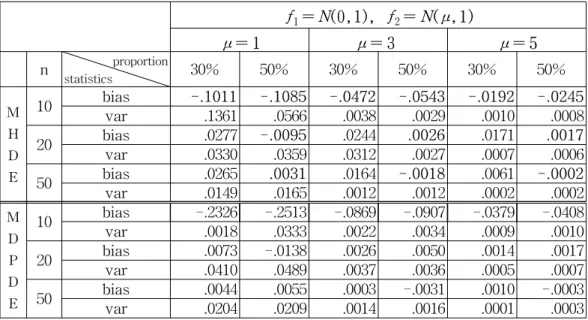
We showed that both the MDPDE and the MHDE have the same asymptotic distribution under certain conditions. In order to verify the asymptotic equivalence, simulations were carried out with 500 random samples of sizes, 10, 20 and 50, generated from 30% and 50% mixtures of two normals, N( 0, 1) and
N( 1, 1), N( 3, 1), N( 5, 1), respectively. An Epanechnikov kernel and a
bandwidth by 'bandwidth.nrd' of S-plus (Venables and Ripley, 1996) are used for
a density estimator. Basu, et al. (1998) did not provide no universal way of
selecting an appropriate α parameter, but recommended α near 0.25. For
computational convenience α = 1/3 is used for MDPDE, In the course of
verifying the above theory we have discovered the case where the MHDE is
consistently better than the MDPDE in terms of having smaller bias. The results
are in Table 1; the numbers in bold indicate the cases where the absolute value
of the bias of the MHDE is smaller than that of the MDPDE, where n = 10 or
proportion is 50%. The variances of both estimators are very close, but there is
no systematic pattern in sizes like biases. The one thing we can think of at this
moment is that this phenomenon is related with the closeness of the model f and
the true density g, because unbiasedness of both the MHDE and the MDPDE is
attained under the condition that g = f. In practice the true density g should be
estimated. Recall that g is estimated by an empirical density for the MDPDE and
by an smoothed (kernel) density estimator for the MHDE. When a kernel density
estimator is more effective in estimating g than an empirical density, we expect
that bias of the MHDE would be smaller than that of the MDPDE.
4. Conclusions
We show that the MDPDE and the MHDE have the same asymptotic distribution when estimating mixture proportions. The MDPDE performs quite well without worrying about choosing a smoothing parameter, however we could identify the cases where the size of bias of the MHDE is smaller than that of the MDPDE are identified. We need more thorough investigation why it happens, but at this moment we conclude that there are cases where smoothing data with a kernel function in estimating a mixture proportion is useful in reducing bias.
Table 1. Statistics on the estimates of mixture proportions ; f= (1-θ)f
1+ θf
2f
1= N(0,1), f
2= N( μ, 1)
μ = 1 μ = 3 μ = 5
n
proportionstatistics
30% 50% 30% 50% 30% 50%
M H D E
10 bias -.1011 -.1085 -.0472 -.0543 -.0192 -.0245
var .1361 .0566 .0038 .0029 .0010 .0008
20 bias .0277 -.0095 .0244 .0026 .0171 .0017
var .0330 .0359 .0312 .0027 .0007 .0006
50 bias .0265 .0031 .0164 -.0018 .0061 -.0002
var .0149 .0165 .0012 .0012 .0002 .0002
M D P D E