115 https://doi.org/10.22889/KJP.2020.51.2.115
예덕나무 가지의 Ethyl Acetate 분획물의 예쁜 꼬마선충 내의 항산화 효과
김준형1·최혜영2·정정은2·강연주2·김선주2·권강무2·김대근2*
1
우석대학교 식품생명공학과,
2우석대학교 약학과
Antioxidant Activity of Ethyl acetate Fraction of Mallotus japonicus Twigs in Caenorhabditis elegans
Jun Hyeong Kim1, Hye young Choi2, Jung Eun Jung2, Yeon Ju Kang2, Sun Ju Kim2, Kang Mu Kwon2, and Dae Keun Kim2*
1
Department of Food and Biotechnology, Woosuk University, Wanju, Jeonbuk 55338, South Korea
2
Department of Pharmacy, Woosuk University, Wanju, Jeonbuk 55338, South Korea
Abstract Caenorhabditis elegans model system was used to investigate the antioxidant activity of methanol extract of Mallotus japonicus twigs. The ethyl acetate soluble fraction of the M. japonicus methanol extract showed the best DPPH radical scavenging activity. The ethyl acetate fraction was measured for the activity of superoxide dismutase (SOD), catalase, and oxi- dative stress tolerance by using C. elegans along with reactive oxygen species (ROS) level. In addition, to confirm that the reg- ulation of the stress response gene is responsible for the increased stress tolerance of C. elegans treated by the ethyl acetate fraction, SOD-3 expression was measured using a transgenic strain. As a result, the ethyl acetate fraction increased SOD and catalase activity, and decreased ROS accumulation in a dose-dependent manner. In addition, the ethyl acetate fraction-treated CF1553 worm showed higher SOD-3::GFP intensity than the control worm.
Keywords Caenorhabditis elegans, Antioxidant activity, Catalase, SOD
호흡을 통해 인체 내로 들어온 산소의 약 2%는 산화 과 정을 거쳐 체내의 세포와 조직을 손상시킬 수 있는 활성 산 소종(reactive oxygen species, ROS)이 되어 산화적 스트레 스를 야기시키는 주요 원인물질이 된다. 이로 인해 세포 손 상이 생기고 노화가 촉진되어 알레르기를 비롯한 면역력 약 화, 염증성 질환 등 다양한 질병을 초래하게 된다. 특히 주 요 성인병인 암을 비롯하여 고혈압, 동맥경화, 뇌졸중 등이 활성산소와 연관되어 있는 등 질병의 약 90%가 활성산소 와 연관 있음이 알려져 있다.
1)인체는 이러한 유해한 활성 산소를 제거하기 위하여 catalase, superoxide dismutase (SOD), glutathione(GSH) 및 glutathione S-transferase(GST) 와 같은 인체 항산화 시스템이 작동되어 체내 산화와 항산 화 균형을 유지하고 있다. 그러나 이러한 조건으로는 유해 한 활성산소를 충분히 제거하기 부족하므로 추가적인 안전 한 항산화 물질이 필요하다. 이에 비타민 C, 비타민 E, 베 타 카로틴 등의 천연 항산화 물질과 butylated hydroxyl
toluene(BHT), butylated hydroxyl anisole(BHA) 등의 합성 항산화제를 사용되고 있다. 그러나 합성 항산화제는 장기복 용 시, 체내에서 독성을 일으키는 것으로 보고되고 있어 유 용한 천연식물 자원으로부터 천연 항산화제를 개발하기 위 해 다양한 연구가 진행되고 있다.
2,3)예덕나무(Mallotus japonicas, Euphorbiaceae)는 예로부터 민간에서 위염, 위궤양과 같은 질병에 사용되어 왔으며, 예 덕나무 추출물은 항암, 항바이러스 및 항염증 활성 등과, 간 세포 손상에 대한 간세포 보호작용 등이 보고되어 있다.
4-6)특히, 예덕나무 잎의 열수 추출물은 강한 DPPH radical 소 거 효능이 있으며, 이는 페놀성 화합물에 기인한 효능임을 LC-MS를 이용하여 보고하였다.
4)본 연구는 예덕나무 가지의 methanol 추출물을 용매로 계 통분획하여 각 분획물에 대해 vitamin C를 대조군으로 하 여 DPPH free radical과 superoxide 소거능 실험을 하여 가 장 강한 소거능을 보인 ethyl acetate 분획물을 확보하였다.
이 분획에 대하여 수명연장 실험모델로 잘 알려진 예쁜꼬 마선충(Caenorhabditis elegans)을 이용한 산화적 스트레스
*교신저자(E-mail):[email protected] (Tel): +82-63-290-1574
에 대한 저항 효능을 확인하였으며, 또한 산화적 스트레스 에 저항할 수 있는 단백질의 증가 여부를 확인하기 위하여 형질전환 mutant를 이용한 유전자 별현 증가 여부 실험을 통하여 몇가지 지견을 얻었기에 이를 보고하고자 한다.
재료 및 방법
실험재료 본 실험에 사용한 예덕나무 가지는 완주군에 서 채집 후 김대근 교수(우석대)가 검증한 후에 음건세절하 여 사용하였으며, 표준품은 우석대학교 약학대학 생약표본 실에 보관하고 있다(WS-19-006).
추출 및 분획 예덕나무 가지를 음건세절 후 얻은 시료 3.2 Kg을 methanol로 진탕하면서 5시간씩 50
oC에서 2회 온 침 추출하였다. 그 추출액을 수욕상에서 감압농축하여 methanol 엑스 약 165 g을 얻었으며, 이 methanol 엑스에 증 류수로 현탁시키고 상법에 따라 동량의 n-hexane(7.7 g), methylene chloride(2.0 g), ethyl acetate(1.2 g) 및 n-butanol (2.7 g)의 순으로 용매 분획하여 각각의 분획물을 얻었다.
DPPH Free Radical 소거법에 의한 항산화활성
7) 96 well plate에 시료를 ethanol로 각 농도별로 조제한 용액에 0.2 mM의 1,1-diphenyl-2-picrylhydrazyl(DPPH)(ethanol)을 일정량씩 가하였다. 10초간 진탕한 후 25
oC에서 30분간 방 치한 후 microplate reader를 이용하여 517 nm에서 흡광도 를 측정하였다. 대조약물은 L-ascorbic acid를 사용하였다.
항산화효과는 시료를 첨가하지 않은 대조군의 흡광도와 비 교하여 그래프로 나타내었다. 각 시료에 대한 DPPH radical 소거작용을 3회 반복하여 측정하였다.
Riboflavin 유래 Superoxide 억제활성
8) 시료의 superoxide 억제능력은 methionine, riboflavin, NBT로 구성 된 평가시스템을 이용하여 광화학작용을 측정하였다. 반응 혼합액은 2.6 μM riboflavin, 3 mM methionine, 75 μM NBT, 0.1 mM EDTA, PBS(pH 7.4) 및 여러 농도의 시료로 이루어졌다. 혼합물은 light box에 넣은 후 5분마다 자리를 임의로 바꾸어 주면서 15분 동안 방치하였다. Light box안 의 온도는 20±1
oC, 빛의 밝기는 5,500 lux를 유지하였다.
NBT는 빛 아래에서 blue formazane으로 환원되어지는데, 이 생성물을 560 nm에서 측정하였다. Blue formazane 형성 억제가 superoxide 억제능력이 된다.
예쁜꼬마선충(Caenorhabditis elegans)의 배양
9) C.
elegans는 E. coli OP50를 도말한 Nematode Growth Medium(NGM) agar plate에 20
oC에서 배양 되었다. 예덕나 무 가지 분획물을 D MSO를 용매로 한 stock solution 상태 로 멸균된 NGM plates(at 50
oC)에 첨가되었다. 최종 D MSO 농도는 모든 상태에서 0.1%(v/v)를 유지하였다.
선충 체내의 항산화 효소(SOD, Catalase) 활성 측정
10,11) 시료를 농도별로 조제한 plate에 성장 단계가 동일한 N2
선충을 배양하였다. 성체가 된 후 4일째에 선충을 모아 M9 buffer로 3회 세척 후 분쇄하여 효소 활성 측정에 사용하였 다(homogenization buffer: 10 mM Tris-HCl, 150 mM NaCl, 0.1 mM EDTA, pH 7.5). SOD 활성은 Ibrahim등의 방법을 응용하여 측정하였다. 먼저 10 mM phosphate buffer(pH 8.0)를 용매로 반응 혼합물(1.6 mM xanthine과 0.48 mM NBT 0.49 mL)를 만든 뒤 농도별 시료 10 μL와 37
oC에서 5분간 pre-incubation시켰다. 그 후 xanthine oxidase 100 μL(0.05 U/mL)을 첨가하고 37
oC에서 20분 동안 incubation시킨 다음 69 mM SD S로 반응을 멈추고 570 nm 에서 흡광도를 측정하였다. Catalase 활성은 Aebi의 방법을 응용하여 25 mM H
2O
2에 농도별 시료 50 μL를 3분 동안 반 응시키고 240 nm에서 흡광도를 측정하였다.
선충 세포 내 활성산소종(ROS) 분석
12) 선충 세포 내 활성 산소종은 2',7'-dichlorodihydro fluorescein diacetate (H
2DCF-DA)를 사용하여 측정하였다. 성장 단계가 동일한 선충을 시료를 농도별로 제조한 plate에서 배양하였다. 성체 가 된 후 4일째 50 μM juglone을 함유한 M9 buffer에 넣고 2시간 노출시킨 뒤 96 well plate에 담긴 50 μL M9 buffer 에 5마리씩 옮겼다. 마지막으로 25 μM H
2DCF-DA 50 μL 를 첨가한 뒤 여기 485 nm, 방출 535 nm에서 흡광도를 각 각 측정하였다.
산화적 스트레스 저항성 측정
13) 성장 단계가 동일한 선 충을 각각의 농도별 plate에서 배양하였다(EDZ 250, 500 μg/
mL). Oxidative stress에 의한 내성은 기존 방법을 약간 변 형하여 평가하였으며, 성체가 된 후 7일째에 일시적으로 선 충을 1 mM juglone이 함유된 M9 buffer가 담긴 96 well plate의 well에 옮기고 시간 별로 생존율을 확인하였다.
형질전환 선충 내 SOD-3::GFP 형광 측정 형질 전환 된 선충으로 SOD-3::GFP를 포함한 CF1553을 농도별로 투 여된 배지에 배양하였다. 성체가 된 후 4일째에 사용하였으 며, 선충은 sodium azide(4%)로 마취시켰고 GFP 발현은 형 광 실체 현미경(Olympus, Japan)으로 관찰하였다. 발현강도 를 정량, 분석하기 위해 현미경을 이용한 사진 촬영과 ImageJ 소프트웨어를 사용하여 분석하였다. 모든 실험은 3회 반복 하였다.
통계 분석 통계 자료의 값은 평균값 ± 표준오차(mean
± S.E.M.)로 표시 하였다. 그룹간의 통계적 유의성 검정은 Student’s t-test를 통해서 분석하였고 선충의 연속적인 생존 도는 Log-rank test 분석 방법을 이용하였다. p값은 *p<
0.05, **p<0.01, ***p<0.001 일 때 유의성이 있는 것으로 간 주하였다.
결 과
DPPH Radical 소거능 DPPH radical 소거능 분석은 실
험에서 사용된 시료의 D PPH radical 소거 활성을 평가하기 위해 수행되었다. 예덕나무 가지 분획물 중에서, DPPH radical 소거 효과는 Fig. 1에 나타난 바와 같이 분획물들 중 ethyl acetate층(IC
50value, 25.65 μg)이 효과가 가장 좋았으 며, 대조군인 비타민 C(IC
50value, 36.13 μg)보다 더 좋은 소거 효과를 보여주었다.
Superoxide 억제활성 Superoxide 억제능은 methionine, riboflavin, NBT로 구성된 평가시스템을 이용하여 광화학작 용을 측정하는 것으로 사용된 시료의 superoxide 억제 활성 평가하기 위해 수행되었다. 예덕나무 가지 분획 중에서, superoxide 억제효과는 Fig. 2에 나타난 바와 같이 그 중 ethyl acetate 분획(IC
50value, 42.88 μg)이, 비타민 C(IC
50value, 70.87 μg)에 비해 더 좋은 superoxide 억제 효과를 나 타내었다.
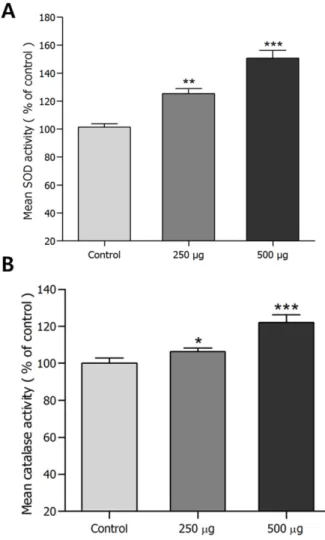
항산화 효소(SOD, Catalase) 활성 증가 효능 Xanthine 을 기질로 xanthine oxidase의 효소반응 과정 중에 생성되 는 superoxide anion을 활용하여 SOD의 활성을 측정한 결
과 Fig. 3A에서 나타난 바와 같이 예쁜꼬마선충의 예덕나 무 가지 ethyl acetate분획물 투여군은 SOD의 활성을 농도 의존적으로 증가 시켰으며, ethyl acetate 분획 500 μg/mL 투 여군은 대조군과 비교 하여 SOD 활성을 약 50.75% 정도 증가시켰다(***p<0.001). 강력한 반응성을 가진 활성산소종 인 hydrogen peroxide를 체내에서 대사시키는 catalase의 활 성은 Fig. 3B에서 나타난 바와 같이 ethyl acetate 분획 500 μg/mL 투여군이 대조군에 비해 catalase활성을 약 22.11% 정도 증가시켰다(***p<0.001)(Fig. 3).
Fig. 1. DPPH radical scavenging effects of the methanol extract, and its fractions from M. japonicas twigs.
Fig. 2. Riboflavin-originated superoxide quenching activities of methanol extract, and its fraction from M. japonicus twigs.
Fig. 3. Effects of ethyl acetate fraction of M. japonicus twigs on the antioxidant enzyme activity of wild-type N2 nematode.
(A) The enzymatic reaction of xanthine with xanthine oxidase was used to generate •O
2- and the SOD activity was estimated spectrophotometrically through formazan formation by NBT reduction. The SOD activity was showed as a percentage of superoxide-scavenged amount per control. (B) Catalase activity was calculated from the concentration of residual H
2O
2, as determined by a spectrophotometric method. The catalase activity was expressed in U/mg protein. Data are expressed as the mean±S.E.M. of three independent experiments. Differ- ences compared to the control were considered significant at
*p<0.05, **p<0.01 and ***p<0.001 by one-way ANOVA.
활성 산소종(ROS) 감소 효능 예덕나무 가지 ethyl acetate 분획의 농도별 세포 내 활성 산소종의 감소 효능을 알아보기 위해 H
2DCF-DA와 선충 내부의 활성 산소종을 반응시켜 형광을 관찰하였다. 활성 산소종 형광의 감소 폭 은 대조군과 비교 하여 예덕나무 가지의 ethyl acetate 분획 500 μg/mL 투여군에서 평균 약 20.68%(***p<0.001) 활성 산소종을 감소시키는 것으로 확인되었다(Fig. 4).
산화적 스트레스 저항성 증가 효능 예덕나무 가지의 ethyl acetate 분획을 juglone으로 산화적 스트레스를 유도한 선충의 생존율에 미치는 영향 평가실험에서 분획을 처리하 지 않은 대조군 선충의 최고 생존시간은 19시간이었으나, ethyl acetate 분획 500 µg/mL 농도에서는 생존시간을 31시 간으로 증가시켰다. 대조군의 평균 생존시간이 13.4±0.6시 간었으나 500 μg/mL 농도 처리군은 평균 생존 시간을 19.7±1.2시간으로 47.6%의 생존 시간을 향상시켰다(***p
<0.001)(Fig. 5, Table I).
형질 전환 선충 내 SOD-3의 발현 증가 효능 선충 내 에서 oxidative stress에 저항하기 위한 단백질의 증가 여부 Fig. 4. Effects of ethyl acetate fraction of the M. japonicus twigs on the intracellular ROS levels of wild-type N2 nematodes. Intra- cellular ROS accumulation was examined in a microplate fluorescence reader at 535 nm (emission) and 485 nm (excitation). (A) Plates were read for 120 min. (B) The average percentages of intracellular ROS accumulation were presented. Differences com- pared with the control were considered significant at **p<0.01 and ***p<0.001 by the one-way ANOVA.
Fig. 5. Effects of ethyl acetate fractions of M. japonicus twigs on the stress tolerance of wild-type N2 nematodes. For the oxidative stress assays, worms were transferred to 96-well plate containing 1 mM of juglone liquid culture, and then their viability was scored. Statistical difference between the curves was analyzed by log-rank test.
Table I. Effects of ethyl acetate fraction of M. japonicus twigs on the oxidative stress tolerance of C. elegans Stress
condition Fraction Mean
lifespan (h) Maximum lifespan
(h) Change in mean
lifespan (%) Log-rank test 1mM
Juglone
Control 250 μg/mL 500 μg/mL
13.4 ± 0.6 15.3 ± 1.0 19.7 ± 1.2
19 27 31
- 14.7 47.6
-
*p<0.05
***p<0.001 Mean lifespan presented as mean ± S.E.M data. Change in mean lifespan compared with control group (%). Statistical significance of the difference between survival curves was determined by log-rank test using the Kaplan-Meier survival analysis.
Differences compared to the control were considered significant at *p<0.05 and ***p<0.001.
를 확인하기 위해서 SOD발현 유전자의 증가 여부를 확인 하였다. SOD-3을 포함한 형질 전환 선충 CF1553을 사용하 여 실험한 결과 CF1553 형질전환 선충에 예덕나무 가지 ethyl acetate 분획의 500 μg/mL 처리군이 처리되지 않은 선 충에 비해 높은 SOD-3::GFP 발현율(20.49%, ***p<0.001) 을 보여 주었다(Fig. 6A, 6B).
고 찰
본 연구에서는 예쁜꼬마선충을 모델로 사용하여 예덕나 무 가지 ethyl acatate 분획물에 대한 선충 내의 항산화 효 과에 대한 실험을 하였다. 예쁜꼬마선충은 토양 선충으로 크기가 작고 수명이 짧고 번식률이 높으며, 몸 전체가 투명 하기 때문에 염료를 사용하지 않고 현미경으로 관찰하기 쉽 고, E. coli를 먹이로 하기 때문에 실험실에서 쉽게 배양할 수 있다. 완전한 게놈 시퀀싱이 수행되어 있어 잘 정립된 유 전 경로가 확보되어 있으며, 현재 다양한 생체 활성 화합물 의 선별에 널리 응용되고 있고, 인간의 노화를 촉진하는 약 리학적 표적을 확인하기 위한 연구의 모델로도 많이 사용 되고 있다.
14,15)예덕나무 가지의 methanol 추출물의 분획물의 DPPH radical과, superoxide 소거활성시험에서, ethyl acetate 분획
은 가장 강한 소거활성을 보여 주었다. Eethyl acetate 분획 은 선충 내의 항산화 효소인 SOD 및 catalase의 활성을 높 이는 것으로 확인되었으며, juglone으로 처리하여 산화적 스 트레스를 가한 후 선충 세포 내 활성 산소종의 수치를 확인 한 결과 상당한 활성 산소종(ROS)의 축적억제 효능을 나타 내었다. Juglone을 처리한 후 ethyl acetate 분획 처리가 선 충의 stress 저항능력에 미치는 영향을 확인한 결과 oxidative stress 조건하에서 대조군과 비교하여 생존율이 농도 의존적 으로 상당히 증가하는 것이 확인되었다. 이와 관련하여, mutant(GFP-fused transgenic strain CF1553)를 이용하여 oxidative stress 저항성 단백질 발현 여부를 확인하는 실험 에서 형광 발현율이 상당히 증가함이 확인되어 oxidative stress에 저항할 수 있는 단백질의 발현이 증가되었음을 확 인하였다.
기존의 보고에 따르면 활성 산소종은 세포의 호흡, 세포 의 손상 및 주변의 산화물 등에 의해 부산물로 발생되며, 산 화적 스트레스는 항산화제의 결핍이나 방어할 수 있는 양 이상의 활성 산소종의 생성이 원인으로 작용하여 이는 노 화 및 암을 비롯한 여러 질병의 원인으로 보고 되어있다.
16)예덕나무 가지의 ethyl acetate 분획은 선충 체내의 SOD나 catalase 등의 항산화 효소의 활성을 증가시키며, 활성 산소 종의 축적을 억제하고 스트레스에 대한 저항력을 높여 주 Fig. 6. Effect of ethyl acetate fraction of M. japonicus twigs on the expression of SOD-3 was determined using transgenic nem- atodes. (A) Images of SOD-3::GFP expression of CF1553 worm in the presence or absence of ethyl acetate fraction. (B) The mean GFP intensity of mutant was represented as mean ± S.E.M. of values from 19 to 25 animals per each experiment. The GFP inten- sity was quantified using Image software by determining average pixel intensity. Data are expressed as the mean ± standard devi- ation of three independent experiments. Differences compared with the control were considered significant at **p<0.01 and
***p<0.001 by one-way ANOVA.
므로 선충의 수명연장이나 노화지연에 영향을 미칠 수 있 을 것으로 추측된다.
17)이러한 결과는 기존의 예덕나무 잎 에서 보고된 rutin의 멜라닌 색소억제활성을 비롯하여 phloroglucinol의 항종양 활성, bergenin의 항궤양, 항염증, 간보호 효과 등이
18-22)이러한 선충의 항산화 활성 및 스트 레스 저항능력에 영향을 줄 것으로 생각되며, 앞으로 예덕 나무 가지의 활성물질에 대한 물질의 분리와 구조확인 및 단일 물질 수준에서의 예쁜꼬마선충 내의 항산화 활성 연 구 및 그 기전에 대한 연구가 필요할 것으로 사료된다.
결 론
예덕나무 가지 ethyl acetate 분획은 DPPH free radical과, superoxide 소거실험에서 강한 항산화력을 보여주었으며, 예 쁜꼬마선충을 이용한 항산화 실험에서는 SOD 및 catalase 의 활성을 농도 의존적으로 높이는 것을 확인하였다. 선충 세포 내의 ROS의 발생을 농도의존적으로 감소시켰으며, juglone 투여로 인한 oxidative stress 조건하에서는 선충의 생존율을 농도 의존적으로 증가시켰다. 이와 관련하여 mutant 인 GFP-fused transgenic strain CF1553을 이용한 oxidative stress 저항성 단백질 발현 실험에서는 oxidative stress에 저 항성이 있는 형광을 띤 단백질의 발현이 증가되었음을 확 인하였다. 이러한 결과는 예덕나무 가지의 ethyl acetate 분 획은 항산화 및 이와 관련된 질병의 예방 및 치료를 위한 천연자원으로서의 가치가 충분히 있을 것으로 사료된다.
사 사
이 논문은 2017년도 교육부의 재원으로 한국연구재단의 지원을 받아 수행된 연구(2017R1D1A3B03032146)로 이에 감사 드립니다.
인용문헌