45(3) : 227∼ 232 (2014)
227
팥 에틸아세테이트 분획이 선충의 스트레스 저항성과 항산화 활성에 미치는 영향
이은별1·안달래1·김반지1·이소연1·차연수2·이재혁3·박정숙4·김대근1*
1우석대학교 약학대학, 2전북대학교 식품영양학과, 3남부대학교 한방제약개발학과, 4남부대학교 대체의학과
Effects of Ethyl acetate Fraction of Vigna angularis on Stress Resistances and Anti-oxidative Activities in Caenorhabditis elegans
Eun Byeol Lee1, Dalrae Ahn1, Ban Ji Kim1, So Yeon Lee1, Youn-Soo Cha2, Jae Hyeok Lee3, Jeong-Suk Park4, and Dae Keun Kim1
*
1College of Pharmacy, Woosuk University, Jeonju 565-701, Korea
2Dept. of Food Science and Human Nutrition, Chonbuk National University, Jeonju, 561-756, Korea
3Dept. of Oriental Pharmaceutical Development, Nambu University, Gwangju 506-706, Korea
4Dept. of Alternative Medicine, Nambu University, Gwangju 506-706, Korea
Abstract − The seed of Vigna angularis (Ohwi) Ohwi & Ohashi (= Phaseolus angularis W. F. Wight, Leguminosae) is one of well-known folk foodstuffs in Korea, China and Japan. In the course of screening for antioxidants from natural plants in Korea by measuring the radical scavenging effect on 1,1-diphenyl-2-picrylhydrazyl (DPPH) a methanol extract of the seeds of V. angu- laris were found to show a potent antioxidant activity. And the ethyl acetate soluble fraction of V. angularis (VAEA) showed the most potent DPPH radical scavenging and superoxide quenching activities. To reveal the effect of antioxidant activities of VAEA, we tested the thermal and oxidative stress tolerances, activities of SOD and catalase, and intracellular ROS level in Cae- norhabditis elegans. Consequently, VAEA-fed worms lived longer than control worms under the thermal and oxidative stress conditions. And VAEA elevated SOD and catalase activities of worms, and reduced intracellular ROS accumulation in a dose- dependent manner.
Key words − Vigna angularis, DPPH, superoxide, Oxidative stress, SOD, catalase, ROS, Caenorhabditis elegans
에너지 대사과정에서 발생하는 대부분의 산소는 인산화 를 통해서 환원되지만 일부 활성산소는 유해한 활성산소종 (ROS)의 형태로 미토콘드리아의 전자전달계에서 주로 생성 되어 유리기가 세포 내의 DNA나 단백질 및 지질 등을 손 상시켜 세포의 기능을 손상시키며, 최근 다소 논란이 있지 만 노인성 질환이나 개체의 노화를 촉진하는데 주요 원인 으로 보고되고 있다.1-3) 미토콘드리아 전자전달계에서 생성 되는 활성산소종에는 superoxide(1O2−), hydroxyl radical(OH) 및 과산화수소수(H2O2) 등이 있으며, 과잉의 유해 활성산소 종은 체내의 항산화 방어체계인 superoxide dismutase, catalase 등과 같은 효소들에 의해 제거될 수 있고, 비타민 C나 E, glutathione과 같은 항산화물질에 의해 제거될 수 있
다.4,5) 지금까지 안전한 유해한 유리기를 제거하기 위한 천
연 항산화제의 연구가 천연물을 대상으로 많은 연구가 이 루어지고 있다.6)
팥(Vigna angularis (Ohwi) Ohwi & Ohashi = Phaseolus angularis W. F. Wight, 콩과 Leguminosae)은 중국원산의 1 년생 덩굴성 초본식물로 30-50 cm까지 자라며, 잎은 3출겹 잎으로 호생한다. 꽃은 1 cm정도로 나비모양이며 노란색으 로 피고, 열매는 협과로 6-10 cm 크기에 씨가 6-10개 정도 들어 있다.7) 팥에 대한 약리활성 연구로는 팥의 물 추출물 의 항비만 효과8)를 비롯하여 실험적 당뇨병쥐의 혈당치에 미치는 영향9), 혈청 콜레스테롤 치에 미치는 영향10), melanoma cell의 점착성, 침해성, 전이성 등의 억제효능11)과 알코올 추출물의 항산화 효과12) 및 항염증 효과13) 등이 보 고되어 있다. 식물화학적 성분연구로는 사포닌 성분14,15)을 비롯하여 flavonoid16), polyphenol8) 및 anthocyanin계 물질17)
*교신저자(E-mail):[email protected] (Tel): +82-63-290-1574
들이 보고되어 있다. 본 연구는 팥의 methanol 추출물의 분 획 중 DPPH free radical과 superoxide quenching 효능이 가장 뛰어난 ethyl acetate분획이 예쁜꼬마선충(Caenor- habditis elegans)의 열과 산화적 스트레스에 대한 저항성과 선충내의 항산화효소인 SOD와 catalase의 활성과 세포내의 ROS의 축적에 미치는 영향에 대해 확인하여 팥 추출물의 항산화효능에 대해 알아보고자 하였다.
재료 및 방법
실험재료 − 본 실험에 사용한 팥은 2013년에 경남 밀양시 의 농촌진흥청 국립식량과학원 기능성작물부 잡곡과에서 제 공하였으며, 표준품은 우석대학교 약학대학 생약표본실에 보관하고 있다(WSU-13-008).
추출 및 분획 − 팥 2 kg을 조말로 분쇄하여 methanol로 진탕하면서 50oC에서 5시간씩 3회 온침 추출하였다. 그 추 출액을 수욕상에서 감압농축하여 methanol엑스 약 84 g을 얻었으며, 이 methanol엑스를 증류수로 현탁시키고 상법에 따라 동량의 n-hexane(650 mg), methylene chloride(11.3 g), ethyl acetate(1.2 g) 및 n-butanol(14.5 g)의 순으로 용매 분 획하여 각각의 분획물을 얻었다.
DPPH Free Radical 소거법에 의한 항산화 활성 측정18)− 96 well plate에 시료를 ethanol로 각 농도별로 조제한 용액 에 0.2 mM의 1,1-diphenyl-2-picrylhydrazyl(DPPH)을 일정 량씩 가하였다. 10초간 진탕한 후 25oC에서 30분간 방치한 후 microplate reader를 이용하여 520 nm에서 흡광도를 측 정하였다. 대조약물은 L-ascorbic acid를 사용하였다. 항산화 효과는 시료를 첨가하지 않은 대조군의 흡광도와 비교하여 그래프로 나타내었다. 각 시료에 대한 DPPH radical 소거작 용을 3회 반복하여 측정하였다.
Xanthin 유래 Superoxide 소거 활성 측정19)− Xanthine/
xanthine oxidase에 의해 생성된 superoxide radical은 Thuong 등의 방법에 따라 측정하였다. Nitro blue tetra- zolium(NBT, 0.48 mM), xanthine(1.6 mM)을 포함하는 phosphate buffer(pH 7.8, 20 mM)와 시료를 함께 혼합한다.
5분 후 xanthine oxidase(0.05 U/mL) 100 µL를 넣고, 37oC 에서 30분간 배양시킨 후 570 nm에서 흡광도를 측정하였 다. Superoxide radical 소거 활성은 시료와 대조군의 NBT 의 환원 정도를 비교하여 나타내었다.
예쁜꼬마선충(Caenorhabditis elegans)의 배양20)− 예쁜 꼬마선충은 Escherichia coli OP50를 도말한 nematod growth medium(NGM) agar plate에 20oC에서 배양하였다.
팥의 ethyl acetate분획을 DMSO 용매로 한 stock solution 상태로 멸균된 NGM plates(at 50oC)에 첨가하였다. 최종 DMSO농도는 모든 상태에서 0.1%(v/v)를 유지하였다.
스트레스 저항성 평가21,22)− 성장 단계가 동일한 선충을
각각의 농도 별(0 µg/ml, 250 µg/ml, 500 µg/ml)로 plate에서 배양하였다. 온도에 의한 내성을 분석하기 위해 선충을 신 선한 배지로 옮기고 성체가 된 후 4일째에 36oC에서 배양 하여 시간 별로 생존율을 18시간동안 측정하였다. 산화적 스트레스에 의한 내성은 기존의 방법을 약간 변형하여 평 가하였다. 성체가 된 후 7일째 일시적으로 선충을 80 mM paraquat이 함유된 M9 buffer가 담긴 96well plate의 well에 옮기고 시간 별로 생존율을 확인하였다. 선충의 생존율은 49시간 동안 확인하였다.
선충 체내의 항산화 효소(SOD, Catalase) 활성 측정23,24)
− 성장 단계가 동일한 N2 선충을 각각의 농도 별(0 µg/ml, 250 µg/ml, 500 µg/ml)로 plate에서 배양하였다. 성체가 된 후 4일째에 선충을 모아 M9 buffer로 3회 세척 후 분쇄하 여 효소활성 측정에 사용하였다(homogenization buffer: 10 mM Tris-HCl, 150 mM NaCl, 0.1 mM EDTA, pH 7.5).
SOD 활성은 Ibrahim 등의 방법을 응용하여 측정하였다. 먼 저 10 mM phosphate buffer(pH 8.0)를 용매로 반응혼합물 (1.6 mM xanthine과 0.48 mM NBT) 0.49 mL를 만든 뒤 sample 10 µL와 37oC에서 5분간 pre-incubation시켰다. 그 후 xanthine oxidase 1 mL(0.05 U/mL)을 첨가하고 37oC에 서 다시 20분 동안 incubation시킨 다음 69 mM SDS로 반 응을 멈추고 570 nm에서 흡광도를 측정하였다. Catalase activity는 Aebi의 방법을 응용하여 25 mM H2O2에 시료 50µL를 3분 동안 반응시키고 240 nm에서 흡광도를 측정 하였다.
선충 세포 내 활성 산소종(ROS) 분석 − 세포내 활성 산 소종은 2',7'-dichlorodihydrofluoroscein diacetate(H2DCF- DA)를 사용해 측정되었다. 성장 단계가 동일한 N2 선충을 각 농도 별(0 µg/ml, 250 µg/ml, 500 µg/ml)로 plate에서 배 양하였다. 성체가 된 후 4일째 40 mM paraquat를 함유한 M9 buffer에 넣고 3시간 노출시킨 뒤 96 well plate에 담긴 50 µL M9 buffer에 5마리씩 옮겼다. 마지막으로 25 µM H2DCF-DA 50 µL를 첨가한 뒤 여기 485 nm, 방출 535 nm 에서 흡광도를 측정하였다.
통계 분석 − 통계 자료의 값은 평균값±표준오차(mean±
S.E.M.)로 표시 하였다. 그룹간의 통계적 유의성 검정은 Student's t-test를 통해서 분석하였고 선충의 연속적인 생존 도는 Log-rank test분석 방법을 이용하였다. p값은 *p<0.05,
**p<0.01, ***p<0.001일 때 유의성이 있는 것으로 간주하 였다.
결 과
DPPH Radical 소거능 − 팥의 분획 중에서, DPPH radical 소거 효과는 Fig. 1에 나타난 바와 같이 분획들 중 ethyl acetate분획(IC50; 41.2µg/mL)이 비타민 C(IC50; 10.3µg/mL)
보다는 낮았지만 가장 높은 DPPH free radical 소거 효과를 나타내었다.
Xanthin 유래 Superoxide 소거 활성 − 시료와 대조군의 NBT의 환원정도를 비교하는 xanthine 유래 superoxide quenching 활성에서는 팥의 ethyl acetate분획이 IC50값이 1.8 µg/mL로 은 비타민 C(IC50; 0.5µg)와 비교해 볼 때 비교적 높은 활성을 나타내었다.
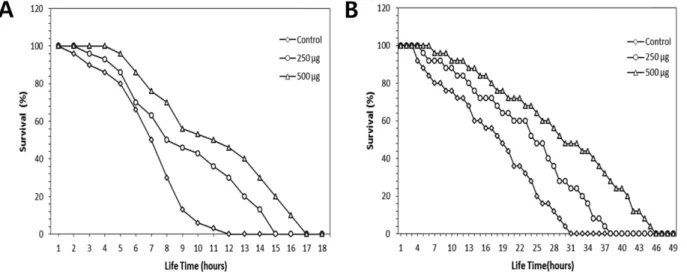
스트레스 저항성 증가 효능 − 팥의 ethyl acetate분획이 선 충의 여러 스트레스 저항성에 미치는 영향을 알아보기 위 해 고온 및 산화적 스트레스 조건에서 선충을 배양하여 생 존율을 측정하는 실험을 수행하였다. 실험 결과 고온 조건 (36oC)에서 선충의 생존도를 관찰한 결과 대조군의 선충은 2시간 만에 죽기 시작하여 12시간에 모두 사멸한 반면 팥 의 ethyl acetate분획군은 농도 의존적으로 생존율이 향상되 었다(**p<0.01, ***p<0.001)(Fig. 3A). 선충에 산화적 스트 레스를 유도하기 위해서 paraquat이 함유된 M9 buffer가 담 긴 96well plate에 배양한 선충의 최고 생존시간은 30시간 이었으나, 팥의 ethyl acetate분획 250 µg/mL와 500 µg/mL 농도 투여군에서 각각 37시간, 45시간으로 농도 의존적으로 증가하였다(***p<0.001)(Fig. 3B).
선충 체내의 항산화 효소 활성 증가 효능 − 활성산소종 들의 전구체 물질로 알려져 있는 superoxide anion(•O2−)은 체내에서는 superoxide dismutase(SOD)에 의해 hydrogen peroxide(H2O2)로 대사되는데, 본 연구에서는 xanthine을 기 질로 한 xanthine oxidase의 효소반응 과정 중에 생성되는 superoxide anion을 활용하여 SOD의 활성을 측정하였다.
Fig. 4A에서 보는 바와 같이 선충의 ethyl acetate분획 투여 군이 SOD의 활성을 농도의존적으로 증가시켰으며, 특히 Fig. 1. DPPH radical scavenging effects of the methanol
extract, and its fractions from V. angularis.
Fig. 2. Xanthine-originated superoxide quenching activities of methanol extract, and its fractions from V. angularis.
Fig. 3. Effects of ethyl acetate from V. angularis on the stress tolerance of wild-type N2 nematodes. (A) To assess thermal tolerance, worms were incubated at 36oC and then their viability was scored. (B) For the oxidative stress assays, worms were transferred to 96-well plate containing 80 mM of paraquat liquid culture, and then their viability was scored. Statistical difference between the curves was analyzed by log-rank test.
500 µg/mL 투여군은 대조군에 비해서 SOD 활성을 약 25.2% 정도 유의성 있게 증가시켰다(**p<0.01). 한편 SOD 에 의해 생성된 hydrogen peroxide 역시 강력한 반응성을 가진 활성산소종으로 체내에서는 catalase에 의해 인체에 무 해한 물로 대사되는데, Fig. 4B에서 나타난 바와 같이 ethyl acetate분획 투여군은 대조군에 비해 500 µg/mL 투여군에 유의성 있게 catalase 활성을 약 46.1% 정도 증가시켰다(**p
<0.01).
선충 세포 내 활성산소종(ROS) 감소 효능 − 팥의 ethyl acetate분획의 세포 내 활성산소종 감소 효능을 알아보기 위
해 H2DCF-DA와 선충 내부의 활성산소종을 반응시켜 형광 을 관찰하였다. 활성산소종 형광의 감소 폭은 대조군과 비 교하여 ethyl acetate분획 250 µg/mL와 500 µg/mL 농도 투 여군에서 각각 약 14.3%(*p<0.05)와 16.1%(**p<0.01)가 낮 게 관찰되어 농도 의존적으로 활성산소종을 감소시키는 것 으로 확인되었다(Fig. 5).
고 찰
팥의 분획 중 ethyl acetate분획은 DPPH radical 소거시험 과, superoxide 소거활성시험에서 가장 강력하게 항산화력 을 보여 주었다. 팥은 염증으로 인한 부종 및 감염에 처방 되는 잘 알려진 약용식물로13) 항염증 효과와 항산화 활성이 보고되어 있다.25) 본 실험의 모델로 사용된 예쁜꼬마선충은 평균수명이 21일 정도의 짧은 수명과26,27) 작은 크기, 빠른 재생 및 취급하기가 비교적 간단하여28,29) 항산화 활성 등의 실험을 하기에 적합한 기능을 갖춘 동물 모델이다.30)본 실 험은 DPPH radical과 superoxide 소거활성이 가장 강한 팥 의 ethyl acetate분획의 선충 내의 항산화 효능에 미치는 영 향을 관찰하기 위하여 본 모델 시스템으로 항산화 관련 실 험을 실시하였다. 먼저 스트레스에 저항능력을 확인하는 실 험에서는 열과 산화적 스트레스를 가하여 선충의 생존도를 확인하였다. 2 가지 스트레스 증가 조건에서 선충의 생존도 를 측정한 결과 ethyl acetate분획 투여군이 열에 의한 스트 레스 및 paraquat을 이용한 산화적 스트레스 조건 모두에서 대조군과 비교하여 생존율이 농도 의존적으로 상당히 증가 하는 것으로 관찰되었다. 안정적인 상태의 선충은 수명을 연장하지만, 산화적 스트레스 등의 다양한 환경 스트레스는 Fig. 4. Effects of ethyl acetate from V. angularis on the antioxidant enzyme activity of wild type N2 nematodes. (A) The enzymatic reaction of xanthine with xanthine oxidase was used to generate •O2− and the SOD activity was estimated spectrophotometrically through formazan formation by NBT reduction. SOD activity was expressed as a percentage of the scavenged amount per control.
(B) Catalase activity was calculated from the concentration of residual H2O2, as determined by a spectrophotometric method. Cat- alase activity was expressed in U/mg protein. Data are expressed as the mean S.E.M of three independent experiments (N=3). Dif- ferences compared to the control were considered significant at *p<0.05, **p<0.01 by one-way ANOVA.
Fig. 5. Effects of ethyl acetate from V. angularis on the intra- cellular ROS accumulation of wild-type N2 nematodes. The worms were incubated with 40 mM paraquat for 3h, and sub- sequently treated with the fluorescent probe H2-DCF-DA.
Intracellular ROS accumulation was quantified spectrometri- cally at excitation 485 nm and emission 535 nm. Plates were read 30 min. Differences compared to the control were con- sidered significant at *p<0.05, **p<0.01 by one-way ANOVA.
수명에 영향을 미친다.31)본 실험의 결과는 ethyl acetate분 획을 처리한 선충이 열과 산화적 스트레스를 저항할 수 있 는 능력이 향상됨으로써 수명을 연장하는데 영향을 끼친 것 으로 생각할 수 있다. 또한 선충의 세포의 양을 정량하여 선 충 체내의 항산화 효소의 활성을 알아본 결과 팥의 ethyl acetate분획은 농도 의존적으로 SOD 및 catalase의 활성을 높이는 것으로 관찰되었다. ROS의 발생은 노화에 영향을 줄 수 있어 ROS의 생산이 감소되면 노화과정이 느려질 수 있을 가능성이 보고되어 있다.32) 선충에 ethyl acetate분획을 처리하고 paraquat를 투여한 후 선충 세포 내 ROS수치를 확인한 결과 상당한 감소 효과를 보여 주었는데 이는 선충 세포 내의 ROS감소로 인해 선충의 수명에 영향을 끼칠 수 있을 것으로 사료된다. 이러한 실험결과는 기존의 팥의 항 염증 효과13)와 항산화력이 있는 플라보노이드 성분들을 비 롯한 페놀성 물질들이8,17,18) 이러한 선충의 스트레스 저항능 력 및 항산화 활성에 영향을 줄 것으로 생각되며, 앞으로 활 성물질에 대한 물질의 분리와 구조확인 및 단일 물질 수준 에서의 활성 확인이 필요한 것으로 사료된다.
결 론
팥의 ethyl acetate분획은 DPPH radical 소거시험과, superoxide 소거활성시험에서 강한 항산화력을 보여 주었으 며, 예쁜꼬마선충(C. elegans) 내의 항산화능에 미치는 영향 을 관찰하기 위하여 열과 산화적 스트레스를 가하여 선충 의 생존도를 측정한 결과 ethyl acetate분획 투여군이 열에 의한 스트레스 및 paraquat을 이용한 산화적 스트레스 조건 모두에서 대조군과 비교하여 생존율이 농도 의존적으로 증 가하는 것을 확인하였다. 또한 선충 체내의 항산화 효소인 SOD 및 catalase의 활성은 ethyl acetate분획 투여에 의해 농 도 의존적으로 활성을 높이는 것을 관찰하였다. 선충 세포 내의 ROS의 발생량은 ethyl acetate분획 투여군에서 농도의 존적으로 감소하는 효과를 보여 주었다. 이러한 결과는 팥 의 ethyl acetate분획이 항산화 및 노화에 관련된 물질개발 의 자원으로서의 개발가치가 있을 것으로 사료된다.
사 사
이 논문은 2014년도 농촌진흥청 어젠다연구개발사업 (Project No. PJ009218)의 지원에 의하여 연구되었으며 이 에 감사드립니다.
인용문헌
1. Labuschagne, C. F. and Brenkman, A. B. (2013) Current methods in quantifying ROS and oxidative damage in Cae-
norhabditis elegans and other model organism of aging. Age- ing Res. Rev. 12: 918-930.
2. Hekimi, S., Lapointe, J. and Wen, Y. (2011) Taking a “good”
look at free radicals in the aging process. Trends Cell Biol.
21: 569-576.
3. Fearon, I. M. and Faux, S. P. (2009) Oxidative stress and car- diovascular disease: novel tools give (free) radical insight. J.
Mol. Cell Cardiol. 47: 372-381.
4. Wei, Y. H. and Lee, H. C. (2002) Oxidative stress, mito- chondrial DNA mutation, and impairment of antioxidant enzymes in aging. Exp. Biol. Med. (Maywood) 227: 671-682.
5. Yu, B. P. (1996) Aging and oxidative stress: modulation by dietary restriction. Free Radic. Biol. Med. 21: 651-668.
6. Cakir, A., Mav,i A., Yildirim, A., Duru, M. E., Harmandar, M. and Kazaz, C. (2003) Isolation and characterization of antioxidant phenolic compounds from the aerial parts of Hypericum hyssopifolium L. by activity-guided fractionation.
J. Ethnopharmacol. 87: 73-83.
7. Lee, Y. N. (2006) New flora of Korea, 628. Kyo-hak pub- lishing Co., LTD, Seoul.
8. Kitano-Okada, T., Ito, A., Koide, A., Kakamura, Y., Han, K.- H., Shimada, K., Sasaki, K., Ohba, K., Sibayama, S. and Fukushima, M. (2012) Anti-obesity role of adzuki bean extract containing polyphenols: in vivo and in vitro effects. J.
Sci, Food Agric. 92: 2644-2651.
9. Itoh, T., Kobayashi, M., Horio, F. and Furuichi, Y. (2009) Hypoglycemic effect of hot-water extract of adzuki (Vigna angularis) in spontaneously diabetic KK-Ay mice. Nutrition 25: 134-141.
10. Itoh, T. and Furuichi, Y. (2009) Lowering serum cholesterol level by feeding a 40% ethanol-eluted fraction from HP-20 resin treated with hot water extract of adzuki beans (Vigna angularis) to rats fed a high-fat cholesterol diet. Nutrition 25:
318-321.
11. Itoh, T., Umekawa, H. and Furuichi, Y. (2005) Potential abil- ity of hot water adzuki (Vigna angularis) extracts to inhibit the adhesion, invasion, and metastasis of murine B16 mel- anoma cells. Biosci. Biotechnol. Biochem. 69: 448-454.
12. Woo, K. S., Song, S. B., Ko, J. Y., Seo, M. C. and Lee, J.
(2010) Antioxidant components and antioxidant activities of methanolic extract from adzuki beans (Vigna angularis var.
nipponensis). Korean J. Food Sci. Technol. 42: 693-698.
13. Yu, T., Ahn, H. M., Shen, T., Yoon, K., Jang, H.-J., Lee, Y.
J., Yang, H. M., Kim, J. H., Kim, C., Han, M. H., Cha, S.-h., Kim, T. W., Kim, S. Y., Lee, J. and Cho, J. Y. (2011) Anti- inflammatory activity of ethanol extract derived from Phaseolus angularis. J. Ethnopharm. 137: 1197-1206.
14. Iida, T., Yoshiki, Y., Kahara, T., Okubo, K. and Ohrui, H.
(1997) A saponin conjugated with 2,3-dihydro-2,5-dihy- droxy-6-methyl-4H-pyran-4-one from Vigna angularis. Phy- tochemistry 45: 1507-1509.
15. Iida, T., Yoshiki, Y., Okubo, K., Ohrui, H., Kinjo, J. and
Nohara, T. (1999) Triterpenoid saponins from Vigna angu- laris. Phytochemistry 51: 1055-1058.
16. Yao, Y., Cheng, X., Wang, L., Wang, S. and Ren, G. (2011) A determination of potential α-glucosidase inhibitors from azuki beans (Vigna angularis). Int. J. Mol. Sci. 12: 6445- 6451.
17. Takahama, U., Yamauchi, R. and Hirota, S. (2013) Isolation and characterization of a cyanidin-catechin pigment from adzuki bean (Vigna angularis). Food Chem. 141: 282-288.
18. Yoshida, T., Mori, K., Hatano, T., Okumura, T., Uehara, L., Komagoe, K., Fujita, Y. and Okuda, T. (1989) Studies on inhibition mechanism of autooxidation by tannins and fla- vonoids. V: Radical scavenging effects of tannins and related polyphenols on 1,1-diphenyl-2-picrylhydrazyl radical. Chem.
Pharm. Bull. 37: 1919-1921.
19. Thuong, P. T., Kang, H. J., Na, M. K., Jin, W. Y., Youn, U.
J. and Seong, Y. H. (2007) Antioxidant constituents from Sedum takesimense. Phytochemistry 68: 2432-2438.
20. Brenner, S. (1974) The genetics of Caenorhabditis elegans.
Genetics 77: 71-94.
21. Lee, E.Y., Shim, Y. H., Chitwood, D. J., Hwang, S. B., Lee, J. and Paik, Y. K. (2005) Cholesterol-producing transgenic Caenorhabditis elegans lives longer due to newly acquired enhanced stress resistance. Biochem. Biophys. Res. Commun.
328: 929-936.
22. Mekheimer, R. A., Sayed, A. A. A. and Ahmed, E. A. (2012) Novel 1,2,4-triazolo[1,5-a]pyridines and their fused ring sys- tems attenuate oxidative stress and prolong lifespan of Cae- norhabiditis elegans. J. Med. Chemi. 55: 4169-4177.
23. Aebi, H. (1984) Catalase in vitro. Methods. Enzymol. 105:
121-126.
24. Ibrahim, H. R., Hoq, M. I. and Aoki, T. (2007) Ovotransferrin
possesses SOD-like superoxide anion scavenging activity that is promoted by copper and manganese binding. Int. J. Biol.
Macromol. 41: 631-640.
25. Kim, M. H. Jeoung, S. H. Lee, S. W. Kim, H. K. Park, C. S.
Jeon, B. H., Oh, H. M. and Rho, M. C. (2012) Effect of Vigna angularis on toll like receptor activation and pro-inflam- matory cytokine production. Korean J. Oriental Physiology
& Pathology 26: 511-518.
26. Brenner, S. (1974) The genetics of Caenorhabditis elegans.
Genetics 77: 71-94.
27. Kenyon, C., Chang, J., Gensch, E., Rudner, A. and Tabtlang, R. (1993) C. elegans mutant that lives twice as long as wild type. Nature 366: 461-464.
28. Fire, A., Xu, S., Montgomery, M. K., Kostas, S. A., Driver, S. E. and Mello, C. C. (1998). Potent and specific genetics interference by double-stranded RNA in Caenorhabditis ele- gans. Nature 391: 744-745.
29. Guarente, L. and Kenyon, C. (2000) Genetic pathways that regulate ageing in model organisms. Nature 408: 255-262.
30. Park, Y. H., Lee, Y. U., Kim, H. J., Lee, Y. S., Yoon, Y. A., Moon, B. H., Chong, Y. H., Ahn, J. H., Shim, Y. H. and Lim, Y. H. (2006) NMR data of flavone derivatives and their anti- oxidative activities. Bul. Korean Chem. Soc. 27: 1537-1541.
31. Zhang, L., Jie, G., Zhang, J. and Zhao, B. (2009) Significant longevity-extending effects of EGCG on C. elegans under stress. Free Radic. Biol. Med. 46: 414-421.
32. Melov, S., Ravenscroft, J., Malik, S., Gill, M. S., Walker, D.
W., Clayton, P. E., Wallace, D. C., Malfroy, B., Doctrow, S.
R. and Lithgow, G. J. (2000) Extension of life-span with superoxide dismutase/catalase mimetics. Science 289(5484):
1567-1569.
(2014. 9. 5 접수; 2014. 9. 16 심사; 2014. 9. 17 게재확정)