INTRODUCTION
The family Gobiidae(generally referred to as gobies) is the most species fish group, comprising 189 genera and 1359 species(Nelson et al., 2016). In Korea, 39 genera and over 70 species have been reported to date(NIBR, 2018). Most gobiid species live in marine, but some are in freshwater or estuarine habitats(Hastings et al., 2014). The genus Glossogobius Gill, 1859, the most species within the family, currently comprises at least 35 species worldwide (Hoese and Allen, 2009; Froese and Pauly, 2019), but none has been reported from Korea to date.
In the present study, a single specimen of the genus Glossogobius collected from Ulsan, on the East Sea coast of Korea, is reported. It was identified as G. olivaceus (Temminck and Schlegel, 1845) based on its morphology, and this is the first report of the species in Korea.
MATERIALS AND METHODS
A single specimen of G. olivaceus was collected from an estuarine region of the Hoe-ya river in Ulsan in May 2015. The specimen was preserved in 10% formalin and transferred in 70% ethanol. Counts and measurements
were made according to Hubbs et al.(2004), and measure- ments were made to the nearest 0.1mm with a digital ver- nier caliper. The vertebrae were counted from a radiograph (CMB-2, Softex, Japan). Sensory canal pores and papillae followed Akihito and Meguro(1975). The specimen was deposited at the National Marine Biodiversity Institute of Korea(MABIK).
Glossogobius Gill, 1859
(New Korean name: Geom-eun-ban-jeom-mang-duk-sok) Glossogobius Gill, 1859: 46(type species: Gobius platy-
cephalus Richardson, 1846).
Aloricatogobius Munro, 1964: 179(type species: Glosso- gobius asaro Whitley, 1959).
Cephalogobius Bleeker, 1874: 320(type species: Gobius sublitus Cantor, 1849).
Illana Smith and Seale, 1906: 79(type species: Illana ca- cabet Smith and Seale, 1906).
Stupidogobius Aurich, 1938: 149(type species: Stupidogo- bius flavipinnis Aurich, 1938).
Description. Head depressed and longitudinal papilla pattern on cheek. Lower jaw protruding. Mental frenum typically lobed. A bony process long and extending from preoperculum to symplectic. Several rows of teeth on both jaws and 27~30 vertebrae present(Gill, 1859; Hoese and Allan, 2009).
—32 — http://www.fishkorea.or.kr
* Corresponding author: Hyuck Joon Kwun Tel: 82-41-950-0815, Fax: 82-41-950-0811, E-mail: [email protected]
ABSTRACT A single specimen of Glossogobius olivaceus was collected from Ulsan, Korea in May 2015, representing the first identification of the species in Korean waters. This species is characterized by several blackish dots on the nape, developed sensory pores and papillae on the head, 33 lateral line scales, and 27 vertebrae. The newly proposed Korean names of the genus and species are
“Geom-eun-ban-jeom-mang-duk-sok” and “Geom-eun-ban-jeom-mang-duk”, respectively.
Key words: First record, Glossogobius olivaceus, Gobiidae, Hoe-ya river, East Sea, Korea
Glossogobius olivaceus (Temminck and Schlegel, 1845)
(New Korean name: Geom-eun-ban-jeom-mang-duk) (Figs. 1~3; Table 1)
Gobius olivaceus Temminck and Schlegel, 1845: 143 (type locality: unknown).
Gobius fasciatopunctatus Richardson, 1845: 145(type locality: Canton, China).
Glossogobius olivaceus: Pan et al., 1991: 460(China); Bo- gutskaya and Naseka, 2004: 221(Russia); Shen and Wu, 2011: 688(Taiwan); Akihito et al., 2013: 1463(Japan).
Material examined. MABIK PI00045858, a single spec- imen, 123.7mm in standard length(SL), estuary of Hoe- ya river(35°23′39.83″N, 129º20′3.9″E), Seosaeng-myeon, Ulju-gun, Ulsan, 27 May 2015, cast net.
Comparative materials. Acanthogobius flavimanus:
PKU 53683, PKU 53685, 2 specimens, Sacheon, Gyeong- sangnam-do, 14 Jan 2015.
Description. Counts are shown in Table 1. Proportions as
% SL: body depth 20.6; head length(HL) 35.4; predorsal length 39.7; preanal length 65.3; prepectoral length 36.3;
prepelvic length 39.4; caudal peduncle depth 11.2; caudal peduncle length 22.4. Proportions as % HL: snout length 34.7; eye diameter 16.9; interorbital width 16.2.
Body oblong and tapers posteriorly. Head large, de- pressed dorsally and snout slightly pointed. Mouth moder- ate and posterior margin of maxilla beyond vertical to ante- rior margin of eye. Anterior tip of lower jaw protrudes be- yond upper jaw. Conical teeth on both jaws. Mental fre num slightly lobed. Eye moderate, and interorbital slightly wide and concave. Two pairs of nostrils present, anterior nos-
Fig. 1. Glossogobius olivaceus, MABIK PI00045858, 123.8mm SL.
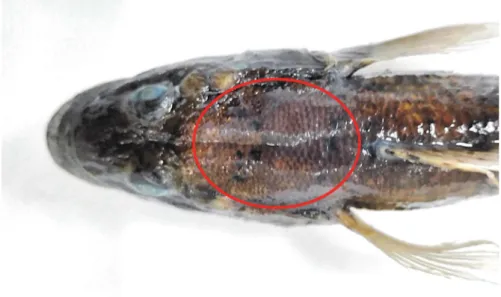
Fig. 2. Blackish dots(red circle) on the nape of Glossogobius olivaceus, MABIK PI00045858.
tril short tube and posterior nostril pore. Gill membranes broadly attached to isthmus. Posterior margin of preoper- cular without spine. Caudal peduncle relatively slender.
Two dorsal fins completely separated. Origin of second dorsal fin located vertically in front of origin of anal fin.
Body covered in ctenoid scales. Small ctenoid scales pres- ent on occipital and nape. Cheek and base of pec toral fin naked. Sensory pores and papillae on head well-developed (Fig. 3): Papillae lines mostly in two or three-rows. Line 5 reaching to line 7 below eye. Line 6 absent. Line 7, 9, 10 are three-rows and 8, 11 are single-row longitudinal lines.
Line 20, 21 and 22 in single-row, line 20 branched and line 21 strongly curved downward posteriorly.
Coloration. When preserved ethanol, head and body dark- ish brown, abdominal region whitish. Lateral region of body with five blackish blotches, and predorsal region with
several small blackish dots(Fig. 2). All fins semi-transpar- ent, except anal fin and pelvic disc, which have darkish membranes and whitish margins. Dorsal and caudal fin membranes show several small darkish dots.
Distribution. G. olivaceus is distributed across East Asia, including the Philippines(Hoese and Allen, 2009), Chi- na(Pan et al., 1991), Taiwan(Shen and Wu, 2011), Japan (Akihito et al., 2013), and Russia(Bogutskaya and Naseka, 2004), as well as Africa, including South Africa and Mad- agascar(Hoese and Allen, 2009). The present study con- firms its presence in Korea, in an estuarine region in Ulsan.
Remarks. Temminck and Schlegel(1845) first described G. olivaceus from Japan in the Fauna Japonica. However, Boeseman(1947) stated that the type specimen of this spe- cies was unknown, and therefore its plate in the original description may not be G. olivaceus. Subsequently, Akihito
Fig. 3. Sensory canal pores and papillae of Glossogobius olivaceus, MABIK PI00045858.
Table 1. Meristic characters of Glossogobius olivaceus
Glossogobius olivaceus Glossogobius fasciatopunctatus
Present study Temminck and chlegel
(1845) Akihito
(1966) Richardson
(1845)
Number of specimens 1 - 150 -
Standard length(mm) 123.8 - 56.0~164.0 -
Dorsal fin rays VI-I, 9 VI-I, 9 V~VI-I, 8~10 VI-I, 9
Anal fin rays I, 8 I, 7 I, 7~9 I, 8
Pectoral fin rays 19 18 17~20 20
Lateral line scales 33 32 28~36 -
Predorsal scales 24 - 19~31 -
Vertebrae 27 - - -
(1966) suggested that the Japanese goby, called “urohaze”
in Japan, is similar in morphology to not only G. fascia- topunctatus but also to G. olivaceus as described in the Fauna Japonica. Therefore, G. olivaceus that was described in the Fauna Japonica has been established as a valid spe- cies, because G. fasciatopunctatus is the junior synonym of G. olivaceus.
In the present study, a single specimen was assigned to the genus Glossogobius based on the following charac- ters: papillae present on the cheek, 27 vertebrae, and a de- pressed head(Hoese and Allen, 2009). Among the known species in the genus, it was identified as G. olivaceus be- cause this specimen has several blackish dots on the nape (Fig. 2)(Akihito, 1966; Akihito et al., 2013). When com- pared with the original description of G. olivaceus, Korean specimen is similar in coloration, fins and scale counts(Fig.
1; Table 1). Also, this species is similar to Acanthogobius flavimanus in external shape but differs in the number of first dorsal fin spines(six in G. olivaceus vs. eight in A. fla- vimanus)(Present study, Akihito et al., 2013).
I propose the new Korean names of “Geom-eun-ban- jeom-mang-duk-sok” for the genus Glossogobius and
“Geom-eun-ban-jeom-mang-duk” for the species G. oliva- ceus.
ACKNOWLEDGEMENTS
This research was supported by National Marine Bio - diver sity Institute of Korea Research Program(2020M 00100).
REFERENCES
Akihito, P. 1966. On the scientific name of a gobiid fish named “uro- haze”. Japan. J. Ichthyol., 13: 73-101.(in Japanese)
Akihito, P. and K. Meguro. 1975. Description of a new gobiid fish, Glossogobius aureus, with notes on related species of the genus. Japan. J. Ichthyol., 22: 127-142.
Akihito, P., K. Sakamoto, Y. Ikeda and M. Aizawa. 2013. Gobiidae.
In: Nakabo, T.(ed.), Fishes of Japan with pictorial keys to the species. 3rd ed. Tokai University Press, Tokyo, Japan, pp.
1361-1541.(in Japanese)
Aurich, H. 1938. Die Gobiiden(Ordnung: Gobioidea). Int. Rev. Ges.
Hydrobiol. Hydrogr., 38: 125-183.
Bleeker, P. 1874. Esquisse d’un système naturel des Gobioïdes. Arch.
Néerl. Sci. Exactes Nat., 9: 289-331.
Boeseman, M. 1947. Revision of the fishes collected by Burger and Von Siebold in Japan. Zool. Med. Leiden, 28: 1-242.
Bogutskaya, N.G. and A.M. Naseka. 2004. Catalogue of agnathans
ments on nomenclature and taxonomy. Russian Academy of Sciences, Moskow, 389pp.(in Russian)
Cantor, T.E. 1849. Catalogue of Malayan fishes. J. As. Soc. Bengal, 18: 983-1443.
Froese, R. and D. Pauly. 2019. FishBase. World Wide Web electronic publication. Available from: http://www.fishbase.org/(ac- cessed 20 September 2019).
Gill, T.N. 1859. Description of a new generic form of Gobinae from the Amazon River. Ann. Lyceum Nat. Hist. New York, 7: 45- Hastings, P.A., H.J. Walker Jr and G.R. Galland. 2014. Fishes: A 48.
guide to their diversity. University of California Press, Oak- land, California, 336pp.
Hoese, D.F. and G.R. Allen. 2009. Description of three new species of Glossogobius from Australia and New Guinea. Zootaxa, 1981: 1-14.
Hubbs, C.L., K.F. Lagler and G.R. Smith. 2004. Fishes of the Great Lakes region. Revised ed. The University of Michigan Press, Ann Arbor, Michigan, 276pp.
Munro, I.S.R. 1964. Additions to the fish fauna of New Guinea. Pap- ua New Guinea Agri. J., 16: 141-186.
National Institute of Biological Resources. 2018. National species list of Korea. Available from: http://kbr.go.kr/(accessed 20 Sep- tember 2019).(in Korean)
Nelson, J.S., T.C. Grande and M.V.H. Wilson. 2016. Fishes of the world. 5th ed. John Wiley and Sons, Inc., Hoboken, New Jer- sey, 752pp.
Pan, J.H., L. Zhong, C.Y. Zheng, H.L. Wu and J.H. Liu. 1991. The freshwater fishes of Guangdong Province. Guangdong Sci- ence and Technology Press, Guangzhou, 589pp.
Richardson, J. 1845. Ichthyology Part 3. In: Hinds, R.B.(ed.), The zo- ology of the voyage of H. M. S. Sulphur, under the command of Captain Sir Edward Belcher, R. N., C. B., F. R. G. S., etc., during the years 1836-42, Smith, Elder and Co., London, 10:
pp. 99-150.
Richardson, J. 1846. Report on the ichthyology of the seas of China and Japan. Rep. Br. Ass. Advmt. Sci., 15th meeting: 187-320.
Shen, S. and G. Wu. 2011. Fishes of Taiwan. National Museum of Marine Biology and Aquarium, Pingtung, 896pp.(in Chi- nese)
Smith, H.M. and A. Seale. 1906. Notes on a collection of fishes from the island of Mindanao, Philippine Archipelago, with de- scriptions of new genera and species. Proc. Biol. Soc. Wash., 19: 73-82.
Temminck, C.J. and H. Schlegel. 1845. Pisces. In: Sieblod, P.F.de (ed.), Fauna Japonica, sive descriptio animalium, quae in itinere per Japoniam suscepto annis 1823-1830 collegit, no- tis, observationibus et adumbrationibus illustravit Ph. Fr. de Siebold, Lugduni Batavorum, Leiden, Part 7-9: pp. 113-172.
Whitley, G.P. 1959. Ichthyological snippets. Aust. Zool., 12: 310- 323.
요 약 : 2015년 5월 우리나라 울산에서 Glossogobius olivaceus 1개체가 처음 채집되었다. 본 종은 목덜미에 검
은 점이 다수 있고 머리에 감각공과 돌기가 발달되었으며, 측선비늘은 33개, 척추골은 27개이다. 본 속 및 종의 새
로운 국명으로 “검은반점망둑속” 및 “검은반점망둑”을 제안한다.
찾아보기 낱말 : 미기록종, Glossogobius olivaceus, 망둑어과, 회야강, 동해, 대한민국