항산화활성 비교를 통한 발효 칠피의 추출용매 조건 탐색
김명옥*#·김주성*#·사여진*·정현주*·전완주**·권용수***·김태영****
최한석****·유창연*·김명조*†
*강원대학교 식물자원응용공학, **강원대학교 의과대학,
***강원대학교 약학대학, ****농촌진흥청 국립농업과학원 농식품자원부 발효이용과
Screening of Extraction Solvent Condition of Fermented Rhus verniciflua
Stem Bark by Antioxidant Activities
Myeong Ok Kim
*#, Ju Sung Kim
*#, Yeo Jin Sa
*, Hyun Ju Jeong
*, Wan Joo Chun
**, Yong Soo Kwon
***, Tae Young Kim
****, Han Seok Choi
****, Chang Yeon Yu
*and Myong Jo Kim
*†*Department of Applied Plant Sciences, Kangwon National Univeersity, Chuncheon 200-701, Korea.
**Department of Pharmacology, Kangwon National Univeersity, Chuncheon 200-701, Korea.
***Neurotoxicology Program, College of Phamacy, Kangwon National Univeersity, Chuncheon 200-701, Korea.
****Fermentation & Food Processing Division, Department of Korean Food Research for Globalization, NAAS, RDA, Suwon 441-707, Korea.
ABSTRACT : In this study, we investigated antioxidant capacity and determined the phenolic and flavonoid contents using each of various solvent conditions from fermented
Rhus vernicifluastem bark (F-RVS). Each extracts displayed markedly similar content of extraction yield. However, M80 extract showed a significantly higher antioxidant activity in comparison to other extract investigated. M80 exhibited strong DPPH radical scavenging activity with RC
50value of 10.5 ± 1.4
㎍/
㎖, reducing power value 1.04 Abs (concentration of 1
㎎/
㎖), and anti-lipid peroxidation activity value of 94.6% (concentration of 10
㎎/
㎖). M80 extract showed the high content of total phenolic (319.7
㎎GAE/
㎖extract) and total flavonoid (111.6
㎎QE/
㎖extract). Phenolic and flavonoid compounds showed significant relationship in DPPH radical scavenging (R
2= 0.911 and 0.912, each extract) and reducing power (R
2= 0.903 and 0.837, each extract) from fermented
R. vernicifluastem bark.
However, antilipid peroxidation activity (R
2= 0.589 and 0.441, each extract) was not significant like DPPH radical scaveng- ing and reducing power. Therefor the result indicated that the potential antioxidant activities and functional values were ovserved significantly at M80 solvent condition from the fermented
R. vernicifluastem bark.
Key Words
:
DPPH, Phenolics, Flavonoid, Reducing Power, Anti-Lipid Peroxidation서 언
옻나무 (
Rhus verniciflua
)는옻나무과 (Anacardiaceae)에속 하며 중국, 일본등동북아시아에서 많이 자라는낙엽활엽교 목으로, 일반성분으로 urushiol, gallic acid, butin, sulferin, garbanzol, fisetine 등이 밝혀졌다 (Choiet al
., 2007; Parket al
., 2000). 특히, urushiol은항암및항산화효과가탁월하 지만 (Richard and Karyn, 2001; Kimet al
., 1998; Limet al
., 2001; Ahnet al
., 2007), 동물피부에알러지를 일으키기 때문에식품으로 이용되지못하고있는 실정이다. 옻나무추 출물및분획물의생리활성물질에대한연구가계속이루어지고있으나 (Kim
et al
., 2010), 식품공전제2식품일반에대한 공동기준및규격의제2항식품원료기준에따르면옻나무를 함유한제품의경우 urushiol이검출되서는안되고, 옻닭또는 옻오리조리용도로만허용하며일반식품으로서사용을엄격 히규제하고있는실정이다. 이와같은옻나무의문제를최소 화하기위해버섯 종균으로발효하여 urushiol의함량을최소화한 연구가 진행되었다. 장수버섯 (
Fomitella fraxinea
)은재 배가용이하기때문에이를이용하고자다양한연구를진행되 었고, 일부결과에서는장수버섯자실체에서분리한다당체에 약리성을 확인하였다 (Yoonet al
., 1998). 또한, 장수버섯을 이용하여옻나무를발효할경우 93%의 urushiol을감소시켰다#
Myeong Ok Kim and Ju Sung Kim are contributed equally to this work.
†
Corresponding author: (Phone) +82-33-250-6413 (E-mail) [email protected]
Received 2010 March 31 / 1st Revised 2010 May 19 / 2nd Revised 2010 June 22 / 3nd Revised 2010 July 7 / Accepted 2010 July 28
(Choi
et al
., 2007).식물체내에존재하는많은화합물들은식물부위, 추출용매
종류, 용매비, 추출온도등다양한조건으로추출하며이러한 추출조건은식물화합물의함량에영향을미치고, 이는항산화 활성, 지질대사등이화학적특성에변화를주는것으로밝혀 졌다 (Kim
et al
., 2001; Leeet al
., 2008). 특히, methanol, ethanol, water 등추출용매를이용한추출 최적화 실험을통 하여 항산화성 물질을 효율적으로찾고자 하는 노력이 많이 시도되고있다 (Anet al.
, 2006; Kohet al
., 2008).본연구에서는발효칠피의추출용매를변화시켜항산화활 성을비교 · 분석하였으며, 발효칠피의항산화활성과관련된 최적추출용매조건을탐색하였다.
재료 및 방법
1. 시약 및 사용기기
본 연구에 사용된 시약은 1,1-diphenyl-2-picrylhydrazyl (DPPH), linoleic acid, ammonium thiocyanate, Folin- ciocalteau, sodium carbonate (Na2CO3)와 대조구로 이용된
butylated hydroxyanisole (BHA), butylated hydroxytoluene (BHT)는 Sigma사제품을 이용하였다. 이 외사용한 시약은
Crown, Yakeri, Deajung, Junsei사 제품으로 모두 특급 제품
을구입하여이용하였다.
2. 실험시료
본실험에 사용된 발효 칠피 (
R. verniciflua
stem bark)는 농촌진흥청발효이용과로부터 1~2㎝로파쇄된칠피를장수 버섯과함께 25℃에서 30일간배양하여우루시올이저감화된 생전환칠피를제공받아사용하였다.5 g의 시료에 methanol, ethanol 및 water (M60, 60%
MeOH extract; M80, 80% MeOH extract; M100, 100%
MeOH extract; E60, 60% EtOH extract; E80, 80% EtOH extract; E100, 100% EtOH extract; W, Water extract)를
50㎖씩가하여 상온에서 24시간씩각각 3회반복추출하였 다. 각조건에따라 2개의시료를추출하였으며, 얻어진추출 물을 40℃에서 감압농축장치 (NE-Series, Eyela, Japan)로농
축하여, 동결건조를한후수율측정 (%,
w
/w
) 및실험에사 용하였다.3. DPPH 라디칼 소거능
DPPH 라디칼소거능은 Blois (1958)의방법을변형하여측 정하였다. 시료를 methanol에 각각 0.1, 0.5, 1.0, 10.0㎎/㎖ 의농도로 조제하였으며, 대조군으로 BHA, BHT를사용하였
다. Methanol 3.9㎖에시료 100㎕를첨가한후 0.15 mM의
DPPH 용액 1㎖을첨가한다. 반응액을 vortexing한뒤실온
에서 30분간반응시킨다. 반응액을 UV-Vis spectrophotometer (V530, Jasco Co., Japan)를 이용하여 517㎚에서 흡광도를
측정하였으며, DPPH를 50% 환원시키는값을 RC50(㎍/㎖)으 로나타냈다.
DPPH 라디칼소거능(%) =
(시료가첨가된반응용액의 OD/시료가첨가되지않은반응 용액의 OD) × 100
4. 환원력
환원력은 Oyaizu (1986)의 방법 을 변형하여 측정하였다.
시료를 methanol에 0.1, 0.5, 1.0㎎/㎖ 의농도로 조제하였으
며, 대조군으로 BHA, BHT를 사용하였다. 100㎕의 시료에 0.2 M sodium phosphate buffer (pH 6.6)를 500㎕를첨가한 후 1% potassium ferricyanide 500㎕첨가하여 50℃에서 20
분간 반응시킨다. 반응액에 10% trichloroacetic acid (
v
/v
)를2.5㎖첨가한후 반응액의 500㎕를취하여 증류수 500㎕, 0.1% ferric chloride 100㎕를첨가하여 700㎚에서흡광도를 측정하였다.
5. 항지질 과산화
항지질 과산화는 ferric thiocyanate법 (Inatani
et al
., 1983)으로 측정하였다. 시료를 0.1, 1.0, 10.0㎎/㎖의농도로 각각 조제하였으며, 대조구는 BHA를사용하였다. 시료 20㎕를취 하여 ethanol에 희석한 2.5% linoleic acid 200㎕와 0.05 M phosphate buffer (pH 7.0) 400㎕, 증류수 380㎕를 차례대
로넣고 70℃암조건에서 24시간 반응시킨다. 반응액 50㎕, 75% ethanol 2.85㎖, 30% ammonium thiocyanate 50㎕와
3.5% HCl-0.02 M ferrous chloride 50㎕를차례로혼합하여
3분간반응후 500㎚에서흡광도를측정하였다. Linoleic acid 산화저해능 (%) =
(1-시료가 첨가된 반응용액/시료가 첨가되지 않은 반응용액) × 100 6. 총 페놀 및 총 플라보노이드 함량
총 페놀 함량은 Folin-ciocalteau법 (Taga
et al
., 1984)을 변형하여 측정하였다. 각각의 시료를 0.1㎎/㎖의농도로 조제한 뒤 100㎖ 를 취한 후 2 N Folin-ciocalteau 시약을 50㎕ 첨가한 후 상온에서 5분간 반응시켰다. 20% sodium carbonate (Na2CO3)를 300㎕를첨가한후다시 15분간반응 시킨 후증류수 1㎖첨가하여 725㎚에서흡광도를 측정하 였다. 결과는 gallic acid를 standard로한표준검량곡선을작 성후페놀함량을정량하였다.
총플라보노이드 함량측정은 Moreno 등 (2000)의방법을 이용하였다. 시료를 1.0㎎/㎖의농도로 조제한뒤 100㎕를
취하여 80% ethanol 900㎕를섞는다. 희석된시료 500㎕를
취하여 10% aluminum nitrate 100㎕ 와 1 M potassium acetate 100㎕, 80% ethanol 4.3㎖를 차례로 첨가한 후상
온에 40분반응시켜 415㎚에서흡광도를측정하였다. 결과는
quercetin을 standard로한표준검량곡선을작성후플라보노 이드함량을정량하였다.
7. 통계처리
실험결과는평균값권 ± 표준편차 (mean±SD)로나타냈으며,
각실험군의통계처리는 3회반복처리하였다. 통계분석은분
산분석 (ANOVA)과 Duncan의다중범위검정을통해 실시하 였다 (
p
< 0.05).결과 및 고찰
1. 추출 수율
담자균균체에서생산하는 laccase는 lignin의분해및무독
화에 관여하는것으로알려져 있다. 담자균류와배양시독성 물질이균체로유입되기전에 laccase가작용해중합시켜균체 를보호하는것으로 추정하고있고, 이는 우루시올을첨가하 여 배양시 97%의저감화된 보고를 확인하였다 (Bao
et al
., 1993; Choiet al
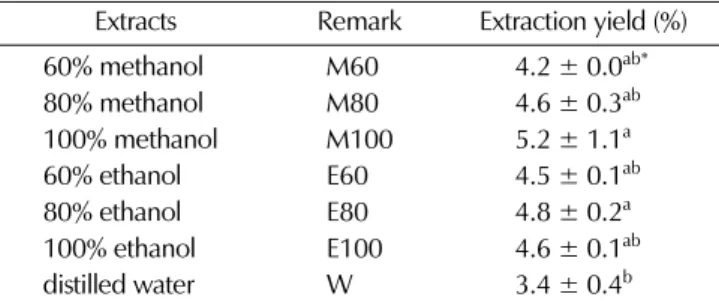
., 2007). 본실험에이용된 우루시올이저감 화된발효칠피의추출수율을측정한결과는 Table 1과같다.추출수율은 W에서 3.4±0.4%로가장낮은활성을보였으며, W를제외한다른추출물은 4.2~5.28%로유사하였다. 이는용 매의극성에따라발효 칠피의용해도에영향을미치는것으 로사료되며, 특히물추출물에서용해도가낮은것은비극성 물질이극성물질에비해많이포함되어있는것으로사료된다.
2. DPPH 라디칼 소거능
DPPH는보라색을띄는 자유라디칼로 BHA, BHT 등과같
은항산화물질에의해환원되면서탈색되는원리를이용하여 다양한천연소재로부터항산화물질을탐색하기위해많이이 용되고 있다 (Jeong
et al
., 2009). 발효 칠피의 DPPH 라디 칼소거능 분석결과는 Fig. 1에나타냈다. 각추출물의 RC50값은 10~22㎍/㎖의항산화활성을나타냈으며, 특히 M80에 서 10.5±1.4㎍/㎖ 으로 대조구로 이용된 BHT (13.0±1.3
㎍/㎖)보다높은활성을보였으며, E100이 22.8㎍/㎖로가장 낮은활성을보였다.
Ahn 등 (2007)의보고에따르면칠피에서분리된화합물이 합성항산화제인 BHT 보다높은 활성을나타냈으며, 이는발 효칠피를이용한본실험에서도유사한결과를보였다. Jung
등 (2006)의 ethanol 추출 칠피의 DPPH RC50값은 38.9~
61.9㎍/㎖으로추출법에따라 소거능의차이를 보이는것을
확인하였으며, 이는 추출 용매의선택에 따라 DPPH 라디칼
소거능에긍정적인영향을줄것으로사료된다.
3. 환원력
환원력은 ferric chloride (Fe3+)가 ferrous chloride (Fe2+)로 환원되는활성을이용해항산화활성검정을하며, 이를흡광
도값으로 평가하는방법이다 (Prasad
et al
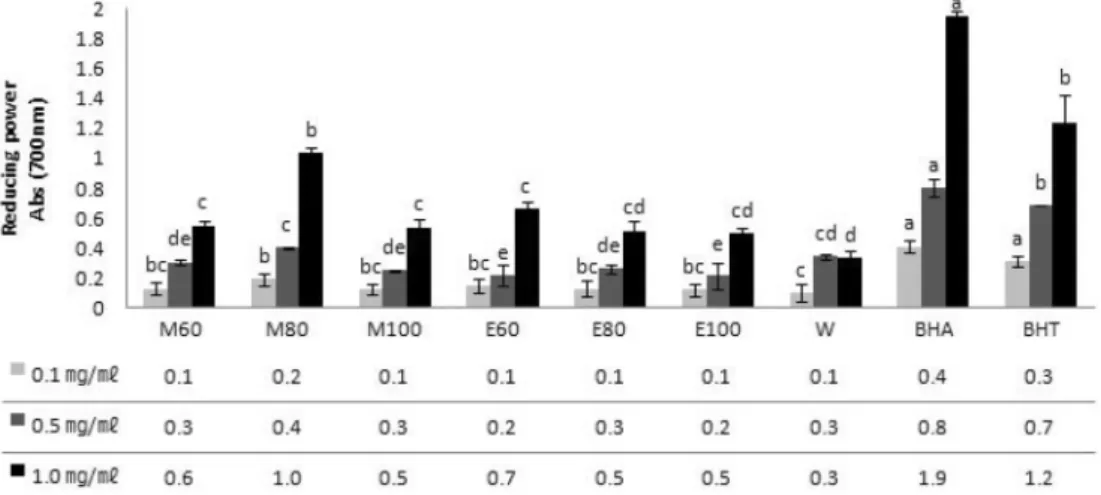
., 2010). 발효칠피의 환원력은 Fig. 2에나타냈다. M80이 0.1, 0.5, 1.0㎎/㎖
에서각각 0.2, 0.4, 1.0의흡광도로다른추출물에비해 높은 환원력을나타냈으며, 모든용매조건에서추출물의농도가높 아짐에따라환원력이높아짐을확인할수있었다. 또한, 용매 조건에의한차이는 M80 1.0㎎/㎖이외에는큰차이를보이 지않았으며, W 0.1, 1.0㎎/㎖에서가장낮은활성을나타냈 다. 다른 보고에서는홍경천 water 추출물과 75% ethanol 추
출물의환원력을측정한결과농도의존적으로환원력이증가 하는경향을나타냈고, water 추출물보다 75% ethanol 추출물 에서 더높은 환원력을나타냈다. 추출 용매중 methanol 추
출물은 없었으나, water 추출물보다는 유기용매 추출물이더
좋은 활성을 보이는 것을 확인하였으며 (Lee
et al
., 2004),이는본연구결과와일치하였다.
4. 항지질 과산화 활성
항지질과산화는 linoleic acid의자동산화억제활성을통해 검정하였다. Linoleic acid는식물성불포화지방산으로라디칼 Table 1. Extraction yield of fermented R. verniciflua stem bark by
various solvents.
Extracts Remark Extraction yield (%)
60% methanol M60 4.2 ± 0.0ab*
80% methanol M80 4.6 ± 0.3ab
100% methanol M100 5.2 ± 1.1a
60% ethanol E60 4.5 ± 0.1ab
80% ethanol E80 4.8 ± 0.2a
100% ethanol E100 4.6 ± 0.1ab
distilled water W 3.4 ± 0.4b
*Each value represents the mean ± SD, and means significantly different by paired Duncan's test at
p< 0.05.
Fig. 1. DPPH free radical scavenging activities of fermented R.
verniciflua stem bark by various solvents (p< 0.05).
에의해산화과정을거치면서체내의지방질산화를유발하여 자유라디칼을 생성한다. 지질산화 초기에발생되는 과산화물 은 ferrous chloride (Fe2+)를 ferric chloride (Fe3+)로 산화시 켜적갈색을띄게 되며, 지질과산화가 진행되면저분자화합 물이 생성된다. 다양한 용매조건의발효칠피의 항지질과산 화 활성을 측정하여 Fig. 3에 나타냈다. M80 0.1, 1.0, 10.0
㎎/㎖에서각각 61.7, 86.7, 94.6%의활성을 보였으며, 다른 용매조건에따른항지질과산화는큰차이를보이지않았다.
토종식물 26종의 실험대상 식물추출물을 AI (Antioxidant
index :각항산화제를 첨가한 실험구의유도기간을 무첨가구
의유도기간으로나눈값)로항산화력을비교한연구에서는결 과값 중 칠피 (건칠)의추출물이 AI 5.18로 육두구 AI 4.20
등에비해높은지질과산화억제효과를나타냈다 (Kim
et al
., 1999). Kim 등 (1995)의보고에서는유기용매별대두추출물의 지질과산화는 시료 및추출법 (추출용매의 조건변화)에따라 차이가있는 것을확인하였다. 이는 본연구결과와 같이추출 용매가바뀜에 따라 추출물의항지질 과산화에 긍정적인 영향을줄것으로기대된다.
5. 총 페놀 및 총 플라보노이드 함량
페놀및플라보노이드화합물은식물체내에서 항산화활성 과관련된연구들이보고되고있다 (Erkan
et al
., 2008; Booet al.
, 2009). 발효칠피의페놀성화합물은생물학적 배양방법에 의해 감소하는경향을보였으나, 발효 칠피에서나타나 는항산화활성이총페놀및총플라보노이드와관련이있음 을 확인하기 위해 실시하였다 (Table 2). 총 페놀 함량은
M80에서 319.7㎎ GAE/㎖로가장높았으며, 다른추출물에 비해 높은함량을 나타내었다. 총플라보노이드함량도 M80
에서 111.6㎎ QE/㎖로가장높았다. 추출용매에의해페놀
및 플라보노이드 함량의 차이를보이며, 이는 DPPH 라디칼
소거능, 환원력, 항지질과산화등에영향을미치는것으로사 료된다 (Kim
et al
., 1995; Ohet al.
, 2006; Wettasinghe and Shahdi, 1999).Fig. 2. Reducing power activities of fermented R. verniciflua stem bark by various solvents (p< 0.05).
Fig. 3. Anti-lipid peroxidation activities of fermented R. verniciflua
stem bark by various solvents.
Table 2. Content of total phenolic and flavonoid content of fermented R. verniciflua stem bark by various solvents.
Extracts TPC1) (㎎ GAE/㎖) TFC2) (㎎ QE/㎖) M60 164.4 ± 12.4b 960.9 ± 2.2c* M80 319.7 ± 32.0a 111.6 ± 1.0a M100 166.5 ± 4.2b 970.2 ± 4.3b E60 202.8 ± 4.7b 964.3 ± 7.1cd E80 141.8 ± 12.4b 951.7 ± 1.7d E100 156.8 ± 12.7b 949.4 ± 1.9d
W 152.1 ± 8.2b 953.1 ± 2.4d
*Each value represents the mean ± SD, and means significantly different by paired Duncan's test at
p< 0.05.
1) TPC : Total phenolic contents
2) TFC : Total flavonoid contents
6. 항산화 활성과 총 페놀 및 총 플라보노이드 함량과의 상 관관계
총페놀및총플라보노이드함량과 DPPH 라디칼소거능,
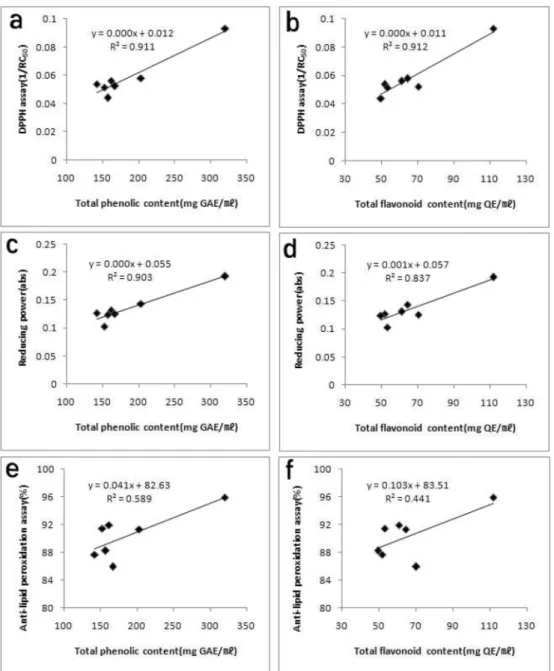
환원력, 항지질과산화와의상관관계는 Fig. 4에나타냈다. 상
관관계는 DPPH 라디칼 소거능과 총페놀 함량 (R2= 0.911)
및총플라보노이드 함량 (R2= 0.912)은유의적으로높게 나 타났으며 (Fig. 4a, 4b), 환원력과총 페놀 함량 (R2= 0.903)
및총플라보노이드함량 (R2= 0.837)은플라보노이드함량보
다는 페놀 함량에 더 큰 상관관계를 갖는 것을 확인하였다
(Fig. 4c, 4d). 한편, 항지질 과산화의 총 페놀 함량 (R2= 0.589)및총플라보노이드함량 (R2= 0.441)은낮은상관관계 를 나타냈다 (Fig. 4e, 4f). 본연구의 항지질 과산화 결과는 Hong 등 (2007)이보고한플라보노이드에의한자유라디칼소
거활성으로보기에는어렵지만, 페놀및플라보노이드함량을
gallic acid와 quercetin으로만정량하였기때문에 이를고려해 야할것으로사료된다.
Fig. 4. Correlation between antioxidant activities and total phenolics, flavonoid content of fermented R. verniciflua stem bark by various solvents. (a) DPPH assay and total phenolic content, (b) DPPH assay and total flavonoid content, (c) reducing power and total phenolics content, (d) reducing power and total flavonoid content, (e) anti-lipid peroxidation assay and total phenolics content, (d) anti-lipid peroxidation assay and total flavonoid content.
감사의 글
본연구는농촌진흥청공동연구바이오그린21사업 (과제번 호 PJ007090)과 2009년정부(교육과학기술부)의재원으로한 국연구재단 (NRF-2009-351-F00050)의지원을받아수행된연 구결과로이에감사드립니다.
LITERATURE CITED
Ahn EM, Park SJ, Choi WC, Choi SH and Baek NI.
(2007).
Antioxidant activity of isolated compounds from the heartwoods of
Rhus verniciflua. Journal of Korean Society Applied Biological Chemistry. 50:358-361.
An BJ, Lee JY, Park TS, Pyeon JR, Bae HJ, Song MA, Baek EJ, Park JM, Son JH, Lee CE and Choi KI.
(2006).
Antioxidant activity and whitening effect of extraction conditions in
Curcuma longaL. Korean Journal of Medicinal Crop Science. 14:168-172.
Bao W, O'Malley DM, Whetten R and Sederoff RR.
(1993). A laccase associated with lignification in loblolly pine xylem.
Science. 260:672-674.
Blois MS.
(1958). Antioxidant determination by the use of a stable free radical. Nature. 181:1199-1200.
Boo HO, Lee HH, Lee JW, Hwang SJ and Park SU.
(2009).
Different of total phenolics and flavonoids, radical scavenging activities and nitrite scavenging effects of
Momordica charantiaL. according to cultivars. Korean Journal of Medicinal Crop Science. 17:15-20.
Choi HS, Kim MK, Park HS, Yun SE, Mun SP, Kim JS, Sapkota K, Kim S, Kim TY and Kim SK.
(2007). Biological detoxification of lacquer tree (
Rhus vernicifluastokes) stem bark by mushroom species. Food Science and Biotechnology.
16:935-942.
Erkan N, Ayranci G and Ayranci E.
(2008). Antioxidant activities of rosemary (
Rosmarinus officinalisL
.) extract, blackseed (
Nigella sativaL
.) essential oil, carnosic acid, rosmarinic acid and sesamol. Food Chemistry. 110:76-82.
Hong BK, Eorm SH, Lee CO, Lee JW, Jeong JH, Kim JK, Cho DH, Yu CY, Kwon YS and Kim MJ.
(2007). Biological activities and bioactive compounds in the extract of
Ace tegmentosumMaxim. stem. Korean Journal of Medicinal Crop Science. 15:296-303.
Inatani R, Nakatani N and Fuwa H.
(1983). Antioxidative effect of the constituents of rosemary (
Rosmarinus offcinalisL.) and their derivatives. Agricultural and Biological Chemistry. 47:521-
Jeong HS, Han JG, Ha JH, Kim Y, Oh SH, Kim SS, Jeong528.
MH, Choi GP, Park UY and Lee HY.
(2009). Antioxidant activities and skin-whitening effects of nano-encapsuled water extract from
Rubus coreanusMiquel. Korean Journal of Medicinal Crop Science. 17:83-89.
Jung CH, Jun CY, Lee SD, Park CH, Cho K and Ko SG.
(2006).
Rhus verniciflua stokes extract: radical scavenging activities and protective effects on H
2O
2-induced cytotoxicity in macrophage RAW 264.7 cell lines. Biological and Pharmaceutical
Bulletin. 29:1603-1607.
Kim IW, Shin DH and Choi U.
(1999). Isolation of antioxidative components from the bark of
Rhus vernicifluastokes screened from some Chinese medicinal plants. Korean Journal Food Science Technology. 31:855-863.
Kim JS, Kwon YS, Chun WJ, Kim TY, Sun J, Yu CY and Kim MJ.
(2010).
Rhus vernicifluastokes flavonoid extracts have anti-oxidant, anti-microbial and
α-glucosidase inhibitory effect. Food Chemistry. 120:539-543.
Kim JY, Maeng YS and Lee KY.
(1995). Antioxidative effects of soybean extracts by using various solvents. Korean Journal Food Science Technology. 27:635-639.
Kim MJ, Choi YH and Kwak SS.
(1998). Comparison of urushiol composition and biological activity between fresh sap and fire distilled sap of lacquer tree. Korean Journal of Plant Resources. 11:40-46.
Kim SM, Cho YS and Sung SK.
(2001). The antioxidant ability and nitrite scavenging ability of plant extracts. Korean Journal of Food Science Technology. 33:626-632.
Koh YJ, Cha DS, Choi HD, Park YK and Choi IW.
(2008).
Hot water extraction optimization of dandelion leaves to increase antioxidant activity. Korean Journal of Food Science Technology. 40:283-289.
Lee EJ, Kwon YI, Shetty K and Jang HD.
(2004). Antioxidant activity of
Rhodiola roseaextract on human low-density lipoprotein oxidation and DNA strand scission. Food Science and Biotechnology. 13:814-820.
Lee SH, Kang KI and Lee SY.
(2008). Saponin composition and physico-chemical properties of Korean red ginseng extract as affected by extracting conditions. Journal of Korean Society Food Science Nutrition. 37:256-260.
Lim KT, Chun H and Kitts DD.
(2001). Antioxidant activity of a
Rhus vernicifluastokes ethanol extract. Food and Chemical Toxicology. 39:229-237.
Moreno MIN, Isla MI, Sampietro AR and Vattuone MA.
(2000). Comparison of the free radical-scavenging activity of propolis from several regions of Argentina. Journal of Ethnopharmacology. 71:109-114.
Oh HI, Lim TS, Lee GD and Kim HK.
(2006). Establishment of microwave-assisted extraction conditions for antioxidative extracts from
Pleurotus eryngii. Journal of Food Science and Nutrition. 25:1-6.
Oyaizu M.
(1986). Studies on products of browning reactions:
antioxidative activities of products of browning reaction prepared from glucosamine. Japanese Journal of Nutrition. 44:
307-315.
Park HJ, Kwon SH, Kim GT, Lee KT, Choi JH, Choi JW and Park KY.
(2000). Physicochemical and biological characteristics of flavonoids isolated from the heartwoods of
Rhus verniciflua. Korean Journal of Pharmacology. 31:345-350.
Prasad KN, Xie H, Hao J, Yang B, Qiu S, Wei X, Chen F and Jiang Y.
(2010). Antioxidant and anticancer activities of 8- hydroxypsoralen isolated from wampee [
Clausena lansium(Lour.) Skeels] peel. Food Chemistry. 118:62-66.
Richard SK and Karyn LJ.
(2001). Enrichment and function of
urushiol-specific T lymphocytes in lesions of allergic contact
dermatitis to urushiol. Journal of Immunology. 145:3706-3713.
Taga MS, Miller EE and Pratt DE.
(1984). Chia seeds as a source of natural lipid antioxidants. Journal of American Oil Chemical Society. 61:928-993.
Wettasinghe M and Shahdi F.
(1999). Antioxidant and free radical-scavenging properties of ethanolic extracts of defatted
borage (
Borago officinalisL.) seeds. Food Chemistry. 67:399-414.
Yoon SH, Lim JH, Kim YS, Kim CH, Jo JH and Hwang YS.