태안에서 서식하는 사구식물 4종의 폴리페놀, 플라보노이드 함량과 항산화 활성 비교
김순석, 차현철*
단국대학교 생명과학과
Comparison of the Total Phenolic and Flavonoid Contents and Antioxidant Activities of Four Kinds of Sand Dune Plants
Living in Taean, Korea
Soon-seok Kim and Hyeon-cheol Cha*
Department of Biological Sciences, Dankook University, Cheonan 31116, Korea
Abstract - This study attempted to investigate the antioxidant properties of four different species of sand dune plants (Calystegia soldanella, Messerschmidia sibirica, Vitex rotundifolia and Rosa rugosa). In order to validate the antioxidant activity of these plants, we first determined the total amount of flavonoid versus phenolic contents (TFC/TPC) and extracted crude flavonoids for measuring antioxidant activities that were determined by DPPH, ABTS and FRAP assays with radical scavenging effects. We found that highest amounts of TPC were detected in R. rugose with values of 110.20 ㎎/g (leaves) and 65.71 ㎎/g (stems), while the highest amounts of TFC in V. rotundifolia with values of 38.07 ㎎/g (leaves) and 6.55 ㎎/g (stems). We further examined how closely related the amounts of TFC/TPC in antioxidant activities and found that R.
rugose has the highest activities of radical scavenging with values of 63.4 ㎍/㎖ and 51.2 ㎍/㎖ determined by DPPH and ABTS assays compared with the value of 21.2 ㎍/㎖ by FRAP assay. It is of note that there is a statistically significant correlation between the resulting antioxidant activities and the total ratio of TFC and TPC, suggesting that the different amounts of TFC/TPC may directly contribute to the various antioxidant activities.
Key words - Antioxidant assay, Antioxidant capacity, Calystegia soldanella, Messerschmidia sibirica, Vitex rotundifolia, Rosa rugosa
*교신저자: [email protected] Tel. +82-41-550-3444
서 언
최근에 들어서 삶의 질을 더욱 높이기 위한 건강기능식품과 보조영양제 등 관련된 제품에 대한 관심과 수요가 증가하고 있 다. 그래서 잘 알려진 약용식물 소재의 생리활성과 주요 성분들 에 대한 연구들이 활발하게 이루어지고 있으며 건강과 질병에 영향을 미치는 활성산소에 대해 주목하였다. 오늘날 사람들의 평균 수명이 늘어남에 따라 스트레스로 인하여 체내에서는 세 포를 손상시키는 활성 산소를 과다생산하게 된다(Im, 2012). 활 성산소종 (ROS)은 여러 생체 조직과 분자들과 빠르게 반응하여
서 단백질의 변성, 지질 과산화, DNA 손상, 면역력 약화 등을 일으키고 각종 질병의 원인으로 작용한다(Yu et al., 2011, Jang et al., 2016). 또한 노화, 암, 당뇨, 동맥경화증 등 다양한 질병 의 원인이 될 수 있다(Yoo et al., 2014). 체내 항산화시스템은 활성산소종의 반응을 제거 또는 억제하기 위해 이들이 지닌 자 유 라디칼을 환원시켜야한다. 이 환원력은 비타민C나 E, 카로 티노이드, 폴리페놀, 플라보노이드 등이 지니고 있다고 알려져 있다(Lee et al., 2011). 폴리페놀 성분을 많이 가진 식물은 항산 화뿐 아니라 항암 또는 심혈관계를 보호하는 작용에 이용 될 수 있다(Rice-Evans et al., 1996). 식물이 가진 항산화활성을 밝 혀내기 위해 DPPH, ABTS, FRAP 등 다양한 assay 측정을 하고, 통계처리를 이용하여 결과들의 상관관계를 비교, 분석하여 자
Original Research Article
원식물로써 활용가치를 검토하였다(Thaipong et al., 2006;
Dudonne et al., 2009; Floegel et al., 2011; Chen et al., 2015).
사구식물은 해안사구라는 한정된 지역 내에 자생하고 있어 천연물로써 활용도가 잘 알려지지 않다. 바닷가에서 모래가 바 람에 날아와 형성된 해안사구는 강한 태양광으로 인해 건조한 상태에 있으며, 사막같이 지온변화가 상당히 크고 상대적으로 부족한 영양염류를 보유하고 있다(Ko, 2008). 그리고 산림이나 농지에 비해 보수력이 낮은 사구에서 서식하는 식물들은 수분 스트레스에 의한 영향을 받기 쉽다(Park, 1990, 2013). 그러므 로 수분스트레스에 저항성을 지닌 일부 식물 종들만이 사구에 적응하여 군락을 이루고 있다(Ranwell, 1972). 이러한 사구식 물의 항산화능에 대한 보고가 미약하므로 본 연구는 태안군 서 북부에 위치한 신두리 해안사구에서 자생하는 사구식물들(Oh et al., 2005) 중 갯메꽃, 모래지치, 순비기나무, 해당화를 대상 으로 항산화물질 함량과 항산화활성의 상관관계를 분석하였다.
재료 및 방법
실험재료
갯메꽃(Calystegia soldanella), 모래지치(Messerschmidia sibirica), 순비기나무(Vitex rotundifolia) 그리고 해당화(Rosa rugosa)의 잎과 줄기를 2015년 6~7월에 충청남도 태안군 원북 면에 자리한 신두리 해안사구에서 채집하였다. 채집한 식물은 식물분류학 전공자 두 분에게 동정을 의뢰하여 이중검정 하였 으며, voucher specimen은 단국대학교 자연과학대학 생명과학 과 표본실에 보관하였다. 선별한 식물체는 실험실로 가져와 증 류수로 세척하였고, 각각 잎과 줄기로 분리하여 동결건조하였 다. 건조된 시료는 믹서를 이용하여 분말로 만들어 상온에 보관 하였다.
시약
본 실험에 사용된 methanol과 ethanol은 대정화금 Co.(KOR) 에서, L(+)-ascorbic acid는 Merck co.(USA), 2,2-diphenyl- 1-picrylhydrazyl (DPPH), gallic acid, sodium acetate trihydrate, iron (Ⅲ) chloride hexahydrate, aluminum nitrate nonahydrate, potassium persulfate, 2,2'-azino- bis-3-ethylbenzothiazoline–
6-sulfonic acid (ABTS), 2,4,6-tri(2-pyridyl)-s-triazine (TPTZ), potassium acetate는 Sigma Co. (USA)에서, sodium carbonate, Folin-Ciocalteu phenol reagent는 Junsei Co. (JPN)에서, 그 리고 hydrochloric acid, acetic acid glacial은 Duksan Co.
(KOR)로부터 구입하였다.
총 폴리페놀 및 플라보노이드 함량
각각의 시료 30 g에 80% methanol 300 ㎖를 가하여 75분간 Ultrasonic Cleaner (8210, Branson Co., USA)을 이용하여 초 음파 파쇄 하였다. 추출물을 No.1 여과지(ADVANTEC Co., JPN)을 이용하여 여과한 후 잔여물에 80% 및 50% methanol 300 ㎖를 재차 가하여 순차적으로 총 3회 추출 하였다. 그 후 Rotary evaporator (N-1110, Eyela Co., JPN)를 이용하여 총 부피 50 ㎖에 맞추어 감압농축을 하였다.
총 폴리페놀 및 플라보노이드 함량 측정에 있어, 80/50%
methanol 추출물을 dimethyl sulfoxide (DMSO)로 치환하여 사 용하였다.
총 폴리페놀의 함량(Total phenolic content ;TPC)은 Folin-Ciocalteu phenol regent 비색법을 변용하여 측정하였 다. 추출물 100 ㎕에 50% Folin–Ciocalteu reagent 100 ㎕ 가하 여 5분간 암실에서 반응시킨 후 10% Na
2CO
3200 ㎕와 증류수 800 ㎕를 순차적으로 가하였다. 30분간 반응시킨 후 12,000 rpm에 10분간 원심분리한다. 상층액을 96 well plate에 각 well 당 200 ㎕씩 분주하여 Biorad 사의 xMark
TMMicroplate spectrophotometer를 이용하여 760 ㎚에서 흡광도 값을 측정 하였다. 총 폴리페놀 표준물질로는 gallic acid를 사용하였다 (Singleton and Rossi, 1965).
총 플라보노이드 함량(Total flavonoid content ;TFC)은 추 출물 20 ㎕와 10% aluminum nitrate 20 ㎕, 1M potassium acetate 20 ㎕를 혼합 후 총 부피가 1 ㎖ 되도록 80% ethanol을 가하였다. 40분간 상온에서 반응을 시킨 후 96 well plate에 200
㎕/well 분주하여 415 ㎚에서 흡광도를 측정하였다. 표준물질 로 quercetin을 사용하였다.
에틸아세테이트 분획(조플라보노이드)
총 폴리페놀 및 플라보노이드 함량 측정에 사용한 것과 동일 한 80/50% methanol 추출물과 chloroform을 conical tube에 1 : 1 (v/v)로 첨가하여 혼합한다. 3000 rpm에서 20분간 원심분리 후, 상층액만 분리하여 새로운 conical tube에 옮긴다. 남은 하 층액과 동일한 부피의 chloroform을 첨가하여 혼합하고 원심분 리한다. 상층액은 계속 conical tube에 옮기고, 남아있는 하층 액이 투명해질 때까지 chloroform 첨가를 반복한다.
chloroform 처리 후 모은 상층액에 ethyl acetate를 동량 첨
가하여 혼합한다. 3000 rpm에서 5분간 원심분리 후, 분리된 상
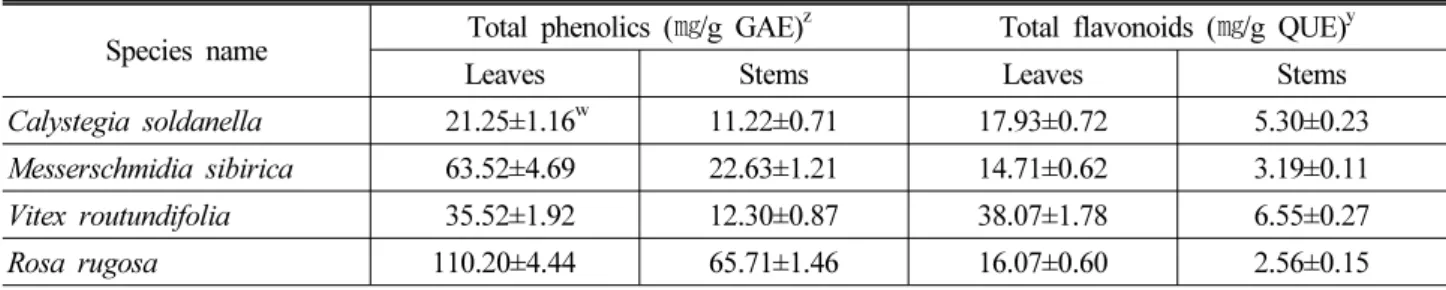
Table 1. A mount of total phenolic and total flavonoid compound
Species name Total phenolics ( ㎎/g GAE)
zTotal flavonoids ( ㎎/g QUE)
yLeaves Stems Leaves Stems
Calystegia soldanella 21.25±1.16
w11.22±0.71 17.93±0.72 5.30±0.23 Messerschmidia sibirica 63.52±4.69 22.63±1.21 14.71±0.62 3.19±0.11 Vitex routundifolia 35.52±1.92 12.30±0.87 38.07±1.78 6.55±0.27 Rosa rugosa 110.20±4.44 65.71±1.46 16.07±0.60 2.56±0.15
z
GAE : Gallic acid equivalent,
yQUE : Quercetin equivalent,
wValues represent means ± SD of the means of the three or more independent experiments.
층액을 둥근 플라스크에 모은다. 남은 하층액에 ethyl acetate 를 첨가하여 상층액이 투명해질 때까지, 남아있는 하층액과 동 일한 부피의 ethyl acetate를 첨가하고 원심분리를 반복 시행한 다. 둥근 플라스크에 모인 상층액을 Rotary evaporator를 이용 하여 용매를 methanol로 치환하여 최종 부피를 1 ㎖로 맞췄고, – 20℃ 냉동보관하였다. 에틸아세테이트 분획 추출물에 대해서 Ahn et al. (2012)을 참고하여 조플라보노이드(crude flavonoid) 라 명명한다.
항산화능(antioxidant capacity)
항산화활성은 DPPH, ABTS, FRAP assay를 통해 활성산소 에 대한 사구식물 4종의 라디칼 소거능(radical scavenging)을 구하고, 50% 소거능에 해당되는 농도(IC
50)를 구하였다. 에틸아 세테이트 분획 추출물을 methanol로 10, 50, 100, 500, 1000 ㎍ /㎖로 희석한 후 각 농도마다 소거능을 측정하고 Sigmaplot 사 의 Table curve 2D v5.01 program을 이용해 IC
50농도를 구하였 다. 각각의 농도에서 DPPH와 ABTS assay에 의한 소거능은 (A) {(1-sample/blank)×100} 으로 나타내었다. FRAP assay는 무 색에서 반응 후 짙은 군청색을 띄는 발색 반응을 보여 (A)식에서 분자와 분모의 위치를 전환하여 (B) {(1-blank/sample)×100}
의 새로운 계산식으로 소거능을 구하였다.
사구식물 간의 항산화활성을 비교하기 위한 positive control 로 ascorbic acid를 사용하였다. ascorbic acid는 1920년대 발견 된 항산화물질로 활성산소에 의해 발생되는 노화와 여러 질병 을 예방하는데 널리 이용되고 있다(Arrigoni and De Tulio, 2002).
DPPH assay는 2-2-diphenyl-1-picrylhydrazyl (DPPH)에 대한 시료의 환원력을 측정한 것으로서, 조플라보노이드 20 ㎕ 에 0.1 mM DPPH 180 ㎕를 가하여 암소에서 30분간 반응을 시 킨 후 517 ㎚에서 흡광도를 측정하였다(Thaipong et al., 2006).
ABTS assay는 2.45 mM potassium persulfate 와 7 mM ABTS를 같은 양으로 혼합하여 암소에서 24시간 방치하여 ABTS
+를 형성시킨다. 732 ㎚에서 흡광도가 0.7±0.02 가 되도 록 증류수로 희석하여 사용하였다. 플라보노이드 10 ㎕에 ABTS 용액 190 ㎕를 가하여 암소에서 10분간 반응을 시킨 후 732 ㎚에서 흡광도를 측정하였다(Lee and Jhoo, 2012).
FRAP (Ferric reducing/antioxidant power) assay 는 (A) 300 mM acetate buffer (pH 3.6), (B) 40 mM TPTZ in HCl 그리 고 (C) 20 mM FeCl
3·6H
2O를 준비한다. A : B : C = 10 : 1 : 1 (v/v/v) 비율로 혼합 후 37℃에서 15분간 반응 시킨다. 플라보 노이드 15 ㎕에 혼합액 750 ㎕ 가하고 5분간 반응을 시킨 후 593
㎚에서 흡광도를 측정하였다(Szôllôsi and Varga, 2002).
ABTS와 FRAP의 B, C 용액은 사용하는데 있어 매 실험마다 새로 제조하여 사용하였다.
통계처리
본 실험의 결과는 3회 이상 반복 측정 후 평균±표준편차로 나타내었고, IBM사 SPSS (Statistical Package for the Social Science) 23.0 program을 이용하여 T-test를 통해 각 실험군 간의 유의성을 검증한 후, p<0.05 수준에서 Duncan's multiple test에 따라 분석하였다.
결과 및 고찰
총 폴리페놀 및 플라보노이드 함량
본 연구에 사용한 사구식물 4종의 잎과 줄기의 methanol 추 출물에 따른 총 폴리페놀 함량 및 플라보노이드 함량은 Table 1에 나타내었다. 사구식물 4종의 총 폴리페놀 함량은 11.22~110.20
㎎/g GAE 범위이고, 이 중 해당화의 잎과 줄기는 각각 110.20
㎎/g, 65.71 ㎎/g으로 각 부위에서 가장 높은 수치를 나타내었
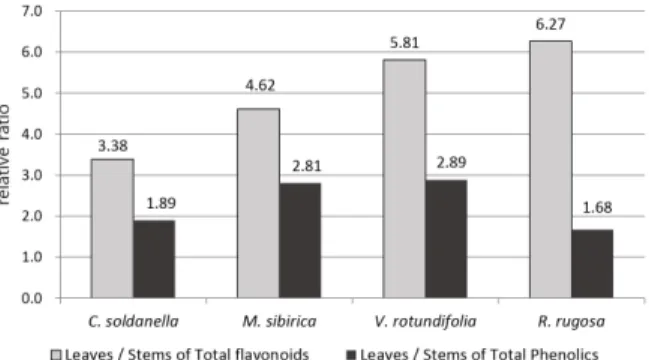
Fig. 1. Relative ratio of leaves/stems on the amount of total phenolics and flavonoids of the four sand dune plants.
Fig. 2. Relative ratio of total flavonoids/phenolics amounts of the leaves and stems in four sand dune plants.
Table 2. Inhibitory concentration (IC
50) measured by three antioxidant assays(DPPH, ABTS, FRAP)
IC
50(㎍/㎖) Species
DPPH ABTS FRAP
Leaves Stems Leaves Stems Leaves Stems C. soldanella 148.0 111.2 209.3 174.0 66.3 53.2
M. sibirica 91.9 86.0 126.5 101.6 31.5 21.2 V. routundifolia 320.4 284.6 461.3 313.6 135.2 105.9 R. rugosa 63.4 94.9 51.2 56.9 34.3 38.3
ascorbic acid 159.5 154.8 78.4
다. Park (2008)은 해당화 잎과 줄기 50% ethanol 추출물에 대 해 총 폴리페놀의 함량은 각각 92±10 ㎎/g 과 78±11 ㎎/g으로 보고하였고, Joo et al. (2007)은 순비기나무 줄기를 ethanol, 증류수, 열수로 추출하여 총 폴리페놀 함량을 측정하였을 때, ethanol 추출물이 다른 용매에 비해 폴리페놀 화합물이 더 잘 용 출됨을 보여 추출 용매에 따른 폴리페놀 함량에 차이가 발생한 다고 판단된다. 총 플라보노이드 함량은 2.56~38.07 ㎎/g QUE 범위이며, 순비기나무의 잎과 줄기에서 각각 38.07 ㎎/g 과 6.55 ㎎/g으로 가장 높은 함량을 보였다.
Fig. 1은 사구식물 4종에서 총 폴리페놀과 총 플라보노이드 의 함량에 대한 leaves/stems의 비율을 나타내었다. 4종 모두 잎이 줄기보다 1.68~6.27배 높았다. 이 중 해당화에서 총 플라 보노이드의 비율이 6.27배로 가장 컸지만 총 폴리페놀의 비율 은 1.68배로 가장 낮게 나타났다.
각 부위에서 total flavonoid/phenolic contents (TFC/TPC) 의 비율을 Fig. 2에 나타내었다. 갯메꽃과 순비기나무의 TFC/TPC 수치는 모래지치와 해당화와 비교하였을 때 수치가 높았다.
참고로 예비실험에서 총 폴리페놀과 플라보노이드 함량을
측정하였을 때 methanol 추출물을 이용했다. 하지만 methanol 추출물과 실험과정에 첨가된 시약의 화학반응 중에서 원인을 알 수 없는 불투명한 침전물이 발생하여 흡광도 측정이 불가능 하였다. 이후 용매를 ethanol과 증류수로 바꿔보았지만 동일한 상황이 발생하였고, 최종적으로 DMSO로 치환하였을 때 침전 물이 생기지 않아 총 폴리페놀과 플라보노이드 함량 측정이 가 능하였다.
항산화활성
항산화활성을 측정하기 위해 4종의 잎과 줄기에서 분리한 조
플라보노이드와 ascorbic acid를 다양한 농도(10, 50, 100, 500,
1000 ㎍/㎖)로 희석하였다. DPPH와 ABTS는 환원반응에 의해
각각 517 ㎚와 732 ㎚에서 농도가 높아짐에 따라 흡광도가 낮아
졌고 라디칼 소거능이 증가함을 확인하였다. 그리고 FRAP
(ferric reducing antioxidant power) assay는 페놀성 화합물에
의해 Fe
3+가 Fe
2+로 환원되어 TPTZ와 결합하여 군청색을 가진
복합체를 형성한다. 조플라보노이드의 농도가 높아짐에 따라
593 ㎚에서 흡광도 또한 높아졌다. assay 반응에 따른 결과가
정반대로 나타나기 때문에 각 농도에 따른 이들의 라디칼 소거
능(%)에 대해서 DPPH, ABTS assay는 (A) 계산식, FRAP assay
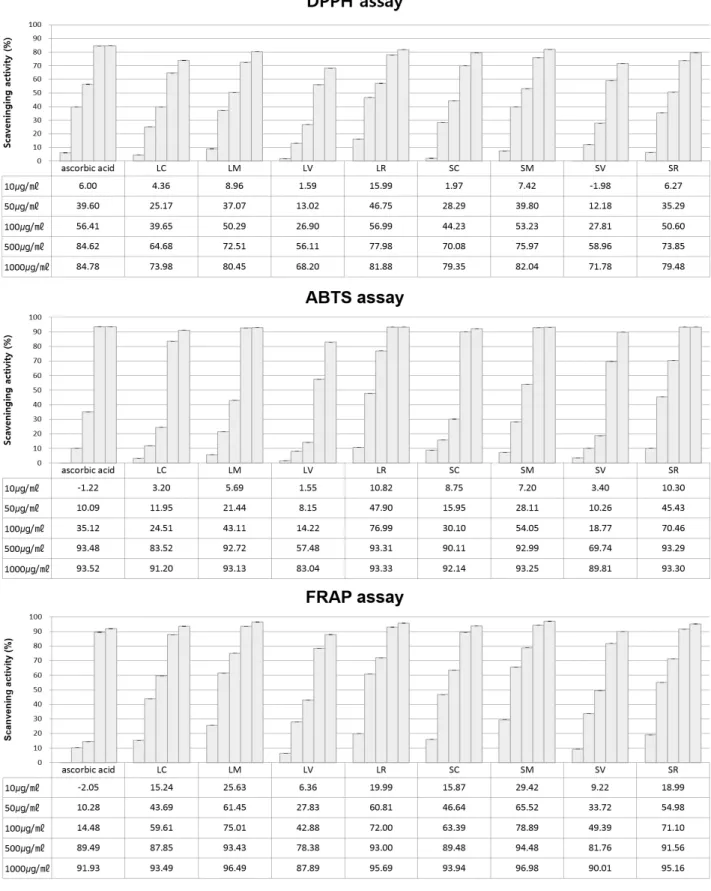
는 (B) 계산식을 사용하여 산출하였다(Fig. 3). 각각의 계산식을
통해 구한 IC
50값을 나타내었다(Table 2). 해당화 잎의 IC
50은
DPPH와 ABTS assay에서 각각 63.40 ㎍/㎖와 51.23 ㎍/㎖로
가장 높은 라디칼 소거능을 보인다. 이는 Kaneta et al. (1979) 및
Hashidoko et al. (1996)의 보고에서와 같이 해당화에 포함된
catechin 유도체, flavonoid, vitamin C 등의 항산화활성이 높은
여러 성분들에 의해 높은 라디칼 소거능을 나타내는 것으로 사
료된다. FRAP assay에서는 모래지치 줄기가 21.2 ㎍/㎖로 가장
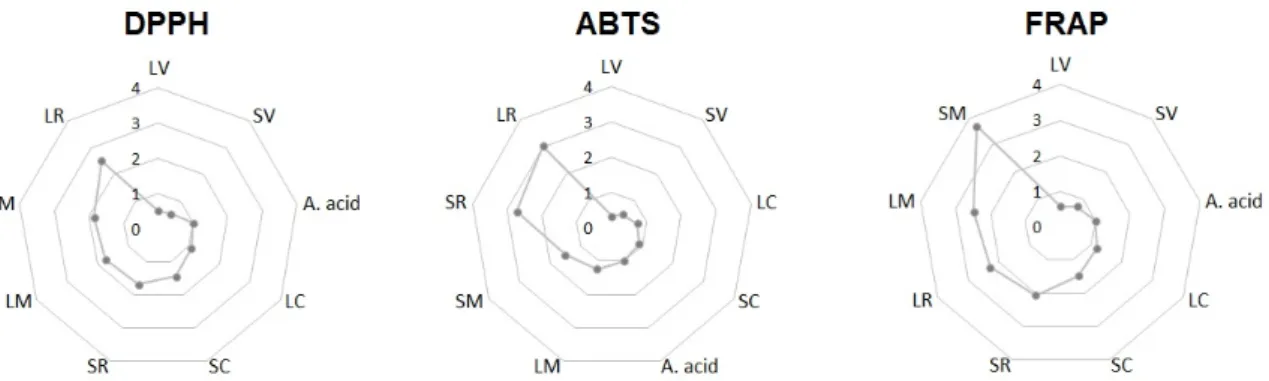
좋은 항산화능을 보였다. 항산화능 분석을 통해 구한 ascorbic
acid의 IC
50을 1.0으로 환산하여 비교한 수치를 Fig. 4에 나타내
Fig. 3. Radical scavenging activities by DPPH, ABTS, FRAP assay.
Value represented with means ± S.D. DPPH(n=7), ABTS(n=4), FRAP(n=9).
Fig. 4. Comparison of the radical scavening power based on the antioxidant capacity of the plants (Note : ascorbic acid`s power is 1.0).
A.acid : ascorbic acid; L- : leaves of species; S- : stems of species & 4 species (C : C. soldanella; M : M. sibirica; V : V. rotundifolia;
R : R. rugosa).
Table 3. Correlation coefficient (R)
T-fla/phe T-phe T-fla DPPH ABTS Total
phenolic -0.498 Total
flavonoid 0.751* 0.124
DPPH 0.782* -0.470 0.563
ABTS 0.893** -0.518 0.686 0.960**
FRAP 0.848** -0.403 0.649 0.977** 0.962**
*The correlation is significant at the 0.05 level.
**The correlation is significant at the 0.01 level.
었고 해당화 잎과 줄기, 모래지치 잎과 유사한 항산화활성을 보 였다. 순비기나무의 잎(LV)과 줄기(SV) 100 ㎍/㎖의 농도에서 측정한 라디칼 소거능이 27.2%와 28.1%로(Fig. 3), Jung et al.
(2004)이 methanol로 추출한 순비기나무 잎과 줄기에서 대해 DPPH assay를 통해 측정한 라디칼 소거능은 각각 18.9%와 18.4%보다 높게 나타났다.
결론적으로 DPPH, ABTS, FRAP assay에서 해당화≧모래 지치>갯메꽃>순비기나무 순으로 항산화능이 뛰어난 것으로 나 타났다. 또한 특이한 점은 Fig. 2에서 사구식물의 TFC/TPC 수 치가 낮을수록 항산화활성이 좋은 경향을 보였다.
이러한 경향성은 Yoshida et al. (1989)과 Olech (2012)가 보 고한 TPC와 라디칼 소거능 사이에는 높은 정상관 관계를 가진 다 말한 것과는 다르게 나타났다.
한편 항산화 이외에도 사구식물들의 여러 효능에 대한 연구 가 보고되었다. 갯메꽃의 메탄올 추출물이 inducible nitric oxide synthase (iNOS)의 발현을 억제하고(Kim et al., 2004), 순비기나무의 플라보노이드 vitexicarpin은 tumor necrosis factor (TNF-α)의 발현을 억제하여 항염/항암 및 진통에 대해 서도 효과를 증명하였다(Lee et al., 2012). 그리고 모래지치와 해당화 추출물은 쥐의 비만세포에 대해 항알러지 효과에 대한 보고하였다(Lee et al., 2006).
분석 실험 사이의 상관관계
3가지 항산화능 분석법을 통해 구한 사구식물 4종의 잎과 줄 기에 대한 항산화능 결과(IC
50)를 IBM 사의 SPSS 23.0 program 을 통해 상관분석(correlation analysis) 및 회귀분석(regression analysis)을 하였다. 그 다음 Duncan’s multiple test를 통해 사 후검정을 실시하였고, 그 결과는 Table 3에 나타내었다. 항산화
능 분석법 간에는 매우 높은 정상관 관계를 확인하였다 (R=0.960~0.977). 항산화능에 미치는 영향은 total phenolic content (TPC) (R
2=0.162~0.268)와 total flavonoid content (TFC) (R
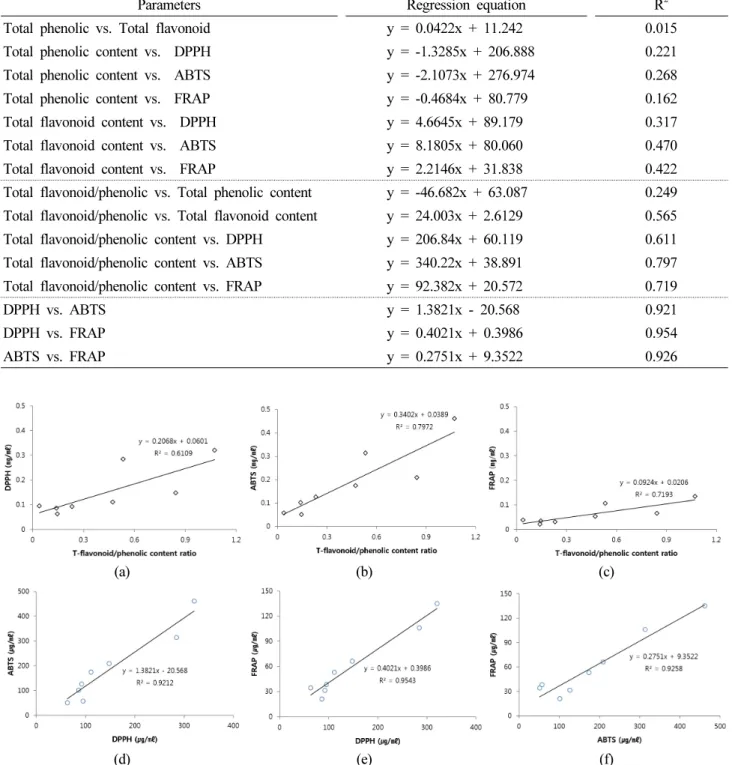
2=0.317~0.470)의 결과를 보였고(Table 4), 이는 TFC 가 TPC보다 다소 유의한 것으로 보인다. 그리고 TFC/TPC와 ABTS assay는 높은 정상관 (R=0.893) 관계로 p<0.01 수준에서 유의했고, 회귀분석을 통하여 확인하였다(y=340.22x+38.891, R
2=0.797) (Fig. 5). 그리고 DPPH (R=0.782)와 FRAP (R=0.848) 에 대해서 높은 정상관 관계이며 p<0.05 수준에서 유의하였다.
TFPc의 비율과 항산화능 분석법(DPPH, ABTS, FRAP assay)과
관계에 대해서는 추가적으로 LC/MS를 통한 폴리페놀 화합물
분석을 통해 플라보노이드 이외의 사구식물이 가진 다른 항산
화물질의 함유량을 분석함으로써 일반적인 육상식물들과 비교
해 볼 필요가 있다고 생각된다. 추후 사구식물의 자원식물로써
의 가치를 높이기 위해 이들이 지닌 항산화물질의 구성비를 탐
색하는데 있어서 고려해야할 점으로 생각된다. 한편 식물의 성
Table 4. The relationships between several evaluation parameters
Parameters Regression equation R
2Total phenolic vs. Total flavonoid y = 0.0422x + 11.242 0.015 Total phenolic content vs. DPPH y = -1.3285x + 206.888 0.221 Total phenolic content vs. ABTS y = -2.1073x + 276.974 0.268 Total phenolic content vs. FRAP y = -0.4684x + 80.779 0.162 Total flavonoid content vs. DPPH y = 4.6645x + 89.179 0.317 Total flavonoid content vs. ABTS y = 8.1805x + 80.060 0.470 Total flavonoid content vs. FRAP y = 2.2146x + 31.838 0.422 Total flavonoid/phenolic vs. Total phenolic content y = -46.682x + 63.087 0.249 Total flavonoid/phenolic vs. Total flavonoid content y = 24.003x + 2.6129 0.565 Total flavonoid/phenolic content vs. DPPH y = 206.84x + 60.119 0.611 Total flavonoid/phenolic content vs. ABTS y = 340.22x + 38.891 0.797 Total flavonoid/phenolic content vs. FRAP y = 92.382x + 20.572 0.719
DPPH vs. ABTS y = 1.3821x - 20.568 0.921
DPPH vs. FRAP y = 0.4021x + 0.3986 0.954
ABTS vs. FRAP y = 0.2751x + 9.3522 0.926
(a) (b) (c)
(d) (e) (f)
Fig. 5. Correlation between total flavonoid/phenolic content ratio and antioxidant assays (a,b,c), and similality among assays (d,e,f).
숙정도에 따라 항산화 활성 및 총 폴리페놀 함량에 차이가 나타 나므로(Park and Kim, 2016), 이를 고려하여 차후 채집시기에 따른 항산화 활성변화를 조사할 필요가 있다.
마지막으로 본 연구는 항산화능이 총 폴리페놀 또는 플라보
노이드 함량이 미치는 영향을 통계분석을 통해 밝혀내었고, 해
당화 잎이 ascorbic acid보다 항산화능이 우수하다는 점을 확인
하였다.
적 요
본 연구에서는 사구식물인 갯메꽃(Calystegia soldanella), 모래지치(Messerschmidia sibirica), 순비기나무(Vitex rotundifolia), 해당화(Rosa rugosa)의 잎과 줄기의 methanol 추출물에서 측 정한 총 폴리페놀 함량은 해당화(110.20 ㎎/g)가 가장 높았고, 총 플라보노이드 함량은 순비기나무(38.07 ㎎/g)가 가장 높게 측정되었다. 추출물의 에틸아세테이트 분획물(조플라보노이 드)을 이용하여 라디칼 소거능을 나타내는 DPPH, ABTS, FRAP assay로 항산화능을 측정하였다. 그리고 총 폴리페놀 / 플라보 노이드 함량 (TFC/TPC) 비와 항산화능, 두 요인 사이의 상관관 계에 대하여 분석하였다. TFC/TPC 비율이 매우 높았던 순비기 나무의 잎과 줄기는 항산화능 실험에서 대조군인 ascorbic acid 보다 떨어지는 것으로 나타났다. 하지만 가장 낮았던 해당화 잎 이 DPPH, ABTS assay에서 가장 항산화능이 높았고, FRAP assay에서 모래지치 줄기가 가장 뛰어났다. 위 결과에서 항산 화활성과 TFC/TPC 간의 상관관계를 통계적으로 유의하다는 점을 확인하여 TFC/TPC의 값이 직접적으로 항산화능에 기여 한다고 판단된다.
사 사
본 연구는 2015년 단국대학교 켐바이오 글로벌 전문인력양 성 사업단에서 지원하는 URP (Undergraduate Research Program)의 연구 수행으로 인한 결과물임을 밝힙니다. 또한 본 실험에 여러 가지 많은 도움을 주신 송미숙, 민병미, 박진희 박 사님께 감사드립니다.
References