Introduction
Many Korean farmers have cultivated watermelon (Citrullus lanatus Thunb.) plants in plastic-film covered greenhouse plots. Because watermelon is profitable and in great demand, the watermelon plants have been conti- nuously cultivated two or three times each year even though problems associated with the continuous watermelon cropping have been occurred. The problems caused by the continuous watermelon cropping are mostly
related to the deterioration of soil properties, such as salt accumulation, acidification or alkalinization of soils, deficiency of specific nutrients, etc. In particular, the salt accumulation in the greenhouse plots is usually caused by the heavy applications of chemical fertilizers and/or pesticides and by some specific environment in the indoor cultivation facilities (Kim and Chung, 2005; Jun and Park, 2001; RDA, 1997). The excess salts reduce plant growth and vigor by altering water uptake and causing ion-specific toxicities or imbalances (Cardon et al, 2007).
An excessive amount of salts are usually remained and accumulated in the root zone because it is caused by water uptake of plants and evaporation from the soil surface,
FertilizerManagement Practices with Rice Straw Application forImproving Soil Quality in Watermelon Monoculture Greenhouse Plots
Byung-Koo Ahn, Young-Han Lee1, and Jin-Ho Lee2*
Jeollabuk-do Agricultural Research and Extension Services, Iksan 570-704, Korea.
1Gyeongsangnam-do Agricultural Research and Extension Services, Jinju 660-3703, Korea.
2Department of Bioenvironmental Chemistry, College of Agricultural and Life Sciences, Chonbuk National University, Jeonju 561-756, Korea.
Indoor cultivation plots for watermelon plant mostly have salt-accumulation problem because of continuous cropping especially with the heavy applications of chemical fertilizers. Thus, this study was conducted to investigate selected soil properties and watermelon growth condition as affected by the application of different farming practices in the salt-affected soils of greenhouse plots used for continuous watermelon production.
Five different practice conditions in the experimental plots were applied, 1) a conventional farming practice (CFP), 2) a nitrogen-phosphorus-potassium (NPK) fertilizer management practice (FMP), and 3) the FMP with different amounts (5, 10, and 15 ton ha-1)of fresh rice straw treatments (FMP-RS), forthree years of study.
As comparing with CFP plots, soil organic matter content gradually increased during the experimental years, whereas it decreased in the FMP only plot. Soil pH was not changed in the CFP and FMP plot, but it declined in the FMP-RS plots; however, it increased again from the third yearin the FMP-RS plots with applying 10 and 15 ton ha-1 of RS treatments. The concentrations of exchangeable cations, Ca2+and Mg2+, except K+, and water-soluble anions, NO3-, Cl-, SO42-and PO43-, markedly decreased in FMP and FMP-RS plots. In particular, the application of rice straw tended to significantly decrease the ion concentrations, especially most anions, in the first year, but there was no more decrease in the second and third study years. With relation to the ion concentrations, the changes of electrical conductivity (EC) after applying the management practices showed very similar to those of the ion concentrations. In addition, incidence of withered watermelon plant after applying the management practices dramatically declined from approximately 20% in the CFP plot to 3.5%
in the FMP-RS plots. Water melon fruit weight was also improved by the management practices, especially FMP-RS. Therefore, the fertilizer and/or fresh rice straw application management practices are beneficial to improve salt-affected soils and watermelon plant growth condition.
Key words: Salt-affected soil, Management practice, Exchangeable cation, Water-soluble anion, Plant withering
Received : January 5. 2010 Accepted : January 13. 2010
*Corresponding author : Phone: +82632702545 Email: [email protected]
evapotranspiration (Bresler et al., 1982). Also, irrigation is only source of water for plants in the greenhouse plot because the closed system does not allow the rain to reach the soil surface. However, the volume of irrigation water applied to the plot is usually not sufficient to leach the excess salts below the root zone. In addition, the crops cultivated in the closed system are usually weak because of poor conditions, such as low temperature during the cold season and the limitation of light intensity, as comparing with those in field (open system). For this reason, the crops cannot uptake nutrients sufficiently; thus soluble salts remain and accumulate in the soils (Park, 2004).
Therefore, to remove the soluble salts accumulated in the greenhouse plot, many researchers have suggested various solutions, such as sufficient irrigation, the cultivation of hyperaccumulators for salts, topsoil replacement, subsoil and/or deep tillage, and soil amendment (Jun et al., 2002; Hwang et al., 1989; Simada, 1979; Bernstein, 1975). Also, to prevent the excessive salt accumulation in the root zone, the fertilizer recommendations for specific crops by soil testing have been suggested (Lee et al., 1994; Song et al., 1993).
However, in the greenhouse plot with excessive salt accumulation, those types of solutions have tended to be not efficient. Thus, application of crop residue might be an efficient solution to remove and/or prevent the salinity problems caused from the accumulation of soluble salts in the root zone. The crop residue at the soil surface reduces evaporative water losses, thereby limiting the upward movement of salt into the root zone. Evaporation and thus, salt accumulation, tends to be greater in bare soils. Under crop residue, soils remain wetter, allowing the irrigated water to be more effective in leaching salts, particularly from the surface soil layers where damage to crop seedlings is most likely to occur (Cardon et al., 2006).
Also, crop residue is an important source of soil organic matter. Soil organic matter (SOM) is often viewed as the thread that links the biological, chemical, and physical properties of a soil. It has been associated with numerous soil functions like nutrient cycling, water retention and drainage, erosion control, disease suppression and pollution remediation (Cooperband, 2002). Therefore, application of crop residue in salt-affected soils might be helpful to improve soil qualities.
The objective of study was to investigate selected soil properties as affected by the application of different
management practices in the salt-affected soils of greenhouse plots used for continuous watermelon production.
Materials and Methods
Experimental Plot This study was conducted in the experimental site located at Vegetable Research Institute in Jeollabuk-do Agricultural Research and Extension Services, Kochang, Korea. The experimental plots con- tained salt-affected soils caused by watermelon monoculture cropping for seven consecutive years. The experimental plots were established in plastic-film covered greenhouse, and individual plot size was 6 m wide and 24 m long (144 m2). The soil at the cite is a sandy clay loam containing 54.0% sand, 22.0% silt, and 24.0% clay in average.
Soil and Rice Straw Analyses Soil samples in the greenhouse plots were collected after harvesting watermelon cultivated with or without the application of fresh rice straw. The soil samples were air-dried and crushed to pass through a 2-mm sieve. Soil pH and electrical conductivity were measured in 1:5 soil/water suspensions. The concentrations of water-soluble anions such as nitrate (NO3-), chloride (Cl-), sulfate (SO42-), and phosphate (PO43-) ions inthe soil samples were determined using a method described by Ahn et al. (2007). Other selected chemical soil properties were determined using the procedures proposed by Rural Development Association (RDA), Korea (2000). The selected properties of soils are presented in Table 1. Also, the samples of fresh rice straw were randomly collected before applying in the plot. The rice straw samples were dried for 72 hrs at 70℃
and ground less than 5-mm in size. Selected chemicals in the samples were determined using the method for plant analysis proposed by RDA (2000).
The concentrations of selected chemicals including carbon (C), nitrogen (N), phosphorus (P), calcium (Ca), magnesium (Mg), potassium (K), and sodium (Na) in the fresh rice straw applied were 893.7 g kg-1, 63.14 g kg-1, 13380 mg kg-1, 940 mg kg-1, 283 mg kg-1, 961 mg kg-1, and 2,051 mg kg-1, respectively.
Fertilizer and Fresh Rice Straw Applications The experimental plots in the greenhouses were prepared in
five different conditions: 1) a plot under conventional farming practice (CFP), 2) a plot under nitrogen- phosphorus-potassium (NPK) fertilizer management practice (FMP), and 3) three plots under the FMP with different amounts of fresh rice straw treatments (FMP-RS).
In the CFP plot, the NPK Fertilizers were applied at the rates of 138-49-87 kg ha-1 as N-P2O5-K2O, which was estimated by using Soil Management and Fertilizer Recommendation System (Version 2002) supplied by National Institute of Agricultural Science and Tech- nology, RDA, Korea. Total amount of phosphorus fertilizer estimated were applied as base-dressing, while nitrogen and potassium were treated in different ratios:
50% of the fertilizers were applied as base-dressing before transplanting watermelon plants, and then the rest of both fertilizers were also applied at separate growing points as top-dressing: 25% of the fertilizers was treated at watermelon fruiting stage, and the other 25% was applied at the fruit hypertrophy stage. In the FMP and FMP-RS plots, however, a specific amount of the NPK fertilizers were applied due to the fertilizer requirements for watermelon plant estimated by soil testing at every application periods even though the fertilization practices, top- and base-dressings, were conducted the same as those for the CFP plot. In addition, the fresh rice straw was applied separately at 0, 5, 10 and 15 ton ha-1to the designa- ted greenhouse plots after cutting into about 10 to 15 cm in length around February 20 every year, and then the plots were plowed.
Watermelon Cultivation A cultivating method for watermelon plants was modified from the one described
by Ahn et al., (2007). Seeds of watermelon (Citrullus lanatus Thunb.) and bottle gourd (Lagenaria leucanth Standl) cultivar FR-Dantos (Dongbu Hannong Seed, Korea) were simultaneously germinated in an incubator at 30°C for 24 hours. Plant seedlings were grown in a plant nursery for 15 days, and then the watermelon plant tops were grafted onto the rootstocks of bottle gourd. The grafted watermelon plants were grown for approximately 30 more days in the nursery. After 45 days in the nursery, the plant was transplanted into the greenhouse plots around March 20 and July 30 in each experimental year for its repeated-cropping using two different cultivation methods, a semi-forcing culture for the watermelon- watermelon-post harvest rotational crop system and a retarding culture, respectively. During the growing periods, before and after the fruit set, the rate of withered watermelon plants was examined. Watermelons were harvested at 90 to 95 days after transplantation. After harvesting the watermelon from the plant, the fruit weight was measured from twenty samples of watermelon collected randomly in each plot.
Results and Discussion
Rural Development Administration (RDA), Korea (1999) suggested that the optimal ranges of selected soil properties, pH, electrical conductivity (EC), NH4OAC extractable (exchangeable) Ca, Mg, and K, organic matter content, and available phosphorus (P2O5), for watermelon cultivation are 6.0~6.5, <2.0 dS m-1, 0.7~0.8 cmolckg-1, 5.0~6.0 cmolckg-1, 1.5~2.0 cmolckg-1, 20~30 g kg-1, and 350~450 mg kg-1, respectively. Soils in the experimental plots were approximately three times as high in EC value Table 1. Selected properties of soils in the experimental plots before applying the different management practices.
Exp. Management Soil‡ pH EC SOM Exch. Cation
(cmolc kg-1) CEC Avail. P2O5 NO3—N plot practice† texture (1:5) (dS m-1) (g kg-1) Ca2+ Mg2+ K+ (cmolc kg-1) (mg kg-1) (mg kg-1)
Plot 1 CFP SL 6.9 6.84 33.1 6.7 4.0 4.1 13.8 1,359 2,194
Plot 2 FMP SL 6.8 6.75 32.7 6.8 4.2 4.2 13.9 1,317 2,089
Plot 3 FMP-RS 5 ton ha-1 SL 6.8 6.95 30.8 6.0 3.7 3.9 11.6 1,334 2,303 Plot 4 FMP-RS 10 ton ha-1 SL 6.8 6.90 28.5 6.6 3.8 3.8 12.3 1,438 2,468 Plot 5 FMP-RS 15 ton ha-1 SL 6.7 6.30 32.8 5.7 2.9 3.6 10.5 1,254 2,036
†CFP: conventional farming practice, FMP: fertilizer management practice, FMP-RS: fertilizer management practice with 5, 10, and 15 ton ha-1 of fresh rice straw applications.
‡SL: sandy loam.
and available phosphorus, five times as high in exchangeable K, and one-half to two times as high in exchangeable Mg as the optimal levels for watermelon plant cultivation (Table 1). Thus, we investigated the selected chemical properties of soils in the greenhouse plots as affected by different farming practices, chemical fertilizer management practice (FMP) of nitrogen- phosphorus-potassium (NPK) and the FMP with different amounts of fresh rice straw application (FMP-RS), as comparing with the impacts of conventional farming practice (CFP).
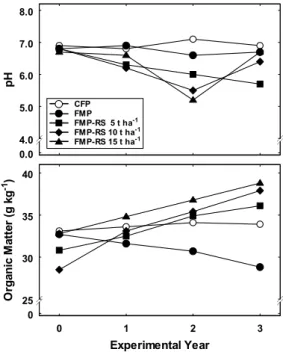
The values of soil pH in the CFP and FMP plots were negligibly changed, whereas the pH values in the FMP-RS plots markedly declined with increasing amounts of rice straw application. During the study years, however, the soil pH values in the FMP-RS plots gradually decreased with 5 ton ha-1of rice straw treatment, but the pH values interestingly increased again from the third experimental year, when higher than 10 ton ha-1 of rice straw was applied (Figure 1).
Changes in soil organic matter (SOM) contents in the plots as influenced by the different farming practices for watermelon plant are also shown in Figure 1. The organic matter contents in the plots were expectedly changed. The SOM content in the CFP plot was not changed, but in the FMP plot it declined every experimental year. These results might be caused from following reasons: plant and
weed residues were left in the CFP plot but they were removed in the FMP plot after harvesting watermelon.
However, the SOM contents in the FMP-RS plots proportionally increased with increasing the application amounts of fresh rice straw during the experimental years.
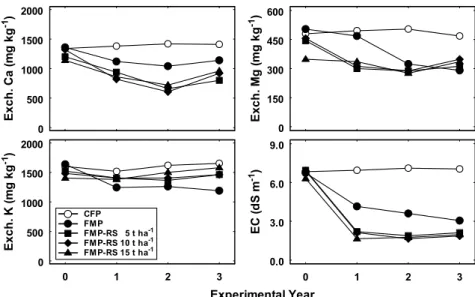
The concentrations of exchangeable cations, Ca2+, Mg2+, and K+, in soils as affected by the applications of different farming practices are presented in Figure 2. The concentrations of those cations were changed only negligibly in the CFP plot. However, the concentrations of Ca2+and Mg2+in the FMP and FMP-RS plots were mostly reduced, while K+ concentrations were not changed or slightly increased with 10 and 15ton ha-1 of rice straw treatments in the FMP-RS plots. The K+concentration in the soils should be associated with higher amounts of K+, 13.38 g kg-1, in the rice straw applied. Only in the FMP plot, all of the cation concentrations declined gradually during the experimental years. Interestingly, impact of different amounts (5, 10, and 15 ton ha-1) of fresh rice straw applications on the decreasing cation concentrations was not clearly appeared. Furthermore, the Ca2+and Mg2+
concentrations in the FMP-RS plots first decreased until the second experimental year, but then increased in the third year. These results showed very similar trends to the changes in pH; thus, the increases of Ca2+ and Mg2+
concentrations after the second study year influenced the pH values.
The values of electrical conductivity (EC) in the plot soils are also shown in Figure 2. Changes in the EC values tended to be similar to those in Ca and Mg concentrations in all plots. The EC values were almost not changed in the CFP plot, whereas they decreased more in FMP-RS plots than in FMP plot. Specific influence for decreasing EC values among different amounts of rice straw applications in the FMP-RS plots was not observed as well. In particular, the application of rice straw in the FMP-RS plots tended to significantly decrease the EC value in the first year, but it did not affect the EC value in the second and third experimental years.
The EC values in soil-solution systems are closely related to the concentrations of water-soluble anions, such as nitrate (NO3-), chloride (Cl-), sulfate (SO42-), and phosphate (PO43-), as well as exchangeable cations (Ca2+, Mg2+, and K+). Thus, the water-soluble anion concentrations in the soils were determined (Figure 3). In the CFP plot, the anion concentrations were negligibly changed: only NO3-concentration slightly decreased, but then there was
0.0 4.0 5.0 6.0 7.0 8.0
pH
CFP FMP FMP-RS 5 t ha-1 FMP-RS 10 t ha-1 FMP-RS 15 t ha-1
0 1 2 3
Experimental Year 0
25 30 35 40
Organic Matter (g kg-1)
Fig. 1. Changes in soil pH and organic matter contents in the plots as influenced by the different management practices.
a little increase in Cl-concentration during the study years.
However, the anion concentrations in other plots were greatly influenced by the each management practice applied. The changes of anion concentrations, except PO43-concentration, showed very similar trend with those of EC values. The concentrations of water-soluble NO3-, Cl-, and SO42- markedly declined with the chemical fertilizer management practice with or without applying rice straw treatment, but even so, those management practices did not much affect them during the second and third years. Its decreasing rates were a little higher in the FMP-RS plots than in the FMP only plot. On the other
hand, the concentration of water-soluble PO43- was gradually reduced by the applications of management practices, especially in the FMP-RS plots, during the three experimental years. In addition, we also determined the concentrations of plant-available NO3--N and PO43--P to compare with those of their water-soluble ions (data not shown). Patterns of changes in both plant-available nutrient concentrations as affected by the applications of the management practices were very similar to those of their water-soluble forms. However, the concentration of PO43--P kept declining during the three experimental years in the FMP-RS plots, especially higher decrease with 15
0 500 1000 1500 2000
Exch. Ca (mg kg-1)
0 150 300 450 600
Exch. Mg (mg kg-1)
0 1 2 3
Experimental Year 0
500 1000 1500 2000
Exch. K (mg kg-1)
CFPFMP FMP-RS 5 t ha-1 FMP-RS 10 t ha-1 FMP-RS 15 t ha-1
0 1 2 3
0.0 3.0 6.0 9.0
EC (dS m-1)
Fig. 2. EC values and the concentrations of exchangeable cations, Ca2+, Mg2+, and K+, in soils as affected by the applications of different management practices.
0 500 1000 1500 2000 2500 3000
NO3- (mg kg-1)
0 100 200 300 400
PO43- (mg kg-1)
0 1 2 3
Experimental Year 0
250 500 750 1000
Cl- (mg kg-1) CFP
FMP
FMP-RS 5 t ha-1 FMP-RS 10 t ha-1 FMP-RS 15 t ha-1
0 1 2 3
0 300 600 900 1200 1500
SO42- (mg kg-1)
Fig. 3. The concentrations of water-soluble anions, NO3-
, Cl-, SO42-
, and PO43-
, in soils as affected by the different management practices.
ton ha-1of the rice straw application; but even so, in the CFP plot it was reduced only in the first experimental year and then there was almost no more decrease in following years.
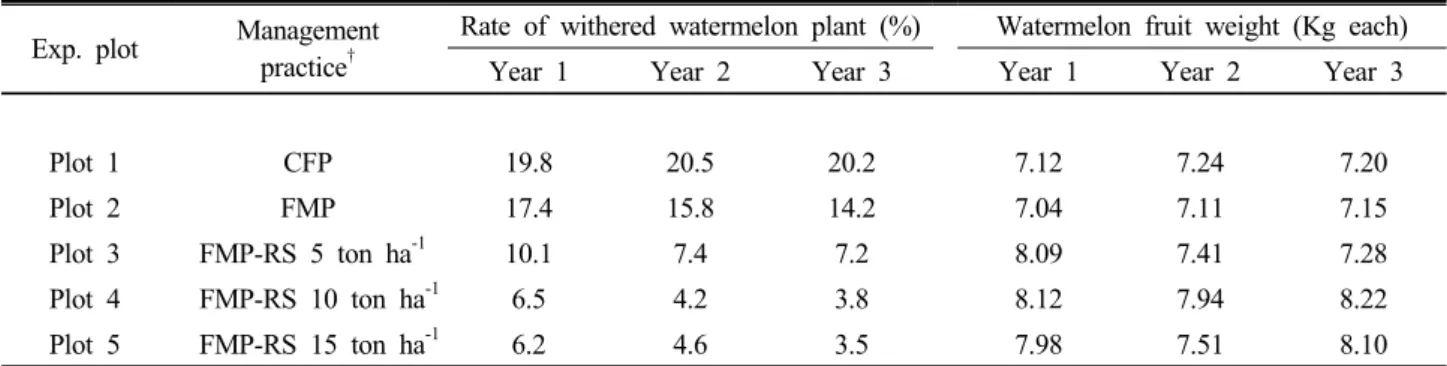
In addition, the incidence rate of withered watermelon plant and watermelon fruit weight as influenced by the applications of CFP, FMP, and FMP-RS are presented in Table 2. The withering rate of watermelon plant in the CFP plot was close to 20% or more of total plant population. However, after applying FMP, it was much reduced up to 14.2%, and then considerably decreased as much as 3.5% in the FMP-RS plots during the three years studied. There could be a number of causes for watermelon plant withering such as soil water content, chemical and physical properties of soil, soil pathogen, climate conditions, and so on (Kwon et al., 2005; Pivonia, 1997; Mansoori and Jaliani, 1996); but major factors for the plant withering are still unsure. One thing is sure that it is happened by imbalance between the uptake of water from roots and the transpiration of water from plant leaves (Kwon et al., 2006; Huh et al., 2003; Lee et al., 1995). In this study, the decrease of watermelon plant withering might be caused by improving soil properties, such as controlling salinity and water and air permeability due to the applications of FMP and FMP-RS, especially with fresh rice straw treatments. On the other hand, the fruit weights of each watermelon harvested from the different plots were between 7.11 and 8.22 kg, and the plots for producing heavier watermelon ranged generally in order of FMP-RS(10 ton ha-1) > FMP-RS(15 ton ha-1) > FMP- RS(5 ton ha-1) > CFP > FMP plot. Also, they mostly decreased in the second year and then increased again as comparing with those in the third year because soil properties and nutritional conditions might be changed in
steady-state levels from the third year.
Conclusion
Comparison among different farming practices, con- ventional farming practice (CFP), nitrogen-phosphorus- potassium (NPK) fertilizer management practice (FMP), and the FMP with different amounts (5, 10, and 15 ton ha-1) of fresh rice straw treatments (FMP-RS), The applications of FMP and FMP-RS greatly improved the deterioration of soil quality influenced by salt accumulation in watermelon monoculture greenhouse plots with decreasing the concentrations of exchangeable cations, especially Ca2+ and Mg2+, and water-soluble anions, NO3-, Cl-, SO42-, and PO43-. Thereby, the values of electrical conductivity (EC) of soils in the FMP and FMP-RS plots were significantly reduced. However, the application of rice straw tended to significantly decrease the ion concentrations, especially most anions, in the first year, but then there was no more decrease in the second and/or third study years. Also, higher amounts (10 and 15 ton ha-1) of rice straw applications might not have more effect to decrease the ion concentrations as comparing with 5 ton ha-1of its application. Nonetheless, FMP-RS application was more effective than FMP application.
Because of improving the soil quality, withering rates of watermelon plant dramatically decreased from approximately 20% in the CFP plot to 3.5% in the FMP-RS plots. Also watermelon fruit weight was positively affected by the management practices, especially FMP-RS. Therefore, the FMP and FMP-RS management practices might very useful tools to improve salt-affected soils and watermelon plant growth condition.
Table 2. Incidence of withered watermelon plant and watermelon fruit weight as influenced by the applications of different management practices during the experimental years.
Exp. plot Management practice†
Rate of withered watermelon plant (%) Watermelon fruit weight (Kg each)
Year 1 Year 2 Year 3 Year 1 Year 2 Year 3
Plot 1 CFP 19.8 20.5 20.2 7.12 7.24 7.20
Plot 2 FMP 17.4 15.8 14.2 7.04 7.11 7.15
Plot 3 FMP-RS 5 ton ha-1 10.1 7.4 7.2 8.09 7.41 7.28
Plot 4 FMP-RS 10 ton ha-1 6.5 4.2 3.8 8.12 7.94 8.22
Plot 5 FMP-RS 15 ton ha-1 6.2 4.6 3.5 7.98 7.51 8.10
†CFP: conventional farming practice, FMP: fertilizer management practice, FMP-RS: fertilizer management practice with 5, 10, and 15 ton ha-1 of fresh rice straw applications.
References
Ahn, B.K., D.H. Kim, and J.H. Lee. 2007. Post harvest cropping impacts on soil properties in continuous watermelon (Citrulllus lanatus Thunb.) cultivation plots. Korean J. Soil Sci. Fert. 40(1):98-107.
Bernstein, L. 1975. Effect of salinity on plant growth. Ann. Rev.
of Phytophology. 13:295-312.
Bresler, E., B.L. McNeal, and D.L. Carter, 1982. Saline and Sodic Soils: Principles-Dynamics-Modeling. Springer Verlag, Berlin, Heidelberg, pp: 236.
Carden,G.E., J.G. Davis, T.A. Bauder, and R.M. Waskom. 2007.
Managing saline soil. Colorado State University Cooperative Extension, CO, USA
Cooperband, L. 2002. Building Soil Organic Matter with Organic Amendments: A resource for urban and rural gardeners, small farmers, turfgrass managers and large-scale producers. Center for Integrated Agricultural Systems.Univ.
of Wisconsin. Madison, WI.
Huh, Y.C., Y.H. Woo, J.M. Lee, and Y.H. Om. 2003. Growth and fruit characteristics of watermelon grafted onto Citrullus rootstock selected for disease resistence. J. Kor. Hort. Sci.
44:649-654.
Hwang, N.Y., J. Ryu, J.S. Na, and J.K. Kim. 1989. Studies on the cause of injury by continuous cropping and the effect of soil conditioner on red pepper (Capsicum annuum L.). II.
Effects of soil conditioners applied on continuous cropping fields. J. Korean Soc. Soil Sci. Fert. 22(3):205-214.
Jun, H.S., and W.C. Park. 2001. Soil chemical characteristics and comparison with infested status of nematode (Meloidogyme spp.) in plastic house continuously cultivated oriental melon in Sonju. Korean J. Environ. Agric.
20:127-132.
Jun, H.S., W.C. Park, and J.S. Jung. 2002. Effects of soil addition and subsoil plowing on the changes of soil chemical properties and the reduction of root-knot nematode in continuous cropping field of oriental melon(Cucumis melo L.). Korean J. Environ. Agric. 21:1-6.
Kim, J.W., and J.B. Chung. 2005. Green pepper cultivation in mixture bed of soil and rice hull for alleviation of salinity problems in plastic film house. Korean J. Soil Sci. Fert.
38:340-344.
Kwon, J.K., G.B. Kweon, K.H. Kang, Y.H. Choi, N.J. Kang, J.H. Lee, H.J. Jeong, and J.M. Park. 2005. Effect of different rootstocks and double grafting on the fruit quality and withering occurrence of greenhouse watermelon. Kor. J. Hort.
Sci. Technol. 23:382-387.
Kwon, J.K., K.H. Kang, G.B. Kweon, Y.H. Choi, N.J. Kang,J.H.
Lee, and H.C. Rhee. 2006. Effect of automatic ventilation of greenhouse during daytime on the growth and wilting occurrence in watermelon. Kor. J. Hort. Sci. Technol.
24:138-142.
Lee, C.S., B.L. Huh, Y.S. Song, and H.K. Kwak. 1994. Revised rates of NPK fertilizers based on soil testing for vegetable crops. J. Korean. Soc. Soil Sci. Fert. 27:85-91.
Lee, S.G., J.S. Lee, K.Y. Kim, J.H. Chung, S.O. Yoo, and J.H.
Bae. 1995. Effect of irrigation control on the quality and yield of watermelon (Citrullus vulgaris S.) in high density staking cultivation under rain-shelter. RDA J. Agric. Sci. Soil Fert.
37:245-249.
Mansoori, B., and N.K.H. Jaliani. 1996. Control of soilborne pathogens of watermelon by solar heating. Crop Protection.
15:423-424.
Park, C. Y. 2004. Solution and reason of salt accumulation in green house soil. p. 108-109. The society of green house soil and environment. National Yeongnam Agricultural Institute, Milyang, Korea.
Pivonia, S. 1997. Sudden wilt of melons in Southern Israel-Fungal agents and relationship with plant development.
Plant Disease. 81:1264-1268.
RDA. 1997. Countermeasure technology for injury by successive cropping in greenhouse. Rural Development Administration, Korea.
RDA. 1999. The standard of fertilizer application on crop species. National Institute of Agricultural Science and Technology, Rural Development Administration, Korea.
RDA. 2000. Methods of analysis of soil and plant. National Institute of Agricultural Science and Technology, Rural Development Administration, Korea.
Simada, N. 1979. Characteristic and Improvement of greenhouse soil. Jeonnong Agricultural Technology Center, Japan.
Song, Y.S., C.S. Lee, H.K. Kwak., and Y.D. Park. 1993.
Recommendation of NPK fertilizers for Chinese cabbage and spinach based on soil testing. J. Korean Soc. Soil Sci. Fert.
26:25-30.
시비관리 및 생 볏짚 처리가 수박연작 시설재배지 토양에 미치는 영향
안병구 이영한· 1·이진호2*
전라북도 농업기술원, 1경상남도 농업기술원, 2전북대학교 생물환경화학과
수박재배에 적합한 양분함량보다 약 배 이상 높고3 , 7년간 수박을 연작해온 시설 재배지에서 시비관리 및 생볏짚을 연용하
면서 토양 중 염류경감 효과와 수박시들음증 발생률을 조사하였다 시험은 관행구 시비관리구 시비관리 및. , , 5, 10, 15
ton ha-1 생볏짚 처리구로 나누어 년간 실시하였다 유기물함량은 예상할 수 있는 바와 같이 대부분의 처리구에서 지속적3 .
으로 증가하였으며 단지 시비관리구에서만 감소하였다 토양, . pH는 관행구 및 시비관리구에서는 변화가 거의 없었고 시,
비관리 볏짚처리구에서 감소하는 경향을 보였다 그러나 시험 년차부터- . 3 10, 15 ton ha-1 시비관리 볏짚처리구에서 다시- 증가하는 경향을 보였다 치환성 양이온 즉. Ca2+, Mg2+, K+, 중Ca2+과 Mg2+의 함량과 수용성 음이온, NO3-
, Cl-, SO42-
, PO43-
의 함량은 시비관리구 및 시비관리 볏짚처리구에서 상당히 감소하는 경향을 보였다 그러나 시비관리 볏짚처리구에- . -
서 생볏짚의 처리량과는 관계없이 시험 년차에 많은 양이 감소한 후1 , 2~3년차에서는 더 이상 감소하지 않는 것으로 나타
났다 또한 치환성. K+ 함량은 시비관리구에서 다고 감소하는 경향을 보였으나 다른 처리구에서는 시험기간 동한 거의 변
화하지 않았다 그리고 이러한 양이온과 음이온의 함량변화와 관계가 깊은 전기전도도. (EC)를 조사한 결과 수용성 음이온
함량변화와 같은 경향을 보이며 감소하였다 또한 수박생육과 관련하여 수박시들음증 발생률은 관행구에서 최고 약. 20%까
지 발생하였으나 시비관리와 함께 생볏짚을, 10 ton ha-1 이상 사용하면 최고3.5%까지 급격히 감소하였다.