http://dx.doi.org/10.7585/kjps.2013.17.4.394
Open Access
394
근권 Trichoderma harzianum MPA167 처리에 의한 생육촉진과 고추 역병균에 대한 고추의 유도저항성
양누리·이세원·김흥태
1·박경석*
국립농업과학원 농업미생물과,
1충북대학교 식물의학과
Growth Promotion and Induction of Systemic Resistance Against Phytophthora capsici on Red-pepper Plant
by Treatment of Trichoderma harzianum MPA167
Nuri Yang, Sae Won Lee, Heung Tae Kim
1and Kyungseok Park*
Agricultural Microbiology Division, National Academy of Agricultural Science, Rural Development Administration, Suwon 441-707, Korea
1
Department of Plant Medicine, Chungbuk National University, Cheongju 361-763, Korea (Received on November 22, 2013. Revised on December 6, 2013. Accepted on December 16, 2013)
Abstract Trichoderma harzianum is one of rhizosphere fungus usually lives near the plant root regions in the soil. T. harzianum plays an important role in plant growth promotion and increases disease resistance against various plant pathogens on crops. In this study, the strain T. harzianum MPA167 was isolated from the barley rhizosphere soil in Suwon, Korea. Among 183 isolates, the strain T. harzianum MPA167 was selected as promising strain in which based on hyperparasitical activity against Phytophthora capsici and estimated disease control activity against P. capsici in the greenhouse conditions. The strain T. harzianum MPA167 was identified using 23s rDNA internal transcribed spacer(ITS) region sequences. MPA167 treatment (1 × 10
6spores/ml) showed greater disease suppression against Phytophthora blight of red-pepper caused by P. capsici in greenhouse compared with the water-treated control. Volatiles derived from T.
harzianum MPA167 elicit growth promotion of tobacco and Arabidopsis seedlings in I-plate assay. In addition, T. harzianum MPA167 strain was also found to be effective for the growth promotion and induction of systemic resistance on red-papper plant. These results suggest that MPA167 might be used as one of the potential biocontrol agents.
Key words Trichoderna hazianum, Phytophthora capsici, volatile compound, disease suppression, induced systemic resistance (ISR).
서 론
고추(Capsicum annuum L.)는 우리나라 밭 작물 중 가장 수익성이 높은 작물 중 하나로 많은 농가의 주요 소득원이 다. 한편 고추에는 고추 탄저병, 역병과 괴저바이러스 등이 심하게 발생하는데 특히 고추 역병균인 Phytophthora capsici
는 기주범위가 넓고 난포자(Ospore)를 생산하여 토양에서 장기간 생존하는 특성이 있어 화학 약제 방제에도 어려움이 많은 균이다. 고추 역병균은 뿌리, 줄기, 잎과 열매 모두에 감염을 일으킬 수 있다(Chi 등, 2013). 이 균은 난균류에 속 하며 생육기 중 유주자낭(zoosporagium)을 대량으로 형성시 켜 비가 오면 유주자(zoospore)를 방출시켜 주변의 기주식 물로 퍼져 나간다(Lamour 등, 2012). 생태적 측면에서도 고 추역병 균은 토양에서 살아가는 토양병원균으로서 전염원이 땅속에 존재하므로 일반 합성농약으로 방제하기가 쉽지 않 다. 우리나라의 경작지는 연작 및 상대적으로 높은 수준의
*Corresponding author
Tel: +82-31-290-0424, Fax: +82-31-290-0406 E-mail: [email protected]
ORIGINAL ARTICLES / CONTROL
살균제 사용으로 인해 오히려 발병을 유도 하거나, 전염원 이 땅속에 존재하므로 일반 합성농약으로 역병을 제거하기 에는 충분하지 않다(Hwang과 Kim, 1995; Jee 등, 2000;
Chi 등, 2013). 또한 살균제의 과다 사용은 농업환경을 악화 시키므로 친환경 작물보호 기술인 생물학적 방제 기술의 개 발이 필요한 실정이다(Erwin과 Ribeiro, 1996; Chi 등, 2013).
고추 역병의 생물학적 방제를 위하여 지금까지는 Gliocladium, Trichoderma, Pseudomonas, Burkholderia, Streptomyces 그리고 Bacillus와 같은 근권 미생물 종들이 연구되어져 왔으며 상용화된 제품도 있다(Francesco 등, 2008).
Trichoderma spp. 은 1794년 처음(Persoon 등, 1794) 기록 되었으며, 식물 뿌리 생태계에 존재하고, 가장 빈번하게 분 리되는 토양곰팡이에 속한다(Harman 등, 2004; Francesco 등, 2008). 또한 매우 다양한 종이 존재하며 T. reesei, T.
harzianum, T. viride, T esperellum 등이 가장 널리 연구되 어졌다. T. ovalisporum, T. martiale, T. stromaticum, T.
theobromicola, T. paucisporum, T. koningiopsis, 그리고 T.
evansii 등을 포함하는 Trichoderma의 많은 새로운 종이 발 견되고 있다(Samuels 등, 2000; Holmes 등, 2004; Bae 등, 2006; Samuels 등, 2006a; Samuels 등, 2006b; Hanada 등, 2008; Samuels 과 Ismaiel 2009). 이 곰팡이는 비병원성으로 식물의 근권에 잘 정착하는 특성이 있으며 많은 식물병원 균의 균사체에 기생하거나 식물의 체내 방어기작을 활성화 시키는 것으로 알려져 있다(Francesco 등, 2008). 또한 Trichoderma spp. 는 주요 식물생장촉진균(Plant Growth Promoting Fungi) 으로 뿌리표면에 균체를 형성(colonization) 할 수 있고, 식물 물질대사 변화에 큰 영향을 줄 수 있다 (Harman 등, 2004). 이들은 식물과 상호작용하며, 식물체 안 에 내생(endophyte)하기도 한다. 즉 이들은 식물의 성장을 촉진시키고, 이용 가능한 영양분(copper, phosphorus, iron, manganese, sodium 등)의 흡수를 증가시켜주며 따라서 작 물의 생산량을 향상시키고 식물 병에 대한 저항성을 강화시 키는 진균으로 잘 알려져 있다(Harman 등, 2004). 1998년 미국 Merer의 결과를 보면 Trichoderma의 유도저항성을 이 용해 토마토, 상추. 고추, 콩, 담배 등에서 잿빛곰팡이 병을 방제하는데 효과가 있는 것을 보고 하였으며(Meyer 등, 1998), Trichoderma T-39 는 제형화 되어 TRICHODEX라는 상품명으로 현재 미국에서 Botrytis cinerea에 의한 잿빛곰 팡이병을 방제하는 미생물 농약으로서 사용되고 있다. 그밖 에도 Plant Helper나 한국에서는 토리라는 이름의 Trichoderma 를 이용한 미생물 농약이 현재 개발된 바 있다. 본 시험은 농가에서 활용 가능한 우수한 Trichoderma 균주를 선발하 고 이들의 기능을 구명하여 친환경 농자재로 활용하기 위하 여 수행하였다.
재료 및 방법
Trichoderma속 균주의 분리
Trichoderma 속 균주를 분리하기 위해 약 6개월에 걸쳐 인 천, 수원, 논산, 춘천, 문경 등 총 21지역, 46종의 식물에서 시료를 채취하였다. 근권 정착력이 뛰어난 근권 진균 (rhizosphere fungi)과 내생균을 선발하기 위해 식물을 뿌리, 줄기, 잎, 열매 등을 표면 세척 후 증류수, Ethanol (70%) 5 분, Sodium hypochlorite (2%) + Tween20 (0.1%) 2분, Ethanol (70%)로 5분, 멸균수로 5번씩 rinsing 순서로 표면살균 하였 다. 살균한 시료들을 멸균 paper towel로 건조 시킨 후, 1 cm 크기로 절단 하였다. 근권 토양시료는 뿌리에 붙어있 는 토양을 실온에서 1일간 풍건하여, 멸균수 27 ml 당 토 양 3 g을 120 rpm에서 10분 간 현탁 하였다. 토양현탁액 15 분간 정치 후, 1 ml 취하여 9 ml 멸균수에 희석하였다.
Trichoderma 배양용 배지로는 Williams의 방법(Glucose 3.0 g, KCL 0.15 g, MgSO
4·7H
2O 0.2 g, NH
4NO
31.0 g, K
2HPO
40.9 g, Bacto Agar 20 g, Chloramphenicol 25 ppm- 20 mg/ml, distilled water 1 L)으로 Trichoderma Selective Media (TSM)배지에 10
−1, 10
−2으로 도말하거나 절단한 조각 4~5 pieces를 올려 놓고, 28
oC 항온기에 배양하였다. 4~7일 간 배양한 Trichoderma의 포자를 백금이로 떼어내어 멸균 수에 현탁하여 Water agar (W.A) 배지에 옮겼다. 28
oC 항온 기에서 1~2일 배양 후, 단포자 분리를 하여 PDA (Potato dextrose agar)배지에 이식하여 배양하였다.
식물 병원균의 배양
주요 식물병원균 8종 즉 Botrytis cinerea, Rhizoctonia solani, Colletotrichum acutatum, Altanaria altanata, Fusarium oxysporum, Phytophthora capsici, Pythium ultimum, Sclerotinia sclerotiorum은 국립농업과학원 농업미생물과에서 보유중인 균주를 사용하였다. 각 균주는 PDA배지에 이식하여 각각 22
oC, 26
oC 에서 4~5일 배양한 후, 직경 5 mm의 코르크 보 러(Cork borer)로 떼어내어 균총을 접종하여 실험에 사용하 였다.
균주선발
각 식물병원균에 대한 길항력 조사
각 식물병원균에 대한 균사생장억제 효과는 대치배양
(Dual culture)를 통해 선발하였다. 분리한 183개의 Tricho-
derma 균주를 PDA배지에 이식하여 28
oC 에서 7일 배양한
후 균총의 선단에서 직경 5 m의 균사조각을 떼어내어 새로
운 PDA배지에 한쪽에 옮기고, 다른 한쪽은 같은 방법으로
앞에서 기술한 8종의 식물 병원균을 각각 치상하여 7일, 14
일 후 식물병원균에 대한 Trichoderma 균주의 균사생장 저
해율(Parizi 등, 2012)을 조사하여 우수한 균주를 선발하였다.
균사생장 저해율 = y − zy*100
y = 병원균의 균사생장 (control) (mm), z = 길항균에 의한 병원균의 균사생장(mm).
고추 역병에 대한 온실효과 검정
3 엽기의 고추(품종; 마니따) 유묘에 선발한 Trichoderma 균주의 포자 현탁액(포자 밀도; 1 × 10
6spores/ml) 을 50 ml 씩 토양 관주 처리하였다. 균주 현탁액을 처리하고 1주일 후에 역병균의 유주포자를 접종하였다. 역병균의 유주포자 를 준비하기 위해서 역병균을 20
oC 의 V-8 juice 액체배지에 배양하여 살균증류수로 2회 세척한 다음, 10 ml의 살균증류 수를 붓고 3일 간 형광등을 쪼여주어 유주포자낭 생성을 유 도하였다. 형성된 유주포자낭을 수확하여 4
oC 에서 1시간 보 관하여 유주포자를 나출시킨 후, 현탁액의 밀도를 1 × 10
5cystspore/ml 로 조절하였다(Ploetz 등, 2002).
선발균주의 동정
ITS (Internal transcribed spacer)유전자 염기서열 변화는 곰팡이의 유연관계를 파악하는데 가장 유용한 정보로 사용 되고 있어서 동정에 활용하였다. 선발한 균주는 ribosomal DNA-ITS 부위의 염기서열 분석을 통해 동정을 실시하였다.
potato dextrose broth 배지에서 7일 배양된 Trichoderma를 2 mL 의 microtube에 넣고, 24시간 동결건조 시킨 후 균사를 고르게 분쇄하여 QIAGEN DNeasy Plant Maxi Kit를 사용 하여 프로토콜에 따라 genomic DNA를 추출하였다 (Druzhinina 등, 2005). ITS 부위의 증폭을 위해 프라이머 SR6R (5'-AAG TAT AAG TCG TAA CAA GG-3')와 LR1 (5'-GGT TGG TTT CTT TCC T-3') 을 사용하였다. PCR 반 응조건은 94
oC 에서 1분 동안 predenaturation 시킨 후에 94
oC 에서 1분 denaturation, 50
oC 에서 1분, 74
oC 에서 1분 30 초 간 extension을 30번 반복 반응한 후에 74
oC 에서 7분간 extension 하여 4
oC 에서 보관하여 ITS 유전자 염기서열 분석 시료로 사용하였다. 이 분석시료는 1.5% agarose gel에 전 기영동을 한 후 ethidium bromide로 염색하여 확인하였으며, marker 로는 100 bp DNA ladder를 사용하였다. 그 후 PROMEGA PCR Clean-up system kit를 사용하여 정제한 후 sequencing을 하고, National Center for Biotechnology Information (NCBI) 의 BLAST 검색을 통해 기존에 알려진 Trichoderma 종의 DNA 염기서열들 간의 유사성을 비교 분 석하였다.
고추 생육촉진효과 검정
포장실험은 경기도 수원시 국립농업과학원 시험포장에서 실시하였으며, 모든 처리는 난괴법 3반복으로 실시하였다.
고추 종자를 50공 폿트에 파종 후 3엽기까지 재배한 후,
MPA167 균주의 포자현탁액을 50 ml씩 2번 관주 처리하였 다. 이때 MPA167 균주 현탁액의 포자 밀도는 1 × 10
7spores/ml로 조절하였다. MPA167 균주 현탁액을 처리한 고 추 유묘는 온실에서 한달 간 재배한 후에 포장에 이식하였 다. 그 후 수확한 고추열매를 각 주당 수확량 및 과실의 무 게, 길이 등을 조사하였다.
휘발성물질에 의한 생육촉진효과 검정
두 개로 분리된 I-plate (90 × 15 mm)를 이용하여 휘발성 물질에 의한 생육촉진효과를 확인하고자 하였다. 기내실험 에 이용된 식물로는 담배와 애기장대를 사용하였고, 종자는 사용 전 소디움하이포클로라이드(1%)와 에탄올(70%)로 병 원균을 제거하였다. 한쪽에는 Murashige and Skoog 배지 (Murashige and skoog solid medium, Sucrose (3%), Plant agar (0.7%), pH 5.7) 를 다른 한쪽에는 그보다 작은 plate (35 × 10 mm)를 올리고, 그 안에는 PDA배지를 분주하였다.
MS 배지를 분주한 한 쪽에는 표면살균한 각각의 종자를 5개 씩 일정한 간격으로 옮겨 심고, PDA배지를 분주한 다른 쪽 에는 MPA167 균주가 포함된 block을 중앙에 올려놓은 다 음 26
oC 의 광조건에서 배양 하였다. 2주 뒤 무처리구와 MPA167균주를 배양한 I plate에서의 담배와 애기장대의 생 중량과 건조중량을 비교하였다.
고추 역병 방제효과 검정
고추 역병에 대한 온실효과 검정과 같은 방법으로 하였으 며, 고추 포트에 사용한 흙은 바로커 상토를 사용하였고, 모 든 in vivo실험은 처리구 당 5주의 고추를 사용하였으며, 3 회 반복실험 하였다. 또한 표준오차는 p = 0.05수준으로 나 타냈다. 본엽 3엽기 이상의 고추 유묘의 근권 토양에 MPA167 균주를 주당 포자현탁액 1 × 10
7spores/ml 의 농도 로 50 ml씩 관주 처리하였다. 처리 1 주일 후 역병균을 인공 접종하여 고추역병의 발병주율 및 발병도를 조사하였다. 고 추역병은 0에서 5까지의 범위(scale)로 설정하여 병 발병도 를 평가하였다(Zhang 등, 2010).
통계분석
모든 데이터는 JMP software로 분석하였으며, 처리 간에 유의차는 p = 0.05에서의 LSD값을 사용하였다.
결과 및 고찰
각 식물병원균에 대한 길항력 조사
주요 식물병원균인 B. cinerea, R. solani, C. acutatum, A.
altanata, F. oxysporum, P. capsici, P. ultimum, S. sclerotiorum
등 8종의 식물병원균과 대치배양하여 선발한 183개 균주의
생장억제 효과를 조사 하였다.
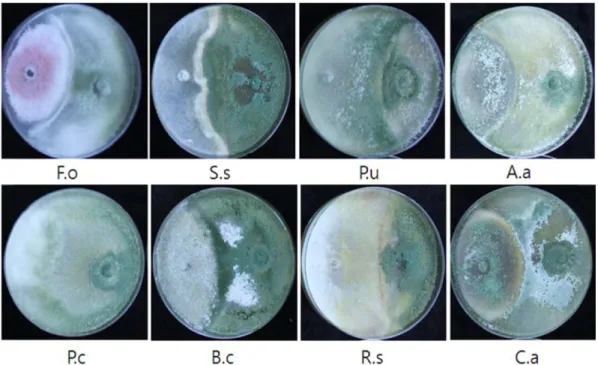
각각의 식물 병원균에 25%의 균주가 모든 공시 병원균의 균사생장을 저해 하였으며, 그 중 고추역병의 병원균인 Phytophthora capsici에서 50% 이상의 균주가 균사생장 저 해 활성을 보였다. 선발한 MPA167의 경우 F. oxysporum을 제외한 모든 병원균에서 균생 성장 저해 활성을 보였고, 2 주 후에는 포자가 병원균을 전체적으로 덮으며 자라는 것을 확인할 수 있었다(Fig. 1, Table 1).
고추 역병에 대한 온실효과 검정
T. harzianum 은 곰팡이균으로 대부분 식물병원균의 생물 학적 방제용으로 빈번히 이용되는 균이다(Rey 등, 2001).
본 실험에서는 근권에서 선발한 Trichoderma harzianum MPA167 균주를 이용하여 고추의 생육촉진과 Phytophthora capsici에 의해 발생하는 고추역병 저항성 효과를 확인하고 자 하였다. 이 전 Screening 과정에서 가장 많은 효과를 보 였던 고추역병의 병원균인 P. capsici에 대한 온실에서의 고 추역병 방제효과 검정을 통해 최종 균주 선발을 하고자 하 였다. 분리한 183개 균주에 대한 고추역병 발생 억제효과를 조사한 결과, 30% 이상의 균주에서 고추역병에 억제효과를 보였다. 반복실험 결과 그 중에서도 고추역병에 방제효과가
뛰어난 5균주를 일부 선발하였고, 최종적으로 MPA167 균 주를 선발하였다.
선발균주의 동정
Internal transcribed spacer (ITS) 영역은 변이가 심하고 쉽게 증폭할 수 있기 때문에 곰팡이의 유연관계를 파악하는 데 가장 유용하며, ITS1과 ITS2의 염기서열 분석은 여러 다 른 곰팡이 중에서 Hypocrea / Trichoderma 의 1500개 이상 의 종을 확인하기 위해 10년 이상 광범위하게 사용되었다 (Druzhinina 등, 2005). 역병에 대해서 높은 발병억제 효과 를 보여 선발한 MPA167 균주는 ITS1과 ITS2의 염기서열 분석을 통해 Trichoderma hazianum으로 동정되었으며, 계 통분석을 실시한 결과 Trichoderma hazianum TH6과 strain 2와 98%의 유사성을 보였다(Fig. 2).
고추 생육촉진효과 검정
50공 폿트에 파종 후 MPA167 균주를 주당 포자현탁액 1 × 10
7spores/ml 의 농도로 50 ml씩 2번 관주 처리한 고추 유묘를 한달 후 실험포장에 정식하였으며, 10개의 고추를 무작위로 선정하여 수확량을 비교한 결과 무처리구에서 수 Fig. 1. Hyperparasitical activity of Trichoderma MPA167 against phytopathogen by dual culture method. (F. o; F. oxysporum, S. s; S.
sclerotiorum, P. u; P. ultimum, A. a; A. altanata, P. c; P. capsici, B. c; B. cinerea, R. s; R. solani, C. a; C. acutatum).
Table 1. Suppression of mycelial growth by a selected Trichoderma strain against eight major fungal pathogens
Stain Hyphal growth inhibition rate (%)
B. C R. S S. S C. a A. a F. O P. C P. U
MPA167 42.10 41.73 57.00 19.21 20.10 0.0 37.06 69.37
확한 고추의 무게는 1.10 kg에 비해, MPA167 균주를 처리 한 고추에서의 수확량은 3.45 kg으로 약 3.1 배 차이가 나는 것을 확인 할 수 있었다. 또한 과실의 길이, 두께, 무게를 비 교해본 결과 무처리구는 길이, 두께, 무게 순으로 고추 한 개당 평균 15.51 g, 12.81 cm, 14.97 mm을 나타내었고, 처 리구는 평균 20.73 g, 13.52 cm, 18.35 mm로 측정 되었다.
길이에서는 큰 차이를 보이진 않았지만 두께와 무게에서 모 두 생육촉진 효과를 나타내는 것을 확인하였다. 이를 통해 MPA167 균주가 과실의 비대에도 영향을 주었을 것으로 판 단된다(Fig. 3).
휘발성물질에 의한 생육촉진효과 검정
두 개로 분리된 I plate (90 × 15 mm)를 이용하여 휘발성 물질에 의한 생육촉진효과 기내실험을 통해 확인한 결과 담 배와 애기장대 모두에서 생육촉진 효과를 보였다. 담배의 경우 무처리구의 생중량은 담배 유묘 한 주당 평균 22.84 mg 인데 반해, 처리구에서는 203.44 mg으로 8.9배 이상의 생육촉진 효과를 보였고, 건조중량의 경우에도 무처리구 1.14 mg, 처리구 8.34 mg으로 7.3배 이상의 효과를 나타내 는 것을 확인하였다. 애기장대의 경우에도 무처리구의 생중 량과 건조중량은 유묘 한 주당 평균 15.08 mg, 0.74 mg이고, 처리구는 86.44 mg과 6.62 mg으로 각각 5.7배, 8.9배 이상 의 효과를 나타내는 것을 확인 할 수 있다(Fig. 4, 5). 이 실 험을 통해 MPA167균주가 식물에 직접적으로 작용하지 않 더라도, MPA167균주가 내는 휘발성 물질이 식물의 생육에 관여 한다는 것을 알 수 있었다. 이렇게 균이 생산하는 휘발 성 물질이 식물의 생육에 관여한다는 연구는 2003년에 세균
Fig. 2. Phylogenetic tree of strain MPA167 from analysis of ITS sequences. The master alignment of ITS1 and 2 sequences from 27 type strains of Trichoderma harzianum and Trichoderma sp.
Fig. 3. Growth promotion of red-pepper in terms of fruit
weight, length, width by treatment with T. harzianum MPA167
under field conditions. The differences in letters on bars
indicate significant difference between treated and control by
LSD (P = 0.05).
이 내는 생육촉진 물질인 2,3-butanediol과 acetoin을 생산해 서 애기장대(Arabidopsis thaliana)의 생육을 촉진한다는 것 이 처음 연구되어진바(Ryu 등, 2003; Lee 등, 2013) 있으며, 곰팡이의 경우도 PGPF에서 생산된 VOC에 의해서도 생육 이 촉진된다는 연구가 Yamagiwa (2011)에 의해 처음 보고 되었다. Trichoderma harzianum이 생산하는 물질인 harzianic acid는 길항능과 식물생육 촉진효과 모두를 가지고 있다고 알려져 있다(Vinale 등, 2009). 이를 토대로 T. harzianum MPA167 이 내는 휘발성 물질은 무엇이며, 이것이 어떤 매커 니즘을 가지고 있는지를 좀 더 연구할 계획이다.
고추 역병 방제효과
고추 역병의 병원균인 P. capsici에 의해 무처리구는 잎이 시들고 말라가며 줄기가 갈변 현상을 일으켜 모두 병이 발 생한데 비해, MPA167균주을 처리한 고추의 경우는 거의
병을 억제하는 것을 볼 수 있다. 무처리구는 80% 이상의 병 이 발생하였고, MPA167균주을 처리한 고추의 경우에는 26% 정도의 발병률을 보여 확연한 고추 역병의 억제효과를 나타내었다(Fig. 6).
이 전 연구에서 Ahmed (2000)는 Trichoderma harzianum 균주가 고추가 생산하는 주된 phytoalexin의 하나인 capsidiol 의 농도를 높여주어 고추 역병에 저항성을 유도한다고 밝힌 바 있다. 이 밖에도 Trichoderma 종은 Rhizoctonia solani (Beagle-Ristaino & Papavizas, 1984)와 Pythium spp. (Hadar 등, 1984) 그리고 이외의 다른 병원균을 방제하는데도 유용 한 생물학적 방제제로서 널리 알려져 있다(Ahmed 등, 1999).
따라서 MPA167균주는 유묘처리를 통하여 식물에 정착시 킬 수 있으므로 다양한 농작물의 재배에 활용할 수 있으며 병저항성 유도와 식물생육촉진을 위한 친환경 농자재로 개 발 될 수 있을 것이다.
Fig. 4. Tobacco and Arabidopsis plant growth promotion by treatment of VOCs from a selected PGPF strain T. harzianum MPA167 in I-plate assay of A: Tabacco plant, B: Arabidopsis.
Fig. 5. In vitro plant growth promotion of tobacco (A) and Arabidopsis (B) seedlings by volatiles derived from T. harzianum MPA167 using I-plate assay. Distilled water was used as control. The fresh weight and dry weight were recorded three week after the treatment.
The differences in letters on bars indicate statistically significant between treated and control according to LSD (P = 0.05).
감사의 글
본 연구는 농촌진흥청 국립농업과학원의 기관고유사업 (PJ008652)의 지원에 의해 수행되었습니다.
Literature Cited