• 검색 결과가 없습니다.

Spatio-Temporal Distribution of Particulate Organic Carbon (POC) and Nitrogen (PON) in the Southwestern Area of East Sea

N/A
N/A
Protected

Academic year: 2021

Share "Spatio-Temporal Distribution of Particulate Organic Carbon (POC) and Nitrogen (PON) in the Southwestern Area of East Sea"

Copied!
7
0
0

로드 중.... (전체 텍스트 보기)

전체 글

(1)

144 Vol. 19, No. 2, 144-150, May 2016

Original Article

동해 남서해역에서 입자성 유기탄소와 질소의 시·공간적 분포 특성

오석진 · 정세미 · 김석윤

부경대학교 해양학과

Spatio-Temporal Distribution of Particulate Organic Carbon (POC) and Nitrogen (PON) in the Southwestern Area of East Sea

Seok Jin Oh, Semi Jeong, and Seok-Yun Kim

Department of Oceanography, Pukyong National University, Busan 48513, Korea

요 약

동해 남서해역에서 입자성 유기탄소와 질소의 시·공간적인 분포 특성을 파악하기 위해서 2011년 9월(하계), 2012년 1 월(동계) 그리고 5월(춘계)에 조사하였다. 9월 표층수는 용승 현상에 따른 냉수괴가 관찰되지 않았지만, 높은 chlorophyll a(Chl-a) 농도, 낮은 비광합성 유기입자물질 비율(27%) 그리고 낮은 POC/PON 비(6.2)로 활발한 아미노산 및 단백질 합성을 의미하는 높은 기초생산을 보였다. 하지만, 2012년 5월에는 높은 비광합성 유기입자물질(66%)과 높은 POC/

PON 비(8.1)에 근거할 때, 9월과 비교하여 상대적으로 낮은 생산성을 보였다. 이와 같이 식물플랑크톤의 대량 발생이 주로 춘계에 발생한다는 기존의 결과와 상반되며, 이는 춘계 대발생 후기의 동물플랑크톤에 의한 페오피그먼트(phaeo- pigment) 의 증가 때문으로 해석된다. 따라서 입자성 유기물질의 조성은 같은 계절이라도 해양환경의 변화에 따라 달라 질 것으로 보인다.

Abstract − In southwestern East Sea, we investigated the spatio-temporal distribution characteristics of particulate organic carbon (POC) and nitrogen (PON) in September 2011 (summer), January (winter) and May 2012 (spring).

Although cold waters known as the origin upwelling in the surface layer of September were not observed, this peri- ods showed high primary productivity because of high concentrations of chlorophyll, low percentage of non-auto- trophic particulate fraction among POC calculated by POC/Chl- a ratio (27%) and low POC/PON ratio (6.2), which means active amino acid and protein synthesis, However, May, 2012 showed low primary productivity because of high percentage of non-autotrophic particulate fractions among POC (66%) and high POC/PON ratio (8.1), Although spring bloom and high primary productivity has been reported in the East Sea, high percentage of non-autotrophic particulate fractions in POC, observed in the East sea during the post 2012 spring, is suggested to be due to the increase of phaeo-pigment during post spring bloom. Thus, composition of particulate organic matter may have sensitively changed by marine environmental factors in spite of same season.

Keywords: Particulate organic carbon (입자성 유기탄소), particulate organic nitrogen (입자성 유기질소), POC/

Chl-a ratio (POC/Chl-a 비), POC/PON ratio (POC/PON 비), detritus (유기쇄설물)

1. 서

해양의 입자성 유기물질(Particulate Organic Matte; POM) 중 유 기탄소의 심층수 침강은 “생물학적 펌프”라고 불리며, 대기 중의 이산화탄소를 생물학적으로 해양에 축적하는 중요한 과정이다(Hara and Koike[2000]). 또한 침강하는 동안 유기입자의 집적을 보이며, 수

중과 저서생태계에 잠재적인 먹이 공급원으로 작용하는 등 생태계 내에 에너지를 전달하는 중요한 역할도 수행한다(Deuser and Ross[1980]). 연안역에서도 POM의 무기화로 방출된 탄소 및 질소는 연안생태계의 잠재적 영양염원으로 중요하다(Opsahl and Benner [1997]). 더욱이 POM 중 미립자(0.35~1 µm)의 경우 해수 중에 장 시간 체류하여 각종 화학물질의 농도분포 및 순환과정에 큰 영향을 미친다(Wells[2002]). POM의 구성원소인 입자성 유기탄소(Particulate Organic Carbon; POC) 와 입자성 유기질소(Particulate Organic Nitrogen;

Corresponding author: [email protected]

(2)

안 인위적인 기원의 질소(anthropogenic N emission)유입으로 기 초생산력 변화를 보고하고 있으나(Mukai et al.[ 1990]; Kim et al.[2011]), 실제 동해 표층의 경우 강한 용존태 무기질소 제한해역 으로 기초생산이 증가할수록 제한 정도도 높아진다(Lee et al.[2009]; Kim and Kim[2013]; Kwon et al.[2014]). 더욱이 남조류가 속해 있는 초미소플랑크톤이 전선역에서 우점하며, 춘계 대발생 시에는 규조 류가 우점하는 등(Kim et al.[2010]), 질소제한 환경임에도 불구하 고, 일부해역의 기초생산은 동중국해와 서태평양보다 높게 평가되고 있다(Kwak et al.[2013a,b]). 또한 동해는 중층수/저층수(mesopelagic/

bathypelagic boundary) 로 격리되는 탄소양이 타 해역에 비하여 높게 나타난다(Hong et al.[1997]; Honjo et al.[2008]). 본 연구는 동해 에서도 생산력이 높은 남서해역에서 입자성 유기물질의 계절변화와 입자성 유기물질의 주요 구성을 밝혀, 해역의 생산성을 토의하는데 그 목적이 있다.

2. 재료 및 방법

본 연구는 2011년 9월(하계), 2012년 1월(동계)과 5월(춘계)에 부경대학교 탐사선인 탐양호(R/V Tamyang)를 이용하여, 동해 남 서해역 표층 A line(3개 정점), B line(3개 정점), C line(7개 정점) 및 D line(8개 정점)에 대하여 관측을 수행하였다(Fig. 1). 수온과 염분은 CTD(SBE 911, Seabird Co., Washington, USA)를 이용하여 측정하였으며, POC와 PON는 미리 450

o

C 에서 48시간 회화시킨 GF/F 여과지(Ø 25 mm, pore size 0.7 μm, Whatman)에 해수 2 L를 여과한 후, 페트리접시(petri dish)에 넣어 분석 전까지 냉동(-20

o

C) 보관하였다. 분석은 여과지를 염산증기로 훈증(fuming)하여 무기 탄소를 제거하고 원소자동분석기 CHN-S(Flash 2000, Thermo Fisher Scientific Inc., MA, USA) 로 측정하였다. Chl- a 자료는 현장에서 CTD 에 장착된 fluorometer로 측정하였지만, 동일한 10개 정점(C와 D line 일부)에서 채수한 해수시료에 대해 아세톤 추출법(SCOR- Unesco[1966]) 으로 측정한 후 보정하여 사용하였다.

3. 결과 및 고찰

2011 년 9월의 관측해역에서 수온의 분포는 대체적으로 남에서

북으로 갈수록 낮아지며, C와 D-line의 경우 연안보다는 외양이 높 은 수온분포를 보였다. 또한 염분은 연안이 외양보다 낮아, 전형적 인 연안역의 염분 농도 분포였다(Fig. 2). 2012년 1월의 수온은 기 온강하에 따라 난류수역이 약화로 낮았지만, 9월과 유사하게 북쪽 으로 갈수록 수온이 낮아지고 연안보다 외양역에서 높았다. 염분은 전체적으로 큰 변화가 없었으며, 균일한 농도분포였다(Fig. 2). 동 년 5월은 1월과 9월보다 비교적인 복잡한 수온의 변화로 다른 시 기보다 더 뚜렷하게 연안보다 외양의 수온이 높았으며, 특히 북쪽 에서 연안으로 16

o

C 이하의 해수가 관입하는 형태가 보였다. 염분도 다른 시기보다 복잡한 염분변화를 보였으나, 대체적으로 9월과 같 이 연안보다 외양역에서 높았다(Fig. 2). Chl-a의 분포는 9월에 다 른 시기보다 높은 농도를 보였으며(B1정점에서 3.46 μg/L), 연안 에서 외양으로 갈수록 낮아지는 경향이었다. 하지만, 1월은 공간적 으로 농도 차이가 크지 않았으며, 경향은 9월과 유사하였다. 5월도 9 월과 같은 농도분포를 보였으며, 최대농도를 보인 정점도 B1이었 다(1.73 μg/L; Fig. 2).

대마난류수(Tsushima Warm Current; TWC) 표층의 경우 수온과 염

분의 범위가 20

o

C 이상과 33.80 psu이하(Park[1978]; Yang et al.[1991],

Kwon et al.[2014])의 특성을 가지고 있어, 9월의 경우 TWC 표층

수 영향이 가장 강하게 영향을 미친 것으로 파악된다. 하지만 본 해

역의 경우 하계 표층에 연안을 따라 북한한류(North Korea Cold

Current; NKCC) 의 기원으로 추정되는 냉수괴가 발달하며, 수괴의

특징은 수온과 염분은 낮고(15

o

C 내외), 용존산소는 높은 것으로

알려져 있다(Lee and Kim[2003]; Suh and Hwang[2005]; Lee

Fig. 1. Map of the southwestern East Sea with black dots showing mon-

itoring stations.

(3)

and Jang[2014]). 냉수괴가 발달하는 요인으로 동해남부해역에서 TWC 의 저기압성 순환, 울기-감포 해역에서 발달한 동한난류로 인 한 등온선 경압사면, 한국 동해남부 연안 주변 해역의 지형적 특징 그리고 남서풍의 지속 등으로 알려져 있으며, 출현 시기도 대부분 이 6~8월에 집중되어 있다. 2012년의 경우 9월 초까지 냉수괴가 발달되어 연도별로 북한한류수의 변화에 따라 출현양상이 변화하 였다(Suh and Hwang[2005]). 본 연구의 9월 조사시기(2011년 9월 26 일부터 28일)에는 냉수괴로 보이는 수괴가 출현하지 않았다. 이 는 국립수산과학원에서 발행되는 동해주간해황정보와 같이 8월말 까지 동해 남부역에서 냉수괴가 관찰되었으나, 9월부터 냉수괴가 소멸되었다는 정보와 일치하였다(http://www.nifs.go.kr/sois/index.jsp).

최근 동한난류(East Sea Warm Current: ESWC)의 본류인 TWC는

쿠로시오 난류(Kuroshio Warm Current; KWC)와 타이완 난류 (Taiwan Current; TC) 의 영향을 받는 것으로 알려져 있고, 동계와 춘계는 KWC가, 추계와 하계는 TC에 따른 영향이 크다(Guo et al.[2006]; Jang et al.[2013]; Isobe[2008]). 여러 가지 의견이 있지 만, 대한해협을 통하여 동해로 수송되는 해수 중 TWC의 영향이 연간 50%이상을 차지하며(Cho et al.[ 2009]; Park et al.[2013]), 두 해 류의 우세에 따라 본 해역의 해양환경의 변화될 것으로 생각된다.

본 연구해역의 수온과 염분의 수평분포를 바탕으로 TC 및 KWC의 영향을 파악하기는 어렵다. 하지만 9월에 Chl-a의 경우 감포 인근 해역에서 3 μM이상의 높은 농도를 보였고, 동계로 갈수록 낮아져, 이를 바탕으로 TC의 영향을 가늠할 수 있을 것으로 생각된다(Fig.

2). Shaw[1992] 와 Gong et al.[1996]은 TC가 동중국해의 대륙사면

Fig. 2. Horizontal variations in temperature, salinity and chlorophyll a at surface layer of southwestern East Sea in September 2011 (sum-

mer), January 2012 (winter) and May 2012 (spring). Small dots indicate the locations of CTD casts.

(4)

비(DIN/DIP ratio)가 10 이하로 질소제한을 보고하였다(Kim et al.[2010]; Kim and Kim[2013]). 따라서 9월의 높은 Chl-a는 6월

~8 월에 발생한 냉수괴와 TC를 통한 질소 공급의 영향으로 생각된다.

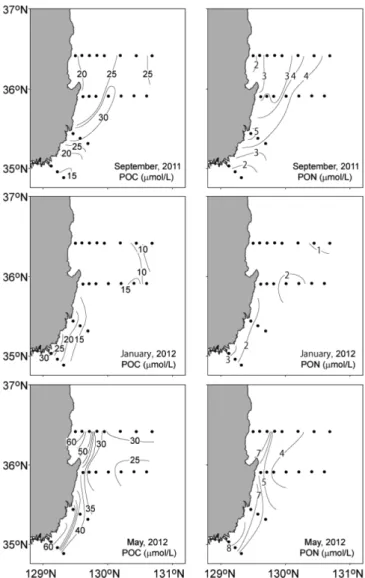
한편, 본 연구해역 POC 농도는 2011년 9월에 정점 C4에서 35.5 μmol/L 로 가장 높았으며, 정점 A3에서 12.9 μmol/L로 가장 낮게 나타나, 전반적으로 Chl-a농도가 높았던 해역에서 POC 농도가 높 았다(Fig. 3). 2012년 1월에는 정점 A1에서 29.61 μmol/L로 가장 높았으며, 정점 D7에서 9.32 μmol/L로 가장 낮아, 9월과 반대의 경 향을 보였다. 2012년 5월은 관측기간 중 가장 높은 농도였으며, 이 중 정점 D2에서 63.7 μmol/L로 가장 높은 농도를 보였으며, 정점 C5 에서 20.5 μmol/L으로 가장 낮은 농도였다. 그리고 외양역보다 연안역에서 2배 이상 높은 농도를 나타내었다. PON은 2011년 9월에 정점 B1에서 5.04 μmol/L로 가장 높은 농도였으며, 정점 D1에서 1.64 μmol/L 으로 가장 낮은 농도를 나타내었다. 2012년 1월에는 정점 B1에서 2.59 μmol/L로 가장 높은 농도였으며, 정점 D8에서 0.86 μmol/L 로 가장 낮아 다른 계절보다 공간적으로 큰 농도 변화는 없었다(Fig. 3). 2012년 5월에는 정점 A1에서 8.80 μmol/L로 3계절 중 가장 높은 농도를 보였고, 외양으로 갈수록 낮아지는 경향이었다.

1 월의 낮은 POC와 PON 농도는 저 수온으로 인하여 식물플랑크 톤의 생물생산이 활발하지 않기 때문으로 고려되지만, 5월은 다른 시기와 비교하여 상대적으로 높게 나타났으나, Chl-a 농도는 9월 보다 낮았다(Fig. 2). 동해에서 조류대량발생(algae bloom)은 춘계 와 추계 두 번의 대발생을 보이며, 추계보다 춘계에 강하게 나타난 다(Kim et al.[2000]; Lee et al.[2009]). 또한 Kim et al.[2000]는 춘계 대발생이 북서해역에서 시작하여 남서해역으로 진행되고, 그 뒤에 북부 해역에서 발생한다고 하였다. 본 해역의 경우 춘계 대발 생이 4월에 가장 높게 나타나며, 5월에 점차 사라지는 양상을 보인다 (Lee et al.[2009]). 이번 5월 조사 시기가 하순(5월 29일부터 6월 1 일)에 진행되어, 춘계 대발생 후기 관측의 결과로 생각된다.

Chl- a는 강한 조도에 따른 광저해(4 E/m

2

/h 이상의 조도), 해수 중 미량금속, 질소 및 인의 제한에 따라 phaeo-pigment로 전환되기 때 문에, POC/Chl-a 비율의 증감은 해역의 영양상태를 간접적으로 지 시한다(Falkowski[1980]; Rueler[1987]; Videau[1987]). 본 연구해 역의 POC/Chl-a 비의 범위는 87.6~202로, 5월에 가장 높았으며, 9 월과 1월은 유사하였다(Fig. 4). Fig. 4에서 보여주는 관계식의 y절

편은 유기쇄설물 및 비광합성 생물의 탄소의 평균농도를 지시하는 것으로 5월(363 μg/L)이 1월과 9월보다 2~3.5배 높았으며, 5월 평 균 POC 중 유기쇄설물 및 비광합성 생물의 탄소 비율이 약 66%로 나타났다(하계는 약 27%, 동계는 약 42%). Hong et al.[2011]은 본 해역과 유사한 해역에서 POC/Chl-a 비율이 30~759로 조사지점에 따라 차이가 있지만, 하계에 가장 높았고, 춘계에 가장 낮았다고 보 고하였다. 또한 동중국해에서도 하계가 높은 비율을 나타났으며, 그 이유를 영양염 제한으로 설명하였다(Kim et al.[2006]). 하지만 본 연구의 결과는 춘계에 가장 높은 비광합성 물질(non-autotrophic fractions) 탄소를 보였다. 이는 춘계 관측시기가 춘계 대발생 후기에 수행되었기 때문으로 생각된다. 춘계 대발생 후기에는 동물플랑크 톤에 의해 포식되는 식물플랑크톤의 양과 심층부로의 침강량이 유 사하며, 춘계 대발생 이후에 동물플랑크톤의 포식은 유광층에서 식 물플랑크톤의 제거에 중요한 역할을 기여한다(Juul-Pedersen et al.[2006]). Chl-a의 분해 산물인 페오피그먼트(phaeo-pigment;

Fig. 3. Horizontal variations in particulate organic carbon (POC) and

nitrogen (PON) at surface layer of southwestern East Sea in September

2011 (summer), January 2012 (winter) and May 2012 (spring). Small

dots indicate the locations of water sampling.

(5)

phaeophorbide a와 phaeophytin a)는 요각류, 난바다 곤쟁이류 (euphausiid), 살파류 그리고 파고트로픽 편모조류(phagotrophic flagellates) 와 같은 동물플랑크톤의 포식활동에 따라 주로 생성되는 것 으로 알려져 있다(Jeffrey[1980]). 따라서 춘계 비광합성 탄소가 높게 나타나는 까닭은 조사 시기 동안 동물플랑크톤이 성장하였고, 이에 따라 페오피그먼트 함량도 증가하였기 때문으로 추정된다.

일반적으로 광합성 조류는 적색광에서 탄수화물을, 청색광에서 아마노산이 합성되기 때문에 파장에 따라 유기물의 조성이 변화되 며, 청색광에 따른 아미노산 합성이 증가는 POC/PON을 감소시키는 결과를 가져온다(Handa[1991]). 또한 POC/PON는 수심에 따라 현 저한 차이를 나타내며, 질소계열인 아미노산, 단백질의 변화에 따라 유광층에서 7~8, 심층에서 >10으로 증가한다(Handa and Tanoue [1979]). 최근 POC/PON는 C-rich를 고려하여 166/20으로 제시하 기도 하지만(Sterner et al.[2008]), 전통적으로 POC/PON의 화학양 론(stoichiometry)은 106/16(=6.63)으로 알려져 있다(Redfield[1958]).

연구 해역의 POC/PON 비를 살펴본 결과, 조사 기간 동안 6.25~7.54의 범위로 나타났으며, 2012년 5월에 가장 높았으며, 9월은 Redfield 비와 유사하였다(Fig. 5). Körtzinger et al.[2001]는 북동대서양에서 POC/PON 비가 춘계 대발생 초기에 5-6이며, 후기는 10-16으로 증 가한다고 보고하였다. 또한 북동대서양의 덴마크 연안에서 낮은 POC/PON 비는 자가영양생물이 높은 비율일 때 나타났지만(45%

이상), 하계와 같이 타가영양생물과 유기쇄설물의 증가하는 계절은 POC/PON 비를 증가시켰다(Frigstad et al.[2011]). 하지만 본 연구 에서 5월은 춘계 식물플랑크톤 대발생 이후에 발생된 비광합성 유 기입자물질(non-autotrophic particulate fractions)의 우점을 알 수 있으며, 하계는 다른 연구해역의 보고와 달리 광합성 유기입자물질 (autotrophic particulate fractions) 이 우점하는 생산력이 높은 시기 임을 알 수 있었다.

Redfield 비는 식물플랑크톤 생장을 위한 최적의 생화학조성으로 알려져 있으나(Lenton and Watson[2000]), 생리·생화학적 기반에

따른 흡수 및 고정시키는 원소의 비율이 다르기 때문에 실내실험의 경우 식물플랑크톤의 원소비가 2-10배로 변화된다(Geider and La Roche[2002]). 또한 일반적인 해역의 화학양론적 반응에서도 자가 영양과 타가영양생물의 다양한 생활단계 및 유기쇄설물이 혼재되어 있기 때문에 시·공간적으로 크게 변화한다(Li et al.[2000]; Schneider et al.[2003]; Sterner et al.[2008]; Frigstad et al.[2011]). 앞으로 동해에서 입자성 유기물의 화학양론에 대한 근본적인 이해를 위해 서는 환경변화에 따른 C:N:P의 누적자료가 필요하며, 특히 동해와 같이 복잡한 해양환경을 가진 해역의 경우 포식과 피식관계과 같은 생물학적인 요인의 이해도 반드시 필요할 것으로 보인다.

4. 결

해양에서 입자성 유기물질은 생태계에 에너지를 축적하고, 대기 중의 이산화탄소를 심층으로 격리시키는 등 해양의 물질순환에 영 향을 줄 수 있는 중요한 pool이다. 본 연구는 동해에서도 생산력이 높은 남서해역에서 입자성 유기물질의 계절변화 및 구성을 밝혀 해 역의 생산성을 토의하였다. 하계는 연안에 북한한류수 기원의 냉수 괴가 보이지 않았으나, 다른 계절보다 높은 Chl-a를 보였으며, POC 중 27%가 유기쇄설물 및 종속영양생물인 비광합성 유기입자였고, POC/PON 비도 Redfield 비보다 낮은 6.2로, 아미노산 및 단백질의 합 성이 활발하다는 것을 알 수 있어 높은 기초생산을 지시하였다. 하 지만, 춘계의 경우, 식물플랑크톤 대발생에 따른 높은 생산력을 보 고한 기존문헌과 달리, POC 중 66%가 비광합성 유기입자이고, POC/PON 비도 8.1로 높아, 타가영양생물과 유기쇄설물의 증가를 나타내었다, 이는 동물플랑크톤 섭식활동에 따른 페오피그먼트 증 가를 설명하는 결과로, 춘계 관측시기가 식물플랑크톤 대발생 후기 (post spring bloom) 임을 알 수 있었다. 따라서 같은 계절이라도 해 양환경변화에 따라 입자성 유기물의 조성이 크게 달라질 수 있어, Fig. 4. Particulate organic carbon (POC) vs Chlorophyll a at surface

layer of southwestern East Sea in September 2011 (summer), Jan- uary 2012 (winter) and May 2012 (spring). POC/Chlorophyll a is calculated from the slop of the best regression line.

Fig. 5. Particulate organic carbon (POC) vs nitrogen (PON) at sur-

face layer of southwestern East Sea in September 2011 (summer),

January 2012 (winter) and May 2012 (spring). POC/PON is calcu-

lated from the slop of the best regression line.

(6)

[1] Byun, S.K., 1989, “Sea surface cold water near the southeastern coast of Korea: Wind effect”, J. Oceanol. Soc. Korea, Vol. 24, 121-131.

[2] Chang, K.I., Teague, W.J., Lyu, S.J., Perkins, H.T., Lee, D.K., Watts, D.R., Kim, Y.B., Mitchell, D.A., Lee, C.M. and Kim, K., 2004, “Circulation and currents in the southwestern East/Japan Sea: Overview and review”, Prog. Oceanogr., Vol. 61, 105-156.

[3] Cho, Y.K., Seo, G.H., Choi, B.J., Choi, B.J., Kim, S., Kim, Y.G., Youn, Y.H. and Dever, E.P., 2009, “Connectivity among straits of the northwest Pacific marginal seas”, J. Geophys. Res: Oceans., Vol. 114, C6.

[4] Deuser, W.G. and Ross, E.H., 1980, “Seasonal change in the flux of organic carbon to the deep Sargasso Sea”, Nature, Vol.

283, 364-365.

[5] Falkowski, P.G., 1980, “Light-shade adaptation in marine phy- toplankton”, Springer US, Vol. 19, 99-119.

[6] Frigstad, H., Andersen, T., Hessen, D.O., Naustvoll, L.J., Johnen, T.M. and Bellerby, R.G.J., 2011, “Seasonal variation in marine C:N:P stoichiometry: can the composition of seston explain stable Redfiled rations?”, Biogeosciences, Vol. 8, 2917-2933.

[7] Geider, R.J. and La Roche, J., 2002, “Redfield revisited: variability of C:N:P in marine microalgae and its biochemical basis”, Eur.

J. Phycol., Vol. 37, 1-17.

[8] Gong, G.C., Chen, Y.L.L. and Liu, K.K., 1996, “Chemical hydrography and chlorophyll-a distribution in the East China Sea in summer: implications in nutrient dynamics”, Cont. Shelf Res., Vol. 16, 1561-1590.

[9] Grossart, H.P., Brinkhoff, T., Martens, T. and Duerselen, C., 2004,

“Tidal dynamics of dissolved and particulate matter and bacteria in a tidal flat ecosystem in spring and fall”, Limnol. Oceanogr., Vol. 49, 2212-2222.

[10] Guo, X., Miyazawa, Y. and Yamagata, T., 2006, “The Kuroshio onshore intrusion along the shelf break of the East China Sea:

The origin of the Tsushima Warm Current”, J. Phys. Oceanogr., Vol. 36, 2205-2231.

[11] Handa, N., 1991, “Chemical studies on organic matter and carbon cycle in the ocean”, J. Oceanogr. Soc. Japan, Vol. 47, No. 2, 49-61.

[12] Handa, N. and Tanoue, E., 1979, “Organic matter in the Bering Sea and adjacent areas”, The Eastern Bering sea shelf: Ocean-

interior of the East/Japan Sea, a large marginal sea of the Northwest Pacific”, Biogeochemical Processes in the North Pacific, 300-321.

[16] Honjo, S., Manganini, S.J., Krishfield, R.A. and Francois, R., 2008, “Particulate organic carbon fluxes to the ocean interior and factors controlling the biological pump: A synthesis of global sediment trap programs since 1983”, Prog. Oceanogr., Vol. 76, No. 3, 217-285.

[17] Iseki, K., Macdonald, R.W. and Wong, C.S., 1984, “Effect of wood waste dumping on organic matter in seawater and surficial sediments of Alberni Inlet, British Columbia”, J. Oceanogr. Soc.

Japan, Vol. 40, 213-220.

[18] Isobe, A., 2008, “Recent advances in ocean-circulation research on the Yellow Sea and East China Sea shelves”, J. Oceanogr., Vol.

64, No. 4, 569-584.

[19] Jang, P.G., Hyun, B.G., Cha, H.G., Chung, H.S. and Jang, M.C., 2013, “Seasonal Variation of Phytoplankton Assemblage Related to Surface Water Mass in the Eastern Part of the South Sea in Korea”, Ocean and Polar Res., Vol. 35, No. 2, 157-170.

[20] Jeffrey, S.W., 1980, “Algal pigment systems, In Primary pro- ductivity in the sea”, Springer, US, 33-58.

[21] Juul-Pedersen, T., Nielsen, T.G., Michel, C., Møller, E.F., Tiselius, P., Thor, P. and Gooding, S., 2006, “Sedimentation following the spring bloom in Disko Bay, West Greenland, with special empha- sis on the role of copepods”, Mar. Ecol. Prog. Ser., Vol. 314, 239-255.

[22] Kim, D.S., Shim, J.H. and Yoo, S.J., 2006, “Seasonal variations in nutrients and chlorophyll a concentration in the northern East China Sea”, Ocean Sci. J., Vol. 41, No. 3, 125-137.

[23] Kim, S.K., Chang, K.I., Kim, B. and Cho, Y.K., 2013, “Con- tribution of ocean current to the increase in N abundance in the northwestern Pacific marginal seas”, Geophys. Res. Lett., Vol.

40, 143-148.

[24] Kim, S.J., Woo, S.H., Kim, B.M. and Hur, S.D., 2011, “Trends in Sea Surface Temperature (SST) Chang Near the Korean Pen- insula for the Past 130 Years”, Ocean and Polar Res., Vol. 33, No. 3, 281-290.

[25] Kim, S.W., Saitoh, S.I., Ishizaka, J., Isoda, Y. and Kishino, M.,

2000, “Temporal and spatial variability of phytoplankton pigment

concentrations in the Japan Sea derived from CZCS images”, J.

(7)

Oceanogr., Vol. 56, No. 5, 527-538.

[26] Kim, T.H. and Kim, G.B., 2013, “Factors controlling the C:N:P stoichiometry of dissolved organic matter in the N-limited, cya- nobacteria-dominated East/Japan Sea”, J. Mar. Syst., Vol. 115, No. 16, 1-9.

[27] Kim, Y.S., Park, K.W., Park, J.W., Jeune, K.H. and Kim, M.K., 2010, “Vertical variations of water environments and phytoplank- ton community during the 2009 autumn in the coast of Dokdo, Korea”, Korean J. Environ. Biol., Vol. 28, No. 4, 202-211.

[28] Kim, K.R. and Kim, K., 1996, “What is happening in the East Sea (Japan Sea)?: Recent chemical observations during CREAMS 93-96”, J. Kor. Soc. Oceanogr., Vol. 31, 15-22.

[29] Körtzinger, A., Koeve, W., Kähler, P. and Mintrop, L., 2001, “C:

N ratios in the mixed layer during the productive season in the northeast Atlantic Ocean”, Deep Sea Res., Part I: Oceano- graphic Research Papers, Vol. 48, No. 3, 661-688.

[30] Kwak, J.H., Lee, S.H., Park, H.J., Choy, E.J., Jeong, H.D., Kim, K.R. and Kang, C.K., 2013a, “Monthly measured primary and new productivities in the Ulleung Basin as a biological “hot spot” in the East/Japan Sea”, Biogeosciences, Vol. 10, No. 7, 4405-4417.

[31] Kwak, J.H., Hwang, J., Choy, E.J., Park, H.J., Kang, D.J., Lee, T. and Kang, C.K., 2013b, “High primary productivity and f-ratio in summer in the Ulleung basin of the East/Japan Sea”, Deep Sea Res., Part I: Oceanographic Research Papers, Vol. 79, 74-85.

[32] Kwon, H.K., Oh, S.J., Park, M.O. and Yang, H.S., 2014, “Dis- tribution of water masses and distribution characteristics of dis- solved inorganic and organic nutrients in the southern part of the East Sea of Korea: Focus on the observed data in September, 2011”, J. Korean Soc. Mar. Environ. Energy, Vol. 17, 90-103.

[33] Lee, J.C. and Kim, I.N., 2003, “Chemical imprints of the upwelled waters off the coast of the southern East Sea of Korea”, J. Kor.

Soc. Oceanogr., Vol. 38, 101-110.

[34] Lee, J.C. and Jang, K.I., 2014, “Variability of the coastal current off Uljin in summer 2006”, Ocean and Polar Res., Vol. 36, 165-177.

[35] Lee, J.Y., Kang, D.J., Kim, I.N., Rho, T., Lee, T., Kang, C.K.

and Kim, K.R., 2009, “Spatial and temporal variability in the pelagic ecosystem of the East Sea (Sea of Japan): a review”, J. Mar.

Syst., Vol. 78, 288-300.

[36] Lenton, T.M. and Watson, A.J., 2000, “Redfield revisited: 1.

Regulation of nitrate, phosphate, and oxygen in the ocean”, Global Biogeochem. Cycles, Vol. 14, No. 1, 225-248.

[37] Li, Y.H., Karl, D.M., Winn, C.D., Mackenzie, F.T. and Gans, K., 2000, “Remineralization ratios in the subtropical North Pacific gyre”, Aquat. Geochem., Vol. 6, No. 1, 65-85.

[38] Mukai H., Ambe Y. and Shibata, K., 1990, “Long-term variation of chemical composition of atmospheric aerosol on the Oki Islands in the sea of Japan”, Atmos. Environ., Vol. 24A, 1379 -1390.

[39] Onitsuka, G., Yanagi, T. and Yoon, J.H., 2007, “A numerical study

on nutrient sources in the surface layer of the Japan Sea using a coupled physical ecosystem model”, J. Geophys. Res: Oceans, Vol. 112, C5.

[40] Opsahl, S., and Benner, R., 1997, “Distribution and cycling of terrigenous dissolved organic matter in the ocean”, Nature, Vol.

386, 480-482.

[41] Park, C.K., 1978, “Chemical oceanographic aspect of the cold water mass in offshore of the east coast of Korea”, Bull. Kor.

Fish. Soc., Vol. 11, 49-54.

[42] Park, Y.G., Yeh, S.W., Hwan, J.H. and Kim, T., 2013, “Origin of the Tsushima Warm Current in a high resolution ocean circu- lation model”, J. Coastal Res., Vol. 65, 2041-2046.

[43] Redfield, A.C., 1958, “The biological control of chemical fac- tors in the environment”, Am. Sci., Vol. 46, 205-221.

[44] Rueler, J.G., 1987, “The role of iron nutrition in photosynthesis and nitrogen assimilation in SCENEDESMUS QUADRICAUDA (Chlorophyceae) 1”, J. Phycol., Vol. 23, No. 3, 452-457.

[45] Schneider, B., Schlitzer, R., Fischer, G. and Nöthig, E.M., 2003,

“Depth dependent elemental compositions of particulate organic matter (POM) in the ocean”, Global Biogeochem. Cycles, Vol.

17, No. 2.

[46] Shaw, P.T., 1992, “Shelf circulation off the southeast coast of China”, Rev. Aquat. Sci., Vol. 6, No. 1, 1-28.

[47] Sterner, R.W., Andersen, T., Elser, J.J., Hessen, D.O., Hood, J.M., McCauley, E. and Urabe, J., 2008, “Scale-dependent carbon: nitro- gen: phosphorus seston stoichiometry in marine and freshwa- ters”, Limnol. Oceanogr., Vol. 53, No. 3, 1169.

[48] Suh, Y.S. and Hwang J.D., 2005, “Study on the Cold Mass Occur- rence in the Eastern Coast of the Korean Peninsula in Summer”, J. Envir. Sci., Vol. 14, No. 10, 945-953.

[49] SCOR-Unesco, 1966, “Determination of photosynthetic pigments, In Determination of photosynthetic pigments in water”, Unesco, Paris, 10-18.

[50] Videau, C., 1987, “Primary production and physiological state of phytoplankton at the Ushant tidal front (west coast of Brittany, France)”, Mar. Ecol. Prog. Ser., Vol. 35, 141-151.

[51] Wells, M.L., 2002, “Marine colloids and trace metals. In: Dennis, A. H. and C. A. Carlson (Eds.), Biogeochemistry of marine dis- solved organic matter”, Elsevier Science, New York, 367-404 [52] Yang, H.S., Kim, S.S., Kang, C.G. and Cho, K.D., 1991, “A study on sea water and ocean current in the sea adjacent to Korea Pen- insula- III. Chemical characteristics of water masses in the polar front area of the central Korean East Sea”, Kor. Fish. Soc., Vol.

24, 185-191.

Received 15 February 2016

Revised 4 April 2016

Accepted 8 April 2016

수치

Fig. 3. Horizontal variations in particulate organic carbon (POC) and nitrogen (PON) at surface layer of southwestern East Sea in September 2011 (summer), January 2012 (winter) and May 2012 (spring)
Fig. 5. Particulate organic carbon (POC) vs nitrogen (PON) at sur- sur-face layer of southwestern East Sea in September 2011 (summer), January 2012 (winter) and May 2012 (spring)

참조

관련 문서

• 이명의 치료에 대한 매커니즘과 디지털 음향 기술에 대한 상업적으로의 급속한 발전으로 인해 치료 옵션은 증가했 지만, 선택 가이드 라인은 거의 없음.. •

The proposal of the cell theory as the birth of contemporary cell biology Microscopic studies of plant tissues by Schleiden and of animal tissues by Microscopic studies of

웹 표준을 지원하는 플랫폼에서 큰 수정없이 실행 가능함 패키징을 통해 다양한 기기를 위한 앱을 작성할 수 있음 네이티브 앱과

In a statement to Kuwait News Agency (KUNA) on the sidelines of a meeting of the Arab Parliament's Foreign Affairs Political and National Security

The meeting was attended by Assistant Foreign Minister for GCC Affairs, Ambassador, Nasser Al-Muzayyen, and Deputy Assistant Foreign Minister for the Office of the

“ Sheikh Nasser has a written message from HH the Amir, Sheikh Sabah Al-Ahmad Al-Jaber Al-Sabah to the Chinese President, Chi Gen Beng related to enhancing mutual

On his part, CEO of Express Roads Authority, Saud Al-Naqqi said that the heavy rains of the previous day led to clogging parts of the express

Kuwait will celebrate on Sunday the fourth anniversary of the UN honoring and proclamation of His Highness the Amir, Sheikh Sabah Al-Ahmad Al-Jaber Al-Sabah as