1. INTRODUCTION
1.1 Necessities for the Research
Workers at the residential social welfare facilities are required to provide the residents the food, clothing and shelter, as well as the rehabilitation services so that they can conduct normal social activities. Thus, socialization can be considered as one of the most important jobs of workers at the residential social welfare facilities, as they not only serve the residents, but also pay special attention to the residents
who are likely to be isolated or discriminated in the society [1]. Specifically for workers at the residential homes for the disabled, enhancing the quality of life of the disabled is a critical role besides providing the general services including food, clothing and shelter to the residents.
Accordingly, in order to enhance the quality of life of the disabled, the working conditions of the workers at the residential homes for the disabled must be improved. The reason for this is that there is a positive correlation between the working condition and the job performance
Effect of Psychological Characteristics on Job Performances of Workers at Residential
Homes for the Disabled
Kyung-seok Seo
*, Sung-Je Cho
**Abstract The purpose of this research was to analyze the effect of psychological characteristics on job performances of workers at residential homes for the disabled . For the study, a survey was conducted on 170 workers at residential homes for the disabled in Gyeongsangbuk-do (Sangjoo-si, Andong-si and Yecheon-gun) from the 7th of October to 11th of November, 2016. For the analysis, SPSS WIN 18.0 and Amos 21.0 programs were used to conduct t-test, one-way analysis of variance, correlation analysis and multiple regression analysis at a significance level of 5%. The research results were as follows. First, it was found that the psychological characteristics of workers at residential homes for the disabled vary significantly upon their work loads. Second, the differences in job performances of workers at the residential homes for the disabled with their general characteristics were analyzed: it was revealed that the job performance of the workers varies significantly with their education levels, positions and monthly incomes. Third, the job performance of workers at the residential homes for the disabled was found to be having positive correlation with their psychological characteristics as follows: self-esteem (r=.363, p<.001) and self-efficacy (r=.275, p<.001), while having negative correlation with depression (r=-.267, p<.001). This paper is required to be used as a primary source for political development on the enhancement of the psychological characteristics of workers at residential homes for the disabled.
Keywords : Residential homes for the disabled, workers, psychological characteristics, job performance, social welfare
*
Department of Education at Dongbang Culture Graduate University
**
Corresponding Author : Department of Education at Dongbang Culture Graduate University ([email protected])
Received June 27, 2017 Revised August 09, 2017 Accepted August 09, 2017
[2]. Furthermore, there are studies that have been reporting the importance of improvement of job performances of the workers at the residential homes for the disabled in the enhancement of the services at the facilities.
Thus, in order to raise the level of satisfaction of the residents in the residential homes for the disabled, improvement of service-oriented leadership and service-oriented attitudes are necessary. Therefore, it is argued that raising the level of satisfaction of workers with the facility can improve the service-oriented attitudes and leadership, and ultimately improve the quality of services [3]. Accordingly, the psychological characteristics of workers at the residential homes for the disabled are very important in pursuing the service-oriented leadership and attitudes. For the foregoing reasons, studies has been conducted on the psychological characteristics of workers at the welfare facilities.
A preceding research on the psychological characteristics of workers at the welfare facilities – specifically on how the workers of occupational rehabilitation facilities for the disabled find their work interesting, have potentials to develop and have prospects – reported that the level of job satisfaction of the workers have positive influences on their psychological health [4]. This report implies that the higher the level of satisfaction on the working condition or the institution, the healthier the workers are psychologically. Also, it was revealed that the job stress and depression, psychological traits of workers at the residential homes for the disabled, have negative influences on the empowerment and organizational effectiveness: the higher the level of job stress and depression, the lower the degree of empowerment and organizational effectiveness [5].
Thus, the psychological state of workers at the residential homes for the disabled is considered to be very critical in the empowerment and organizational effectiveness. Furthermore, it was also argued that there are significant correlations between the personal traits of workers at the residential homes for the disabled children and the environmental characteristics, self-efficacy and job satisfaction [6].
Likewise, researches show that the empowerment and organizational effectiveness of residential homes for the disabled are negatively influenced by psychological characteristics of the workers, job stress and depression. Yet, there is a lack of studies on the influences of the psychological characteristics of workers at the residential homes for the disabled on their job performance. Thus, the existing researches are mainly focused on the influence of job satisfaction of workers at the residential homes for the disabled on the quality of life [4], the influence of social and psychological characteristics of workers at the residential homes for the disabled on the organizational effectiveness [5] and the influence of the psychological traits of workers at the residential homes for the disabled children on their job satisfaction [6]. In fact, there are only a small number of existing studies on the general and psychological characteristics on the workers at the residential homes for the disabled.
Accordingly, this study aims to analyze the factors related in considering the importance of psychological characteristics of workers at residential homes for the disabled on their job performances. Therefore, the purpose of this research is to analyze the effects of psychological characteristics of workers at residential homes for the disabled on their job performances.2
1.2 Research Questions
The detailed research questions are as follows:
1. How do the psychological characteristics of workers at residential homes for the disabled vary with their general characteristics?
2. How does the level of job performance of workers at residential homes for the disabled varies with their general characteristics?
3. What are the effects of psychological characteristics of workers at residential homes for the disabled on their job performances?
2. Research Method
2.1 Research Target
For this study, a survey was conducted on 170 workers at residential homes for the disabled in Gyeongsangbuk-do (Sangjoo-si, Andong-si and Yecheon-gun) from the 7th of October to 11th of November, 2016. The sample size was calculated using Cohen’s sample size formula on G*Power 3.1, a test power analysis program. At the 5% of significance level, 95% of test power and 0.15 of medium effect power, the minimum sample size was calculated to be 119.
Accordingly, from the total number of 200 sets of survey data, the non-responses and unreliable responses were excluded, leaving 170 sets of data for analysis.
2.2 Research Method
Before starting the survey, the survey respondents were informed sufficiently about the purpose and method of completing the survey.
The survey was conducted in a form of
self-reporting and individual interviews with the respondents.
2.3 Research Tools
The research tools consist of 9 terms on the demographical characteristics, 20 terms on psychological characteristics and 11 terms on the job performance. The detailed classification and evaluation on each variables are as follows:
2.3.1 Demographical Characteristics
The terms developed in Investigation on the Local Social Health [7] were edited and modified to be used as the investigation tool. Questions on the following demographical characteristics of the targets were added on the survey: gender, age, marital status, religion, education level, years of service, position, monthly income and work load.
2.3.2 Psychological Characteristics Scale The scale for Psychological characteristics of Lim Hyeonjo [8] (2012) was used as the investigation tool. The questions on subfactors of Psychological characteristics consist of 4 terms for Self-efficacy, 10 terms for Self-esteem and 6 terms for Depression. The scale for the survey questions was arranged in Likert’s 5-point scale.
2.3.3 Job Performance Scale
The survey questions origin from Tseng &
Fan (2011) and developed by Kim Gyeongsuk (2015), [8] were used to measure the level of job performance. The questions on subfactors consist of 3 terms for efficiency, 3 terms for effectiveness and 5 terms for working condition – total number of 11 terms. The 5-point scale of Likert was used.
2.3.4 Data Processing and Analysis The collected data were analyzed using SPSSWIN 21.0 program. First, in order to investigate the general characteristics of the worker at residential homes for the disabled, a frequency analysis was conducted. Second, SPSSWIN 18.0 was used to conduct t-test and one way analysis of variance at the significance level of 5%. Third, in order to study the effects of psychological characteristics of the workers on their job performance, correlation analysis and multiple regression analysis were conducted.
2.4 Verification of Reliability
The different methods of verifying reliability are as follows: test-retest method (used to compare the results of using the same measuring tool before and after a certain period of time), alternative-form method and internal consistency method. In this research, Cronbach’s α coefficient was used to analyze the reliability and the detailed research result are on <Table 1>.
Table 1. Verification of reliability of the psychological characteristics and job performance of workers at the residential homes for the disabled
Division Factors Number of Terms
Cronbac h’s α Psychological
characteristics
Self-efficacy 4 .762
Self-esteem 10 .819
Depression 6 .920
Psychological characteristics 20 .909 Job
Performance
Efficiency 3 .638
Effectiveness 3 .683
Working
condition 5 .763
Job performance 11 .841
3. Research Results
3.1 General Characteristics of Workers at Residential Homes for the Disabled
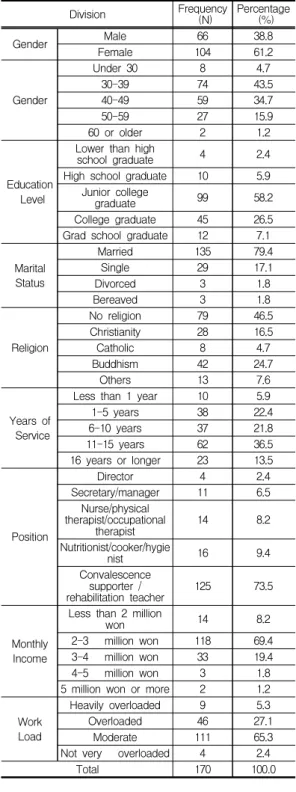
The result of investigation on the general characteristics of workers at residential homes for the disabled is as on <Table 2>. The respondents consist of 38.8% of males and 61.2%of females. The proportion of the respondents in each age group is in the following order, 43.5%
in ‘30-39’, 34.7% in ‘40-49’, 15.9% in ‘50-59’, 4.7% in ‘less than 30’ and 1.2% in ‘60 or older’.
For education level, 58.2% responded ‘junior college graduate’, 26.5% ‘college graduate’, 7.1%
‘grad school graduate or higher’, 5.9% ‘high school graduate’ and 2.4% ‘lower than high school graduate’. Also, 79.4% of the respondents were married, 17.1% were single and 1.8% were in both groups of ‘divorced’ and ‘bereaved’. 46.5%
said they believe in ‘no religion’, 24.7% in
‘Buddhism’, 16.5% in ‘Christianity’, 7.6% in
‘others’ and 4.7% in ‘Catholic’. For years of service, 36.5% have worked for ‘11-15 years’, 22.4% for ‘1-5 years’, 21.8% for ‘6-10 years’, 13.5% for ‘16 years or longer’ and 5.9% for ‘less than 1 year’. The majority of the respondents were ‘convalescence supporter / rehabilitation teacher’ (73.5%), followed by ‘nutritionist/cooker/hygienist’ (9.4%), ‘nurse/
physical therapist/occupational therapist’ (8.2%),
‘secretary/manager’ (6.5%) and ‘director’ (2.4%).
Also, 69.4% said their monthly income is ‘2-3 million won’, 19.4% ‘3-4 million won’, 8.2% ‘2 million won or less’, 19.4% ‘4-5 million won’ and 1.2% ‘5 million won or more’. Regarding the work load, 32.4% of the total responded that they are overloaded with work: 65.3% ‘moderate’, 27.1%
‘overloaded’, 5.3% ‘heavily overloaded’ and 2.4% ‘not very overloaded’.
3.2 Descriptive Statistics on Social Support and Job Performance
3.2.1 Psychological characteristics The result of descriptive statistics on the psychological characteristics is on <Table 3>. The average for overall psychological characteristics is 3.67: ‘Self-esteem’ (M=3.66), ‘Self-efficacy’
(M=3.43) and ‘Depression’ (M=2.15).
Table 3. Descriptive statistics on psychological characteristics
Division N Max. Min. Ave. σ
Psycholog characteri ical
stics
Self-ef
ficacy 170 2.00 5.00 3.43 .71 Self-e
steem 170 2.40 5.00 3.66 .53 Depre
ssion 170 1.00 4.83 2.15 .80 Psychological
characteristics 170 2.05 4.95 3.67 .55
3.2.2 Job Performance
The result of descriptive statistics on the job performance is on <Table 4>. The average for overall psychological characteristics is 3.38:
‘Efficiency’ (M=3.47), ‘Working condition’
(M=3.42) and ‘Effectiveness’ (M=3.22).
Table 4. Descriptive statistics on job performance
Division N Max
. Min. Ave
. σ
Perfo Job rman ce
Efficiency 170 2.33 5.00 3.47 .52 Effectiven
ess 170 2.00 5.00 3.22 .52 Working
condition 170 2.00 5.00 3.42 .54 Job performance 170 2.36 4.91 3.38 .44
Division Frequency
(N) Percentage (%)
Gender Male 66 38.8
Female 104 61.2
Gender
Under 30 8 4.7
30-39 74 43.5
40-49 59 34.7
50-59 27 15.9
60 or older 2 1.2
Education Level
Lower than high
school graduate 4 2.4
High school graduate 10 5.9 Junior college
graduate 99 58.2
College graduate 45 26.5
Grad school graduate 12 7.1 Marital
Status
Married 135 79.4
Single 29 17.1
Divorced 3 1.8
Bereaved 3 1.8
Religion
No religion 79 46.5
Christianity 28 16.5
Catholic 8 4.7
Buddhism 42 24.7
Others 13 7.6
Years of Service
Less than 1 year 10 5.9
1-5 years 38 22.4
6-10 years 37 21.8
11-15 years 62 36.5
16 years or longer 23 13.5
Position
Director 4 2.4
Secretary/manager 11 6.5
Nurse/physical therapist/occupational
therapist 14 8.2
Nutritionist/cooker/hygie
nist 16 9.4
Convalescence supporter /
rehabilitation teacher 125 73.5
Monthly Income
Less than 2 million
won 14 8.2
2-3 million won 118 69.4
3-4 million won 33 19.4
4-5 million won 3 1.8
5 million won or more 2 1.2 Work
Load
Heavily overloaded 9 5.3
Overloaded 46 27.1
Moderate 111 65.3
Not very overloaded 4 2.4
Total 170 100.0
Table 2. General Characteristics of Research
Subjects
3.3 Validation of Research Questions
3.3.1 Differences in the psychological characteristics of the workers at residential homes for the disabled due to their general characteristics
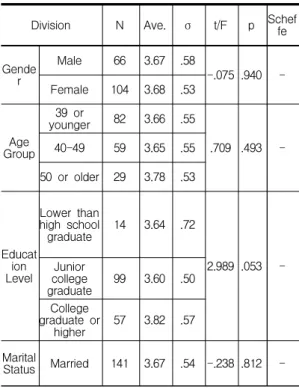
The differences in the psychological characteristics of the workers at residential homes for the disabled due to their general characteristics were investigated and the result thereof is as on <Table 5>.
position and monthly income were found to be not influential at the significance level of 5%.
The workers who reported to be overloaded with work (M=3.44) had higher psychological characteristics (t=-3.977, p<.001) than the workers who reported to be having moderate work load (M=3.79).
Table 5. Descriptive statistics on psychological ch aracteristics
* p<.05, ** p<.01, *** p<.001
The result shows that the psychological characteristics of workers at residential homes for the disabled varies significantly with their work load, whereas the gender, age, education level, marital status, religion, years of service,
Division N Ave. σ t/F p Schef fe
Gende r
Male 66 3.67 .58
-.075 .940 - Female 104 3.68 .53
Group Age 39 or
younger 82 3.66 .55
.709 .493 - 40-49 59 3.65 .55
50 or older 29 3.78 .53
Educat Level ion
Lower than high school
graduate 14 3.64 .72
2.989 .053 - Junior
college
graduate 99 3.60 .50 College
graduate or
higher 57 3.82 .57 Marital
Status Married 141 3.67 .54 -.238 .812 -
Single 29 3.70 .59
Religio n
No religion 79 3.68 .57
.359 .783 - Christianity 28 3.73 .56
Buddhism 42 3.68 .51 Others 21 3.57 .54
Years Servic of
e
Less than
5 year 48 3.80 .54
1.782 .171 - 6-10 years 37 3.65 .57
11 years
or longer 85 3.62 .54
Posi tion
Director /Secretar y/manag
er
15 3.78 .61
.911 .437 - Nurse/ph
ysical therapist/
occupatio therapist nal
14 3.80 .55
Nutritioni st/cooker
/hygienist 16 3.79 .64 Convales
cence supporter rehabilitat / teacher ion
125 3.63 .53
Mon thly Inco me
than 3 Less million won
132 3.66 .55
-.83 0 .408 - 3 million
won or
more 38 3.74 .55
Wor k Loa d
Overload
ed 55 3.44 .56 -3.
977
***.000 -
Moderate 115 3.79 .51
3.3.2 Differences in the level of job performances of the workers at residential homes for the disabled due to their general characteristics
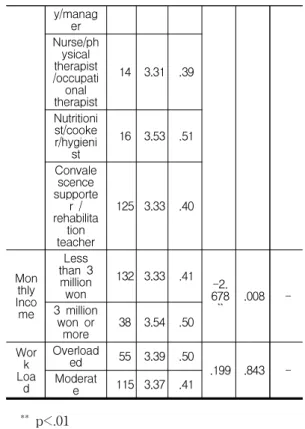
The differences in the job performances of the workers at residential homes for the disabled due to their general characteristics were investigated and the result thereof is as on
<Table 6>.
Table 6. Descriptive statistics on job performance
** p<.01
The result shows that the job performance of workers at residential homes for the disabled varies significantly with their education level, position and monthly income, whereas the gender, age, marital status, religion, years of service and work load were found to be not influential at the significance level of 5%.
The level of job performance were found to be higher for education level with college graduate of higher (M=3.51), followed by those with less than high school graduate (M=3.48) and junior college graduate (M=3.29) (F=5.251, p<.01). Also, level of job performance were found to be higher for director /Secretary/
manager (M=3.70), followed by nutritionist/
cooker/hygienist (M=3.53), convalescence supporter/ rehabilitation teacher (M=3.33) and nurse/ physical therapist/occupational therapist
Division N Ave
. σ t/F p Sch
effe Gen der Male 66 3.40 .47 .494 .622 -
Female 104 3.36 .42 Age Gro
up
39 or
younger 82 3.30 .40
2.98 9 .053 - 40-49 59 3.41 .45
50 or
older 29 3.52 .49
Edu cati Lev on el
Lower than high school graduate
14 3.48 .52
2.98 9 .053 - Junior
college
graduate 99 3.29 .39 College
graduate higher or
57 3.51 .48
Mari tal Stat us
Married 141 3.40 .45
1.65 6 .100 - Single 29 3.25 .40
gion Reli
religion No 79 3.31 .44
1.18 8 .316 - Christian
ity 28 3.44 .36 Buddhis
m 42 3.42 .41
Others 21 3.47 .59
Yea rs Ser of vice
than 5 Less
year 48 3.43 .45
.992 .373 - years 6-10 37 3.29 .44
11 years
longer or 85 3.38 .44 Posi tion Director
/Secretar 15 3.70 .57 4.1
90
**.007 -
y/manag er Nurse/ph
ysical therapist /occupati therapist onal
14 3.31 .39
Nutritioni st/cooke r/hygieni
st
16 3.53 .51 Convale
scence supporte rehabilita r / teacher tion
125 3.33 .40
Mon thly Inco me
than 3 Less million won
132 3.33 .41 -2.
678
**.008 - 3 million
won or
more 38 3.54 .50 Wor k
Loa d
Overload
ed 55 3.39 .50
.199 .843 - Moderat
e 115 3.37 .41
(M=3.31) (F=4.190, p<.01). Lastly, workers with monthly income of less than 3 million won (M=3.33) showed higher level of job performances than those with income of 3 million won or higher (M=3.54) (t=-2.678, p<.001).
3.3.3
Effects of the psychological characteristics of the workers at residential homes for the disabled on their job performancesThe correlation between psychological characteristics of the workers at residential homes for the disabled on their job performances was investigated and the result thereof is as on
<Table 7>.
Table 7. Correlation between psychological char acteristics of the workers at residential homes for the disabled on their job performances
* p<.05, ** p<.01, *** p<.001
The result shows that the job performance of workers in resident homes for the disabled has positive correlations with self-esteem (r=.363, p<.001) and self-efficacy (r=.275, p<.001), and has negative correlation with depression (r=-.267, p<.001). Specifically, the efficiency and working condition factors of the job performance showed positive correlations with the self-efficacy and self-esteem factors of psychological characteristics and showed negative correlation with depression, while the effectiveness factor of the job performance showed significant positive correlation with self-efficacy and self-esteem factors only.
4. CONCLUSION
The purpose of this study was to investigate the effects of psychological characteristics on the workers at the residential homes for the disabled on their job performance. The results of the research are as follows.
Firstly, the differences in the psychological characteristics of workers at residential homes for the disabled were investigated. As a result, the psychological characteristics of the workers varied significantly depending on their work load, where as their gender, age, education level, marital status, religion, years of service, position and monthly income were found to be not influential at the significance level of 5%. The workers who reported to be overloaded with work (M=3.44) had higher psychological characteristics than the workers who reported to be having moderate work load (M=3.79) (t=-3.977, p<.001). Such result is in accordance with a previous study [10], which reported that there is a backward correlation between delinquency of children and exhaustion of
Division
Psychological
Characteristics Job Performance Effic
acy Este em
Depr essi on
Tot al Effici ency
Effe ctive ness
Con ditio n
Tot al
hologi Psyc Char cal acteri stics
Self-ef ficacy 1 Self-e steem .507
** *1 Depres
sion -.584
***-.566
***1 Psychological
Characteristic s
.762
***
.867
** *-.866
***1
Perfor Job mance
Efficie
ncy .154
*.340
** *-.182
*.285
***1 Effect
ivene
ss .196
*.276
** *-.141 .247
**.549
** *1 Worki
condit ng ion
.292
***
.297
** *-.293
***.349
***.464
** *.578
** *1
Perfor Job manc e
.275
***
.363
** *-.267
***.365
***.754
** *.819
** *.891
** *1
workers and concluded that the exhaustion can be prevented when the works of each worker is clearly divided according to the work analysis on the facility of social workers, and thus the sense of responsibility and autonomy of the workers are improved. The result implies that workers at local children center can find psychological stability when they feel a sense of responsibility and autonomy with their works.
Secondly, the differences in level of job performance of workers at residential homes for the disabled were investigated. As a result, it was found that the job performance of workers at residential homes for the disabled varies significantly with their education level, position and monthly income, whereas the gender, age, marital status, religion, years of service and work load were found to be not influential at the significance level of 5%. The level of job performance were found to be higher for education level with college graduate of higher (M=3.51), followed by those with less than high school graduate (M=3.48) and junior college graduate (M=3.29) (F=5.251, p<.01). Also, level of job performance were found to be higher for director /Secretary/manager (M=3.70), followed by nutritionist/cooker/hygienist (M=3.53), convalescence supporter / rehabilitation teacher (M=3.33) and nurse/physical therapist/
occupational therapist (M=3.31) (F=4.190, p<.01).
Lastly, workers with monthly income of less than 3 million won (M=3.33) showed higher level of job performances than those with income of 3 million won or higher (M=3.54) (t=-2.678, p<.001). Such result is in accordance with a previous study [11], which reported that the wage, promotion and years of services of worker at welfare facilities for the elderly have significant influences and resulted that the level
of job satisfaction was the highest for nutritionists, secretaries and managers – except for 1 director and 1 doctor – and also high for nurses (physical or rehabilitation therapists), who tend to have the expertise and more direct interactions with the elderly, while the level of job satisfaction is low for cookers, drivers/guards and officers. The result indicates that the level of job performance varies with educational levels, positions and monthly incomes of workers.
Thirdly, the correlation between psychological characteristics and job performance of workers at residential homes for the disabled was analyzed. As a result, it was revealed that the job performance of workers in resident homes for the disabled has positive correlations with self-esteem (r=.363, p<.001) and self-efficacy (r=.275, p<.001), and has negative correlation with depression (r=-.267, p<.001). Specifically, the efficiency and working condition factors of the job performance showed positive correlations with the self-efficacy and self-esteem factors of psychological characteristics and showed negative correlation with depression, while the effectiveness factor of the job performance showed significant positive correlation with self-efficacy and self-esteem factors only. Such result corresponds to a study [10], which showed that the exhaustion of workers will be prevented when the works of each worker is clearly divided according to the work analysis on the facility of social workers, and thus the sense of responsibility and autonomy of the workers are improved. It also agrees with a study [12], which, from the correlation between working condition, job satisfaction and self-esteem, showed that high autonomy in working enhances the level of job satisfaction
and self-esteem, whereas low autonomy in working causes stronger intention of changing job.
There is a necessity for further researches on the influences of emotional labor of workers at the residential homes for the disabled on the quality of their services.
REFERENCES
[1] J. W. Choi, "A study on effect of interpersonal skills and job stress on job involvement among social welfare residential facility workers", School of Social Welfare Yonsei University, Ph.d.
2015.
[2] H. S. Nam, "The caretakers Mediating Effect of Psychological Empowerment on the Relationship between Job Environment and Job Satisfaction", Journal of Welfare for the Aged, vol. 60, pp. 379-402, 2013.
[3] Y. W. Song, "Research on Job Satisfaction and Service Orientation of Persons with Disabilities", Inha University, Master's Degree, 2007,
[4] H. S. Nam,"The Impact of Job Satisfaction of Vocational Rehabilitation Professionals on the Quality of Life",Journal of Agricultural Extension & Community Development, Vol.20(1),pp.41-69, 2013.
[5] D. R. Lee,"The Effects of the Socio-Psychological Factors of Residential Facilities for the Handicapped on Their Organizational Effectiveness", Journal of the Korean Academy of Health and Welfare for Elderly, Vol. 7(2), pp.87-104.
2015.
[6] C. Kim, K. R. Hwang, "The Relationship of Employee-related Variables in the Child
Care Center for the Children with Disabilities between Their Job Satisfaction",Korean Journal of Physical and Multiple Disabilities, Vol.54(4), pp.
177~195, 2011.
[7]
Statistics of Disease Control Division(
KCDC), 2011.[8] H. J, Lim “A Study on the Effects of Couples’Characteristics, Social Support, Mothers’ Psychological Characteristics on the Planning for Second Childbirth”, Graduate School of Paichai University Daejeon, Korea, Ph, D , 2012.
[9] K, S, Kim, "Job Performance Determinants model of the Social Workers in Public Sector
- Focused on Mediating effects of the self efficacy, the intrinsic job motivation -”The
Graduate School Ewha Womans
University, Ph. D, 2015.
[10] I. J. Chung, K. R. Lee, J. E, Lee, “The Effect of Workers’ Burnout on Children’s Psycho social Adjustment in Community Child Centers“, Journal of the Korean Academy of Health and Welfare for Elderly, Vol.31(0). pp.205-234, 2010.
[11] K. T. Kim,"A Study on the Job Satisfactions of Senior Welfare Facilities Workers", The Journal of Social Sciences, Vol.19(0),pp.1-22, 2004.
[12] S. H. Lee, "The Relation among the Working Situation, Job Satisfaction ,and Self-esteem among Workers at Residential Facilities", The Graduate School of Ewha Womans University, Master's Degree, 2009.
[13] S. h. Oh, S. J. Cho, "A Research on Relationships between Stress Level of Parents in Single Parent Families and Life
Satisfaction", Journal of Korea Institute of Information, Electronics, and Communication Technology, Vol.7(1), pp26-35, 2014.
Author Biography
Kyung-seok Seo [Lifetime member]
•Feb. 2002 : Graduate School of Social Welfare, Daegu University (Master of Social Welfare)
•Feb. 2008 : Graduated from Catholic University of Daegu Graduate School of Social Welfare Ph.D.
•Sept. 2016∼ Present : Ph.D program at Dongbang Graduate School of Culture;
Department of Education
<Research Interests> Information, Education, Social Welfare,
Sung-Je Cho [Regular Member]