Kor. J. Pharmacogn.
42(2) : 110∼ 116 (2011)
110
홍화의 성분 분리 및 항산화 활성
최현규·강연복·박성희1·손애량2·나민균·이승호*
영남대학교 약학대학, 1경남도립거창대학 보건의료행정과, 2경남도립거창대학 뷰티디자인과
Constituents of Flowers of Carthamus tinctorius L. and Their Antioxidant Activity
Hyun Gyu Choi, Yanfu Jiang, Sung Hee Park1, Ae-Ryang Son2, MinKyun Na and Seung Ho Lee*
College of Pharmacy, Yeungnam University, Gyeongsan 712-749, Korea
1Department of Health & Medical Administration, Gyeongnam Provincial Geochangcollege,Geochang 670-804, Korea
2Department of Beauty Design, Gyeongnam Provincial Geochangcollege, Geochang 670-804, Korea
Abstract− As part of our ongoing study focused on the discovery of antioxidants from natural products by measuring the DPPH (1,1-diphenyl-2-picrylhydrazyl) radical scavenging activity, methanol extract of flowers of Carthamus tinctorius L. was found to show potent antioxidant activity. Activity-guided fractionation of the methanol extract lead to the isolation of twenty compounds including two flavonol glycosides, quercertin-3-O-β-D-glucopyranoside (12) and kaempferol-3-O-α-L-rhamnopy- ranosyl-β-D-glucopyranoside (18), two flavanone glycosides, (2S)-4',5,6,7-tetrahydroxyflavanone 6-O-β-D-glucopyranoside (15) and (2R)-5,7,8',4-tetrahydroxyflavanone 8-O-β-D-glucopyranoside (16), and two acetylenic glycosides, 8Z-decaene-4,6-diyne- 1-O-β-D-glucopyranoside (13) and 4,6-decadiyne-1-O-β-D-glucopyranoside (14). Their chemical structures were identified by using spectroscopic analysis. Among them, compounds 12-18 were tested in DPPH assay. Compounds 13-16 were first reported to their antioxidant activity. Quercertin-3-O-β-D-glucopyranoside (12) showed the most potent inhibitory effect on DPPH with IC50 value of 56.7µM.
Key words–Carthamus tinctorius, DPPH, Quercertin-3-O-β-D-glucopyranoside, Acetylenic glycoside
홍화(Carthamus tinctorius L. Safflower)는 국화과 (Com- positae)에 속하는 여러해살이식물로서 원산지는 아프가니스 탄의 산악지대 또는 이집트 및 에티오피아라고 알려져 있 다.1) 꽃이 필 때의 관상화를 그대로 또는 황색색소의 대부분 을 제거하고, 압축해서 판상으로 한 것을 약용으로 한다.2) 홍람, 홍화, 잇꽃, 잇나물 이라고도 한다. 높이는 1 m 내외 이며, 잎은 어긋나고 넓은 바소꼴이며, 톱니끝이 가시처럼 생긴다. 꽃은 7~8월에 피고 엉겅퀴같이 생겼으나 붉은 빛이 도는 노란색이고 가지 끝에 1개씩 달린다. 총포는 잎 같은 포로 싸이고 가장자리에 가시가 있다. 열매는 수과 로서 길 이 6 mm이며 윤기가 있고 짧은 관모가 있다. 종자는 흰색 이다. 꽃받침 중앙에 1.5~3 cm크기의 관상화가 뭉쳐서 핀 다.3) 홍화는 본초강목에서 통증을 제거하고, 혈액순환을 원
활하게 해준다고 기록되어 있어, 혈행 장해, 통경액, 맹증, 갱년기 장해, 특히 산전 산후의 부인병에 정혈제로 널리 쓰 였으며, 한방에서 뇌일혈 후 의 반신불수에 중요하게 쓰인 다고 알려져 있다. 또한, 완하 작용 발한 작용, 하혈 작용이 있으며,4,5) 기분을 진정시키는 효과가 있다고 알려져 있다.
약리활성에 관한 연구로는 항산화 활성,6) 조골모유사세포활 성,7)멜라닌 생합성 저해 활성,8)항 바이러스 활성,9)등이 보고 되었다.홍화로부터 분리 보고된 성분으로는 flavonoid 성분인 kaempferol, quercertin, quercitrin, 6-hydroxy- kaempferol, luteolin, apigenin이 분리 보고 되었고,10) quinochalcone계 색소 성분인 safflomin A, safflomin B, hydroxysafflor yellow A, carthamin이 보고되었고,11) polyacetylenic glycoside인 4',6'-acetonide-8Z-decaene-4,6- diyne-1-O-β-D-glucopyranoside, 4,6-decadiyne-1-O-β-D- glucopyranoside, acetylenic glucoside, Z-decaene-4,6-diyne- 1-O-β-D-glucopyranoside가 분리 보고 되었다.12) 또한 홍화
*교신저자(E-mail):[email protected] (Tel): +82-53-810-2818
에서 분리된 serotonin 유도체의 항산화활성이 보고 되었고,13) trachorogenin, quercertin, catechin은 tyrosinase를 억제하는 활 성이 있다고 보고되었으며, 2-hydroxyarctiin, matairesinol glycoside, sesquiterpene glucoside 등은 항암 효과가 있다고 보고되었다.14) 최근 보고된 논문에서 페놀성 화합물인 matairesinol 4'-O-β-D-glucoside, 8'-hydroxyarctigenin 4'-O-β-D- glucoside, matairesinol, 8'-hydroxyarctigenin, N-feruloylserotonin 5-O-β-D-glucoside, N-(p-coumaroyl) serotonin,13) luteolin 7-O-β-D-glucoside, luteolin, acacetin 7-O-β-glucuronide, acacetin10) 등은 항산화 활성을 가진다고 보고되었다.
본 연구에서는 홍화로부터 성분을 분리하고, 분리한 화 합물에 대하여 항산화 활성을 측정하였다. Acetylenic glycosides인 8Z-decaene-4,6-diyne-1-O-β-D-gluco-pyranoside (13), 4,6-decadiyne-1-O-β-D-glucopyranoside (14), flavanone glycoside인 (2S)-4',5,6,7-tetrahydroxyflavanone 6-O-β-D- glucopyranoside (15), (2R)-5,7,8'4-tetrahydroxy flavanone 8-O-β-D-glucopyranoside (16)의 항산화 활성은 본 연구에서 처음 보고되는 것이다.
재료 및 방법
실험재료 − 홍화는 2008년 3월 대구시 약령시장에서 구 입하여 사용하였으며, 표품은 영남대학교 약학대학에 보관 하고 있다.
시약 및 기기 − 추출 및 column chromatography용 용매 는 시약용 1급을 사용하였다. TLC plate는 Kieselgel 60 F254 (Merck) 및 RP-18 (Whatman)을 사용하였다. Column chromatography용 고정상은 silica gel (70-230 mesh, Merck), Sephadex LH-20 (25-100µ, Sigma Chem. Co.), MCI-gel CHP-20P (75-150µ, Mitsubishi Chem. Co.), RP- 18 (40-63µm, Merck), Toyopearl HW-40F (Tosho) 등을 사용하였다.
HPLC의 고정상으로는 Shim-pack PREP-ODS column 20 mm×250 mm (Shimadzu)을 사용하였으며, 이동상의 조 성은 MeOH와 H2O, acetonitrile의 이상 또는 삼상 혼액을 사용하였으며, 시료에 따라서 비율을 정하여 기울기 용리를 하였다.
발색 시약으로는 FeCl3/ethanol 용액, anisaldehyde-sulfuric acid 시액, vanillin-sulfuric acid 시액, phosphomolybdenic acid, Liebermann-Burchard 시액, dragendorff 시액 등을 사 용하였다.
HPLC는 LC-10A (Shimadzu)를 사용하였다. Fraction collector는 SF-160 (Advantec)을 사용하였다. EI-MS spectrum 은 Micromass spectrum (AUTOSPEC, UK)을 사용하였다.
NMR spectrum은 Bruker ARX 250 spectrometer (250 MHz)의 Bruker's standard pulse program을 사용하였으며,
시료는 CDCl3, CD3OD, pyridine-d5, 또는 acetone-d6 (Aldrich Chem. Co.)에 녹여 사용하였고, chemical shift value는 tetramethylsilane (TMS)으로부터 downshift된 part per million (ppm) 단위로 나타내었다.
DPPH free radical 소거법에 의한 항산화활성 측정 − 96 well microplate에 시료 10 µL를 넣고 DPPH solution (2.0×10⁻⁴, ethanol) 190µL를 가한 후 실온에서 30분간 반응 시켜 각 반응액의 흡광도를 517 nm에서 측정하였다. 대조 군으로는 시료 대신 DMSO를 가해 시료의 흡광도 감소 정 도를 조사하였으며, DPPH radical을 50% 소거시키는 시료 의 농도를 IC50 로 하였다. 각 시료에 대한 DPPH radical 소 거작용을 3회 반복하여 측정 하였다.15,16)
화합물의 분리 및 구조 − 홍화(Carthamus tinctorius) 5.5 kg을 MeOH로 3회 추출하여 여과한 후, 감압 농축하여 MeOH추출물(1.5 kg)을 얻었다. 추출물(1.5 kg)을 증류수에 현탁시키고 동량의 n-Hexane을 가하여, n-Hexane 층과 수 층을 분획하는 조작을 3회 반복 실시한 후 감압농축하여 223 g의 n-Hexane 분획을 얻었다. 다시 수층에 동량의 EtOAc을 가한 후 3회 반복 분획하여 48 g의 EtOAc분획을 얻었고, 나머지를 물분획 (640 g)으로 하였다. 얻어진 분획 을 각종 크로마토그래피법을 통하여 n-Hexane 분획에서 화 합물 1-3을 얻었고, EtOAc 분획에서 화합물 4-16을, H2O 분획에서 화합물 17-20을 분리하였다.
β-Amyrin acetate (1) − White crystal ; 1H-NMR (250 MHz, CDCl3) ; δ 0.74 (3H, s, H-28), 0.80 (6H, s, C-29 and H-30), 0.93 (6H, s, H-23 and H-24), 1.16 (3H, s, H- 25), 1.20-1.97 (s, CH3, CH2), 2.02 (3H, s, H-29), 4.47 (1H, dd, J = 3.0, 5.0, 12.0, CH-3), 5.15 (1H, m, H- 12).13C-NMR (63 MHz, CDCl3) ; δ 14.1 (C-25), 18.2 (C- 6), 21.3 (C-32), 22.6 (C-24), 23.4 (C-23), 23.5 (C-11), 23.6 (C-2), 25.9 (C-26), 26.1 (C-27), 26.8 (C-28), 28.0 (C-15), 28.4 (C-12), 31.1 (C-12), 31.6 (C-13), 32.5 (C- 20), 32.5 (C-17), 33.3 (C-7), 34.7 (C-21), 36.8 (C-22), 37.1 (C-10), 37.7 (C-4), 38.2 (C-1), 39.7 (C-8), 41.6 (C- 14), 46.7 (C-19), 47.2 (C-18), 47.5 (C-9), 55.2 (C-5), 80.9 (C-3), 121.6 (C-12), 145.2 (C-13), 171.05 (C-31).
Trilinolein (2) − Yellow oil ; 1H-NMR (CDCl3, 250 MHz)
; δ 0.81-0.85 (9H, m, H-1), 1.57 (6H, m, H-2), 2.01 (12H, t, J = 6.1 Hz, H-8, 4), 2.27 (6H, t, J = 7.5 Hz, COCH2), 2.73 (6H, t, J = 5.6 Hz, H-11), 4.10 (2H, dd, J
= 11.9, 5.9 Hz,H-α, γ), 4.26 (2H, dd, J = 11.9, 4.3 Hz, H-α, γ), 5.21-5.35 (13H, m, β-CH, H-CH2). 13C-NMR (CDCl3, 63 MHz) ; δ 173.1 (α, γ-CO), 172.7 (β-CO), 130.1 (C-13), 129.9 (C-9), 127.9 (C-10), 127.8 (C-12), 68.7 (C-β), 62.0 (C-α, γ), 33.9 (C-2), 31.4 (C-16), 29.6 (C-7), 29.4 (C-15), 29.2 (C-6), 29.1-29.7 (CH2), 27.1 (C-8,
C-14), 25.5 (C-11), 24.7 (C-3), 22.6 (C-17), 14.1 (CH3).
Linoleic acid (3) − Yellow oil ; 1H-NMR (250 MHz, CD3OD) ; δ 0.82-0.85 (3H, m, H-1), 1.28 (2H, m, H-2), 1.32 (2H, m, H-3), 1.57 (2H, m, H-5), 2.03 (6H, q, J = 6.3, H-8, 14), 2.30 (2H, t, J = 7.5, H-17), 2.74 (H, t, J = 6.3, H-CH2), 5.23-5.31 (4H, m, H-5,6,8,9). 13C-NMR (63 MHz, CD3OD) ; δ 13.4 (CH3). 22.65 (C-17), 24.9 (C-3), 25.6(C-11), 27.2 (C-8 and C-14), 29.1-29.7 (CH2), 29.2 (C-6), 29.3 (C-15), 29.6 (C-7), 31.5 (C-16), 34.0 (C-2), 128.0 (C-12), 128.0 (C-10), 129.8 (C-9), 129.8 (C-13), 176.8 (C-1).
Quercertin (4) − Yellow powder ; 1H-NMR (250 MHz, CD3OD) ; δ 6.18 (1H, d, J = 2.02, H-6), 6.38 (1H, d, J
= 2.03, H-7), 6.89 (1H, d, J = 8.5,H-2'), 7.63 (1H, dd, J
= 2.1, 8.51, H-5'), 7.72 (1H, d, J = 2.02, H-6'). 13C-NMR (63 MHz, CD3OD) ; δ 151.4 (C-2), 137.6 (C-3), 177.5 (C-4), 163.8 (C-5), 99.2 (C-6), 165.6 (C-7), 94.4 (C-8), 158.2 (C-9), 105.8 (C-10), 124.1 (C-1'), 115.9 (C-2'), 146.2 (C-3'), 150.4 (C-4'), 116.2 (C-5'), 121.7 (C-6').
Apigenin (5) − Yellow powder ; 1H-NMR (250 MHz, CD3OD) ; δ 6.19 (1H, d, J = 2.05, H-6), 6.44 (1H, d, J
= 2.12, H-8), 6.58 (1H, s, H-3), 6.92 (2H, d, J = 8.92, H-3' and H-5'), 7.85 (2H, d, J = 8.95, H-2' and H-6').
13C-NMR (63 MHz, CD3OD) ; δ 164.3 (C-2), 103.6 (C- 3), 182.6 (C-4), 162.9 (C-5), 99.8 (C-6), 165.7 (C-7), 94.7 (C-8), 162.5 (C-9), 104.7 (C-10), 128.7 (C-1'), 135.8 (C- 2', C-6'), 116.7 (C-3', C-5'), 158.3 (C-4').
Kaempferol (6) − Yellow powder ; 1H-NMR (250 MHz, CD3OD) ; δ 6.06 (1H, d, J = 2.07, H-6), 6.27 (1H, d, J
= 2.07, H-8), 6.78 (2H, d, J = 9.80, H-3' and H-5'), 7.97 (1H, d, J = 4.95, H-2' and H-6'). 13C-NMR (63 MHz, CD3OD) ; δ 147.9 (C-2), 137.2 (C-3), 177.3 (C-4), 162.5 (C-5), 99.2 (C-6), 165.6 (C-7), 94.4 (C-8), 160.5 (C-9), 104.5 (C-10), 123.7 (C-1'), 130.7 (C-2' and C-6'), 116.3 (C-3' and C-5'), 158.2 (C-4').
Luteolin (7) − Yellow powder ; 1H-NMR (250 MHz, CD3OD) ; δ 6.15 (1H, d, J = 1.97, H-6), 6.39 (1H, d, J
= 2.02, H-8), 6.49 (1H, s, H-2'), 6.84 (1H, d, J = 8.85, H-3), 7.34 (1H, m, H-5' and H-6'). 13C-NMR (63 MHz, Pyridine-d5) ; δ 164.7 (C-2), 104.9 (C-3), 182.6 (C-4), 163.7 (C-5), 99.8 (C-6), 165.7 (C-7), 94.7 (C-8), 158.4 (C-9), 103.9 (C-10), 122.8 (C-1'), 114.5 (C-2'), 147.6 (C- 3'), 151.5 (C-4'), 116.7 (C-5'), 119.4 (C-6').
Ferulic acid (8) − Yellow powder ; 1H-NMR (250 MHz, CD3OD) ; δ 3.82 (3H, s, H-10), 6.24 (1H, d, J = 15.9, H-8), 6.73 (1H, d, J = 8.15, H-3), 6,97 (1H, dd, J = 1.9,
8.2, H-6), 7.11 (1H, d, J = 1.75, H-2), 7.51 (1H, d, J = 15.9, H-7). 13C-NMR (63 MHz, CD3OD) ; δ 126.8 (C-1), 123.0 (C-2), 110.5 (C-3), 149.4 (C-4), 148.4 (C-5), 115.2 (C-6), 115.4 (C-7), 145.7 (C-8), 170.2 (C-9), 55.4 (C-10).
Syringaresinol (9) − Yellow gum ; 1H-NMR (600 MHz, CDCl3) ; δ 3.07 (2H, m, H-1 and H-5), 3.87 (12H, s, H- 3', 5', 3'' and 5''), 3.89 (2H, d, J = 3.6, H-2 and H-6), 4.26 (2H, dd, J = 6.6, 9.2, H-2 and H-6), 4.70 (2H, d, J
= 3.6, H-4 and H-8), 5.49 (OH, s, OH-4' and OH-4''), 6.56 (4H, s, H-2', 6', 2'' and 6''). 13C-NMR (150 MHz, CDCl3); δ 54.3 (C-1 and C-5), 71.8 (C-2 and C-6), 86.1 (C-4 and C-8), 56.4 (C-3', 5', 3'' and 5''), 132.1 (C-1' and C-1''), 102.7 (C-2', 6', 2'' and 6''), 147.1 (C-3', 5', 3'' and 5''), 134.3 (C-4' and C-4'').
Isoferulic acid (10) − Yellow powder ; 1H-NMR (250 MHz, CD3OD) ; δ 3.83 (3H, s, H-10), 6.21 (1H, d, J = 15.9, H-8), 6.88 (1H, d, J = 8.0, H-3), 6.98 (2H, d, J = 8.2, H-6 and H-2), 7.49 (1H, d, J = 1.6), 7.51 (1H, d, J = 15.9, H-7). 13C-NMR (63 MHz, CD3OD) ; δ 127.9 (C-1), 121.7 (C-2), 111.4 (C-3), 150.4 (C-4), 147.1 (C-5), 113.6 (C-6), 115.4 (C-7), 145.6 (C-8), 169.8 (C-9), 55.3 (C-10).
4-Hydroxybenzoic acid (11) − Yellow powder ; 1H-NMR (250 MHz, CD3OD) ; δ 6.73 (2H, d, J = 7.4, H-5 and H- 3), 7.78 (2H, d, J = 7.4, H-6 and H-2).13C-NMR (63 MHz, CD3OD) ; δ 122.7 (C-1), 133.0 (C-2 and C-6), 116.0 (C-3 and C-5), 163.4 (C-4), 170.1 (C-7).
Quercertin-3-O-β-D-glucopyranoside (12) − Yellow powder
; 1H-NMR (250 MHz, CD3OD) ; δ 5.20 (1H, d, J = 7.42, H-1''), 6.14 (1H, d, J = 2.02, H-6), 6.32 (1H, d, J = 2.03, H-7), 6.81 (1H, d, J =8.5, H-2'), 7.53 (1H, dd, J = 2.1, 8.51, H-5'), 7.65 (1H, d, J = 2.02, H-6'). 13C-NMR (63 MHz, CD3OD) ; δ 151.4 (C-2), 137.6 (C-3), 178.5 (C-4), 162.0 (C-5), 98.9 (C-6), 165.1 (C-7), 93.7 (C-8), 158.0 (C-9), 104.7 (C-10), 122.2 (C-1'), 115.0 (C-2'), 144.9 (C- 3'), 148.8 (C-4'), 115.0 (C-5'), 116.5 (C-6'), 104.7 (C-1''), 74.7 (C-2''), 77.1 (C-3''), 70.2 (C-4''), 77.4 (C-5''), 61.1 (C- 6'').
8Z-Decaene-4,6-diyne-1-O-β-D-glucopyranoside (13) − Yellow syrup ; 1H-NMR (CD3OD, 250 MHz) ; δ 1.90 (2H, m, CH3-10, H-7), 2.52 (2H, t, J = 7.0 Hz, H-3), 4.30 (1H, d, J = 7.80 Hz,H-1'). 13C-NMR (CD3OD, 63 MHz) ; δ 69.2 (C-1), 29.5 (C-2), 16.5 (C-3), 85.1 (C-4), 66.0 (C-5), 79.3 (C-6), 72.5 (C-7), 109.8 (C-8), 143.2 (C-9), 16.7 (C- 10), 104.1 (C-1'), 74.7 (C-2'), 77.6 (C-3'), 71.1 (C-4'), 77.5 (C-5'), 62.3 (C-6').
4,6-Decadiyne-1-O-β-D-glucopyranoside (14) − Bright
yellowish syrup ; 1H-NMR (CD3OD, 250MHz) ; δ 0.78 (3H, dt, J = 2.2, 7.5, H-10), 1.47 (2H, m, H-9), 1.75 (2H, m, H-2), 2.08 (2H, t, J = 6.7Hz, H-3), 2.42 (2H, t, J =7.0, CH2 -3), 4.30 (1H, d, J =7.80 CH-1'). 13C-NMR (CD3OD, 63 MHz) ; δ 67.8 (C-1), 28.8 (C-2), 15.7 (C-3), 77.8 (C- 4), 67.8 (C-5), 66.2 (C-6), 78.1 (C-7), 20.7 (C-8), 21.7 (C-9), 13.1 (C-10), 104.2 (C-1'), 74.8 (C-2'), 77.4 (C-3'), 71.1 (C-4'), 77.4 (C-5'), 62.3 (C-6').
(2S)-4',5,6,7-Tetrahydroxyflavanone 6-O-β-D-glucoside (15) − Yellowish powder ; 1H-NMR (DMSO-d6, 250 MHz)
; δ 5.43 (1H, dd, J = 12.5, 3.0Hz H-3',5'), 3.28 (1H, dd, J = 17.0, 12.5 Hz H-3), 2.68 (1H, dd, J = 17.0, 3.0 Hz), 7.31 (2H, d, J = 8.5 Hz, ), 6.79 (2H, t, J = 8.5 Hz, H-8),
12.24 (1H, s, 5-OH), 0.92 (3H, t, J = 7.2 Hz, H-10), 9.60 (3H, d, J = 7.8 Hz, OH-4'). 13C-NMR (DMSO-d6, 63 MHz)
; δ 197.1 (C-4), 159.4 (C-7), 15.6 (C-3), 158.6 (C-4), 157.7(C-5), 155.0 (C-6), 128.8 (C-7), 128.4 (C-8), 126.2 (C-9), 115.2 (C-10), 104.7 (C-1'), 101.8 (C-2'), 95.0 (C-3'), 78.5 (C-4'), 77.2 (C-5'), 76.1 (C-5').
(2R)-5,7,8',4-Tetrahydroxy flavanone 8-O-β-D-glucoside (16) − Yellow powder ; 1H-NMR (DMSO-d6, 250 MHz) ; δ 5.43 (1H, d, J = 11.8, 3.0Hz H-3',5'), 3.28 (1H, dd, J = 17.2, 11.8 Hz, H-3), 2.75 (1H, dd, J = 17.0, 3.0 Hz ), 7.37 (2H, d, J = 8.5 Hz, H-2',6'), 6.79 (2H, t, J = 8.5 Hz, H-8), 4.61 (2H, d, J = 6.4 Hz, H-2''), 3.70 (3H, m, H-6').
13C-NMR (DMSO-d6, 62.9 MHz) ; δ 159.4 (C-7), 15.6
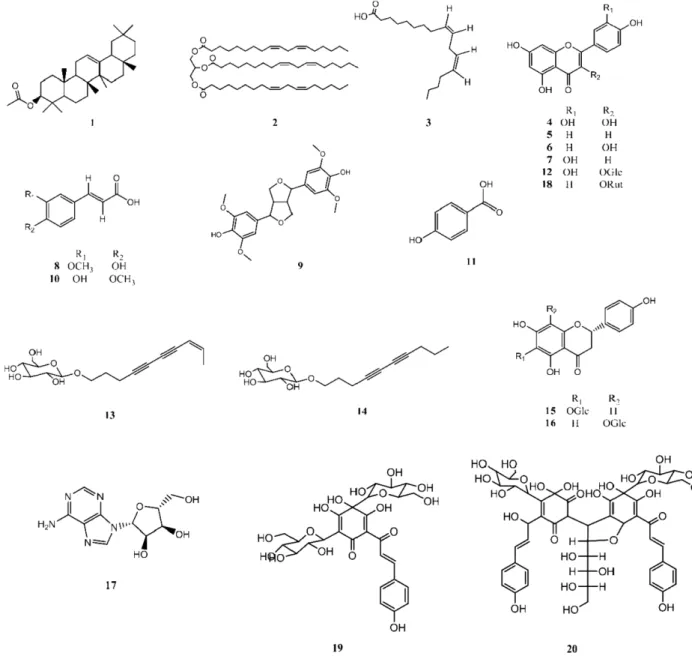
Fig. 1. Chemical structures of constituents isolated from C. tinctorius.
(C-3), 158.6 (C-4), 157.7(C-5), 155.0 (C-6), 128.8 (C-7), 128.4 (C-8), 126.2 (C-9), 115.2 (C-10), 155.5 (C-4'), 107.2 (C-1''), 101.8 (C-2''), 95.0 (C-3''), 80.61 (C-4''), 77.2 (C- 5''), 62.2 (C-6'').
Adenosine (17) − Yellow crystal ; 1H NMR (DMSO- d6-250 MHz) ; δ 3.59 (2H, dt, J = 3.6, 12.3 Hz, H-5'), 3.97 (1H, q, J = 3.3 Hz, H-4’), 4.13 (1H, dd, J = 3.1, 5.0 Hz, H-3), 4.57 (1H, dd, J = 5.2, 5.7 Hz, H-2'), 5.85 (1H, d, J = 6.24, H-1'), 8.13 (1H, s, H-2), 8.32 (1H, s, H-8). 13C-NMR (DMSO-d6, 63 MHz) ; δ 152.3 (C-2), 149.0 (C-4), 119.3 (C-5), 156.1 (C-6), 138.8 (C-8), 87.9 (C-1'), 73.4 (C-2'), 70.6 (C-3'), 85.8 (C-4'), 61.6 (C-5').
Kaempferol 3-O-α-L-rhamnopyranosyl-β-D-glucopyranoside (18)− Yellow powder ; 1H-NMR (DMSO-d6, 250 MHz) ; δ 6.06 (1H, d, J = 2.07, H-6), 6.27 (1H, d, J = 2.07, H- 8), 6.78 (2H, d, J = 9.80, H-3' and H-5'), 7.97 (1H, d, J
= 4.95, H-2' and H-6') 5.12 (1H, d, J = 7.0, H-1''), 1.12 (3H, d, J = 6.0, H-6'''). 13C-NMR (DMSO-d6, 63 MHz) ; δ 147.9 (C-2), 137.2 (C-3), 177.3 (C-4), 162.5 (C-5), 99.2 (C-6), 165.6 (C-7), 94.4 (C-8), 160.5 (C-9), 104.5 (C-10), 123.7 (C-1'), 130.7 (C-2' and C-6'), 116.3 (C-3' and C-5'), 158.2 (C-4') (C-1''), 75.7 (C-2''), 77.1 (C-3''), 71.3 (C-4''), 77.1 (C-5''), 68.7 (C-6'') 102.3 (C-1'''), 72.2 (C-2'''), 73.8 (C-3'''), 71.3 (C-4'''), 69.7 (C-5'''), 17.9 (C-6''').
Hydroxysafflor yellow A (19) − Yellow powder ; 1H- NMR (CD3OD, 250MHz) ; δ 7.24 (d, J = 15.6 Hz, H-8), 7.42 (d, J = 15.6 Hz, H-9), 7.43 (d, J = 7.1 Hz, H- 11,15), 6.80 (d, J = 7.1 Hz, H-12, 14), 3.85 (d, J = 9.5 Hz, H-G1), 3.46 (t, J = 9.3 Hz, H-G2), 3.28 (t, J = 9.0 Hz, H-G3), 3.15 (m, H-G4), 3.50 (m, H-G5), 3.70 (m, H- G6), 4.40 (d, J = 10.0 Hz, H-G1''), 4.07 (t, J = 9.5 Hz, H-G2''), 3.36 (t, J = 8.8 Hz, H-G3''), 3.15 (m, H-G4''), 3.32 md, H-G5''), 3.43 (dd, J = 12.7, 4.4 Hz, d, J = 9.5 Hz, H-G6''). 13C-NMR (CD3OD, 63MHz) ; δ 189.3 (C-1), 96.9 (C-2), 181.1 (C-3), 83.2 (C-4), 194.8 (C-5), 103.1 (C-6), 178.3 (C-7), 118.3 (C-8), 138.1 (C-9), 125.1 (C-10), 127.4 (C-11, 15), 113.3 (C-12, 14), 154.8 (C-13), 82.9 (C- G1), 66.8 (C-G2), 75.0 (C-G3), 76.6 (C-G4), 66.83 (C- G5), 57.90 (C-G6), 71.5 (C-G1''), 66.0 (C-G2''), 75.8 (C- G3''), 66.6 (C-G4''), 77.2 (C-G5''), 58.2 (C-G6'').
Safflomin B (20) − Yellow powder ; 1H-NMR (CD3OD, 250 MHz) ; δ 7.45 (d, J = 15.8 Hz, H-8), 7.71 (d, J = 15.8 Hz, H-9), 7.53 (d, J = 8.5 Hz, H-11,15), 3.56 (m, H-G1), 3.32 (m, H-G2), 3.24 (m, H-G3), 3.24 (m, H-G4), 3.68 (m, H-G5), 3.86 (d, J = 12.2 Hz, H-G6), 3.58 (m, H-G6), 7.55 (d, J = 15.8 Hz, H-8'), 7.74 (d, J = 15.8 Hz,
H-9'), 7.50 (d, J = 8.5 Hz, H-11',15'), 6.80 (d, J = 8.5 Hz, H-12',14'), 3.68 (m, H-G1'), 3.27 (m, H-G2'), 3.42 (m, H-G3'), 2.28 (d, J = 9.58 Hz, H-G4'), 3.41 (m, H-G5'), 3.63 (m, H-G6'), 3.38 (m, H-G6'), 4.94 (d, J = 8.0 Hz, H-G1''), 5.01 (t, J = 6.8 Hz, H-G2''), 3.97 (d, J = 5.8 Hz, H-G3''), 3.67 (m, H-G4''), 3.79 (dd, J = 11.0, 2.7 Hz, H- G5''), 3.59 (m, H-G6''). 13C-NMR (CD3OD, 63 MHz) ; δ 191.0 (C-1), 109.2 (C-2), 175.6 (C-3), 82.2 (C-4), 196.0 (C-5), 113.6 (C-6), 180.9 (C-7), 119.3 (C-8), 144.3 (C-9), 128.3 (C-10), 131.8 (C-11, 15), 116.9 (C-12, 14), 161.5 (C-13), 88.4 (C-G1), 79.8 (C-G2), 71.2 (C-G3), 82.2 (C- G4), 72.2 (C-G5), 62.7 (C-G6), 86.2 (C-G1'), 79.5 (C- G1'), 68.9 (C-G1'), 80.4 (C-G1'), 70.2 (C-G1'), 60.7 (C- G1'), 37.4 (C-G1'') ,94.9 (C-G2''), 72.8 (C-G3''), 70.9 (C- G4''), 72.9 (C-G5''), 65.0 (C-G6'').
결과 및 고찰
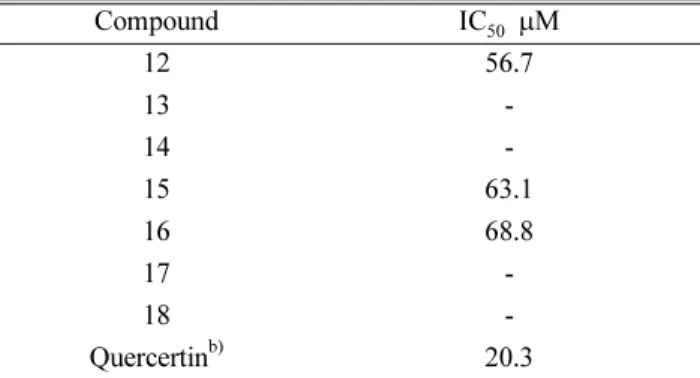
홍화의 함유 성분을 분리하고 얻어진 화합물에 대하여, DPPH radical 소거효능을 측정하였다. 분리된 화합물은 각 종 spectral data를 검토하여 화합물의 구조를 추정하고 해 당하는 화합물의 spectral data를 문헌에 소개된 것과 대조 하여 각각 β-amyrin acetate (1),17) trilinolein (2),18) linoleic acid (3),18) quercertin (4),10) apigenin (5),12) kaempferol (6),10) luteolin (7), 10) ferulic acid (8),19) syringaresinol (9), isofe- rulic acid (10),19) 4-hydroxybenzoic acid (11),19) quercertin- 3-O-β-D-glucopyranoside (12),10) 8Z-decaene-4,6-diyne-1- O-β-D-glucopyranoside (13),12) 4,6-decadiyne-1-O-β-D-glu- copyranoside (14),12) (2S)-4',5,6,7-tetrahydroxyflavanone 6- O-β-D-glucoside (15),20) (2R)-5,7,8',4-tetrahydroxy flava- none 8-O-β-D-glucoside (16),21) adenosine (17), kaempfe- rol 3-O-α-L-rhamnopyranosyl-β-D-glucopyranoside (18),12) hydroxysafflor yellow A (19)11), safflomin A (20)11)로 동정 하였다. 분리한 화합물 중 항산화활성이 이미 보고된 화합 물을 제외한 화합물 13-17의 DPPH radical 소거능에 의한 항산화활성을 측정하였고, 이를 Table I에 나타내었다. Ace- tylenic glycoside인 화합물 13, 14는 활성을 보이지 않았다.
Flavanone glycoside인 화합물 15, 16의 IC50는 각각 63.1, 68.8µM이었다. 화합물 12의 IC50는 56.7 µM로서 화합물 15, 16 와 거의 동등한 radical 소거 활성을 나타냈다. 이와 같은 결과는 활성에 중요한 영향을 미치는 것이 hydroxyl group의 수나 위치에 있을 것이라는 보고에 따라22), 화합물 15, 16의 분자구조에서 당의 위치만 다를 뿐 같은 골격을 가지고 있기 때문에 이러한 동일한 골격에 결합된 당의 위 치는 radical 소거능에 큰 영향을 미치지 않기 때문인 것으 로 판단된다. 이상의 결과로 볼 때, 홍화에서 분리한 화합
물 12-18은 홍화의 항산화활성을 뒷받침하는 하나의 근거 로 사료된다.
결 론
홍화의 MeOH엑스로부터 20종의 화합물을 분리하여 각 각 β-amyrin acetate (1), trilinolein (2), linoleic acid (3), quercertin (4), apigenin (5), kaempferol (6), luteolin (7), ferulic acid (8), syringaresinol (9), isoferulic acid (10), 4- hydroxybenzoic acid (11), quercertin-3-O-β-D-glucopyra- noside (12), 8Z-decaene-4,6-diyne-1-O-β-D-gluco-pyrano- side (13), 4,6-decadiyne-1-O-β-D-glucopyranoside(14), (2S)- 4',5,6,7-tetrahydroxyflavanone 6-O-β-D-glucopyranoside (15), (2R)-5,7,8',4-tetrahydroxyflavanone 8-O-β-D-glucopyranoside (16), adenosine (17), kaempferol 3-O-α-L-rhamnopyranosyl- β-D-glucopyranoside (18), hydroxysafflor yellow A (19), safflomin A (20)로 구조를 동정하였다. 그 중 화합물 12-18 의 항산화활성을 DPPH radical 소거능을 이용하여 측정하 였고, 13-16의 항산화활성은 처음 보고되는 것이다. Quer- certin-3-O-β-D-glucopyranoside (12)가 가장강한 활성을 보 여주었으며, IC50 value는 56.7 µM이었다.
사 사
이 연구는 2009년도 영남대학교 학술연구조성비에 의한 것임.
인용문헌
1.이상인 (1981) 본초학, 459-460. 수서원, 서울.
2. Lee. T. B. (1989) Illustrated flora of Korea. Hyangmunsa, Seoul, Korea.
3.배기환 (2000) 한국의 약용식물, 446. 교학사. 서울.
4.손성연, 신농본초경, 13. 의도한국사영인 2, 서울.
5.이상인, 안덕균 (1992) 본초학, 172. 영림사, 서울.
6. Kalyarat, K. and Kaew, K. (2006) Antioxidant activity, phe- nolic compound contents and antimutagenic activity of some water extract of herbs. Thai J. Pharm. Sci. 30: 28-35.
7. Rhyu, I. C., Lee, Y. M., Ku, Y., Bae, K. W. and Chung, C. P.
(1997) The biologic effects of safflower(Carthamus tincto- rius Linne) extract and Dipsasi Radix extract on periodontal ligament cells and osteoblastic cells. J. Korean Acad. Peri- odontol. 27: 867-882.
8. Roh, J. S., Han, J. Y., Kim, J. H. and Hwang, J. K. (2004) Inhibitory effects of active compounds isolated from Saf- flower (Carthamus tinctorius L.) seeds for melanogenesis.
Biol. Pharm. Bull. 27: 1976-1978.
9. Narong, C., Teerapol, S.,Wilairat, C. and Worawidh, W.
(2007) In vitro study of antiviral activity of plant crude- extracts against the foot and mouth disease virus Kasetsart. J.
(Nat. Sci.) 41: 97-103.
10. Lee, J. Y., Chang, E. J., Kim, H. J., Park, J. H. and Choi, S.
W. (2002). Antioxidative flavonoids from leaves of Cartha- mus tinctorius. Arch. Pharm. Res. 25: 313-319.
11. Yoon, J. M., Cho, J. E., Park, Y. H., Kim, T. R., Hahn, Y. and Paik, Y. S. (2003) Thermal stability of the pigments hydrox- ysafflor yellow A, safflor yellow B, and precarthamin from Safflower (Carthamus tinctorius). Food Chem. Toxicol. 68:
839-843.
12. Zhou, Y. Z., Ma, H. Y., Chen, H., Qiao, L., Cao, J. Q., Peil, Y. H. (2006) New acetylenic glucosides from Carthamus tinctorius. Chem. Pharm. Bull. 54: 1455-1456.
13. Naoto, K. Kanna, K., Tetsuya, S., Katsunori, K., Yasufumi, F., Katsuya, S., Harumi, A., Takashi, N., Yusuke, A. and Koichi, L. (2006) Serotonin derivatives, major safflower (Carthamus tinctorius L.) seed antioxidants, inhibit low-density lipopro- tein (LDL) oxidation and atherosclerosis in apolipoprotein E- deficient mice. J. Agric. Food Chem. 54: 4970-4976.
14. Kim, E. O., Oh, J. H., Lee, S. K., Lee, J. J. and Choi, S. W.
(2007) Antioxidant properties and quantification of phenolic compounds from safflower (Carthamus tinctorius L.) seeds.
Food Sci. Biotechnol. 16: 71-77.
15. Wang, L. F., Zhang, H. Y. (2003) A theoretical investigation on DPPH radical-scavenging mechanism of edaravone.
Bioorg. Med. Chem. Lett. 13: 3789-3792.
16. Na, M.K., An, R.B., Lee, S.M., Min, B.S., Kim, Y.H., Bae, K.H., K, S.S. (2002). Antioxidant compounds from the stem bark of Sorbus commixta. Nat. Prod. Sci. 8: 26-29.
17. Akihisa, T., Yasukawa, K., Oinuma, H., Kasahara, Y., Yaman- ouchi, S., Takido, M., Kumaki, K. and Tamura, T. (1996) Triterpene alcohols from the flowers of Compositae and their anti-inflammatory effects. Phytochemistry 43: 1255-1260.
18. Knowles, P. F. (1965) Variability in oleic and linoleic acid contents of safflower oil. Economic Botany 19: 53-62.
Table I. DPPH Radical scavenging effects of constituents isolated from C. tinctorius
Compound IC50 µM
12 56.7
13 -
14 -
15 63.1
16 68.8
17 -
18 -
Quercertinb) 20.3
a)The values indicate 50% decrease of DPPH radical and are the means of triplicate data.
b)Positive control.
19. Hartley, R. D., Ford, C. W., Russell, R. B. (1989) Phenolic constituents of plant cell walls and wall biodegradability.
Plant Cell Wall Polymers 9: 137-145.
20. Zhao, M. B., Yoichiro, I. and Pengfei, T. (2005) Isolation of a novel flavanone 6-glucoside from the flowers of Carthamus tinctorium (Honghua) by high-speed counter-current chro- matography. J. Chromatog A 1090: 193-196.
21. Allais, D. P., Chulia, A. J., Kaouadji, M., Simon, A. and Delage, C. (1995) 3-Desoxycallunin and 2''-acetylcallunin, two minor 2,3-dihydroflavonoidglucosides from Calluna vul-
garis. Phytochemistry 39: 427-430.
22. Pratt, D. E. (1976) Role of flavones and related compounds in retarding lipid-oxidative flavor change in food. P. 1. In: Phe- nolic, sulfur and Nitrogen Compounds in food Flavors.
American Chemical Society, Washington DC, USA.
23. Sohal, R, S., Weindruch, R. (1996) Oxidative stress, caloric restriction, and aging. Science 273: 59-63.
24. Kang, P., Izumo, S. (2000) Apoptosis and heart failure: crit- ical review of the literature. Circ. Res. 86: 1107-1113.
(2011. 5. 19 접수; 2011. 5. 26 심사; 2011. 5. 26 게재확정)