135 This is an Open-Access article distributed under the terms of the Creative Commons Attribution Non-Commercial License (http://
creativecommons.org/licenses/by-nc/3.0) which permits unrestricted non-commercial use, distribution, and reproduction in any medium, provided the original work is properly cited.
J. Mushrooms 2020 June, 18(2):135-140 http://dx.doi.org/10.14480/JM.2020.18.2.135 Print ISSN 1738-0294, Online ISSN 2288-8853
© The Korean Society of Mushroom Science
An-Soo Lee(researcher), Jae-Hong Lee(researcher), Heon-Seop Won (researcher), Se-Jeong Hwang(researcher), Tae-Sung Jung(researcher), Dae-Ki Hong(researcher)
*Corresponding author E-mail : [email protected] Tel : +82-33-248-6103 Received March 5, 2020 Revised March 19, 2020 Accepted March 27, 2020
산느타리 봉지재배시 배지의 화학성이 수량에 미치는 영향
이안수 · 이재홍 · 원헌섭 · 황세정 · 정태성 · 홍대기
강원도농업기술원 환경농업연구과
Relationship between chemicals in substrates and yield of Pleurotus pulmonarius
An-Soo Lee, Jae-Hong Lee, Heon-Seop Won, Se-Jeong Hwang, Tae-Sung Jung, Dae-Ki Hong
Agricultural Environment Research Division, Gangwondo Agricultural Research and Extension Services, Chuncheon, 24226, Korea
ABSTRACT: We examined the chemical properties of mixed media and the yield of Pleurotus pulmonarius using bag culture (1 kg) and also evaluated their relationship. The yield of mushrooms in the first flush appeared to be correlated with total nitrogen content. The highest yield of mushroom in the first flush occurred when the nitrogen content of the media was 1.12 %; however, when the nitrogen content was lower or higher than 1.1 %, the yield decreased. The yield of mushrooms in the second flush was highly correlated with various chemical properties including total nitrogen, total carbon, and C/N ratio; for example, higher nitrogen and carbon content produced a higher yield in the second flush. Therefore, when cultivating bottle culture, the nitrogen content of the media should be approximately 1.1 %, such that most mushrooms are harvested in the first flush. Additionally, when cultivating bag culture for harvesting two or more times, it is advantageous to have higher nitrogen and carbon contents in the media than the amount required for bottle culture media.
KEYWORDS: Bag culture, Chemical properties, Correlation coefficient, P. pulmonarius, Yield
서 론
느타리는 늦은 봄에서 초겨울까지 활엽수에서 다발로 발생하며, 속명 Pleurotus는 측면의 귀모양을, 종명 ostreatus는 굴맛이 난다는 의미로 영명으로는 Oyster mushroom으로 불리어 진다. 국내에서 생산 및 소비가 가 장 많은 버섯으로, 재배형태는 원목재배, 균상재배, 상자
재배, 봉지재배, 병재배 등으로 매우 다양한데, 최근에는 생산성이 높고 재배안정성이 뛰어난 병재배와 봉지재배가 주류를 이룬다.
병, 봉지재배시 배지재료는 톱밥, 면실피, 비트펄프, 면 실박 등이 주로 활용되고 있지만 이들 배지재료 중 톱밥 을 제외한 대부분의 재료가 수입에 의존하고 있기에 수급 과 가격의 안정성이 낮아 문제가 되고 있다. 이에 따라 새 로운 배지재료 탐색 등 다양한 연구들이 수행되어 왔다.
느타리 재배용 미루나무와 미송톱밥을 대체하기 위하여 간벌 소나무(Lee et al., 2018), 옻나무(Lee et al., 2014), 왕겨(Lee et al., 2001), 산겨릅나무(Lee et al., 2013), 구 지뽕나무(Lee et al., 2012), 팽연왕겨·코코피트·코코넛나 무톱밥(Jang et al., 2010), 콘코브(Kim et al., 2011) 등에 대한 연구가 수행되었다. 느타리 재배시 영양원으로 주로 이용되고 있는 면실박을 대체하기 위하여 보리가루(Lee et al., 2017), 케이폭박(Won et al,. 2010), 아주까리박·유채박·
야자박·코코넛박(Kim et al., 2005), 알팔파펠렛·옥수수주 정박·카사바주정박(Jang et al., 2014a) 등의 연구결과를 보고되었다. 또한 비트펄프를 대체하기 위하여 열매탈과 팜이삭을 연구한 결과, 수량성이 우수하였다고 보고되었 다(Kang et al., 2014).
농산부산물을 느타리 배지재료로 활용하기 위하여 한약 재인 단삼의 부산물을 병당 5 g 첨가시 수확량이 우수하 였다(Lee et al., 2015)고 하였고, 버섯 수확후배지를 재활 용하기 위한 연구들(Baek et al., 2018 ; Cheong et al., 2012)도 보고된 바 있다.
Lee 등(2019)은 532배지에서 20% 사용되고 있는 면실 박의 첨가비율은 12% 이상이면 충분하다 하였고, Lee 등 (2002)은 면실박을 20% 이상 혼합시 낮은 C/N율로 자실 체가 생육되지 않았다고 하였다.
배양환경에 따른 연구로 배양온도 및 기간(Ha et al., 2003), 배양기간중 차광처리(Jung et al., 2014), 통기성 개선(Yoo et al., 2012), 후숙조건(Chang et al., 2012)에 관한 연구가 있었다. Yoon 등(1996)은 균상재배시 배지량 이 버섯수량에 미치는 영향을, Lee 등(2002)은 봉지재배 시 배지직경과 배지량에 관한 연구결과를 보고하였다.
Jang 등(2014b)은 느타리 재배를 위한 LED 청백광 하에 서 상품수량이 높고 항산화물질 ergothioneine 함량이 높 다고 하였다.
이상과 같이 느타리의 수량과 관련하여 기존 배지재료 의 혼합비율, 대체재료 선발, 배양 및 생육환경 구명 등의 연구결과는 다수 보고되어 있으나, 배지 화학성과 버섯 수량에 대한 연구는 고활성 칼슘의 버섯 생육에 대한 효 과(Jang & Goo, 2005) 외에는 찾아보기 어려웠다. 더구 나 느타리와 종(species)이 다른 산느타리 수량에 관한 연 구는 전혀 찾아볼 수 없었는데, 본 연구에서 봉지재배시 혼합배지의 화학성과 산느타리 수량성간의 관계를 분석한
결과를 보고하고자 한다.
재료 및 방법
시험품종 및 종균
본 시험에 사용된 산느타리 균주는 2016년도 강원도농업 기술원에서 육성한 ‘자산’ 품종으로 PDA(potato dextrose agar) 배지에서 증식시켜 톱밥종균용 접종원으로 사용하였 다. 톱밥종균의 조성은 부피비로서 미루나무톱밥 85%와 미강 15%를 혼합 후 수분을 62% 내외로 조정하였다. 살 균은 121oC에서 90분간 실시하였고, 접종원을 첨가한 뒤 에 온도 22oC, 습도 70%의 배양실에서 30일 정도 배양하 여 종균으로 사용하였다.
생육배지 조성
산느타리 배지재료 중 영양원의 혼합비율과 관련한 시 험을 위하여 미루나무톱밥과 면실피를 1 : 5의 비율로 고 정하고, 비트펄프·면실박·대두박·케이폭박·맥주박의 비율 을 Table 1과 같이 10처리를 두었다. 배지재료는 부피비 율을 기준으로 혼합하였다. M4 까지는 질소원이 10%씩 들어가므로 비트펄프를 30%로 하였고, M5~M10은 질소 원이 20%씩 혼합되기에 비트펄프를 20%로 감량하였다.
배지 화학성 분석
혼합배지의 화학성 분석은 살균배지(수분이 약 65% 함 유)를 이용하였다. pH는 혼합배지 5 g을 채취하고 증류수
Table 1. Mixing ratio(v/v) of media materials for Pleurotus pulmonarius
Division Main-substrates Source of nutrients
Sawdust Cottonseed hull Beetpulp Cotton seed meal Soybean cake Kapok cake Beer cake
M1 1 5 3 1
M2 1 5 3 1
M3 1 5 3 1
M4 1 5 3 1
M5 1 5 2 2
M6 1 5 2 2
M7 1 5 2 2
M8 1 5 2 1 1
M9 1 5 2 1 1
M10 1 5 2 1 1
Table 2. Nitrogen and carbon contents in each media materials used
Sawdust Cottonseed hull Beetpulp Cotton seed
meal Soybean cake Kapok cake Beer cake
TN♪(%) 0.2 2.4 1.5 6.2 - 5.1 2.1
TC♪(%) 46.9 42.1 37.4 39.3 - 45.7 26.4
♪ Abbreviation : TN(Total nitrogen), TC(Total carbon)
25 ml를 가하여 pH 전극(ORION 3STAR, USA)을 이용하 여 측정하였다. 유기물, 총질소 및 총탄소는 ELEMENTAR 사의 원소분석기(Vario Max CN)를 이용하여 분석하였다.
버섯생육 및 수량성 조사
수분함량이 약 65%로 조절된 혼합배지를 1 kg씩 PP봉 지에 충진하고, 살균기에 넣고 102oC에서 배기하면서 120분간 예비살균한 후, 121oC에 90분간 살균하였다. 냉 각 후 봉지배지에 산느타리 종균을 약 10g씩 접종하였고 30일간 배양실(22oC, 암조건)에서 배양하였다. 배양이 완 료된 배지를 생육실로 옮겨서 일 14시간 조명, 온도 17oC, 습도 95%, CO2 농도 1,500 ppm의 환경에서 발이와 생육을 유도하였다. 약 7일후 1주기 버섯을 수확하여 갓 경, 경장, 경태, 수량을 조사하였다. 1주기 수확후 생육환 경을 그대로 유지하면서 약 7일간의 휴주기를 거쳐서 2주 기 버섯을 발생, 수확하여 수량성을 조사하였다. 2주기 수 확까지는 약 20일이 소요되었다.
배지의 화학성과 버섯수량간의 상관관계 분석
MS Office(excel 2016)를 이용하여 배지의 화학성과 각 배지별 버섯 수확량(1, 2주기)간의 상관관계를 분석하고 상관도 그래프를 구하였다. 단, 버섯이 전혀 발생하지 않 았던 처리는 통계분석에서 제외하였다.
결과 및 고찰
혼합배지의 화학성
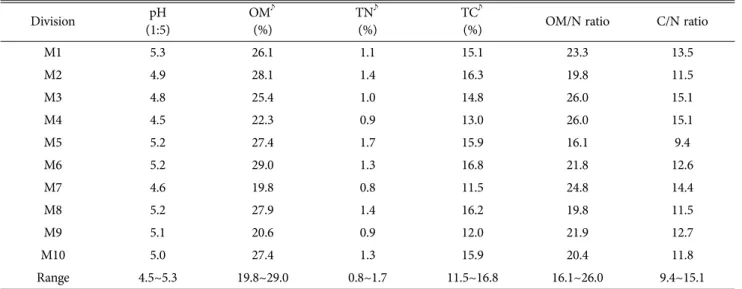
혼합배지의 화학성은 Table 3와 같았다. pH는 4.5 ~ 5.3 사이에 분포하였는데, 이 범위에서는 산느타리의 생육 과 수량에 영향을 미치지 않을 것으로 사료되었다. 톱밥 과 면실피(주재료)의 비율은 동일하고 영양원의 혼합비율
을 달리하였기에 총질소함량이 0.8 ~ 1.7%로 비교적 다양 하게 나타났고 총탄소함량은 11.5 ~ 16.8%였으며, 이에 따른 C/N율은 9.4 ~ 15.1의 범위를 보였다.
산느타리 생육 및 수량성
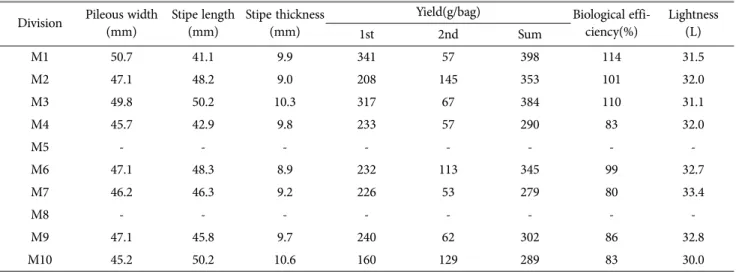
Table 4에는 혼합배지별 산느타리(자산)의 생육 및 수 량성을 나타내었다. 산느타리는 일반느타리에 비하여 대 가 짧고 갓이 큰 특성을 보이므로 수확시 갓의 크기는 45.2 ~ 50.7 mm 정도였고 대 길이는 50.2 mm 가량이었 다. 버섯 수확량에서 혼합배지들간에 다소 차이는 있었지 만, 2주기의 수량은 1주기 대비 상대적으로 적어 1주기 수량이 전체 수량의 대부분을 차지하였다. 버섯 수량이 가장 높았던 M1 배지의 총질소량은 1.12%였고 C/N율은 13.5였다. 또한 M5와 M8 배지에서는 버섯이 발생되지 않았는데, 이들 배지는 질소원으로 각각 대두박 20%, 대 두박과 케이폭박이 10%씩 첨가된 배지였다. 이들의 질소 함량은 각각 1.70, 1.41%였고 C/N율은 9.4, 11.5로써 질 소함량이 가장 많고 C/N율은 가장 낮은 값을 보였기에 대두박 등의 질소 영양원 과다가 버섯 미발생의 원인일 것으로 추정되었다. 이와 유사한 결과로 Lee 등(2002)이 면실박을 20% 이상 혼합시 낮은 C/N율 때문에 느타리이 발생되지 않았다고 보고한 바 있다. 느타리 병재배용 배 지로 활용되고 있는 532배지의 경우, 주재료로 톱밥을 이용하지만 본 연구에서는 면실피가 다량 첨가되었기 때 문에 질소함량이 보다 높았을 것이다. 버섯이 발생하지 않은 M8과는 달리 질소함량과 CN율이 비슷했던 M2에 는 정상적으로 버섯이 발생하였는데, M2가 M8과 달랐 던 점은 비트펄프가 10% 더 많고, 케이폭박이 추가되지 않았던 점이었다. 이러한 차이가 버섯발생에 영향을 미친 것으로 판단되었다.
Table 3. Chemical compositions of mixed media
Division pH
(1:5)
OM♪ (%)
TN♪ (%)
TC♪
(%) OM/N ratio C/N ratio
M1 5.3 26.1 1.1 15.1 23.3 13.5
M2 4.9 28.1 1.4 16.3 19.8 11.5
M3 4.8 25.4 1.0 14.8 26.0 15.1
M4 4.5 22.3 0.9 13.0 26.0 15.1
M5 5.2 27.4 1.7 15.9 16.1 9.4
M6 5.2 29.0 1.3 16.8 21.8 12.6
M7 4.6 19.8 0.8 11.5 24.8 14.4
M8 5.2 27.9 1.4 16.2 19.8 11.5
M9 5.1 20.6 0.9 12.0 21.9 12.7
M10 5.0 27.4 1.3 15.9 20.4 11.8
Range 4.5~5.3 19.8~29.0 0.8~1.7 11.5~16.8 16.1~26.0 9.4~15.1
♪ Abbreviation : OM(Organic matter), TN(Total Nitrogen), TC(Total Carbon)
배지의 화학성과 버섯수량간의 상관관계
혼합배지의 주요 화학성과 버섯 수량간의 상관계수를 조사한 결과는 Table 5와 같았다.
산느타리의 1주기 수확량은 총질소량과 상관을 보였는 데, 이를 도표로 나타내면 Fig. 1과 같았다. 혼합배지의 총질소량이 1.1% 정도일 때 산느타리의 1주기 수량이 가 장 높게 나타났고 이보다 총질소량이 많거나 적은 경우 수량이 적어지는 경향을 보였다.
산느타리 2주기 수확량은 1주기 수확량에 비하여 상대 적으로 적지만 유기물 함량, 총질소량, 총탄소량 등 보다 다양한 배지 화학성과 높은 상관이 있는 것으로 나타났다 . Fig. 2는 총질소와 2주기 수량, Fig. 3에는 총탄소와 2주 기 수량간의 관계를 보여준다. 산느타리 2주기 수확량은 해당범위 내에서 질소와 탄소 함량이 많을수록 증가되었 다. 앞서 살펴본 바와 같이 1주기 버섯은 질소함량이 1.1% 부근에서 높았고, 2주기 버섯 수량은 질소함량 1%
Table 4. Characteristics of growth and yield of P. pulmonarius according to mixed media
Division Pileous width (mm)
Stipe length (mm)
Stipe thickness (mm)
Yield(g/bag) Biological effi- ciency(%)
Lightness
1st 2nd Sum (L)
M1 50.7 41.1 9.9 341 57 398 114 31.5
M2 47.1 48.2 9.0 208 145 353 101 32.0
M3 49.8 50.2 10.3 317 67 384 110 31.1
M4 45.7 42.9 9.8 233 57 290 83 32.0
M5 - - - -
M6 47.1 48.3 8.9 232 113 345 99 32.7
M7 46.2 46.3 9.2 226 53 279 80 33.4
M8 - - - -
M9 47.1 45.8 9.7 240 62 302 86 32.8
M10 45.2 50.2 10.6 160 129 289 83 30.0
Table 5. Correlation coefficient between chemical properties of substrates and yield of P. pulmonarius
Division pH O.M. T-N T-C OM/N C/N 1st Yield 2nd Yield
O.M. 0.376* -
T-N 0.461* 0.726** -
T-C 0.376* 1.000** 0.886** -
OM/N ratio 0.485* 0.420* 0.867** 0.419* -
C/N ratio 0.486* 0.419* 0.866** 0.419* 1.000** -
1st Yield 0.209 0.285 0.580* 0.282 0.409 0.41 -
2nd Yield 0.406 0.717** 0.952** 0.715** 0.876** 0.874** 0.455* -
Sum of Yield 0.268 0.457* 0.478* 0.457* 0.005 0.005 0.644* 0.016
* : significant at 5%, ** : significant at 1%
Fig. 1. Relationship between total nitrogen content and 1st yield of P. pulmonarius.
Fig. 2. Relationship between total nitrogen content and 2nd yield of P. pulmonarius.
이상의 구간에서 질소함량이 높을수록, 탄소함량 13% 이 상의 구간에서 탄소함량이 높을수록 증가되었다. 다만, 면 실박과 케이폭박의 합계 20% 첨가된 M5, M8에서는 버 섯이 발생하지 않았으므로 주의해야 할 것이다.
적 요
산느타리 배지재료별 적정 혼합비율을 구명하기 위하여 1 kg 봉지재배를 통해 배지의 화학성과 2주기까지의 버섯 수량간 관계를 분석한 결과, 1주기 버섯 수확량은 총 질 소량과 상관을 보였는데, 총 질소량 1.1% 부근에서 최대 의 수량을 보였고 그보다 질소량이 적거나 많은 경우 수 량이 적어지는 경향을 보였다. 또한 2주기 버섯 수확량은 총질소, 총탄소, C/N율 등 여러 가지 화학성과 높은 상관 을 보였는데, 질소함량 1% 이상의 구간에서 질소함량이 높을수록, 탄소함량 13% 이상의 구간에서 탄소함량이 높 을수록 수량이 증가되는 양상을 보였다. 따라서 산느타리 재배시 혼합배지의 질소함량이 1.1% 정도인 경우 1주기 버섯수량이 가장 높았고, 2주기 수량은 질소와 탄소의 함 량이 높은 배지에서 높은 경향을 보였다. 다만, 면실피가 다량 첨가된 배지에서 대두박과 케이폭박이 합계 20% 첨 가되면 버섯 발생에 문제가 생길 수 있으므로 주의해야 할 것이다.
감사의 글
본 연구는 농촌진흥청 공동연구과제(PJ01341104)에서 이루어진 결과입니다. 연구비 지원에 감사드립니다.
REFERENCES
Baek IS, Kim JH, Lee YS, Shin BE, Lee YH, Lee YS. 2018. Yield characteristics of Pleurotus ostreatus according to the use of spent mushroom substrate with high nitrogen content. J Mushrooms 16: 257-262.
Chang WB, Kim MJ, Park JS, Choi JS, Song IG. 2012. Effects on yield of Pleurotus ostreatus according to afterripening conditions with bottle cultivation. J Mushrooms 10: 63-67.
Cheong JC, Lee CJ, Shin PG, Suh JS. 2012. Recycling post-harvest medium from bottle cultivation for oyster mushroom. J Mushrooms 10: 167-173
Ha TM, Chi JH, Ju YC, Kim HD. 2003. Study on the characteristics of fruit body growth according to incubation temperatures and period for oyster mushroom. J Mushrooms 1: 34-43
Jang MJ, Lee YH, Ju YC. 2010. Selection of an substitute sawdust material in Pleurotus ostreatus by bottle cultivation. Kor J Mycol 38: 142-145.
Jang MJ, Lee YH. 2014a. Effect of nutrient substrates on Pleurotus ostreatus in bottle culture. J Mushrooms 12: 367-370.
Jang MJ, Lee YH. 2014b. The suitable mixed LED and light intensity for cultivation of oyster mushroom. J Mushrooms 12: 258-262
Jung YK, Lee YH, Baek IS, Chi JH, Kang YJ. 2014. The effect of shading treatment on the uniform primordium formation and development of pleurotus ostreatus during incubation.
Kor J Mycol 42: 247-252.
Kang MG, Kim WH, Park JH, Kim SH, Park SH, Woo JH, Choi SY, Park SD. 2014. Substitution effect of PEFB(Palm empty fruit bunch) for beet pulp in bottle cultivation of Pleurotus ostreatus. J Mushrooms 12: 12-16.
Kim JH, Choi JI, Lee YH, Moon YH, Ju YC. 2011. Screening of optimum nutrient supplement of corncob as a mainsubstrate for bottle culture of oyster mushrooms. J Mushrooms 9: 166- 169.
Kim JH, Ha TM, Ju YC. 2005. Selection of substitute medium of cotton seed pomace on the oyster mushroom for bottle cultivation. J Mushrooms 3: 105-108.
Lee CJ, Jhune CS, Jeong JC, Kong WS, Seo JS, Park KC, Park CK, Shin YS. 2012. Cultural characteristics of oyster mushroom on addition rate of cudrania tricuspidata. J Mushrooms 10:
129-135.
Lee CJ, Jhune CS, Jeong JC, Moon JW, Kong WS, Seo JS, Park KC, Shin YS. 2013. Characteristics of culture of oyster mushroom on addition rate of acer tegmentosum. Kor J Mycol 41: 21-27.
Lee CJ, Lee EJ, Park HS, Kong WS. 2018. Growth characteristics and productivity of oyster mushrooms after adding pine tree sawdust obtaining from thinning out trees in a forest. J Mushrooms 16: 338-341.
Lee CJ, Lee EJ, Park HS, Kong WS. 2019. Growth characteristics of oyster mushroom in bottle cultivation with addition of cottonseed meal. J Mushrooms 17: 162-166.
Lee CJ, Lee UJ, Park HS, Kong WS. 2017. Growth characteristics of oyster mushrooms upon addition of barley flour as a substitute for cotton seed meal. J Mushrooms 15: 145-149.
Lee CJ, Moon JW, Yoo YM, Han JY, Cheong JC, Kong WS, Kim YG, Yoo YJ. 2015. Growth characteristics and productivity of oyster mushroom according to adding of Salvia miltiorrhiza.
J Mushrooms 13: 262-265.
Lee CJ, Yoo YM, Han JY, Cheong JC, Jhune CS, Moon JW, Kong WS, Suh JS. 2014. Growth characteristics and productivity of oyster mushrooms according to adding of Rhus vemiciflua sawdust. J Mushrooms 12: 232-235.
Lee HD, Kim HK, Kim YG, Lee GS. 2001. Bottle cultivation of Fig. 3. Relationship between total carbon content and 2nd
yield of P. pulmonarius.
Pleurotus ostreatus, agrocybe aegerita and ganoderma lucidum by using rice hull media. Korean J Plant Res 14: 213-219.
Lee YH, Cho YJ, Kim HD. 2002. Comparison in cultural characteristics according to pot diameter and substrate weight in pot cultivation of Pleurotus ostreatus. Kor J Mycol 30: 18-22.
Won SY, Lee YH, Jeon DH, Ju YC, Lee YB. 2010. Development for new mushroom substrate using Kapok seedcake for bottle
culture of oyster mushroom. Kor J Mycol 38: 130-135.
Yoo YJ, Shim KK, Koo CD, Kim MK. 2012. Studies on the aeration improvement of inner bottle culture system during the mycelial culture of Pleurotus ostreatus. J Mushrooms 10:
68-73.
Yun YS, Rew YH, Park SD, Choi BS. 1996. Effects of the quantities of substrate on the yield of oyster mushroom Pleurotus ostreatus. Kor J Mycol 24: 89-92.