※ This paper was supported by Research Funds of Mokpo National University in 2013.
First Author:Division of Electronic and Information Eng., Chonbuk National University, [email protected], Student member
° Corresponding Author:Dept. of Multimedia Engineering, Mokpo National University, [email protected], Regular member
* Division of Electronic and Information Eng., Chonbuk National University, [email protected], Student member
** Division of Electronic and Information Eng., Chonbuk National University, [email protected], Lifelong member
** IT Convergence Research Center, Chonbuk National University, Chonbuk National University
논문번호:KICS2013-06-265, 접수일자:2013년 6월 26일, 심사일자:2013년 8월 22일, 최종논문접수일자:2013년 11월 19일
Novel License Plate Detection Method Based on Heuristic Energy Map
Md.Mostafa Kamal Sarker, Sook Yoon°, Jaehwan Lee*, Dong Sun Park**
ABSTRACT
License Plate Detection (LPD) is a key component in automatic license plate recognition system. Despite the success of License Plate Recognition (LPR) methods in the past decades, the problem is quite a challenge due to the diversity of plate formats and multiform outdoor illumination conditions during image acquisition. This paper aims at automatical detection of car license plates via image processing techniques. In this paper, we proposed a real-time and robust method for license plate detection using Heuristic Energy Map(HEM). In the vehicle image, the region of license plate contains many components or edges. We obtain the edge energy values of an image by using the box filter and search for the license plate region with high energy values. Using this energy value information or Heuristic Energy Map(HEM), we can easily detect the license plate region from vehicle image with a very high possibilities. The proposed method consists two main steps: Region of Interest (ROI) Detection and License Plate Detection. This method has better performance in speed and accuracy than the most of existing methods used for license plate detection. The proposed method can detect a license plate within 130 milliseconds and its detection rate is 99.2% on a 3.10-GHz Intel Core i3-2100(with 4.00 GB of RAM) personal computer.
Key Words
: Automatic number plate recognition, Region of interest, Connected component analysis, Box filter, Heuristic energy map
Ⅰ. Introduction
In recent years, with the increase of terrorist activities around the world, security has become a major concern. The demand for security-related services has been higher than there ever was, and there is a great need to find new way to protect ourselves or improve the existing methods by using information technology. One area of interest has been automated surveillance systems controlled by computers, which could work independently with minimal human intervention. An automated system has been evolved into the Intelligent Transport System (ITS) that could identify suspect
vehicles passing though can issue alerts or report such incidence to corresponding authorities immediately. This may speed up response time significantly and can save lives. License Plate Recognition (LPR) is an important technology in ITS combining the method of computer vision, image processing and pattern recognition. License Plate Detection is a necessary procedure for LPR.
In real-life context, the License Plate Detection
(LPD) has to confront some difficulties which
result from uncontrolled imaging conditions such
as complex scene, bad weather condition, low
contrast, blurring and viewpoint changes
[1,2].
Methods to locate the license plate region in
images or videos from previous literature can be grouped into the following categories: Binary Image Processing, Gray-Level Processing, Color Processing and Classifiers or Machine learning algorithms
[2].
In the binary image processing methods to extract license plate regions from background images, techniques based on combinations of edge statistics and morphology could achieve good results
[3-5]. However, such methods are typically based on a hypothesis that the edges of the license plate frames are clear and horizontal. If the license plate frames were not clear or they had some affine transformation, these algorithms may not produce reliable results.
In the gray-level image processing methods to detect license plates with black characters over white backgrounds, the large contrast between the characters and the background is exploited
[6][7][8]. It is assumed that the density of edges in the license plate region is larger than other regions if the contrast of the character and the license plate is sufficiently large.
In many countries or regions, the format of license plates is strictly enforced. The color of the text and background is fixed, so that many algorithms use color information to detect license plates
[9,10]. However, if the lighting conditions change, the color of the license plates will vary.
So the license plate detection algorithms that only rely on the color information may not achieve high detection rates.
Recently, machine learning-based license plate detection methods using different classifiers become very popular
[11-14]. The basic idea is to use a classifier to group the features extracted from the vehicle images into positive class (license plate region) or negative class (no license plate region). Artificial neural network (ANN), genetic algorithm (GA), Support Vector Machine (SVM), adaptive boosting (AdaBoost) were used for the license plates detection. However, such algorithms usually need many predefined parameters and sufficient sample data. And if the parameters were not tuned properly or sufficient
data are not given, they may not produce satisfied results.
In this paper, a real-time and robust LPD method for traffic control applications will be presented. As the main contribution, we propose a new method which is based on the heuristic energy map (HEM) of a vehicle image for detecting the license plate region. In a vehicle image, the edge is a very important information to find the license plate area. License plate region contains many edges because of characters. Even though the method based on energy value information or heuristic energy map is more robust against some environmental variants, however, since it is a time-consuming job, it is not proper in real-time system. In order to compensate the problem, we use a method which operates in two stage: Region of Interest Detection for the localization and License Plate Detection for the purpose.
This paper organized as follows: Background and challenges of license plate detection system will presented in Section 2. Our proposed license plate detection method described in Section 3.
The experimental results in Section 4 show that proposed method is able to ensure the fast and very good accuracy of detection rate. Finally, conclusion is summarized in Section 5.
Ⅱ. Background and Challenges
Automatic Number Plate Recognition (ANNR) can be called such as Automatic license-plate recognition (ALPR), Automatic vehicle identification (AVI), Car plate recognition (CPR), License-plate recognition (LPR), Lecture Automatique de Plaques d'Immatriculation (LAPI), etc.
In License Plate Recognition System (LPRS),
we need to deal with a large variety of license
plates, especially in South Korea, as shown in
Fig. 1. In Korea, there exist various colors and
sizes of license plates and different patterns and
formats of numbers and characters which they
include. There are three different sizes of license
Fig. 1. Different types and sizes of Korean license plate
plates available in Korea, such as large (520 mm
× 110 mm), medium (440 mm × 200 mm) and small (335 mm × 170 mm or 155 mm)
[15].
All variations under consideration are summarized as follows:
1. Plate variations:
i) Location: Plates may exist in different locations of an input image.
ii) Quantity: An input image may contain many or no plates.
iii) Size: Plates with different sizes may exist in an image or different images.
iv) Colors of plate characters and backgrounds: Plates may have various characters and background colors due to different plate types (taxis, private cars, etc.) or capturing devices.
v) Others: In addition to characters, a plate may contain adornments, such as frames and screws.
2. Environment variations:
i) Illumination: Different types of illumination may occur in input images, mainly due to environmental lighting and vehicle headlights.
ii) Plate-like background patterns: A background may contain patterns similar to plates, such as numbers stamped on a vehicle, bumpers with vertical patterns, and textured floors
3. Camera variation
The last challenging issue we need to address in LPD is the large variations in camera perspectives when the license plate image is captured.
4. Car speed variations
Significant variations in car speed when the license plate images are captured may make captured images distorted.
Fig. 2. Examples of variations under consideration
Ⅲ. Proposed System
In an image, edges or components have
significant domain-knowledge information and can
be used to find any object in an image. All
components or edges have energy value. Using
the energy value we can easily find the position
of license plate because license plate region
contain high energy value. However, since energy
values in an image can be varied by many
environmental factors such as weather and
illumination, it may not be easy to ensure that
license plate region has always higher energy
value than the other regions, especially, if the
whole image is the target. But even though the
effect from the environmental factors is given, the
symptom of being a region with high energy can
be retained at the local investigation. In addition,
since the process to detect license plate using
energy map is a time-consuming task, it is not
proper in real-time system. Therefore, our
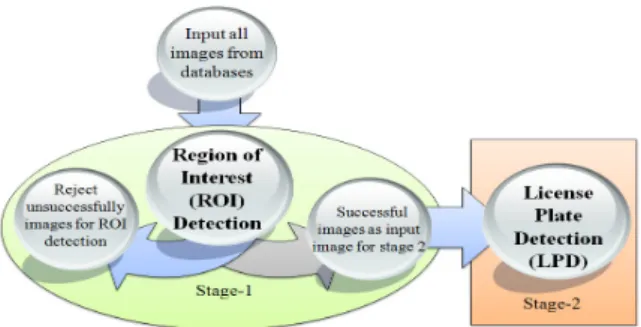
proposed method consist of two main steps: (I)
Fig. 5. Cropping the image
Region of Interest (ROI) Detection and (II) License Plate Detection (LPD). Before detection of license plate using the energy map, a target range to be investigated for detecting a region with high energy value is localized from a whole image to a relatively small region called ROI.
Fig. 3. The system diagram of proposed LPD System Using Heuristic Energy Map
3.1. Region of Interest (ROI) Detection The Region of Interest (ROI) Detection finds the position of a car or vehicle in an image. The original image size is very large ( resolution of 1280×720 pixels). Since computational complexity for processing a large image is very high, we do the ROI for reduced the image size first and then find the license plate. This procedure is fast for license plate detection. In the ROI detection part, the image size reduced very effectively with 75.41% from original image size. Fig. 4 shows the work flow of the Region of Interest (ROI) Detection.
Fig. 4. Schematic diagram of Region of Interest (ROI) Detection
There are six steps for ROI detection. Since all images in the database for our experiment have no license plate in the region of 0-200 pixels over width region. For this reason, we can crop and eliminate these regions from original images and resize the input images with a resolution of 1280×520 pixels. Fig. 5 shows an image cropped from an original image. The image is converted from 24-bit color image to 8-bit grayscale image as:
(1)
Prewitt operator, as shown in Fig. 5, is applied to get its edge image from a grayscale image.
The Prewitt operator is based on convoluting the
image with a small, separable, and integer valued
filter in horizontal and vertical direction and is
therefore relatively inexpensive in terms of
computations. On the other hand, the gradient
approximation which it produces is relatively
crude, in particular for high frequency variations
in the image.
Fig. 10. Detection of Region of Interest (ROI)
Fig. 9. Projection on the X (Horizontal) and Y (Vertical) directions of edge image
Fig. 8. (a) 2*5 ‘Rectangular’ Structuring Element, (b) Result obtained after opening operation with Fig. 7(a) Fig. 7. Edge image obtained from a grayscale image using Prewitt operator.
Fig. 6. Convolution masks of Prewitt Operator
Magnitude of the gradient, M is defined as
M = S2x+S
2y(2)
If
M≥threshold,the current pixel is marked as an edge pixel. Fig. 7 shows an edge image obtained from a grayscale image using Prewitt operator.
There are many small edges or components in
an edge image. Morphological opening operation
(first erosion and then dilation) defined in Eq. (3)
is used to remove all of these small components
or edges from the image. Opening is widely used
Fig. 13. Edge image from grayscale image using Sobel vertical edge operator.
Fig. 11. The process of License Plate Detection (LPD) system
for the smoothing of binary scenes and removal of background noise that is of smaller extension than the structuring element.
A○B = ( A⊖B)⊕B
(3)
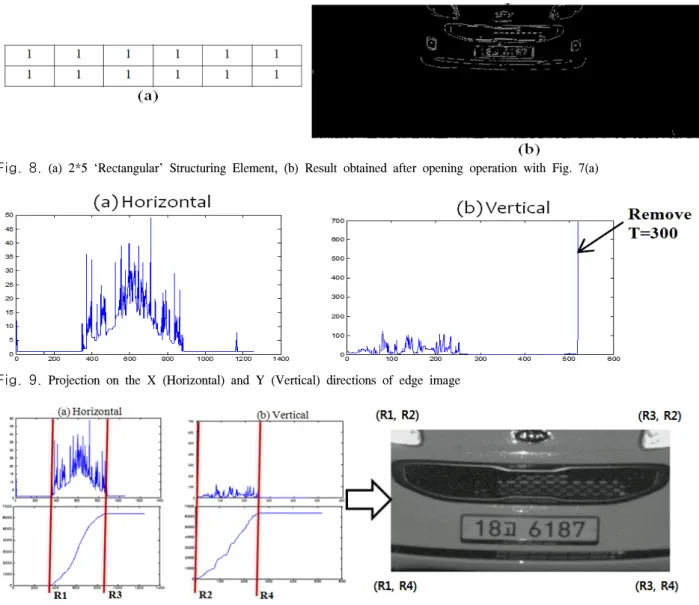
In mathematical morphology, the shape and size of a structuring element plays crucial role in image processing and we use the rectangular structuring elements shown in Fig 8(a). Fig. 8(b) shows the result obtained after opening operation with Fig. 8(a).
After removing small components or edges, projection on the X (horizontal) direction and projection on the Y (vertical) direction of edge image are obtained as shown in Fig. 9. There are some big edges appearing in edge image but not being contained in license plate. So we eliminate those big edges using maximum threshold (we use 300) of vertical projection information.
Finally, four points R1, R2, R3, and R4 are found from horizontal and vertical projection information to determine the Region of Interest (ROI) which contain the maximum histograms or intensity values as shown in Fig. 10.
3.2. License Plate Detection(LPD)
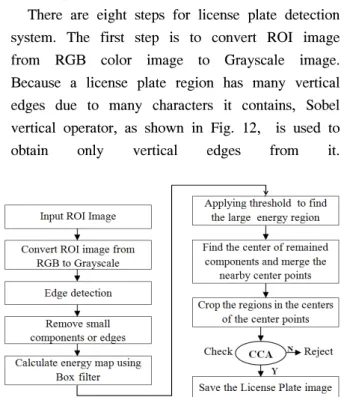
For License Plate Detection (LPD), the ROI image is loaded as an input image. Fig. 11
describes the process of License Plate Detection (LPD) system.
There are eight steps for license plate detection system. The first step is to convert ROI image from RGB color image to Grayscale image.
Because a license plate region has many vertical edges due to many characters it contains, Sobel vertical operator, as shown in Fig. 12, is used to obtain only vertical edges from it.
Fig. 12. Convolution mask of Sobel vertical edge operator
Fig. 16. (a) the image after finding the center of remained components and merging the nearby center points (b) Crop the region in the centers of the center points from ROI image.
Fig. 15. (a) the pseudo code for calculating threshold value (b)image after applying threshold
Fig. 14. (a)Edge image after removing small components or edges (b) Calculating edge image energy map by using Box-filter
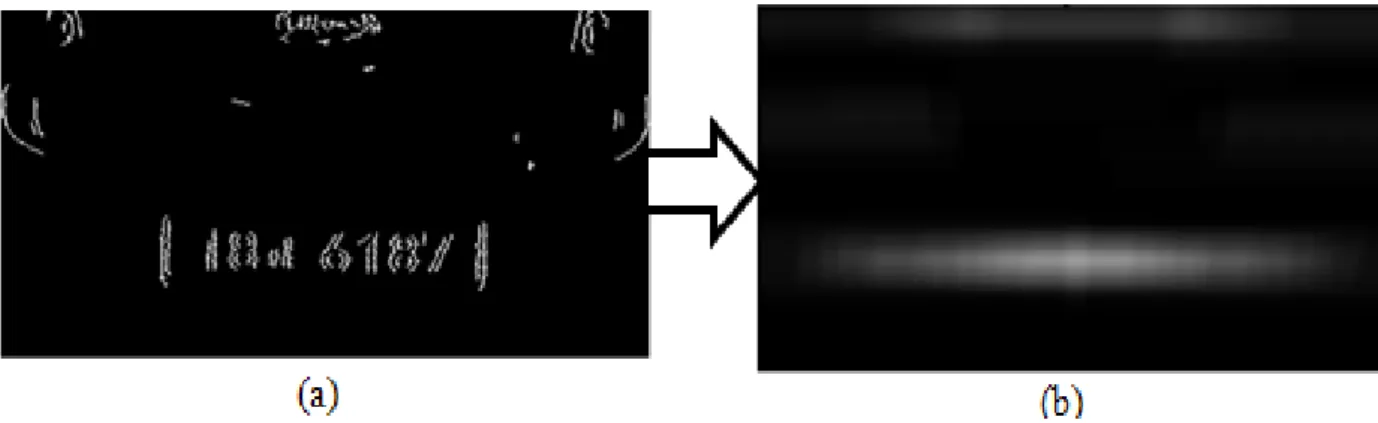
Fig. 13 shows an edge image obtained from a grayscale image using Sobel vertical edge operator. After obtaining vertical edges, the morphological opening operator is also used for removing small components or edges. Now, the box filter
[16]is used to blur the edge image, before calculating the energy map of the edges, as shown in Fig. 14. The kernel K in Eq. (4) is used.
For applying threshold to find the large energy region, we should calculate the threshold value.
Fig. 15 shows the pseudo code for calculating threshold value and image after applying threshold . Then, a centre point of remained components is found as shown in Fig. 16(a) and the region of 100x 40 is determined around the center point.
And then licence plate area is detected by
cropping the region from the ROI image, as
shown in Fig. 16(b). Fig. 17(a) shows some
Number of test images Test accuracy Time
51884 99.5% 70 milliseconds
Table 2.
License plate detectionMethods Main Procedures for License plate
detection
Database
size Image conditions LPD
rate Processi ng time Real
time Plate format
[21] Sliding Concentric
Windows, Histogram 40 images 640x480 pixels (Different distances and
weather, road) 82.5% - - Korean
plates
[22] vertical edge, edge filtering, morphological
operation 350 images Different distances and
lighting condition, road 95.2% - - Iranian
plates
[23] Vertical Edge Detection, Unwanted ines
Elimination
664 images 352x288
(various weather condition, road)
91.65
% 47.7ms Yes Malaysian
plates
[24]
Scan line, texture properties, color, and
Hough transform
332 images 867 × 623 pixels (various illumination and different distances, road)
97.1% 0.53s No Taiwanese
plates
[14] Gaussian Windows 595 images
512x240 (Different distances,
basement garage) 98.7% - - Korean
plates Our
Propose d method
Heuristic energy map 52000 images
1280x720 pixels, (various weather condition and
different illumination, road)
99.2% 130 ms Yes Korean
Plates
Table 3.
Performance Comparison of Some Typical ALPR Systems for License Plate Detection (LPD)Number of test images Image size reduction Test accuracy Time
52000 75.41% 99.7% 60 milliseconds
Table 1.
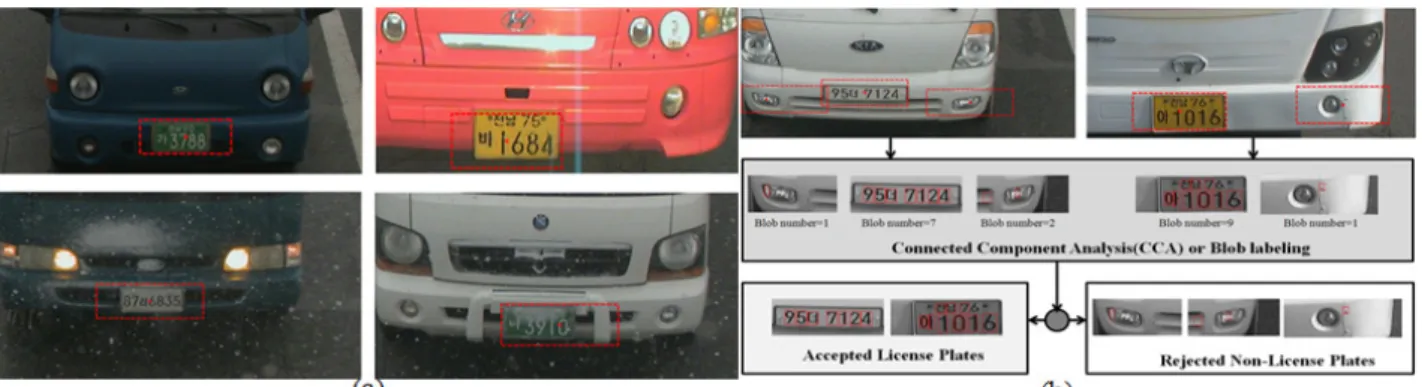
Region of Interest (ROI) detectionresults of successful license plate detection from images under different weather conditions and illuminations, when the heuristic energy map is used.
There are some non license plate area detected as the license plate region by using heuristic energy map. Connected-component labeling is used to delete them
[17-20]. Blob extraction is generally performed on the result from a thresholding step. Blobs may be counted, filtered, and tracked. With the CCA judgment, we can reject the false positive region images and find the only license plate region images and save it, as shown in Fig. 17(b). The method to distinguish license plates from non-license plates is given
below;
If (6 <= the number of blobs <= 10) accept the region as a License Plate.
else
reject the region as a Non-license Plate.
Ⅳ. Experimental results and discussions
We proposed a two-stage method for license
plate detection. So our experimental results will
be divided into two parts. For testing performance
of our proposed method, we use two different
databases. The details experimental results are
presented in the next.
Fig. 17. (a) some results of successful license plate detection from images under different weather conditions and illuminations (b) Example of filtering false positives by CCA
4.1. Databases
For our test experiment, we use two different databases to calculate the detection rate and computational time. The details about databases describe as below;
Database-1: The number of total images is 16000. an image is captured by CMOS camera and the weather was bad (cloudy, raining and snowing) when it was taken.
Database-2: The numbers of total images are 36000. The image is captured by CMOS camera and the weather was good (sunny, clear sky) when it was taken.
Fig. 18 shows the description of image capturing environment.
Fig. 18.The description of image capturing environment
The height of the pole is 6m but the height until the arm (where a image capturing camera is attached) is 5m. The distance from bottom of pole to loop (car position) is 13m. So the angle between camera and loop is 21°. When the images are created by capturing cars running about 100km/hr.
4.2. Experimental results for License Plate Detection by using Heuristic Energy Map
52000 images from our databases are used to verify the proposed method. The experiment is based upon the condition of CPU 3.10-GHz Intel Core i3-2100 with 4.00 GB of RAM and implemented in Matlab R2010a. The following Table 1 shows the performance of the first step of our proposed method, Region of Interest (ROI) detection in image size reduction rate, accuracy, and time. Table 2 shows the performance of the license plate detection (LPD) step in accuracy and computational time.
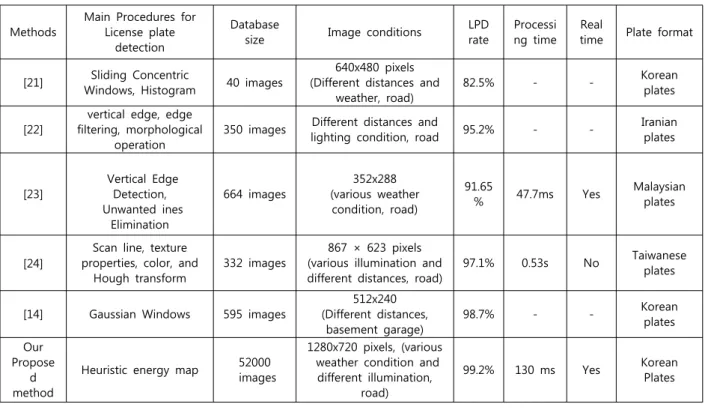
ROI detection step, there are 156 images which are not detected and in license plate detection step, 260 images are missed. In other words, 416 out of 52000 images are missed. Therefore, totally, the average detection rate is 99.2% and computational time is 130 milliseconds. Table 3 shows the performance comparison of the proposed method with other existing methods. It shows that the proposed one is superior in accuracy and speed to the others, even using different data set.
V. Conclusion and future work
This is paper presents a practical license plate
detection system using heuristic energy map of
edges or components of an image. The various of
image processing algorithms are mutually
implemented. We proposed ROI detection to
reduce the big original image size to small image size. The average percentage of image size reduction is 75.41% . It is very quick to detect a license plate from a small image and easy to find it properly. Experimental results show that the proposed method is a simple and effective License Plate Detection (LPD) algorithm. and also show that our method has better performance than the other existing methods. The detection rate of our proposed method is 99.2% with the computational time of 130 milliseconds. Related to proposed methods, further study for improvement of the accuracy and practicality of this method is required. Also, the license plate recognition is our main future work.
References
[1] C. N. E. Anagnostopoulos, I. E.
Anagnostopoulos, V. Loumos, and E. Kayafs,
“A license plate-recognition algorithm for intelligent transportation system applications,”
IEEE Trans. Intell. Transp. Syst., vol. 7. no. 3,
pp. 377-392, Sep. 2006.
[2] C. N. E. Anagnostopoulos, I. E.
Anagnostopoulos, I. D. Psoroulas, V. Loumos, and E. Kayafas, “License plate recognition from still images and video sequences : a survey,” IEEE Trans. Intell. Transp. Syst., vol.
9, no. 3, pp. 377-391, Sep. 2008.
[3] B. Hongliang and L. Changping, “A hybrid license plate extraction method based on edge statistics and morphology,” in Proc. 17th Int.
Conf. Pattern Recognition (ICPR'04), vol. 2,
pp. 831-834, Cambridge, U.K., Aug. 2004.
[4] D. Zheng, Y. Zhao, and J. Wang, “An efficient method of license plate location,”
Pattern Recogn. Lett., vol. 26, no. 15, pp.
2431-2438, Nov. 2005.
[5] P. V. Suryanarayana, S. K. Mitra, A.
Banerjee, and A. K. Roy, “A morphology based approach for car license plate extraction,” in Proc. Annu. IEEE INDICON
2005, pp. 24-27, Chennai, India, Dec. 2005.[6] J. Cano and J.-C. Pérez-Cortés, “Vehicle
license plate segmentation in natural images,”
Lecture Notes Comput. Sci., vol. 2652. pp.
142-149, June 2003.
[7] L. Hsi-Jian, C. Si-Yuan, and W. Shen-Zheng,
“Extraction and recognition of license plates of motorcycles and vehicles on highways,” in
Proc. 17th Int. Conf. Pattern Recognition (ICPR'04), vol. 4, pp. 356-359, Cambridge,U.K., Aug. 2004.
[8] K. Fatih, K. Binnur, and G. Muhittin,
“License plate character segmentation based on the Gabor transform and vector quantization,” Lecture Notes Comput. Sci., vol.
2869. pp. 381-388, Nov. 2003.
[9] L. Miao, F. Wang, and H. Wang, “Automatic license plate detection based on edge density and color model,” in Proc. Annu. Conf.
Chinese Control Decision Conf. (CCDC’09),
pp. 3718-3721, Guilin, China, June 2009.
[10] K. Deb and K.-H. Jo, “HSI color based vehicle license plate detection,” in Proc. Int.
Conf. Control, Automation, Syst. (ICCAS 2008), pp. 687-691, Seoul, Korea, Oct. 2008.
[11] M. I. Chacon M and A. Zimmerman S,
“License plate location based on a dynamic PCNN scheme,” in Proc. Int. Joint Conf.
Neural Networks, vol. 2, pp. 1195-1200,
Portland, U.S.A., July 2003.
[12] K. K. Kim, K. I. Kim, J. B. Kim, and H. J.
Kim, “Learning-based approach for license plate recognition,” in Proc. 2000 IEEE Signal
Process. Soc. Workshop Neural Networks Signal Process. X, vol. 2, pp. 614-623,Sydney, Australia, Dec. 2000.
[13] Y.-N. Chen, C.-C. Han, C.-T. Wang, B.-S.
Jeng, and K.-C. Fan, “The application of a convolution neural network on face and license plate detection,” in Proc. 18th Int.
Conf. Pattern Recognition (ICPR 2006), pp.
552-555, Hong Kong, China, Aug. 2006.
[14] Y. Kang and C. Bae, “License plates detection using a Gaussian windows,” J. Korea Inform.
Commun. Soc. (KICS), vol. 37A, no. 9, pp.
780-785, Sep. 2012.
[15] M. Yu and Y. D. Kim, “An approach to
Korean license plate recognition based on vertical edge matching,” in Proc. 2000 IEEE
Int. Conf. Syst., Man, Cybernetics, vol. 4, pp.2975–2980, Nashville, U.S.A., Oct. 2000.
[16] M. J. McDonnell, “Box-filtering techniques,”
Computer Graphics Image Process., vol. 17,
no. 1, pp. 65-70, Sep. 1981.
[17] H. Samet and M. Tamminen, “Efficient component labeling of images of arbitrary dimension represented by linear bintrees,”
IEEE Trans. Pattern Anal. Mach. Intell., vol.
10, no. 4, pp. 579-586, July 1988.
[18] M. B. Dillencourt, H. Samet, and M.
Tamminen, “A general approach to connected-component labeling for arbitrary image representations,” J. ACM, vol. 39, no.
2, pp. 253-280, Apr. 1992.
[19] W. Chen, M. L. Giger, and U. Bick, “A fuzzy c-means (FCM)-based approach for computerized segmentation of breast lesions in dynamic contrast-enhanced MR Images,”
Academic Radiology, vol. 13, no. 1, pp. 63-72,
Jan. 2006.
[20] K. Wu, W. Koegler, J. Chen, and A.
Shoshani, “Using bitmap Index for interactive exploration of large datasets,” in Proc. 15th
Int. Conf. Sci. Stat. Database Manage., pp.99-108, Cambridge, U.S.A., July 2003.
[21] K. Deb, H. Chae, and K. Jo, “Vehicle license plate detection method based on sliding concentric windows and histogram,” J.
Comput., vol. 4, no. 8, pp.771–777, Aug.
2009.
[22] M. Ashoori-Lalimi and S. Ghofrani, “An efficient method for vehicle license plate detection in complex scenes,” Circuits Syst., vol. 2, no. 4, pp. 320-325, Oct. 2011.
[23] A. M. Al-Ghaili, S. Mashohor, A. R. Ramli, and A. Ismail, “Vertical edges-based car license plate detection method,” IEEE Trans.
Veh. Technol., vol. 62, no. 1, pp. 26-38, Oct.
2012.
[24] J.-M. Guo and Y.-F. Liu, “License plate localization and character segmentation with feedback self-learning and hybrid binarization
techniques,” IEEE Trans. Veh. Technol., vol.
57, no. 3, pp. 1417–1424, May 2008.
Md.Mostafa Kamal Sarker
He received his B.Sc degree from Shahjalal University of Science and Technology, Sylhet, Bangladesh in 2008.
And in 2013 he received his M.S degree from Chonbuk National University, Republic of Korea. His research interest includes Image Processing, Digital Image Processing, and Machine Learning. His research area includes Artificial Intelligence.
Sook Yoon
She received the B.S., M.S., and Ph.D. degrees in engineering from
Chonbuk National
University, Jeonbuk, Korea, in 1993, 1995, and 2003, respectively.
Until June 2006, she conducted her postdoctoral research work in electrical engineering at the University of California, Berkeley. She is presently a associate professor at Department of Multimedia Engineering, Mokpo National University, Jeonnam, Korea. Her current research interests include image processing, pattern recognition, machine learning, and multimedia computing.
Jaehwan Lee
He received the B.S degree from Chonbuk National University, Korea in 2012.
Now he is M.S student
with Chunbuk National
University, Korea. His
research interest includes
Image Processing, Signal Processing, Machine
learning.
Dong Sun Park