• 검색 결과가 없습니다.

Comparison of Temperature Distribution in Agar Phantom and Gel Bolus Phantom by Radiofrequency Hyperthermia

N/A
N/A
Protected

Academic year: 2021

Share "Comparison of Temperature Distribution in Agar Phantom and Gel Bolus Phantom by Radiofrequency Hyperthermia"

Copied!
8
0
0

로드 중.... (전체 텍스트 보기)

전체 글

(1)

https://doi.org/10.14316/pmp.2016.27.4.224 pISSN 2508-4445, eISSN 2508-4453

Received 16 December 2016, Revised 0 000 2016, Accepted 0 000 2016

Correspondence: Sung Kyu Kim ([email protected]) Tel: 82-53-620-3373, Fax: 82-53-624-3599

cc This is an Open-Access article distributed under the terms of the Creative Commons Attribution Non-Commercial License (http://creativecommons.org/licenses/by-nc/4.0) which permits unrestricted non-commercial use, distribution, and reproduction in any medium, provided the original work is properly cited.

Comparison of Temperature Distribution in Agar Phantom and Gel Bolus Phantom by Radiofrequency Hyperthermia

Dong Kyung Jung*, Sung Kyu Kim

, Joon Ha Lee

, Sang Mo Youn*, Hyung Dong Kim*, Se An Oh

§

, Jae Won Park

, Ji Won Yea

*Department of Radiation Oncology, Daegu Fatima Hospital,

Departments of Radiation Oncology, Yeungnam University College of Medicine,

Department of Biochemistry & Molecular Biology, Yeungnam University College of Medicine,

§
Department of Radiation Oncology, Yeungnam University Medical Center, Daegu, Korea

The usefulness of Gel Bolus phantom was investigated by comparing the temperature distribution characteristic of the agar phantom produced to investigate the dose distribution characteristic of radiofrequency hyperthermia device with that of the Gel Bolus phantom under conditions similar to those of an agar phantom that can continuously carry out temperature measurement. The temperatures of the agar phantom and the Gel Bolus phantom were raised to 36.5±3

o

C and a temperature sensing was inserted at depths of 5, 10, and 15 cm from the phantom central axis. The temperature increase rate and the coefficient of determination were analyzed while applying output powers of 100 W and 150 W, respectively, at intervals of 1 min for 60 min under conditions where the indoor temperature was in the range 24.5∼27.5

o

C, humidity was 35∼40%, internal cooling temperature of the electrode was 20

o

C, size of the upper electrode was 250 mm, and the size of the lower electrode was 250 mm. The coefficients of determination of 150 W output power at the depth point of 5 cm from the central axis of the phantom were analyzed to be 0.9946 and 0.9926 in the agar and Gel Bolus phantoms, respectively; moreover, the temperature change equation of the agar and Gel Bolus phantoms with time can be expressed as follows in the state the phantom temperature is raised to 36

o

C: Y(G) is equation of Gel Bolus phantoms (in 5 cm depth) applying output power of 150 W. Y(G)=0.157X+36. It can be seen that if the temperature is measured in this case, the Gel Bolus phantom value can be converted to the measured value of the agar phantom. As a result of comparing the temperature distribution characteristics of the agar phantom of a human-body-equivalent material with those of the Gel Bolus phantom that can be continuously used, the usefulness of Gel Bolus phantom was exhibited.

󰠏󰠏󰠏󰠏󰠏󰠏󰠏󰠏󰠏󰠏󰠏󰠏󰠏󰠏󰠏󰠏󰠏󰠏󰠏󰠏

Key Words: Ratio frequency hyperthermia device, dose distribution characteristic, agar phantom, and Gel Bolus phantom

Introduction

As cancer incidence rate increases every year due to genetic and environmental factors, various cancer treatment methods are also gaining interests. The various approaches to treat can- cers include surgery, anti-cancer therapy, and radiotherapy.

1,2)

However, cancer cells cannot be completely removed by sur-

gery; moreover, if cancer has metastasized to other organs, ra-

diation is to be applied, in which case, normal tissues are in-

evitably damaged by the radiation. The method of treating can-

cer by administering anti-cancer drugs causes a side effect of

damaging normal tissues. Recently, radiofrequency hyperthermia

as a cancer treatment method that does not damage normal tis-

sues while destroying cancer cells is gaining interest. As it

maintains the normal tissues of the human body by minimizing

the side effect on the cells and tissues inside human body

while focusing on damaging cancer cells, it is widely used in

clinical treatment.

3)

It is based on the principle that human tis-

(2)

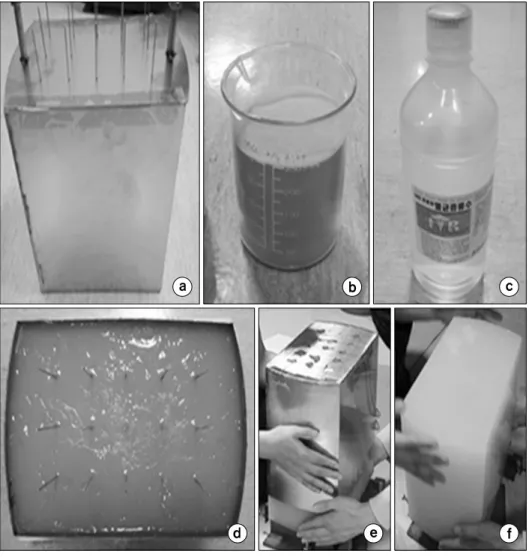
Fig. 1. Making of agar phantom:

(a) Agar phantom mold, (b) Agar powder of MSC Co. Ltd, (c) Sterile water, (d) Gel agar solidi- fied with phantom, (e) Gel agar phantom separated from the mold, (f) Completed production of agar phantom.

sues sensitive to heat, such as those affected by cancer, are easily damaged when exposed to a temperature of 42.5

o

C or higher. The advantage of hyperthermia is that the treatment ef- ficiency is increased by 1.1 to 6.14 times without causing any side effects on patients with diverse types of cancers.

4-7)

As ra- diofrequency hyperthermia is used directly on the affected area, it is essential to manage the accuracy of the radiofrequency hy- perthermia device. While applying a radiofrequency hyper- thermia device clinically, a hyperthermia plan for the treatment of cancer should be established, and measurement of the actual temperature inside the hyperthermia should be performed regu- larly to efficiently transfer thermal energy to the cancer cells.

Currently, in clinical applications, the temperature rise and dis- tribution of a radiofrequency hyperthermia device are measured using an agar phantom, a human-body-equivalent material.

However, as agar phantom is vulnerable to long-term preserva-

tion, a new phantom, Gel Bolus phantom, was produced by comparing its temperature distribution characteristics with those of the existing agar phantom. This new Gel Bolus phantom can be used for the hyperthermia device. The temperature dis- tribution characteristic of the Gel Bolus phantom was also studied.

Materials and Methods

Celsius TCS, Celsius42+ GmbH (Celsius, Germany) in the

radiofrequency hyperthermia device, and, to measure the tem-

perature of the produced “Gel Bolus phantom”, Tempsens

(TMS-G4-10-100SCA-M2-C42, Canada), a thermometer, and a

temperature sensor (OTG-MPK5, Canada) were used. Moreover,

powder agar CAR-15 (MSC Co., Korea) was used to produce

agar phantom and super flex bolus (BOL-X II, USA) was used

(3)

Fig. 2. Gel bolus phantom.

Fig. 4. Illustration of the simulation model on the gel bolus phantom.

Fig. 3. Illustration of the simulation model on the agar phantom.

to produce the Gel Bolus.

1. Production of agar phantom

To produce an agar phantom in the form of the lower abdo- men of a human body, an agar phantom mold in the size of 300×300×200 mm was produced using 2-mm-thick austenitic stainless steel KS STS304, and a mixture of 100 ml powder agar and 19,000 ml sterile distilled water was poured into the mold and separated from it after a 24-h solidification process (Fig. 1).

2. Production of Gel Bolus phantom

A human-body-equivalent material, which is chemically composed of elements such as carbon, oxygen, hydrogen, and phosphorus, and with a specific gravity similar to that of water (density of 1.03 g/cm

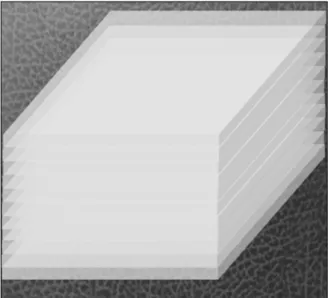
3

), was banked up to 200 mm. The height of the Gel Bolus was same as that of the agar phantom, so as to not allow the generation of any air layer between the surfaces of the bolus (Fig. 2).

3. Measurement of temperature distribution at depth points

The temperatures of the agar and Gel Bolus phantoms were raised to 36.5±3

o

C, and a temperature sensor was inserted at the depths of 5, 10, and 15 cm from the phantom central axis.

The rate of temperature increase and the coefficient of deter-

mination were analyzed while applying output powers of 100 W and 150 W, respectively, at intervals of 1 min for 60 min under conditions where the indoor temperature was in the range 24.5∼27.5

o

C, humidity was 35∼40%, internal cooling temperature of the electrode was 20

o

C, size of the upper elec- trode was 250 mm, and the size of the lower electrode was 250 mm (Figs. 3 and 4).

Result

1. Temperature distribution in the agar phantom

The analysis of the temperature change of 360 kJ at depth

points with the output power of 100 W applied for 60 min in-

dicated that the coefficients of determination were 0.9946,

0.9835, and 0.9949 at depths of 5, 10, and 15 cm, respec-

tively. In addition, the temperature of the agar phantom rose

by 1

o

C at 9.06, 10.95, and 9.94 min at depths of 5, 10, and

15 cm from the phantom central axis, respectively (Fig. 5).

(4)

Fig. 5. Depth of measurement temperature on the agar phantom for 60 min at 100 W output power.

Fig. 7. Depth of measurement temperature on the gel bolus phantom for 60 min at 100 W output power.

Fig. 6. Depth of measurement temperature on the agar phantom for 60 min at 150 W output power.

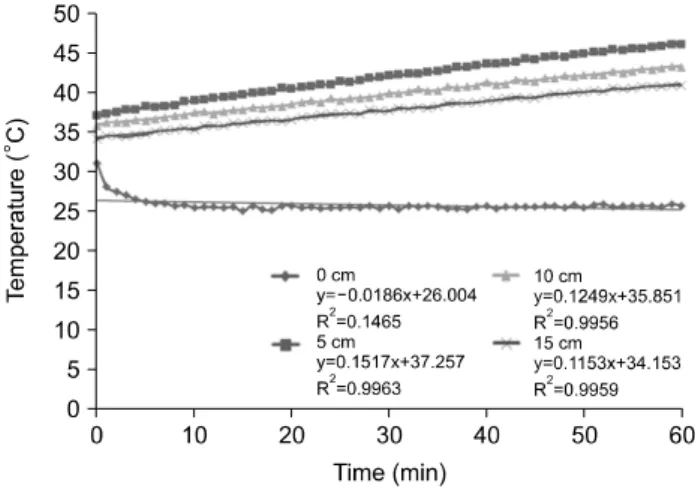
Fig. 8. Depth of measurement temperature on gel bolus phantom for 60 min at 150 W output power.

The analysis of the temperature change of 540 kJ at depth points with the output power of 150 W applied for 60 min in- dicated that the coefficients of determination were 0.9982, 0.9968, and 0.9977 at depths of 5, 10, and 15 cm, respec- tively. In addition, temperature of the agar phantom rose by 1

o

C at 6.33, 6.29, and 6.77 min at depths of 5, 10, and 15 cm from the phantom central axis, respectively (Fig. 6).

2. Temperature distribution in the Gel Bolus phantom The analysis of the temperature change of 360 kJ at depth points with the output power of 100 W applied for 60 min in- dicated that the coefficients of determination were 0.9926, 0.9934, and 0.9908 at depths of 5, 10, and 15 cm, respec-

tively. In addition, the temperature of the agar phantom rose by 1

o

C at 11.93, 12.45, and 14.18 min at depths of 5, 10, and 15 cm from the phantom central axis, respectively (Fig. 7).

of the analysis of the temperature change of 540 kJ at deep

points with the output power of 150 W applied for 60 min in-

dicated that the coefficients of determination were 0.9963,

0.9956, and 0.9959 at depths of 5, 10, and 15 cm, respec-

tively. In addition, the temperature of the agar phantom rose

by 1

o

C at 6.59, 8.01, and 8.67 min at depths of 5, 10, and 15

cm from the phantom central axis, respectively (Fig. 8).

(5)

Fig. 9. 5-cm depth for 60 min at 100 W output power for the temperature analysis of the agar and gel bolus phantoms.

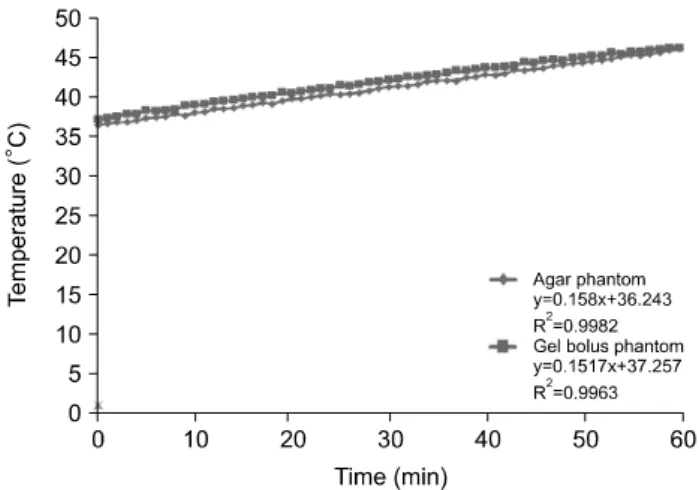
Fig. 10. 5-cm depth for 60 min at 150 W output power for the temperature analysis of the agar and gel bolus phantoms.

3. Comparative analysis of the temperatures measured in the agar and Gel Bolus phantoms

1) Comparison of the temperatures measured at 5-cm depth with 100 W output power: The coefficients of determination obtained with 100 W output power at the depth of 5 cm from the phantom central axis were 0.9946 in the agar phantom and 0.9926 in the Gel Bolus phantom, and the time taken for a temperature increase of 1

o

C in the Gel Bolus phantom was analyzed to be 11.93 min, which was 2.87 min longer than 9.06 min, the time taken in the agar phantom. The temperature rise gradients of the agar and Gel Bolus phantoms were found to be 0.1104 and 0.0838, respectively (Fig. 9).

2) Comparison of the temperatures measured at 5-cm depth with 150 W output power: The coefficients of determination obtained with 150 W output power at the depth of 5 cm from the phantom central axis were 0.9982 in the agar phantom and 0.9963 in the Gel Bolus phantom, and the time taken for a temperature increase of 1

o

C in the Gel Bolus phantom was analyzed to be 6.59 min, which was 0.26 min longer than 6.33 min, the time taken in the agar phantom. The temperature rise gradients of the agar and Gel Bolus phantoms were found to be 0.158 and 0.1517, respectively (Fig. 10). The equations of temperature change with time of the agar and Gel Bolus phantoms can be expressed as follows in the state the phantom temperature is raised to 36

o

C:

Y(A)=0.158X+36 (1)

Y(G)=0.157X+36 (2)

Here, Y(A) is the agar phantom function, Y(G) is the Gel Bolus phantom function, and X represents time.

By comparing Equations (1) and (2), if the output is set to 150 W and the temperature is measured at 5-cm depth, the Gel Bolus phantom value can be converted to the measured value of the agar phantom.

3) Comparison of the temperatures measured at 10-cm depth with 100 W output power: The coefficients of determination obtained with 100 W output power at the depth of 10 cm from the phantom central axis were 0.9935 in the agar phantom and 0.9934 in the Gel Bolus phantom, and the time taken for a temperature increase of 1

o

C in the Gel Bolus phantom was analyzed to be 12.48 min, which was 1.53 min longer than 10.95 min, the time taken in the agar phantom. The temperature rise gradients of the agar and Gel Bolus phantoms were found to be 0.0913 and 0.0803, re- spectively (Fig. 11).

4) Comparison of the temperatures measured at

10-cm depth with 150 W output power: The coefficients

of determination obtained with 150 W output power at the

depth of 10 cm from the phantom central axis were 0.9967 in

the agar phantom and 0.9956 in the Gel Bolus phantom, and

the time taken for a temperature increase of 1

o

C in the Gel

Bolus phantom was analyzed to be 8.01 min, which was 1.72

(6)

Fig. 11. 10-cm depth for 60 min at 100 W output power for the temperature analysis of the agar and gel bolus phantoms.

Fig. 13. 15-cm depth for 60 min at 100 W output power for the temperature analysis of the agar and gel bolus phantoms.

Fig. 14. 15-cm depth for 60 min at 150 W output power for the temperature analysis of the agar and gel bolus phantoms.

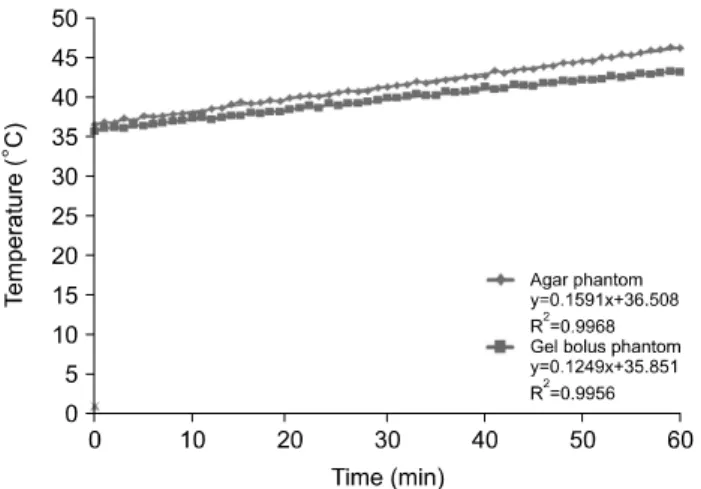
Fig. 12. 10-cm depth for 60 min at 150 W output power for the temperature analysis of the agar and gel bolus phantoms.

min longer than 6.29 min, the time taken in the agar phantom.

The temperature rise gradients of the agar and Gel Bolus phantoms were found to be 0.1591 and 0.1249, respectively (Fig. 12).

5) Comparison of the temperatures measured at 15-cm depth with 100 W output power: The coefficients of determination obtained with 100 W output power at the depth of 15 cm from the phantom central axis were 0.9949 in the agar phantom and 0.9908 in the Gel Bolus phantom, and the time taken for a temperature increase of 1

o

C in the Gel Bolus phantom was analyzed to be 14.18 min, which was 4.24 min longer than 9.94 min, the time taken in the agar phantom.

The temperature rise gradients of the agar and Gel Bolus

phantoms were found to be 0.1006 and 0.0705, respectively (Fig. 13).

6) Comparison of the temperatures measured at

15-cm depth with 150 W output power: The coefficients

of determination obtained with 150 W output power at the

depth of 10 cm from the phantom central axis were 0.9977 in

the agar phantom and 0.9956 in the Gel Bolus phantom, and

the time taken for a temperature increase of 1

o

C in the Gel

Bolus phantom was analyzed to be 8.67 min, which was 1.9

min longer than 6.77 minutes, the time taken in the agar

phantom. The temperature rise gradients of the agar and Gel

Bolus phantoms were found to be 0.1477 and 0.1153, re-

spectively (Fig. 14).

(7)

Discussion and Conclusion

The comparison of the permittivity of the two phantoms re- sulting from their material properties can enable us to derive appropriate equations. Owing to the time it takes to produce an agar phantom, it is impossible to use the agar phantom if the temperature is required to be measured suddenly for accu- racy management of a hyperthermia device. However, as a Gel Bolus phantom can measure the temperature of a hyperthermia device immediately in an emergency, it is assumed to be fea- sible as a substitutive phantom if the temperature is measured at a depth of 5 cm using with 150 W output power.

For cancer treatment, surgery, anti-cancer therapy, radio- therapy, and hyperthermia are employed. Among these, as hy- perthermia causes less damage to normal tissues than when treated with radiotherapy and the radiation chemistry therapy, it has become an acceptable approach in the cancer treatment field.

8,9)

As new blood vessels of cancer cells have more im- paired blood flow than normal blood vessels, they are easily destroyed when a temperature increase is induced, because the vascular system cannot be maintained.

10,11)

Moreover, if hyper- thermia is carried out parallel with the oxygen regeneration ef- fect, the treatment effect can be enhanced by increasing the chemosensitivity to cancer tissues.

12,13)

A radiofrequency hyper- thermia device effectively transfers thermal energy to cancer cells. However, as a radiofrequency hyperthermia device is di- rectly used on the affected area, it is essential to manage the accuracy of temperature change. In this study, the agar used to develop the human body model phantom is a material that is frequently used by bionics researchers as it is composed of a human-body-equivalent material having a physical character- istic where the shape can be easily changed.

14,15)

However, agar phantom biologically allows bacteria such as mildew to easily reproduce. Accordingly, the temperature was measured using the Gel Bolus phantom, also composed of a human- body-equivalent material used for radiation oncology. The co- efficients of determination of the agar phantom when the out- put powers were 100 W and 150 W were found to be between 0.9935 and 0.9982, and those of the Gel Bolus phantom were between 0.9926 and 0.9956, respectively, which are shown to be close to 1. Further, it was observed that the time taken for

a temperature rise lengthened by 2.87 min when the output was 100 W and 1.29 min when the output was 150 W. The temperature rise gradient correction factor of the Gel Bolus phantom was between 1.137 and 1.427 when the output power was 100 W and between 1.042 and 1.281 when the output power was 150 W.

Through this study, the temperature distribution of a radio- frequency hyperthermia device could be determined using the proportional index and the time taken for temperature rise when an agar phantom and a newly produced Gel Bolus phan- tom, both composed of human-body-equivalent materials, were appropriately used. It showed the usefulness of the Gel Bolus phantom.

References

1. Byun YJ, Lee EH, Lee JP, Chang KH, Ryu HS: The ef- fect of hormone replacement therapy on osteoporosis following irradiation of gynecologic cancer patients. J Gynecol Oncol 16(1): 53-60 (2005)

2. Chung IY, Kim EJ, Park JM, Yoo JM: Results of combined chemotherapy and radiotherapy for advanced intraocular retino- blastoma, Korean J Ophthalmol 44(7): 1528-1537 (2003) 3. Kim MO: Concurrent chemoradiotherapy of locally advanced

pancreatic carcinoma and effects of hyperthermia. Korean Cancer Association 26(4): 561-566 (1994)

4. Cui ZG, Piao JL, Rehman MU, Ogawa R, Li P, Zhao QL, et al: Molecular mechanisms of hyperthermia-induced apoptosis enhanced by withaferin A. Eur J Pharmacol 15(723):

99-107 (2014)

5. Hatashita M, Taniguchi M, Baba K, Koshiba K, Sato T, Jujo Y, et al: Sinodielide A exerts thermosensitizing effects and induces apoptosis and G2/M cell cycle arrest in DU145 hu- man prostate cancer cells via the Ras/Raf/MAPK and PI3K/Akt signaling pathways. Int J Mol Med 33(2): 406-414 (2014) 6. Song X, Kim SY, Lee YJ: Evidence for two modes of syner-

gistic induction of apoptosis by mapatumumab and oxaliplatin in combination with hyperthermia in human colon cancer cells.

PLoS One 8(8): e73654 (2013)

7. Jiang W, Bian L, Wang N, He Y: Proteomic analysis of protein expression profiles during hyperthermia-induced apopto- sis in Tca8113 cells. Oncol Lett 6(1): 135-143 (2013) 8. Jang HS: Clinical trial of concomitant thermo-chemotherapy in

cervix cancer patients. Korean Cancer Association 27(6):

968-977 (1995)

9. Suh CO, Loh JK, Seong JS, Roh JK, Kim BS, Park IS, et al: Effect of radiofrequency hyperthermia on hepatocellular carcinoma. Korean Cancer Association 20(2): 117-125 (1988) 10. Solopan S, Belous A, Yelenich A, Bubnovskaya L,

Kovelskaya A, Podoltsev A, et al: Lanthanum-strontium

(8)

manganite magnetic fluid as potential inducer of tumor hyperthermia. Exp Oncol 33(3): 130-135 (2011)

11. Lui PC, Fan YS, Xu G, Ngai CY, Fung KP, Tse GM, et al: Apoptotic and necrotic effects of tumour necrosis factor-al- pha potentiated with hyperthermia on L929 and tumour necrosis factor-alpha-resistant L929. Int J Hyperthermia 26(6): 556-564 (2010)

12. Thews O, Lambert C, Kelleher DK, Biesalski HK, Vaupel P, Frank J: Impact of therapeutically induced reactive oxygen species and radical scavenging by alpha-tocopherol on tumor cell adhesion. Oncol Rep 18(4): 965-971 (2007) 13. Ahmed K, Zhao QL, Matsuya Y, Yu DY, Salunga TL,

Nemoto H, et al: Enhancement of macrosphelide-induced apoptosis by mild hyperthermia. Int J Hyperthermia 23(4):

353-361 (2007)

14. Sikora M, Gese A, Czypicki R, Gąsior M, Tretyn A, Chojnowski J, et al: Correlations between polymorphisms in genes coding elements of dopaminergic pathways and body mass index in overweight and obese women. Endokrynol Pol 64(2): 101-107 (2013)

15. Frascione N, Pinto V, Daniel B: Development of a bio- sensor for human blood: new routes to body fluid identification.

Anal Bioanal Chem 404(1): 23-28 (2012)

수치

Fig.  1.  Making  of  agar  phantom:
Fig.  4.  Illustration  of  the  simulation  model  on  the  gel  bolus  phantom.
Fig.  6.  Depth  of  measurement  temperature  on  the  agar  phantom  for  60  min  at  150  W  output  power.
Fig.  9.  5-cm  depth  for  60  min  at  100  W  output  power  for  the  temperature  analysis  of  the  agar  and  gel  bolus  phantoms.
+2

참조

관련 문서

(Purpose) Recently early detection of gastric cancer and rate of preoperative staging are increasing due to development of endoscopy and imaging technique,

The contemporary music of the twentieth century due to various and new changes in the style of presentation, shows dramatic differences in comparison to

In order to analyze thermal stability and capacity loss according to the temperature of the battery cell by applying different C-rate discharge and

The data are corrected for temperature error due to solar radiation and the effect of low temperature on the anerod capsule and curvature of the surface of

In Section 2, social deficiency, various deficits in relation to society were considered based on various social phenomena, and by referencing Erik

To visualize the vari- ation in various transport characteristics (the non-dimen- sional axial velocity and temperature distributions, pressure gradient, rate of heat

As a result of 1 st clean flotation, it found that various bubble size distribution increases its recovery and increasing of bias increases its grade,

The purpose of this study was to provide primary material in discussing methods to activate the treatment effects of diabetes and reduce the rate of