• 검색 결과가 없습니다.

Fabrication of a Patient-Customized Helmet with a Three-Dimensional Printer for Radiation Therapy of Scalp

N/A
N/A
Protected

Academic year: 2021

Share "Fabrication of a Patient-Customized Helmet with a Three-Dimensional Printer for Radiation Therapy of Scalp"

Copied!
6
0
0

로드 중.... (전체 텍스트 보기)

전체 글

(1)

Original Article

Fabrication of a Patient-Customized Helmet with a

Three-Dimensional Printer for Radiation Therapy of Scalp

Se An Oh*, Chang Min Lee , Min Woo Lee , Yeong Seok Lee , Gyu Hwan Lee , Seong Hoon Kim*, Sung Kyu Kim*, Jae Won Park*, Ji Woon Yea*

*Department of Radiation Oncology, Yeungnam University Medical Center, Daegu, Gyeongnam Science High School, Jinju, Korea

Received 13 September 2017 Revised 27 September 2017 Accepted 28 September 2017

Corresponding author Ji Woon Yea ([email protected]) Tel: 82-53-620-3371 Fax: 82-53-624-3599

The purpose of the present study was to develop and evaluate patient-customized helmets with a three-dimensional (3D) printer for radiation therapy of malignant scalp tumors. Computed tomography was performed in a case an Alderson RANDO phantom without bolus (Non_Bolus), in a case with a dental wax bolus on the scalp (Wax_Bolus), and in a case with a patient-customized helmet fabricated using a 3D printer (3D Printing_Bolus); treatment plans for each of the 3 cases were compared. When wax bolus was used to fabricate a bolus, a drier was used to apply heat to the bolus to make the helmet. 3-matic ® (Materialise) was used for modeling and polyamide 12 (PA- 12) was used as a material, 3D Printing bolus was fabricated using a HP JET Fusion 3D 4200. The average Hounsfield Unit (HU) for the Wax_Bolus was − 100, and that of the 3D Printing_Bolus was

− 10. The average radiation doses to the normal brain with the Non_Bolus, Wax_Bolus, and 3D Printing_Bolus methods were 36.3%, 40.2%, and 36.9%, and the minimum radiation dose were 0.9%, 1.6%, 1.4%, respectively. The organs at risk dose were not significantly difference. However, the 95% radiation doses into the planning target volume (PTV) were 61.85%, 94.53%, and 97.82%, and the minimum doses were 0%, 77.1%, and 82.8%, respectively. The technique used to fabricate patient-customized helmets with a 3D printer for radiation therapy of malignant scalp tumors is highly useful, and is expected to accurately deliver doses by reducing the air gap between the patient and bolus.

Keywords: 3D Printer, Radiotherapy, Wax bolus, Patient-customized helmet bolus

Copyright © 2017 Korean Society of Medical Physics

CC
This is an Open-Access article distributed under the terms of the Creative Commons Attribution Non-Commercial License (http://creativecommons.org/licenses/by- nc/4.0) which permits unrestricted non-commercial use, distribution, and reproduction in any medium, provided the original work is properly cited.

Introduction

The efficacy of radiation therapy for malignant scalp tumors becomes substantially lower when the therapy is applied without a bolus, due to failure to deliver the desired radiation dose, caused by build-up of high-energy photon radiation. 1-5) Vyas et al. 6) advised the use of a bolus for radiation therapy of skin cancer.

In order to perform radiation therapy for malignant

scalp tumors, Song et al. 7) conducted various comparative studies on changes in density using a tissue compensator, dosimetry with a helmet bolus, surface dosing during radiation therapy, efficiency in the fabricating process, and comparison of the total period of fabricating by using Bolx- II (Action Products, USA), paraffin wax (Densply, USA), and a solid thermoplastic (Med-Tec, USA).

However, manual fabricate of a bolus using paraffin, which is widely used in most departments of radiation

Progress in Medical Physics 28(3), September 2017

https://doi.org/10.14316/pmp.2017.28.3.100

pISSN 2508-4445, eISSN 2508-4453

(2)

oncology, is time-consuming, and creates an air gap between the fabricated bolus and the patient. An air gap may lower the efficacy of cancer treatment by generating uncertainty in calculating radiation doses. 8-10)

Many studies applying 3D printing technique for radiation therapy have been performed. For example, Yea et al. 11) used a 3D printer to fabricate an anthropomorphic patient-specific head phantom, and reported its usefulness for confirming the radiation dose in patient-specific quality assurance required for complex therapies such as intensity modulated radiation therapy (IMRT). Park et al. 12) fabricated a patient-customized malleable bolus using a

3D scanner and printer, and evaluated its usefulness for radiation therapy.

The purpose of the present study was to develop and evaluate a patient-customized helmet using a 3D printer, in order to resolve the problem of an air gap between the skin of the patient and the bolus.

Materials and Methods

1. Fabricating a helmet using paraffin wax

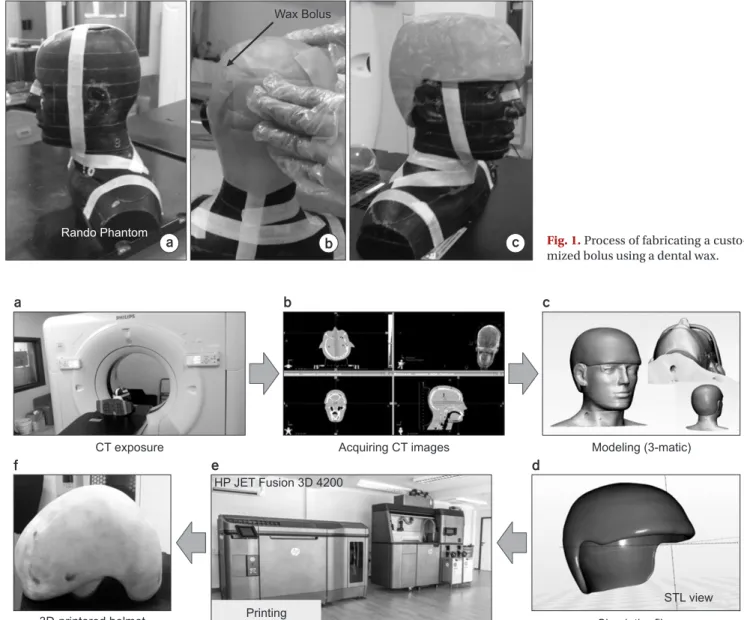
As shown in Fig. 1a, an Alderson RANDO Phantom was

CT exposure

3D-printered helmet

Acquiring CT images Modeling (3-matic)

Printing

Check the files STL view HP JET Fusion 3D 4200

a b c

d f e

Fig. 2. Process of fabricating a customized bolus using a 3D printer (HP JET Fusion 3D 4200) after modelling through 3-matic ® (Materialise, Leuven, Belgium) from CT images of a RANDO phantom.

Fig. 1. Process of fabricating a custo- mized bolus using a dental wax.

Wax Bolus

Rando Phantom

a b c

(3)

used to evaluate the usefulness of a patient-customized helmet bolus created with a 3D printer. In order to fabri- cate a helmet using paraffin, dental wax (DAE-DONG INDUSTRY) currently utilized at our institution was used.

To deliver sufficient radiation dose to scalp tumors, a helmet was fabricated by overlapping 5 sheets of wax with thicknesses of 1.7 mm, as shown in Fig. 1b. The time needed to fabricate the helmet was approximately 3 hours.

Fig. 1c shows Rando phantom using the bolus wax.

2. Fabricating a patient-customized helmet using a 3D printer

In order to fabricate a patient-customized helmet using a 3D printer, an Alderson RANDO phantom was scanned for 1 minute using a Brilliance Big Bore CT Simulator (Philips Inc., Cleveland, OH, USA), as shown in Fig. 2a.

MIMICS software (Materialise, Leuven, Belgium), which shows 3D reconstruction images in transverse, frontal,

and sagittal directions was used to convert Digital Imaging and Communications in Medicine (DICOM) data into stereolithography (STL) format. In addition, 3-matic ® (Materialise), an STL-based modelling tool, was used to fabricate a patient-customized 3D-printed helmet. A 1-mm margin was intentionally designed to easily place the helmet on the RANDO phantom. Fig. 2c shows the modelling process using 3-matic. Fig. 2d shows the process of confirming the modeled patient-customized helmet with STL Viewer. And then, The STL file of the patient- customized helmet was printed in Multi Jet Fusion (MJF) mode using HP JET Fusion 3D 4200, as shown in Fig. 2e.

The MJF is unique mode with HP, but still similar to the Selective Laser Sintering (SLS) mode for melting and stacking metal or polymer powder. 13) The Polyamide-12 (PA-12) approved by FDA (Food and Drug Administration) was used as the printing material. Fig. 2f shows Rando phantom fabricated with patient-customized helmet using the 3D Printer.

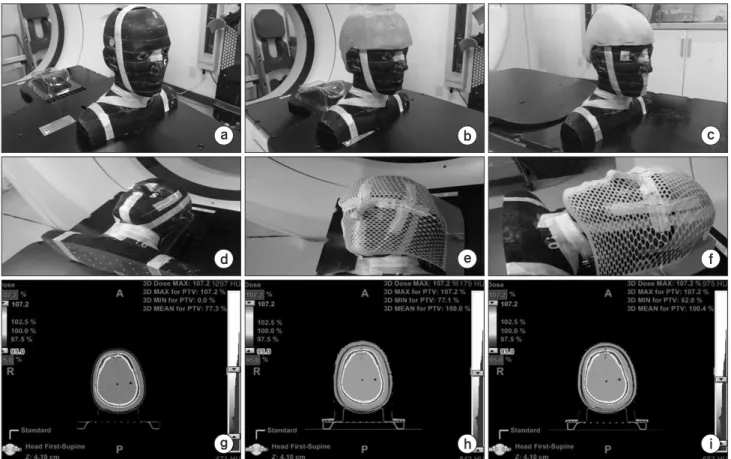
Fig. 3. Images (a), (b), and (c) for a Non_Bolus, Wax_Bolus, and 3D Printing_Bolus; images (d), (e), and (f) taken on a CT couch before imaging; CT Images (g), (h), and (i).

a b c

d e f

g h i

(4)

3. Acquire computed tomography (CT) images

Fig. 3a shows the only RANDO phantom without use of the bolus helmet. Fig. 3b shows the image of the helmet fabricated with wax bolus placed onto the RANDO phantom, and Fig. 3c shows the image of the helmet with the patient-customized helmet printed using a 3D printer.

In Fig. 3e and 3f, a DUON TM (OrfitIndustries, Wijnegem, Belgium) mask was used to fix the bolus and the head component of the RANDO phantom. Fig. 3g, 3h, and 3i are the images obtained by scanning for the Rando phantom with Non_Bolus, Wax_Bolus, and 3D Printing_Bolus, respectively.

4. Radiation treatment planning

The Eclipse Treatment Planning System 8.6 (Varian Medical Systems, Palo Alto, CA, USA) was used. A radiation oncologist contoured for the clinical target volume (CTV) with the skull and body using a Segmentation Wizard, and also set the planning target volume (PTV) by extending the CTV for 5 mm. The treatment plan was used for IMRT technique with 6 MV photons to deliver 2 Gy with 30

fractionations to the PTV. All treatment plans were set by using 9 beams at 40-degrees intervals, and an analytical anisotropic algorithm was used for calculations.

Results

1. Hounsfield unit (HU) evaluation of the customized bolus

The average HU value of a helmet fabricated with dental wax bolus was 100, and the average HU value of a 3D-printed patient-customized helmet was − 10.

2. Evaluations with treatment planning system

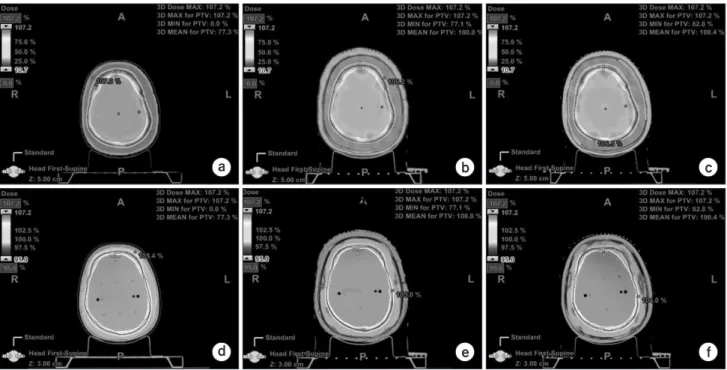
Fig. 4a, 4b, and 4c show the Non_Bolus, Wax_Bolus, and 3D Printing_Bolus dose distribution. Fig. 4d, 4e, and 4f show the 95% dose distribution for each case. Since the maximum dose of the treatment plan for Non_Bolus is 107.2%, the maximum doses of the treatment plans for Wax_Bolus and 3D Printing_Bolus were set to 107.2%

equally. Fig. 4d shows that 95% of the desired dose could not be delivered to the PTV region. On the other hand,

a b c

d e f

Fig. 4. Images (a), (b), and (c) showing radiation therapy plan for the Non_Bolus, Wax_Bolus, and 3D Printing_Bolus; dose distribution

when at least 95% radiation dose is delivered to PTV volume.

(5)

95% of the desired dose was successfully delivered to most of the PTV with use of a customized helmet fabricated by using the Wax_Bolus and 3D Printing_Bolus. Fig. 5 shows the dose volume histograms for the Non_Bolus, Wax_Bolus, and 3D Printing_Bolus. The average radiation dose entering the normal brain were 36.3%, 40.2%, and 36.9%, and the minimum doses were 0.9%, 1.6%, and 1.4%, respectively. However, the 95% radiation dose entering the PTV were 61.85%, 94.53%, and 97.82%, and the minimum doses were 0%, 77.1%, and 82.8%, respectively.

Discussion and Conclusion

In the present study, a patient-customized helmet was fabricated by using a 3D printer in order to resolve the air gap problem raised when using a manually fabricated bolus using paraffin during radiation therapy for malignant scalp tumors. For each of the cases of Non_Bolus, Wax_

Bolus, and 3D Printing_Bolus, CT images were taken and treatment plans were compared. Dosimetric evaluation with the 3D-printed helmet on the RANDO phantom showed that radiation doses into the brain were similar in all 3 cases, but the doses delivered to the PTV were significantly different in each case. While a desired radiation dose was not delivered with the Non-Bolus, the 3D Printing_Bolus was confirmed to deliver a radiation dose similar to that of the Wax_Bolus, which was previously used. Therefore, a patient-customized helmet fabricated with a 3D printer was extremely useful for radiation

therapy.

Fujimoto et al. 2) fabricated a patient-specific bolus using 3D-printing technique and evaluated its clinical feasibility, since a commercial bolus does not completely match irregularities in the patient’s skin. They used 3D Slicer software (ver. 4.2.2; Brigham and Women’s Hospital, Boston, MA, USA) to convert DICOM files into STL files, and used the Laplacian smoothing filter function of MeshLab (ver. 1.3.4; Visual Computing Lab, Pisa, Italy) software to strengthen the adhesion between the patient and the bolus. They also printed the bolus in fused-deposition modeling mode with ABS plastic, which has a density of 1.04 g/cm 3 . According to their report, a 3D-bolus can increase reproducibility of set-up conditions in comparison to a commercial bolus. Moreover, they reported that a 3D bolus is useful for high-accuracy dose delivery through reduction of air gaps, which are unpre- dictable due to irregularity of the patient skin surface. Their conclusions matched those of the present study.

However, a limitation of the present study was the inability to confirm the feasibility of using the bolus in actual patients. However, patients wearing a bolus should have less discomfort when the Wax_Bolus is used, due to its malleability. With the 3D Printing_Bolus, patients may feel uncomfortable when wearing a helmet composed of polyamide 12, which is a hard material. Thus, use of Tango Plus (Stratasys Ltd.), a malleable printing material, is advised in order to lessen patient discomfort from wearing a bolus. 12)

Three hours are required to fabricate a bolus using wax, during which a patient cannot move. A 3D printer only required 30 seconds, which is the duration needed to take a CT image. On the other hand, 19 hours were required to fabricate a patient-customized helmet. For clinical use, 1) reduction in the printing time, 2) lower-cost 3D printing materials, and 3) use of malleable materials to avoid patient discomfort are necessary. If these requirements are met, 3D printing to compensate the radiation dose delivered to the skin for malignant scalp tumors should be extremely useful.

In conclusion, a technique to fabricate patient-custo- mized helmets with a 3D printer for radiation therapy of malignant scalp tumors was developed, and is expected to

0 100

80 60 40

20

Ratio of total structure volume [%]

Relative dose [%]

0

PTV_Non_Bolus PTV_Wax_Bolus PTV_3D Printing_Bolus Brain_Non_Bolus Brain_Wax_Bolus Brain_3D Printing_Bolus

100 80

60 40

20

Fig. 5. Dose-volume histogram for Non_Bolus, Wax_Bolus, and

3D Printing_Bolus.

(6)

be capable of high-accuracy dose delivery by reducing the air gap between the patient and the bolus.

Acknowledgements

This study was supported by the Basic Science Research Program through the National Research Foundation of Korea (NRF) funded by the Ministry of Education (NRF- 2017R1D1A1B03031512), and also by a Korea Foundation for the Advancement of Science and Creativity (KOFAC) grant funded by the Korean government (MOE).

Conflicts of Interest

The authors have nothing to disclose.

Availability of Data and Materials

All relevant data are within the paper and its Supporting Information files.

References

1. Ostheimer C, Hübsch P, Janich M, Gerlach R, Vordermark D. Dosimetric comparison of intensity-modulated radio- therapy (IMRT) and volumetric modulated arc therapy (VMAT) in total scalp irradiation: a single institutional experience. Radiat Oncol J. 2016;34:313.

2. Fujimoto K, Shiinoki T, Yuasa Y, Hanazawa H, Shibuya K. Efficacy of patient-specific bolus created using three- dimensional printing technique in photon radiotherapy.

Phys Med. 2017;38:1-9

3. Wojcicka JB, Lasher DE, McAfee SS, Fortier GA. Dosimetric comparison of three different treatment techniques in extensive scalp lesion irradiation. Radiother Oncol. 2009;

91:255-60.

4. Sponseller P, Paravathaneni U. A case study of radio- therapy planning for intensity modulation radiation therapy for the whole scalp with matching electron treat- ment. Med Dosim. 2013;38:122-4.

5. Song JH, Jung J-Y, Park H-W, et al. Dosimetric comparison of three different treatment modalities for total scalp irradiation: the conventional lateral photon-electron technique, helical tomotherapy, and volumetric-modu- lated arc therapy. J Rad Res. 2014;56: 717-26.

6. Vyas V, Palmer L, Mudge R, et al. On bolus for megavoltage photon and electron radiation therapy. Med Dosim. 2013;

38: 268-73

7. Song YM, Kim JS, Hong CS, Ju SG, Park JY, Park SY.

Comparison of three different helmet bolus device for total scalp irradiation. J Korean Soc Rad Ther. 2012;24:7.

8. Bush K, Gagne I, Zavgorodni S, Ansbacher W, Beckham W. Dosimetric validation of Acuros ® XB with Monte Carlo methods for photon dose calculations. Med Phys. 2011;

38:2208-21.

9. Oh SA, Yea JW, Kang MK, Park JW, Kim SK. Analysis of the setup uncertainty and margin of the daily exactrac 6D image guide system for patients with brain tumors. PloS One. 2016;11:e0151709

10. Oh SA, Kang MK, Kim SK, Yea JW. Comparison of IMRT and VMAT techniques in spine stereotactic radiosurgery with international spine radiosurgery consortium con- sensus guidelines. Prog Med Phys. 2013;24:145-53.

11. Yea JW, Park JW, Kim SK, et al. Feasibility of a 3D-printed anthropomorphic patient-specific head phantom for patient-specific quality assurance of intensity-modulated radiotherapy. PloS One. 2017;12:e0181560.

12. Park JW, Oh SA, Yea JW, Kang MK. Fabrication of malleable three-dimensional-printed customized bolus using three- dimensional scanner. PloS One. 2017;12: e0177562.

13. http://h20195.www2.hp.com/v2/GetDocument.aspx?

docname=4AA6-4892EEP.

수치

Fig. 2. Process of fabricating a customized bolus using a 3D printer (HP JET Fusion 3D 4200) after modelling through 3-matic ® (Materialise, Leuven, Belgium) from CT images of a RANDO phantom.
Fig. 1c shows Rando phantom using the bolus wax.
Fig. 3a shows the only RANDO phantom without use of  the bolus helmet. Fig. 3b shows the image of the helmet  fabricated with wax bolus placed onto the RANDO  phantom, and Fig
Fig. 5. Dose-volume histogram for Non_Bolus, Wax_Bolus, and  3D Printing_Bolus.

참조

관련 문서

To obtain the local concentration and distribution of soot particles formed within the flame, laser-backlit images produced with a 635 nm light source

In this study, we have acrylic aicd plasma-polymerized on the three-dimensional polycaprolactone (3D PCL) scaffolds surface and then immobilized the bone

In this study, we have deposited poly acrylic acid films on three-dimensional (3D) PCL scaffolds using plasma polymerization and then plasma-polymerized 3D

The untreated surfaces and AA plasma treated with 3D-PCL surfaces were also examined for their in vitro pre-osteoblast (MC3T3-E1) cells proliferation and

That is, the dry powder of the sludge wastes, generated during the decommissioning of nuclear power plants, were compacted, and a study, focused on

마찬가지로 원자핵도 내부에 여러 에너지 준위를 가지는데, 에너지를 흡수하여 기저 상태에서 여기 상태로 전이될 수도 있고 반대로 에너지를 방출하여 여기 상태에서

verify that USF2 interacts with BRCA1 in HeLa cells, and investigate changing interaction between.. BRCA1 and USF2 after treatment of ionizing radiation (IR), we

While existing radiation measuring devices could be used only to a limited extent, radiation measuring devices based on the Internet of Things and disaster prevention