• 검색 결과가 없습니다.

Effects on the Consumer Buying Behavior of an Agricultural Brand in South Korea

N/A
N/A
Protected

Academic year: 2021

Share "Effects on the Consumer Buying Behavior of an Agricultural Brand in South Korea"

Copied!
8
0
0

로드 중.... (전체 텍스트 보기)

전체 글

(1)

Abstract

Purpose - This study aims to understand the brand marketing of agricultural products and redefine their status in South Korea by analyzing impacts on consumer buying behaviors.

Research design, data, and methodology - Products, with in- dependent variables, were divided into agricultural brand prod- ucts and generic products. Dependent variables were limited to expanding sales of a specialty brand through consumer aware- ness, consumer buying behavior, and confidence in agricultural products’ quality. Control variables were based on characteristics of products such as freshness, safety, quality, and their category. Moderating effects were examined on consumer char- acteristics, including income levels and age.

Results - Consumers increasingly purchased agricultural brand products rather than generic agricultural products because of the general reliability of quality assurance.

Conclusions - Large agricultural specialty stores have en- hanced the perceptions of quality assurance, freshness, safety, and diversity. Through a critical analysis of the domestic con- sumer income levels and age, gender, and demographic factors, such as agricultural consumer buying behavior not affecting con- sumers' health and life, this study proposes positive changes in quality perception.

Keywords: Consumer, Buying, Behavior, Agricultural Brands.

JEL Classifications: M21, Q13, E03.

* Professor, Department of Business Management, Chodang University, Korea. Tel: +82-2-380-5809 . E-mail: [email protected].

** Adjunct Professor, Department of Distribution Management, Yuhan University, Korea.

*** Professor, Graduate School of Management of Technology, Sogang University, Korea

**** Professor, University of Wahran, Algeria

***** Corresponding Author, Professor, College of Health Industry, Eulji University, Korea. Tel: +82-10-2263-7292. E-mail: [email protected].

1. Introduction

The liberalization of agricultural trade around the world has been actively discussed recently. There are domestic agricultural products with increasing competitiveness due to increasing agri- cultural imports. The competitiveness of domestic agricultural products and the differentiation strategy has emerged as an ur- gent task because of varying consumer needs for food consumption. As a result, the actors such as producer organ- izations, municipalities and government, have been branding agricultural products using a variety of strategies to promote dif- ferentiation and development of agricultural products. Due to changing market conditions, agricultural distribution markets try to determine all the marketing tools to meet the needs of cus- tomers including the QoS (Quality of Service) and various value up like store brand, economic value, and store convenience(Kim, 2012). The customers will increase awareness through branding of agricultural products. In example, agricultural product, like eggs, it is very import to decision making for customer purchas- ing because of quality and safety so that brand name is very important(Kim, 2013). Now a day, Consumer wants to well-being foods in accordance with "do well by doing good"(Lee, 2013).

This can create added value of agriculture and improve com- petitiveness through market differentiation. The purpose of this study is to know whether the agricultural brand products affect consumer purchasing behavior or not, through examining the re- lationship between the brand products and consumer purchasing behavior. The large farm stores, which handle bulk agricultural products, were chosen to investigate whether brand l products affect consumer purchasing behavior or not. It is an advantage to plan the marketing of brand products for the future, through theoretical study and understanding consumer purchasing behav- ior patterns. For this study, the survey was conducted with con- sumers who used shops specializing in agricultural products and lived in a large metropolitan area, for 15 days from April 26 to May 10 in 2010. For statistical analysis of the questionnaire for each question, the researchers directly visited large agricultural stores, explained about the survey, distributed, and collected questionnaires. Looking at the survey data collection, this re- search study was done through the metropolitan area to target consumers. Out of 290 questionnaires that were distributed, 271 were collected. With the exception of 11 unreliable ques- tionnaires, the statistical analysis of 260 (89.6%) questionnaires Print ISSN: 2233-4165 / Online ISSN: 2233-5382

doi: http://dx.doi.org/10.13106/jidb.2014.vol5.no2.21.

Effects on the Consumer Buying Behavior of an Agricultural Brand in South Korea

3)
Pan-Jin Kim*, Mi-Song Kim**, Wanki Kim***, Ouafaa Mehyaoui****, Myoung-Kil Youn*****

Received: August 12, 2013. Revised: April 20, 2014. Accepted: May 22, 2014.

(2)

has been analyzed. The SPSS / WIN 12.0 statistical program was used.

The investigation of the economic activity in this study was carried out to distinguish the differences between different prod- ucts and brands that affect purchasing activity. Agricultural prod- ucts are formed by consumers for brand awareness and pur- chase activity analysis, and a large farm specialized in food store brands and "Buy a Brand" marketing strategy." Therefore, the purpose of this research through the income level and dem- ographic factors such as age, domestic consumers can affect their buying behaviors through a positive analysis about the pro- posed, were used to elucidate the relationship between the ac- tivities

2. The research model and hypothesis 2.1. Research model and setting

In a 2009 food industry-specific results report of a department of agriculture, forestry and food survey, the percentage of con- sumers affected by the brand was 65.1%, and unaffected re- spondents were higher than 34.9%. Brand awareness and pur- chasing behavior to determine the quality of agricultural products affected were mostly about 71.0 percent of the survey re- spondents have a 'brand as a quality guarantee that will be recognized.

In this study, the empirical research model that shows brand agricultural influences on a consumer’s buying behavior was de- signed as Figure 1.

The types of products as independent variables, were divided into agricultural brand products and general food. Brand prod- ucts included the variables of brand name, regional character- istics, scaling, standardization, quality management and the brand assets. Sales according to the dependent variables were limited to expanding sales of a specialty brand agricultural prod- ucts such as consumer awareness, confidence and reliability of products for the consumer for the quality of agricultural products. Control variables were selected according to character- istics of products such as Brands for agricultural products was limited to consumers' purchasing behavior, freshness, safety, quality, and a category. Moderating effects were examined ac- cording to consumer characteristics, including income levels.

The studies (Baltas and Argouslidis, 2007; Ailawadi et al., 2001) reported that the prestige stores and the brand of product are shown to affect the consumers' characteristics and consumption. Independent labels and national brands, the attrib- utes of the seller, store image, and store brand all have been reported to have an impact on the choice of the store and sat- isfaction of consumers (Collins-Dodd and Lindley, 2003; Keller, 1991; Wu et al., 2011). In addition, if consumers have the neg- ative factor that underestimates the quality of the product, it should reflect the full effect consumer characteristics that influ- ence purchasing behavior of consumers and situational control parameters (Aaker, 1991; Madan and Suri, 2001). The distance between the consumers and the store also affect consumers' store choice (Kim and Youn, 2010), and retail environment also affects the brand selection of agriculture from consumers (Aaker, 2000; Kim et al., 2009; Yu, 2003). Consumers are price con- scious if they visit stores or buy a particular product (Thaler, 1985) and if ads do affect (Shin and Lee, 2010; Grewal et al., 1998). In addition, there are claims that the size of stores and

Brand agricultural products General agricultural products

Agricultural Type

Sales growth The performance of consumer buying behavior

Social experience(age), Income level Consumer Characteristics

Freshness, Safety, Quality, Diversity Product Characteristics

Hypothesis 1 Hypothesis 2 Hypothesis 3 (Control variables)

(Control variables)

(Independent variables) (Dependent variables)

<Figure 1>The Research model

(3)

consumer perceptions about a particular store has affected the satisfaction and store choice of consumers. Satisfaction with specific shops and brands also can affect the service quality of the product in the analysis (Oliver, 1981 Bitner, 1990Jung et al., 2006; Kim et al., 2011). The quality that consumers recognizes also appeared to have an influence on satisfaction (Spreng and Mackoy, 1996).

In this paper, the conclusions are drawn through the design of the research model based on previous studies and the set- ting up of a hypothesis. The number of agricultural brands has increased sustainably. When this paper has the results of a sur- vey of the Ministry of agricultural brands, brands cannot produce the end of 1999, 3,215 dogs at the end of 2006 into 6552 with an average annual growth rate of 10.7% was high. This quality guarantee for consumers that can produce reliable evidence is as important. Prefer these brands produce symptoms in the fu- ture for the brand agricultural research will be interpreted as meaning that actively made.

Looking at the status of agricultural products and domestic brands, by 1812 the number of brands of food crops was regis- tered in the legal protection of the Patent Office at 2410.

Records registered the highest rates of branded items as 70.2 percent with livestock products higher. Concentrated in food crops, especially rice, which would upset the brand of agricul- tural products because the brand was started by a planter of rice and agricultural organizations across the country and the in- troduction of competitive brands and branding has shown the highest degree. In this study, a large agricultural specialty store customers who use their purchasing activities specialty store brand image for the preference for using under the assumption branded food marketing and consumer purchasing behavior rela- tionships to examine the following hypotheses were set up.

Hypothesis 1. Product reliability in brand agricultural marketing will influence more positive in consumer’s pur- chasing behavior.

Zeithaml et al.(1996) is asserted that purchasing intention be- haviors are influenced by product, service, repurchasing in- tention, price sensibility therefore, large agricultural specialty stores have received favorable responses from consumers be- cause of their image that it has handled the brand product. In previous studies(Kim and Youn, 2010), it was analyzed that brands have a competitive advantage in agricultural marketing, development, and agricultural products for safety, quality man- agement, high reliability compared to other stores. And also consumer purchasing attitude involves consumer perceiving from desirable situation individually (Kim et al., 2014). In this study, variables such as freshness, safety, quality, and variety were set considering the characteristics of food.

Hypothesis 2. Freshness, safety, and various types in agricul- tural brand marketing will have a positive im- pact on consumer purchasing behavior.

In the result of leading, there are a lot of research papers that state how characteristics of consumers affect a lot of sat- isfaction and purchasing behavior.

Also, variables such as the age of social experience and in- come level were used as the characteristics of consumers.

Hypothesis 3. The age and income level in agricultural brand marketing will have an impact on consumer buying behavior.

3. Empirical analysis

People looking for details of those surveyed, generally look at the gender distribution of 18 male patients (6.9%), women's 242 people (93.1%) appears as a woman's response rate was high.

Looking at the distribution of age, 20, 14 (5.4%), 30 34 patients (13.1%), 40 62 people (23.8%), 50 72 people (27.7%), 60 or more 78 (30.0%), etc. appeared.

Less than high school education for 101 people (38.8%), a professional graduate 85 (32.7%), four-year Univ.68 (26.2%), Graduate School at least six patients (2.3%) were due. Full-time job status, the 50 (19.2%), temporary 43 (16.5%), 146 people full-time housewives (56.2%), unemployed, and 21 (8.1%) were due. If the average monthly income of less than 1 million won 18 patients (6.9%), less than 100 to 2,000,000 won 95 (36.5%), less than 200 to 3,000,000 won 67 (25.8%), 4,000,000 won more than 63 people (24.2%), no 17 patients (6.5%) were due.

Mainly to buy agricultural products from Korea, where con- sumers look for a large agricultural produce primarily from spe- cialty stores that buy the majority of responses to 57.7% was accounted for over the next 24.2% two large supermarkets, wet markets were the order of 10.4%. In addition, the use of a large number of specialty stores’ agricultural products once a week for a look around and that you use to answer a majority of 48.8 percent was close to 2 times the 29.6 percent share, is about three times a week, 14.6%, 5.4% is about five times a week daily, was followed by 1.5%. Large agricultural specialty stores use about why we look at distances close to the product of the kind many abundant, respectively, 32.7% distance to near or product type many abundant specialty shops rely on the re- sponse represent the majority were convenience stores with a large parking lot next to 17.7%, a 9.2 percent because rates are cheap, the service was in order, and, because it is a 3.8%.

3.1. Difference test of purchasing for brand agricultural

products(reliability of products for the consumer)

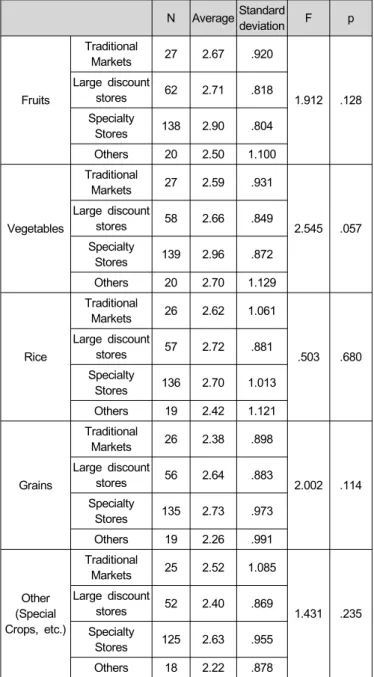
As shown in Table 1., the price of brand products being

more than the price of common agricultural purchases, whether

or not looking for validation, for fruits, vegetables, rice, coarse

grains, and other (special crops, etc.), had no positive or neg-

ative influence on customer buying activity.

(4)

This results in a far country for agricultural consumers' brand awareness is low that means, in particular, except for key items such as rice and agricultural products and the brand with the differences not agricultural land indicates that it does not recognize.

<Table 1> Difference Test Whether or Not to Purchase (even if the price of brand agricultural products is more than generic items.)

N Average Standard deviation F p

Fruits

Traditional

Markets 27 2.67 .920

1.912 .128 Large discount

stores 62 2.71 .818

Specialty

Stores 138 2.90 .804

Others 20 2.50 1.100

Vegetables

Traditional

Markets 27 2.59 .931

2.545 .057 Large discount

stores 58 2.66 .849

Specialty

Stores 139 2.96 .872

Others 20 2.70 1.129

Rice

Traditional

Markets 26 2.62 1.061

.503 .680 Large discount

stores 57 2.72 .881

Specialty

Stores 136 2.70 1.013

Others 19 2.42 1.121

Grains

Traditional

Markets 26 2.38 .898

2.002 .114 Large discount

stores 56 2.64 .883

Specialty

Stores 135 2.73 .973

Others 19 2.26 .991

Other (Special Crops, etc.)

Traditional

Markets 25 2.52 1.085

1.431 .235 Large discount

stores 52 2.40 .869

Specialty

Stores 125 2.63 .955

Others 18 2.22 .878

3.2. Brands of consumer buying behavior analysis for agricultural products

Table 2. as shown in the brand, to buy food for a reason, to verify the difference, by looking at food specialty shops and oth- er stores by customers because of quality assurance among customers (F = 5.075, p <.01), due to reliance on Nutrition (F =

4.020, p <.01), because of the safety of the cultivation method (F = 4.819, p <.01) by showing that the difference was related to the question mainly to buy agricultural brand products.

As a result of post verification, quality assurance in the case of agricultural specialty stores, mainly working in groups and tra- ditional markets and hypermarkets, groups differed from each other, shown in nutrition and safety of growth. The groups pri- marily used by large supermarkets and others, showed differ- ences between the groups.

However, in the groups analyzed for home brand, advertising, recommendation (from friends, neighbors, etc.) and gifts, no dif- ferences were obvious.

This type of quality assurance in agricultural brand marketing, affects consumer buying behavior with a desirable positive im- pact so Hypothesis 1 was adopted.

<Table 2> Difference test of the reason for buying of brand agricultural products

N Average Standard deviation F p

Quality Assurance

Traditional

Markets 23 3.43 .945 5.075** .002 Large discount

stores 57 3.42 .865

Specialty Stores 131 3.89 .834

Others 19 3.74 .733

Home brand

Traditional

Markets 23 2.87 1.140

2.536 .058 Large discount

stores 52 2.65 1.064

Specialty Stores 130 3.06 1.002

Others 20 2.60 1.188

Advertising

Traditional

Markets 22 2.68 1.086 .622 .601

Large discount

stores 52 2.60 .975

Specialty Stores 126 2.70 .915

Others 18 2.39 .979

Neighbors and friends recommend to

Traditional

Markets 21 2.38 .973

1.094 .353 Large discount

stores 50 2.70 .886

Specialty Stores 124 2.69 .989

Others 18 2.39 1.037

Trust for the Nutrition

Traditional

Markets 22 3.18 .907

4.020** .008 Large discount

stores 52 3.00 .990

Specialty Stores 129 3.53 .977

Others 19 3.37 .955

The safety of growth

Traditional

Markets 22 3.23 1.110

4.819** .003 Large discount

stores 52 3.10 .913

Specialty Stores 130 3.67 .976

Others 18 3.61 1.092

(5)

3.3. Consumer buying behavior analysis for demographic factors

Table 3. as shown in the agricultural specialty store merchan- dise, on the differences between the test for the look of agricul- tural products, the freshness, the food specialty store customers who use agricultural businesses, specialty

store food freshness for better recognition that other stores used primarily to customers was higher than in analysis (F = 5.174, p <.01) to purchase agricultural products primarily a re- sult of post verification mainly used to produce a group of spe- cialist shops and traditional markets are mainly used for each other and the difference between the groups was seen.

Also produce the kind of agricultural specialty store customers who use agricultural business, specialty store food of the types of good are aware that the other stores used primarily to cus- tomers higher than that were analyzed (F = 5.341, p <.001) produce mainly purchased. As a result of the Schaeffer mainly used to produce a group of specialist shops and traditional mar- kets are mainly used for each other and the difference between the groups was seen. However, the safety, assortment, and price for agricultural products are used primarily in specialty stores and other outlets and there is no statistically significant difference between those two categories.

These results were found using specialty store customers and in other outlets, on the type of food for freshness and interest in safety, assortment and pricing. Based on these results that 'brand in marketing of agricultural produce freshness, safety, and various types of consumer buying behavior has a positive im- pact’, Hypothesis 2 was adopted.

<Table 3> Difference test of comments on agricultural products from specialty stores

**p<.01,***p<.001

Table 4. as shown in the income gap and the related differ- ences of buying agricultural brand products in looking for vali- dation of fruits, vegetables, rice, coarse grains, and other (special crops, etc.), showed no significant differences.

Verification results in Table 4. as shown in the income levels of consumer purchases of agricultural products and brands showed no significant difference. Based on these results of agricultural brand marketing, Hypothesis 3 was rejected.

These results in general in Korea consumer demographic characteristics (income level, age, education level, etc.) vary de- pending on the purchasing behavior satisfaction that is present in many previous studies, but in this study produce a specific product for the consumer characteristics of the consumer buying behavior does not affect the results of the study appeared to place an in-depth analysis is considered to be necessary.

<Table 4> Difference test of brand purchase of agricultural products according to the average monthly income

N Average Standard deviation F p

Freshness

Traditional

Markets 27 3.48 .643

5.174** .002 Large discount

stores 63 3.76 .689

Specialty Stores 147 3.99 .731

Others 19 3.63 .684

Safety

Traditional

Markets 26 3.54 .811

1.939 .124 Large discount

stores 58 3.69 .568

Specialty Stores 139 3.86 .754

Others 18 3.78 .647

Diversity

Traditional

Markets 27 3.52 .580

5.341*** .001 Large discount

stores 57 3.61 .701

Specialty Stores 133 3.95 .689

Others 19 3.68 .582

Assortment (size, shape, etc.)

Traditional

Markets 26 3.38 .752

2.052 .107 Large discount

stores 57 3.51 .571

Specialty Stores 132 3.70 .771

Others 18 3.72 .575

Price

Traditional

Markets 27 2.96 .940

1.260 .289 Large discount

stores 56 3.18 .575

Specialty Stores 138 3.23 .804

Others 19 3.00 .745

N Average Standard deviation F p

Fruits

Less than 1 million

won 16 2.88 .885

1.225 .301 1 million to 2 million

won 94 3.11 .921

2 million to 3 million

won 64 3.09 .830

More than 4 million

won 60 3.32 .701

NA 17 3.06 .556

Vegetables

Less than 1 million

won 14 3.00 .877

1.914 .109 1 million to 2 million

won 91 2.98 .954

For gifts

Traditional

Markets 22 3.00 1.414

2.012 .113 Large discount

stores 51 2.84 1.155

Specialty Stores 124 3.25 1.138

Others 18 2.78 1.060

(6)

These results rapid economic development and unemployment income, improvement of the domestic consumer for agricultural commodities, a change of consciousness is very evolutionary clearly shown, and the domestic consumers of agricultural prod- ucts purchase behavior and consciousness level developed countries reached a level and that this the result of the analysis is confirmed by means that.

<Table 5> Difference test whether or not to purchase even if the price of brand agricultural products is more than general them according to the average monthly income

As shown above Table 5. even though the price of brand products was more than the price of generic products, and whether or not customers were looking for validation of fruits, vegetables, rice, coarse grains, or other (special crops, etc.), there was no significant influence on customer choice, according to income level.

As shown in Table 6, we look for the relationship between purchasing behavior and age, depending on differences in in- come and the opinions about items in an agriculture special store. The relation between the perception of freshness and safety showed r=.683 (p <.01), a positive result showingthat cor- relation value was of the highest degree. The relation between the degree of purchasing agricultural brand products and the comments for items of agricultural special stores is from r=.180(p<.01) to r=.262(p <.01). In the verification of age and in- come level the difference between purchasing at the price of an agricultural brand product and the price of the generic product plus the comments for items of agricultural special stores, is 2 million to 3 million

won 64 3.08 .896

More than 4 million

won 60 3.35 .755

NA 17 3.29 .686

Rice

Less than 1 million

won 13 3.00 1.080

.506 .732 1 million to 2 million

won 89 2.82 1.029

2 million to 3 million

won 60 2.75 1.068

More than 4 million

won 58 2.97 1.008

NA 17 2.71 .588

Grains

Less than 1 million

won 13 3.00 1.225

.213 .931 1 million to 2 million

won 88 2.80 .973

2 million to 3 million

won 62 2.76 1.003

More than 4 million

won 57 2.82 .947

NA 17 2.71 .772

Other (Special

Crops, etc.)

Less than 1 million

won 14 3.07 1.141

1.006 .405 1 million to 2 million

won 86 2.63 .921

2 million to 3 million

won 58 2.67 1.176

More than 4 million

won 50 2.72 .948

NA 17 2.35 1.115

N Average Standard deviation F p

Fruits

Less than 1 million

won 17 2.76 .752

1.034 .390 1 million to 2 million

won 92 2.74 .912

2 million to 3 million

won 61 2.70 .863

More than 4 million

won 61 2.98 .826

NA 16 2.75 .577

Vegetable s

Less than 1 million

won 14 2.93 1.072

.652 .626 1 million to 2 million

won 92 2.74 .924

2 million to 3 million

won 62 2.79 .960

More than 4 million

won 60 2.97 .802

NA 16 2.88 .806

Rice

Less than 1 million

won 13 3.15 .801

.982 .418 1 million to 2 million

won 90 2.60 .992

2 million to 3 million

won 62 2.73 1.058

More than 4 million

won 57 2.65 .991

NA 16 2.56 .892

Grains

Less than 1 million

won 13 3.00 1.080

.582 .676 1 million to 2 million

won 89 2.63 .934

2 million to 3 million

won 61 2.64 1.049

More than 4 million

won 57 2.56 .866

NA 16 2.56 .892

Other (Special

Crops, etc.)

Less than 1 million

won 12 2.92 .900

.756 .555 1 million to 2 million

won 84 2.56 .923

2 million to 3 million

won 59 2.49 1.040

More than 4 million

won 49 2.51 .916

NA 16 2.31 .873

(7)

from r=.236(p <.01) to r=.309 (p<.01), which showed a positive correlation.

In other words, looking at the results of this study, such as age and income demographics of consumer buying behavior Taken together, if the products of food specialty stores were de- sirable, the degree for purchasing agricultural brand products was high. Even if the price of agricultural brand products were higher than generic products, the purchasing rate was high.

4. Conclusion

This study analyzed large agricultural specialty shops that consumers think about the positive and favorable image and ap- peared to be more reliable.

In addition, agricultural products and branded generic brands of agricultural produce are good quality, a fresh and safe way to grow and can be eaten as a relief to have a positive perception.

These are positive and favorable images of the large agricul- tural specialty store brands at competitive agricultural marketing strategies that you can see.

This study has investigated the relationship between agricul- tural products and consumer buying behaviors to know how the brand marketing of agricultural products affects consumer behavior. Agricultural brands and consumer buying behavior, with the factors influencing the determination of a positive qual- ity assurance and freshness, safety, class, age and income lev- el of consumers, were used as parameters. To verify this, 260 subjects who used the food specialty stores in the consumer survey, performed an empirical analysis. The results were sum- marized as follows…

First, it was analyzed which agricultural quality assurance had the positive effect for consumer buying behavior in the market- ing of agricultural brand products. The empirical result was as a positive influence on consumer buying behavior.

Second, it was analyzed which of: freshness, safety, and vari- ous types of products were the positive affect for consumer buying behavior in the marketing of agricultural brand products.

The empirical result of them was analyzed as a positive influence.

Third, it was analyzed which income levels and age of con- sumers were visible in the differences of consumer buying be- havior in the marketing of agricultural brand products. The em-

pirical results of such as income level and age and demo- graphic factors were on the purchasing behavior of consumers did not provide any difference that was significant.

As shown in these results, customers using large agricultural specialty stores gave a positive image for quality assurance, freshness, safety, and diversity. Consumers increased their pur- chases for the agricultural brand products more than for generic agricultural products because of the general reliability of quality assurance. In addition, demographic factors, consumers to pur- chase brand agricultural products appears to be not significantly affect the domestic consumers' purchase behavior for brand and generic agricultural products than in the past, regardless of in- come level and age, such as improved health and quality of life preference for the brand to produce higher were analyzed.

A limitation of this study was the regional problem due to the majority of survey respondents using specialty stores in the met- ropolitan area. There are two types of future research: First, by analyzing agricultural brand products through a variety of con- sumer opinions through surveys of national agricultural findings, specialty stores and other outlets that consumers use, and then those consumer opinion surveys should be analyzed simultaneously. Second, there are studies for agricultural brand commodities, competitiveness and high quality food safety, culti- vated for originating development guidance and professional and systematic marketing strategies to maintain the positive recog- nition and high reputation for food specialty stores of customers.

<Table 6> Relationships in buying behavior and comments on age, monthly income, and agricultural items in the store

Age Monthly

income Freshness Safety Variety Assortment Price Buying behavior

1 Buying

behavior 2

Age 1

Monthly

income .197(**) 1

Freshness -.044 -.094 1

Safety -.142(*) -.002 .683(**) 1

Variety .036 -.087 .621(**) .579(**) 1

Assortment -.103 -.060 .539(**) .488(**) .543(**) 1

Price -.038 -.103 .386(**) .416(**) .303(**) .408(**) 1

Buying

behavior 1 .058 .031 .239(**) .203(**) .262(**) .182(**) .180(**) 1

Buying

behavior 2 .056 -.002 .274(**) .255(**) .309(**) .303(**) .236(**) .525(**) 1

*p<.05,**p<.01

(8)

References

Aaker, D. A. (1991). Managing Brand Equity. Mac Milan, NY.:

The Free Press.

Aaker, D. A., & Joachimsthaler, E. (2000). Brand Leadership.

NY.: The Free Press.

Ahn, K. H., & Ghosh, A. (1989). Hierarchical Models of Store Choice. Int. J. Retail., 4(5), 39-52.

Ailawadi, K. L., Neslin, S., & Gedenk, K. (2001). Pursuing the value conscious consumer : Private labels versus na- tional brand promotions. Journal of Marketing, 65(1), 71-89.

Ahn, U. K. (2008). Agricultural Marketing Management . Ⅲ Seoul, Korea: Korea Standards Association of Agricultural (KSA.)

Baltas, G., & Argouslidis, P. C. (2007). Consumer characteristics and demand for store brands. International Journal of Retail and Distribution Manage., 35(5), 328-341.

Bitner, M. J. (1990). Evaluating service encounters: The effects of physical surrounding and employee response. Journal of Marketing, 54(2), 69-82.

Collins-Dodd, C. & Lindley, T. (2003). Store brand and retail dif- ferentiation: the influence of store image and store brand attitude on store own brand perceptions. Journal of Retailing and Consumer Service, 10(6), 345-352.

Grewal, D., Monroe, K. B., & Krishnan, R. (1998). The Effects of Price- Comparison Advertising on Buyers’ Perceptions of Acquisition Value, Transaction Value, and Behavioral Intentions. Journal of Marketing, 62(2), 46-59.

Jung, Nan-Ho, Kim, Nam-Myun, & Sung, IL-Seok (2006). A Study on Consumer's Choice Factors for Retailer Shops :Focused on Traditional Market, Super Supermarket and Discount Store in Daejeon, Korea. Journal of Distribution Science, 4(2), 41-64.

Keller, K. L. (1991). Conceptualizing, measuring and managing customer-based brand equity. Working Paper, 91(123).

Marketing Science Institute, Oct..

Keller, K. L. (2003). Strategic Brand Management. Upper Saddle River, NJ.: Prentice Hall.

Kim, Jeong -Ok, Kim, Mee-Lan, & Kim, Moon-Jung (2014). The Effect of Food Choice Motive on Attitude and Purchase Intention toward Organic Food. Journal of Distribution Science, 12(3), 17-24.

Kim, Jong-Jin, Shim, Kyu-Yeol ,Kim, Mi-Song, & Youn, Myoung-Kil (2013). Analyzing Factors Influencing Purchasing Behavior of PB Eggs: Focusing on Eggs from Large Distribution Companies. Journal of Distribution Science, 11(10), 107-116

Kim, Pan-Jin, & Youn, Myong-Kil (2010). Retail Sales forecast- ing of agricultural products marts in a mid-sized city us- ing the Huff Model. J. Food, Agricult. and Environ., 8(2), 945-948.

Kim, Pan-Jin, Kim, Wanki, Chung, Won-Ki, &Youn, Myoung-Kil (2011). A using New Huff model for predicting potential retail market in South Korea. African Journal of Business Management, 5(5),1543-1550.

Kim, Pan-Jin, Kim, Kyeong-Cho, Namkung, Seok, & Youn, Myoung-Kil (2009). A Study on the Customers’

Awareness for Modernizing the Facilities of Traditional Market. Journal of Distribution Science, 7(1),55-70.

Kim, Soon-Hong (2012). A Study on the Impact of Customer Equity on Customer Loyalty in the Korean Retail Industry: Mediation of Customer Satisfaction and Switching Costs. Journal of Distribution Science, 10(11), 79-88.

Korea Agro-Fisheries Trade Corp (2006). All of the food brand.

Seoul, Korea: Korea Agro-Fisheries Trade Corp

Lee, Eun-Young (2013).T he Influence of Consumers' Perception and Attitude to Causes on Consumer, Journal of Distribution Science, 11(12).63-69.

Madan, V., & Suri, R. (2001). Quality Perception and Monetary Sacrifice : a Comparative Analysis of Discount and Fixed Prices. J. Pro. and Bra Manage., 10(3): 170-182.

Nevin, J. R., & Michael, J. H. (1980). Image as a Component of Attraction to Interurban Shopping Areas. Journal of Retailing, 56(Spring), 77-93.

Oliver, R. L. (1981). Measurement and evaluation of satisfaction process in retail setting. Journal of Retailing, 57(3), 25-48.

Shin, Hyeong-Jin, & Lee, Sang-Youn (2010). Study on Influence of Standardization of Agricultural Product Packages on Cost in Hypermarkets. Journal of Distribution Science, 8(4), 35-41.

Spreng, R. A., & Mackoy, R. D. (1996). An empirical examina- tion of a model of perceived service quality and satisfaction. Journal of Retailing, 72(2), 201-214.

Thaler, R. (1985). Mental Accounting and Consumer Choice.

Marketing Science, 4(Summer), 199-214.

Wu, P. C. S., Yeh, G. Y. Y., & Hsiao, C. R. (2011).The effect of store image and service quality on brand image and purchase intention for private label brands. Austrian Marketing Journal, 19(1), 30-39.

Zeithaml, V. A., Bery, L. L., & Parasuraman, A. (1996). The

Behavioral Consequences of Service Quality. Journal of

Marketing, 60(2), 31-46.

수치

Table 2. as shown in the brand, to buy food for a reason, to verify the difference, by looking at food specialty shops and  oth-er stores by customoth-ers because of quality assurance among customers (F = 5.075, p &lt;.01), due to reliance on Nutrition (F

참조

관련 문서

The paper has suggested characters that can elevate cognition on family restaurant brands, and it examines effects of characters upon brand cognition through

- &#34;This work was supported by the Korea Foundation for the Advancement of Science and Creativity(KOFAC) grant funded by the Korea government(MOE)&#34;... 여러분들이

- &#34;This work was supported by the Korea Foundation for the Advancement of Science and Creativity(KOFAC) grant funded by the Korea government(MOE)&#34;...

- &#34;This work was supported by the Korea Foundation for the Advancement of Science and Creativity(KOFAC) grant funded by the Korea government(MOE)&#34;... 정리한

&#34;The Principle of Separating Economics from Politics, and Prospects for Improvement in North-South Relations.&#34; East Asian Review.. The Korean Journal

- &#34;This work was supported by the Korea Foundation for the Advancement of Science and Creativity(KOFAC) grant funded by the Korea government(MOE)&#34;...

model development and empirical testing. Brand authenticity: Towards a deeper understanding of its conceptualization and measurement.. Brand authenticity: Testing

- &#34;This work was supported by the Korea Foundation for the Advancement of Science and Creativity(KOFAC) grant funded by the Korea government(MOE)&#34;... 정리한