• 검색 결과가 없습니다.

Coil embolization of ruptured intrahepatic pseudoaneurysm through percutaneous transhepatic biliary drainage

N/A
N/A
Protected

Academic year: 2021

Share "Coil embolization of ruptured intrahepatic pseudoaneurysm through percutaneous transhepatic biliary drainage"

Copied!
5
0
0

로드 중.... (전체 텍스트 보기)

전체 글

(1)

Yeungnam Univ J Med 2018;35(1):109-113

Coil embolization of ruptured intrahepatic pseudoaneurysm through percutaneous transhepatic biliary drainage

Jee Young An

1

, Jae Sin Lee

1

, Dong Ryul Kim

1

, Jae Young Jang

1

, Hwa Young Jung

1

, Jong Ho Park

2

, Sue Sin Jin

2

1

Department of Internal Medicine, College of Medicine, The Catholic University of Korea, Seoul;

2

Department of Internal Medicine, Changwon Fatima Hospital, Changwon, Korea

A 75-year-old man with chronic cholangitis and a common bile duct stone that was not previously identified was admitted for right upper quadrant pain. Acute cholecystitis with cholangitis was suspected on abdominal computed tomography (CT); therefore, endoscopic retrograde cholangiopancreatography with endonasal bili- ary drainage was performed. On admission day 5, hemobilia with rupture of two intrahepatic artery pseudo- aneurysms was observed on follow-up abdominal CT. Coil embolization of the pseudoaneurysms was con- ducted using percutaneous transhepatic biliary drainage. After several days, intrahepatic artery pseudo- aneurysm rupture recurred and coil embolization through a percutaneous transhepatic biliary drainage tract was conducted after failure of embolization via the hepatic artery due to previous coiling. After the second coil embolization, a common bile duct stone was removed, and the patient presented no complications during 4 months of follow-up. We report a case of intrahepatic artery pseudoaneurysm rupture without prior history of intervention involving the hepatobiliary system that was successfully managed using coil emboliza- tion through percutaneous transhepatic biliary drainage.

Keywords: Hepatic artery; Pseudoaneurysm; Hemobilia; Embolization

Copyright ©2018 Yeungnam University College of Medicine

This is an Open Access article distributed under the terms of the Creative Commons Attribution Non-Commercial License (http://creative- commons.org/licenses/by-nc/4.0/) which permits unrestricted non-commercial use, distribution, and reproduction in any medium, provided the original work is properly cited.

Received: August 17, 2017, Revised: October 18, 2017 Accepted: October 19, 2017

Corresponding Author: Jong Ho Park, Department of Internal Medicine, Changwon Fatima hospital, 45, Changi-daero, Uichang-gu, Changwon 51394, Korea Tel: +82-2-55-270-1000, Fax: +82-2-55-265-7766 E-mail: [email protected]

INTRODUCTION

A hepatic artery aneurysm (HAA) is very rare, with an esti- mated prevalence of 0.002%. Most HAA patients are asymp- tomatic until the aneurysm ruptures. However, ruptures oc- cur in 21-80% of cases and can result in a mortality rate of 21-43%[1-3]. Depending on the composition of the wall, aneu- rysms may be divided into true aneurysms or pseudoaneu- rysms. The incidence of hepatic artery pseudoaneurysms has

been increasing due to complications following surgery or pro- cedures involving the hepatobiliary system [1].

The authors report a case of ruptured intrahepatic pseu- doaneurysm and rebleeding treated by embolization through a percutaneous transhepatic biliary drainage (PTBD) catheter in a patient with no history of surgery or procedures involving the hepatobiliary system.

CASE

A 75-year-old male was emergently admitted for the chief

complaint of right upper quadrant (RUQ) pain and fever for

3 days. The patient had no underlying diseases, medication

history, including anticoagulant use, or history of surgery or

abdominal procedures. Physical examination showed blood

pressure (BP) 105/60 mmHg, pulse 98 beats/min, respirations

(2)

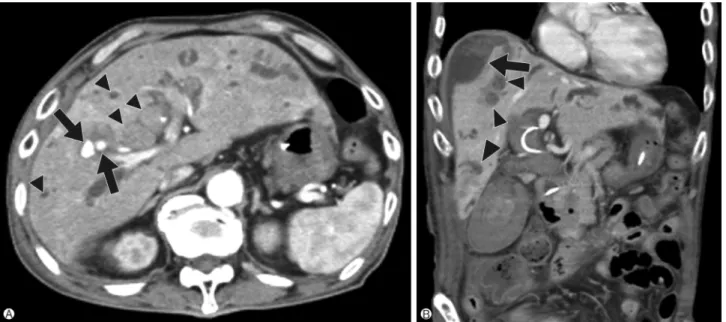
Fig. 1. Initial abdominal computed tomography. (A) High density materials are seen in gallbladder and common bile duct with marked biliary dilatation and pericholecystic infiltrations suggesting intramural gallbladder hematoma and cholangitis. (B) Suspcious intrahepatic aneurysms (arrows) are seen at liver segment 5 and hemobilia induced biliary dilatations are observed.

Fig. 2. Follow-up abdominal computed tomography. (A) Two intrahepatic psuedoaneurysms (arrows) with partial rupture and active bleeding at liver segment 5 is observed with intrabiliary hematoma and biliary dilatation (arrow heads). (B) Intrahepatic bile duct dilatation (arrow head) and right perihepatic subcapsular hematoma (arrow) at liver dome due to rupture and spillage of intrahepatic bile duct are observed.

16/min, and body temperature 37.8°C. The patient appeared acutely ill, with tenderness in the RUQ, but no abdominal rigidity. The white blood cell count was 9,930/mm

3

, with he- moglobin (Hb) 9.6 g/dL, platelet count 363,000/mm

3

, total bilirubin 4.7 mg/dL, direct bilirubin 3.8 mg/dL, aspartate tran- saminase (AST) 315 IU/L, alanine transaminase (ALT) 114 IU/L, alkaline phosphatase (ALP) 370 IU/L, and prothrombin time 14.6 s (international normalized ratio 1.31).

Abdominal computed tomography (CT) performed on the

day of admission showed intra-gallbladder hematoma and fin-

dings of partial expansion of the intrahepatic bile duct caused

by hemobilia (Fig. 1). Upper gastrointestinal endoscopy sho-

wed edema in the duodenal ampulla of Vater, but no blee-

ding. The patient was diagnosed with acute cholangitis, and

his progress was monitored with antibiotic maintenance after

endoscopic nasobiliary drainage.

(3)

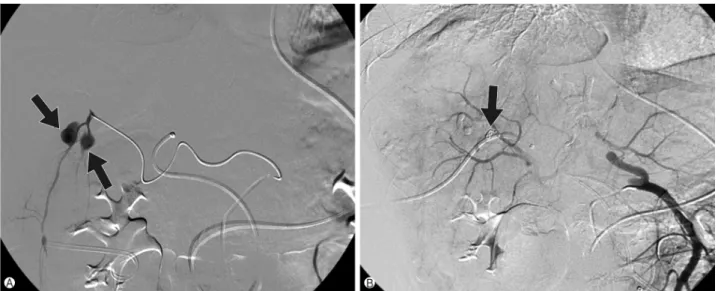
Fig. 3. Initial hepatic artery angiography. (A) Two intrahepatic pseudoaneurysms (arrows) at liver segment 5 are seen. (B) Inserted coils (arrow) for embolization of the intrahepatic pseudoaneurysm are observed.

Fig. 4. Follow-up hepatic artery angiography. (A) Recurred intrahepatic pseudoaneurysm (arrow) is observed at liver segment 5. (B) After approach of the intrahepatic bile duct — intrahepatic pseudoaneursym fistula using microcatheter through a percutaneous trans- hepatic biliary drainage tract, the psuedoaneurysm (arrow) and intrahepatic artery (arrow head) are seen. (C) Inserted coils (arrow) for embolization of recurred intrahepatic pseudoaneurysm are observed.

On the following day, RUQ pain persisted; percutaneous transhepatic gallbladder drainage (PTGBD) was performed and the fluid was bloody. On the 5th hospital day, the RUQ pain worsened. While BP (110/70 mmHg) and pulse (75 beats/min) remained stable, Hb decreased from 8.8 g/dL to 7.3 g/dL, and total bilirubin increased to 5.2 mg/dL, with AST 54 IU/L, ALT 20 IU/L, and ALP 128 IU/L. Abdominal CT showed hemobilia and two intrahepatic pseudoaneurysms located in the fifth liver segment (Fig. 2). Emergency hepatic arterial angiography was performed; after confirming a ruptured intrahepatic pse- udoaneurysm(Fig. 3A), coil embolization and PTBD were per- formed for hemostasis and biliary drainage (Fig. 3B). The pa- tient stabilized, but on the 15th hospital day, the RUQ pain recurred. His BP and pulse were stable, but Hb decreased slightly from 9.0 g/dL to 8.3 g/dL and total bilirubin increased

to 9.2 mg/dL. Abdominal CT was repeated. Hemobilia and coil-embolized intrahepatic pseudoaneurysms were enhanced.

Emergency hepatic arterial angiography was performed for possible recurrent rupture of the intrahepatic pseudoaneur- ysms (Fig. 4A). Although another transarterial coil emboliza- tion was planned, superselection was impossible due to a pre- viously inserted coil and winding vascular path. However, a microcatheter was able to approach the biliary-intrahepatic pseudoaneurysm fistula through the PTBD catheter that had been inserted (Fig. 4B), and coil embolization of the intrahe- patic pseudoaneurysm was successfully completed (Fig. 4C).

Subsequently, clinical improvement continued and PTGBD

and PTBD catheters were removed. When removing the PTBD

catheter, bile duct stones were also removed. The patient was

discharged after 35 days of hospitalization and followed up

(4)

for 4 months, during which time there were no signs of recur- rence.

DISCUSSION

HAA is very rare. However, among intra-abdominal aneur- ysms, it has the highest prevalence after splenic aneurysms, accounting for 20-40% [1-4].

True aneurysms are mostly found as single, extrahepatic lesions, whereas pseudoaneurysms are mostly found as multi- ple, intrahepatic lesions. Pseudoaneurysms often occur as a result of complications from surgeries and procedures that involve the biliary tract, in addition to abdominal trauma.

However, in rare cases, they may also be caused by inflamma- tion around the artery due to pancreatitis. In the past, true aneurysms were more common, but with a recent increase in surgeries and procedures that involve the biliary tract, the occurrence of pseudoaneurysms is increasing, although the exact prevalence is difficult to measure [1,5-7]. A study by Tessier et al. analyzed the medical records of 153 patients with hepatic artery pseudoaneurysms and found that occur- rence after PTBD was most common, accounting for 31%, followed in order by laparoscopic cholecystectomy (28%), open cholecystectomy (13%), and percutaneous liver biopsy (7%) [7]. The risk factors associated with iatrogenic pseudoa- neurysms include a history of anticoagulant use, female sex, obesity, and vascular calcification [11]. The present case in- volved natural rupture of intrahepatic pseudoaneurysms in a patient with chronic cholangitis caused by bile duct stones.

Based on review of other reports, the cause of intrahepatic pseudoaneurysms in the present case can be considered as being very rare.

Approximately 60% of HAA patients are symptomatic, with the most common symptoms being epigastric and RUQ pain, while Quincke’s triad (abdominal pain, jaundice, and hemo- bilia) appear in only about 33% of patients [2,8]. In the pres- ent case, hemobilia was present in the fluid drained via PTGBD performed on the day after admission; thus, Quincke’s triad was fulfilled. HAA may rupture in the hepatic vein, portal vein, bile duct, or directly into the abdominal cavity, and is diagnosed for the first time in 20-80% of patients when rup- ture occurs [2,6,9]. Mortality associated with HAA rupture is reportedly 21-43%, while the risk of rupture is high when the aneurysm is ≥2 cm [2,9].

Abdominal sonography is used for diagnostic screening of HAA, but in most cases, abdominal CT is performed to con- firm the relationship between the size of the HAA and sur- rounding structures [1,6]. Selective angiography is the most sensitive and specific method for diagnosing HAA, and pro- vides important pre- and intra-operative information, such as the location of the aneurysm, anatomical anomalies, and collateral circulation [2,3,6].

In the past, most authors recommended that HAA should

be treated regardless of the symptoms due to the risk of rup-

ture and death. Recently, however, not all asymptomatic HAA

cases are treated. For asymptomatic atherosclerotic HAA,

treatment is recommended only when the diameter is ≥2 cm,

but a case involving non-atherosclerotic multiple aneurysms

must be treated regardless of the size due to the high risk of

symptoms and rupture [1,9]. Treatment methods may vary

according to the location and shape of HAA, as well as the

patient’s condition [3,7,8]. For extrahepatic artery aneurysms,

embolization may be an option if the aneurysm sac has a

pocket shape and adequate hard area. However, for extrahe-

patic artery aneurysms with a spindle shape or lacking a hard

area, surgery should be considered [3,8]. In the past, intrahe-

patic artery aneurysms required liver resection, but since hep-

atic artery embolization was introduced in 1977, emboliza-

tion is performed on most patients, using Gelfoam, coils, and

spirals [8]. The success rate of hepatic artery embolization is

reportedly 88-100% [6]. Embolization has the advantage of

minimizing hepatic parenchymal ischemia, but may also cause

occlusion in normal blood vessels or liver failure due to back-

flow of the material used in embolization. Moreover, re-em-

bolization may also be required since recurrence is found in

approximately 37-42% of patients [6-8,10]. If embolization

cannot be performed through the hepatic artery or rupture

of the intrahepatic artery aneurysm continues despite hepatic

artery embolization, ultrasound-guided percutaneous emboli-

zation may be performed by directly puncturing the aneur-

ysm sac [2,3]. Surgery involves removal of the aneurysm and

suturing the arterial wall or applying a patch suture, with the

advantages of reducing the incidence of rebleeding, as well as

reducing embolization-related complications, such as vascular

occlusion and liver failure [11]. However, data on compar-

isons between embolization and surgery showed that both have

similar efficacy, but embolization is preferred since it reduces

the duration of hospital stay and the need for transfusion,

(5)

while also allowing timely correction of acute bleeding [1].

In the present case, transarterial embolization was initially performed by inserting the coils into the proximal area of the two intrahepatic pseudoaneurysms. After 10 days, rebleeding occurred in one of the intrahepatic pseudoaneurysms; altho- ugh another transarterial coil embolization was planned, su- perselection was impossible due to a previously inserted coil and winding vascular path. However, hemobilia continued, and the biliary-intrahepatic pseudoaneurysm fistula was loca- ted through the PTBD catheter that had been inserted. After approaching the intrahepatic pseudoaneurysm through the fistula, embolization was performed using 2 Tornado coils.

Review of various reports did not find any previous case of embolization of an intrahepatic pseudoaneurysm through a PTBD catheter. Hence, we report this case and a literature review.

CONFLICT OF INTEREST

No potential conflict of interest relevant to this article was reported.

ORCID

Jee Young An, https://orcid.org/0000-0002-4578-0712 Jong Ho Park, https://orcid.org/0000-0002-7275-9687

REFERENCES

1. Nagaraja R, Govindasamy M, Varma V, Yadav A, Mehta N, Kumaran V, et al. Hepatic artery pseudoaneurysms: a single- center experience. Ann Vasc Surg 2013;27:743-9.

2. Willson TD, Korn JM, Blecha MJ, Podbielski FJ, Connolly MM. Spontaneous rupture of a saccular intrahepatic artery aneurysm. Vasc Endovascular Surg 2012;46:679-81.

3. Baggio E, Migliara B, Lipari G, Landoni L. Treatment of six hepatic artery aneurysms. Ann Vasc Surg 2004;18:93-9.

4. Dolapci M, Ersoz S, Kama NA. Hepatic artery aneurysm. Ann Vasc Surg 2003;17:214-6.

5. Yu YH, Sohn JH, Kim TY, Jeong JY, Han DS, Jeon YC, et al. Hepatic artery pseudoaneurysm caused by acute idiopathic pancreatitis. World J Gastroenterol 2012;18:2291-4.

6. Finley DS, Hinojosa MW, Paya M, Imagawa DK. Hepatic artery pseudoaneurysm: a report of seven cases and a review of the literature. Surg Today 2005;35:543-7.

7. Tessier DJ, Fowl RJ, Stone WM, McKusick MA, Abbas MA, Sarr MG, et al. Iatrogenic hepatic artery pseudoaneurysms:

an uncommon complication after hepatic, biliary, and pancre- atic procedures. Ann Vasc Surg 2003;17:663-9.

8. Lumsden AB, Mattar SG, Allen RC, Bacha EA. Hepatic artery aneurysms: the management of 22 patients. J Surg Res 1996;

60:345-50.

9. Abbas MA, Fowl RJ, Stone WM, Panneton JM, Oldenburg WA, Bower TC, et al. Hepatic artery aneurysm: factors that predict complications. J Vasc Surg 2003;38:41-5.

10. Cho GH, Lee JJ, Yu SK, Kwon KA, Park DK, Kim YS, et al. A case of non-traumatic hemobilia due to pseudoaneurysm of the hepatic artery. Korean J Gastrointest Endosc 2006;33:

173-7. Korean.

11. Razik R, Fallah A, Sandroussi C, Wei AC, McGilvray ID.

Dissecting pseudoaneurysm of the proper hepatic artery re-

paired by primary anastomosis: a case report. Case Rep Surg

2012;2012:804919.

수치

Fig. 2. Follow-up abdominal computed tomography. (A) Two intrahepatic psuedoaneurysms (arrows) with partial rupture and active bleeding at liver segment 5 is observed with intrabiliary hematoma and biliary dilatation (arrow heads)
Fig. 3. Initial hepatic artery angiography. (A) Two intrahepatic pseudoaneurysms (arrows) at liver segment 5 are seen

참조

관련 문서

Liquid radioactive waste system of a nuclear power plant is to remove the radioactive material collects various equipment and floor drainage, including

(4) These neologisms are words stably used as general words commonly used by the public during a certain period after going through widespread spacial

The study was conducted to find out the relationship between teacher passion and intrinsic motivation and class attitude that was perceived by participants in physical

After her husband died for his country, she had a crisis in her writing, but she overcame her anxiety of being alone in a period of turbulence

Toroidalnaja kamera magnitnaja katushka (Toroidal chamber

and Simmons, J.S., 2002, Long-term performance of passive acid mine drainage treatment systems, Proceedings of the 23rd AnnualWest Virginia Surface Mine Drainage Task

This abnormal condition at the water purification plant lasted from 

In general, seismic response analysis was carried out under undrained drainage condition, but in this study, drain drainage analysis was conducted to