261
오이 노균병의 생물적 방제를 위한 Bacillus amyloliquefaciens CC110균주 선발
이상엽*·원항연·김정준·한지희
농촌진흥청 국립농업과학원 농업미생물과
Selection of Bacillus amyloliquefaciens CC110 for
Biological Control of Cucumber Downy Mildew Caused by Pseudoperonospora cubensis
Sang Yeob Lee *, Hang Yeon Weon, Jeong Jun Kim and Ji Hee Han
Agricultural Microbiology Division, National Academy of Agricultural Science (NAAS), Rural Development Administration (RDA), Suwon 441-707, Korea
ABSTRACT : In order to select antagonists for biological control of downy mildew of cucumber, 126 bacteria were isolated from cucumber plants collected from several locations in Korea. Among them, Five isolates were selected as potential biocontrol agents of cucumber downy mildew using a leaf disc bioassay method. In preventive and curative effect tests, the isolate CC110 was found to be effective to control downy mildew on cucumber showing diseased area by 0% whereas that of control was 15.0~18.0%. A bacterium isolate CC110 was identified as Bacillus amyloliquefaciens subsp. plantarum based on phylogenetic analysis using gyrB gene sequence. The culture liquid of isolate CC110 in TSB media were more effective for the control of the disease than those cultured in LB, NB, and KB media in leaf disk bioassay. when undiluted liquid, two-fold, five-fold diluted culture broth, and undiluted liquid, two-fold, five-fold diluted filtrate of isolate CC110 in TSB media were treated, diseased area of cucumber powdery mildew were 0%, 3.0%, 8.0%, 0%, 4.0% and 7.0%, respectively, whereas diseased area in the control was 21.0%. In the cucumber seedling tests, when the culture broth of isolate CC110 in TSB media was treated, diseased area were 35.0%, whereas that of control was 82.0%. When B. amyloliquefaciens CC110 was treated four times at five-day interval in the vinylhouse test, the control effect of cucumber downy mildew was higher than that treated three at seven-day interval.
KEYWORDS : Bacillus amyloliquefaciens, Biological control, Cucumber, Downy mildew
서 론
Pseudoperonospora cubensis에 의한 노균병은 오이, 참외,
멜론과 호박 등 가장 경제적으로 중요한 작물에 발생하는 병해로 특히 오이 경우는 80%까지 수량을 감소할 정도로 심각하며, 미국, 유럽, 중국과 이스라엘에서 수량 손실이 보 고되었다(Lebeda et al., 2011). 우리나라에서는 오이를 비 롯한 박과 작물 등 약 9여종의 식물에 노균병 발생이 기록 되어 있다(The Korean Society of Plant Pathology, 2009).
오이 노균병의 발생은 15oC가 적온이며 최소한 잎 젖음 시간이 2시간 필요하며 노균병균의 유주자낭이 발아하여 5~28oC 온도범위에서 감염시키고, 감염기간은 온도, 광조 사 기간, 전염원 농도와 젖음기간에 따라서 4일에서 12일 걸린다(Cohen, 1981; Thomas, 1996).
노균병의 병징은 초기에는 잎의 앞면에 퇴록된 부정형 사각형 반점이 생기고 엷은 황색을 띠며 잎 뒷면에는 수침 상으로 나타난다. 아랫잎에서 먼저 발생되어 위로 진전되 는데 작은 반점들이 합쳐지면 병반은 커지고 황갈색을 띠
*Corresponding author E-mail: [email protected] Received November 13, 2013 Revised December 5, 2013 Accepted December 11, 2013
This is an Open Access article distributed under the terms of the Creative Commons Attribution Non-Commercial License (http://
creativecommons.org/licenses/by-nc/3.0/) which permits unrestricted non-commercial use, distribution, and reproduction in any medium, provided the original work is properly cited.
Kor. J. Mycol. 2013 December, 41(4): 261-267 http://dx.doi.org/10.4489/KJM.2013.41.4.261 pISSN 0253-651X
© The Korean Society of Mycology
며 잎이 말라 죽는다(National Institute of Agricultural Science and Technology, 1997).
이러한 식물병원균으로부터 수량 손실을 감소하기 위한 오이 노균병의 방제는 유럽에서는 저항성품종 사용과 화학 농약처리, 미국에서는 오이에 5~7일 간격으로 살균제를 체 계처리와 재배적 방법 등으로 관리하고 있다(Elizabeth et al., 2011).
그러나 오이 노균병 방제를 위하여 사용한 화학농약 메 타락실, 아족시스트로빈, 크레소심메틸, 피라클스트로빈, 포세칠알, 프로파모카브, 홀펫, 만코지, 디메쏘모르프, 만디 프로파미드, 이프로발리카브, 벤치아브알리카브가 일본 등 여러 나라에서 저항성이 나타난 것으로 보고되었다(Lebeda et al., 2012).
이러한 유기합성화학농약의 지속적 사용으로 농업생태계 의 파괴와 저항성 식물병원균의 출현으로 새로운 작물보호 제 개발에 대한 노력(Tanaka and Omura, 1993; Russell et al., 1995)과 소비자의 안전 농산물에 대한 요구가 중대되어 유용미생물을 활용한 친환경적인 생물학적 방제법 연구가 활발히 시도되고 있다(Hornby, 1990). 전 세계적으로 미생 물농약은 149종이 등록되어 병해충과 잡초방제에 사용되고 있으며(Copping, 2004), 이는 농업생태계의 파괴와 병원균 의 저항성 발생 감소 대책으로서의 역할이 기대되고 있다 (Fravel, 2005).
오이 노균병에 대한 생물적 방제 연구는 국화과 금불초 속 Inula viscosa의 식물추출물이 노균병 균의 유주자 방출 과 포자낭 발아를 억제 등 여러 식물병원균에 효과가 있다 고 하였으며, 그리고 마늘에서 분리한 휘발성 물질 알리신 (allicin)이 오이 노균병을 발생을 50~100% 억제시키고 비 단백질 아미노산 BABA의 식물체에 유도저항성을 증진으 로 노균병을 억제한다고 보고하였다(Lebeda et al., 2011).
미생물을 이용한 연구 사례는 Bacillus subtilis와 Strepto- myces sp.로 포도 노균병, Pseodomonas fluorescens로 종자 또는 토양처리를 통한 수수 노균병 방제 연구가 보고되었 을 뿐이다(Tofazzal et al., 2013).
따라서 본 연구에서는 환경친화적 안전 농산물 생산을 위하여 Bacillus amyloliquefaciens CC110 균주를 이용하여 오이 노균병 방제효과를 검정하기 위해 오이 잎 절편을 이 용한 예방 및 치료효과 검정, 배지 선발, 처리농도와 유묘 검정을 통한 분리한 세균의 처리효과를 구명하고자 실시 하였다.
재료 및 방법
시험 병원균
오이 노균병균(P. cubensis)은 국립농업과학원 오이 재배 포장에서 채집한 병든 오이 잎에서 노균병균의 포자낭을 수거하여 현탁액으로 제조하여 건전한 오이 잎 뒷면에 접 종하여 습실 처리한 플라스틱 상자안에 넣고 20oC 조절한
하루에 12시간씩 형광등이 조사되는 배양기에 넣어 7~10 일간 배양하면서 오이 잎에 형성한 노균병균을 수거하여 건전한 오이 잎에 접종하는 계대배양을 하면서 실험에 이 용하였다. 오이 식물체는 바로커상토(서울바이오)를 직경 7 cm 비닐포트에 담아 싱싱백다다기 오이(동부한농)를 파 종하여 온실에서 재배한 오이 잎을 사용하였다.
시험 미생물 분리 및 보관
2010년 4월 12일에 순천의 낙안읍, 구례, 공주, 서천, 춘 천, 양평 등 오이 재배 단지에서 건전한 오이 잎을 채취하 여 오이의 잎을 10% 차아염소산나트륨 용액에 30초간 소 독하여 멸균수로 3회 수세한 후 멸균된 유발로 마쇄하여 80oC에서 10분간 처리한 다음 1/10 Tryptic soy agar 배지 (TSA, Difco.)에 도말하여 20oC에서 2일간 배양한 후 단콜 로니를 분리하여, 다시 20oC에서 새로운 TSA배지에 획선 배양하여 재분리한 단콜로니를 새로운 TSA배지에 이식하 여 28oC에서 배양한 균체를 20% glycerol 용액에 담아서 -70oC 초저온냉동고에 보관하면서 사용하였다.
시험 미생물의 생물검정
오이 식물체는 바로커상토(서울바이오)를 직경 7 cm 비 닐포트에 담아 싱싱백다다기 오이(동부한농)를 파종하여 온실에서 재배한 오이 잎을 사용하였다. 저장한 균주를 TSA 배지에 28oC에서 2일간 배양한 후 단 콜로니를 떼어내 어 Tryptic soy broth 배지(TSB, Difco.)에 이식하여 28oC 에서 150 rpm으로 24시간 배양하였다. 배양한 균주를 2엽 기의 오이에 분무 처리하여 5시간 후에 오이 잎을 직경 25 mm로 잘라내어 습실처리한 24×24 cm의 페트리디쉬에 넣 고 20oC로 조절하여 하루에 12시간씩 형광등이 조사되는 배 양기에 넣어 7일 후에 노균병의 병반면적율을 조사하였다.
선발 미생물의 동정
CC110 균주의 분류학적 계통분석을 위해서는 gyrB 유전 자 염기서열 분석을 이용하였다. 즉, CC110 균주의 균체에 서 PureHelixTM Genomic DNA Prep Kit (Nanohelix Co., Korea)로 추출한 DNA를 UP1과 UP2r 프라이머(Yamamoto and Harayamaet al.,, 1995)를 이용하여 PCR을 통해 gyrB 유전자를 증폭하였다. 증폭 산물은 다시 UP1과 UP2r pri- mer와 DNA sequencing kit (BigDye terminator Cycle Se- quencing Ready Reacions v3.1, Applied Biosystem, USA) 를 사용하여 반응시킨 후, 3700 Genetic Analyser (Applied Biosystems)로 1,489 bp의 염기서열을 결정하였다. 표준균 주와의 염기서열 유사도는 NCBI의 megablast를 통해 계산 하였고, 유연관계를 분석하기 위하여 CLUSTAL W prog- ram을 이용하여 염기서열을 정렬한 후 MEGA version 5.1 프로그램(Tamura et al., 2011)을 이용하여 진화계통수를 작성하였다. branch의 안정성은 1,000회의 resampling (boot- strap value)을 통하여 조사하였다.
선발 미생물의 형태, 생리 생화학적 특성조사
형태학적 특성은 TSA 배지에서 1~2일 동안 배양된 균을 1.5% agarose가 얇게 코팅된 슬라이드 글라스에 접종하고, 형광현미경(DM2500, Leica)을 사용하여 1,000배의 배율로 관찰하였다. 포자가 미처 형성되지 못하였거나, 이미 포자 가 나출된 균주는 배양 시간을 증가 또는 감소시켜 관찰하 였다.
생리화학적 특성조사에서 Catalase 활성은 3% (v/v) hyd- rogen peroxide 용액을 떨어뜨려 기포방울의 형성유무로, oxidase 활성은 1% (w/v) tetramethyl-p-phenylenediamine (bioM)을 이용하여 결정하였다. 혐기조건에서의 생육능은 AnaeroGen sachet pouches(Oxoid, England)를 이용하여 28oC에서 2주간 배양한 후 결정하였다. 단백질(10% skim- med milk, w/v), 전분(1.0%, w/v), 지질(1.0% tributyrin), 섬유소(CM-cellulose, 0.1%, w/v), 키틴(0.5%, w/v)의 가수 분해능은 Smibert & Krieg(1994)의 방법에 준해 수행하여 배양 7일 후에 판정하였다. pH에 따른 생육 범위는 0.5 간 격 citric acid/Na2HPO4(pH 5.0와 6.0), NaH2PO4/Na2HPO4
(pH 6.5와 8.0), Tris/HCl (pH8.5와 pH9.0), Na2CO3/Na HCO3 (pH 9.5와 10.0) (Gomori, 1955)의 완충액을 이용하 여 시험하였다. 생육 온도범위는 10~55oC로 조절된 배양기 에서 2일간 배양 후 생육여부를 조사하였다. 염농도 따른 생육 범위는 NaCl을 배지에 첨가해 1% 간격으로 0~16%로 조정한 후 수행하였다.
선발 균주의 배지종류별 오이 노균병 발생 억제 효과 조사 배지종류별 오이노균병에 대한 생물검정을 위하여 바로 커상토를 직경 7 cm 비닐포트에 담아 싱싱백다다기 오이를 파종하여 2엽기의 오이를 사용하였다. 선발균주를 TSB, LB (Luria-Bertani), KB(King's B broth)와 NB(nutrient broth, Difco) 배지별로 28oC에서 120 rpm으로 24시간 진탕배양 하였다. 2엽기의 오이 유묘에 배양액을 분무처리하고 5시 간 후에 직경 25 mm 잎 절편을 만들어서 24×24 cm 사각플 레이트에 키틴타올을 깔아 플레이트 내 습도를 유지한 후 에 오이 잎 절편을 일정한 간격으로 배열하였다. 노균병균 은 붓을 사용하여 포자낭을 수거하여 포자낭 1×10⁵ ml-1로 조절하여 상온에 2시간 방치한 다음, 오이 잎 절편의 중앙 에 노균병균의 포자낭 현탁액을 10 µl씩 점접종하여, 20oC 로 조절하여 하루에 12시간씩 형광등이 조사되는 항온기에 넣어 7일 후에 노균병균의 병반면적율을 조사하였다.
선발 균주의 TSB배지에서 배양한 처리형태별 오이 노균 병 발생 억제 효과 조사
선발 균주 CC110을 TSB배지에 이식하여 2일간 28oC에 서 150 rpm으로 진탕배양하여 원심분리(8000 rpm, 10oC, 30분)하였다. 배양액은 원액, 2배액과 5배액으로, 배양여액 은 원액, 2배액과, 5배액으로 희석하고, 세포(cell)는 1×10⁸/ ml, 5×10⁷/ml, 1×10⁷/ml, 5×10⁶/ml, 1×10⁶/ml 농도별로 오이
잎에 처리한 후에 상기와 같이 잎 절편을 만들어서 노균병 균의 포자낭을 1×10⁵/ml을 10 µl씩 점접종하여, 20oC 항온 기에서 형광등을 하루에 12시간 조사하면서 처리 8일 후에 노균병 병반면적율을 조사하였다.
오이 유묘에 대한 노균병 발생 억제 효과 조사
원예용 장기육묘용 상토(부농상토)와 바로커상토(서울바 이오)를 1:1로 비율로 혼합하여 직경 7 cm 비닐포트에 담아 은성백다다기 오이(농우종묘)를 파종하여 온실에서 재배하 였다. 2엽기의 오이 유묘에 균주 CC110을 TSB배지에서 배 양한 배양액을 분무처리하고 5시간 후에 배양한 노균병균 을 붓을 사용하여 유주자낭을 수거하여 유주자낭 1×10⁵ ml-1 로 조절하여 상온에 2시간 방치하였다. 오이노균병균을 배 양액을 처리한 2엽기의 오이 식물체에 처리당 6반복으로 분무 접종하여 상대습도 100%이며, 20oC로 조절한 접종상 에 넣어 7일 후에 오이 노균병의 병반면적율을 조사하였다.
비닐하우스포장에서 선발균주의 처리간격 및 횟수별 오이 노균병 발생 억제 효과 조사
유리온실에서 육묘한 3엽기의 싱싱백다다기오이를 비닐 하우스 포장에 정식하여 오이 노균병이 발생하기 전에 선 발 균주를 TSB배지에 배양하여 5일 간격 4회와 7일 간격 3회 3반복으로 처리하고, 대조약제로 디메토모르프수화제 1,000배를 7일 간격으로 3회 3반복으로 처리하여 최종 처리 7일 후에 오이 노균병의 병반면적율을 조사하였다.
결과 및 고찰
분리균주의 오이 노균병 발생 억제 효과 조사
분리균주를 Tryptic Soy Broth 배지(TSB, Becton, Difco.) 에 이식하여 28oC에서 150 rpm으로 24시간 배양하였고, 2 엽기의 오이 잎절편을 이용한 생물검정한 결과에서 분리 균주의 배양액을 분무처리하고 노균병균을 접종하는 예방 효과에서 모든 균주가 전혀 노균병이 발생하지 않았지만, 노균병을 접종하고 분리균주의 배양액을 처리하는 치료효 과에서는 균주 CC110을 제외한 모든 균주는 노균병이 발 생하여 균주 CC110을 선발하였다(Table 1).
선발 미생물의 동정
선발 CC110 균주의 gyrB 유전자 염기서열을 이용하여 분류학적 계통분석을 수행한 결과, Bacillus amyloliquefa- ciens subsp. plantarum FZB42T 균주와 유연관계가 가장 높 았다(Fig. 1).근연 균주들과의 염기서열 유사도 분석에서는 B. amyloliquefaciens subsp. plantarum FZB42T와 97.7%, B.
siamensis KCTC 13613T균주와는 96.5%, B. amyloliquefa- ciens subsp. amyloliquefaciens DSM 7T와는 95.5%의 염기 서열이 일치하였다. 따라서 CC110 균주는 분류학적 계통 분석과 염기서열 유사도 분석에 기반하여 Bacillus amylo-
liquefaciens subsp. plantarum로 동정되었다.
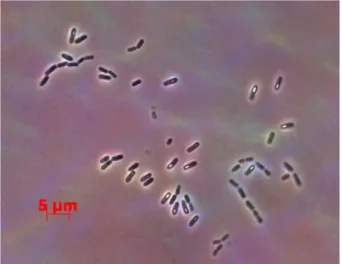
CC110 균주의 생리생화학 특성을 조사한 결과, 그람 양 성, 호기성이며 포자를 형성하는 간균(2.9×0.9 µm)으로 편 모를 통해 운동하는 하는 것으로 관찰되었다. CC110균주 의 포자는 타원형(ellipsoidal)이고 영양 세포의 끝 부위에 서 형성되었다. 한편 CC110 균주는 pH 5.0~10.0, 온도 10
~55oC, 염농도 1~15%의 범위에서 생육이 가능하였다. 또한 전분, 카제인, CM-셀룰로오스, 젤라틴을 가수분해할 수 있 고, 질산 환원능, catalase, oxidase 활성을 가지고 있었다.
탄소원 이용성 시험에서는 glucose, arabinose, mannose, mannitol, N-acetyl-glucosamine, maltose, gluconate, mal- ate, citrate 등의 기질을 이용할 수 있었다(Table 2, Fig. 2).
CC110균주의 배지종류별 오이 노균병 발생 억제 효과 조사
B. amyloliquefaciens CC110균주의 배지종류별 오이노균 병에 대한 생물검정 결과 LB(Luria-Bertani)와 KB(King's B broth)배지에서 배양한 배양원액 처리에서 전혀 발병하지 않았지만 배양액의 5배 희석액에서 TSB배지의 배양원액보 다 많은 오이 노균병이 발생하였다(Table 3). 그러므로 4종 의 배지 중에서 오이노균병 발생량이 적은 TSB배지를 선
발하였다.
CC110균주의 TSB배지에서 배양한 처리형태별 오이 노균
병 발생 억제 효과
선발 CC110균주를 TSB배지에 이식하여 2일간 28oC에서 150 rpm으로 진탕배양하여 원심분리(8000 rpm, 10oC, 30분) 한다. 배양액은 원액, 2배액과 5배액으로, 배양여액은 원액, 2배액과, 5배액으로 희석 처리하고, 세포(cell)는 농도별로 오이 잎에 처리하여 생물검정을 한 결과 배양액 처리와 배 양여액처리에서 희석배수가 높을수록 오이 노균병 발생량 이 많았으며, cell 처리에서 cell 농도가 높을수록 오이 노균 병이 발생량이 많았지만, cell이 1×10⁸/ml 처리는 9.4%, 5×
107/ml 처리구에서 10.0%, 1×10⁷/ml 이하 처리에서는 무처 리구와 노균병 발생이 비슷하여 방제효과가 거의 없었다 (Table 4). 그러므로 CC110균주의 배양액이나 배양여액을 이용하는 방법을 선택하였다.
오이 유묘에 대한 노균병 발생 억제 효과 조사
오이 노균병균을 배양액을 처리한 2엽기의 오이 식물체 에 분무 접종하여 상대습도가 100%이며 20oC로 조절한 Table 1. Control effect of five isolates against cucumber downy mildew caused by P. cubensis in leaf disk bioassay
Control % diseased leaf areaa)
CC110 S2-1 S2-3 Y1-3 Y20-3 Control
Preventiveb) 0 0 0 0 0 18.0
Curativec) 0 0.8 0.8 1.2 1.2 15.0
a)Investigation was made 7 days after inoculation of P. cubensis (1×10⁵/ml).
b) The bacterial suspension was treated onto cucumber leaf disks before inoculation of P. cubensis.
c) The bacterial suspension was treated onto cucumber leaf disks after inoculation of P. cubensis.
Fig. 1. Phylogenetic dendrogram constructed from a comparative analysis of gyrB gene sequence showing the relationships bet- ween strain CC110 and related Bacillus species. Bootstrap values (expressed as percentages of 1,000 replications) are shown at branch points. Bar, 5 substitutions per 100 nucleotide positions. Bacillus cereus ATCC 14579T (AE016877) was used as an outgroup.
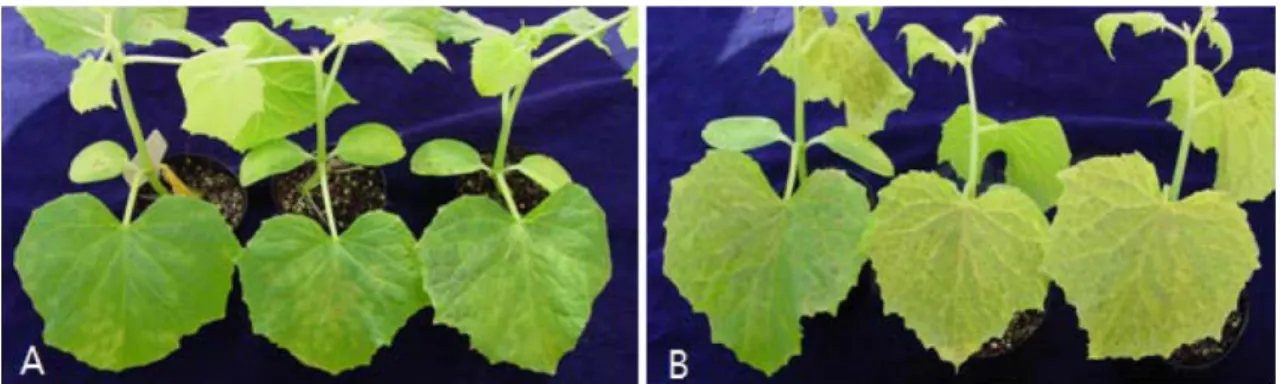
접종상에 넣어 7일후에 오이 노균병 발생을 조사한 결과 CC 110균주의 배양액처리구가 35.0%, 무처리구가 82.0%
노균병이 발생하여 57.3%의 방제효과를 나타내었다(Table 5, Fig. 3).
비닐하우스포장에서 선발균주의 처리간격 및 횟수별 오이 노균병 발생 억제 효과 조사
비닐하우스 포장에서 오이 노균병이 발생하기 전에 균주 CC110을 TSB배지에서 배양하여 5일 간격 4회 처리가 19.9%, 7일 간격 3회 처리가 24.1%, 대조약제를 7일 간격 3회 처리한 화학약제 디메쏘모르프수화제가 12.4% 그리고 무처리가 42.8% 발생하였다(Table 6).
국내에서는 오이 노균병 방제에 TSB배지에서 배양한 배 양액 처리에서 B. subtilis B29균주가 선발된바 있으며(Lee Table 2. Phenotypic characteristics of B. amyloliquefaciens
CC110
Characteristics Strain CC110
Sporangium bulging −
Spore shape Ellipsoidal
Spore position Terminal
Cell size > 3(µm) −
Growth range
pH 5.0~10.0
NaCl (%) 1~15
Temperature (oC) 10~55
Anaerobic growth -
Hydrolysis of:
Starch +
Casein +
Carboxymethyl cellulose +
Gelatin +
Lipid −
Chitin −
Nitrate reduction +
Oxidase activity +
Catalase activity +
Carbon assimilation
Glucose +
Arabinose +
Mannose +
Mannitol +
N-Acetyl-glucosamine +
Maltose +
Gluconate +
Caprate −
Adipate −
Malate +
Citrate +
Phenyl-acetate −
+, positive; −, negative.
Table 3. Suppression of downy mildew on the cucumber leaf disk treated with B.amyloliquefaciens CC110 cultured on various media
Treatment % diseased leaf area 7 days after treatment
TSB LB NB KB Control
Cultured liquid 4.0 0 11.0 0
5-fold of 22.0
cultured liquid 3.0 10.0 20.0 22.0 Media broth 22.0 24.0 24.0 25.0
Fig. 2. Phase-contrast micrograph of sporulating cells of B.
amyloliquefaciens CC110.
Table 4. Suppression of downy mildew on the cucumber leaf disk treated by treatment with various cultured liquid, super- natant liquid and cells in TSB of B. amyloliquefaciens CC110
Treatment Dilution (×) Infected area (%)
Cultured liquid 0 0.0
×2 3.0
×5 8.0
Supernatant liquid of cultured liquid
0 0.0
×2 4.0
×5 7.0
Cell 9.4
10.0 21.0 20.0 19.0
Control - 21.0
et al., 2010), 외국에서는 수수 노균병의 생물적 방제에 Pseudomonas fluorescens가 노균병균의 포자형성을 억제하 였으며 단독처리보다 종자처리와 경엽 처리하여 방제효과 를 증가시켰다고 하였다(Umesha et al., 1988). 또한 옥수 수 노균병 생물적 방제에 Trichoderma spp.와 Bacills sub-
tilis 균주를 혼용처리와 침지 및 경엽처리가 방제효과를 증
가되었다(Sadoma,et al., 2011). 그리고 포도 노균병에 대한 생물적 방제로 이스라엘에서 기생진균으로 fumonisin 톡신 을 생성하는 Fusarium proliferatum이 노균병균의 유주자낭 형성을 감소하였다는 연구가 보고되었다(Stuart et al., 1996;
Shlomo et al., 2001). B. amyloliquefaciens subsp. plantarum 의 게놈 분석하여 발견된 cyclic lipopeptides (bacillomycin D, fengycin, iturin, surfactin), dipeptide (bacilysin), side- rophore(bacillibactin)와 polyketides(bacillaene, difficidin, macrolactin)의 유전자가 여러 항균물질을 생성하여 식물병 원균에 대하여 항균력과 식물생장력을 가지고 있어 작물 생산량과 품질을 향상시키는 미생물농약과 미생물비료이 균주로서 사용이 가능하다고 하였다(Borriss, 2011; Borriss R. et al., 2011; Lee et al., 2012).
본 연구에서 선발한 B. amyloliquefaciens CC110균주도 이와 유사한 항균물질 생산 유전자를 가질 수 있어 식물병 방제에 우수한 균주로 생각되며, 추후에 오이 노균병균에 대한 작용기작 연구가 필요하며 포장에서 경엽처리보다도 종자처리와 함께 경엽 처리하면 오이노균병에 대한 생물적 방제 효과를 증가시킬 수 있을 것으로 사료된다.
적 요
Pseudoperonospora cubensis에 의한 오이 노균병의 생물 적 방제를 위하여 오이 재배단지의 오이 식물체 126균주를 분리하였다. 그 중에서 잎 절편 생물검정 통하여 5균주를 선발하였다. CC110균주는 오이노균병 예방과 치료효과 검 정에서 전혀 병이 발생하지 않았지만 무처리는 15.0~18%
노균병이 발생하였다. CC110균주는 gyrB gene sequence
분석에 의하여 Bacillus amyloliquefaciens subsp. plantarum 로 동정하였다. CC110균주를 TSB배지에서 배양한 배양액 은 LB, NB와 KB 배지에서 배양한 배양액보다 오이 노균 병 발생이 적어 효과적이었다. CC110균주를 TSB배지에서 배양한 배양액의 원액, 2배와 5배 희석한 처리구에서 0%, 3.0%와 8.0% 그리고 배양여액을 원액, 2배와 5배 희석한 처리구에서 0%, 4.0%와 7.0% 노균병이 발생하였고, 무처 리는 21.0% 발생하였다. 오이 유묘검정에서 CC110균주를 TSB배지에서 배양한 배양액은 오이 노균병이 35.0% 발생 하였고 무처리는 82.0% 발생하였다. 비닐하우스 포장에서 오이 노균병에 대하여 B. amyloliquefaciens CC110균주를 5 일 간격 4회 처리가 7일 간격 3회 처리보다 방제효과가 높 았다.
Fig. 3. Control effect of downy mildew on the cucumber seedling treated with CC110 isolate. A, B. amyloliquefaciens CC110; B, control.
Table 5. Control effect of B. amyloliquefaciens CC110 against downy mildew in the cucumber seedling
Infected area (%) Control efficacy B. amyloliquefaciens CC110 Control (%)
35.0 aa) 82.0 b 57.3
a)Means, followed by a common letter are not significantly differ- ent at the 1% level by DMRT.
Table 6. Control effect of B. amyloliquefaciens CC110 on cu- cumber downy mildew when it was treated at different appli- cation intervals and times in the vinylhouse
Treatment Day interval Treated times % lesion areaa) B. amyloliquefaciens
CC110
5 4 19.9 abb)
7 3 24.1 b
Dimethomorph WP
(×1,000) 7 3 12.4 a
Control - - 42.8 c
a)Results were obtained seven days after final treatment.
b)Means, followed by a common letter are not significantly differ- ent at the 1% level by DMRT.
감사의 글
본 연구는 농촌진흥청 국립농업과학원 농업과학기술 연 구개발사업(과제번호: PJ90709202)의 지원에 의해 이루어 진 것이며, 이에 감사드립니다.
참고문헌
Borriss, R. 2011. Use of plant-associated Bacillus strains as bio- fertilizers and biocontrol agents, pp. 41-76. In: Bacteria in agrobiology: plant growth response Eds. Maheshwari D K.
Springer Heidelberg, Heidelberg, Germany.
Borriss, R., Chen, X. H., Rückert, C., Blom, J., Becker, A., Baum- garth, B., Fan, B., Pukall, R., Schumann, P., Sproer, C., Junge, H. and Vater, J. 2011. Relationship of Bacillus amyloliquefa- ciens clades associated with strains DSM 7T and FZB42T: A proposal for Bacillus amyloliquefaciens subsp. amyloliquefaci- ens subsp. nov. and Bacillus amyloliquefaciens subsp. planta- rum subsp. nov. based on complete genome sequence compa- risons. Int. J. Syst. Evol. Microbiol. 61:1786-1801.
Cohen, Y. 1981. Downy mildew of cucurbits. In: The downy mil- dew. pp. 341-353. Eds. Spencer. D. M. Academic Press. New York.
Copping, L. G. 2009. The manual of biocontrol agents. 3th edi- tion, pp. 702. BCPC. UK.
Elizabeth, A. S., Leah, L. G. Lina, M. Q. Marina, V. Mary, K. H.
and Brad, D. 2011. The cucurbit downy mildew pathogen Pseudoperonospora cubensis. Mol. Plant Pathol. 12(3): 217-226.
Fravel, D. R. 2005. Commercialization and implementation of biocontrol. Annu. Rev. Phytopathol. 43:337-359.
Lebeda, A. and Cohen, Y. 2011. Cucurbit downy mildew(Pseudo- peronospora cubensis)–biology, ecology, epidemiology, host–
pathogen interaction and control. European J. Plant Pathol.
129:157-192.
Lebeda, A. and Cohen, Y. 2012. Fungicide resistance in Pseudope- ronospora cubensis, the causal pathogen of cucurbit downy mildew. In: Fungicide Resistance in Crop Protection: Risk and Management, pp. 44-63. Eds. Thind TS, CABI. Walling- ford, UK.
Lee, S. Y., Kim, B. Y., Ahn, J. H., Song, J., Seol, Y. J., Kim, W. G.
and Weon, H. Y. 2012. Draft Genome Sequence of the Bio- control Bacterium Bacillus amyloliquefaciens Strain M27. J.
Bacteriol. 194:6934-6935.
Lee, S. Y., Lee, Y. K., Park, K. and Kim, Y. K. 2010. Selection of beneficial microbial agents for control of fungal diseases in the phyllosphere of cucumber plant. Kor. J. Pest. Sci. 14(4):
326-331. (in Korean).
National Institute of Agricultural Science and Technology. 1997.
Compendium of vegetable diseases with color plates. pp. 448.
Sammi press. Seoul. (in Korean).
Rusell, P. E., Milling, R. J. and Wright, K. 1995. Control of fungi pathogenic to plants. pp. 85-110. In fifty years of antimicro- bials: past perspectives and future trends. Fifty-third sympo- sium of the Society for General Microbiology held at the University of Bath, April 1995.
Sadoma, M. T., El-Sayed, A. B. B. and El-Moghazy, S. M. 2011.
Biological control of downy mildew disease of maize caused by Peronospora sorghi using certain biocontrol agents alone or in combination. J. Agryc. Res. Kafer El-Sheikh Univ., 37(1):1- 11.
Shlomo, B., Abraham, S. and Oded, Y. 2001. Isolation and charac- terization of a cold-tolerant strain of Fusarium proliferatum, a biocontrol agent of grape downy mildew. Phytopathology. 91 (10): 1062-1068.
Stuart, P. F., Roger, C. P., David, M. G., Robert, C. S. and Abra- ham, S. 1996. Fusarium proliferatum as a biocontrol agent against grape downy mildew. Phytopathology. 86(10):1010- 1017.
Tamura, K., Peterson, D., Peterson, N., Stecher, G., Nei, M. and Kumar, S. 2011. MEGA5: Molecular evolutionary genetics analysis using maximum likelihood, evolutionary distance, and maximum parsimony methods. Mol. Biol. Evol. 28, 2731- 2739.
Tanaka, Y. T. and Omura, S. 1993. Agroactive compounds of microbial origin. Ann. Rev. Microbiol. 47:57-87.
The Korean Society of Plant Pathology. 2009. List of plant diseases in Korea, 5th edition, pp. 853. JY press, Anyang. (in Korea).
Thomas, C. E. 1996. Downy mildew. In: Compemdium of cucur- bit diseases, pp. 25-27. Eds. T. A. Zitter, D. L. Hopkins, & C.
E. Thomas. St. Paul; American phytopathological Society Press.
Tofazzal Islam Md. and Motaher hossain Md. 2013. Biological control of Peronospormycete phytopathpthogen by bacterial antagonist, In: Bacteria in agrobiology : disease management, pp. 167-218. Eds. D. K. Maheshwari. Springer-Verlag Berlin Heidelberg.
Umesha, S., Dharmesh, S. M., Shetty, S. A., Krishnappa, M. and Shetty, H. S. 1998. Biocontrol of downy mildew disease of pearl millet using Pseudomonas fluorescens. Crop Prot. 17(5):
387-392.
Yamamoto, S. and Harayama, S. 1995. PCR amplification and direct sequencing of gyrB genes with universal primers and their application to the detection and taxonomic analysis of Pseudomonas putida strains. Appl. Environ. Microbiol. 61:1104- 1109.