This is an Open Access article distributed under the terms of the Creative Commons Attribution Non-Commercial License (http: //creativecommons.org/licenses/by- nc/4.0/) which permits unrestricted non-commercial use, distribution, and reproduction in any medium, provided the original work is properly cited.
© 2020 THE KOREAN SOCIETY OF MYCOLOGY.
Accepted: August 27, 2020 Revised: July 03, 2020 Received: April 29, 2020 https://doi.org/10.4489/KJM.20200033 Kor. J. Mycol. 2020 September, 48(3): 337-343
OPEN ACCESS pISSN : 0253-651X eISSN : 2383-5249
RESEARCH NOTE
에키나시아 흰가루병을 일으키는 Podosphaera xanthii 동정
최인영
1,2, 홍선희
3, 이용호
3, 신현동
4,*1
전북대학교 농생물학과,
2전북대학교 농업과학기술연구소,
3한경대학교 식물생명환경과학과,
4고려대학교 환경생태공학부
Identification of Podosphaera xanthii as the causal agent of powdery mildew disease affecting Echinacea purpurea in Korea
In-Young Choi
1,2, Sun-Hee Hong
3, Yong-Ho Lee
3, and Hyeon-Dong Shin
4,*1
Department of Agricultural Biology, Jeonbuk National University, Jeonju 54896, Korea
2
Institute of Agricultural Science and Technology, Jeonbuk National University, Jeonju 54896, Korea
3
Department of Plant and Environment Science, Hankyong National University, Anseong 17579, Korea
4
Division of Environmental Science and Ecological Engineering, Korea University, Seoul 02841, Korea
*
Corresponding author: [email protected]
ABSTRACT
During the extensive forays for discovering the biodiversity of phytopathogenic fungi in Korea, powdery mildew-affected purple coneflowers (Echinacea purpurea) were frequently found. Since 2004, nine samples have been deposited in the Korea University Herbarium. The initial symptoms include white, evanescent mycelia and irregular patches on mature leaves.
Mild symptoms in the form of discolored lesions are also noticed on the stem and petal of the affected plants. Based on the morphological characteristics of the anamorph and the phylogenetic analysis of the internal transcribed spacers (ITS) and large subunit (LSU) rDNA sequences, the causal fungus was identified as Podosphaera xanthii. This is the first report that identifies the causal agent of powdery mildew disease affecting purple coneflower in Korea.
Keywords: Erysiphaceae, Podosphaera xanthii, Powdery mildew, Purple coneflower
우리나라에 분포하는 식물병원성 균류의 다양성을 연구하는 과정에서 흰가루병균과 (Erysiphaceae)에 속하는 다수의 균류가 채집되었다. 흰가루병균은 다양한 국화과(Asteraceae) 식 물에서 흔하게 관찰되지만, 에키나시아에 기생하는 흰가루병균은 한국에서 지금까지 기록되지 않았다. 저자들은 2004년에 처음으로 에키나시아에서 흰가루병의 발생을 발견하였고, 2015년부 터 2020년까지 8차례 추가로 확인하였다.
에키나시아로 통칭되는 식물은 전 세계적으로 약 40종이 있지만, 재배를 위해 10종 정도가 널리 보급되었다. 우리나라에서는 국가표준식물목록 [http://www.nature.go.kr/kpni/]에 Echinacea purpurea(에 키나시아), E. pallida(팔리다에키나시아), E. paradoxa(파라독사에키나시아), E. tennesseensis(테네시에
키나시아), E. angustifolia(앙구스티폴리아에키나시아) 등 5종이 등록되어 있다. 그러나 실제 화단에 널리 식재되는 식물은 E. purpurea의 여러 품종이다.
에키나시아(E. purpurea)는 �purple coneflower�라 불리는 북미 원산의 약용식물로서 전 세계적으로 널리 재배되며[1-3], 꽃이 아름다워 관상식물로도 널리 식재된다[2,4]. 우리나라에 도입된 시기는 불분명하며, 다양한 관상용 품종이 지속적으로 도입되고 있다.
우리나라에서 Echinacea속 식물에는 아직 어떠한 병원균도 기록되어있지 않다[5,6]. 본 연구 기 간에도 저자들은 Echinacea속 식물체에서 흰가루병 이외에는 뚜렷한 병해를 관찰하지 못했다. 저 자들이 채집한 총 9점의 시료는 모두 에키나시아(E. purpurea)에 속하며, 흰가루병균은 형태적 특 징을 기초로 동정했을 때 모두 Podosphaera속에 속하였다. 그 중, 대표적인 3점을 대상으로 분자분 석을 실시하였으며, 에키나시아 흰가루병균을 P. xanthii로 동정하였기에 보고한다.
표본 내역
2004년부터 2020년에 총 9회에 걸쳐 흰가루병에 감염된 에키나시아를 채집하였다. 이들 시료 는 건조표본으로 제작되어 고려대학교 식물표본보관소(Korea University Herbarium [KUS], Seoul, Korea)에 보존되었으며, 내역은 Table 1과 같다.
흰가루병의 병징
에키나시아 흰가루병은 대부분 잎의 앞면에 발생하였고 잎의 뒷면에도 약하게 발생하였다 (Fig. 1A-1C). 때로 줄기에도 발병하였으며(Fig. 1D), 매우 드물게 꽃잎에도 균총과 함께 발생하 여 병반 부위에 변색이 생겼다(Fig. 1E-1G). 발병 초기에는 흰가루병균의 균사가 잎의 양면에 얇 게 퍼져 맨눈으로 인지하기 어려웠다. 병이 진전되어도 균사층이 두껍지 않고 얇게 퍼지며, 뚜렷 한 균총을 형성하지 않으므로 다른 흰가루병에 비해 쉽게 눈에 띄지는 않았다. 다만, 흰가루병에 감염된 잎은 흰가루병균 균사체의 영향으로 인하여 광택을 잃고 녹색이 옅어져 관상가치가 다소 떨어졌다. 또한, 어린잎이나 줄기에서는 병징이 매우 약하거나 거의 발병하지 않았고, 주로 성숙 한 잎에서만 발생하였다. 따라서, 잎이 뒤틀리는 등 특별한 기형이 나타나지 않았으며, 조기낙엽 을 일으킨다고 판단되지도 않았다. 다만, 병든 잎은 건전한 잎에 비해 활력을 잃고 차츰 말라 죽는 특징이 나타났다. 에키나시아 흰가루병에 감염된 잎은 서울에서 11월 중순의 서리를 맞아 죽을
Table 1. Voucher specimen of Echinacea purpurea with Podosphaera xanthii deposited in the Korea
University Herbarium (KUS).KUS Number Collection date Location GPS coordinate
F20785 6 Oct 2004 Phoenix Park, Pyeongchang 37°35′N; 128°19′E F28768 30 Jul 2015 Jirisan Herb Valley, Namwon 35°26′N; 127°32′E F28787 18 Aug 2015 Gyeongnam Arboretum, Jinju 35°09′N; 128°17′E F28851 15 Sep 2015 Jirisan Herb Valley, Namwon 35°26′N; 127°32′E F30047 24 Sep 2017 Bukhansan Eco Park, Seoul 37°41′N; 127°02′E F31456 11 Nov 2019 Korea University Farm, Namyangju 37°35′N; 127°14′E
F31457 12 Nov 2019 Anam-dong, Seoul 37°35′N; 127°01′E
F31476 12 Nov 2019 Sarabong, Jeju 33°31′N; 126°32′E
F31899 15 Jul 2020 Bomun-dong, Seoul 37°34′N; 127°01′E
때까지도 유성세대의 형성이 관찰되지 않았다. 이러한 병징은 대부분 그늘진 곳에서 자라는 개 체에서 관찰되었으며, 병세는 약한 편이었다. 한편, 한 개체에서도 아랫잎일수록 발병이 심한 경 향이었으며, 아랫잎부터 말라죽으므로 관상 가치를 크게 떨어뜨렸다.
흰가루병균의 형태적 특징
에키나시아 흰가루병균의 분류학적 특성을 파악하고 크기를 측정하기 위해서 명시야광학현 미경(BX51, Olympus, Tokyo, Japan)을 사용하였고, 현미경사진은 미분간섭현미경(Axio Imager,
Carl Zeiss, Göttingen, Germany)을 이용하여 촬영하였다. 흰가루병의 각 특징에 대한 검경은 모두 신선시료를 사용하였다. 균사는 기주식물의 표면에 존재하며, 대부분 직선상이거나 파상이며, 때로는 결절을 형성하였다. 균사 부착기는 발달이 미약하고 드물었으나, 유두상으로 단생하는 특징을 나타냈다. 분생포자경은 표생균사의 윗부분으로부터 발달하며, 120-240×9-11 µm의 크 기, 4-10(-14)개의 세포로 구성되었고, 미성숙 분생포자를 3-6(-8)개씩 연쇄상으로 형성하였다(Fig.
2A and 2B). 분생포자경의 기부세포는 아래쪽이 곧고, 길이는 30-60 µm였다(Fig. 2C). 1차 분생포 자는 정부가 둥근형이고 기부가 뭉툭한 절단형이며, 다른 특성은 2차 분생포자에 준하였다. 2차 분생포자는 무색의 단세포이며, 뚜렷한 피브로신체(fibrosin body)를 가지며, 타원형 내지 달걀형 이며, 크기는 25-36×16-20 µm이며(Fig. 2D and 2F), 대부분 포자의 측면에서 발아하였으며, 발아 관은 대체로 분지하였다(Fig. 2E). 따라서 분생포자경과 분생포자에 피브로신체를 가지며, 분생 포자를 연쇄상으로 형성하는 특징으로 보아, 에키나시아 흰가루병균은 Podosphaera속에 속하였 다[7].
Fig. 1. Symptoms of powdery mildew caused by Podosphaera xanthii on Echinacea purpurea. (A) Heavy infections detracting from
the beauty of the plant. (B) Close-up view of powdery mildew colonies on infected leaf surface. (C) Young plant was already infected when planted in a flower garden. (D) Powdery mildew symptoms on stem (arrows). (E, F) Powdery mildew symptoms on petals. (G) Close-up of spot symptoms on an infected petal.흰가루병균의 염기서열 분석
형태적 특징을 기초로 한 흰가루병균 동정을 재확인하고자 고려대학교 식물표본보관소에 보존되어있는 3개의 건조표본(KUS-F30047, KUS-F31457, KUS-F31476)을 선발하여 염기서열 기반의 계통학적 분석을 수행하였다. Genomic DNA는 선발된 표본의 잎 윗면에 형성된 흰가 루병 균사체를 메스로 긁어 1.5 mL eppendorf tube에 채취하여 액체질소를 넣고 마쇄한 후, Plant Genomic DNA Extraction Kit (Bioneer, Daejeon, Korea)를 이용하여 추출했다. 추출된 Genomic DNA 의 internal transcribed spacer (ITS) 영역과 28S large subunit (LSU) rDNA 영역의 염기서열을 분석하 였다. Ribosomal DNA (rDNA)의 ITS 영역은 ITS1F[8]와 PM6 primer[9], LSU 영역은 PM3와 TW14 primer[10]를 사용하여 PCR로 증폭시켰다. 증폭된 산물은 정제를 위해 1.5% agarose gel에서 분리 한 후 PCR/Gel purification kit (Bioneer, Daejeon, Korea)를 사용하였다. ABI 3130 auto sequencer를 이용
Fig. 2. Conidial stage of a powdery mildew fungus, Podosphaera xanthii, examined on Echinacea purpurea. (A, B) Mature
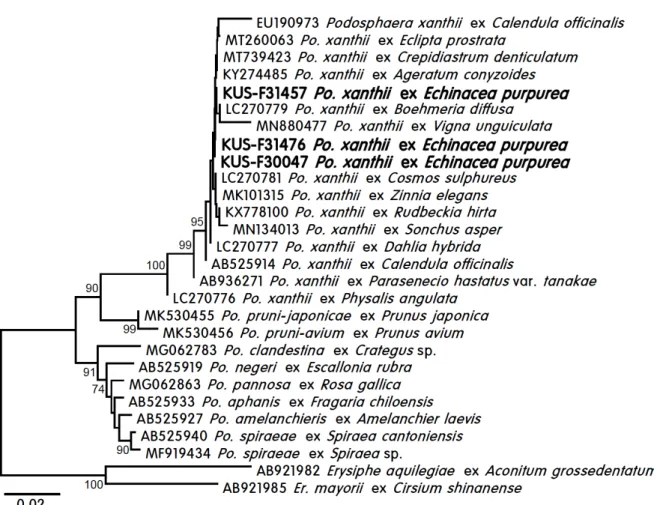
conidiophores. Arrows indicate fibrosin bodies. (C) Immature conidiophore. (D) Conidia. (E) A conidium with biforked germ tube. (F) Conidia showing prominent fibrosin bodies (arrows).Fig. 3. Phylogenetic tree based on neighbor-joining method comparing internal transcribed spacer (ITS) and the 28S large subunit (LSU)
sequences of Podosphaera xanthii on Echinacea purpurea isolates and some reference isolates retrieved from GenBank. The numbers above the nodes are the bootstrap values obtained from 1,000 replications. The Korean isolates presented in this study are indicated in bold.하여 ITS와 LSU의 염기서열을 Macrogen (Seoul, Korea)에 의뢰하여 분석하였으며, ITS와 LSU 염기 서열은 GenBank database (National Centre for Biotechnology Information [NCBI], US National Institute of Health Bethesda, http://blast.ncbi.nlm.nih.gov/Blast.cgi)에서 Blastn을 통해 상동성을 확인하였다. 계통학 적 분석은 MEGA 6.0 program[11]을 이용하여 neighbor-joining 방법으로 수행하였으며, 염기서열의 유전자 거리는 Tamura-Nei parameter model로 계산하였고, bootstrap analysis은 1,000 반복으로 수행하 였다.
에키나시아 흰가루병균에 대한 NCBI의 GenBank 등록번호는 ITS 영역의 염기서열은 MT826242, MT826243, MT826244이며, LSU 영역의 염기서열은 MT826245, MT826246, MT826247이다. NCBI 에서 ITS 영역에 대한 Blastn search한 결과 GenBank에 P. xanthii로 등록된 MT260063, LC270780,
MG171189 등과 100%의 상동성을 보였다. LSU 영역에 대한 Blastn search한 결과도 P. xanthii로 등 록된 AB525914, KX842351, AB022410 등과 >99%의 상동성을 보였다. 또한, 계통수 작성 결과 에키 나시아 흰가루병원균의 ITS, LSU dataset 염기서열은 국화과에 속하는 여러 종의 식물에서 흰가루 병으로 보고된 P. xanthii 등과 하나의 그룹을 형성하였다(Fig. 2).
고찰
에키나시아는 세계적으로 널리 식재되는 식물임에도 불구하고 흰가루병균이 기록된 사례는 많지 않고, 미국과 호주에서 에키나시아 흰가루병의 기록이 있다[12]. 미국에서는 어떤 분류군 의 흰가루병균인지 밝혀지지 않은 상태로서 Oidium sp.로 기록되었으나, 미국 농무성 데이터베 이스 자료[5]에는 이에 관한 기록이 없는 실정이다. 따라서, 미국에서는 실제 에키나시아 흰가루 병의 기록은 부정된다고 볼 수 있다. 한편, 호주에서 Sphaerotheca fuliginea로 흰가루병균이 기록되 었으나, 최근의 문헌[13]에서도 이에 관한 언급이 전혀 없으므로 실제 이 흰가루병의 존재 여부 는 알 수 없다. 한편, 최근에 캐나다[14]와 이탈리아[15]에서 각각 에키나시아 흰가루병의 발병을 보고하면서 흰가루병균을 Golovinomyces cichoracearum으로 동정하였다. 캐나다에서는 1997년과 1998년에 브리티시 콜롬비아 주에서 발병이 관찰되었고, 무성세대와 유성세대가 각각 확인되었 다. 이탈리아에서는 2017년 8월부터 10월에 흰가루병이 발견되었으며, 유성세대의 형성은 없었 다. 따라서, 에키나시아에 발생하는 흰가루병균으로서 Podosphaera xanthii는 본 연구를 통하여 전 세계적으로 처음 기록되는 것이다.
적요
한국에서 식물병원성 균류의 생물다양성을 파악하기 위한 균류 탐사를 통하여 에키나시아 흰가루병이 지속적으로 관찰되었다. 총 9점의 시료를 고려대학교 식물표본보관소에 보존하였 다. 병든 식물에서는 주로 성엽에서 흰색의 얇은 균사층이 전면으로 또는 부분적으로 나타났다.
흰가루병균의 감염으로 줄기와 꽃잎에서는 변색 부위가 나타나는 특징을 보였다. 이 흰가루병 균 무성세대의 형태적 특징과 더불어 ITS 및 LSU 염기서열을 계통분석한 결과, 이 흰가루병균 은 Podosphaera xanthii로 동정되었다. 이는 한국에서 에키나시아 흰가루병에 관한 최초의 보고 이다.
ACKNOWLEDGEMENTS
This study was carried out with the support of the �Cooperative Research Program for Agricultural Science & Technology Development(Project Nos. PJ014976112020, PJ0134762020)� Rural Development Administration, Republic of Korea.
REFERENCES
1. CABI. Echinacea purpurea [Internet]. Wallingford, : CAB International; 2020 [cited 2019 Nov 19]. Available from www.cabi.org/isc/datasheet/48033.
2. Kumar KM, Ramaiah S. Pharmacological importance of Echinacea purpurea. Intl J Pharm Biosci 2011;2:304-14.
3. Gu Y, Maenaka T, Saito K, Yamashita T, Choi IS, Terai K, Ahn KS. Antioxidant and immuno- enhancing effects of Echinacea purpurea (American herb) in vivo. Orient Pharm Exp Med.
2005;5:48-56.
of purple coneflower (Echinacea purpurea) to nitrogen sources at different level of irrigation.
Physiol Mol Biol Plants. 2019;25:177-87.
5. Farr DF, Rossman AY. Fungal databases, U.S. National Fungus Collections [Internet]. Beltsville:
Systematic Mycology and Microbiology Laboratory; 2020 [cited 2020 Sep 1]. Available from:
http://nt.ars-grin.gov/fungaldatabases.
6. The Korean Society of Plant Pathology. List of plant diseases in Korea. 5th ed. Seoul: Korean Society of Plant Pathology; 2009.
7. Braun U, Cook RT. Taxonomic manual of the Erysiphales (powdery mildews). Utrecht: CBS- KNAW Fungal Biodiversity Centre; 2012.
8. White TJ, Bruns T, Lee SB, Taylor JW. Amplification and direct sequencing of fungal ribosomal RNA genes for phylogenetics. In: PCR Protocols: A Guide to Methods and Applications, ed. by Innis MA, Gelfand DH, Sninsky JJ, White TJ ediotrs. San Diego:
Academic Press; 1990. P. 315-322.
9. Takamatsu S, Kano Y. PCR primers useful for nucleotide sequencing of rDNA of the powdery mildew fungi. Mycoscience 2001;42:135-39.
10. Khodaparast SA, Takamatsu S, Hedjaroude GA. Phylogenetic analysis of Iranian powdery mildew fungi using nucleotide sequences of 28S ribosomal DNA. J Agric Sci Technol 2005;7:49-58.
11. Tamura K, Stecher G, Peterson D, Filipski A, Kumar S. MEGA6: Molecular evolutionary genetics analysis version 6.0. Mol Biol Evol 2013;30:2725-9.
12. Amano K. Host range and geographical distribution of the powdery mildew fungi. Tokyo:
Japan Sci. Soc. Press; 1986.
13. Kiss L, Vaghefi N, Bransgrove K, Dearnaley JDW, Takamatsu S, Tan YP, Marston C, Liu SY, Jin DN, Adorada DL, et al. Australia: A continent without native powdery mildews? The first comprehensive catalog indicates recent introductions and multiple host range expansion events, and leads to the re-discovery of Salmonomyces as a new lineage of the Erysiphales.
Front Microbiol 2020;11:1571.
14. Sholberg PL, Ginns JH, Li TSC. First report of powdery mildew caused by Erysiphe cichoracearum on coneflowers. Plant Dis 1999;83:694.
15. Garibaldi A, Bertetti S, Matic S, Guillino ML. Powdery mildew caused by Golovinomyces cichoracearum on Eastern purple coneflower (Echinacea purpurea) in Italy. Plant Dis 2018;102:1028.