목향에탄올추출물의 ROS-MAPKs 경로를 통한 세포사멸 유도
김대성·이성진·이장천*·우원홍·임규상·문연자**,#
원광대학교 한의학전문대학원, *부산대학교 한의학전문대학원, **원광대학교 한의과대학 (Received April 9, 2012; Revised May 19, 2012; Accepted May 22, 2012)
Ethanol Extract of Saussurea lappa Root Induces Apoptosis through an ROS-MAPKs-Linked Cascade
Dae-Sung Kim, Sung-Jin Lee, Jang-Cheon Lee*, Won-Hong Woo, Kyu-Sang Lim and Yeun-Ja Mun**,#
*Dept. of Herbal Resources, Professional Graduate School of Oriental Medicine, Wonkwang University, Iksan 570-749, Korea
**Division of Pharmacology and Basic Korean Medicine, School of Korean Medicine, Pusan National University, Pusan 626-870, Korea
***Dept. of Anatomy, College of Oriental Medicine, Wonkwang University, Iksan 570-749, Korea
Abstract — Saussurea lappa (SL) and major compounds, sesquiterpene lactones, have been suggested to possess various biological effects, including anti-tumor, anti-ulcer, anti-inflammatory, anti-viral and cardiotonic activities. Therefore, the eth- anol extract of Saussurea lappa root (ESL) is studied for the mechanism of its action in apoptotic pathway. ESL-treated cells manifested nuclear condensation, and fragmentation. ESL also triggered the mitochondrial apoptotic pathway, as indicated by a change in Bax/Bcl2 ratio and caspase-9/-3 activation. ESL induced p38 MAPK/JNK, p53, and ASK1 phosphorylation.
ROS scavenger reversed ESL-induced apoptotic cell death via inhibition of caspase-3 and p38 MAPK/JNK phosphorylation.
These results suggest that ESL induced apoptosis in HepG2 cells through the ROS-p38/JNK pathway.
Keywords □ Saussurea lappa, Bax/Bcl2, caspases, MAPKs, apoptosis
세포고사는 정상적인 세포의 수를 조절하는데 있어 필요한 과 정으로 다양한 원인의 손상에 의해 유도되며, 유해한 세포의 제 거 등에 관여하여 개체의 항상성을 유지하는 중요한 조절 기구 로 작용하고 있다.1,2)세포고사에서 endonuclease인 caspases가 활성화되어 PARP, beta-catenin, retinoblastoma, lamins, gelsolin 등 다양한 세포내 단백질을 분해함으로써 궁극적으로 세 포사멸에 이르게 하기 때문에 caspase는 세포사멸 실행자로 인 식되고 있다.3-5)
Mitogen-activated protein kinase(MAPK) family는 여러 가지 외부자극에 의해 세포의 성장, 사멸, 분화 등에 관여하고 extracellular signal regulating kinase 1/2(ERK1/2 또는 p44/
42), c-Jun N-terminal kinase(JNK), p38 MAP kinase로 구성되 어 있으며, 전사조절인자들의 인산화를 통해 여러 유전자들의 발 현을 조절한다.6)그 중 JNK와 p38 MAPK는 염증성 cytokine,
산화적 스트레스, 세포사멸 유도 인자들에 의해 활성화 된다.7,8) 한편 Apoptosis signal regulating kinase 1(ASK1)는 칼슘 유입, 소포체 스트레스, lipopolysaccharide(LPS), reactive oxygen species(ROS), tumor necrosis factor(TNF) 등에 의해 활성화 되 고, MAPK의 상위인자로서 MAPKK, MKK4/MKK7, MKK3/
MKK6의 활성을 경유하여 JNK와 p38을 활성화하는 것으로 알 려져 있다.9)
목향은 국화과에 속한 다년생 식물인 Saussurea lappa의 뿌리 로서 sesquiterpene 및 sesquiterpene lactone계 화합물을 함유 하고 있으며, 주성분은 esequiterpene lactone계 화합물들인 costunolide와 dehydrocostus lactone으로 알려져 있다.10)이들 의 주성분은 항균 작용, 항염증 작용 및 혈관생성 억제 효능, iNOS의 생성억제 등의 약리 작용을 지니고 있다.11-13)최근 목향 에탄올추출물이 세포고사(apoptosis)와 G2-growth arrest를 통해 위암세포의 증식을 억제하는 것으로 보고되었고,14,15) costunolide 는 azoxymethane-유도 대장암에서 세포고사를 통해 암을 억제 하였으며 isocostunolide는 멜라닌세포주에서 미토콘드리아의 막전위 상실에 의한 세포고사를 유도함이 보고되었다.16,17)또한
#본 논문에 관한 문의는 저자에게로 (전화) 063-850-6942 (팩스) 063-850-5195 (E-mail) [email protected]
종설
174 김대성·이성진·이장천·우원홍·임규상·문연자
목향으로부터 분리된 물질들이 D-galactosamine(D-GalN)과 lipopolysaccaride(LPS)로 유도된 간염을 개선하고 보호해준다고 보고하였고, HeLa, OVCAR-3, HepG2 cell line들에서 세포독성 을 나타낸다고 보고하였으나 신호전달 기전에 대한 것은 아직 보 고되지 않았다.18,19)
따라서 본 연구에서는 목향 에탄올추출물의 세포사멸 유도기 전을 조사하기 위하여 사람의 간암세포주인 HepG2 세포를 사 용하여 세포사멸 유도효과와 ASK1, MAPK, Bax/Bcl2, p53에 미 치는 영향을 조사하였다.
실험방법
시료 및 추출물제조
본 실험에 사용된 목향은 삼홍건재약국(서울)에서 구입한 것 을 정선하여 사용하였다. 목향 100 g에 에탄올 2 l를 가하여 실 온에서 초음파분쇄 시킨 후 3일간 추출한 것을 일차로 거즈 여 과 한 다음 filter paper로 vacuum pump를 이용하여 여과하였 다. 여과된 목향에탄올추출물을 rotary evaporator로 감압 농축 하여 2.71 g(수득율: 1.36%)의 건조된 추출물을 얻어 시료로 사 용하였다. 목향에탄올추출물 시료는 DMSO에 녹여 사용하였다.
시약
세포 배양액인 RPMI 1640과 fetal bovine serum(FBS), antibiotic-antimycotic 등의 세포배양용 시약들은 Gibco-BRL사 (Grand Island, USA), 3-(4,5-dimethylthiazol-2-yl)-2,5-diphenyl- tetrazolium bromide(MTT), N-acetyl-cysteine(NAC)는 Sigma- Aldrich사(St. Louis, USA)에서 구입하였다. Bcl-2, Bax 및 pro- caspase-3 항체는 Santa Cruz(San Diego, USA), cleaved caspase-3, -9, PARP, p38, phospho-p38, SAPK/JNK, phospho- SAPK/JNK, p53, phospho-p53, ASK1, phospho-ASK1 항체는 Cell signaling사(Beverly, USA), anti-Goat, anti-Rabbit, anti- Mouse IgG HRP conjugate antibody는 Zymed Laboratories Inc.사(San Francisco, CA, USA)에서 구입하여 사용하였다.
세포배양
실험에 사용한 인체 간암세포주인 HepG2 세포는 한국세포주 은행(KCLB)에서 분양받아 10% FBS, 100 units/ml penicillin, 100µg streptomycin, 0.25 µg/ml amphotericin B를 첨가한 RPMI 1640을 사용하여 37oC, 5% CO2 incubator에서 배양하였 으며, 48시간 주기로 배양액을 교체하였다.
MTT assay
목향 에탄올추출물의 HepG2 세포에 대한 독성은 Mosmann 의 방법20)에 준하여 측정하였다. 24-well 배양용기에 세포를 2×
104cell/well의 밀도로 분주하여 24시간 부착시킨 후 목향에탄올 추출물을(25~200 µg/ml) 24시간 처리하였다. MTT 용액(0.5 µg/
ml)을 3시간 처리한 후 형성된 formazan은 DMSO(1 ml)로 용해 시켜 ELISA reader(Bio-TEK, Winooski, USA)로 570 nm에서 흡광도를 측정하였다.
세포학적 관찰
HepG2 세포를 6-well 배양용기에 3×10⁵세포/well의 밀도로 분주하고 부착시킨 후, 목향에탄올추출물을 24시간 처리하였다.
세포는 hoechst 33258 dye(2 µg/ml)로 염색 후 형광 현미경으로 관찰하였다. DAPI 염색은 목향에탄올추출물을 24시간 처리한 후 4% formaldehyde로 실온에서 30분 동안 세포를 고정하고 PBS 로 3회 세척하였다. DAPI(300 nM)로 30분 동안 염색하여 형광 현미경으로 관찰하였다.
Western blot 분석
HepG2 세포를 10 cm 배양용기에 2×10⁶세포/dish의 밀도로 분주하여 부착시키고 목향에탄올추출물을 24시간 처리하였다. 배 양된 세포를 모두 수거하여 lysis buffer로 4oC에서 60분간 용해 시킨 후, 13,000 rpm에서 30분간 원심분리 하여 얻은 세포 용해 액은 Bradford 방법을 이용하여 단백질정량을 하였다. 세포 용해 액은 2× sample buffer와 혼합하여 95oC에서 5분간 끓인 후 7.5~12% SDS-polyacrylamide gel에 전기영동하여 단백질을 분 리하였다. 전기영동이 끝난 후 polyvinylidene difluoride membrane(Millipore, Bedford, MA, USA)에 전이시켰다.
Membrane은 5% skim milk-TBST(20 mM Tris-HCl, pH 7.5, 150 mM NaCl, 0.05% Tween 20)에서 1시간 동안 blocking하고, Bcl-2, Bax, cleaved-caspase-3, pro-caspase-3, cleaved-caspase- 9, PARP, ASK-1, p38, SAPK/JNK, p53 항체를 blocking buffer 에 첨가하여 4oC에서 16시간 또는 실온에서 2시간 반응시켰다.
TBST로 세척한 후 이차항체 anti-rabbit, anti-mouse IgG conjugated horse-radish peroxidase와 1시간 반응시킨 후 WEST-ZOL®(plus) Western blot detection system(iNtRON, Korea)을 사용하여 ChemiDoc으로 band의 사진을 촬영하였다.
통계 처리
모든 실험은 3회 반복하였으며, 분석 수치는 mean±S.D로 나 타내었고, 통계분석은 Student's t test에 의해 분석되었다. 통계 적 유의성은 p≤0.05를 *, p≤0.01를 **로 나타내었다.
실험결과 및 고찰
HepG2 세포의 세포고사 유도
HepG2 세포에 목향에탄올추출물 50 µg/ml와 75 µg/ml을 처리
하고 24시간 배양한 후 hoechst 33258로 염색하여 세포고사의 특징인 핵의 변화를 관찰하였다(Fig. 1A). 대조군에서는 핵의 응 축이 관찰되지 않았고, 목향에탄올추출물 처리군은 핵의 응축과 쪼개짐이 관찰되었다. 목향에탄올추출물의 세포 독성을 조사하 기 위하여 시료를 농도별로(0, 25, 50, 75, 100, 200 µg/ml) 처리 하고 24시간 후 생존율을 측정하였다. 실험 결과 세포 생존율은 각각 100%, 74%, 62%, 47%, 40%, 18%로서 목향에탄올추출물 의 농도 의존적으로 감소되었다(Fig. 1B).
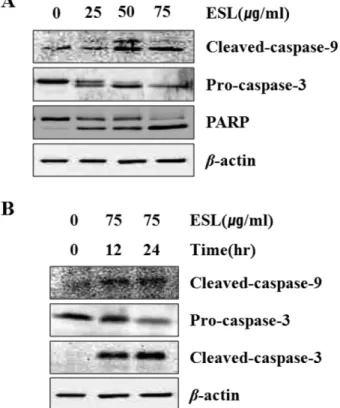
Caspases는 여러 가지 death signal에 의해서 활성화 되는데, 그 중 caspase-3는 세포고사의 실행자로서 상위의 caspase-9에 의해 활성화 되고 PARP를 불활성화 시켜 손상된 DNA 복구 경 로를 차단함으로서 세포고사를 유도한다.3-5)본 연구에서 목향에 탄올추출물이 caspases와 PARP에 미치는 영향을 조사하기 위하 여 시료를 25, 50, 75 µg/ml로 처리하고 24시간 후 이들 단백질 의 발현을 조사하였다. 실험 결과 cleaved-caspase-9 단백질 발 현은 증가하였으며, pro-caspase-3 단백질 발현이 감소하였고, PARP의 분절화가 증가되었다(Fig. 2A). 또한 시간에 따른 영향 을 알아보기 위하여 목향 에탄올추출물 75 µg/ml를 처리하고 각 각 12, 24시간 후 caspase의 발현을 조사하였다. 실험 결과 시간
의존적으로 pro-caspase-3 단백질 발현이 감소하였으며, cleaved- caspase-3와 -9 단백질 발현은 대조군 보다 증가하였다(Fig. 2B).
이상의 결과 목향에탄올추출물은 HepG2 세포에 농도 의존적으 로 세포고사를 유도하는 것으로 사료된다.
Bcl-2와 Bax 단백질 발현에 미치는 영향
Bcl-2 family 단백질은 미토콘드리아의 막 투과성과 cytochrome c 방출을 제어하는데 cytochrome c는 caspase-9을 활성화시킴으 로서 세포사멸을 조절한다. Bcl-2 family 단백질은 그 기능과 아 미노산 서열의 유사성에 따라 anti-apoptotic 단백질(Bcl-2, Bcl- xL, Mcl-1), pro-apoptotic 단백질(Bax, Bak) 그리고 Bcl-2 homology(BH)3 only pro-apoptotic 단백질(Bid, Bak, Bad, Bik, Bmf)로 나눌 수 있다.21) Anti-apoptotic 단백질은 미토콘드리아 막의 탈분극화를 억제하고 막의 산화적 인산화를 증가시켜 미토 콘드리아의 permeability transition pore를 억제한다. 이는 미토 콘드리아 내에 존재하는 cytochrome c의 유출을 억제함으로써 apoptosis를 억제한다. 이와는 반대로 pro-apoptotic 단백질들은 anti-apoptotic 단백질들의 작용을 억제하고 미토콘드리아 막을 Fig. 1− Effects of ethanol extract of Saussurea lappa root (ESL) on
apoptosis in HepG2 cell. Cells were treated with or without ESL for 24 hours. All the cells were stained with hoechst 33258, and examined by fluorescent microscopy (original magification 200×) (A). HepG2 cells were treated with ESL at different concentrations for 24 hours. The proportion of survival cells was measured by MTT assay. The experiments were performed in triplicate. Data presented as means±S.D. of three independent experiments.
**p<0.01 compared with control (B).
Fig. 2− Effects of ESL on the protein levels in dose- and time- dependent manner. Cells were treated with various concentrations of ESL for 24 hours. Cell lysates were analyzed by Western blot with an antibody against pro- caspase-3, cleaved-caspase-9, or PARP (A). Cells were treated with 75µg/ml ESL for 12 and 24 hours. Cell lysates were analyzed by Western blot with an antibody against pro-caspase-3, cleaved-caspase-3 and -9 (B).
176 김대성·이성진·이장천·우원홍·임규상·문연자
탈분극화시켜 permeability transition pore를 열게 하여 cytochrome c를 방출시킨다. Cytochrome c는 pro-caspase-9와 하위 단계의 caspase-3를 활성화함으로써 apoptosis를 촉진시키 게 된다.4,21)본 실험은 HepG2 세포에서 목향에탄올추출물에 의 한 세포고사가 미토콘드리아를 경유하는 것인지 조사하기 위하 여 시료를 5, 50, 75 µg/ml로 처리하고 24시간 후 Bcl-2 family 단백질의 발현을 조사하였다. 실험 결과 Bax는 농도 의존적으로 발현양이 증가한 반면, Bcl-2는 농도 의존적으로 발현양이 감소 되었다(Fig. 5). 따라서 본 실험 결과 목향에탄올추출물은 HepG2 세포에서 pro-apoptotic 단백질 증가 및 anti-apoptotic 단백질 감 소시켰고, 이는 caspase-9과 caspase-3의 활성을 촉진하여 세포 고사가 유도되었을 것으로 사료된다.
MAPK, ASK1 및 p53 인산화에 미치는 영향
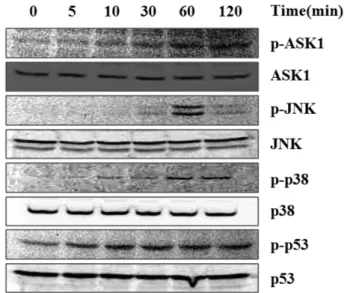
ASK1은 TNF-α, Fas, 산화적 스트레스에 의해 활성화되며 산 화적 스트레스에 의한 세포고사에서 중요한 역할을 한다. 세포 내에서 ASK1이 과발현 되면 하위의 표적 단백질인 p38 MAPK 와 JNK를 활성화시키고 세포사멸을 유도 한다고 보고되었다.22) 또한 JNK와 p38 MAPK는 염증성 cytokine, 산화적 스트레스, heat shock, radiation 등과 같은 일련의 자극에 의해 활성화되어 서 염증반응, apoptosis, 세포분화 등 다양한 생물학적 반응을 유 도한다.6,7)본 연구에서는 목향에탄올추출물이 p38 MAPK/JNK 와 ASK1 인산화에 미치는 영향을 조사하기 위하여 시료를 75 µg/
ml 농도로 처리하고 시간별로 세포를 수거하여 Western blott을 시행하였다. 실험 결과 p38 MAPK는 60분과 120분에서 인산화 됨을 확인할 수 있었고, JNK는 60분에 인산화 되었다. p-ASK1 은 목향 에탄올추출물 처리 후 10분부터 발현되기 시작하여 120 분까지 지속되었다(Fig. 4).
p53은 종양 억제 단백질로서 비정상적인 세포의 성장을 억제 하고 세포내에서 여러 경로를 통해 조절인자로서의 역할을 하고 있다.23)세포의 DNA가 손상된 경우 p53은 p21 유전자를 활성 화 시키고 세포주기를 정지시켜 DNA의 수복이 일어날 수 있도 록 하며 심각한 DNA 손상의 경우 p53이 전사조절인자로서 세
포고사를 촉진하는 Bcl-2 계열 단백질인 Bax의 발현을 증가시키 고 Bcl-2의 발현을 감소시킴으로써 apoptosis를 유도한다.24,25)실 험 결과 p53은 목향에탄올추출물 처리 후 5분부터 대조군에 발 현되어 120분까지 지속되었다(Fig. 4). 따라서 목향에탄올추출물 은 p53의 활성을 통해 Bax와 Bcl-2의 발현에 영향을 주었을 것 으로 사료된다.
ROS 생성을 통한 세포고사 유도
Reactive oxygen species(ROS)는 다양한 세포들에서 endonuclease를 활성화시켜 DNA 손상을 유도하여 세포고사를 야기한다고 보고되어 있다.26,27)또한 ROS는 ASK1의 활성을 유 도하고, mitochondrial membrane potential(MMP)의 소실을 일 으켜 미토콘드리아내의 각종 apoptotic molecule들이 세포질로 유출되어 세포고사가 유발된다.28)
본 실험에서 NAC을 처리하여 ROS의 생성을 억제 하였을 때 목향에탄올추출물에 의한 세포고사에 변화가 있는지 조사하였다.
먼저 HepG2 세포에 NAC(10 mM)을 2시간 전 처리 한 후 시료 (75µg/ml)를 처리하고 세포생존율을 측정하였다. 실험 결과 시 료군의 세포생존율은 54%였으나, NAC 병용 처리 시 113%로 회복되었다. 실험 대조군으로서 NAC에 의해 세포생존율은 감소 되지 않았으며, H2O2(250 mM) 처리군에서는 45%로 감소하였으 나, NAC 병용 처리 시 115%로 세포생존율이 회복되었다(Fig.
5A). 세포고사의 형태학적 특징인 세포 내 핵의 변화를 관찰한 결과에서도 목향에탄올추출물 처리 시 핵의 응축이 관찰되었으 나 NAC 전처리군에서는 핵의 응축이 관찰되지 않았다(Fig. 5B).
따라서 목향에탄올추출물에 의해 나타나는 세포생존율의 감소와 Fig. 3− Effects of ESL on the protein levels of Bcl-2 and Bax in
HepG2 cells. Cells were treated with various concentration of ESL for 24 hours. Cell lysates were analyzed by Western blot with a primary antibody against each protein.
Fig. 4− Time-course activation of ASK1, p38 MAPK/JNK and p53 in ESL-treated HepG2 cells. Cells were exposed to 75µg/
ml ESL for indicated periods. Activation of proteins was assessed as described in materials and methods.
핵의 응축 현상은 ROS의 생성을 억제 하였을 때 효과적으로 회 복된 것으로 나타났다.
한편 NAC 전처리에 의한 ROS의 생성 억제 시 caspases와 MAPK 단백질 변화를 관찰하였다. 실험 결과 NAC 전처리는 목 향에탄올추출물에 의한 pro-caspase-3, PARP, Bcl-2 단백질 발현 의 변화를 차단하였다(Fig. 6A). 또한 p38 MAPK/JNK는 목향 에탄올추출물에 의해 인산화가 되었지만 NAC과 목향에탄올추 출물 병용처리한 군에서는 인산화가 차단되었다(Fig. 6B). 그러
므로 목향에탄올추출물은 ROS 생성을 통해 MAPK 경로를 활 성화 시키고 caspase를 자극하여 HepG2 세포의 세포고사를 유 도하는 것으로 사료된다.
결 론
목향에탄올추출물이 인간 간암 세포주인 HepG2 세포의 apoptosis에 미치는 영향과 기전을 조사하였다. 목향에탄올추출 물은 농도 의존적으로 HepG2 세포의 생존율을 감소시켰고 핵 의 응축을 유도하였다. 또한 caspase-3, -9을 활성화, PARP의 분 절 및 p53의 발현을 증가시켰을 뿐만 아니라 Bax/Bcl-2 비율을 변화시켰으며 ASK1, JNK, p38 MAPK를 인산화 하였다. 그러 나 목향 에탄올추출물에 의한 세포생존율 억제, 핵의 응축, caspase-3의 활성, PARP의 분절, Bcl-2 발현 감소, MAPK의 인 산화는 ROS 억제제인 NAC의 전처리에 의해 억제되었다. 이러 한 결과는 목향에탄올추출물이 ROS 생성을 유도하여 ASK1의 인산화를 유도하고 하위의 p38 MAPK/JNK를 활성화시킴으로 써 미토콘드리아를 경유하는 apoptosis를 유도하는 것으로 사료 된다.
Fig. 6− Anti-oxidant NAC inhibits ESL-induced pro-caspase-3, PARP, Bcl-2 down-regulation (A) and p38 MAPK/JNK activation (B) in HepG2 cells. Cells were pretreated with NAC for 2 hours, followed by ESL treatment. Cell lysates were analyzed by Western blot with a primary antibody against each protein.
Fig. 5− The recovery effect of NAC on ESL-induced cytotoxicity and chromosome condensation. HepG2 cells were treated with 75µg/ml of ESL or H2O2 for 24 hours in either the presence or absence of NAC pre-treatment for 2 hours. (A) The proportion of survival cells was measured by MTT assay. The experiments were performed in triplicate. Data presented as means±S.D. of three independent experiments.
a: p<0.01 compared with control, b: p<0.01 compared with ESL treated group, c: p<0.01 compared with H2O2 treated group. (B) All the cells were stained with DAPI dye, and examined by fluorescent microscopy (original magification 200×). a: control, b: ESL (75µg/ml), c: NAC (10 mM), d:
NAC+ESL.
178 김대성·이성진·이장천·우원홍·임규상·문연자
감사의 말씀
이 논문은 2011년도 교육과학기술부의 재원으로 한국연구재 단의 지원을 받아 수행된 연구임[과제번호: 2011-0028280].
참고문헌
1) Mountz, J. D., Zhou, T., Wu, J., Wang, W., Su, X. and Cheng, J. : Regulation of apoptosis in immune cells. J. Clin. Immunol. 15, 1 (1995).
2) Woo, M., Hakem, R., Soengas, M. S., Duncan, G. S., Shahinian, A., Kägi, D., Hakem, A., McCurrach, M., Khoo, W., Kaufman, S. A., Senaldi, G., Howard, T., Lowe, S. W. and Mak, T. W. : Essential contribution of caspase 3/CPP32 to apoptosis and its associated nuclear changes. Genes Dev. 12, 806 (1998).
3) Kaufmann, S. H., Desnoyers, S., Ottaviano, Y., Davidson, N. E.
and Poirier, G. G. : Specific proteolytic cleavage of poly(ADP- ribose) polymerase: an early marker of chemotherapy-induced apoptosis. Cancer Res. 53, 3976 (1993).
4) An, B. and Dou, Q. P. : Cleavage of retinoblastoma protein during apoptosis: an interleukin 1 beta-converting enzyme-like protease as candidate. Cancer Res. 56, 438 (1996).
5) Hwang, S. G., Lee, H. C., Trepel, J. B. and Jeon, B. H. : Anticancer-drug-induced apoptotic cell death in leukemia cells is associated with proteolysis of beta-catenin. Leuk. Res. 26, 863 (2002).
6) Su, B. and Karin, M. : Mitogen-activated protein kinase cascades and regulation of gene expression. Curr. Opin.
Immunol. 8, 402 (1996).
7) Chen, Y. R., Wang, X., Templeton, D., Davis, R. J. and Tan, T. H. : The role of c-Jun N-terminal kinase (JNK) in apoptosis induced by ultraviolet C and gamma radiation. Duration of JNK activation may determine cell death and proliferation. J. Biol.
Chem. 271, 31929 (1996).
8) Kawasaki, H., Morooka, T., Shimohama, S., Kimura, J., Hirano, T., Gotoh, Y. and Nishida, E. : Activation and involvement of p38 mitogen-activated protein kinase in glutamate-induced apoptosis in rat cerebellar granule cells. J. Biol. Chem. 272, 18518 (1997).
9) Ichijo, H., Nishida, E., Irie, K., Dijke, P., Saitoh, M., Moriguchi, T., Takagi, M., Matsumoto, K., Miyazono, K. and Gotoh, Y. : Induction of apoptosis by ASK1, a mammalian MAPKKK that activates SAPK/JNK and p38 signaling pathways. Science 275, 90 (1997).
10) Kang, S. H., Kim, J. S., Chi, H. J., Chang, S. Y., and Ha, K. W. : Isolation and quantitative determination of costunolide from saussurea root. Kor. J. Pharmacogn. 30, 48 (1999).
11) Wedge, D. E., Galindo, J. C. and Macías, F. A. : Fungicidal
activity of natural and synthetic sesquiterpene lactone analogs.
Phytochemistry 53, 747 (2000).
12) Park, H. J., Jung, W. T., Basnet, P., Kadota, S. and Namba, T. : Syringin 4-O-beta-glucoside, a new phenylpropanoid glycoside, and costunolide, a nitric oxide synthase inhibitor, from the stem bark of Magnolia sieboldii. J. Nat. Prod. 59, 1128 (1996).
13) Jeong, S. J., Itokawa, T., Shibuya, M., Kuwano, M., Ono, M., Higuchi, R. and Miyamoto, T. : Costunolide, a sesquiterpene lactone from Saussurea lappa, inhibits the VEGFR KDR/Flk-1 signaling pathway. Cancer Lett. 187, 129 (2002).
14) Ko, S. G., Koh, S. H., Jun, C. Y., Nam, C. G., Bae, H. S. and Shin, M. K. : Induction of apoptosis by Saussurea lappa and Pharbitis nil on AGS gastric cancer cells. Biol. Pharm. Bull.
27, 1604 (2004).
15) Ko, S. G., Kim, H. P., Jin, D. H., Bae, H. S., Kim, S. H., Park, C. H. and Lee, J. W. : Saussurea lappa induces G2-growth arrest and apoptosis in AGS gastric cancer cells. Cancer Lett.
220, 11 (2005).
16) Mori, H., Kawamori, T., Tanaka, T., Ohnishi, M. and Yamahara, J. : Chemopreventive effect of costunolide, a constituent of oriental medicine, on azoxymethane-induced intestinal carcinogenesis in rats. Cancer Lett. 83, 171 (1994).
17) Chen, C. N., Huang, H. H., Wu, C. L., Lin, C. P. and Hsu, J. T. : Hsieh HP, Chuang SE, Lai GM. Isocostunolide, a sesquiterpene lactone, induces mitochondrial membrane depolarization and caspase-dependent apoptosis in human melanoma cells.
Cancer Lett. 246, 237 (2007).
18) Sun, C. M., Syu, W. J., Don, M. J., Lu, J. J. and Lee, G. H. : Cytotoxic sesquiterpene lactones from the root of Saussurea lappa. J. Nat. Prod. 66, 1175 (2003).
19) Yaeesh, S., Jamal, Q., Shah, A. J. and Gilani, A. H. : Antihepatotoxic activity of Saussurea lappa extract on D- galactosamine and lipopolysaccharide-induced hepatitis in mice. Phytother. Res. 24, 229 (2010).
20) Mosmann, T. : Rapid colorimetric assay for cellular growth and survival: application to proliferation and cytotoxicity assays. J.
Immunol. Methods 65, 55 (1983).
21) Vermeulen,. K., Van Bockstaele, D. R. and Berneman, Z. N. : Apoptosis: mechanisms and relevance in cancer. Ann. Hematol.
84, 627 (2005).
22) Sarker, K. P., Biswas, K. K., Yamakuchi, M., Lee, K. Y., Hahiguchi, T., Kracht, M., Kitajima, I. and Maruyama, I. : ASK1-p38 MAPK/JNK signaling cascade mediates anandamide- induced PC12 cell death. J. Neurochem. 85, 50 (2003).
23) Hattangadi, D. K., DeMasters, G. A., Walker, T. D., Jones, K. R., Di, X., Newsham, I. F. and Gewirtz, D. A. : Influence of p53 and caspase 3 activity on cell death and senescence in response to methotrexate in the breast tumor cell. Biochem.
Pharmacol. 68, 1699 (2004).
24) Yamaguchi, H., Chen, J., Bhalla, K. and Wang, H. G. : Regulation of Bax activation and apoptotic response to microtubule-damaging agents by p53 transcription-dependent and-independent pathways. J. Biol. Chem. 279, 39431 (2004).
25) Tan, J., Zhuang, L., Leong, H. S., Iyer, N. G., Liu, E. T. and Yu, Q. : Pharmacologic modulation of glycogen synthase kinase- 3beta promotes p53-dependent apoptosis through a direct Bax- mediated mitochondrial pathway in colorectal cancer cells.
Cancer Res. 65, 9012 (2005).
26) Buttke, T. M. and Sandstrom, P. A. : Oxidative stress as a mcdiator of apoptosis. Immunol. Today. 15, 7 (1994).
27) Ueda, N. and Shah, S. V. : Endonuclease-induced DNA damage and cell death in oxidant injury to renal tubular epithelia cells.
J. Clin. Invest. 90, 2593 (1992).
28) Sarker, K. P., Biswas, K. K., Yamakuchi, M., Lee, K. Y., Hahiguchi, T., Kracht, M., Kitajima, I. and Maruyama, I. : ASK1-p38 MAPK/JNK signaling cascade mediates anandamide- induced PC12 cell death. J. Neurochem. 85, 50 (2003).