Y. W. Kim ( )
국립산림과학원 산림생물공학과
(Div. of Forest Biotechnology, Korea Forest Research Institute, Korea)
e-mail: [email protected]
낙엽송 (Larix kaempferi) 현탁배양된 배발생세포로부터 체세포배 유도 및 발아를 위한 삼투압제 종류 및 농도 효과
김용욱
Effect of kinds and concentrations of osmoticum on somatic embryo induction and germination from suspended embryogenic cell in Larix kaempferi
Yong-Wook Kim
Received: 29 June 2013 / Accepted: 9 September 2013
ⓒKorean Society for Plant Biotechnology
Abstract This study was conducted to examine suspended embryogenic cells growth with days of culture, effects of various kinds/ concentrations of osmoticum for induction of somatic embryos (SEs), following somatic embryos germination or plantlet regeneration. The proliferation pattern of embryogenic cells in suspension culture is characterized by settled cells volume (SCV) increased with the duration of culture with marked the maxium of SCV (10.1 ㎖) in 18 days of culture, however the SCV of cells gradually decreased after that. In comparison of kinds/ concentrations of osmoticum on somatic embryo induction, the highest induction number (352.3/g·FW) of the SE was showed in 0.2 M sucrose, in addition, we also observed some effects with treatments of 0.2 M maltose (203.7) and 0.3 M maltose (193.7), respectively.
However, no somatic embryos produced in treatments of 7.5% PEG plus 0.15 M sucrose or maltose. In comparison of germination efficiency of SEs which occurred from the treatments of various kinds/ concentrations of osmoticum, the highest induction frequency of cotyledon (25.2%) was obtained from SEs that produced 0.3 M maltose, however, the best occurrence rates of hypocotyl (39%), radicle (30.3%) and plantlet regeneration (3.5%) were observed from the 0.2 M sucrose treatment, respectively.
Keywords Germination, Japanese larch, Larix kaempferi, Settled cells volume, Somatic embryo, Osmoticum, Suspended cells
서 론
낙엽송(Larix kaempferi)은 낙엽 침엽교목으로 우리나라에 는 1904년, 일본으로부터 종자가 최초로 도입되어 전국 각지에 식재되었으며, 현재 주요 조림 수종중의 하나로 현재 대단위 면적으로 식재되고 있다. 낙엽송의 특성으 로는 유시(juvenile)생장이 빠르며 30년생일 경우 ha 당 259 m3의 목재를 생산하며 건축, 토목, 합판용재로 널리 이용된다.
낙엽송 묘목생산은 주로 실생묘생산이 거의 주를 이 루고 있지만 종자생산이 5 ~ 6년 주기로 매우 큰 차이를 보여 매년 규칙적인 종자생산이 불가능하다. 그 대안으 로 삽목방법이 있으나 이 또한 삽수의 조직성숙정도에 따라 발근율에 큰 차이를 보이며, 생산된 그 삽목묘는 몇 년 간 사향성(斜向性) 생장을 보이는 단점이 있다.
이러한 단점을 극복하기 위해 현재 아배양(芽培養)을 비롯한 몇몇 조직배양 기술의 적용이 가능한데 그 중 체세포배 유도법을 이용한 클론묘 생산이 현재 가장 효 과적이다.
낙엽송 속(Larix)의 체세포배 유도는 Nagmani와 Bonga (1985)가 유럽낙엽송(L. decidua)의 female gametophyte 조 직으로부터 반수체성 식물체를 유도한 것이 그 시초로서 본 연구수종인 낙엽송의 경우 미숙배로부터 체세포배 발 DOI:http://dx.doi.org/10.5010/JPB.2013.40.3.141
Research Article
생 연구(Kim et al. 1999), 그 후 ABA 및 삼투압제 효과 (Kim and Moon 2007), TIBA 등의 항옥신류 첨가 효과(김 과 문 2009), 체세포배 유도의 배발생조직 라인 효과(김 2010) 등에 관한 몇 편의 연구보고가 있다. 그러나 상기 한 논문의 체세포배 유도 방법은 고체배지위로 배발생조 직을 직접 배양하여 그로부터 직접 체세포배를 발생시키 는 방법으로서 한 번에 다량의 체세포배 발생이 제한적 이다.
최근에는 배발생조직을 이용한 세포 현탁배양을 통해 직·간접의 체세포배 유도로 유용 식물체의 클론증식(Ingram and Mavituna. 2000) 및 원예 및 주요 약용식물의 대량생 산(Paek et al. 2005) 등으로 폭넓게 활용되고 있다. 침엽수 종의 체세포배 유도의 경우 액체배지에서 체세포배 발생기 술은 고체배지에서 보다 몇 가지 장점을 지니는데 첫째, 세 포 현탁배양은 고체배지에서보다 더 빠른 생장속도로 수많 은 체세포배를 동시에 유도할 수 있으며(Ramakrisshnan et al. 2005), 둘째, 소규모의 세포 현탁배양기술을 바탕으로 생물반응기까지 발전이 가능하여 궁극적으로는 체세포 배의 대량생산이 이루어져 산업화를 가능케 하며(Gupta and Timmis 2005), 마지막으로는 배발생세포의 적정 생장 을 위한 영양요구도 등에 대한 물질조작(Ali et al. 2005) 등에 관한 연구를 훨씬 용이하게 수행할 수 있다. 그러나 낙엽송의 경우 세포수준에서 식물체 재분화까지의 기관 분화에 관한 연구는 아직 없다.
따라서 본 연구는 낙엽송의 배발생조직을 이용하여 세 포배양을 실시 한 후 현탁세포 배양기간에 따른 세포생 장 유형 및 현탁세포로부터 체세포배 발생을 위한 삼투 압제 종류 및 농도를 구명하고 그로부터 유래한 체세포 배의 발아효율 등을 조사함으로써 차후 낙엽송 배발생 세포배양 시스템을 이용한 클론식물체의 대량생산을 위 한 기초자료 획득에 그 목적이 있다.
재료 및 방법
배발생조직 유도
배발생조직 유도를 위한 재료로서 종자채취는 충북 충주 에 위치한 국립산림품종관리 센터 내 낙엽송 클론 채종 원에서 7월초 미숙구과를 채취하여 종자를 분리한 다음 멸균 후 종자내의 미숙배만을 분리하여 배양하였다. 배 발생조직 유도를 위한 배지조성은 LM (Litvay et al. 1985) 기본배지에 2.0 ㎎/L 2,4-D, 1.0 ㎎/L BA, 1,000 ㎎/L L-glutamine 및 3.0% sucrose를 첨가하였고, 0.4% gelite (Sigma)을 첨가 시켜 반고형 배지로 만들어 사용했다. 배양환경은 25±1℃, 암소에서 8주 동안 새로운 배지교환 없이 연속배양으로 이루어졌으며, 유도된 배발생조직의 증식은 유도배지의
조성과 동일한 배지를 이용하였고, 약 1.0 cm 정도 크기 로 양분한 후 새로운 배지로 이식하는 방법으로 조직을 증식시켰다.
배발생세포의 현탁배양
배발생조직을 증식배지에 계대배양한 후 7일째의 조직 2 g 을 ½LM배지에 2.0 mg/L 2,4-D, 1.0 mg/L BAP, 2% sucrose, 1,000 mg/L glutamine으로 조성된 액체배지를 사용하였으 며, 세포현탁배양 시작은 50 mL 액체배지가 포함된 250 mL 용량의 삼각플라스크에 잘게 부수어 넣고 120 rpm, 25±1
℃의 암상태에서 이루어졌다. 증식중인 현탁세포의 계대 배양은 최초 3주 동안에는 10일 간격으로 하였고 계대배 양 시에는 현탁배양액: 새배지를 1:1 동량으로 섞어 실시 하였다. 그 이후에는 1주 간격으로 배발생세포가 포함된 기존의 15 mL 현탁배양액과 새로운 액체배지 35 ml를 섞 어 총 50 ml로 조정한 다음 배발생세포를 증식시켰다. 진 탕배양은 120 rpm, 25±1 ℃, 암배양 조건의 교반기에서 배양하였다.
체세포배 유도
새로운 액체배지로 계대배양 후 9 ~ 12일째 되는 세포를 수거해서 1,000 rpm, 10분간 원심분리하여 세포를 가라앉 힌 다음 상층액은 피펫으로 완전히 제거 한 후 세포 pellet에 ½LM배지에 3% sucrose 및 1,000 mg/L glutamine으 로 조성된 액체배지로 3회 세척한 후 체세포배 유도를 위한 세포를 준비하였다. 그 후 mL 당 생중량 30 mg 정 도의 세포가 포함되게 밀도를 조정한 다음 3 ml (총 90 mg) 정도의 현탁세포를 5.5 cm 크기의 종이필터(Whatman) 위 로 세포현탁액을 깔아준 후 진공펌프를 약 5초간 작동시 켜 액체배지만을 제거하였다. 그 후 배발생조직이 포함된 종이필터를 ½LM배지에 60 μM abscisic acid (ABA), 1,000 mg/L glutamine 및 0.8% gelrite가 첨가한 반고형 배지에 치 상하여 체세포배를 발생시켰다. 배양은 25±1℃, 암소에 서 이루어졌으며 총 8주 배양 후 처리구 별 발생된 체세 포배 수를 조사하였다.
체세포배 발아
체세포배 발아는 배발생조직으로부터 유도된 자엽단계 체세포배만을 분리하여 1/2LM 배지에 2.0% sucrose 및 0.4%의 gellan gum을 첨가한 발아배지 위로 평행으로 배 양하였고, 발아조건은 25±1℃, 18/6 광주기를 가진 광조 건(50 μEm-2s-1, Philips, F40 CW, 40 watt) 하에서 이루어 졌다.
Fig. 1 Settled cells volume (SCV) of an embryogenic suspension culture in L. kaempferi over a 21 days culture period. The bar indicates the standard error of mean values derived from three replicates
Fig. 2 Initial growth of embryogenic cells in suspension culture of L. kaempferi. a: Early division pattern of embryogenic cell and elongation of the suspensor (eh: embryonal head, s: suspensor), b: Suspension culture of embryogenic cells in liquid medium.
c: A typical embryogenic cell composed of a polarized embryonal head and suspensors (eh: embryonal head, s: suspensor). d:
Embryogenic cell having a broad embryonal head (arrows), which eventually divided into two neo-somatic embryos by cleavage somatic embryogenesis. e: Acetocarmine-stained embryogenic cells showing a red embryonal head and a weakly staining suspensors.
Embryogenic cells with a broad embryonal head (arrows), which eventually give rise to two neo-somatic embryos by cleavage somatic embryogenesis. f: Acetocarmine-stained embryogenic cells composed of a polarized embryonal head and suspensors 세포배양 기간에 따른 settled cells volume (SCV) 비교
세포배양 시작은 20 mL 액체배지가 포함된 100 mL 삼각 플라스크에 ml 당 20 mg 배발생조직을 첨가하여 이루어 졌다. 세포배양 시작일 부터 21일까지 3일 간격으로 세포 를 회수해 SCV를 측정하였으며, SCV측정은 눈금이 새겨 진 15 mL 원심분리관에 세포현탁액을 넣은 후 30분정도 정체한 다음 액체배지를 제외한 세포부피만을 측정하였 다. 각 SCV 측정 처리구 당 3개의 세포배양 플라스크를 수거하여 3번의 SCV를 측정하였다.
세포배양액의 삼투압제 종류 및 농도 별 체세포배 유도 비교
체세포배 유도에 영향하는 9 종류의 삼투압제 종류 및 농도(Fig. 3 참고)에 따른 효과를 비교하였다. 각 처리구 에서 8주 배양 후 각각의 체세포배 유도 효과를 비교하 였고, 배양반복 수는 각 처리구 당 10 반복(페트리디시) 배양하였다.
9종류 삼투압제 처리구 유래의 체세포배 발아율 비교
본 실험은 Figure 4에서 보는바와 같이 총 9 종류의 삼투 압제 처리구로 부터 유도된 체세포배 발아율 비교를 위 해 수행되었다. 발아 배양 6 주 후에 자엽, 하배축, 뿌리 발생율 및 식물체 전환율을 처리구 별로 각각 조사하였 고, 배양반복 수는 각 처리구 (삼투압제 처리구 별) 당 10 반복 (페트리디시) 배양하였으며, 페트리디시 당 체세포 배를 7 개씩 발아 유도하였다.
결과 및 고찰
세포배양 기간에 따른 SCV 비교
Figure 1은 낙엽송 배발생세포의 배양기간에 따른 SCV 변화에 대한 결과로서 SCV의 경우 세포생장이 정지되고 마침내는 갈변화 조짐을 보이는 배양 18일(10.1 mL SCV) 까지 세포생장이 지속되었으나 배양 21일 후에는 SCV는 8.4로 낮아져 더 이상 세포증식이 이루어지지 않았고, 현 탁세포 상태 또한 다소 갈변화된 현상을 보였다(Fig. 1).
따라서 낙엽송 배발생세포의 배양기간에 따른 생장유형 은 배양 6 ~ 18일까지 세포증식이 지속적으로 증가하는 지수기(exponential stage)이며 배양 18일 이후는 생장이 더 이상 이루어지지 않는 정체기(stationary stage)로 구분할 수 있다.
이러한 세포생장의 유형은 Picea sitchensis 배발생세포 배양의 경우 SCV 변화는 배양 30일까지 지속적인 생장
을 계속하여 본 실험결과와 거의 유사한 세포생장 유형 을 보였지만(Krogstrup 1990), white spruce의 경우 배양 12 일 후 가장 높은 세포 SCV를 보인 이후 점차 감소하였고 (Dong and Dunstan 1994), interior spruce 세포생장은 배양 10일 후 가장 높은 SCV를 보였다가 그 후에는 감소하는 경향을 보여(Lulsdorf et al. 1992) 본 실험에서와 같이 배
Fig. 3 Effects of 9 treatments of osmoticum on somatic embryo induction from suspended-embryogenic cells in L. kaempferi.
The bar indicates the standard error of mean values derived from ten replicates (petri dish). 1: 0.2 M sucrose, 2: 0.3 M sucrose, 3: 0.2 M maltose, 4: 0.3 M maltose, 5: 0.1 M sucrose+0.2 M maltose, 6: 0.2 M sucrose+0.1 M maltose, 7:
0.15 M sucrose+0.15 M maltose, 8: 0.15 M sucrose+7.5%
PEG*, 9: 0.15 M maltose+7.5% PEG, *Polyethyleneglycol (MW 3,350)
양 18일까지 생장이 지속되는 낙엽송의 경우 다른 침엽 수종의 배발생세포의 증식유형과는 다소 차이를 보였다 (Fig. 1). 그리고 본 실험의 경우 배양 18일 이후부터는 세 포정체기에 접어들어 더 이상의 세포증식이 이루어지지 않았는데, 이것은 배지 내 glucose 및 fructose와 같은 탄수 화물이 고갈되어 세포 생중량이 감소한 결과로서 보이 며, Lulsdorf 등(1992)은 interior spruce와 black spruce의 배 발생 세포배양 8 및 10일 후 조차도 이미 fructose 등의 탄 수화물이 일찍 소모되어 더 이상의 세포생중량 증가가 없다고 보고하고 있다.
세포배양중인 배발생세포를 현미경으로 세포유형을 관찰을 해보면 다양한 생장단계를 보이는 수많은 배발생 세포로 이루어진 것을 볼 수 있다(Fig. 2a). 먼저 배발생세 포의 발달 초기단계는 세포질이 충만한 embryonal head와 액포로 가득찬 긴 튜브모양을 한 suspensor로 이루어진 원 배(proembryo) (Fig. 2b)를 볼 수 있으며, 그 후 생장이 지 속되면 embryonal head는 더욱 커지고 다수의 suspensor로 분화된 원배형태로 증식하게 된다(Fig. 2c). 그 후 embryonal head의 수차례 세포분열을 거쳐 더욱 커지게 되며(Fig.
2d), 배발생 세포배양이 지속되면 embryonal head 부위는 더욱 커져 분할하여 2개의 원배형성이 이루어지고 아래 쪽으로는 수개의 suspensor가 연결된 초기단계의 체세포 배로 분열되는 분할 다배형성(cleavage polyembryogenesis) 방식으로 많은 수의 체세포배가 증식되는 것을 관찰할 수 있다(Fig. 2e, f).
세포배양액의 삼투압제 종류 및 농도 별 체세포배 유도 비교
침엽수종의 체세포배를 효율적으로 유도하기 위해서 고 려해야할 요인 중 하나가 삼투압제 종류 및 농도의 설정 이다. 따라서 Fig. 3은 현탁배양세포로부터 삼투압제 종 류 및 농도에 따른 체세포배 발생 효과 비교에 관한 것으 로서 최대 체세포배 유도 수는 0.2 M sucrose에서 352.3개 (/g.FW)로 나타났으며(Fig. 3), 또한 0.2 M (203.7개) 및 0.3 M (193.7개) maltose 처리구에서 다소 체세포배 유도에 효 과가 있었다(Fig. 3). 그러나 0.15 M sucrose+7.5% polyethylene glycol (PEG) 혹은 0.15 M maltose+7.5% PEG처리구에서는 전혀 체세포배가 유도되지 않아 본 실험에서는 PEG첨가 가 효과가 전혀 없음을 보였다(Fig. 3). 낙엽송의 배발생 조직을 고체배지에 배양하여 직접적으로 체세포배를 발 생시킨 김 등(2007)의 보고에 따르면 0.2 M maltose 단일 첨가구에서 가장 많은 자엽단계의 체세포배가 발생되어 본 연구의 배발생 세포로부터 체세포배 발생 시에는 보 다 높은 고농도의 삼투압을 필요로 하는 것으로 나타나 다소 상이한 최적 삼투압제 종류 및 농도를 보였다. 이것 은 액체배양으로 증식되어온 초기 발생단계 체세포배의 삼투압제 요구도는 고체배지 상에서 증식해온 배발생조
직과는 체세포배 발생 시에는 상이한 최적의 삼투압제 종류 및 농도를 보이는 것으로 생각된다. 많은 침엽수종 의 배발생조직으로부터 체세포배 유도에서 maltose 첨가 가 매우 효과적인 것으로 알려져 있는데(Yildirim et al. 2006;
Shoji et al. 2006) 그 이유는 sucrose보다 대사 분해속도가 서서히 이루어져 배지 내 삼투압 유지가 보다 유리하며, 또한 sucrose 첨가로 야기되는 저산소증(hypoxia)과 세포 내 에탄올 침적이 덜한 것으로 보고하고 있다(Scott et al.
1995). Finer 등(1989)은 Pinus strobus의 현탁배양세포로 부 터 체세포배의 발달은 6% sucrose에서 가장 양호하였으며, Hakmann and von Arnold (2000)는 white spruce (Picea glauca) 의 체세포배 발생시에는 90 ~ 120 mM sucrose 첨가가 유 리하였음을 보고하고 있다. 또한 Tautorus 등(1992)은 sucrose 농도를 30 mM에서 60 mM로 증가시킬 때 세포생중량과 총 체세포배 유도수가 서로 증가함을 보고하고 있다. 그 러나 Larix속 수종 중 L. × leptoeuropaea (Lelu and Label 1994) 및 L. × eurolepis (Lelu and Paques 2009) 수종의 체세 포배 유도에는 0.2 M sucrose 첨가가 선호되며, 특히 L.
laricina (Klimaszewska et al. 1997)의 경우 고농도의 0.4 M sucrose 및 0.2 M sucrose+5, 10% PEG 첨가가 효과적인 것 으로 보고하고 있다. 특이하게도 celery 현탁세포로부터 체 세포배 발생의 경우 당알콜 중 하나인 mannitol를 3 ~ 4%
첨가로 구형체세포배 수를 크게 증가시킬 뿐 아니라, 특 히 체세포배의 정상적인 분화과정을 자극하여 어뢰형 체 세포배 발달을 가속시킨다는 연구보고(Nadel et al. 1989) 가 있어 수종 혹은 배양환경에 따라 최적의 삼투압제 종 류 및 농도는 매우 다양하여 가장 최적인 조건은 실험을 통해 구명되어야 할 것으로 사료된다.
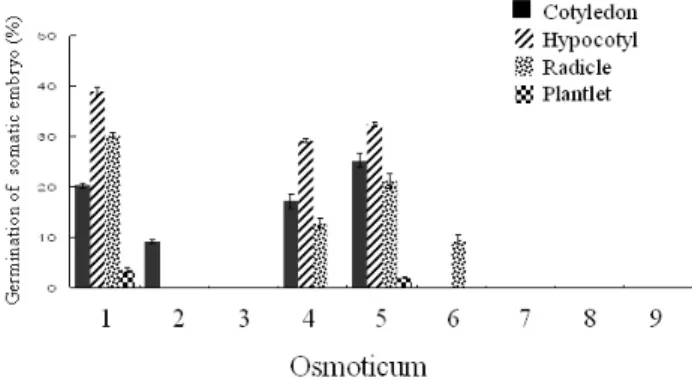
Fig. 4 Effect of various osmoticum kinds/ concentrations for somatic embryo germination which obtained from somatic embryos shown in Fig. 3 in L. kaempferi. The bar indicates the standard error of mean values derived from ten replicates (petri dish).
다양한 삼투압제 처리구 유래의 체세포배 발아율 비교
체세포배 발아율은 체세포배 유도 시 배지에 첨가된 삼 투압제 종류 및 농도에 따라 크게 좌우되는데, Figure 4는 앞의 Figure 3의 다양한 삼투압제 종류 및 농도의 처리구 로부터 유도된 체세포배의 발아율에 관한 비교 결과이 다. 최대 자엽형성율(25.2%)은 0.3 M maltose, 하배축 형성 률(39%), 뿌리 발생율(30.3%) 및 식물체 재분화율(3.5%)은 0.2 M sucrose 처리구에서 유도한 체세포배로부터 각각 나타났다(Fig. 4). 그리고 최대 식물체로 전환율은 0.2 M sucrose처리구로부터 발생된 체세포배를 발아시켰을 때 3.5%로 나타났는데, 이것은 Kim and Moon (2007)이 액체 배양을 거치지 않은 배발생조직으로부터 체세포배를 직 접유도 시 보여준 35.5%의 식물체 전환율과 비교한다면 극히 저조한 결과로 나타났다. 아마 이것은 배발생세포 로부터 체세포배 유도에 필요한 ABA 및 삼투압제 종류 및 농도 등 기타 체세포배 발생조건을 충분하게 충족하 지 않은 것으로 보여 고체배지로부터 직접 체세포배 발 생기술이 식물체 전환율 등을 고려한다면 훨씬 유리하다 는 것을 보여주고 있다. 따라서 액체배지 내에 첨가한 삼 투압제 종류 및 농도가 차후 체세포배의 자엽발생 등과 같은 기관 분화율 및 식물체 전환율에 중요한 요인으로 작용한다는 것을 고려하면 차후 액체배양으로 식물체의 대량생산을 고려한다면 최적의 배양환경 등을 절대적으 로 구명할 필요가 있다. 특히 Figure 4에서보면 고농도의 0.3 M sucrose, 0.2 M maltose, 0.2 M sucrose+0.1 M maltose 및 0.15 M sucrose+0.15 M maltose처리구 등에서 유도된 체세포배로 부터는 거의 기관분화가 이루어지지 않아 0.2 M 이상의 고농도 sucrose, maltose와 혼합첨가 혹은 PEG 첨가 등으로 정상적인 발아가 힘든 비정상적인 체세포배 가 다수 유도되어 본 연구수종에는 적합하지 않은 처리 구로 밝혀졌다(Fig. 4). 그러나 Klimaszewska 등(1997) 은 L. laricina 수종의 경우 0.2 M sucrose+5% PEG처리구로부
터 유도한 체세포배 발아율이 47.8%의 높은 발아율을 보 고하고 있어 다른 수종과는 달리 PEG 첨가가 발아에 유 효함을 보여 Larix 속내의 수종에 따라 최적 삼투압제 종 류 및 농도에 많은 차이가 있음을 보여준다. 또한 Lelu- Walter and Paques (2009)는 L. × eurolepis의 체세포배 발아 실험에서 1.0%의 gelrite 첨가 배지에서 96.7 및 69.3%의 최대 발아율 및 식물체 전환율율 보고해 삼투압제 종류 및 농도 등의 요인 외에도 배지내의 gelrite 농도를 높여 발아체로의 수분흡수율을 제한함으로써 발아율을 높일 수 있다는 가능성을 보고하고 있다. Kim과 Moon (2007) 또한 0.8% gelrite가 첨가된 고체배지에서 유도한 체세포 배의 식물체 전환율이 최대 35.5%를 보여 체세포배 유도 시 고농도의 gelrite 첨가가 차후 발아율과 식물체 전환율 에 크게 영향을 미치는 것으로 알 수 있다. 결론적으로 수종 및 배양유형에 따라 최적의 체세포배 발아결과가 매우 다양하게 나타나기 때문에 발아율 증진을 위해 삼 투압제 종류 및 농도에 관한 최적을 구체적인 실험을 통 해 밝혀야 할 것으로 생각된다.
적 요
본 연구는 낙엽송 배발생세포의 배양기간에 따른 현탁세 포의 생장, 체세포배 유도 및 발아를 위한 다양한 삼투압 제 종류 및 농도 효과를 조사하기 위해 수행되었다. 배발 생 현탁세포의 생장은 배양일수가 증가함에 따라 settled cells volume (SCV)가 지속적으로 증가하는 경향을 보여 배양 18일 경에는 최대 10.1 ㎖의 SCV를 보였고, 그 이후 로는 세포생장이 감소하였다. 현탁세포로부터 체세포배 발생을 위한 삼투압제 종류 및 농도에 따른 효과 비교에 서 최대의 체세포배 유도 수는 0.2 M sucrose 처리구에서 352.3개(/g FW)로 나타났으며, 0.2 M maltose (203.7) 및 0.3 M maltose (193.7) 처리구에서 또한 효과가 있었다.
그러나 7.5% polyethylene glycol (PEG)이 첨가된 0.15 M sucrose 혹은 maltose 각각의 처리구에서는 체세포배 발생 이 전혀 이루어지지 않았다. 다양한 삼투압제 종류 및 농 도에서 발생된 체세포배의 발아율 비교에서는 최대 자엽 형성율(25.2%) 0.3 M maltose, 하배축 형성률(39%), 뿌리 발생율(30.3%) 및 식물체 재분화율(3.5%)은 0.2 M sucrose 처리구에서 각각 나타났다.
인용문헌
Ali MB, Thanh NT, Yu KW, Hahn EJ, Paek KY, Lee HL (2005) Induction in the antioxidative systems and lipid peroxidation in suspension culture toots of Panax ginseng induced by
oxygen in bioreactors. Plant Sci 169:833-841
Dong JZ, Dunstan D (1994) Growth parameters, protein and DNA synthesis of an embryogenic suspension culture of white spruce (Picea glauca). J Plant Physiol 144:201-208
Finer J, Kriebel HB, Becwar MR (1989) Initiation of embryogenic callus and suspension cultures of eastern white pine (Pinus strobus L.). Plant Cell Rep 8:203-206
Gupta PK, Timmis R (2005) Mass propagation of conifer trees in liquid cultures-progress towards commercialization. Plant Cell Tiss Org Cult 81:339-346
Hakman I, von Arnold S (2000) Somatic embryogenesis and plant regeneration from suspension cultures of Picea glauca (White spruce). Physiol Plant 72:579-587
Ingram B, Mavituna F (2000) Effect of bioreactor configuration on the growth and maturation of Picea sitchensis somatic embryo cultures. Plant Cell Tiss Org Cult 61:87-96
Kim YW (2010) Somatic embryogenesis and plant regeneration with embryogenic tissue lines in Larix leptolep. J Kor For Soc 99:633-637
Kim YW, Moon HK (2007) Enhancement of somatic embryogenesis and plant regeneration in Japanese larch (Larix leptolepis).
Plant Cell Tiss Org Cult 88:241-245
Kim YW, Moon HK (2009) Effect of TIBA, PCIB and phloroglucinol on somatic embryo maturation and germination in Japanese larch (Larix leptolepis). J Plant Biotech 36:230-235
Kim YW, Youn Y, Noh ER, Kim JC (1999) Somatic embryogenesis and plant regeneration from immature zygotic embryos of Japanese larch (Larix leptolepis). Plant Cell Tiss Org Cult 55:95-101
Klimaszewska K, Devantier Y, Lachance D, Lelu MA, Charest PJ (1997) Larix larcina (tamarack): somatic embryogenesis and genetic transformation. Can J For Res 27:538-550
Krogstrup P. (1990) ffect of culture densities on cell proliferation and regeneration from embryogenic cell suspensions of Picea sitchensis. Plant Sci 72:115-123
Lelu MA, abel P (1994) Changes in the levels of abscisic acid and its glucose ester conjugate during maturation of hybrid larch (Larix×leptoeuropaea) somatic embryos, in relation to
germination and plantlet recovery. Physiol Plant 92:53-60 Lelu MA, Paques L (2009) Simplified and improved somatic
embryogenesis of hybrid larches (Larix×eurolepis and Larix×marschlinsii). Perspectives for breeding. Ann For Sci 104:1-10
Litvay JD, Verma DC, Johnson MA (1985) Influence of a loblolly pine (Pinus taeda L.) culture medium and its components on growth and somatic embryogenesis of the wild carrot (Darcus carota L.). Plant Cell Rep 4:325-328
Lulsdorf MM, Tautorus TE, Kikcio SI, Dunstan DI (1992) Growth parameters of embryogenic suspension cultures of interior spruce (Picea glauca-engelmannii complex) and black spruce (Picea mariana Mill). Plant Sci 82:227-234
Nadel BL, Altman A, Ziv M (1989) Regulation of somatic embryogenesis in celery cell suspensions. Plant Cell Tiss Org Cult 18:181-189
Nagmani R, Bonga JM (1985) Embryogenesis in subcultured callus of Larix decidua. Can J For Res 15:1088-1091 Paek KY, Chakrabarty D, Hahn EJ (2005) Application of
bioreactor systems for large scale production of horticultural and medicinal plants. Plant Cell Tiss Org Cult 81:287-300 Ramakrishnan K, Gnanam R, Sivakumar P (2005) In vitro somatic
embryogenesis from cell suspension cultures of cowpea {Vigna unguiculata (L.) Walp}. Plant Cell Rep 24:449-461 Scott P, Lyne RL, Rees TA (1995) Metabolism of maltose and
sucrose by microspores isolated from barley (Hordeum vulgare). Planta 197:435-441
Shoji M, Sato H, Nakagawa R, Funada R, Kubo T, Ogita S (2006) Influence of osmotic pressure on somatic embryo maturation in Pinus densiflora. J For Res 11:449-453
Tautorus TE, Lulsdorf MM, Kikcio SI, Dunstan DI (1992) Bioreactor culture of Picea mariana Mill. (black spruce) and the species complex Picea glauca-engelmannii (interior spruce) somatic embryos. Growth parameters. Appl Microbiol Biotechnol 38:46-51
Yildirim T, Kaya Z, Iʂik K (2006) Induction of embryogenic tissue and maturation of somatic embryos in Pinus brutia TEN.
Plant Cell Tiss Org Cult 87:67-76