494
초임계수 처리로 가수분해된 목질계 바이오매스를 이용한 바이오 에탄올 생산
서 현 범 ․
1한 재 건 ․ 최 원 석 ․
2이 오 규 ․
2이 수 민 ․
2최 석 환 ․
1이 현 용 ․ †정 경 환 충주대학교 식품생명공학부,
1강원대학교 BT특성화학부대학,
2국립산림과학원 화학미생물과
(접수 : 2008. 6. 26., 게재승인 : 2008. 11. 17.)
Bioethanol production from wood biomass hydrolysate with supercritical water treatment
Hyeon-Beom Seo, Jae-Gun Han
1, Won-Seok Choi, Oh-Kyu Lee
2, Soo-Min Lee
2, Seok Hwan Choi
2, Hyeon Yong Lee
1, and Kyung-Hwan Jung†
Division of Food and Biotechnology, Chungju National University, Jeungpyung, Chungbuk 368-701, Korea
1
College of Bioscience and Biotechnology, Kangwon National University, Chunchon 200-702, Korea
2
Division of Wood Chemistry & Microbiology, Korea Forest Research Institute, Seoul 130-712, Korea (Received : 2008. 6. 26., Accepted : 2008. 11. 17.)
We investigated the bioethanol production using wood biomass hydrolysate which obtained from the supercritical water (SCW) treatment. SCW-treated hydrolysate was used C-source of culture medium in shaking flask culture for bioethanol production.
When the concentrated SCW-treated hydrolysate (SCW3) was used, yeast cell growth was slower compared with those in other SCW-treated hydrolysate (SCW1, SCW2). In addition, the bioethanol productions were 0.51 to 0.56 (%,w/v) when SCW1, SCW2, and SCW3 were used. Therefore, we removed the toxic phenolic compound in SCW-treated hydrolysate by pretreatments of activated charcoal and calcium hydroxide. Activated charcoal reduced more efficiently the phenolic compounds in SCW3 by 94.6%. Finally, when we pretreated SCW3 by activated charcoal and this was used for bioethanol production, 0.96 (%,w/v) bioethanol was produced and the ethanol yield based on reducing sugar reached 0.5.
Key Words : Bioethanol, Supercritical water treatment, Wood biomass, Activated charcoal, Calcium hydroxide
서 론
1)
Wood biomass는 식량자원에 영향을 끼치지 않는 바이오 에너지 원으로서 매우 중요하다. 이제까지 wood biomass의 일반적인 용도는 화목으로 가정집 보일러나 화력발전소의 연료로 사용되는 것이었다(1). 현재 관심의 대상이 되는 wood biomass의 또 다른 용도는 바이오 에탄올을 생산을 위한 단당류의 원료로서 사용 되는 것이며, 이러한 단당류를 얻는 전통적인 방법은 산 가수분해 와 효소 가수분해가 일반적인 방법이다. 그러나 산 가수분해의 경우 산이 가수분해과정에서 상대적으로 높아서, 가수분해 반응기 의 부식을 초래할 수 있으며, 산을 재활용하기 위한 회수공정도
†Corresponding Author : Division of Food and Biotechnology, Chungju National University, Jeungpyung, Chungbuk 368-701, Korea Tel : +82-43-820-5246, Fax : +82-43-820-5240
E-mail : [email protected]
간단한 공정이 아니라는 것이 알려져 있다(2). 효소 가수분해의 경우 긴 반응시간과 낮은 효율성이 산업화에 주요 장애 요인이다.
이러한 전통적인 공정상의 문제를 극복하기 위하여 초임계수 처리법 (supercritical water (SCW) treatment)이 이미 cellulose(3) 와 lignocellulose(4)의 가수분해에 적용되었다. SCW는 물의 임계점 (374℃ and 22.1 Mpa) 이상의 상태에 존재하는 물이 며, 상온에서의 일반적인 물과 매우 달라서, 유전상수 (dielectric constant)는 감소하고 이온강도는 증가한 상태이기 때문에, SCW 와 lignocellulose 사이에 가수분해반응을 유발할 수 있다(5).
본 연구에서는 약산 (0.05% hydrochloric acid) 조건에서 SCW 처리로 가수분해한 wood biomass로 부터 바이오 에탄올을 생산하는 과정과 효과적인 전처리 방법에 대하여 연구하였다.
Lignocellulose의 산을 이용한 가수분해는 손쉬운 방법이지만, 효모성장에 해로운 부산물이 발생하는 것으로 알려져 있다(6).
특히 furfural, 5-hydroxy methylfurfural, levulinic acid 그리고
phenolic compounds 등의 물질이 주로 hemicellulose와 lignin
Vol. 23, No. 6, 494-498(2008)
으로부터 만들어 지는 것으로 알려져 있다(7). 특히 activated charcoal(8)과 calcium hydroxide(9)를 처리하는 방법이 바이오 에탄올 생산과 수율에 미치는 영향을 조사하였다.
재료 및 방법
효모균주
본 실험에서 사용된 균주는 Saccharomyces cerevisiae ATCC 24858 이며, 이 균주의 보관을 위해 YM (yeast extract 0.3%, malt extract 0.3%, peptone, 0.5%, glucose 1%) 배지에 접종하여 shaking incubator(30℃, 150rpm)에서 24시간 배양한 후, 배양 된 세포액을 50% glycerol에 1:1로 섞어서 -80℃ deep freezer에 보관하였다.
Wood biomass 가수분해물
현사시 나무 (Populus alba×glandulosa)를 Zirconium planetary mono mill (Pulverisette 6, FRITSCH, Germany)을 사용하여 60 mesh로 잘게 부수고 건조하여 사용하였다. 시료 처리방법은 상온에서 목분 20 g을 염산 1 mL가 포함된 1 L 증류수에 넣어 혼합한 후 펌프압력을 이용해 예열된 증류수와 1:1로 섞인 후 반응관 안으로 들어가게 하였다. 이때 최종 염산 농 도는 0.05% (v/v)가 되며 이 혼합액의 유속은 100 mL/min으 로 유지되었기 때문에 실제 가수분해 반응은 반응관을 통과 하는 1분간 일어난다. 본 연구에서 사용된 SCW 처리조건은 300℃, 230 atm이었으며 최종 SCW 처리 수용액 양은 2 L였다.
자세한 초임계수 가수분해 장치 (Supercritical water hydrolysis equipment)는 Choi 등(10) 그리고 Koo 등(11)의 연구논문에 자세히 기록되어있다. 이때 염산을 사용하여 SCW 처리한 경우 에 얻은 가수분해물을 SCW1라 하였고, 염산을 넣지 않고 SCW 처리한 경우에 얻은 가수분해물을 SCW2라 하였다. SCW3는 SCW1를 진공회전증발농축기 (EYELA, Japan)를 이용하여 60℃
에서 농축하여 얻은 시료였다.
Flask culture
Seed culture는 YPD (yeast extract 1%, peptone 2%, glucose 2%) 배지를 이용하여 shaking incubator (30℃, 150 rpm)에서 24시간 배양하였다. 이때 deep freezer에 보관된 stock vial을 이용 하여 접종하였다. 본 배양에 사용한 기본배지 조성은 YPD 배지의 glucose를 대신하여 SCW 처리한 가수분해물을 넣어 만든 것으로 SCW 처리 가수분해물 (50 mL)에 yeast extract (1%), peptone (2%)을 넣어 만들었다. 이때 초기 배지의 pH는 NaOH powder를 이용하여 5.5로 맞추었다. 배양 부피의 10%에 해당하는 seed culture를 접종한 후, shaking incubator (30℃, 150 rpm)에서 배양하였다.
Cell growth
세포성장을 측정하기 위하여 Spectrophotometer (Thermo Scientific, USA)를 이용하여 600 nm에서 배양액의 OD (optical density) 값을 측정하였다. 배지에 포함된 가수분해물의 색이 어둡고 탁도가 심해서, 세포성장은 최대 세포성장시 OD 값을 1로 한 상대적인 OD값으로 환산하여 표시하였다.
환원당 정량
배양액에 남아있는 환원당은 DNS (dinitrosalicylic acid) 방법 을 이용하여 정량하였다(12). 배양상등액을 취한 후, DNS용액 과 반응 시킨 후, 반응액의 흡광도를 96-well microplate (SPL, Korea)에 200 ㎕ 분주하여, 595 nm에서 Microplate reader (Bio-Rad, USA)를 이용하여 측정하였다.
TLC (thin layer chromatography)
단당류의 소비양상을 관찰하기 위하여 TLC를 수행하였고, 이때 농도를 알고 있는 단당류를 standard로 사용하여 정량분 석을 위한 quantitative TLC 수행하였다. TLC Plate (Partisil
®K5F, Whatman)는 20×10cm로 잘라서 사용하였고, 시료를 1㎕
loading 하였고, 전개용매는 acetonitrile과 증류수를 85:15 비율로 사용하였다. 전개가 끝난 후, TLC plate를 발색시약 (0.5% α-naphtol, 5% H
2SO
4in ethanol)에 담근 후, 꺼내서 dry oven에 넣어 80℃에서 15분간 구웠다. 단당류의 정량분석을 위해서 단당류의 spot을 AlphaEase FC software (Alpha Innotech, U.S.A.)를 이용하여 일차원상의 peak로 재구성한 후, 농도를 알고 있는 표준물질과 비교하여 단당류의 함량을 계산하였다.
Acivated charcoal 및 Calcium hydroxide 처리 Activated charcoal를 이용하여 SCW처리 가수분해물의 phenol류 성분을 제거하기 위하여, acivated charcoal powder (Daejung Chemicals & Metals Co, Korea)와 SCW 처리 가수분해물 (pH 를 5.5로 미리 맞춤)을 1 (w):10 (v)으로 혼합한 후, 잘 섞고 감압여과장치를 이용하여 activated charcoal을 제거하였다(8).
또한 calcium hydroxide (Ca(OH)
2)를 이용하여 phenol류 성분을 제거 할 때에는 SCW 처리 가수분해물 30 mL에 0.7 g Ca(OH)
2를 혼합한 후, 상온에서 30분간 incubation 하고, 4,000 rpm에서 원심분리하여 그 상층액을 사용하였다(9).
Total phenol류 정량
SCW 처리 가수분해물에 함유된 total phenol류의 함량은 Folin-Ciocalteu reagent (Hayashi Pure Chemical Co., Japan)를 이용하여 측정하였다(13). 이때 standard 로서 gallic acid (Sigma) 를 사용하였고, 반응액 200 ㎕를 96-well microplate로 옮긴 후, Microplate reader를 사용하여 655nm에서 흡광도를 측정하였다.
Gas Chromatography
배양액의 바이오 에탄올 함량은 n-butanol을 internal standard 로 하여, gas charomatography (HP6890, Agilent)를 이용하여 분석 하였다. 이때 FID (flame inonization detector)를 이용하여 검출 하였고, INNOWax column (30 m×0.32 mm, 0.25 μm, Agilent 19091N-113)을 사용하였고, 오븐온도는 150℃, injector와 FID 온도는 250℃로 조절하였다. N
2를 carrier gas로 50 mL/min로 흘려주었다.
결 과
SCW 처리물을 이용한 바이오 에탄올 생성
Fig. 1과 같이 SCW1과 SCW2를 이용하여 바이오 에탄올을
생산하기 위하여 효모를 배양하였을때 비슷한 성장곡선 양상을 보였다. 그러나, SCW1을 농축한 SCW3을 사용하여 배양하였을 때는 성장의 시작이 상대적으로 느려지는 현상이 관찰되었다.
배지중의 단당류의 성분변화를 TLC로 확인한 결과 Fig. 2와 같이 glucose, arabinose, xylose등이 관찰되었으며, 또한 확인되지 않은 많은 성분도 관찰 되었다. 이때 바이오 에탄올 생성 중에 glucose 는 모두 소비되나 arabinose, xylose는 소비되지 않았다. 효모의 성장은 단당류가 소비된 후에도 계속되어 SCW1, SCW2는 96시간 까지, SCW3는 144시간 까지 계속되었다. 당의 소비양상을 DNS 환원당 정량법과 quantitative TLC 방법 (glucose, xylose, arabinose 만 측정)을 이용하여 측정하였을 경우(Fig. 3, Fig. 4), 소비되는 양상은 유사하였으나, 두 방법에 의해서 측정된 단당류의 절대량 은 두 배 이상의 큰 차이를 보였다. 그리고 모든 경우에 DNS 방법으로 측정된 환원당이 효모 성장이 멈춘 후, 1~3% 까지 남아 있는 것으로 측정되었으나(Fig. 3), quantitative TLC로 측정한 경우 glucose는 모두 소비되고, xylose, arabinose등의 오탄당만 남아 있는 것으로 확인 되었다(Fig. 4). Glucose는 SCW1과 SCW2 사용하였을 경우, 6시간 만에 모두 소비 되었고, SCW3의 경우 96시간에야 비로서 모두 소비되었다(Fig. 2). 이때 바이오 에탄올 생성량은 Table 1과 같이 0.51% (w/v)에서 0.56% (w/v) 정도였다.
Table 1. Bioethanol production using SCW-treated hydrolysates Sample Sampling time (h) Ethanol (%,w/v)
SCW1 24 0.56
SCW2 24 0.51
SCW3 96 0.55
Figure 1. Cell growth profiles in flask cultures using SCW1, SCW2 and SCW3.
Figure 2. TLC patterns of culture supernatant from Fig. 1. X, A, and G indicate the standard of xylose, arabinose, and glucose, respectively.
SCW1, SCW2, and SCW3 indicate the hydrolysates used in flask cultures.
Figure 3. Consumption profiles of reducing sugar in flask cultures using SCW1, SCW2 and SCW3. Reducing sugar was measured by DNS method.
Figure 4. Consumption profiles of reducing sugar in flask cultures using SCW1, SCW2 and SCW3. Reducing sugar was measured by quantitative TLC in which glucose, xylose, and arabinose were considered in measurement.
Activated charcoal과 Calcium hydroxide 이용한 SCW 처리물의 전처리
SCW1과 SCW2는 단당류 함량이 상대적으로 SCW3 보다 매우 낮았기 때문에 보다 많은 바이오 에탄올 생산을 위하여 SCW3를 바이오 에탄올을 생산을 위한 가수분해물로 사용하기 로 하였다. 그리고 SCW3에 남아있는 lignocellulose에서 유래된 phenol류 성분을 제거하기 위하여, SCW3를 activated charcoal 로 처리한 경우와 calcium hydroxide로 처리한 경우, 두 가지에 대하여 바이오 에탄올 생산성을 조사하였다. 두 가지 모두 Table. 2와 같이 phenol류의 성분이 현저하게 감소되는 것이 확인되었는데, activated charcoal 처리한 경우는 94.9%, Ca(OH)
2처리한 경우는 54.8% phenol류 성분이 감소되었다. 이 두 가지
전처리한 SCW3는 바이오 에탄올 생산을 위한 효모 배양의
배지 성분으로 사용되었다. 효모의 성장은 두 경우 유사한 양상
을 보였고, 단당류의 소비가 더 이상 일어나지 않아도 효모 성장
은 72시간 까지 계속되었다(Fig. 5, Fig. 6). 이때도 glucose는
모두 소비되나 arabinose, xylose는 소비되지 않았으며(Fig. 7),
환원당으로서 당의 소비양상을 DNS 방법과 quantitative TLC
방법 (glucose, xylose, arabinose만 측정)을 이용하여 측정하였을
경우(Fig. 5, Fig. 6), 소비되는 양상은 유사하였으나, 모두 24시간
만에 glucose만 모두 소비 되고, 나머지 단당류는 소비 되지 않았
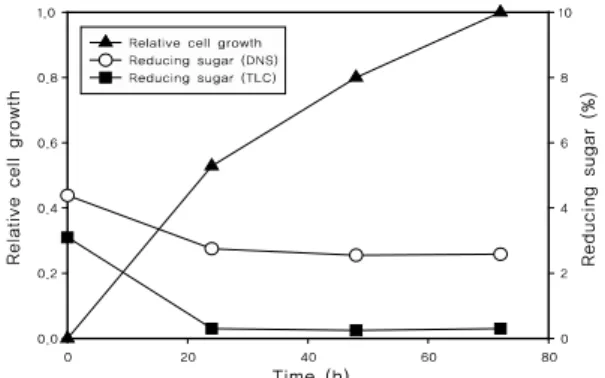
다. 이때 Fig. 5와 Fig. 6에서 처럼 activated charcoal과 calcium
hydroxide 처리한 SCW3를 가지고 만든 배지의 초기 환원당
농도는 처리전 보다 약 34% 정도 감소되는 것으로 관찰되었다.
그러나 quantitative TLC로 측정한 결과에서는 처리 후 약간의 감소만 관찰되었다. 이때 바이오 에탄올 생산량과 수율은 Table 3 과 같았으며, activated charcoal을 전처리한 SCW3를 사용하여 바이오 에탄올 생산한 경우에 0.96%의 생산량과 이론 수율에 가까운 0.5의 수율을 보였다. 반면에 calcium hydroxide를 처리 한 SCW3를 사용하였을 경우에는 0.68%의 바이오 에탄올 생산 량을 보였으며, 수율은 환원당 정량을 기준으로는 0.4, TLC 기준으로는 0.22의 수율을 보였다.
Table 2. Effects of activated charcoal and calcium hydroxide on removal of phenolic compound
Total phenolic compound (mg/L)
Activated charcoal treatment Calcium hydroxide treatment
before after before after
7600.0 387.0 9690.6 4370.6
Table 3. Bioethanol production and bioethanol yield of SCW3
Sample Ethanol
1(%, w/v)
Ethanol yield
DNS
2TLC
3SCW3 0.55 0.21 0.19
Activated charcoal-treated SCW3 0.96 0.5 0.5
Calcium hydroxide-treated SCW3 0.68 0.4 0.22
1; Ethanol production was measured at 24h-sample. 2; Ethanol yield was calculated based on the reducing sugar measured by DNS method.
3; Ethanol yield was calculated based on the reducing sugar measured by quantitative TLC.
Figure 5. Cell growth profiles and consumption profiles of reducing sugars in flask cultures using activated charcoal-treated SCW3. Reducing sugars were measured by DNS and quantitative TLC methods.
Figure 6. Cell growth profiles and consumption profiles of reducing sugars in flask cultures using calcium hydroxide-treated SCW3. Reducing sugars were measured by DNS and quantitative TLC methods.
Figure 7. TLC patterns of culture supernatant from Fig. 1. X, A, and G indicate the standard of xylose, arabinose, and glucose, respectively.
SCW3 (activated charcoal) and SCW3 (Ca(OH)
2) indicate activated charcoal-treated and calcium hydroxide-treated hydrolysate, respectively.
고 찰
초임계수 처리를 이용한 wood biomass의 가수분해와 bioethanol 생산은 아직 많은 연구 보고 사례가 없다. 최근에 국내에서는 Choi 등(10)과 Koo 등(11)이 가수분해 방법에 대하여 연구 하였고, Miyafuji 등(14)과 Nakata 등(15)이 wood biomass와 cellulose에 대하여 초임계수 처리 가수분해와 bioethanol 생산을 시도 하였다.
본 연구에서는 SCW1, SCW2, SCW3 모두 확인 되지 않은 가수분해물이 TLC 결과 확인 되었고, 효모 배양이 멈춘 후 에도 DNS 방법에 의해서 많은 환원력이 있는 물질이 측정되 었다. 그래서 DNS 방법에 의한 환원당 측정은 환원당을 직접 적으로 의미하지는 않는다. 그리고 hemicellulose에서 유래된 단당류를 본 실험에서 사용한 효모가 소비하지 못해서 약간의 이러한 잔류 단당류가 TLC에 의해서 배양 후반까지 관찰 되었 다. 세 가지 가수분해물은 색이 어둡고 탁하여서 효모의 성장 을 측정한 OD 값이 가수분해물 마다 매우 큰 차이가 있어서 효모 배양시 최대 OD 값을 1로 하여 환산하였다. Fig. 1에서 SCW3를 사용한 배지에서의 성장이 가장 느린 것은 가수분 해물의 농축과 함께 가수분해물 속의 독성물질도 같이 농축된 현상으로 추론되었다. 또한 SCW3의 경우 더 많은 단당류를 포함하고 있음에도 불구하고, 바이오 에탄올 생산량이 SCW1과 SCW2와 유사 하였다(Table. 1). 이러한 현상도 독성물질의 농축으로 추론되었다. 그래서 본 연구에서 두 가지의 보고된 phenol류의 제거 방법을 시도하여 바이오 에탄올 생성을 증진 시킬 수 있는지 조사하였다. Miyafuji 등(14)의 연구 결과에서는 activated charcaol을 처리 하였을 경우 furan계 물질과 phenol계 물질이 감소되었고, Nakata 등(15)의 calcium hydroxide 처리로 유기산류가 많이 감소하는 결과를 보고 하였다.
Fig. 5, Fig. 6에서 24시간에도 효모 성장이 계속되는 것은
가구분해물 중에 확인 안된 에너지원이 남아있고, 생성된 에탄올
이 에너지원으로 사용되었기 때문이며, 이로 인하여 실제로
72시간때 배양에서 에탄올이 전혀 검출되지 않았다. 본 연구를
통하여 SCW 처리방법으로 얻어진 wood biomass에서 바이오
에탄올 생산이 가능함을 확인했고, 이때 activated charcoal 처리
와 calcium hydroxide 처리 방법으로 phenol류의 독성 물질을
제거 했을 경우, activated charcoal을 처리한 경우에 더 효과가
우수했음을 확인 할 수 있었다. SCW3의 경우에는 activated
charcoal을 처리하기 전 0.55%의 바이오 에탄올 최대생산량이
activated charcoal 처리로 0.96%까지 약 88% 증가하였고, 에탄올 수율도 약 0.2에서 이론 수율에 가까운 0.5까지 두 배 이상 향상 되었다. 본 연구를 통하여 SCW 처리 wood biomass 가수분해 물에서 바이오 에탄올을 생산할 경우에 발생하는 효모성장 저해 요인과 에탄올 수율 저하 요인을 phenol류 제거 방법을 통하여 해결하였다. Miyafuji 등(14)과 Nakata 등(15)의 연구에서는 가수 분해물의 함량이 단당류 기준으로 0.1~0.2%에 불과 하였고, 생산 된 bioethanol도 0.03~0.09 (%, w/v) 정도 밖에 되지 않았다.
앞으로 SCW 처리를 통하여 얻어진 wood biomass 가수분해 물을 완전히 바이오 에탄올로 전환하기 위해서는 hemicellulose 에서 유래된 오탄탕을 이용하는 효모균주를 이용한 공정개발이 필요하다고 사료된다.
국문요약
초임계수 처리를 통하여 얻어진 목질계 바이오매스 가수분해 물을 이용한 바이오 에탄올 생산에 대하여 연구하였다. 초임계수 처리 가수분해물은 바이오에탄올 생산을 위한 배지의 탄소원 으로 사용되었다. 농축된 초임계수 처리 가수분해물 (SCW3)을 사용하여 효모를 배양하였을 때, 다른 두 가지 초임계수 처리 가수분해물 (SCW1, SCW2) 을 사용한 경우에 비하여 효모의 성장속도가 늦었다. 그리고 모든 경우에 0.51에서 0.56 (%, w/v) 의 바이오 에탄올이 생산되었다. 그래서 농축된 초임계수 처리 가수분해물 (SCW3)을 활성탄과 수산화 칼슘으로 전처리하여 페놀류 독성물질을 제거하였다. 활성탄 전처리가 보다 효과적 으로 94.6%의 페놀류 화합물을 제거하였고, 바이오 에탄올도 0.96 (%, w/v) 생산 할 수 있게 하였고, 환원당을 기준으로 한 바이오에탄올 수율도 0.5에 이르렀다.
감 사