Introduction
Lung cancer is one of the most common forms of cancer worldwide. Patients with this disease have a bad prognosis.
The main risk factor of lung cancer is smoking. It can be divid- ed into two major types, non-small cell lung cancer and small cell lung cancer (SCLC)
1.
The prevalence of SCLC increases with age. At diagnosis, patients with SCLC can be subdivided into those with limited disease (LD) and extensive disease (ED). Multimorbid condi- tions have been associated with a slightly increased hazard of death in patients with LD-SCLC, independent of treatment
2. By contrast, the prognosis in patients with ED-SCLC is associ- ated with treatment, not with age
2.
This study was designed to determine the prognostic factors affecting survival in patients with SCLC, who were diagnosed with this disease at Asan Medical Center from January 1, 2008, to December 31, 2012.
The Younger Patients Have More Better
Prognosis in Limited Disease Small Cell Lung Cancer
Hye-Jin Kim, M.D.
1, Chang-Min Choi, M.D., Ph.D.
2,3and Seul-Gi Kim
4Departments of
1Internal Medicine,
2Pulmonary and Critical Care Medicine,
3Oncology, and
4Biostatistical and Clinical Epidemiology, Asan Medical Center, University of Ulsan College of Medicine, Seoul, Korea
Background: Factors associated with the prognosis of patients with small cell lung cancer (SCLC) is relatively unknown, than of those with non-small cell lung cancer. This study was undertaken to identify the prognostic factors of SCLC.
Methods: The medical records of 333 patients diagnosed with SCLC at tertiary hospital from January 1, 2008, to December 31, 2012 were retrospectively reviewed. Patients were categorized by age (≤65 years vs. >65 years) and by extent of disease (limited disease [LD] vs extensive disease [ED]). Overall survival and progression free survival rates were determined. Factors associated with prognosis were calculated using Cox’s proportional hazard regression model.
Results: Most baseline characteristics were similar in the LD and ED groups. Eastern Cooperative Oncology Group (ECOG) performance status (PS), first chemotherapy regimen, and prophylactic cranial irradiation (PCI) differed significantly in patients with LD and ED. Mean ECOG PS was significantly lower (p<0.001), first-line chemotherapy with etoposide-cisplatin was more frequent than with etoposide-carboplatin (p<0.001), and PCI was performed more frequently (p=0.019) in LD-SCLC than in ED-SCLC. Prognosis in the LD group was better in younger (≤65 years) than in older (>65 years) patients, but prognosis in the ED group was unrelated to age.
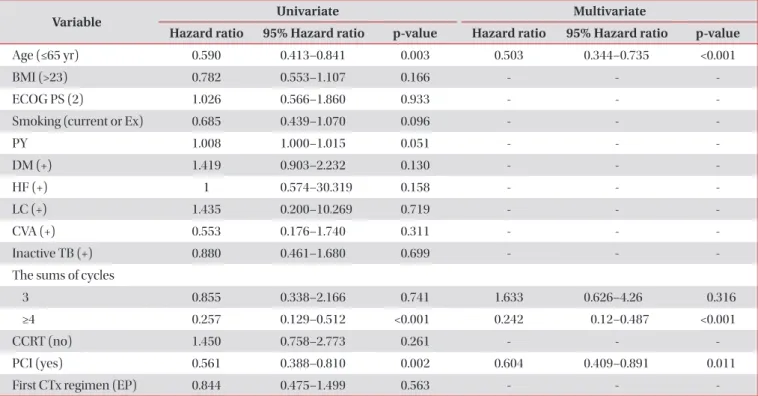
Conclusion: This study showed that overall survival (OS) was significantly improved in younger than in older patients with LD-SCLC. Univariate and multivariate analyses showed that age, PCI and the sum of cycles were significant predictors of OS in patients with LD-SCLC. However, prognosis in the ED group was unrelated to age.
Keywords: Prognosis; Small Cell lung Carcinoma; Age Groups
Copyright © 2016
The Korean Academy of Tuberculosis and Respiratory Diseases.
All rights reserved.
Address for correspondence: Chang-Min Choi, M.D., Ph.D.
Department of Pulmonary and Critical Care Medicine, Asan Medical Center, University of Ulsan College of Medicine, 88 Olympic-ro 43-gil, Songpa-gu, Seoul 05505, Korea
Phone: 82-2-3010-5902, Fax: 82-2-3010-6968 E-mail: [email protected]
Received: Mar. 8, 2016 Revised: May. 8, 2016 Accepted: Jun. 22, 2016
cc
It is identical to the Creative Commons Attribution Non-Commercial
License (http://creativecommons.org/licenses/by-nc/4.0/).
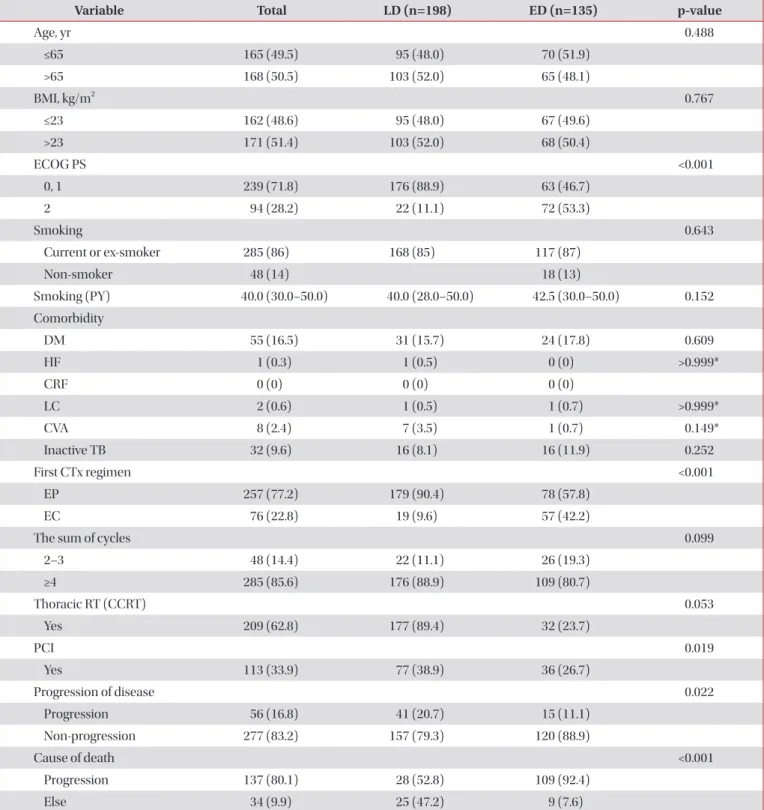
Table 1. Baseline characteristics
Variable Total LD (n=198) ED (n=135) p-value
Age, yr 0.488
≤65 165 (49.5) 95 (48.0) 70 (51.9)
>65 168 (50.5) 103 (52.0) 65 (48.1)
BMI, kg/m
20.767
≤23 162 (48.6) 95 (48.0) 67 (49.6)
>23 171 (51.4) 103 (52.0) 68 (50.4)
ECOG PS <0.001
0, 1 239 (71.8) 176 (88.9) 63 (46.7)
2 94 (28.2) 22 (11.1) 72 (53.3)
Smoking 0.643
Current or ex-smoker 285 (86) 168 (85) 117 (87)
Non-smoker 48 (14) 18 (13)
Smoking (PY) 40.0 (30.0–50.0) 40.0 (28.0–50.0) 42.5 (30.0–50.0) 0.152
Comorbidity
DM 55 (16.5) 31 (15.7) 24 (17.8) 0.609
HF 1 (0.3) 1 (0.5) 0 (0) >0.999*
CRF 0 (0) 0 (0) 0 (0)
LC 2 (0.6) 1 (0.5) 1 (0.7) >0.999*
CVA 8 (2.4) 7 (3.5) 1 (0.7) 0.149*
Inactive TB 32 (9.6) 16 (8.1) 16 (11.9) 0.252
First CTx regimen <0.001
EP 257 (77.2) 179 (90.4) 78 (57.8)
EC 76 (22.8) 19 (9.6) 57 (42.2)
The sum of cycles 0.099
2–3 48 (14.4) 22 (11.1) 26 (19.3)
≥4 285 (85.6) 176 (88.9) 109 (80.7)
Thoracic RT (CCRT) 0.053
Yes 209 (62.8) 177 (89.4) 32 (23.7)
PCI 0.019
Yes 113 (33.9) 77 (38.9) 36 (26.7)
Progression of disease 0.022
Progression 56 (16.8) 41 (20.7) 15 (11.1)
Non-progression 277 (83.2) 157 (79.3) 120 (88.9)
Cause of death <0.001
Progression 137 (80.1) 28 (52.8) 109 (92.4)
Else 34 (9.9) 25 (47.2) 9 (7.6)
Values are presented as number (%).
*Using Fisher exact test.
LD: limited disease; ED: extensive disease; BMI: body mass index; ECOG PS: Eastern Cooperative Oncology Group performance
status; PY: pack years; DM: diabetes mellitus; HF: heart failure: CRF: chronic renal failure; LC: liver cirrhosis; CVA: cerebrovascular
disease; TB: tuberculosis; CTx: chemotherapy; EP: etoposide-cisplatin; EC: etoposide-carboplatin; RT: radiotherapy; CCRT: concurrent
chemoradiotherapy; PCI: prophylactic cranial irradiation.
Materials and Methods
1. Patient selection
This study included 333 patients who were newly diag- nosed with SCLC at tertiary hospital from January 1, 2008, to
December 31, 2012.
2. Study design
Patient records were compiled and analyzed retrospectively using the ABLE
3,4(Asan Biomedical Research Environment)
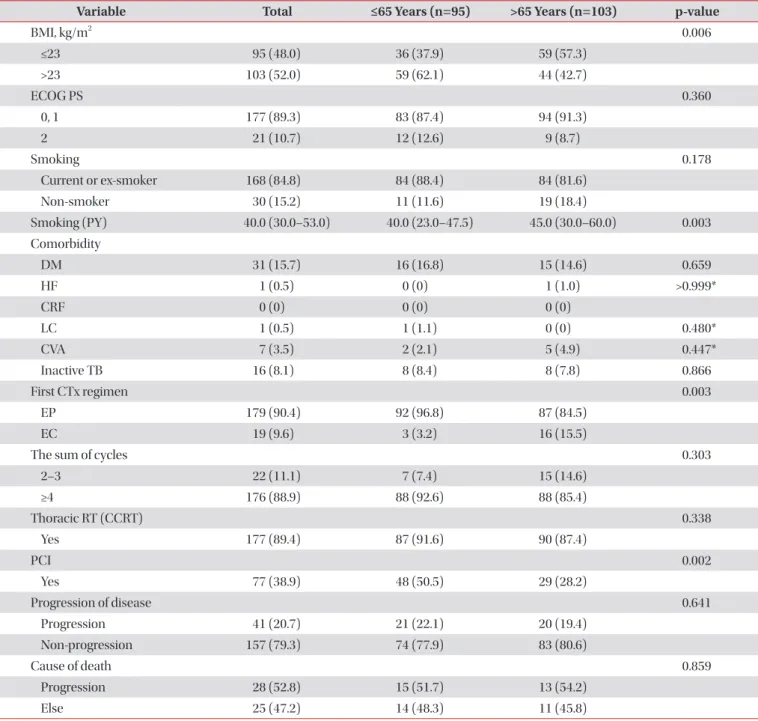
Table 2. Baseline characteristics (limited disease small cell lung cancer)
Variable Total ≤65 Years (n=95) >65 Years (n=103) p-value
BMI, kg/m
20.006
≤23 95 (48.0) 36 (37.9) 59 (57.3)
>23 103 (52.0) 59 (62.1) 44 (42.7)
ECOG PS 0.360
0, 1 177 (89.3) 83 (87.4) 94 (91.3)
2 21 (10.7) 12 (12.6) 9 (8.7)
Smoking 0.178
Current or ex-smoker 168 (84.8) 84 (88.4) 84 (81.6)
Non-smoker 30 (15.2) 11 (11.6) 19 (18.4)
Smoking (PY) 40.0 (30.0–53.0) 40.0 (23.0–47.5) 45.0 (30.0–60.0) 0.003
Comorbidity
DM 31 (15.7) 16 (16.8) 15 (14.6) 0.659
HF 1 (0.5) 0 (0) 1 (1.0) >0.999*
CRF 0 (0) 0 (0) 0 (0)
LC 1 (0.5) 1 (1.1) 0 (0) 0.480*
CVA 7 (3.5) 2 (2.1) 5 (4.9) 0.447*
Inactive TB 16 (8.1) 8 (8.4) 8 (7.8) 0.866
First CTx regimen 0.003
EP 179 (90.4) 92 (96.8) 87 (84.5)
EC 19 (9.6) 3 (3.2) 16 (15.5)
The sum of cycles 0.303
2–3 22 (11.1) 7 (7.4) 15 (14.6)
≥4 176 (88.9) 88 (92.6) 88 (85.4)
Thoracic RT (CCRT) 0.338
Yes 177 (89.4) 87 (91.6) 90 (87.4)
PCI 0.002
Yes 77 (38.9) 48 (50.5) 29 (28.2)
Progression of disease 0.641
Progression 41 (20.7) 21 (22.1) 20 (19.4)
Non-progression 157 (79.3) 74 (77.9) 83 (80.6)
Cause of death 0.859
Progression 28 (52.8) 15 (51.7) 13 (54.2)
Else 25 (47.2) 14 (48.3) 11 (45.8)
Values are presented as number (%).
*Using Fisher exact test.
BMI: body mass index; ECOG PS: Eastern Cooperative Oncology Group performance status; PY: pack years; DM: diabetes mellitus; HF: heart
failure: CRF: chronic renal failure; LC: liver cirrhosis; CVA: cerebrovascular disease; TB: tuberculosis; CTx: chemotherapy; EP: etoposide-
cisplatin; EC: etoposide-carboplatin; RT: radiotherapy; CCRT: concurrent chemoradiotherapy; PCI: prophylactic cranial irradiation.
system. Factors analyzed included type of lung cancer, weight, height, body mass index, smoking history (pack-years [PY]), comorbidities (diabetes mellitus, heart failure, chronic renal failure, liver cirrhosis, cerebrovascular disease, and pulmonary tuberculosis), Eastern Cooperative Oncology Group (ECOG) performance status, stage at diagnosis, first chemotherapy
regimen (etoposide-cisplatin [EP] and etoposide-carboplatin [EC]), the sum of cycles, concurrent chemoradiotherapy (CCRT) and cause of death.
Patients were divided into two groups by age (≤65 years vs.
>65 years) and extent of disease (LD vs. ED).
Eligible SCLC patients were ambulatory. They were newly
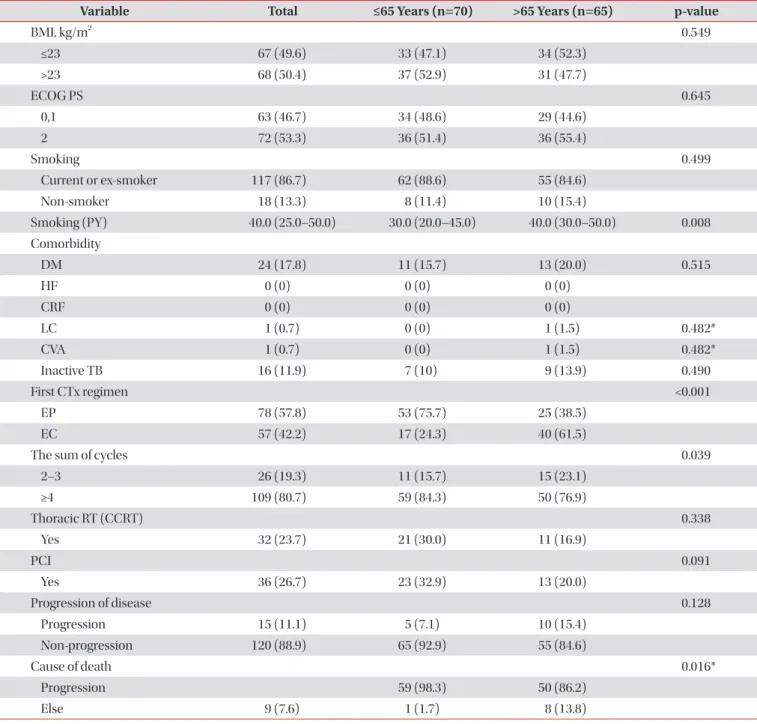
Table 3. Baseline characteristics (extensive disease small cell lung cancer)
Variable Total ≤65 Years (n=70) >65 Years (n=65) p-value
BMI, kg/m
20.549
≤23 67 (49.6) 33 (47.1) 34 (52.3)
>23 68 (50.4) 37 (52.9) 31 (47.7)
ECOG PS 0.645
0,1 63 (46.7) 34 (48.6) 29 (44.6)
2 72 (53.3) 36 (51.4) 36 (55.4)
Smoking 0.499
Current or ex-smoker 117 (86.7) 62 (88.6) 55 (84.6)
Non-smoker 18 (13.3) 8 (11.4) 10 (15.4)
Smoking (PY) 40.0 (25.0–50.0) 30.0 (20.0–45.0) 40.0 (30.0–50.0) 0.008
Comorbidity
DM 24 (17.8) 11 (15.7) 13 (20.0) 0.515
HF 0 (0) 0 (0) 0 (0)
CRF 0 (0) 0 (0) 0 (0)
LC 1 (0.7) 0 (0) 1 (1.5) 0.482*
CVA 1 (0.7) 0 (0) 1 (1.5) 0.482*
Inactive TB 16 (11.9) 7 (10) 9 (13.9) 0.490
First CTx regimen <0.001
EP 78 (57.8) 53 (75.7) 25 (38.5)
EC 57 (42.2) 17 (24.3) 40 (61.5)
The sum of cycles 0.039
2–3 26 (19.3) 11 (15.7) 15 (23.1)
≥4 109 (80.7) 59 (84.3) 50 (76.9)
Thoracic RT (CCRT) 0.338
Yes 32 (23.7) 21 (30.0) 11 (16.9)
PCI 0.091
Yes 36 (26.7) 23 (32.9) 13 (20.0)
Progression of disease 0.128
Progression 15 (11.1) 5 (7.1) 10 (15.4)
Non-progression 120 (88.9) 65 (92.9) 55 (84.6)
Cause of death 0.016*
Progression 59 (98.3) 50 (86.2)
Else 9 (7.6) 1 (1.7) 8 (13.8)
*Using Fisher exact test.
BMI: body mass index; ECOG PS: Eastern Cooperative Oncology Group performance status; PY: pack years; DM: diabetes mellitus; HF: heart
failure: CRF: chronic renal failure; LC: liver cirrhosis; CVA: cerebrovascular disease; TB: tuberculosis; CTx: chemotherapy; EP: etoposide-
cisplatin; EC: etoposide-carboplatin; RT: radiotherapy; CCRT: concurrent chemoradiotherapy; PCI: prophylactic cranial irradiation.
diagnosed of SCLC at tertiary hospital during this period. Pa- tients had never been treated SCLC before. They had 0–2 in ECOG performance status. Patients aged ≤18 years were ex- cluded. Primary end points is overall survival (OS). Secondary end points is progression-free survival (PFS).
3. Statistical analysis
Clinical factors in patients aged ≤65 years vs. >65 years and those with LD and ED were compared by Mann-Whitney U tests for continuous variables and chi-square tests or Fisher exact tests for categorical variables. OS and PFS were esti- mated by the Kaplan-Meier method, with results compared by log-rank tests. Risk factors for survival were determined by multivariable analysis using Cox’s proportional hazard
regression model. Statistical analyses were performed using SAS ver. 9.4 (SAS Institute Inc., Cary, NC, USA) and R ver. 3.2.0 (Microsoft (R), Seattle, WA, USA). All p-values were two-sided statistical (α=0.05), with p-values <0.05 considered statistically significant.
Results
The baseline characteristics of the 333 included patients are shown in Table 1. By age, 165 of these patients were ≤65 years old and 168 were >65 years old. Of the 333 patients with SCLC, 198 had LD, including 95 aged ≤65 and 103 aged >65 years, whereas 135 patients had ED, including 70 aged ≤65 and 65 aged >65 years. A comparison of the two age groups
A
1.0 0.8 0.6 0.4 Survivalprobability 0.2
0 60
0 12 24 36 48
Median OS (mo) 34.422.2 p=0.003
<65
>65 Log-rank
B
1.0 0.8 0.6 0.4 Survivalprobability 0.2
0 60
0 12 24 36 48
OS (LD) OS (ED)
Months Months
11.79.4 p=0.279
<65
>65 Log-rank
Median OS (mo)
Figure 1. (A, B) Subgroup analysis showed that overall survival (OS) was significantly longer in younger than in older patients with limited disease (LD) (p=0.003), but did not differ with age in extensive disease (ED) (p=0.279).
Figure 2. (A, B) Subgroup analysis showed that progression-free survival (PFS) was similar in all patients with limited disease (LD) (p=0.336) and extensive disease (ED) (p=0.727).
A
1.0 0.8 0.6 0.4 Survivalprobability 0.2
0 60
0 12 24 36 48
Median PFS (mo) 12.313.1 p=0.336
<65
>65 Log-rank
B
1.0 0.8 0.6 0.4 Survivalprobability 0.2
0 60
0 12 24 36 48
PFS (LD) PFS (ED)
Months Months
6.16.9 p=0.727
<65
>65 Log-rank
Median PFS (mo)