• 검색 결과가 없습니다.

Does Different Performance of Sampling Gears (Cast Net versus Gill Net) Bring the Inappropriate Estimation of Freshwater Fish in a Large River?

N/A
N/A
Protected

Academic year: 2021

Share "Does Different Performance of Sampling Gears (Cast Net versus Gill Net) Bring the Inappropriate Estimation of Freshwater Fish in a Large River?"

Copied!
9
0
0

로드 중.... (전체 텍스트 보기)

전체 글

(1)

─ 156 ─

ⓒ The Korean Society of Limnology. All rights reserved.

This is an open-access article distributed under the terms of the Creative Commons Attribution Non-Commercial License (http://creativecommons.org/licenses/by-nc/3.0/), which permits unrestricted non-commercial use, distribution, and reproduction in any medium, provide the original work is properly cited.

INTRODUCTION

Quantitative sampling and identification of fish species in a given region is a fundamental step to fish ecology and has major applications for fisheries, as such data are useful

for both environmental assessment and proper management (Pennington and Stromme, 1998; Kennard et al., 2006).

However, inaccurate data may result in unsuitable policies and management plans, potentially hampering conservation efforts (Sinclair and Murawski, 1997; Hampton et al., 2005;

Maunder et al., 2006; Polacheck, 2006). Thus, appropriate sampling methods (Rozas and Minello, 1997) are required for the most accurate environmental assessment possible.

Part of designing appropriate sampling methods involves the

Does Different Performance of Sampling Gears

(Cast Net versus Gill Net) Bring the Inappropriate Estimation of Freshwater Fish in a Large River?

Jeong-Hui Kim 1 (0000-0003-2331-4232) , Sang-Hyeon Park 1,2 (0000-0001-6036-8489) , Seung-Ho Baek 1 (0000-0002-8280-8665) , Min-Ho Jang 3 (0000-0001-6108-3186) , Hae-Jin Lee 4 (0000-0002-0380-7024) and Ju-Duk Yoon 5, * (0000-0003-1667-327x)

1

EcoResearch incorporated, Gongju 32588, Republic of Korea

2

Department of Marine Fisheries Resources, Mokpo National University, Mokpo 58554, Republic of Korea

3

Department of Biology Education, Kongju National University, Gongju 32588, Republic of Korea

4

Water Environmental Engineering Research Division, National Institute of Environmental Research, Incheon 22689, Republic of Korea

5
Research Center for Endangered species, National Institute of Ecology, Yeongyang 36531, Republic of Korea

Abstract The accurate estimation of fish assemblages is highly dependent on the sampling gear used for sampling. We used data from 15 sampling sites along the Nakdong River, which is a large river in South Korea, to identify differences in assemblages and sizes of freshwater fishes collected with either cast nets or gill nets, the two most commonly used sampling gear in South Korea. The two gears differed in the fish assemblages they captured, with more species caught by gill nets. Further, due to its tighter mesh size, the cast net caught significantly smaller fishes than the gill nets (independent t-test, p < 0.05). We found the cast net to be appropriate for species that inhabit shallow (less than 2 m) and open water, but inappropriate for deep water, habitats with plant beds, and nocturnal species. Thus, cast net sampling is not efficient in a large river environment, and a combination of sampling methods is more suitable for understanding fish assemblages in such habitats. In general, appropriate selection of fishing methods to specific habitats is necessary to improve data quality and minimize the misrepresentation of environmental conditions.

Key words: cast net, gill net, fish assemblage, large river, size class

Manuscript received 1 April 2020, revised 4 June 2020, revision accepted 4 June 2020

* Corresponding author: Tel: +82-54-680-7360, Fax: +82-54-680-7329 E-mail: [email protected], [email protected]

https://doi.org/10.11614/KSL.2020.53.2.156 ISSN: 2288-1115 (Print), 2288-1123 (Online)

Original article

(2)

selection of sampling gear. Equipment type directly relates to fishing yield and the scientific evaluation of fish fauna by, for example, altering the assemblages captured (Knight and Bain, 1996; Rozas and Minello, 1997; Rotherham et al., 2007, 2011; Oliveira et al., 2014). Thus, inappropriate gear is likely to cause inaccurate estimations of fish populations, resulting in sampling data that do not reflect the true status of the species (Rotherham et al., 2007, 2011).

In large warm-water rivers, the most commonly used sam- pling gears are seine nets, benthic trawls, boat electrofishing, gill nets, and hoop nets (Guy et al., 2009). For commercial fishing, the gill and hoop nets are normally used, but for sci- entific research, the gill and cast nets are preferred in South Korea (Yoon et al., 2015). The cast net shows high portability and the lack of species specificity (Emmanuel et al., 2008), and its portability allows for convenient application to diverse environments, from small creeks to rivers or reservoirs (e.g.

Meador and Kelso, 1990; Stevens, 2006; Stevens et al., 2006;

Sheaves and Johnston, 2008). Further, the cast net covers a larger area than a throw net per deployment and can be used in environments where trawling, gill nets, or seine nets can- not (Stein III et al., 2014).

Due to its ubiquity in South Korea, the majority of data used in research, fishery management, and policy come from cast net sampling. However, no studies to date have been conducted on how well cast net sampling represents fish as- semblages, in comparison to other methods. Therefore, we examined differences in assemblages and size of a freshwater fish in the Nakdong River, South Korea, collected with a cast net versus multi-mesh gill nets. Based on net characteristics (i.e., mesh size), we hypothesized that: (i) the cast net and multi-mesh gill nets collect different fish assemblages; and (ii) fish size will differ by capture method, with smaller fish captured in the cast net and larger individuals sampled in the gill nets.

MATERIALS AND METHODS

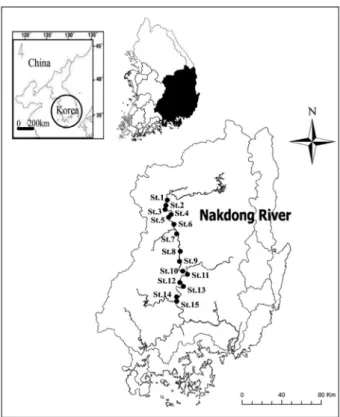
The study was conducted at 15 sites in the main channel of the Nakdong River (over 6 th stream order) from its mid-lower to mid-upper reaches, which is approximately 200 km (Fig.

1). Water qualities and physical characteristics of all study sites measured by NRERC (2012) were not different. Stream widths were slightly different across sites, ranging from 350 to 500 m. Maximum depths were about 5 m, and the domi-

nant substrate was sand.

Fish were collected during May and October 2012, using both a cast net (mesh 7 mm; area πr 2 , 16.6 m 2 ; r =2.3 m) and gill nets with two mesh sizes (mesh 30 mm, height 80, length 50 m; mesh 70 mm; height 150 cm, length 50 m). Sinking gill nets were used, and gill nets consisted of two 50-m panels of stretched mesh (30 and 70 mm) connected together. Fol- lowing the shoreline, 10 deployments were conducted per site using the cast net. Deployments were spaced at least 20 m apart within a 200-m section to minimize any effects from the previous deployment (i.e., fish avoiding the area where the net was cast). The radius of the cast net is 2.3 m, and the linear catching distances were 3.5~4 m. We considered dif- ferences between deployments to be negligible because cast nets were deployed by individuals with more than 10 years of experience. Gill nets were set in the afternoon before sunset and retrieved the next morning after sunrise (approximately 12 hours including two crepuscular periods). We tried to sus- tain hanging ratio of 0.4.

We calculated the Shannon diversity index and IBI (index of biological integrity) based on the results of our sampling.

Fig. 1. Map of the 15 stations that were sampled. Sites are distrib-

uted from the mid-lower to mid-upper areas of the Nakdong River,

South Korea.

(3)

The Shannon diversity index (H: Magurran, 1998) was com- puted using the equation: H = -∑ P i ×ln P i , where P i =n i / N, n i is the number of individuals of ith species, and N is the total number of individuals. The IBI is adjusted for Korean freshwater fishes (MOE/NIER, 2011) based on Karr (1981).

Total length (TL, cm) was measured to explore size dif- ferences in the collected fishes, depending on gear type.

All measurements were processed immediately after fish collection. Fishes were moved to an aerated tank (size:

100 ×100×80 cm) and anesthetized using 0.1 g L -1 ethyl 3-aminobenzoate methanesulfonate salt (Sigma-Aldrich, Mu- nich, Germany). The TL was measured with a digital caliper to the nearest 1 mm. After measurement, fishes were moved to a different tank and subsequently released at the site of capture once they were fully recovered.

Differences in the species composition between the two sampling gears were analyzed using nonmetric multidimen- sional scaling (NMDS), analysis of similarities (ANOSIM), similarity profile (Simprof) and similarity percentage (SIM- PER) performed with primer 6 software (Primer-E Ltd. Plym- outh, UK). NMDS constructs two-dimensional ordination in a manner that best represents relationships between samples in a similarity matrix (Field et al., 1982). Similarity matrices were generated for fish assemblages by square-root-trans- forming the raw data and calculating Bray-Curtis similarity indices for each pairwise assemblage comparison. The ro- bustness of the ordination is indicated by its stress value, ranging from < 0.2 (fair) to < 0.05 (excellent) (Clarke and Warwick, 1994). We then characterized the effects of fish- ing nets on assemblage composition with SIMPER (Clarke, 1993), which was run using the similarity matrices. The average dissimilarity percentages between groups and of the contributing species were identified.

The Wilcoxon signed ranks test was used to look for statis- tical differences between the cast net group versus the gill net group, in the following variables: number of species, number of individuals, the Shannon diversity index, and IBI. TL dif- ferences between cast net-caught fish and gill net-caught fish were examined with an independent t-test. These analyses were performed in SPSS 18.0 (SPSS Inc., Chicago, IL, USA).

RESULTS

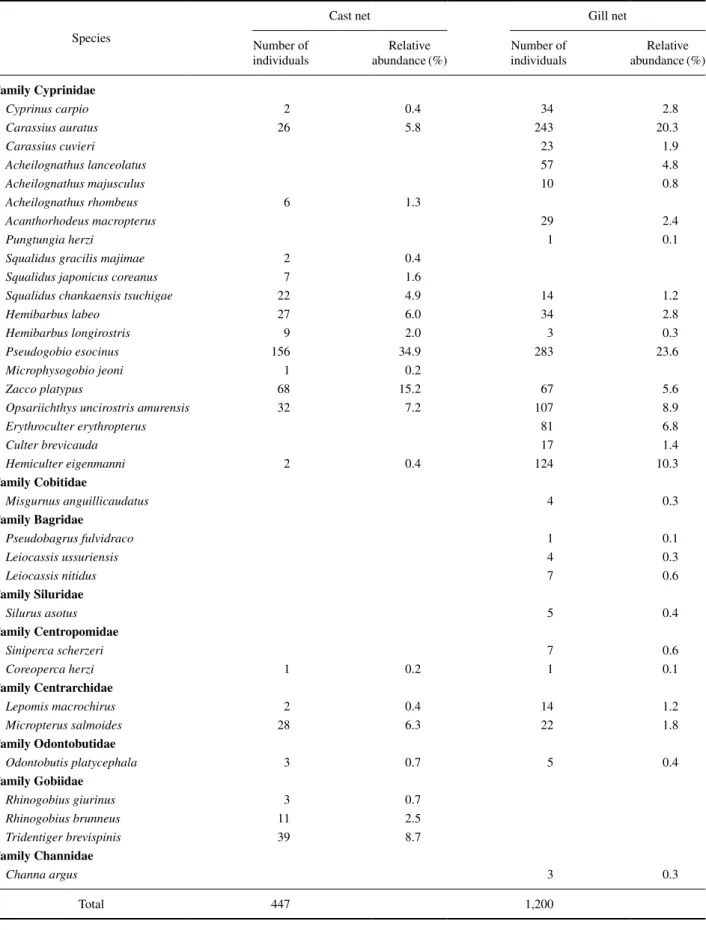
A total of 1,647 individuals classified into 34 species were

caught. The gill nets collected more individuals and species than the cast net (Table 1). Only 13 species were caught by both gears, while 14 (from Bargidae) and seven (from Gobii- dae) species were caught exclusively in gill nets and the cast net, respectively. Pseudogobio esocinus was the dominant species in both gears, while Carassius auratus, Hemiculter eigenmanni, and Opsariichthys uncirostris amurensis were predominantly caught with gill nets. Differences due to sam- pling gear were also apparent on the level of individual sites (Table 2). More species (Wilcoxon test, p =0.001) except Site (St.) 14, and more individuals (Wilcoxon test, p =0.002) except St. 2 and St. 14 were collected by gill nets. The Shan- non diversity index and IBI of fish caught with gill nets were higher than those caught with the cast net (Wilcoxon test, p < 0.05), and values calculated from the combined data of both gear types exceeded those calculated from the data of a single gear.

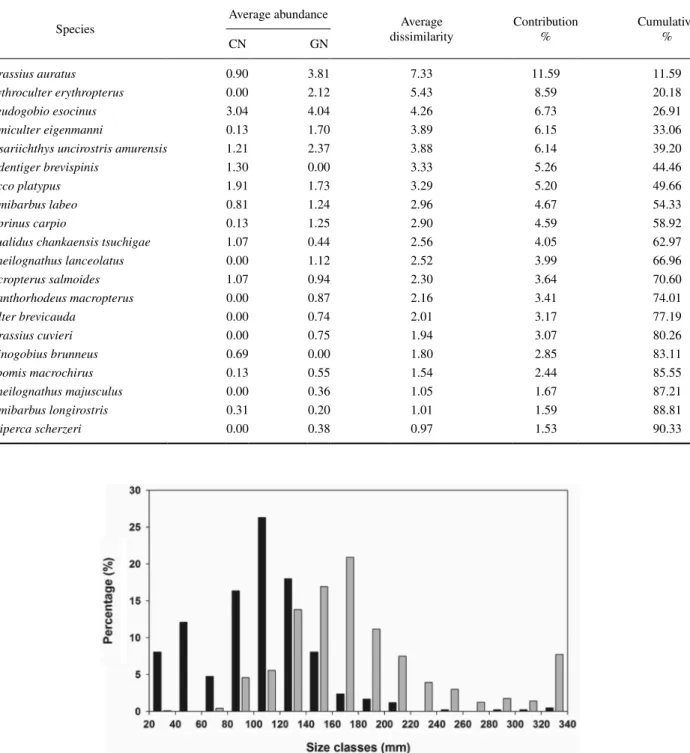
ANOSIM detected significant differences in fish assem- blages between two gears (Global R =0.759, p=0.001). Cast net samples clearly separated from gill net samples in the NMDS ordination plot, with only one sample (St. 11) from the cast net grouping with the gill net samples (Fig. 2). SIM- PER analysis identified average similarities of 56.03% and 55.31% for the cast net and gill nets, respectively, while the average dissimilarity was 63.27% (Table 3). Several Cyprin- idae contributed to the average dissimilarities of fish assem- blages, including C. auratus (average dissimilarity, 7.33%) and Tridentiger brevispinis (3.33%).

Gill nets collected significantly longer fish than the cast net (Independent t-test, p =0.000; Fig. 3). Fish sampled in the cast net predominantly ranged in TL from 40 to 140 mm, although individuals less than 40 mm were also frequently observed (8.1%), while individuals longer than 240 mm were rare (1.2%). Fish sampled in gill nets mainly ranged from 120 to 220 mm. Smaller fishes (less than 80 mm) were far rarer (0.5%) than bigger fishes (longer than 240 mm; 15.1%) in the gill nets.

DISCUSSION

The catch composition of different fishing equipment is

likely to vary depending on the morphology of local species

(Huse et al., 2000). For example, fish girth has been demon-

strated to affect the composition of gill net catches (Reis and

(4)

Table 1. Species composition and number of individuals collected by the cast net and the gill net.

Species

Cast net Gill net

Number of individuals

Relative abundance (%)

Number of individuals

Relative abundance (%) Family Cyprinidae

Cyprinus carpio 2 0.4 34 2.8

Carassius auratus 26 5.8 243 20.3

Carassius cuvieri 23 1.9

Acheilognathus lanceolatus 57 4.8

Acheilognathus majusculus 10 0.8

Acheilognathus rhombeus 6 1.3

Acanthorhodeus macropterus 29 2.4

Pungtungia herzi 1 0.1

Squalidus gracilis majimae 2 0.4

Squalidus japonicus coreanus 7 1.6

Squalidus chankaensis tsuchigae 22 4.9 14 1.2

Hemibarbus labeo 27 6.0 34 2.8

Hemibarbus longirostris 9 2.0 3 0.3

Pseudogobio esocinus 156 34.9 283 23.6

Microphysogobio jeoni 1 0.2

Zacco platypus 68 15.2 67 5.6

Opsariichthys uncirostris amurensis 32 7.2 107 8.9

Erythroculter erythropterus 81 6.8

Culter brevicauda 17 1.4

Hemiculter eigenmanni 2 0.4 124 10.3

Family Cobitidae

Misgurnus anguillicaudatus 4 0.3

Family Bagridae

Pseudobagrus fulvidraco 1 0.1

Leiocassis ussuriensis 4 0.3

Leiocassis nitidus 7 0.6

Family Siluridae

Silurus asotus 5 0.4

Family Centropomidae

Siniperca scherzeri 7 0.6

Coreoperca herzi 1 0.2 1 0.1

Family Centrarchidae

Lepomis macrochirus 2 0.4 14 1.2

Micropterus salmoides 28 6.3 22 1.8

Family Odontobutidae

Odontobutis platycephala 3 0.7 5 0.4

Family Gobiidae

Rhinogobius giurinus 3 0.7

Rhinogobius brunneus 11 2.5

Tridentiger brevispinis 39 8.7

Family Channidae

Channa argus 3 0.3

Total 447   1,200  

(5)

Pawson, 1999). Although we did not statistically examine the relationship between morphology and gill net collection, we observed effects of body depth and serrated spine presence.

Specifically, gill nets tended to catch large, fusiform fish of high body depth. Moreover, gill nets frequently captured Bagridae and Siluridae, which possess serrated spines that Fig. 2. Non-metric multidimensional scaling of samples based on Bray-Curtis similarities. Grey triangles indicate cast net sampling sites and black triangles indicate gill net sampling sites. The sites are grouped based on the Simprof test from a cluster analysis. One cast net site is grouped with the gill net sites.

Table 2. Number of fish species and individuals, the Shannon diversity index, and IBI (index of biological integrity) of fishes caught by the cast net and gill nets.

Site

Number of species Number of

individuals Shannon’s H IBI

CN GN Total CN GN CN GN Total CN GN Total

St. 1 8 14 18 38 179 1.67 2.08 2.21 50.0 62.5 68.8

St. 2 9 12 15 51 41 1.67 2.00 2.08 56.3 62.5 68.8

St. 3 6 13 17 17 80 1.62 2.10 2.32 43.8 62.5 68.8

St. 4 7 10 12 28 56 1.40 1.98 2.02 31.3 56.3 56.3

St. 5 9 12 15 37 109 1.89 1.77 2.03 56.3 62.5 75.0

St. 6 9 14 17 29 73 1.93 2.04 2.19 56.3 62.5 68.8

St. 7 7 11 12 18 51 1.72 1.92 1.94 56.3 62.5 62.5

St. 8 7 13 16 28 110 1.61 2.13 2.20 50.0 62.5 75.0

St. 9 8 11 16 21 59 1.91 1.96 2.34 50.0 56.3 56.3

St. 10 6 10 14 19 35 1.67 1.95 2.27 56.3 50 56.3

St. 11 8 11 14 25 77 1.64 2.00 2.08 56.3 56.3 62.5

St. 12 7 13 17 22 82 1.58 2.17 2.40 50.0 62.5 75.0

St. 13 9 12 17 43 49 1.21 2.05 2.20 37.5 62.5 68.8

St. 14 12 10 16 42 36 2.12 1.96 2.33 75.0 68.8 75.0

St. 15 8 11 13 29 163 1.68 1.64 1.78 50.0 50.0 56.3

CN, Cast net; GN, Gill nets; Total, Gill net +Cast net

(6)

are easily entangled in the mesh. With the exception of Mis- gurnus anguillicaudatus, gill nets used in this study do not generally appear to be effective for collecting small and eel-

like fish.

In contrast, ecological features such as habitat exert a great- er effect on cast net catches than fish morphology. We did not Table 3. SIMPER analysis results representing the contributions of species to the differentiation between the cast net (CN) and the gill net (GN). The total average dissimilarity between two groups was 63.27% and a cumulative percent reaches 90% was considered the cut-off.

Species

Average abundance

Average dissimilarity

Contribution

%

Cumulative

CN GN %

Carassius auratus 0.90 3.81 7.33 11.59 11.59

Erythroculter erythropterus 0.00 2.12 5.43 8.59 20.18

Pseudogobio esocinus 3.04 4.04 4.26 6.73 26.91

Hemiculter eigenmanni 0.13 1.70 3.89 6.15 33.06

Opsariichthys uncirostris amurensis 1.21 2.37 3.88 6.14 39.20

Tridentiger brevispinis 1.30 0.00 3.33 5.26 44.46

Zacco platypus 1.91 1.73 3.29 5.20 49.66

Hemibarbus labeo 0.81 1.24 2.96 4.67 54.33

Cyprinus carpio 0.13 1.25 2.90 4.59 58.92

Squalidus chankaensis tsuchigae 1.07 0.44 2.56 4.05 62.97

Acheilognathus lanceolatus 0.00 1.12 2.52 3.99 66.96

Micropterus salmoides 1.07 0.94 2.30 3.64 70.60

Acanthorhodeus macropterus 0.00 0.87 2.16 3.41 74.01

Culter brevicauda 0.00 0.74 2.01 3.17 77.19

Carassius cuvieri 0.00 0.75 1.94 3.07 80.26

Rhinogobius brunneus 0.69 0.00 1.80 2.85 83.11

Lepomis macrochirus 0.13 0.55 1.54 2.44 85.55

Acheilognathus majusculus 0.00 0.36 1.05 1.67 87.21

Hemibarbus longirostris 0.31 0.20 1.01 1.59 88.81

Siniperca scherzeri 0.00 0.38 0.97 1.53 90.33

Fig. 3. Sizes of fishes collected with cast nets and gill nets from fifteen study sites. Total lengths were grouped in 20 mm blocks, starting from

20 mm to longer than 320 mm. Black and grey bars indicate the percentages of fishes collected with cast nets and gill nets, respectively.

(7)

find support for the suggestion that cast nets would be useful in aquatic plant beds (Stein III et al., 2014). Fishes predom- inantly caught in the cast net (P. esocinus, Zacco platypus, Hemibarbus labeo, and Gobiidae) prefer shallow water with little shelter, and actual catching efficiency in habitats with plant beds was substantially lower than gill nets, which were able to capture species that favor such habitats (e.g., C. aura- tus and genus Acheilognathus) during their daily migration to open water. The lower efficiency of cast nets is likely due to impediment from aquatic plants that prevent the net from touching the bottom, allowing fishes to escape. Further, the cast net is not effective at water depths greater than 2 m, as the increased length of time for the net to reach the bottom al- lows fish to avoid capture. Finally, we found that the cast net rarely caught nocturnal species, such as Bagridae and Silurus asotus, likely because they were inactive and hidden during the daytime. We conclude that the cast net is inadequate for deep water, habitats with plant beds, and nocturnal species, but it is well-suited for sampling in shallow and open water (e.g., Jang et al., 2005; Stevens et al., 2006; Emmanuel et al., 2008; Sheaves and Johnston, 2008; Stein III et al., 2014).

Gill net catches tend to exhibit bell-shaped selectivity curves, as the mesh size results in frequent capture of medi- um-sized fish (Huse et al., 2000; Jørgensen et al., 2009). In general, we found that gill nets caught fish with greater TLs than the cast net, but allowed small fish ( < 80 mm) to escape.

Thus, gill net catches tend to underestimate the number of small individuals in a fish assemblage (Rulifson, 1991; Eros et al., 2009). Using a cast net, with its smaller mesh, should therefore provide complementary data on smaller fish. Alter- natively, using gill nets with a wide range of mesh sizes could also effective for catching variety size of fish.

In support of our hypothesis, we found consistent differ- ences between fish assemblages caught with a cast net versus gill nets. In particular, gill net sampling resulted in higher species richness than cast net sampling. One possible reason for this difference could be the limited, briefer deployment of cast nets (10 times per site) compared with the gill nets (in the water for 12 hours per site). However, fish assemblages collected by the cast net exhibited similar patterns and gener- ally grouped together across sites, indicating that increasing deployment should not significantly alter the patterns we found. Nonetheless, we acknowledge the difficulty in direct- ly comparing the collection outcomes of gill nets (passive) and cast nets (active), due to the numerous related variables

involved beyond sampling effort, such as net characteristics, fishing methods, and river habitats.

In summary, we found that fish richness was lower when using only a single gear for sampling. Our results are in line with conclusions from previous studies indicating that data collected with one method is limited, and a single, universal method of investigating ichthyofauna does not exist (Penczak et al., 1998; Loisl et al., 2014). Thus, the combined use of diverse sampling methods is more likely to improve study reliability (Loisl et al., 2014; Oliveira et al., 2014). This is particularly important in South Korea, as cast nets are pre- dominantly used in research for their convenience, even in habitats where they are inefficient. The data from studies using inappropriate or limited gear could lead to a misunder- standing of environmental conditions and the establishment of problematic management plans that are time-consuming and expensive, without being effective (Polacheck, 2006;

Rotherham et al., 2011). Therefore, to improve data quality, researchers should seek to use multiple types of sampling gear that suit specific habitats.

Author information Jeong-Hui Kim (EcoResearch incor- porated, CEO), Sang-Hyeon Park (EcoResearch incorporated, Senior Researcher / Mokpo National University, Ph.D. can- d i date), Seung-Ho Baek (EcoResearch incorporated, Senior Researcher), Min-Ho Jang (Department of Biology Educa- tion, Kongju National University, Professor), Hae-Jin Lee (Water Environmental Engineering Research Division, Nat- ional Institute of Environmental Research, Researcher), Ju- Duk Yoon (Research Center for Endangered species, National Institute of Ecology, Lead researcher)

Author contribution statement Conceptulation : Ju-Duk Yoon, Field survey : Ju-Duk Yoon, Kim Jeong-Hui, Sang- Hyeon Park, Seung-Ho Baek, Min-Ho Jang, Data analysis : Ju-Duk Yoon, Kim Jeong-Hui, Hae-Jin Lee, Manuscript writing : Kim Jeong-Hui, Ju-Duk Yoon

Conflict of interest  The authors declare no conflict of interest and the sponsors had no role in the design, execution, interpretation, or writing of the study.

Funding This work was supported by a grant from the Nat-

ional Institute of Environment Research (NIER), funded by

the River Nakdong Basin Management Committee (NIER-

2012-00-01-264).

(8)

REFERENCES

Clarke, K.R. 1993. Non-parametric multivariate analysis of changes in community structure. Australian Journal of Ecology 18: 117-143.

Clarke, K.R. and W.M. Warwick. 1994. Similarity-based testing for community pattern: the 2-way layout with no replica- tion. Marine Biology 118: 167-176.

Emmanuel, B.E., L.O. Chukwu and L.O. Azeez. 2008. Cast net design characteristics, catch composition and selectivity in tropical open lagoon. African Journal of Biotechnology 7:

2081-2089.

Eros, T., A. Specziár and P. Bíró. 2009. Assessing fish assemblag- es in reed habitats of a large shallow lake - A comparison between gillnetting and electric fishing. Fisheries Research 96: 70-76.

Field, J.G., K.R. Clarke and M. Warwick. 1982. A practical strate- gy for analyzing multi-species distribution patterns. Marine Ecology Progress series 8: 37-53.

Guy, C.S., P.J. Braaten, D.P. Herzog, J. Pitlo and R.S. Rogers.

2009. Warmwater fish in rivers, p. 59-84. In: Standard met- h ods for sampling North American freshwater fishes (Bonar, S.A., W.A. Hubert and D.W. Willis, eds.). American Fisher- ies Society, Bethesda.

Hampton, J., J.R. Sibert, P. Kleiber, M.N. Maunder and S.J. Har- ley. 2005. Decline of Pacific tuna populations exaggerated?

Nature 434: E1-E2.

Huse, I., S. Løkkeborg and A.V. Soldal. 2000. Relative selectivity in trawl, longline and gillnet fisheries for cod and haddock.

ICES Journal of Marine Science 59: 1271-1282.

Jang, M.H., G.I. Cho and G.J. Joo. 2005. The impact of unreg- ulated fishing on the size distribution of a fish population in a temperate upland stream pool. Journal of Freshwater Ecology 20: 191-193.

Jørgensen, C., B. Ernande and Ø. Fiksen. 2009. Size-selective fishing gear and life history evolution in the Northeast Arc- tic cod. Evolutionary Applications 2: 356-370.

Karr, J.R. 1981. Assessment of biotic integrity using fish commu- nities. Fisheries 6: 21-27.

Kennard, M.J., B.J. Pusey, B.D. Harch, E. Dore and A.H. Arth- ington. 2006. Estimating local stream fish assemblage attri- butes: sampling effort and efficiency at two spatial scales.

Marine and Freshwater Research 57: 635-653.

Knight, J.G. and M.B. Bain. 1996. Sampling fish assemblage in forest floodplain wetlands. Ecology of Freshwater Fish 5:

76-85.

Loisl, F., G. Singer and H. Keckeis. 2014. Method-integrated fish assemblage structure at two spatial scales along a free-flowing stretch of the Austrian Danube. Hydrobiologia 729: 77-94.

Magurran, A.E. 1988. Ecological diversity and its measurement.

Princeton university press, Princeton.

Maunder, M.N., J.R. Sibert, A. Fonteneau, J. Hampten, P. Kleiber

and S.J. Harley. 2006. Interpreting catch per unit effort data to assess the status of individual stocks and communities.

ICES Journal of Marine Science 63: 1373-1385.

Meador, M.R. and W.E. Kelso. 1990. Growth of largemouth bass in low salinity environments. Transactions of the American Fisheries Society 119: 545-552.

MOE/NIER. 2011. The survey and evaluation of aquatic ecosys- tem health in Korea. Ministry of Environment/National Institute of Environmental Research, Inchon.

NRERC. 2012. Research on the effect of weir construction on freshwater ecosystem. Nakdong River Environmental Re- search Center, Goryeong.

Oliveira, A.G., L.G. Gomes, J.D. Latini and A.A. Agostinho.

2014. Implications of using a variety of fishing strategies and sampling techniques across different biotopes to deter- mine fish species composition and diversity. Natureza &

Conservação 12: 112-117.

Penczak, T., L.C. Gomes, L.M. Bini and A.A. Agostinho. 1998.

The importance of qualitative inventory sampling using electric fishing and nets in a large, tropical river (Brazil).

Hydrobiologia 389: 89-100.

Pennington, M. and T. Stromme. 1998. Surveys as a research tool for managing dynamic stocks. Fisheries Research 37: 97- 106.

Polacheck, T. 2006. Tuna longline catch rates in the Indian Ocean:

did industrial fishing result in a 90% rapid decline in the abundance of predatory species? Marine Policy 30: 470- 482.

Reis, E.G. and M.G. Pawson. 1999. Fish morphology and esti- mating selectivity by gillnets. Fisheries Research 39: 263- 273.

Rotherham, D., A.J. Underwood, M.G. Chapman and C.A. Gray.

2007. A strategy for developing scientific sampling tools for fishery-independent surveys of estuarine fish in New South Wales, Australia. ICES Journal of Marine Science 64: 1512-1516.

Rotherham, D., W.G. Macbeth, S.J. Kennelly and C.A. Gray.

2011. Reducing uncertainty in the assessment and manage- ment of fish resources following an environmental impact.

ICES Journal of Marine Science 68: 1726-1733.

Rozas, L.P. and T.J. Minello. 1997. Estimating densities of small fishes and decapod crustaceans in shallow estuarine habi- tats: a review of sampling design with focus on gear selec- tion. Estuaries 20: 199-213.

Rulifson, R.A. 1991. Finfish utilization of man-initiated and adja- cent natural creeks of South Creek estuary, North Carolina using multiple gear types. Estuaries 14: 447-464.

Sheaves, M. and R. Johnston. 2008. Influence of marine and fre shwater connectivity on the dynamics of subtropical estuarine wetland fish metapopulations. Marine Ecology Progress Series 357: 225-243.

Sinclair, A.F. and S.A. Murawski. 1997. Why have groundfish

stocks declined? p. 71-93. In: Northwest Atlantic ground

(9)

fish: perspectives on a fishery collapse (Boreman, J.J., B.

Nkashima, J. Wilson and R. Kendall, eds.). American Fish- eries Society, Bethesda.

Stein III, W., P.W. Smith and G. Smith. 2014. The cast net: an overlooked sampling gear. Marine and Coastal Fisheries 6:

12-19.

Stevens, P.W. 2006. Sampling fish communities in saltmarsh im- poundments in the northern Indian River Lagoon, Florida:

cast net and culvert trap gear testing. Florida Scientist 69:

135-147.

Stevens, P.W., C.L. Montague and K.J. Sulak. 2006. Patterns of fish use and piscivore abundance within a reconnected salt- marsh impoundment in the northern Indian River Lagoon, Florida. Wetlands Ecology and Management 14: 147-166.

Yoon, J.D., J.H. Kim, H.J. Lee and M.H. Jang. 2015. Use of the

cast net for monitoring fish status in reservoirs distributed

in the Korean peninsula. Journal of Ecology and Environ-

ment 38: 383-388.

수치

Fig. 1.  Map of the 15 stations that were sampled. Sites are distrib- distrib-uted from the mid-lower to mid-upper areas of the Nakdong River,  South Korea
Table 1.  Species composition and number of individuals collected by the cast net and the gill net
Table 2.  Number of fish species and individuals, the Shannon diversity index, and IBI (index of biological integrity) of fishes caught by the  cast net and gill nets.
Fig. 3.  Sizes of fishes collected with cast nets and gill nets from fifteen study sites

참조

관련 문서

* in large objects with small surface area A to volume V ratio (A/V) the physical and chemical properties are primarily defined by the bulk (inside). * in small objects with

The measured microbial degradation activities (per liter) in response to different sampling sizes. The estimated average values and their standard deviations in microbial

1 John Owen, Justification by Faith Alone, in The Works of John Owen, ed. John Bolt, trans. Scott Clark, &#34;Do This and Live: Christ's Active Obedience as the

가속도의 법칙: The acceleration of an object as produced by a net force is directly proportional to the magnitude of the net force in the same direction as the net force

Model performances in the stations of Nam river monitoring data 42 Table 15... List

Every seconds complete mixing across the cross section of the river (but not longitudinally) occurs. An instantaneous injection of a conservative tracer results in a

Further, in this course, students will learn all the capabilities necessary for the modeling of the practical fluid phenomena in the river and for the analysis

For the discharge described in Example 5.5 2, calculate the equilibrium partial pressure of the chemical above the river at the discharge point Is volatilization from the