1. 서 론
최근 LED 디스플레이 산업의 발전과 동시에 디바이 스의 효율을 증진시키기 위한 고굴절 코팅에 대한 연 구가 활발히 진행되고 있다 [1-3].
고굴절 코팅막의 재료로써 zirconia dioxide (ZrO2) 와 titanium dioxide (TiO2)를 이용한 연구가 활발히 진행되고 있으며, ZrO2는 높은 굴절률과 강도, 인성을 가지며 열전도도가 낮아 내열, 코팅, 기계 구조용부품 등의 고온재료와 각종 고인성의 기계부품에 사용된다.
a. Corresponding author; [email protected] Copyright ©2017 KIEEME. All rights reserved.
This is an Open-Access article distributed under the terms of the Creative Commons Attribution Non-Commercial License (http://creativecommons.org/licenses/by-nc/3.0) which permits unrestricted non-commercial use, distribution, and reproduction in any medium, provided the original work is properly cited.
또한 산·염기에 강한 내식성을 가지고 있어 광촉매제, 담체제로 사용되고 있다 [4,5].
ZrO2박막은 sol-gel, sputtering, chemical vapor deposition (CVD), layer-by-layer self assembly (LBL-SA), liquid phase deposition (LPD)법과 같은 다양한 방법들에 의해 제조된다 [6-11]. 특히 습식공 정 중 두 물질의 정전기력을 이용하여 박막을 제조하 는 LBL-SA법은 광학용 디바이스를 위한 코팅방법으 로 적합하며, LBL-SA법으로 TiO2/PSS 가스 센서용 박막과 PDDA/SiO2 박막, 초친수 박막등을 제조하는 선행사례가 있다 [12-14]. LBL-SA법은 박막을 제조하 는 공정 중에서 용액의 pH, 농도 및 코팅 프로세스를 간단히 제어할 수 있으며, 위의 조건에 따라 제조되는 코팅막의 표면구조 및 막 두께를 나노스케일로 제어가 가능하다. 또한 LBL-SA법은 상온 상압에서 물에 녹
LBL-SA법을 이용한 고굴절률 ZrO2 박막 제조
최창식1, 이지선1, 이미재1, 이영진1, 전대우1, 안병조2, 김진호1,a
1 한국세라믹기술원 광⋅디스플레이 소재센터
2 한경 TEC 주식회사
Fabrication of High Refractive Index ZrO
2Thin Film by a Layer-by-layer Self-assembly Method
Chang-Sik Choi
1, Ji-Sun Lee
1, Mi-Jai Lee
1, Young-Jin Lee
1, Dae-Woo Jeon
1, Byoung-Jo Ahn
2, and Jin-Ho Kim
1,a1 Optic & Display Materials Center, Korea Institute of Ceramic Engineering and Technology, Jinju 52851, Korea
2 HanKyung TEC Co., Ltd, Jinju 52611, Korea
(Received October 4, 2016; Revised January 27, 2017; Accepted February 9, 2017)
Abstract: ZrO2/PSS thin film with a high refractive index was fabricated on a glass substrate by a layer-by-layer self-assembly method. The surface morphology and thickness of the fabricated ZrO2/PSS thin films were measured as a function of the number of (ZrO2/PSS)n. As the number of (ZrO2/PSS)n increased from n = 5 to n = 20, RMS roughness decreased from 29.01 nm to 8.368 nm. The ZrO2 thin films exhibited high transmittance of 85% or more;
and the 15-bilayer thin film exhibited the highest transmittance among the samples. The transmittance of the fabricated (ZrO2/PSS)15 thin film was ca. 90.8% in the visible range. The refractive index of the glass substrate coated by a (ZrO2/PSS)15 thin film with a thickness of 160 nm increased from ca. 1.52 to 1.74 at the 632 nm wavelength.
Keywords: Layer-by-layer self-assembly method, High refractive index, Thin film, ZrO2, Transimittance
DOI: https://doi.org/10.4313/JKEM.2017.30.4.199 ISSN 1226-7945(Print), 2288-3258(Online)
200 J. Korean Inst. Electr. Electron. Mater. Eng., Vol. 30, No. 4, pp. 199-203, April 2017: C.-S. Choi et al
거나 분산되어 양전하 혹은 음전하를 갖는 전해질 폴 리머, 나노입자들을 가지고 그 용액에 기판을 번갈아 침적하여 서로 다른 전하를 갖는 물질의 정전기력을 이용한 박막을 제조할 수 있다 [15-17]. ZrO2의 zeta potential을 보면 산성 pH에서 양전하의 성분을 갖게 된다 [18].
본 연구에서는 LBL-SA법을 통해 ZrO2를 함유한 고 굴절 박막을 제조하기 위하여 유리 기판위에 양전하를 띄는 ZrO2 나노입자 분산 용액과 음전하를 띄는 PSS 를 이용하여 (ZrO2/PSS) 박막을 제조하였고, 적층 횟 수에 따른 코팅막의 투과율, 반사율, 두께, 굴절률 및 표면거칠기 특성을 확인하였다.
2. 실험 방법
ZrO2박막을 코팅하기 위해서 양전하를 갖는 ZrO2 용 액(5 wt%, 한경TEC, pH-2.6)과 음전하를 갖는 고분자 poly (sodium, 4-styrene sulfonate) (PSS, Aldrich) 를 0.01M 사용하였다.
ZrO2용액의 pH는 아세트산을 이용하여 pH 2.6으 로 적정하였으며, PSS용액은 pH조절하지 않았다. 기 판으로 사용된 slide glass는 표면 친수 처리를 위하 여 KOH용액(1.0 wt%)에 침적되어 5분간 초음파 처리 를 한 후 증류수를 이용하여 세척하였다. 친수처리 된 기판은 먼저 ZrO2용액에 10분간 침적된 후 증류수에 1분씩 3회 세정되었다. 이후 PSS용액에 10분간 침적 된 후 증류수에 3회 세정되었다. 기판위에 ZrO2를 적 층 후 PSS를 적층하여 제조된 박막을 ZrO2/PSS로 표기하고 이 과정을 1 bilayer로 지칭하였으며 코팅 을 n회 실시할 경우, (ZrO2/PSS)n 으로 표기하였다.
LBL-SA법을 이용한 박막제조 모식도를 그림 1에 나 타내었다.
박막의 표면미세구조는 주사전자현미경(filed emission scanning electron microscopy, FE-SEM, JSM6700, JEOL) 분석을 하였다. 박막 표면의 거칠기는 원자간력 현미경(atomic force microscope, AFM, EM4SYS PAFM NXⅡ)을 이용하여 측정하였고, 박막의 광학적 특성을 확인하기 위해 자외-가시선분광광도계(UV-Vis spectrophotometer, V-570, JASCO)를 사용하여 가 시광선 영역(380~780 nm)에서 투과율을 측정하였으 며, 박막의 두께와 굴절률을 확인하기 위해서 박막 분 석기(thin-film analyzer; F20-UV, FILMETRICS)를 사용하였다.
3. 결과 및 고찰
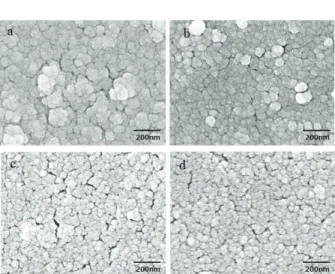
그림 2는 적층 횟수에 따른 ZrO2/PSS박막의 표면 미세구조를 FE-SEM으로 측정하였다. ZrO2/PSS의 적 층 횟수가 5, 10, 15, 20회로 증가함에 따라 유리기판 위에 흡착되어 있는 수십 나노의 입자들이 치밀한 구 조로 형성되어 있는 것을 알 수 있었다. 그리고 적층 횟수가 적을수록 입자사이의 응집현상이 큰 것을 확인 할 수 있었다.
AFM을 이용하여 제조된 박막의 표면 roughness를 그림 3에 나타내었다. 측정범위는 가로×세로 직경 10 μm로 측정하였다. ZrO2/PSS박막의 적층 횟수가 5, 10, 15, 20회로 증가함에 따라 RMS roughness는 각 각 약 29 nm, 17 nm, 9 nm, 8 nm 순으로 낮아졌으 며 15회 적층한 박막과 20회 적층한 표면 거칠기 값이
Fig. 1. Schematic diagram of a layer-by-layer self-assembly process.
Fig. 2. FE-SEM image of (ZrO2/PSS)n thin film surface;
a: n=5, b: n=10, c: n=15, d: n=20.
차이가 적었다. 이것은 적층 횟수가 증가함에 따라 유 리기판 위에 흡착된 입자들이 균일하게 코팅되었다는 것을 확인할 수 있으며, 그림 2와 동일한 현상으로 입 자들이 균일하고 치밀한 구조로 형성된 것을 나타낸다.
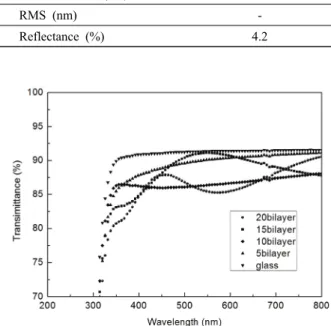
그림 4에 적층 횟수에 따른 투과율을 나타내었다.
그림 4에 보이는 것과 같이 ZrO2/PSS입자들이 코팅된
박막이 가시광 영역에서 85% 이상의 높은 투과율을 나타냈으며, 15회 적층하였을 때 가장 높은 투과율을 나타냈다.
F20을 이용하여 제조된 박막의 두께 및 굴절률을 확 인한 결과 632 nm 파장영역에서 약 1.69~1.74의 굴절 률을 가졌으며, 단면 반사율은 6.291~7.117%로 나타났다.
Fig. 3. AFM image of (ZrO2/PSS)n thin film; a: n=5, b: n=10, c: n=15, d: n=20.
202 J. Korean Inst. Electr. Electron. Mater. Eng., Vol. 30, No. 4, pp. 199-203, April 2017: C.-S. Choi et al
적층 횟수에 따른 (ZrO2/PSS)n 박막의 물성을 표 1 에 나타내었다. 4개의 샘플의 물성을 확인한 결과, 15 bilayers의 박막에 ZrO2/PSS입자들이 가장 치밀하게 위치해 있으며, 박막의 두께가 최적의 두께라고 판단되 었다.
4. 결 론
LBL-SA법을 의해 양전하를 갖는 ZrO2 나노입자와 음전하를 갖는 전해질 폴리머 PSS로 구성된 (ZrO2/ PSS) 고굴절 박막을 제조하였다. 박막의 굴절률을 향 상시키기 위해 적층 횟수의 변화를 주었으며, 적층 횟 수가 증가함에 따라 두께는 약 37 nm에서 255 nm로 증가되었다. 이것은 양전하의 ZrO2와 음전하의 PSS가 서로 다른 정전기적 인력에 의해 적층되어 두께가 증 가된 것으로 확인되었다. 또한 박막의 적층 횟수에 따 라 표면 roughness가 감소하는 경향을 확인할 수 있 었으며, 이것은 적층 횟수가 증가할수록 유리기판 위에 입자가 균일하게 코팅되었다는 것을 알려준다. 적층 횟
수가 5, 10, 15, 20순으로 증가할 때, 박막의 투과율 값이 일정하지 않은 것은 5 bilayers의 경우 적층 횟수 가 적기 때문에 90.2%의 값을 나타낸 것이며, 10 bilayers의 경우 입자가 조밀하고 치밀하게 형성하지 않아서 투과율이 86.4%로 감소된 것으로 생각한다. 또 한 15 bilayers의 경우 입자가 조밀하고 치밀하게 형성 이 되어 투과율이 90.8%로 증가되었으며, 20 bilayers 의 경우 15 bilayers의 박막과의 RMS값은 근소한 차 이를 가지고 있으나, 박막의 두께가 증가하였기에 투과 율이 85.8%로 감소된 것으로 생각한다. LBL-SA법으 로 제조된 ZrO2/PSS 박막은 85% 이상의 높은 투과율 을 나타났으며, 15 bilayers 적층할 때 가장 높은 투 과율을 나타냈다. ZrO2/PSS 박막은 flexible한 전자소 자나 기판, BLU (back light unit)의 광원렌즈에 응용 품으로써 사용이 기대된다.
감사의 글
본 연구는 산업통상자원부 경제협력권산업융성사업 의 연구비 지원으로 수행되었습니다.
REFERENCES
[1] J.L.H. Chau, Y. M. Lin, A. K. Li, W. F Su, K. S. Chang, S. L. Hsu, and T. L. Li, Mater. Lett., 61, 2908 (2007).
[DOI: https://doi.org/10.1016/j.matlet.2007.01.088]
[2] J. H. Kim, D. H. Kim, S. K. Kim, D. Bae, Y. Z. Yoo, and T. Y. Seong, Ceram. Int., 42, 14071 (2016). [DOI:
https://doi.org/10.1016/j.ceramint.2016.06.015]
[3] M. Sangermano, B. Voit, F. Sordo, K. J. Eichhorn, and G.
Rizza, Polymer, 49, 2018 (2008). [DOI: http://dx.doi.org/
10.1016/j.polymer.2008.03.010]
[4] G. K. Chuah, Catal. Today, 49, 131 (1999). [DOI:
https://doi.org/10.1016/S0920-5861(98)00417-9]
Fig. 4. Transmittance of (ZrO2/PSS)n thin film.
Layers Bare glass 5 10 15 20
Transmittance (%) 91.4 90.2 86.4 90.8 85.8
Refractive index (at 632 nm) 1.52 1.7 1.72 1.74 1.71
Film thickness (nm) - 37 78 160 255
RMS (nm) - 29.01 17.12 9.814 8.368
Reflectance (%) 4.2 6.815 9.781 6.291 6.828
Table 1. Properties of prepared (ZrO2/PSS)n thin films as a function of coating.
[5] G. K. Chuah, S. Jaenicks, S. A. Cheng, and K. S. Chan, Appl. Catal., A, 145, 267 (1996). [DOI: http://dx.doi.org/
10.1016/0926-860X(96)00152-4]
[6] P. Chrysicopoulou, D. Davazoglou, C. Trapalis, and G.
Kordas, Thin Solid Films, 323, 188 (1998). [DOI:
https://doi.org/ 10.1016/S0040-6090(97)01018-3]
[7] M. Takeuchi, T. Itoh, and H. Nagasaka, Thin Solid Films, 51, 83 (1978). [DOI: https://doi.org/10.1016/0040-6090(78) 90215-8]
[8] K. S. Yeung and Y. W. Lam, Thin Solid Films, 109, 169 (1983). [DOI: https://doi.org/10.1016/0040-6090(83)90136-0]
[9] J. H. Kim and S. Shiratori. J. Appl. Phys., 44, 7588 (2005). [DOI: https://doi.org/10.1143/JJAP.44.7588]
[10] Y. Tsuge, J. H. Kim, Y. Sone, O. Kuwaki, and S.
Shiratori, Thin Solid Films, 516, 2463 (2008). [DOI:
https://doi.org/10.1016/j.tsf.2007.04.084]
[11] H. J. Kim, K. J. Jeong, and D. S. Bae, J. Mater. Res., 22, 249 (2012).
[12] J. H. Kim, J. H. Hwang, M. J. Lee, S. K. Kim, and T.
Y. Lim, J. Kor. Cryst. Growth Cryst. Technol., 20, 221 (2010). [DOI: https://doi.org/10.6111/JKCGCT.2010.20.5.221]
[13] J. G. Park, K. H. Kyung, M. J. Lee, J. H. Hwang, T. Y.
Lim, and J. H. Kim, J. Mater. Res., 24, 715 (2014).
[14] J. H. Kim, J. H. Hwang, T. Y. Lim. J. H. Jang, and S.
H. Kim, J. Kor. Cryst. Growth Cryst. Technol., 20, 168 (2010). [DOI: https://doi.org/10.6111/JKCGCT.2010.20.4.168]
[15] G. Decher, J. D. Hong, and J. Schmit, Thin Solid Films, 831, 210 (1992).
[16] J. D. Mendelsohn, C. J. Barrett, V. V Chan, A. J. Pal, A. M. Mayes, and M. F. Rubner, Langmuir, 16, 5017 (2000). [DOI: https://doi.org/10.1021/la000075g]
[17] S. S. Shiratori and M.F Rubner, Mactomolecules, 33, 4213 (2000). [DOI: https://doi.org/10.1021/ma991645q]
[18] M. Ozawa, S. Suzuki, C. K. Loong, and P. Thiyagarajan, J. Mater. Sci., 16, 1360 (1997).