• 검색 결과가 없습니다.

Mn/CeO2와 Mn/ZrO2 촉매 상에서 NH3를 사용한 NO의 선택적 촉매 산화 반응

N/A
N/A
Protected

Academic year: 2021

Share "Mn/CeO2와 Mn/ZrO2 촉매 상에서 NH3를 사용한 NO의 선택적 촉매 산화 반응"

Copied!
7
0
0

로드 중.... (전체 텍스트 보기)

전체 글

(1)

Mn/CeO 2 와 Mn/ZrO 2 촉매 상에서 NH 3 를 사용한 NO의 선택적 촉매 산화 반응

고정휘⋅박성훈*⋅전종기**⋅손정민***⋅이시훈***⋅박영권

서울시립대학교 에너지환경시스템 공학과, *순천대학교 환경공학과, **공주대학교 화학공학부,

***전북대학교 자원에너지 공학과

(2011년 10월 25일 접수, 2011년 11월 10일 심사, 2011년 11월 29일 채택)

-

Low Temperature Selective Catalytic Reduction of NO with NH 3 over Mn/CeO 2 and Mn/ZrO 2

Jeong Huy Ko, Sung Hoon Park*, Jong-Ki Jeon**, Jung Min Sohn***, See-Hoon Lee***, and Young-Kwon Park

Graduate School of Energy and Environmental System Engineering, University of Seoul, Seoul 130-743, Korea

*

Department of Environmental Engineering, Sunchon National University, Suncheon 540-742, Korea

**

Department of Chemical Engineering, Kongju National University, Cheonan 331-717, Korea

***
Department of Mineral Resources and Energy Engineering, Chonbuk National University, Jeonju 561-756, Korea (Received October 25, 2011; Revised November 10, 2011; Accepted November 29, 2011)

본 연구에서는 저온에서 질소산화물 저감효율이 뛰어난 것으로 알려진 망간전구체의 종류에 따른 영향을 고찰하기 위해 초임계수열법으로 합성한 세리아(CeO 2 ) 와 지르코니아(ZrO 2 ) 를 담체로 하여 저온 SCR 공정에서의 온도에 따른 활성변화를 비교 분석하였다. Manganese acetate (MA)와 Manganese nitrate (MN), 두 종류 망간전구체의 농도를 영향인 자로 고려하여 촉매의 활성변화를 고찰하였다. 활성화된 시료의 특성은 N 2 adsorption-desorption, TGA, XRD, XPS를 통해 분석하였고 질소산화물 저감효율을 측정하기 위해 NOx 분석기를 이용하여 De-NOx 실험을 수행하였다. 제조방 법에 따라 합성한 촉매의 질소산화물 저감 효율을 분석한 결과 Manganese acetate (MA)를 활성물질로 사용한 촉매가 Manganese nitrate (MN) 을 사용한 촉매에 비해 전체적인 온도 영역에서 우수한 질소산화물 저감효율을 보였다. 이는 특성분석 결과를 통해 알 수 있듯이 Manganese acetate (MA)의 주성분인 Mn 2 O 3 가 Manganese nitrate (MN)의 주성분인 MnO 2 에 비해 높은 산소 이동도를 갖고 담체와의 강한 상호작용을 형성하는 것에 기인한 것으로 보인다.

Manganese (Mn) catalysts were generated using CeO 2 and ZrO 2 supports synthesized by the supercritical hydrothermal method and two different Mn precursors, aimed at an application for a low-temperature selective catalytic reduction process.

Manganese acetate (MA) and manganese nitrate (MA) were used as Mn precursors. Effects of the kind and the concentration of the Mn precursor used for catalyst generation on the NOx removal efficiency were investigated. The characteristics of the generated catalysts were analyzed using N 2 adsorption-desorption, thermo-gravimetric analysis, X-ray diffraction, and X-ray photoelectron spectroscopy. De-NOx experiments were carried out to measure NOx removal efficiencies of the catalysts. NOx removal efficiencies of the catalysts generated using MA were superior to those of the catalysts generated using MN at every temperature tested. Analyses of the catalyst characteristics indicated that the higher NOx removal efficiencies of the MA-de- rived catalysts stemmed from the higher oxygen mobility and the stronger interaction with support material of Mn 2 O 3 pro- duced from MA than those of MnO 2 produced from MN.

Keywords: De-NOx, SCR, Mn/CeO 2 , Mn/ZrO 2 , hydrothermal synthesis in supercritical water

1. Introduction

1)

Stringent regulations are implemented all over the world to reduce NO x emissions from vehicles, power generation facilities, industrial facilities, and incinerators, fostering extensive research and develop- ment for treatment and reduction of NO x . Among a number of available technologies to reduce NO x contained in exhaust gas from

† 교신저자 (e-mail: [email protected])

stationary emission sources such as incinerators and thermal power stations, selective catalytic reduction (SCR) is known to be the best technology in the technical and economical aspects, being used extensively all over the world. In SCR processes, NO x is reduced into non-toxic gases, N 2 and H 2 O, by using reducing agents such as NH 3 , urea, and hydrocarbons[1-3].

Various metal oxides (Mn, Ni, Cu, Cr, V and Fe) have been applied

as the catalytic material for development of low-temperature SCR

catalysts[4,5]. In particular, manganese is known to be superior to

(2)

Pure ZrO 2 89.3 - - - MA-MnO x (0.05)/ZrO 2 (550) 86.4 55.14 21.76 3.53 MA-MnO x (0.10)/ZrO 2 (550) 79.8 53.13 17.89 8.65 MA-MnO x (0.15)/ZrO 2 (550) 75.3 52.00 15.88 10.75 MN-MnO x (0.05)/ZrO 2 (550) 84.1 54.76 21.33 4.57 MN-MnO x (0.10)ZrO 2 (550) 78.6 54.34 17.34 8.27 MN-MnO x (0.15)/ZrO 2 (550) 72.8 52.65 16.63 10.36 related to NO x removal efficiency, depend on the manganese precursor

used and the synthesis method.

In this study, manganese oxide-based catalysts were prepared by using CeO 2 and ZrO 2 support produced with supercritical method and two kinds of manganese precursors, Mn(CH 3 COO) 2 (manganese acetate) and Mn(NO 3 ) 2 (manganese nitrate). The characteristics of these catalysts were investigated using N 2 adsorption-desorption, thermo- gravimetric analysis (TGA), and X-ray diffraction (XRD). SCR experi- ments were carried out using NH 3 as the reducing agent to measure the NO x removal efficiency of the prepared catalysts.

2. Experimental

In this study, two kinds of MnO x were impregnated using the incipient wetness impregnation method on a CeO 2 and ZrO 2 support produced with supercritical method[6]. Mn(CH 3 COO) 2 (Aldrich, 99%+) and Mn(NO 3 ) 2 (Aldrich, 98%) were used as the manganese precursors.

Three different concentrations (5, 10, and 15 wt%) of Mn precursors were added to the support and the produced catalysts were calcined for 3 h at 550 ℃ in the air. The MnO x /CeO 2 or ZrO 2 catalysts generated using manganese acetate (MA) and manganese nitrate (MN) will be referred to as MA-MnO x (concentration)/CeO 2 or ZrO 2 and MN-MnO x (concentration)/CeO 2 or ZrO 2 , respectively, hereafter corresponding to the kind and the concentration of the manganese precursor used and the calcination temperature.

Specific surface areas of the generated catalysts were analyzed by measuring the N 2 adsorption-desorption at -196 ℃ with Sorptomatic 1990 (Thermo) after pretreating the catalysts at 150 ℃ under the vacuum condition.

The Brunaure-Emmett-Teller (BET) method was used to calculate the specific surface area from the absorption-desorption isotherms. X-ray photoelectron spectroscopy (XPS) measurements were performed using a AXIS-NOVA (Kratos. Inc). A monochromatic Al K α (1486.6 eV) of X-ray soruce and 40 eV of analyzer pass energy were used in ultra high vacuum condition (5.2 × 10 -9 Torr). An XRD analyzer (Rigaku D/MAX-

Ⅲ) was used to investigate the crystalline phase of MnO x impregnated on the catalysts. Cu Kα X-ray source was used with the scan range of 0∼90° and the step size of 0.02°. TGA was carried out to measure the reduction of mass of manganese impregnated on the catalyst depending on temperature and to identify the kind of the impregnated

manganese oxide. Pyris 1 thermo-gravimetric analyzer (PerkinElmer) was used for the analysis increasing the temperature from room temperature to 700 ℃ with the rising rate of 5 ℃/min under a N 2 flow rate of 50 mL/min.

In order to measure the NO x removal efficiency of the prepared catalysts, a stainless steel reactor with an inner diameter of 260 mm and a height of 1500 mm was fabricated. The upper and lower spaces of the catalyst layer in the reactor were filled with quartz wool to minimize the channeling phenomenon and to fasten the catalyst layer.

The inlet gas was composed of NO, N 2 , O 2 , and NH 3 , with its flow rate controlled by a mass flow controller (Sierra Instruments, Inc, &

Hi-Tec co.). The inlet concentrations of NO, NH 3 , and O 2 were controlled at 1000, 1000 ppm, and 5 vol.%, respectively. The ratio of the amount of catalyst sample and the inlet gas flow rate (W/F) was set at 5 g min/L (SV ≒ 12000 hr -1 ). A bypass line was added to measure the NO concentration of the inlet gas. The inlet and outlet NO concentrations were measured by a NO x analyzer (42i-HL, Thermo Ins). The NO x removal efficiency was calculated by the following equation:

 ×     

where  and  are the inlet and the outlet NO concentrations, respectively.

3. Results and Discussion

Table 1 shows the specific surface areas and compositions of the

catalysts used in this study. The specific surface area of the pure CeO 2

(3)

Figure 1. XRD patterns of MnO x /CeO 2 catalysts.

Figure 2. XRD patterns of MnO x /ZrO 2 catalysts.

support was 52.3 m 2 /g. When 5, 10, and 15% of MA precursor was impregnated, its specific surface area decreased to 43.2, 39.5, and 37.8 m 2 /g, respectively. Similarly, when 5, 10, and 15% of MN precursor was impregnated on the CeO 2 support, the specific surface area decreased to 46.7, 40.2, and 39.6 m 2 /g, respectively. Similar trend was observed when ZrO 2 was used as the support material. The specific surface area of the pure ZrO 2 support was 89.3 m 2 /g. When 5, 10, and 15% of MA precursor was impregnated, its specific surface area de- creased to 86.4, 79.8, and 75.3 m 2 /g, respectively, whereas it decreased to 84.1, 78.6, and 72.8 m 2 /g when 5, 10, and 15%, respectively, of MN precursor was used. These results indicate that impregnation of MnO x on the support clogged the pores of the support reducing the surface area.

The quantitative analysis of catalyst surface composition using XPS showed that the Mn content of MA-MnO x /CeO 2 increased with the precursor concentration. Similar trend was shown for the case of MN-MnO x /CeO 2 except that the Mn content obtained with 10% pre- cursor concentration was a little lower than that obtained with 5%

precursor concentration. The Mn content of MA-MnO x /CeO 2 was

consistently higher than that of MN-MnO x /CeO 2 . When ZrO 2 was used

as the support material, the Mn contents of both MA-MnO x /ZrO 2 and

MN-MnO x /ZrO 2 increased with the precursor concentration. Similar to

the case of CeO 2 , the Mn content of MA-MnO x /ZrO 2 was generally

higher than that of MN-MnO x /ZrO 2 . The higher Mn content obtained

with MA precursor can be attributed to better dispersion of MnO x .

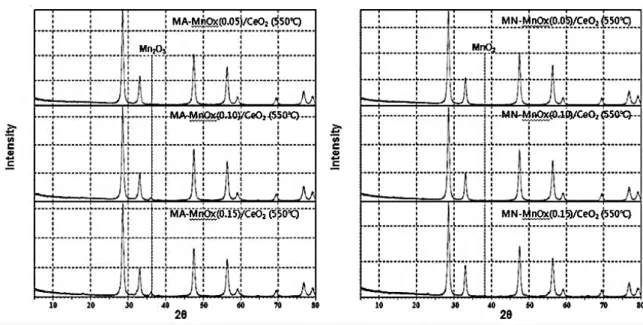
Figure 1 shows the results of XRD analyses conducted to investigate

(4)

Figure 3. TG curve profiles of MnO x /CeO 2 catalysts.

Figure 4. TG curve profiles of MnO x /ZrO 2 catalysts.

the crystalline phase of MnO x impregnated on CeO 2 surface. As is shown in this figure, MA-MnO x /CeO 2 exhibited peaks at 2 θ= 28.7°, 47.8°, and 56.6°, which is ascribed to the effect of the support. As the concentration of the Mn precursor increased, the intensity of the peak appearing at 36.2°, which represents Mn 2 O 3 , increased[7,8]. For the case of MN-MnO x /CeO 2 , the intensity of the peak appearing at 2 θ=

37.8°, which represents MnO 2 , increased with the concentration of the

precursor[9-11]. Figure 2 shows the XRD analysis results for MnO x / ZrO 2 . Both ZrO 2 -based catalysts exhibited peaks at 2 θ= 28.1°, 31.5°, and 50°, which is attributed to the effect of the support material.

Similar to the case of MnO x /CeO 2 , when MA was used as the pre- cursor, a Mn 2 O 3 peak appeared at 36.2°, whereas in the case of MN- MnO x /ZrO 2 , a MnO 2 peak appeared at 2 θ= 37.8°.

The MnO x can also be identified indirectly by observing the mass

(5)

Figure 5. XPS spectra of CeO and MnO x /CeO 2 .

Figure 6. XPS spectra of ZrO and MnO x /ZrO 2 .

reduction rate of MnO x /CeO 2 and MnO x /ZrO 2 under a temperature rising condition of TGA experiments (Figures 3 and 4). As shown in Figure 3, MA-MnO x /CeO 2 did not show rapid mass reduction regardless of the MA concentration used. To the contrary, MN-MnO x /CeO 2 experienced dramatic mass reduction over the temperature range of 500 ∼600 ℃ and the magnitude of the rapid mass reduction increased with the MN concentration. Similarly, MN-MnO x /ZrO 2 showed significant mass reduction over 500 ∼600 ℃, whose extent increased with the precursor concentration, whereas MA-MnO x /ZrO 2 did not show large mass reduction (Figure 4). This result can be attributed to conversion of MnO 2 , the major crystalline phase produced from MN, into Mn 2 O 3 in that temperature range[12] :

2MnO 2 → Mn 2 O 3 + O

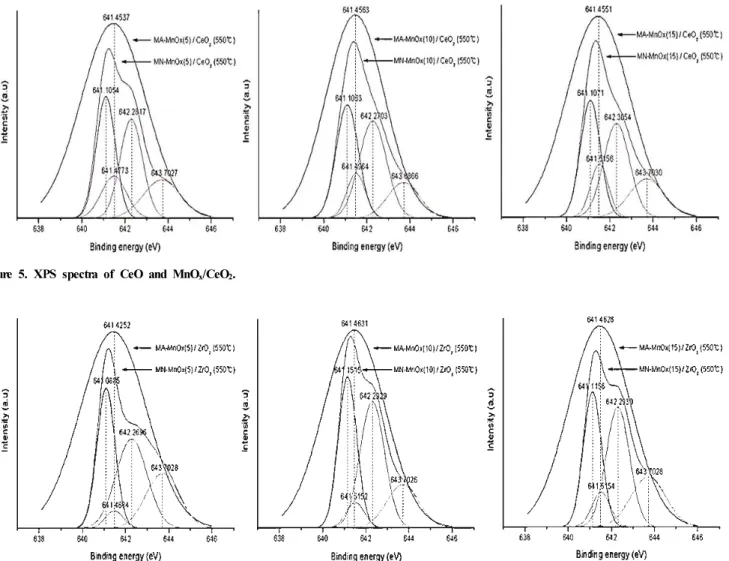
The Mn2p spectra of the catalysts obtained by XPS analysis are shown in Figures 5 and 6. Both MA-MnO x /CeO 2 and MA-MnO x /ZrO 2 exhibited a peak at 641.5 eV (±0.2 eV) binding energy, which can be attributed to the effect of Mn 2 O 3 as was discussed above for XRD analysis results[11,12]. On the other hand, the spectra of MN-MnO x /

CeO 2 and MN-MnO x /ZrO 2 showed peaks appearing at four different binding energy levels. Identification and quantification of MnO x formed on the surface of MN-MnO x catalysts could be done using deconvolution technique. Although the intensity varied with the precursor concentration, the two peaks appearing at 641.1 eV (±0.2 eV) and at 642.3 eV (±0.2 eV) are believed to be due to the effect of MnO 2 as was shown in the XRD result[11-14]. The third peak appearing at 643.7 eV (±0.2 eV) represents Mn-nitrate[11,12], which is due to the nitrate species that were not decomposed during the calcination process. The last peak of MN-MnO x catalysts is the Mn 2 O 3 peak appearing at 641.5 eV (±0.2 eV), which is believed to be due to conversion of MnO 2 , the main crystal phase of MN, into Mn 2 O 3 during the calcination process.

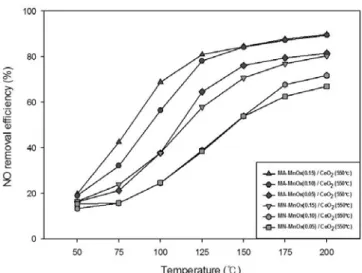
Figure 7 compares the NO x removal efficiencies obtained using MA-

MnO x /CeO 2 and MN-MnO x /CeO 2 at different temperatures. MA-MnO x /

CeO 2 exhibited a higher NO x removal efficiency than MN-MnO x /CeO 2

at every temperature tested regardless of the precursor concentration

[12,15]. The efficiency of MA-MnO x /CeO 2 increased with the precursor

concentration at every temperature. As the temperature increased, the

efficiency of MA-MnO x /CeO 2 increased rapidly until the rate of

(6)

Figure 7. NO removal efficiency of MnO x /CeO 2 catalysts obtained with different Mn precursor concentrations.

Figure 8. NO removal efficiency of MnO x /ZrO 2 catalysts obtained with different Mn precursor concentrations.

increase decreased considerably from 125 ℃. The NO x removal effi- ciency of MA-MnO x (15)/CeO 2 (550), which showed the best perfor- mance among the CeO 2 -based catalysts tested in this study, was 20%

at 50 ℃, increased rapidly reaching 81% at 125 ℃, and continued to increase slowly to reach 90% at 200 ℃. MN-MnO x /CeO 2 also showed increasing trend of the NO x emission efficiency with the precursor concentration at every temperature. However, the temperature depen- dency of the efficiency of MN-MnO x /CeO 2 was a little different from that of MA-MnO x /CeO 2 ; the rapidest increase of the efficiency ap- peared within the temperature range of 100 ∼150 ℃. The NO x removal efficiency of MN-MnO x (15)/CeO 2 (550), which showed the best perfor- mance among the MN-MnO x /CeO 2 catalysts, was 16, 57, and 80% at 50, 125, and 200 ℃.

Figure 8 compares the NO x removal efficiencies obtained using MA- MnO x /ZrO 2 and MN-MnO x /ZrO 2 . Similar to the case of CeO 2 -based catalysts, MA-MnO x /ZrO 2 showed a higher NO x removal efficiency

generated by using CeO 2 and ZrO 2 supports and two kinds of Mn precursors for low-temperature SCR process were measured at various temperatures. The effects of the kind and concentration of Mn precursors were investigated. XRD analysis showed that the major crystalline phase of MN-MnO x catalysts generated by using Mn(NO 3 ) 2 as the precursor was MnO 2 mixed with small amounts of Mn(NO 3 ) 2 and Mn 2 O 3 . When Mn(CH 3 COO) 2 was used as the precursor, the major crystalline phase of the resulting MA-MnO x catalysts was Mn 2 O 3 . It was shown by XPS analysis that the surface Mn contents and binding energies of MA-MnO x catalysts were higher than those of MN-MnO x catalysts. Correspondingly, the NO x removal efficiencies of MA-MnO x catalysts were higher than those of MN-MnO x catalysts at every temperature tested in this study. Both kinds of catalysts showed increasing trend of NO x removal efficiency with increasing precursor concentration. The results of this study indicate that the NO x removal efficiency is dependent on the major crystalline phase and the amount of MnO x formed on the support as well as on the interaction between the support material and precursor.

Acknowledgement

This work was supported by Korea Sanhak Foundation.

References

1. J. H. Ko, S. H. Park, J. K. Jeon, S. S. Kim, S. C. Kim, J. M. Kim, D. Chang, and Y. K. Park, Catal. Today, in press.

2. J. S. Cha, J. C. Choi, J. H. Ko, Y. K. Park, S. H. Park, K. E.

Jeong, S. S. Kim, and J. K. Jeon, Chem. Eng. J., 156, 321 (2010).

3. Y. B. Jo, J. S. Cha, J. H. Ko, M. C. Shin, S. H. Park, J. K. Jeon, S. S. Kim, and Y. K. Park, Korean J. Chem. Eng., 28, 106 (2011).

4. G. Marban, R. Antuna, and A. B. Fuertes, Appl. Catal. B: Environ., 41, 323 (2003).

5. E. G. Bordeje, A. Monzon, M. J. Lazaro, and R. Moliner, Catal.

Today, 102, 177 (2005).

6. K. H. Kim, J. R. Kim, and S. K. Ihm, J. Hazard. Mater., 167, 1158 (2009).

7. G. S. Qi, R. T. Yang, and R. Chang, Appl. Catal. B: Environ., 51, 93 (2004).

8. M. Machida, M. Uto, and T. Kijima, Stud. Surf. Sci. Catal., 143,

(7)

855 (2000).

9. Y. J. Kim, H. J. Kwon, I. S. Nam, J. W. Choung, J. K. Kil, H.

J. Kim, M. S. Cha, and G. K. Yeo, Catal. Today, 151, 244 (2010).

10. Z. Wu, B. Jiang, and Y. Liu, Appl. Catal. B: Environ., 79, 347, (2008).

11. D. A. Pena, B. S. Uphade, and P. G. Smirniotis, J. Catal., 221, 421 (2004).

12. J. Li, J. Chen, R. Ke, C. Luo, and J. Hao, Catal. Commun., 8,

1896 (2007).

13. C. D. Wagner, W. M. Riggs, L. E. Davis, J. F. Moulder, and G.

E. Mullerberg, Handbook of X-ray Photoelectron Spectroscopy, Eden Prairie (1979).

14. P. R. Ettireddy, N. Ettireddy, S. Mamedov, P. Boolchand, and P.

G. Smirniotis, Appl. Catal. B: Environ., 76, 123 (2007).

15. K. Kapteijn, L. Singoredjo, A. Andreini, and J. A. Moulijn, Appl.

Catal. A: Gen., 3, 173 (1994).

수치

Figure 1. XRD patterns of MnO x /CeO 2  catalysts.
Figure 3. TG curve profiles of MnO x /CeO 2  catalysts.
Figure 5. XPS spectra of CeO and MnO x /CeO 2 .
Figure 7. NO removal efficiency of MnO x /CeO 2  catalysts obtained  with different Mn precursor concentrations.

참조

관련 문서

The Government policy in the petroleum sector is aimed at developing exploration of the petroleum potential of Mongolia, increasing production and fully supplying

"The Ministry of Environment and Tourism (MET) has supported the Mongolian Sustainable Finance lnitiative from its inception given the importance of

[r]

원고지는 현장에서 제공되나 필기구는 반드시 개인 지참. 글의 논리적인 구성과 주제에 맞는 내용을 우선적으로 채점하고 맞춤법, 원고지

Extra revenues from oil and three large minerals producers are transferred to the NFRK when prices exceed reference prices for oil, gas, copper, lead, zinc and

1.1 The purpose of this Code law shall be to determine the common rights and duties of employers and employees who are parties to labour relations based on an employment

• 이명의 치료에 대한 매커니즘과 디지털 음향 기술에 대한 상업적으로의 급속한 발전으로 인해 치료 옵션은 증가했 지만, 선택 가이드 라인은 거의 없음.. •

For the smelting of South African manganese ores for the production of high C ferro manganese in a Noranda type plasma reactor (Fig 3c), researchers at Davy McKee has