약학회 지 제 5S 권 제 2 호 78-~82 (2009)
Yakhak Hoeji Vol. 53, No. 2 •첸 후 츰 학
Dexamethasone에 의한 RANKL 유도성 파골세포 분화 촉진 효과
노 아 롱 새 미 • 천링 • 박효정 • 양 미 혜 * • 이정민 • 임 미 정 ^ 숙명 여 자대 학교 약학대 학, *경 복대 학교 자연과학대 학 생 명 공학부 (Received January 8, 2009: Revised March 10, 2009; Accepted April 6, 2009)
The Stimulatory Effect of Dexamethasone on RANKL-induced Osteoclastogenesis
A Long Sae M i No, Ling Chen, Hyojung Park, Mihye Yang*, Jung M in Lee and M ijung Y in / College of Pharmacy, Sookmyung Women's University, Seoul 140-742, Korea
^College of Natural Sciences, Kyungpook National University, Daegu 702-701, Korea
Abstract — We explored the effects of dexamethasone on osteoclast precursors using BMMs. Dexamethasone inhibited the proliferation of BMMs. Furthermore, it stimulated the osteoclast formation via NFATcl activation in the presence of RANKL. Since dexamethasone targeted the early stage of osteoclast formation, we investigated its effect on mRNA expres
sion of GR and IFN-p. Whereas dexamethasone had no effects on GR expression in the presence of RANKL, it reduced the expression of IFN-P,suggesting that dexamethasone increased RANKL-induced osteoclast formation by modulating IFN-p.
Keywords □ glucocorticoid, dexamethasone, osteoclast, IFN-p
골량이 감소함으로써 나타나는 골다공증은 척추가 굽어 키가 작아•지거나 골절을 유발하여 삶을 질을 저하시킨다. 국민건강영 양조사에 따르면 1998년 2.8명이던 골다공증 유병률은 2002년 11.5명으로 무려 4배나 증가하였으며, 고령화에 따라 골다공증 환자는 점차 증가하는 추세이다. 건강한 뼈는 일생동안 뼈가 지 속 적 형 성 되 고 파괴되며, 이를 뼈의 재형성이라 한다.^* 뼈의 재형성은 새로운 뼈를 만드는 조골세포(osteoblast)와 오래된 뼈 률 파괴하는 파골세포(osteoclast)에 의해 평형을 유지한다. 조골 및 파골세포는 밀접한 관계를 맺고 있어, 괴골세포의 분화는 조 골세포에 의해 엄격하게 조 절 된 다 즉 , 조골세포는 파골세포 분화인자인 M-CSF(Macrophage Colony-Stimulating Factor, or CSF-1) 및 RANKL(Receptor Activator of Nuclear Factor- kappaB Ligand, OPGL, ODF; or TRANCE)을 통해 괴윌-세포의 분화률 조절함으로써 체내 골형성파 골파괴의 동적인 평형을 유 지한다.2
Glucocorticoid(GC)는 치료목적으로 투여되었을 때 체내에서 소염 또는 면역 억제와 같은 다양한 면역반융을 유발하는 것이
*본 논문에 관한 문의는 저자서1게로 (전화) 02-710-9572 (팩스) 02-710-9871 (E-mail) [email protected]
알려져 있다.®따라서 GC는 염증 및 면역부견 질환에 빈번하 게 사용되고 있다. 그러나 장기? I의 GC 투여는 골다공증을 유 발하는 것이 널러 알려져 있으며, 이러한 골손실의 부작용으로 인해 GC의 사용이 제한되고 있는 실정이다.®■띠
GC에 의한 골다공증 유발은 골형성 부견에서 기인하는 것으 로 생각되어왔다. 실제로 조골세포에 대한 GC의 영향은" in vitro 및 in w'wj에서 많이 보고되었으며, in wYro에서는 G O } 조골세 포의 분화와 기능에 중요한 역할을 담당하는 Runx2와 collagen I의 발현을 차단하는 것으로 나타났다.^^* 또한 GC는 조골세포 표면의 RANKLE M-CSF 발현을 증가시키며 , RANKL의 decoy receptof?] osteoprotegerin(OPG)의 발현을 감소시킨다.오"*'오뜨* GC 의 장기 투여 모델 동물을 사용한 in vivo 실험에서는 GC에 의 한 조골세포의 아포토시스가 가속화된다는 것이 밝혀졌다 이상 다수의 연구결파는 GC 사용에 의한 골손실의 발병기전 으로 오랫동안 인지되어 왔다. 그러나 최근 둘어 GC가 파골 세포의 수명을 증가시키는 것으로 나타나는 등^^^ 파골세포에 직접적으로 미처는 영향이 보고되기 시작하였다. 이는 GC에 의한 골손실이 조골세포에 의한 골형성 부견뿐 아니라 파골세포 에 의한 골파괴 이상과도 연관되어 있옴을 시사하는 것이다.
그러나 GC의 파골세포에 대한 직접적인 영향은 아직 충분히 밝 혀지지 않았고, 특히 파골세포 분화에 대한 GC의 효과는 보고
78
Dexamethasone 에 의한 RANKL 유도성 파골세포 분화 촉진 효과 79
된 바가 거의 없다. 이에 본 연구자는 미우스 골수세포률 이용해 GC가 파골세포 분화에 미치는 영향을 조사하였기에 보고하는 바 이다.
실험 방법
마우스 골수세포의 배양
ICR mouse(6~9주, 수컷)틀 경추 탈골한 후 70% 에탄을로 소 득하였다. 경골 부분의 피부를 절개하여 부착 근육을 떼어냈다.
경골 원심부를 절단하고 슬개골을 탈골시켜 경골을 적출하였다.
뼈 양끝을 조금 잘라 한 쪽 끝에 25G의 주사«1늘을 꽂고 a-MEM 을 훌려 보내 골수세포률 시험관에 모았다. 원심 분리한 후 a- MEM에 현탁하고 2배의 Gey's solution을 가해 적혈구를 제거
했다. 원심 분리한 후 10% FBS가 함유된 a-MEM으로 재현탁 했다.
파골세포의 분화유도
초기 배양한 골수세포룰 M-CSF lOng/miS. 하롯밤 배양한 후 부유세포틀 M-CSF 30 ng/miSL 3일간 추가 배양했다. 접착 세포 를 회수 후 1X10⁵cells/well에 RANKL 50ng/m/과 M-CSF 30 ng/m/ 존재하에서 4일간 배양했다. 배양이 끝난 세포는 10%
formalin으로 10분간 고정한 후 ethanol-aceton(l: 1)로 1분간 재 고정하여 TRAP(tartrate-resistant acid phosphatase) staining을 했다. 3개 이상의 핵을 가진 TRAP+ 세포름 다핵 파골세포로 관정 했다.
Primer 서열 PCR 조건 Cycle
GR F: CGCTCAGTGTTTTCTAATGG R: ATCAGGAGCAAAGCATAGCA
94T 30초, 55T 30초, 72X 30초
28 cycle
IFN-p F: CTTCTCCACCACAGCCCTCTC R; CCCACGTCAATCTTTCCTCTT
94X 30초, 53다 C 30초, 72X 30초
35 cycle
p-actin F: TGTGATGGTGGGAATGGGTCAG R: TTTGATGTCACGCACGATTTCC
94T 30초, 58T 30초, 72X 1분
22 cycle
세포증식 측정
3-(4,5-dimethylthiazol-2-yl)-2,5-diphenyltetazolium bromide (MTT) 정량은 Mosmann의 방법을 변형하식 실시하였다. IX ig*
cells/well 농도로 96 well plate에 분주한 세포에 시료률 처러하 고 일정 시간 동안 배양하였다. 배양액을 버리고 PBS로 wash한 후, MTT 용액 (0.5mg^m/>을 100 |i/well 첨 가하식 호일로 싼 상 태에서 5시간 동안 배양하고, Solubilization buffer(10% SDS in 0.01 M HCl)률 100 M//well 첨가하고 다시 호일로 * 다. 16-17
시간 동안 배양한 후, 570nm에서 흡광도룰 측정하였다.
통계처리
실험결과는 평균 + 표준편차로 표기하였고, Student's MestSL 분 석 하 p 값이 0.05 미만일 때 통계적으로 유의하다고 관단하 였다.
실험 결과 및 고찰
Western blot 분석
시료률 처리한 세포률 lysate buffer로 용해하고 원심분리 하 였다. 여기서 얻은 상등액을 10% SDS-PAGE률 이용해 전기영 동하고 이룰 nitrocellulose membrane으로 이전시켰다. 이를 5%
skim milk가 함유된 TBS 용액으로 blocking하고, 1차 항체로서 anti-NFatcl(l: 1000, Santa cruiz) 또는 p-actin(l: 4000, Sigma) 체와 각각 번응시켰다. PBST로 5회 세정하31 HRPCHorseradish peroxidase)가 결합된 2차 항체와 반응시 킨 후 ECL Advance (Amersham. CO.)로 발색시켜 분석하였다.
RNA 분리 및 RT-PCR 분석
Total RNA 주즐은 Easy-blue(Intron, Biochemistry. INC.)를 이용하였다. cDNA는 1 (ig의 total RNA를 oligodT primer, 10 mM dNTF; 1 unit RNase inhibitor 그리고 4 unit Script reverse transcriptase(Fermentas, Life science) 로 42°C 에서 60분 처러하o 옥 합성한 후, 70T에서 log" 가열함으로써 반응을 중지 시켰다. Polymerase chain reaction(PCR)의 조건과 사용한 primer(5' 나 3')의 서열은 다옴과 같다.
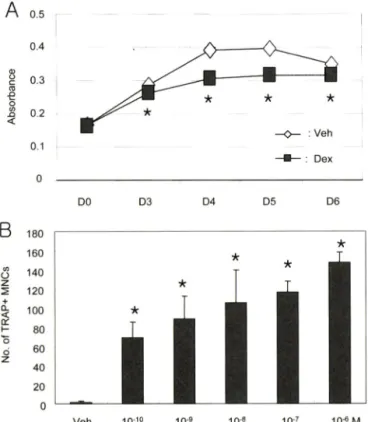
파골세포 분화에 미치는 dexamethasone의 촉전적 효과 마우스 골수세포를 M-CSF로 처리하의 3일간 배양하면 Bone Marrow Macrophages(BMM)가 생성되녀, 이는 M-CSF와 RANKL 존재하에서 파골세포로 분화한다. Dexamethasone이 파 골세포 분화에 직접적으로 미치는 영향을 조사하기 위해 먼저 BMM의 증식에 머치는 영향을 조사하였다. BMM을 M-CSF 존 재하에서 dexamethasone으로 처리하여 최대 6일간 배양하고, day 0, 3, 4, 5, 6에 그 증식 정도률 MTT assay로 측정하였다.
Dexamethasone은 죽정한 시점에서 BMM의 증식을 모두 유의 성 있게 감소시켰다(Fig. 1A). 이 결과는 dexamethasone이 BMM의 증식을 억세하고 분화률 촉진할 가능성을 제시하는 것 이므5L, '다음은 dexamethasone이 괴■골세포의 분화에 머처는 영 향을 조사하였다. 이룰 위해 골수세포률 M-CSF와 RANKL 존 재하식1서 ICr오® M~l(r®M의 dexamethasone으로 농도별로 처리 한 후 4일간 배양하였다. Dexamethasone은 골수세포로부터 파 골세포로의 분화를 농도 의존적으로 촉진하는 것을 알 수 있다 (Fig. IB). 이상의 결과로 dexamethasone은 BMM의 증식을 억 제하고 파골세포로의 분화를 촉진하는 것으로_ 밝혀졌다.
Vol. 53, No. 2, 2009
Veh DO-4 DO-1 DO-2 DO-3
Stage-specific effects of dexamethasone on osteoclast formation. BMM cells were cultured with 30 ng/m/ M-CSF and 50 ng/ml RANKL for 4 days. Dexamethasone (100 nM) was added during the indicated times. Cells were then fixed and stained for TRAP TRAP-positive (+) multi
nucleated cells (MNCs) were counted. The experiments were performed 3 times, and the reproducibility was confirmed. Values are the mean±SD of triplicate cultures in a representative experiment. Veh: vehicle, *: /><0.05, significantly different from vehicle.
^
뿔 름 를 황 헬 헬 종 헬 텔 헬 헬 ^ 배 !!NFatd
p -a c tin
Veh RANKL Dex RANKL+Dex
Fig. 3 - Effects of dexamethasone on the expression of NFATcl.
BMM cells were cultured for 48 hrs and the expression of NFATcl was determined by western blotting assay. The experiments were performed 3 times, and the reproduci
bility was confirmed.
에 서 특히 Nuclear Factor of Activated T cells(NFAT)cl은 파 골세포의 분화를 조절하는 중요한 견사인자로 알려져 있다.
Dexamethasone이 파골세포 분화를 촉진하였으므로, dexame- thasone의 처리가 NFATcl의 발현을 번화시키는지 여부를 항 NFATcl 항체를 이용한 western blotting assay로 조사하였다.
BMM을 48시간 처리하였을 때 dexamethasone은: RANKL 존재 하에서 NFATcl의 발현을 유의성 있게 중가시켰으며(Fig. 3), 이 는 dexamethasone이 파골세포로의 분화를 촉진하는 것과 일처 히는 결과이다. 따라서 dexamethasone은 NFATcl을 메개한 파 골세포 분화를 촉진하는 것으로 생각되었다.
Dexamethasone은 glucocorticoid receptor(GR)를 통해 신호
# 콘!■며, GR'& nuclear receptor superfamily of ligand- dependent transcription fectors에 속하는 것으로 알려져 있다.
Dexamethasone에 의한 파골세포로의 분화 촉진이 GR 발현과 연관되어 었는지 알아보기 위해 GR 특이적 서열을 이용해 RT-
/. Pharm. Soc. Korea
Veh 10-피 10 ® 10'® 10•구 10-® M
Fig. 1 - Effects of dexamethasone on the proliferation of mouse bone-marrow macrophage (BMM) cells. A, BMM cells were cultured with 30 ng/m/ M-CSF in the absence or presence of dexamethasone (100 nM) for indicated times.
Cell proliferation was determined by MTT assay as described in materials and methods. B, BMM cells were cultured with 30 ng/m/ M-CSF and 50 ng^m/ RANKL in the presence of various concentration of dexamethasone for 4 days. Cells were then fixed and stained for TRAE TRAP- positive (+) multinucleated cells (MNCs) were counted.
The experiments were performed 3 times, and the reproducibility was confirmed. Values are the mean±SD of triplicate cultures in a representative experiment. Veh:
vehicle, *: /)<0.05, significantly different from vehicle.
Dexamethasone이 파골세포 분화의 어느 단계룰 족진하는지 조사하기 위해 골수세포의 M-CSF와 RANKL 배양액에 dexa
methasone 을 day 0—4까지 날짜별로 처리하였다. Dexame- thasone은 4일간의 배양기간 중 dayl까지 처러되었을 때(D0-1) 가장 효율적으로 파골세포 분화를 촉진하였으며, 이는 dexa
methasone 이 4일간 처러되었을 때(D0~4)와 유사한 정도틀 보 였다(Fig. 2). 그러나 dexamethasone의 파윌'세포 분화에 대한 촉 진적 효파는 day 2(D0~2)와 day 3(D0~3)까지 처리되었을 때 소멸하였다. 이에 대한 원인온 현재로서는 알 수 없으며, 추후 추 가적인 실험을 통해 밝혀지기률 기대한다.
피골세포 분화 촉진에 왼여하는 dexam ethasone 작 전 규명
파g-세포 분화에 관여하는 다성한 유전자가 밝혀졌으며, 그 중
80 노아§새머 • 천링 • 박효정 • 양미혜 • 이정민 • 임미정
0 0 0 0
0 0
0 0
0
864208642
1 1
1 1
1
0 Z
Fig.
A
v
uc
or
qJ
MO
<q
n 10U
160 140
120 100
80 60 40
20
s o z s
+d>/dJJO
oz
Dexamethasone 에 의한 RANKL 유도성 피곰세포 분화 촉진 효과 81
G R
p-actin
Veh RANKL Dex RANKL+DEX
B
IFN-p
(3-actin
Veh RANKL Dex RANKL+DEX Fig. 4 - Effects of dexamethasone on the mRNA expression of GR
and IFN-p. BMM cells were cultured for 48 hrs and the mRNA expression of GR (A) or IFN-P (B) was determined by RT-PCR assay. The experiments were performed 3 times, and the reproducibility was confirmed.
PCR assay률 수행하였다.
BMM은 GR mRNA률 발현하며, 발현 정도는 dexamethasone 을 48시간 처리하였을 때 큰 폭으로 감소하였다. 그러나 RANKL 존재하에서 dexamethasone 처리는 GR 발현에 큰 영향을 미처 지 않았다(Fig. 4A). 이상의 결과로, 파골세포에 대한 dexame- thasone의 분화 촉진효과는 GR 발현과 밀접하게 연관되지 않음 을 알 수 있다.
파골세포의 분화를 조절하는 분자 중 interferon-p(IFN- P)는 파골세포의 분화 초기에 억제적 효과를 나 타 낸 다 :알 려 져 있다.^* Dexamethasone을 BMM 초기에 처리하였을 때 파 1 ■세 포로의 분화를 촉진하는 효과를 보였으므로, 이에 IFN-P의 발현 이 관여하는 것은 아닌지 조사하고자 IFN-P 특이적 서열로 RT- PCR assay틀 수행하였다. BMM을 RANKL로 처리하였을 때 기 존에 알려진 바와 같미 IFN-P의 발현은 증가하였다(Fig. 4B). 그 러나 dexamethasone 또는 RANKL파 dexamethasone의 처리는 IFN-P 의 발현을 현저하게 감 소 시 켰 다 . 이상의 결과는 dexamethasone이 RANKL에 의한 IFN-p의 발현을 감소시킴으 로써 파골세포로의 분화를 촉진시키는 것을 의미한다. 본 연구 는 미우스 골수세포에 dexamethasone을 단득 처러하였을 때 파 골세포 분화에 미처는 영향과 그 작용기견을 분석하였으며, 이 는 기존의 논 문 는 다른 차별성을 가진다고 할 수 있다.
결 론
NFATcl의 활성화를 데개히는 것으로 밝혀졌다. Dexamethasone 의 과골세포 분화 촉진은 분화 초기에 작용하였으며 , 이의 작용 기전으로 dexamethasone에 의한 아우스 골수세포의 증식 억제 와 IFN-P의 발현 억제가 제시되었다.
감사의 말씀
본 연구는 숙명여자대학교 2008학년도 교내연구비 지원에 의 해 수행되었으므로 이에 감사드럽니다.
참고문헌
2)
3)
Dexamethasone은 미우스 골수세포의 파골세포로의 분화률 농 도 의존적으로 촉진하였으며, 이는 분화에 될수적인 전사인자
1) Takahashi, N., Akatsu, T, Udagawa, N., Sasaki, T, Yamaguchi, A., Moseley, J. M., Martin, T. J. and Suda, T : Osteoblastic cells are involved in osteoclast formation. Endocrinology 123, 2600 (1988).
Suda, T, Takahashi, N., Udagawa, N., Jimi, E., Gillespie, M. T.
and Martin, T. J. : Modulation of osteoclast differentiation and function by the new members of the tumor necrosis factor receptor and ligand families. Endocr. Rev. 20, 345 (1999).
Wong, B. R., Rho, J., Arron, J., Robinson, E., Orlinick, J., Chao, M,, Kalachikov, S., Cayani, E., Bartlett, E S. 3rd, Frankel, W N., Lee, S. Y. and Choi, Y.: TRANCE is a novel ligand of the tumor necrosis factor receptor family that activates c-Jun N- terminal kinase in T cells. J. Biol Chem. 272, 25190 (1997).
4) Yasuda, H., Shima, N., Nakagawa, N., Yamaguchi, K., Kinosaki, M., Mochizuki, S., Tomoyasu, A., Yano, K., Goto, M., Murakami, A., Tsuda, E., Morinaga, T, Higashio, K., Udagawa, N., Takahashi, N. and Suda, T. : Osteoclast differentiation factor is a ligand for osteoprotegerin/osteoclastogenesis-inhibitory fector and is identical to TRANCE/RANKL. Proc. N atl Acad. Sci USA 95, 3597 (1998).
Lacey, D. L., Timms, E., Tan, H. L., Kelley, M. J., Dunstan, C. R., Burgess, T, Elliott, R., Colombero, A., Elliott, G., Scully, S., Hsu, H., Sullivan, J., Hawkins, N., Davy, E., Capparelli, C., Eli, A., Qian, Y. X., Kaufman, S., Sarosi, L, Shalhoub, V, Senaldi, G., Guo, J., Delaney, J. and Boyle, W. J. : Osteoprotegerin ligand is a cytokine that regulates osteoclast differentiation and activation. Cell 93, 165 (1998).
Pitzalis, C., Pipitone, N. and Perretti, M. : Regulation of leukocyte-endothelial interactions by glucocorticoids. Ann.
KY. Acad. Sci 966, 108 (2002).
7) Langenegger, T. and Michel, B. A. : Drug treatment for rheumatoid arthritis. Clin. Orthop. Relat Res. 366, 22 (1999).
8) Riccardi, C., Zollo, 0., Nocentini, G., Bruscoli, S,, Bartoli, A., D'Adamio, E, Cannarile, L., Delfino, D., Ayroldi, E. and Migliorati, G. : Glucocorticoid hormones in the regulation of cell death. Therapie 55, 165 (2000).
5)
6)
Vol. 53, No. 2, 2009
82 노아통Ml미 ■천링 • 박효정 • 양미혜 ■이정민 • 임미정
9) Canalis, E. and Delany, A. M. : Mechanisms of glucocorticoid action in bone. Ann. N.Y. Acad. Sci. 966, 73 (2002).
10) Weinstein, R. S. :' Glucocorticoid-induced osteoporosis. Rev.
Endocr. Metab. Disord. 2, 65 (2001).
11) Patschan, D., Loddenkemper, K. and Buttgereit, E : Molecular mechanisms of glucocorticoid-induced osteoporosis. Bone. 29, 498 (2001).
12) Manolagas, S. C. and Weinstein, R. S. : New developments in the pathogenesis and treatment of steroid-induced osteoporosis.
J. Bone. Miner. Res. 14, 1061 (1999).
13) Pereira, R. M., Delany, A. M. and Canalis, E. : Cortisol inhibits the differentiation and apoptosis of osteoblasts in culture.
Bone. 28, 484 (2001).
14) Hofbauer, L. C„ Gori, E, Riggs, B. L., Lacey, D. L., Dunstan, C. R., Spelsberg, T. C. and Khosla, S. : Stimulation of osteoprotegerin ligand and inhibition of osteoprotegerin production by glucocorticoids in human osteoblastic lineage cells; potential paracrine mechanisms of glucocorticoid- induced osteoporosis. Endocrinology 140, 4382 (1999).
15) Rubin, J,, Biskobing, D. M., Jadhav, L., Fan, D., Nanes, M. S., Perkins, S. and Fan, X .: Dexamethasone promotes expression of membrane-bound macrophage colony-stimulating factor in murine osteoblast-like cells. Endocrinology 139, 1006 (1998).
16) Weinstein, R. S., Jilka, R. L., Parfitt, A. M. and Manolagas, S. C. : Inhibition of osteoblastogenesis and promotion of
apoptosis of osteoblasts and osteocytes by glucocorticoids. /.
Clin. Invest 102, 274 (1998).
17) Jia, D., O'Brien, C. A., Stewart, S. A., Manolagas, S. C. and Weinstein, R. S .: Glucocorticoids act directly on osteoclasts to increase their life span and reduce bone density. Endocrinology 147, 5592 (2006)
18) Dovio, A., Micossi, L, Bianco, E. and Angeli, A .: Determinants of glucocorticoid action in the bone microenvironment. J.
Endocrinol Invest 31, 7 (2008).
19) Takaoka, A. and Taniguchi, T .: New aspects of IFN-alpha/beta signalling in immunity, oncogenesis and bone metabolism.
Cancer Sci 94, 405 (2003).
20) Sivagurunathan, S., Muir, M, M., Brennan, T. C., Seale, J. R and Mason, R, S. : Influence of glucocorticoids on human osteoclast generation and activity. J. Bone. Miner. Res. 20, 390 (2005).
21) Hirayama, X, Sabokbar, A. and Athanasou, N. A. : Effect of corticosteroids on human osteoclast formation and activity. J.
Endocrinol 175, 155 (2002).
22) Takuma, A., Kaneda, T, Sato, T, Ninomiya, S., Kumegawa, M. and Hakeda, Y. : Dexamethasone enhances osteoclast formation synergistically with transforming growth factor-beta by stimulating the priming of osteoclast progenitors for differentiation into osteoclasts. J. Biol Chem. 278, 44667 (2003).
J. Pharm. Soc. Korea