단수수는 생육기간이 약 4개월로 짧아 우리나라에서 2기 작이 가능하고(Choi et al., 2012), 광합성 능력이 높은 C4
작물로 C3 작물에 비해 양·수분을 효율적으로 이용하여 한 계지역에서의 생장이 가능하며(Anten et al., 1995), 원료 당 (Bian et al., 2006; Carpita & McCann, 2008), 사료화(Dar, 2006), 곡실(Ahn et al., 2012) 등 용도가 다양하다. 특히 수 수(Carpita & McCann, 2008), 옥수수(Savallios et al., 2008), 억새, 갈대, 우뭇가사리(Bok et al., 2010) 등과 함께 바이오 에너지 작물로 유망하게 평가받아 왔는데, 이중 단수수는 광합성 효율 및 셀룰로오스 함량이 타작물에 비해 높아 바 이오에너지 생산에 적합(Gibson, 2009; Gnansounou et al.,
2005)한 것으로 평가받고 있다(Carpita & McCann, 2008).
작물의 재식밀도는 작물 생산성에 크게 영향을 미치므로 대부분의 관행적인 작물 관리방법에서 핵심적인 요소이다 (Hiltbrunner et al., 2007). 적정 재식밀도는 수관 내 미세환 경과 광합성능을 향상시키며 잎의 노화를 지연시키고(Dong et al., 2012; Yang et al., 2014), 지상부의 바이오매스 축적 량을 약 22~33% 증가(Dai et al., 2015; Wang et al., 2015) 시키는 등 광 이용 효율을 높여 잠재적인 바이오매스 생산 량을 높인다(Yao et al., 2015). 반면 적정밀도 이상의 재배 는 개체간 경쟁을 유발하여 엽장 및 줄기 직경, 순동화율의 감소(Cipollini & Bergelson, 2001) 등과 같은 악영향을 초
재식밀도가 ‘초롱’ 단수수의 생육 및 수량구성요소에 미치는 영향
최영민
1
・ 한현아1
・ 신소희1
・ 허병수1
・ 최규환1,†
・ 권석주2
Effect of Planting Density on Growth and Yield Components of the Sweet Sorghum Cultivar, ‘Chorong’
Young Min Choi
1
, Hyun-Ah Han1
, So-Hee Shin1
, Byong Soo Heo1
, Kyu-Hwan Choi1,†
, and Suk-Ju Kwon2
ABSTRACT This study was conducted to investigate the effect of planting density on plant growth, yield, and quality in the sweet sorghum cultivar ‘Chorong’ (Sorghum bicolor (L.) Moench). Plants were cultivated at densities of 16.7, 11.1, 8.3, 6.7, and 5.6 plants·m-2. Factors related to yield and yield components were analyzed using correlation and multivariate analyses. There was no significant difference among plant densities in stem length from 20 to 110 days after sowing. But the stem diameter was thin, and a decrease in number of tillers occurred more rapidly as planting density increased. At harvest, juice and sugar yield were higher at densities of 16.7 (42.9, 4.16 Mg·ha-1, respectively) and 11.1 (37.1, 3.73 Mg·ha-1) plants·m-2 than at 8.3 (30.5, 2.96 Mg·ha-1), 6.7 (26.6, 2.41 Mg·ha-1), and 5.6 (24.7, 2.22 Mg·ha-1) plants·m-2. The soluble solids and total sugar contents were not different among treatments, but relatively high values were observed at the density of 11.1 and 8.3 plants·m-2. As plant density was increased from 5.6 to 11.1 plants·m-2, the lodging index (1 = no, 9 = lodging) increased rapidly from 2.00 to 6.33. To determine the optimal planting density, the number of typhoons and topographical characteristics should be considered. Correlation and principal components analyses revealed that plant density exhibited a positive relationship with fresh stem yield (r = 0.62**), dry stem yield (r = 0.58**), juice (r = 0.63**), and sugar yield (r = 0.66**), but a negative with stem diameter (r = -0.65**). The yield factors were not statistically related to stem height, diameter, and number of nodes.
Keywords : fresh stem yield, lodging, multivariate analysis, number of additional tillers, soluble solids content, sugar yield DOI : https://doi.org/10.7740/kjcs.2019.64.1.040
Original Research Article
ⓒ 본 학회지의 저작권은 한국작물학회지에 있으며, 이의 무단전재나 복제를 금합니다.
This is an Open-Access article distributed under the terms of the Creative Commons Attribution Non-Commercial License (http://creativecommons.org/licenses/by-nc/3.0) which permits unrestricted non-commercial use, distribution, and reproduction in any medium, provided the original work is properly cited.
1)전라북도농업기술원 작물식품과 농업연구사 (Junior Scientist, Crops & Food Division, Jeollabuk-do Agricultural Research and Extension Services, Iksan 54591, Korea.)
2)전라북도농업기술원 작물식품과 농업연구관 (Senior Scientist, Crops & Food Division, Jeollabuk-do Agricultural Research and Extension Services, Iksan 54591, Korea.)
†
Corresponding author: Kyu-Hwan Choi; (Phone) +82-63-290-6031; (E-mail) [email protected]
<Received 22 February, 2019; Revised 7 March, 2019; Accepted 8 March, 2019>
래할 수도 있다(Leskovsek et al., 2012). 또한 최적의 재식밀 도는 식물의 유전형과 토양조건 및 수분 공급과 같은 유전·
환경적 요인에 의존적으로 변화하기도 한다(Cusicanqui &
Lauer, 1999).
단수수는 비교적 재배가 용이하고 다양한 이점이 있음에 도 불구하고, 국내 생산은 통계적으로 보고되지 않을 만큼 미미한 수준이며, 2008년 이후 농촌진흥청을 중심으로 다양 한 측면의 연구가 진행되어 왔으나, 값싼 당원료 수입으로 인한 수요 저조, 생산‧가공체계 미비, 성숙기 태풍(또는 강한 바람)에 의한 도복 피해, 외국 단수수 품종 및 사탕수수에 비해 낮은 당도 등의 여러 재배‧산업적 원인에 의해 재배가 확대되지 못하고 있는 실정이다. 특히 수수와 달리 수체 내 수액의 생산이 주목적인 단수수는 개화기 전후의 광합성 효 율이 중요(Martin & Kelleher, 1984)함에도 불구하고 안정 생산에 관한 국내 관련연구가 전무한 실정으로 재배를 시도 하는 농업인의 영농에 어려운 점이 많은 편이다.
본 연구는 단수수의 재식밀도에 따른 생육, 수량 및 품질 을 비교하고 수량과 관련된 요인간 다변량 분석을 통해 안 정 재배를 위한 기초자료를 확보하고자 수행하였다.
재료 및 방법 재배방법 및 재식밀도의 조절
시험포장의 토성은 모래, 미사, 점토의 함량이 각각 42.0, 20.2, 37.8%인 식양토로 조사되었다. 토양의 화학성은 pH가 6.6으로 생육에 적합한 중성의 범위였으며, EC는 0.74 dS·m-1, 유기물 18.3 g·kg-1로 유기물은 적정범위(20~30 g·kg-1)보다 다소 낮은 수준이었다. 유효인산은 513 mg·kg-1 (150~250), 치환성 칼륨 0.70 cmolc·kg-1 (0.45~0.55)으로 적정 범위보 다 높았으며, 칼슘과 마그네슘은 각각 7.01, 1.55 cmolc·kg-1 수준이었다.
실험재료인 단수수 ‘초롱’은 2017년 3월 국립식량과학원 바이오에너지연구소에서 분양받은 종자를 사용하였으며, 2018년 5월 25일, 72공 육묘용 플러그트레이에 원예용상토 를 이용하여 파종한 후 6월 11일 이식까지 약 17일간 상온 조건에서 육묘하였다. 육묘 후 4×2 m의 시험구에 열간격을 60 cm로 고정하였으며, m-2당 재식밀도를 16.7, 11.1, 8.3, 6.7, 5.6주(각각의 주간거리는 10, 15, 20, 25, 30 cm)씩 각 각을 난괴법 3반복으로 배치 및 이식하였다. 이식시 묘의 상태는 초장이 18.9±1.7 cm로 병해충 피해가 없고 육안으 로 판단했을 때 건전한 묘만을 사용하였다. 이식 후의 재배 관리는 농촌진흥청 농업기술길잡이 “수수”(RDA, 2016)에 준하여 관리하였다.
생육, 수량 및 도복지수 조사
재식밀도별 생육의 변화를 측정하고자 초장, 경태, 분지 수를 이식 4일 후(6월 15일)부터 10일 간격으로 9월 15일 까지 5개체씩 3반복으로 조사하였다. 초장의 조사는 지표 면 지제부에서 가장 상층부에 전개된 잎의 끝 지점까지를 측정하였고, 출수된 이후부터는 이삭목까지를 측정하였다.
경태는 지제부 바로 위 첫 번째 마디의 중간부를 가장 넓은 면과 좁은 면을 측정한 후 평균하여 산출하였으며, 분지수 는 주경을 제외한 지제부에서 발생한 모든 분지를 계수하 였다.
수확기 조사는 출수 후 50일이 되는 9월 23일에, 5개체씩 3반복 무작위로 채취하여 실시하였다. 초장 및 경태는 생육 조사와 동일한 방법으로 하였으며, 주경의 마디수는 지제부 로부터 이삭목까지 모든 마디를 계수하였다. 가용성 고형물 함량은 각 줄기의 중간부위(약 20 cm의 절편)에서 착즙하여 디지털 굴절당도계(PR-101α, Atago Co. Ltd., Japan)로 측 정하였으며, 이삭과 잎을 제거하여 생경수량을 측정한 후, 얇게 잘라 60°C에서 4일간 건조하여 건물수량을 측정하였 다. 또한 착즙액의 수량 및 당수량은 Wortmann et al.
(2010)의 다음 식을 적용하여 산출하였다.
CSY = (FSY – DSY) × (°Brix / 100) × 0.75 JY, 80% extracted = [FSY - (DSY – CSY)] × 0.8 SY = JY × (°Brix / 100) × 0.75
위 식에서 보존적 당수량(conservative sugar yield, CSY), 생경수량(fresh stem yield, FSY), 건물수량(dry stem yield, DSY), 착즙액 수량(juice yield, JY), 당수량(sugar yield, SY) 은 hectare당 Mg (ton)으로 산출하였고, 0.75와 0.8은 각각 착즙액 내 당 농도를 나타내는 상수(°Brix의 75%)와 착즙 액의 수율(착즙율)을 의미한다.
도복지수는 각 시험구 내 도복된 개체수를 계수하여 전 체 주수에 대한 백분율값을 지수화하여 표현하였다. 또한 도복으로 부러지거나 쓰러져 토양표면에 닿아 수량 및 품 질이 감소하는 것을 방지하기 위해 시험구 사이의 열 마다 지표면으로부터 1 m 높이를 통과하는 줄을 고정하였으며, 45° 이상 쓰러진 개체만을 도복으로 판정하였다.
주요 유리당함량 분석
유리당함량 분석을 위해 수확기 조사와 동일한 시기에 재식밀도 각 처리별 15주(분지경 포함)씩 3반복으로 수확 한 후 각 줄기의 중간부위 20 cm에서 착즙액을 채취하였 다. 채취한 시료는 50 mL conical tube에 희석하여 원심분리
기(Centrifuge 5804R, Eppendorf AG, Hamburg, Germany) 로 3,000 rpm, 10분간 원심분리한 후, 0.45 um syringe filter (Millipore, Billerica, MA, USA)로 여과하여 분석에 사용 하였다. 분석은 HPLC (Shinseido Nanospace SI-2, Shiseido, Japan)와 동일회사의 refractive index detector (RID)를 사 용하였으며 Column은 Unison UK-Amino (250×3 mm, 3 um, Imtakt Corp. Japan)를 사용하였고, 이 때 column 분석 온도는 60°C이었다. 이동상은 water (Fisher Scientific, MA, USA) 100%로 하였으며, injection volume은 4 uL이고 flow rate는 0.4 mL·min-1이었다. 표준물질인 sucrose, glucose, fructose, lactose 및 maltose는 Sigma-Aldrich Co. (St. Louis, MO, USA) 제품을 사용하였다.
통계분석
수집된 데이터의 분석은 Windows용 SAS system release 8.01 (SAS Institute Inc, Cary, N.C., USA)을 이용하여 Duncan 의 다중검정(p=0.05)과 회귀, 상관, 주성분분석을 실시하였다.
결과 및 고찰
재식밀도별 파종 후 일수에 따른 생육 특성
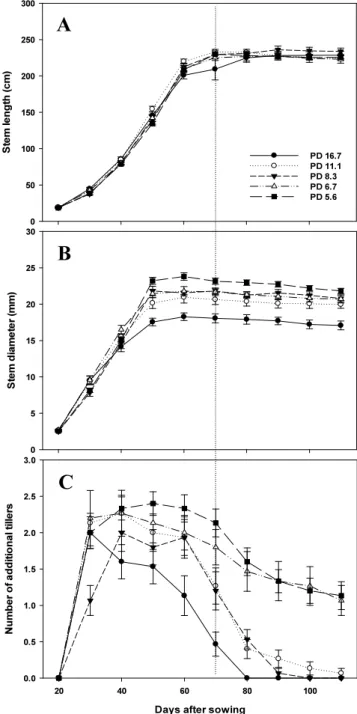
주경장은 모든 재식밀도(m-2당 재식주수) 처리구에서 파 종 후 60일까지 급격한 신장을 보인 후 수확기까지 완만해 졌으며 파종 110일(수확 전) 후에는 주경장이 222.9~231.5 cm로 처리간 차이는 보이지 않았다(Fig. 1A). 경태는 주경 장보다 약 10일 정도 빠른 파종 후 50일경까지 급격한 증 가 후 완만해지는 경향을 보였고, 재식밀도 16.7주·m-2 처 리구가 가장 얇았으며 재식밀도가 감소할수록 증가하는 경 향을 나타내었다(Fig. 1B). 본 실험에서 출수기는 모든 처 리구가 파종 후 71일(8월 4일)로 조사되었는데, 주경장이 경태에 비해 약 10일 후까지 신장이 지속된 것은 출수에 따 른 것으로 생각되며, 경태의 비대가 완만해지는 파종 후 약 50일경이 영양생장기에서 생식생장기로 전환되는 시기로 판단된다. 따라서 동 시기 단수수의 생장이 절간생장이나 개화‧성숙 등에 의해 조절된다는 Shukla et al. (2017)의 보고 와 일치하였다. 또한 단수수 ‘Wray’, ‘Keller’, ‘Rio’의 영양 생장기는 파종 후 36~80일까지로 보고(Tsuchihashi & Goto, 2008)되었으나, 위 3품종이 열대 및 아열대 지역에서 주로 재배되는 품종인 것에 비해 ‘초롱’은 온대기후인 국내 재래 종 유래 품종으로 유전적 차이에 기인하는 것으로 생각된 다. 분지수의 경우 파종 후 30~40일경부터 주당 1.0~2.3개 까지 빠르게 증가한 이후 감소하는 경향을 보였는데, 주경 장과 경태의 생장이 최대치에 도달하는 파종 후 50일경부
터 급격히 감소하였다. 분지수의 감소는 재식밀도 5.6, 6.7 주·m-2 처리구가 가장 적었으며, 재식밀도가 높을수록 감소 하는 시기가 빠른 경향이었다(Fig. 1C). 이와 같은 결과는
S te m l e ngt h ( c m )
0 50 100 150 200 250 300
PD 16.7 PD 11.1 PD 8.3 PD 6.7 PD 5.6
S tem d ia m et er ( m m )
0 5 10 15 20 25 30
Days after sowing
20 40 60 80 100
N u m b er o f a ddi ti o n al t il lers
0.0 0.5 1.0 1.5 2.0 2.5 3.0
A
B
C
Fig. 1. Influence of planting density on the seasonal patterns of stem length (A), diameter (B), and number of additional tillers (C) of the sweet sorghum cultivar
‘Chorong’ in 2018. Vertical bars represent standard
error of the means (n = 15). Legend in the graph
indicates planting density (PD) and the unit is number
of plants per square meter. The dotted line represents
heading date (71 days after sowing).
종실용 수수(Han & Yoon, 2017)와 옥수수(Lee et al., 2004;
Yoshida, 1973), 단수수(Tang et al., 2018)의 재식밀도가 낮을수록 분얼 발생이 증가하고 유효경의 비율이 감소한다 는 보고와 일치하였다.
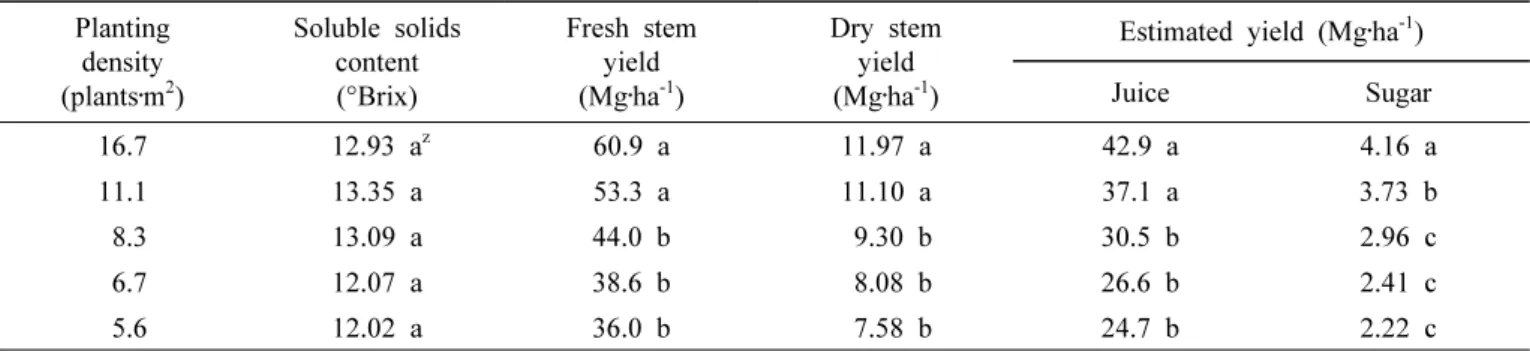
재식밀도에 따른 수량, 유리당 함량 및 도복위험성 파종 후 121일(출수 후 50일)이 되는 시점에 모든 처리구 를 일시 수확하여 수량구성요소를 조사한 결과는 Table 1 과 같다. 가용성 고형물 함량은 재식밀도 11.1, 8.3주·m-2 처리구가 각각 13.35, 13.09°Brix로 16.7주·m-2 처리구와 재 식밀도가 낮은 처리구들보다 높은 편이었으나 처리간 통계 적인 차이는 없었다. ha당 생경수량은 재식밀도 16.7, 11.1 주·m-2 처리구가 각각 60.9, 53.3 Mg·ha-1로 가장 높았으며, 건물수량(11.97, 11.10 Mg·ha-1)도 유사한 경향을 보였다. 또 한 재식밀도 16.7주·m-2 처리구는 추정한 착즙액과 당수량이 각각 42.9, 4.16 Mg·ha-1로 가장 높았고, 다음이 11.1 (37.1, 3.73 Mg·ha-1)주·m-2 처리구였다. 8.3 (30.5, 2.96 Mg·ha-1), 6.7 (26.6, 2.41), 5.6 (24.7, 2.22)주·m-2 처리구는 통계적인 차이는 없었으나 재식밀도가 높아짐에 따라 수량도 증가하
는 경향을 나타내 재식밀도와 엽면적지수, 바이오매스 생 산량간 정의 관계가 있다고 보고한 Tang et al. (2018)의 보 고와 유사하였다.
일반적으로 재식간격이 좁을수록 초기 군락의 광 이용효 율은 증가하지만 수형이 완전히 형성되고 개체간에 경쟁 상황이 되면 광합성 효율은 감소하게 된다. 본 실험에서 재 식밀도가 높은 16.7, 11.1주·m-2 처리구는 출수기 전후인 파 종 후 60~80일 사이에 분지수가 급격히 감소하였으나 6.7, 5.6주·m-2 처리구는 수확이 되는 시점까지 최소 분지수 1개 이상을 유지하였다. 따라서 재식밀도가 낮은 두 처리구의 분지들은 상대적으로 성숙까지의 일수가 최대 30일 이상(분 지수 발생이 최고치가 되는 시점까지)이 부족하였으며, 수 확기 m-2당 총 경수는 재식밀도가 높은 처리구와 유사한 수 준을 나타내었다(데이터 미제시). Martin & Kelleher (1984) 는 재식간격이 좁을수록 건물량과 수용성 탄수화물의 수량 이 많고 이는 개화 전 광합성 생산량이 더 높기 때문에 당 축적 및 줄기의 비대에 밀접한 관련이 있다고 보고하였으며, 결과적으로 재식간격이 좁을수록 수량은 증가하였다(Turgut et al., 2005).
Table 1. Effect of planting density on yield components at harvest (50 days after heading) of the sweet sorghum cultivar
‘Chorong’.
Planting density (plants ‧m
2)
Soluble solids content (°Brix)
Fresh stem yield (Mg ‧ha
-1)
Dry stem yield (Mg ‧ha
-1)
Estimated yield (Mg‧ha
-1)
Juice Sugar
16.7 12.93 a
z60.9 a 11.97 a 42.9 a 4.16 a
11.1 13.35 a 53.3 a 11.10 a 37.1 a 3.73 b
8.3 13.09 a 44.0 b 9.30 b 30.5 b 2.96 c
6.7 12.07 a 38.6 b 8.08 b 26.6 b 2.41 c
5.6 12.02 a 36.0 b 7.58 b 24.7 b 2.22 c
z
Mean separation within columns by Duncan's multiple range test at P = 0.05.
Table 2. Effect of planting density on sugar contents in juice at harvest (50 days after heading) of the sweet sorghum cultivar
‘Chorong’.
Planting density (plants‧m
-2)
Fructose (%)
Glucose (%)
Sucrose (%)
Maltose (%)
Total (%)
16.7 1.10 a
z1.81 a 7.84 a 0.40 ab 11.15 a
11.1 1.23 a 2.16 a 8.44 a 0.38 abc 12.21 a
8.3 1.00 a 1.88 a 9.59 a 0.34 bc 12.81 a
6.7 1.18 a 1.97 a 7.41 a 0.46 a 11.02 a
5.6 1.04 a 1.69 a 7.18 a 0.27 c 10.18 a
z
Mean separation within columns by Duncan's multiple range test at P = 0.05.
유리당(Table 2)은 모든 처리구에서 fructose, glucose, sucrose, maltose가 검출되었고, fructose와 glucose는 각각 1.00~1.23, 1.69~2.16% 범위내로 처리간 차이를 보이지 않 았다. 반면 비율이 가장 높았던 sucrose 함량은 재식밀도간 통계적 차이는 없었으나 가용성 고형물 함량과 마찬가지로 8.3 (9.59%), 11.1 (8.44%)주·m-2 처리구에서 높은 경향을 보였으며, 총 유리당 함량도 유사하였다. 작물의 생장상태 또는 단계는 체내 탄수화물함량에 영향을 미치는 중요한 요 인인데(Naoyuki & Goto, 2004), 특히 단수수 5품종(‘Soave’,
‘Rio’, ‘Vespa’, ‘Tumo’, ‘M81-E’)의 유리당 함량 분석결과 sucrose, maltose, glucose, fructose 순으로 많고, 총 당 및 sucrose 함량과는 정의관계가 성립된다(Almodares et al., 2008). 따라서 재식밀도가 높을수록 초기 엽면적의 빠른 확 보를 통해 수량과 sucrose 함량이 높았던 것으로 판단되었다.
단수수의 착즙액과 당수량을 구하는 방법은 연구자들마 다 일부 차이는 있으나 일반적으로 가용성 고형물 함량과 줄기의 수량을 기준으로 산출된다. 따라서 재식밀도가 낮 은 처리구들은 줄기가 굵고 분지수가 많기는 하였지만, 재 식밀도가 높을수록 분지수가 적은 반면 단위면적당 생경수 량이 증가하여(비교적 가용성 고형물 함량도 높았던) 결과 적으로 재식밀도가 높을수록 수량 증가에 유리하였다. 하 지만 가용성 고형물 함량과 유리당 함량의 경우 통계적인 차이는 없었으나 11.1, 8.3주·m-2 처리구에서 비교적 높은 편으로 조사되었는데, 시럽과 같은 고농축액 제조 시 소요 되는 착즙액의 양은 유리당 함량(또는 당도)에 의해 결정되
므로 추후 보다 세밀한 분석과 품질면에서의 한계치 설정 이 필요할 것으로 생각되었다.
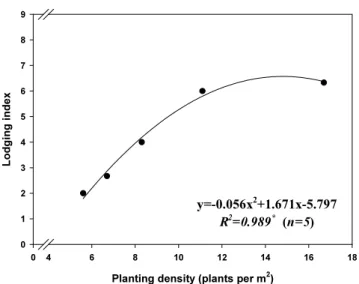
특히 재식밀도에 따른 도복지수를 조사한 결과(Fig. 2), 도복이 발생한 시점은 9월 3일(출수 후 30일경), 최대 풍속 은 5.7 m·s-1 (기상청)로 상대적으로 강한 편은 아니었음에 도 재식밀도가 5.6에서 11.1주·m-2까지 증가할 때, 도복지 수도 2~6까지 급격히 증가하였다(R2=0.989*). 단수수의 도 복은 수량감소(Fedenko et al., 2015)는 물론 병해충 피해의 온상이 될 위험성이 크므로 재배지에서는 태풍의 도래 횟 수, 강풍에 대한 위험도, 지형적 특성 등을 고려한 후 최종 적으로 재식밀도를 적용해야 할 것으로 판단된다.
생육 및 수량 요인간 다변량 분석
단수수 ‘초롱’의 수확기 생육 및 품질 요인간 상관분석 결과를 산점도매트릭스로 작성한 결과(Fig. 3), 주경의 길 이와 굵기, 마디 개수는 다른 요인들간 통계적 관계가 없었 다. 수량을 구성하는 요소 중 하나인 가용성 고형물 함량은 당수량(r=0.49**)과 정의관계에 있고, 생경수량, 건물수량, 착즙액과 당수량간에는 모두 고도로 유의한 정의 상관관계 가 인정되어 재식밀도와 수량과의 관계에 대해 보고한 Tang et al. (2018)과 Yao et al. (2015)의 연구결과와 일치 하였다. 특히 재식밀도는 주경의 굵기(r=-0.65**)와는 부의 관 계, 생경수량(r=0.62**), 건물수량(r=0.58**), 착즙액(r=0.63**) 및 당수량(r=0.66**)과는 정의 관계를 나타내었다. 주성분분 석은 고유값(eigen value)이 1 이상인 주성분이 PC1~PC4 총 4개로 누적분산은 85.9%였으며, 각 주성분의 설명력은 45.2, 17.2, 12.4, 11.2%이었다(Table 3). 이중 주성분의 수 효를 결정하는 누적분산 60% 이상인 PC1과 PC2의 고유값 (누적분산 62.4%)을 기준으로 산점도를 작성한 결과(Fig.
4), 상관분석 결과와 마찬가지로 재식밀도, 생경수량, 건물 수량, 착즙액 및 당수량은 비교적 가까운 거리에 위치하여 하나의 그룹에 속하는 것으로 조사되었다. 주경의 길이와 굵기, 마디의 개수도 가까운 위치에 있으나 수량을 결정하 는 요인들과는 거리가 먼 것으로 나타났다.
이상의 결과를 종합해 보았을 때, 착즙액을 목적으로 단 수수를 재배할 시에는 5.6~16.7주·m-2까지 재식밀도와 함 께 생경수량이 증가하여 최종적인 착즙액과 당수량이 증가 하였다. 하지만 통계적인 차이는 없었으나 비교적 11.1, 8.3 주·m-2에서 유리당 함량이 높았고, 재식밀도가 높을수록 도 복지수가 증가하는 점 등을 고려하여 최종적으로 재식밀도 를 결정해야 할 것이다.
Planting density (plants per m
2)
0 4 6 8 10 12 14 16 18
Lod gin g ind ex
0 1 2 3 4 5 6 7 8 9
y=-0.056x2+1.671x-5.797 R2=0.989* (n=5)
Fig. 2. Correlation between plant density and lodging index
at 30 days after heading date of the sweet sorghum
cultivar ‘Chorong’. Lodging index is the indexed
value of percentage.
PD
SL
SD
Node
SSC
MCS DM
FSY
DSY
CSY JY
SY
0.04 -0.65** -0.06 0.17 0.18 -0.18 0.62** 0.58** 0.66** 0.63** 0.66**
-0.15 0.22 -0.17 -0.11 0.11 -0.06 0.01 -0.16 -0.08 -0.16 0.10 -0.04 -0.09 0.09 -0.10 -0.06 -0.21 -0.12 -0.22
-0.22 -0.15 0.15 -0.06 0.00 -0.16 -0.08 -0.17 -0.16 0.16 0.07 0.14 0.46** 0.10 0.49**
-1.00** 0.30** -0.07 0.27* 0.37** 0.26*
-0.30** 0.07 -0.27* -0.37** -0.26*
0.92** 0.89** 1.00** 0.87**
0.81** 0.89** 0.80**
0.91** 1.00**
0.89**
Fig. 3. Scatter plot matrix and Pearson’s coefficient between growth and yield characteristics surveyed at harvest period of the sweet sorghum cultivar ‘Chorong’. Plant density (PD), stem length (SL), stem diameter (SD), number of nodes (Node), soluble solids content (SSC), moisture contents of stem (MCS), dry matter (DM), fresh stem yield (FSY), dry stem yield (DSY), conservative sugar yield (CSY), juice yield (JY), sugar yield (SY).
**P ≤ 0.01,
*P ≤ 0.05 represent significant values (n=75).
Table 3. Principal component (PC) analysis results of growth and yield characteristics of the sweet sorghum cultivar ‘Chorong’.
Principal component Eigen value Variability (%) Cumulative variance (%)
PC1 5.42 45.2 45.2
PC2 2.06 17.2 62.4
PC3 1.49 12.4 74.7
PC4 1.34 11.2 85.9
적 요
본 연구는 단수수 ‘초롱’(Sorghum bicolor (L.) Moench) 의 재식밀도(16.7, 11.1, 8.3, 6.7, 5.6주·m-2)에 따른 생육, 착즙액의 수량 및 품질을 비교하고 적정 재식밀도와 다변 량 분석을 통해 수량에 관계된 요인을 분석하고자 수행하 였다. 재식밀도에 따라 파종 후 일수별 주경장은 처리간 차 이가 없었으나 재식밀도가 높아짐에 따라 경태는 얇아지고 분지의 퇴화가 빨라지는 경향을 보였다. 수확기 추정한 착 즙액과 당수량은 재식밀도가 높은 16.7 (각각 42.9, 4.16 Mg·ha-1), 11.1 (37.1, 3.73 Mg·ha-1)주·m-2 처리구가 8.3 (30.5, 2.96 Mg·ha-1), 6.7 (26.6, 2.41 Mg·ha-1), 5.6 (24.7, 2.22 Mg·ha-1)주·m-2 처리구보다 많았다. 가용성 고형물 및 유리당 함량은 통계적인 차이는 없었으나 11.1, 8.3주·m-2 처리구에서 높은 편이었다. 반면 재식밀도가 5.6~11.1주·m-2 까지 증가했을 때 도복지수(9에 가까울수록 도복피해가 커 짐)가 2.00~6.33까지 급격히 증가하여 최종 재식밀도의 결 정시 태풍의 도래 횟수나 지형적인 특성 등을 고려해야 할 것이다. 추가적으로 조사항목간 상관분석과 주성분 분석에 서 재식밀도는 생경수량(r=0.62**), 건물수량(r=0.58**), 착 즙액(r=0.63**) 및 당수량(r=0.66**)과는 정의관계를, 주경의 굵기(r=-0.65**)와는 부의관계를 나타내었다. 또한 수량 관 련 요인들은 초장, 경태, 마디수와 통계적 관계가 없었다.
사 사
본 논문은 전라북도농업기술원 연구사업(과제번호: LP00 3524)의 지원에 의해 이루어진 것임
인용문헌(REFERENCES)
Ahn, S. H., S. S. Nam, J. K. Bang, C. Y. Yu, Y. H. Choi, Y. H. Moon, S. T. Bark, Y. L. Cha, B. C. Koo, and K.
G. Park. 2012. Characteristics of sweet sorghum germplasms for bioethanol production. Kor. Soc. Internat. Agric. 24(1) : 32-35.
Almodares, A., R. Taheri, and S. Adeli. 2008. Stalk yield and carbohydrate composition of sweet sorghum (Sorghum bicolor (L.) Moench) cultivars and lines at different growth stages.
Malays. Appl. Biol. 37(1) : 31-36.
Anten, N. P. R., F. Schieving, E. Medina, M. J. A. Werger, and P. Schuffelen. 1995. Optimal leaf area indices in C
3and C4
4mono- and dicotyledonous species at low and high nitrogen availability. Physiol. Plant 95 : 541–550.
Bian, Y., S. Yazaki, M. Inoue, and H. Caih. 2006. QTLs for sugar content of stalk in sweet sorghum (Sorghum bicolor (L.) Moench). Agric. Sci. China 5(10) : 736-744.
Bok, T. G., M. S. Lee, W. S. Shin, J. H. Ryu, and H. B. Lee.
2010. Major characters of the developed sweet sorghum lines induced by mutagene, gamma-ray. Kor. J. Agric. Sci.
37(3) : 351-354.
PC1