International Exchanges for Aspiring Students in Engineering Field
Takashi Sato ․ Shuichi Sakamoto ․ Tadaaki Shimizu ․ Hideki Ikeda ․ Tetsuo Oka† Niigata University, 8050 Ikarashi-2-nocho, Nishi-ku, Niigata 950-2181, Japan
ABSTRACT
In 1996, the Faculty of Engineering, Niigata University, Japan entered an era of open student-exchange with Otto-von-Guericke- University Magdeburg, Germany. Thus far, more than 50 of our students have devoted anywhere from three months, to an entire year of their courses, to collaborative efforts with fellow students, (-and some cases, the local citizenry) -in their native environment experiencing unfamiliar education systems and cultures.
Keywords: International Cooperation, Engineering Education, German and Japanese Universities, Student Exchange
I. Introduction
1)Much has been made of recent reports claiming that Japanese students today show a decided lack of interest in studying abroad, compared with students in other Asian countries, or even Japanese students a decade ago. Leaders in government and academia worry that in the near future this may cause some negative effects on the Japanese economy and Japanese society as a whole as globalization progresses. To provide our students with opportunities to experience different education systems and cultures, Niigata University has been holding “Summer School in Engineering” -classes annually in cooperation with Otto- von-Guericke-University Magdeburg, Germany since 1996.
[1]-[4] More than 200 students have benefited from bilateral exchanges in the last 15 years and more than 50 have enjoyed longer-term (-three months, or more-) stays. It is our strongly-held belief that in order to facilitate these exchanges, accurate and timely information as well as adequate financial support must be provided. It is also important for us to set these exchange in appropriate period of time in students’ university life since engineering students usually spend 6 years (including 2 years at Graduate schools) to complete their courses.
Received 4 October, 2011; Revised 12 June, 2012 Accepted 17 July, 2012
† Corresponding Author: [email protected]
II. Cooperative Ties to Continue-
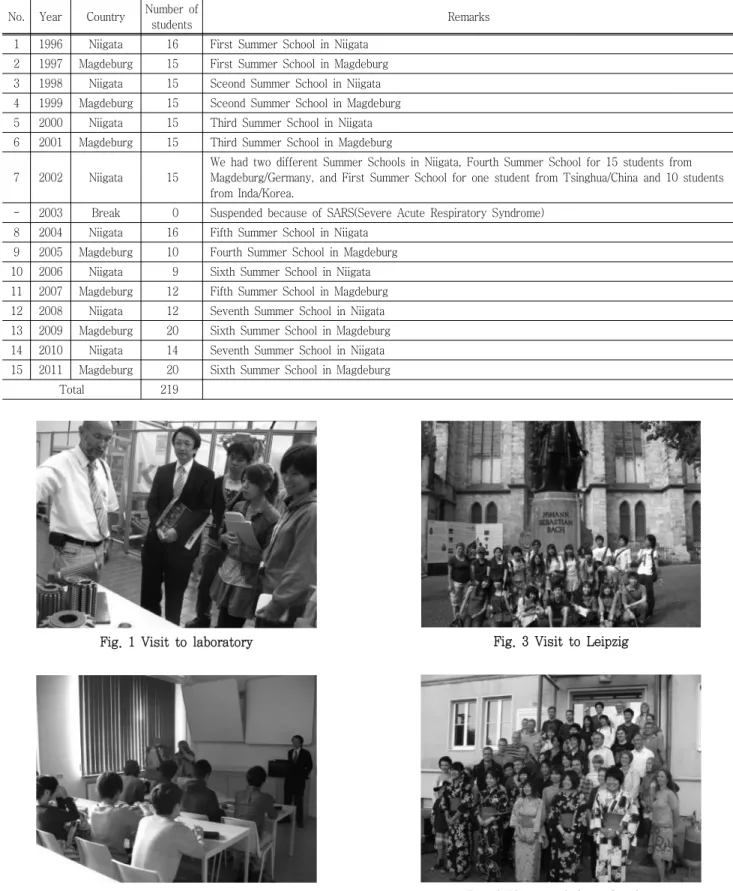
Each year since 1996, a two-week “Summer School in Engineering” program has allowed roughly 12 students from each institution to exchange visits and study together, with the total now numbering about 200. Table 1 shows the list of participants, over the last 15 years.
The program consists of visits to research laboratories in the host-university, as well as local factories. These afford the students invaluable hands-on experience with a variety of technologies, to challenge their minds and stimulate their curiosity and sense of wonder. The program also includes a bit of language and social studies to broaden the students’ perspectives. This combination of technical and cultural experiences enable the students to think, not only about each technology, but also about its social background in which they have been produced.
Figs 1 through 4 show some of the activities in which the students participate.
While in the beginning of our Summer School, a lack of adequate dormitory and home-stay accommodations in Niigata University created problems, it was eventually offset, by numerous kind offers, from students’ families and friends, and the public at-large. In a questionnaire, German students and Japanese host families were asked to evaluate their home stays. Responses from both sides were overwhelmingly positive, with everyone indicating a
Table 1 Number of students in the Summer School No. Year Country Number of
students Remarks
1 1996 Niigata 16 First Summer School in Niigata 2 1997 Magdeburg 15 First Summer School in Magdeburg 3 1998 Niigata 15 Sceond Summer School in Niigata 4 1999 Magdeburg 15 Sceond Summer School in Magdeburg 5 2000 Niigata 15 Third Summer School in Niigata 6 2001 Magdeburg 15 Third Summer School in Magdeburg
7 2002 Niigata 15
We had two different Summer Schools in Niigata, Fourth Summer School for 15 students from Magdeburg/Germany, and First Summer School for one student from Tsinghua/China and 10 students from Inda/Korea.
- 2003 Break 0 Suspended because of SARS(Severe Acute Respiratory Syndrome) 8 2004 Niigata 16 Fifth Summer School in Niigata
9 2005 Magdeburg 10 Fourth Summer School in Magdeburg 10 2006 Niigata 9 Sixth Summer School in Niigata 11 2007 Magdeburg 12 Fifth Summer School in Magdeburg 12 2008 Niigata 12 Seventh Summer School in Niigata 13 2009 Magdeburg 20 Sixth Summer School in Magdeburg 14 2010 Niigata 14 Seventh Summer School in Niigata 15 2011 Magdeburg 20 Sixth Summer School in Magdeburg
Total 219
Fig. 1 Visit to laboratory
Fig. 2 Language class
Fig. 3 Visit to Leipzig
Fig. 4 Photo with host families
desire to repeat, if given the opportunity, -and, assuming the availability of adequate financial resources.
The choice of the language spoken in the counter-part country, namely English-speaking country or not, is con- sidered to be also one key of such success. At first, some of our colleagues advised that the student exchanges with universities in English speaking countries would be better choice compared with exchanges with the German Uni- versity. But, because the ability of students of Niigata University to communicate in English is not always high, it seemed to be quite risky to send them to an English- speaking country; the students were anticipated to hesitate to communicate because of their insufficient language ability in comparison to native English speakers. Since English is not the native language for both German and Japanese, both people are considered to equally know the difficulty in communication in foreign language, English, thus we expect both people to try to communicate having a viewpoint of non-native English speaker each other.
Though Japanese students also feel that they can only speak less than 50% what they want to speak, they managed to communicate with German students in English.
We believe that, given sufficient information, the students’
interest in longer-term (three months to a year-) overseas exchanges will be aroused. Currently, the number of participants stands at 50, among whom around a third are involved in long-term arrangements. The outstanding success of our program can be attributed, not only to our efforts to steadfastly maintain, and build upon the good inter-institution relationship developed with Magdeburg University over the years, but also the fact that we have established fully-bilateral student exchanges; if our student exchange had been unilateral one, such a good and long- lasting relationship would have not been established.
III. Aims of International Cooperation
During the various activities, students have ample op- portunity to compare/contrast education systems. We found that, while Japanese universities normally have ‘test oriented’
education systems in which students’ “knowledge” is checked in written paper test, whereas engineering education in
Germany provides a system of “Diplomarbeit” (Diploma work) with internship, and a series of oral examinations, in order to cultivate the students’ “understanding”. As a result, Japanese graduates tend to be specialists, while German graduates tend to be generalists, when it comes to the field of engineering.[1]-[4] By comparing themselves with students from different countries and/or educational backgrounds, it is our hope that our graduates will gain a greater awareness of any shortcomings and make efforts at meliorating the situation. The question then becomes:
‘-how do we obtain the resources necessary to provide students with opportunities for overseas study?’
It’s interesting to note, that while very few Japanese universities demonstrate an interest in six-month internships, in Germany, the system requires that students participate in such programs. –And it shows, in the methodologies of the two systems; -where most Japanese students, especially in engineering, tend to –and are in fact expected to-, solve problems using acquired knowledge, believing that there is but one correct “answer” to each problem, German students approach a given issue from numerous angles, determining the most suitable “solution” through a careful process of elimination.
But, based on the success of our program, we reconfirmed the importance thereof, as well as that of maintaining strong relations- , and exchanging accurate and timely information, with our international friends.
A feature of our “Summer School” program is that considerable part of expenses during the courses have been covered by the universities and the students are required to pay basically airfare, insurance, and some other personal expenses, so there is far greater incentive to join, -and we expect to see an increase in the number of students expressing a strong desire to study abroad.
Another, far bigger problem, in Japanese universities, is their seeming intractability, regarding overseas study.
Not just the students, but also young research assistants and associate professors are under an inordinate amount of pressure to “produce”, leaving little or no time to even consider opportunities for international exchanges.
Other recent evolving processes are seeing Japanese universities’ “Chair system” creating divisions in the re-
lationship between professors and associate professors.
So, we are extremely concerned, that this will have a powerful negative effect on young associate professors’
chances of taking their sabbatical years.
IV. Participation of Students from other Field than Engineering
Since 2009, this summer school has been open not only for the students of engineering field but also for students from other fields, e.g. humanities and social science of Niigata University. Thus the German side prepared two courses, namely engineering course and language / culture course. The participation of students from humanities and social science is expected to give a good influence on students in engineering field; the exchange of the experi- ences of other students from totally different viewpoints will stimulate the curiosity of the students of engineering field and encourage them for further study.
V. Conclusion
Based on positive responses from former participants, the Faculty of Engineering at Niigata University has more candidate students expressing a strong desire to study abroad than ever before, while, curiously, the opposite appears to be true, for the rest of the country, -possibly a reaction to the disastrous events of the last several months.
We believe that it is of the utmost importance, that students who have previously taken part in the Summer School program share their opinions and experiences with other students, because the comments of peers can carry more weight, than those of their professors, who may, -or may not have actually had similar experiences.
We wish to thank the Niigata University Faculty of Engineering Support Association, for their kind assis- tance.
Reference
1. Takashi Sato, Christine Sobczyk, Shuichi Sakamoto, Nozomu Ishii, Yuji Tanabe, Masaki Goda, Takeo Maruyama, Tomiichi Hasegawa, Hideo Ohkawa, and Lutz Wisweh, “DIFFERENCES OF ENGINEERING EDUCATION SYSTEMS BETWEEN JAPAN AND GERMANY~CONSIDERATION ABOUT “BEFORE AND AFTER GRADUATION”~”, 11th WCCEE (2008).
2. Takashi Sato, Shuichi Sakamoto, Tadaaki Shimizu, Takamasa Suzuki, Hiroyasu Iwabe, Tetsuo Oka, Yuji Tanabe, Hideo Ohkawa, and Lutz Wisweh, “Discussion about Engineering Education in Japanese University from the International Point of View”, Proc. 12th WCCEE: 048 (2010).
3. Takashi Sato, Lutz Wisweh, Shuichi Sakamoto, Tadaaki Shimizu, Takamasa Suzuki, Hideki Ikeda, Tetsuo Oka, Yuji Tanabe, and Hideo Ohkawa, “International Cooperative Activities for the Engineering Education between Otto- von-Guericke-University Magdeburg, Germany, and Niigata University, Japan”, Proceedings of ACEE 2009: 122-123 (2009).
4. Takashi Sato, Lutz Wisweh, Shuichi Sakamoto, Tadaaki Shimizu, Hideki Ikeda, Tetsuo Oka, and Yuji Tanabe,
“International Cooperative Activities for the Engineering Education between Otto-von-Guericke-University Magdeburg, Germany, and Niigata University, Japan”, Journal of Engineering Education Research, 13(5): 49-54 (2010).
Takashi Sato
Professor, Faculty of Engineering, Niigata University, Japan Received BS (1976), MS (1978) and Ph.D. (1983) in Electronic Engineering from Kyoto University. His work experiences are Professor (1995-), Associate Professor (1986-1995), Assistant Professor (1984-1986) and Research Assistant (1981-1984), Faculty of Engineering, Niigata University. He was a visiting fellow, JILA, University of Colorado, USA (1988-1989). His current research focuses on the frequency stabilization of a semiconductor laser.
Phone: +81-25-262-6723 Fax: +81-25-262-6723 E-mail: [email protected]
Shuichi Sakamoto
Associate Professor, Faculty of Engineering, Niigata University
Received BS (1986), MS (1988) and Ph.D. (1991) in Mechanical Engineering from Niigata University. His work experiences are Associate Professor (1998-) and Research Assistant (1991-1998), Faculty of Engineering, Niigata University. He was working as a Research Associate of JSPS (1989-1991). His current research focuses on the sound noise control, sound absorption construction and various measuring method using sound.
Phone: +81-25-262-7003 Fax: +81-25-262-7003
E-mail: [email protected]
Tadaaki Shimizu
Professor, Faculty of Engineering, Niigata University, Japan Received BS (1983) in Chemical Engineering, MS (1985) and Ph.D. (1994) in Chemical Energy Engineering from Tokyo University. His work experiences are Professor (2008-), Associate Professor (2003-2008) and Research Assistant (1988-2003), Faculty of Engineering, Niigata University. His current research focuses on the chemical energy engineering, especially combustion of solid fuels.
Phone: +81-25-262-6783 Fax: +81-25-262-6783
E-mail: [email protected]
Hideki IKEDA
Associate Professor, International Exchange Support Center, Niigata University
Received BA (1987) in Spanish from Osaka University of Foreign Studies (Currently Osaka University) and also received BA (1994), MA (1996) in Japanese Linguistics from Osaka University. His work experiences are Associate Professor (1999-) International Exchange Support Center, Niigata University and Research Assistant (1998-1999), Osaka University. His current research focuses on The acquisition of tone and rhythm in Japanese as a second language.
Phone: +81-25-262-6476 Fax: +81-25-262-6476 E-mail: [email protected]
Tetsuo Oka
Professor, Faculty of Engineering, Niigata University, Japan 1979 Kyoto University, Department of Engineering, Bachelor 1992 Nagoya University, Graduate School of the University, Department of Applied Physics, Ph.D. Interesting Research Area: Applied superconductivity, thermal behaviors of the magnetic flux during the pulsed-field magnetization, performances of trapped field magnet activated by static magnetic fields, construction of various magnetic field generators using HTS bulk materials, industrial application of high temperature superconducting bulk magnets.
Phone: +81-25-262-7668 Fax: +81-25-262-7666 E-mail: [email protected]