*Corresponding author: Woo-Jung Choi Phone: +82-62-530-2153; Fax: +82-62-530-2159;
E-mail: [email protected]
Korean J Environ Agric. 2018;37(3):151-159. English Online ISSN: 2233-4173
Published online 2018 August 6. https://doi.org/10.5338/KJEA.2018.37.3.21 Print ISSN: 1225-3537
Pollutant Runoff Reduction Efficiency of Surface Cover, Vegetative Filter Strip and Vegetated Ridge for Korean Upland
Fields: A Review
Se-In Park1, Hyun-Jin Park1, Hye In Yang1, Han-Yong Kim2, Kwang-Sik Yoon1 and Woo-Jung Choi1*
1Department of Rural & Biosystems Engineering, Chonnam National University, Gwangju 61186, Korea
2Department of Applied Plant Science, Chonnam National University, Gwangju 61186, Korea
Received: 26 June 2018/ Revised: 27 July 2018/ Accepted: 30 July 2018 Copyright ⓒ 2018 The Korean Society of Environmental Agriculture
This is an Open-Access article distributed under the terms of the Creative Commons Attribution Non-Commercial License (http://creativecommons.org/licenses/by-nc/3.0) which permits unrestricted non-commercial use, distribution, and reproduction in any medium, provided the original work is properly cited.
ORCID Se-In Park
https://orcid.org/0000-0002-0735-7913 Hyun-Jin Park
http://orcid.org/0000-0002-2642-5723
ORCID Hye In Yang
http://orcid.org/0000-0003-3142-2444 Han-Yong Kim
https://orcid.org/0000-0001-6280-6251
ORCID
Kwang-Sik Yoon
http://orcid.org/0000-0003-4996-2860 Woo-Jung Choi
http://orcid.org/0000-0002-2009-8207
151
Abstract
BACKGROUND: In this review paper, the effects of surface cover (SCV), vegetative filter strip (VFS), and vegetated ridge (VRD) on the pollutant runoff from steep-sloping uplands were analyzed to compare the pollutant reduction efficiency in runoff (PRErunoff) of the practices and to investigate how slope and rainfall parameters affect the PRErunoff.
METHODS AND RESULTS: The PRErunoff of SCV, VFS, and VRD for pollutants including suspended solids and biological oxygen demand was compared by analysis of variance. The effect of slope and rainfall parameters on the
PRErunoff was explored by either mean comparison or
regression analysis. It was found that the PRErunoff differs with the practices due to different pollutant reduction mechanisms of the practices. Though the PRErunoff was likely to be affected by site condition such as slope and rainfall (amount and intensity), more comprehensive
understanding was not possible due to the limited data set.
CONCLUSION: The PRErunoff of SCV, VFS, and VRD differed due to the distinctive mechanisms of pollutant removal of the practices. It is necessary to accumulate experimental data across a variety of gradient of slope and rainfall for comprehensive understanding of the effects of the practices on pollutant runoff from steep-sloping uplands.
Key words: Best management practices, Land slope, Rainfall, Soil erosion, Upland fields
Introduction
Intensification of agriculture that relies heavily on high inputs of mineral and organic fertilizers certainly contributed to increases in agricultural productivity (Gilland, 2002). However, high-input intensive agriculture caused water pollution via non-point source pathways such as surface run-off that brought worldwide concerns on the negative impacts of modern agriculture (Withers and Lord, 2002). To reduce the impact of agricultural activities on water pollution, developed
Research Article Open Access
countries have shifted the agricultural paradigm from high-input intensive agriculture to low-input sustainable agriculture (Parris, 2011). Due to such efforts, fertilizer consumption in OECD countries has been reduced which led to decline in the nutrient surplus by 17% during the last decade (Parris, 2011).
However, the relative contribution of agricultural sector to water pollution is reported to be still high, ranging from 30 to 80% for NO3- and from 20 to 70%
for phosphorus (P) in surface water body (Parris, 2011) with curtailment of pollutants load from point sources (Skinner et al., 1997). Such high contribution of agricultural sector to water pollution highlights the necessity of further efforts to reduce agricultural water pollution. For this reason, in developed countries including USA (Whitney et al., 2012), UK (Kay et al., 2009, 2012), and other OECD countries (OECD report, 2010, DOI: https://doi.org/0.1787/
89264086845), agricultural policies such as regulatory instruments, payments, taxes, and nutrient trading market are helpful in reducing agricultural non-point source pollution. In South Korea, the Ministry of Agriculture, Food and Rural Affairs (MAFRA) has also launched a payment program that financially supports farmers’ activities to reduce agricultural non-point source pollution (MAFRA report 11-1543000 -001840-01, 2017).
In South Korea, upland fields are critical sources of non-point source pollution due to steep-sloping topography as well as seasonal precipitation pattern;
i.e., 95% of cropping fields is located at landscape with slope >2% and two-third of annual precipitation (about 1,300 mm) occur during the short-term monsoon period in the summer (Hur et al., 2005). For those reasons, the mean annual soil loss of Korean uplands is estimated to be 37.7 Mg/ha, which is more than 3-folds of the OECD standard of soil erosion (11 Mg/ha) (Jung et al., 2005). Soil erosion not only degrades soil productivity by losing fertile surface soil (den Biggelaar et al., 2004) but also causes water pollution through inflow of nutrient-enriched runoff water into surface water body surrounding the fields (Shi and Schulin, 2018).
Several best management practices (BMPs) has been tested and proposed to reduce soil and nutrient runoff from steep-slopping upland fields in South Korea which include surface cover (SCV) (Shin et al., 2016), vegetative filter strip (VFS) (Seo and Choi, 2013), and vegetated ridge (VRD) (Kim and Kim,
2015). In South Korea, the beneficial effects of SCV, VFS, and VRD on reducing surface runoff and nutrient loss from steep-sloping upland fields have been proven for various soil types, slope levels, and crop species (Seo and Choi, 2013; Kim and Kim, 2015;
Shin et al., 2016). However, no information on the differences in the pollutant reduction efficiency of these three BMPs is available even though the pollutant removal mechanisms of SCV, VFS, VRD differ and thus the pollutants removal efficiency may differ depending on the pollutant. In addition, as the efficiency of the BMPs in reducing pollutant load from upland fields are likely to vary with site conditions such as slope and rainfall characteristics, it is necessary to investigate how the reduction efficiency varies with site conditions. Such information may be useful in establishing a goal for pollutant load reduction in the upland fields where the MAFRA’s program is implemented.
In this paper, 1) we reviewed studies on the effects of SCV, VFS, and VRD on soil loss and pollutants loads from steep-sloping upland fields of South Korea to compare pollutant reduction efficiency in runoff
(PRErunoff) of the three BMPs, 2) when data are
available, the effects of site conditions such as slope and rainfall characteristics on the PRErunoff was investigated, and 3) further research direction was suggested to obtain information that might be necessary to support the MAFRA’s program.
Materials and Methods Data Collection
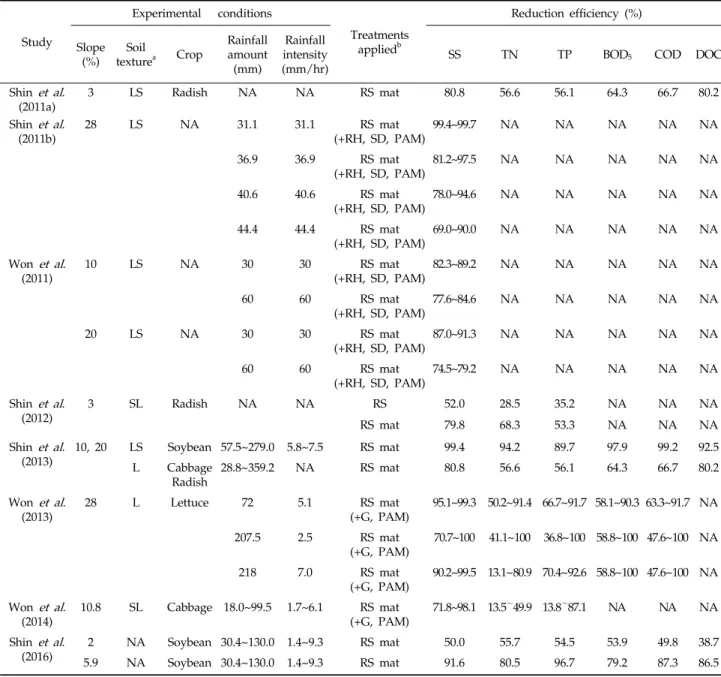
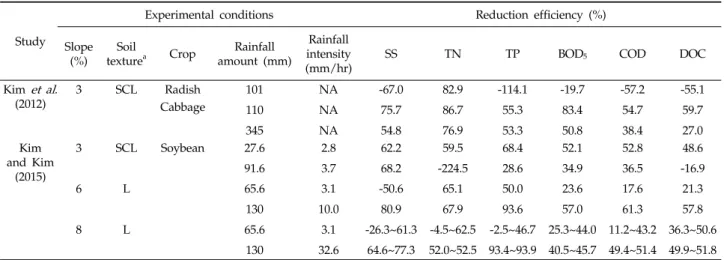
As the pattern of pollutant load from upland fields via runoff is likely to be affected by soil, crop, topography, and seasonal distribution of rainfall (Prosdocimi et al., 2016), we considered studies that were conducted in South Korea to provide information that is more relevant to Korean agricultural environment and thus can support the MAFRA’s program. Among various BMPs adoptable to steep-sloping uplands fields, we focused on SCV (Shin et al., 2011a, 2011b, 2012, 2013, 2016; Won et al., 2011, 2013, 2014) (Table 1), VFS (Choi and Jang, 2014;
Lee et al., 2015) (Table 2), and VRD (Kim et al., 2012;
Kim and Kim, 2015) (Table 3) as these three BMPs have been relatively well studied. Though a few modeling studies were also available, we did not include these studies.
Study
Experimental conditions
Treatments appliedb
Reduction efficiency (%)
Slope (%)
Soil
texturea Crop
Rainfall amount (mm)
Rainfall intensity (mm/hr)
SS TN TP BOD5 COD DOC
Shin et al.
(2011a)
3 LS Radish NA NA RS mat 80.8 56.6 56.1 64.3 66.7 80.2
Shin et al.
(2011b)
28 LS NA 31.1 31.1 RS mat
(+RH, SD, PAM)
99.4~99.7 NA NA NA NA NA
36.9 36.9 RS mat
(+RH, SD, PAM)
81.2~97.5 NA NA NA NA NA
40.6 40.6 RS mat
(+RH, SD, PAM)
78.0~94.6 NA NA NA NA NA
44.4 44.4 RS mat
(+RH, SD, PAM)
69.0~90.0 NA NA NA NA NA
Won et al.
(2011)
10 LS NA 30 30 RS mat
(+RH, SD, PAM)
82.3~89.2 NA NA NA NA NA
60 60 RS mat
(+RH, SD, PAM)
77.6~84.6 NA NA NA NA NA
20 LS NA 30 30 RS mat
(+RH, SD, PAM)
87.0~91.3 NA NA NA NA NA
60 60 RS mat
(+RH, SD, PAM)
74.5~79.2 NA NA NA NA NA
Shin et al.
(2012)
3 SL Radish NA NA RS 52.0 28.5 35.2 NA NA NA
RS mat 79.8 68.3 53.3 NA NA NA
Shin et al.
(2013)
10, 20 LS Soybean 57.5~279.0 5.8~7.5 RS mat 99.4 94.2 89.7 97.9 99.2 92.5 L Cabbage
Radish
28.8~359.2 NA RS mat 80.8 56.6 56.1 64.3 66.7 80.2
Won et al.
(2013)
28 L Lettuce 72 5.1 RS mat
(+G, PAM)
95.1~99.3 50.2~91.4 66.7~91.7 58.1~90.3 63.3~91.7 NA
207.5 2.5 RS mat
(+G, PAM)
70.7~100 41.1~100 36.8~100 58.8~100 47.6~100 NA
218 7.0 RS mat
(+G, PAM)
90.2~99.5 13.1~80.9 70.4~92.6 58.8~100 47.6~100 NA
Won et al.
(2014)
10.8 SL Cabbage 18.0~99.5 1.7~6.1 RS mat (+G, PAM)
71.8~98.1 13.5⁓49.9 13.8⁓87.1 NA NA NA Shin et al.
(2016)
2 NA Soybean 30.4~130.0 1.4~9.3 RS mat 50.0 55.7 54.5 53.9 49.8 38.7
5.9 NA Soybean 30.4~130.0 1.4~9.3 RS mat 91.6 80.5 96.7 79.2 87.3 86.5
NA, not available.
aLS, loamy sand; SL, sandy loam; L, loam.
bRS, rice straw; RH, rice hull; SD, saw dust; PAM, polyacrylamide; G, gypsum.
Table 1. Summary of studies on the pollutants reduction efficiency in runoff by surface cover
For each study, characteristics of experimental site including slope, soil texture, crop species, and rainfall amount and intensity as well as the PRErunoff for each event of each BMP were obtained if they were available. The considered pollutants were suspended solids (SS), total nitrogen (TN), total phosphorus (TP), biological oxygen demand (BOD), chemical oxygen demand (COD), and total dissolved organic carbon (DOC).
Data Analysis
For each BMP (SCV, VFS, and VRD), arithmetical mean of the PRErunoff was calculated to investigate overall effects of the BMPs on the reduction in pollutant load across experimental conditions including slope, soil texture, crop species, and rainfall amount.
The difference in the PRErunoff of the three BMPs was compared with analysis of variance (ANOVA). The effects of slope on the PRErunoff was investigated for the three BMPs by comparing the PRErunoff with different slopes. The effects of rainfall amount and
Study
Experimental conditions
Vegetated grass species
Reduction efficiency (%)
Slope (%)
Soil
texturea Crop
Rainfall amount (mm)
Rainfall intensity (mm/hr)
SS TN TP BOD5 COD DOC
Choi and Jang (2014)
5 LS Soybean 38.1 NA Turf grass 96.9~99.2 21.5~73.8 78.2~96.6 17.6~53.8 79.6 24.4~41.5 70.7 NA 94.7~99.7 11.8~29.3 33.7~73.6 -96.8~100 70.1~83.0 -34.3~22.4
76.8 NA 92.3 72.7 86.3 6.5 68.1 40.0
97.4 NA 84.7 71.4 75.7 7.3 66.7 97.2
122.3 NA 82.5~97.9 0.0~83.7 0.0~66.0 -65.8~91.3 3.3~60.8 -30.2~5.8
184.8 NA 76.6 91.1 87.8 5.2 62.0 38.1
5 LS Soybean 38.1 NA Kentucky
blue grass
98.4~99.2 71.8 96.1~96.5 25.2~56.6 79.6 24.4~47.2 70.7 NA 98.4~100 45.4~50.0 70.7~81.7 -34.1~4.3 85.5~88.3 17.9~28.8
76.8 NA 77.8 61.9 79.1 21.0 52.3 22.2
97.4 NA 83.2 70.8 82.8 24.1 67.0 52.5
122.3 NA 96.9~99.9 84.0~90.8 83.8~84.6 -45.0~12.8 54.8~71.7 -42.4~21.5
184.8 NA 90.7 87.9 84.5 25.0 77.3 28.3
Lee et al.
(2015)
8 L Soybean 65.6 NA Turf grass 35.9 82.1~84.2 7.9~40.5 NA NA NA
78.4 NA -195~58.2 56.5~75.5 -37.9~58.6 NA NA NA
103.6 NA 26.0~39.4 31.6~51.6 -64.7~64.7 NA NA NA
NA, not available.
aLS, loamy sand; L, loam.
Table 2. Summary of studies on the pollutants reduction efficiency in runoff by vegetative filter strip
Study
Experimental conditions Reduction efficiency (%)
Slope (%)
Soil
texturea Crop Rainfall amount (mm)
Rainfall intensity (mm/hr)
SS TN TP BOD5 COD DOC
Kim et al.
(2012)
3 SCL Radish
Cabbage
101 NA -67.0 82.9 -114.1 -19.7 -57.2 -55.1
110 NA 75.7 86.7 55.3 83.4 54.7 59.7
345 NA 54.8 76.9 53.3 50.8 38.4 27.0
Kim and Kim
(2015)
3 SCL Soybean 27.6 2.8 62.2 59.5 68.4 52.1 52.8 48.6
91.6 3.7 68.2 -224.5 28.6 34.9 36.5 -16.9
6 L 65.6 3.1 -50.6 65.1 50.0 23.6 17.6 21.3
130 10.0 80.9 67.9 93.6 57.0 61.3 57.8
8 L 65.6 3.1 -26.3~61.3 -4.5~62.5 -2.5~46.7 25.3~44.0 11.2~43.2 36.3~50.6 130 32.6 64.6~77.3 52.0~52.5 93.4~93.9 40.5~45.7 49.4~51.4 49.9~51.8 NA, not available.
aSCL, silt clay loam; L, loam.
Table 3. Summary of studies on the pollutants reduction efficiency in runoff by vegetated ridge
intensity on the PRErunoff was investigated by regression analysis for only SCV which had enough data set for regression analysis. For the analysis of the effects of slope and rainfall on the PRErunoff, SS was considered as a representative water quality parameter due to a large size of data set. All the statistical analysis was conducted using IBM SPSS Statistics 23 (IMP Corp. Armonk, NY, USA) α value of 0.05 was chosen to indicate statistical significance.
Results and Discussion
Pollutant Reduction Efficiency in Runoff by BMPs Though several studies that investigated the effects of SCV, VFS, and VRD on reduction of pollutant runoff from Korean uplands are available (Tables 1–
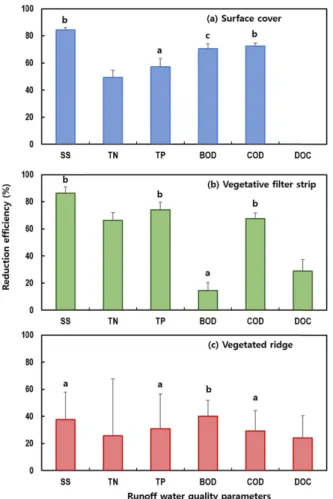
3), there was no study that compared the PRErunoff of the three BMPs. Overall, SCV and VFS had a greater PRErunoff than VRD for SS (P<0.001), TP (P=0.050), and COD (P=0.007); e.g., the PRErunoff for SS was 84.4±
Fig. 1. Pollutants reduction efficiency in runoff by (a) surface cover (n=19), (b) vegetative filter strip (n=15), and (c) vegetated ridge (n=9). Values are the means of the data presented in Tables 1–3, and vertical bars are the standard errors of the mean. For surface cover, DOC data were not available. ANOVA for comparison of the effects of surface cover, vegetative filter strip, and vegetated ridge on the pollutants reduction efficiency in runoff are provided in Table 4, and different lowercase letters indicate significant difference between surface cover, vegetative filter strip, and vegetated ridge at α=0.05.
Pollutants F Degree of freedoma Pb
SS 10.9 2 <0.001
TN 1.3 2 0.290
TP 3.3 2 0.050
BOD 9.6 2 0.001
COD 6.3 2 0.007
DOC 0.08 1 0.774
aSurface cover effects on DOC was not available.
bBolds indicate statistically significant difference among surface cover, vegetative filter strip, and vegetated ridge.
Table 4. Analysis of variance (ANOVA) for comparison of the effects of surface cover, vegetative filter strip, and vegetated ridge on the pollutants reduction efficiency in runoff
1.8% for SCV, 86.4±4.7% for VFS, and 37.6±20.4% for VRD (Fig. 1). For TN, there was no difference (P=0.290) between SCV, VFS, and VRD, and for BOD (P=0.001), VFS had lower PRErunoff than VRD (Fig. 1).
Therefore, our review suggests that SCV, VFS, and VRD could reduce pollutant runoff substantially, but the PRErunoff differs with the BMPs probably due to differences in the reduction mechanisms of the three practices.
Surface cover can reduce surface runoff by up to 96% via protecting soil aggregates against raindrop impact and by decreasing overland flow velocity due to increased surface roughness (Prosdocimi et al., 2016). Reduction of soil loss and/or erosion rate by
SCV or surface mulching has been extensively studied and the PRErunoff varies with the mulching materials and application rate (Prosdocimi et al., 2016). For example, it has been reported that wood mulching is more effective than straw mulching (Robichaud et al., 2013) and maize residue is better than soybean and sorghum residues (Gilley et al., 1986a, 1986b).
Regarding mulching application rate, it has been suggested that a surface mulching cover of 60% area is the minimum threshold for a significant reduction of soil loss (Pannkuk and Robichaud, 2003; Cerdà and Doerr, 2008). However, in this review, it was not straightforward to discuss the potential effects of SCV materials and application rate on the PRErunoff for Korean uplands due to the lack of relevant data.
Vegetative filter strip is often established in the downside area of upland fields to remove sediment and pollutants from surface runoff through filtration, sedimentation, and infiltration (Lobo and Bonilla, 2017). It has been shown that VFS could remove up to 99% of SS (Osborne and Kovacic, 1993), 90% of TP and 80% of TN from runoff (Chaubey et al., 1994).
Considering the physical mechanisms of pollutant removal by VFS, however, dissolved pollutants may not be removed as efficiently as particulate pollutants by VFS (Lobo and Bonilla, 2017). Therefore, in this review, a lower PRErunoff for BOD and DOC than other pollutants (Fig. 1) should be ascribed to the physical removal mechanisms of VFS that has limitation in removing dissolved pollutants. In addition, supply of organic C from root exudates might further contribute to the lower PRErunoff for BOD of VFS than that of VRD (Zhai et al., 2013).
Vegetated ridge is constructed across the slope
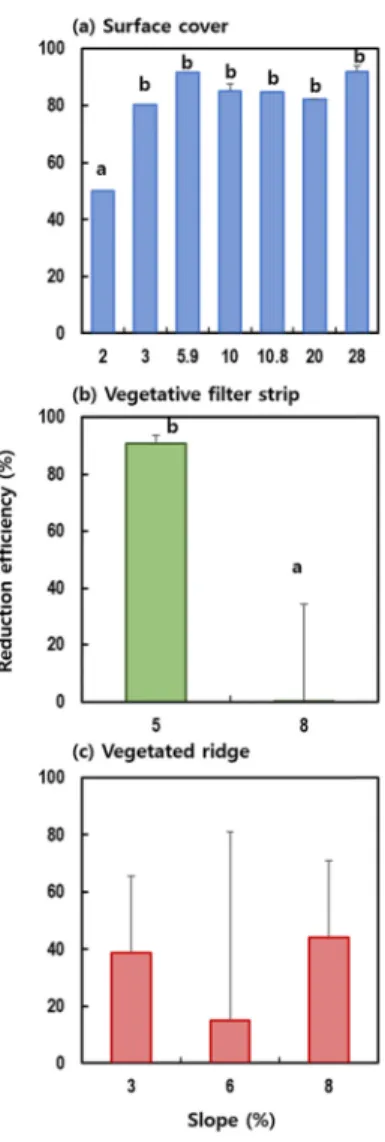
Fig. 2. Changes in the reduction efficiency of suspended solids in runoff by (a) surface cover, (b) vegetative filter strip, and (c) vegetated ridge as affected by slope. Values are the means of the data presented in Tables 1–3, and vertical bars are the standard errors of the mean.
Different lower case letters indicate significant difference with slope at α=0.05.
similar to contour ridge systems, which results in rainwater ponding in the furrow area that reduces runoff velocity while increasing infiltration and reducing soil erosion (Liu et al., 2014). Due to the confined capacity of the ridge, however, when the ponded rainwater exceeds the storage capacity, it overflows the ridge and the concentrated rainwater might lead to soil erosion (Flanagan and Livingston, 1995; Hatfield et al., 1998), resulting in a relatively low PRErunoff as observed in this review (Fig. 1).
Effects of Slope and Rainfall Parameters on Pollutants Reduction Efficiency in Runoff
Soil loss and pollutant runoff are highly dependent
on slope and rainfall parameter such as rainfall amount and intensity, and soil loss usually increases with increasing slope gradient and rainfall amount and intensity (Römkens et al., 2001; Shen et al., 2016).
In this review, the effect of slope on PRErunoff for SS was found to differ among SCV, VFS, and VRD (Fig. 2).
For SCV, the PRErunoff was 50% at slope of 2%, and it increased to >80% at slope of 3% and there was no difference in the PRErunoff at slope between 3 and 28%, suggesting that the PRErunoff for SS by SCV is not affected by slope greater than 3%. For VFS, the PRErunoff for SS was >90% at slope of 5%, but it was close to 0% at slope of 8%, and for VRD, the PRErunoff
for SS did not differ with slope. Slope gradient has direct impact on soil erodibility and percolation (Li et al., 2010) and is also indirectly related to several factors affecting infiltration rate that include surface soil sealing, soil water storage, and effective rainfall (Fox et al., 1997). Therefore, slope gradient should collaborate with the BMPs on the PRErunoff. However, as seen in Tables 2 and 3, only a few studies are available for VFS and VRD, and thus more experimental studies at different slope are required to evaluate the effects of slopes on the PRErunoff of VFS and VRD.
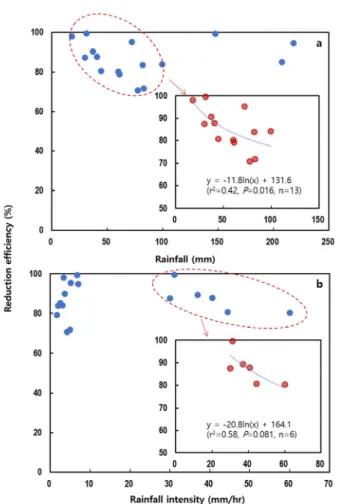
The relationship between either rainfall amount or rainfall intensity and the PRErunoff for SS by SCV was not significant when all the data were included (Fig. 3).
However, for events with rainfall amount below <100 mm, the PRErunoff for SS tended to decrease with rainfall amount (Fig. 3a). For rainfall intensity, similar pattern was found for events with rainfall intensity
>30 mm/hr (Fig. 3b). These results suggest that at a given site conditions, the PRErunoff for SS of SCV is likely to vary with rainfall parameters. Raindrops impact the physical properties of soil surface by creation of surface seal that further impacts infiltration rate, soil water storage, water suction, and surface roughness (Bradford et al., 1987; Mualem et al., 1993; Fohrer et al., 1999; Assouline, 2004).
However, again, due to the limited number of experimental data, it is not straightforward to interpret such relationship between rainfall parameters and the PRErunoff for SS of SCV, strongly highlighting the necessity of accumulation of experimental data that might allow comprehensive understanding of the interactive effects of SCV and rainfall parameters on SS runoff reduction.
Fig. 3. Changes in the reduction efficiency of suspended solids by surface cover as affected by (a) rainfall amount and (b) rainfall intensity. Figures were not presented for vegetative filter strip and vegetated ridge due to lack of relevant data.
Conclusions
In this review, it was found that SCV, VFS, and VRD could reduce pollutant runoff substantially, even though the PRErunoff varies with the BMPs due to different pollutant runoff reduction mechanisms of the BMPs. Among the three BMPs, SCV was proven to be most effective in removing all pollutants studied; whereas VFS that relies on physical filtration of pollutants does not reduce BOD satisfactorily compared with SCV and VRD probably due to low filtration efficiency of dissolved pollutants as well as supply of organic C from root exudates. The VRD has a relatively low PRErunoff (except for BOD) compared to SCV and VFS due to confined rainwater ponding capacity of ridge. Slope and rainfall parameters such as rainfall amount and intensity should collaborate with the BMPs in reduction of pollutant runoff;
however, limited number of data set did not allow
more systematic analysis of the effects of slope and rainfall on the PRErunoff of the BMPs. Therefore, it is necessary to accumulate experimental data across a variety of gradient of slope and rainfall for comprehensive understanding of the effects of the three BMPs on the PRErunoff. As the previous studies have rarely been replicated and thus our current understanding of the effects of BMPs lacks statistical significance, future studies need to be fully replicated (e.g., triplicates) to allow statistical analysis of the effects of BMPs. In addition, to implement the BMPs at a farm scale, information on expense, labor cost, and profit loss associated with the BMPs should also be provided to support a financial payment program of the MAFRA.
Note
The authors declare no conflict of interest.
Acknowledgment
This work was carried out with the support of
“Cooperative Research Program for Agriculture Science and Technology Development (Project No.
PJ013401032018)”, Rural Development Administration, Republic of Korea. We also thank to the scholarship awarded to HJP by the Korean Government (NRF- 2017H1A2A1044523).
References
Assouline, S. (2004). Rainfall-induced soil surface sealing.
Vadose Zone Journal, 3(2), 570-591.
Bradford, J. M., Ferris, J. E., & Remley, P. A. (1987).
Interrill soil erosion processes: I. Effect of surface sealing on infiltration, runoff, and soil splash detachment. Soil Science Society of America Journal, 51(6), 1566-1571.
Cerdà, A., & Doerr, S. H. (2008). The effect of ash and needle cover on surface runoff and erosion in the immediate post-fire period. Catena, 74(3), 256-263.
Chaubey, I., Edwards, D. R., Daniel, T. C., Moore Jr., P.
A., & Nichols, D. J. (1994). Effectiveness of vegetative filter strips in retaining surface-applied swine manure constituents. Transactions of the American Society of Agricultural Engineers, 37(3), 845-850.
Choi, K. S., & Jang, J. R. (2014). Selection of appropriate plant species of VFS (Vegetative Filter Strip) for reducing NPS pollution of uplands. Journal of Korea Water Resource Association, 47(10), 973-983.
den Biggelaar, C., Lal, R., Wiebe, K., & Breneman, V.
(2004). The global impact of soil erosion on productivity. I: Absolute and relative erosion-induced yield losses. Advances in Agronomy, 81, 1–48.
Flanagan, D. C., & Livingston, S. J. (1995). Water Erosion Prediction Project (WEPP) User Summary-NSERL Report No. 11. USDA-ARS National Soil Erosion Research Laboratory, West Lafayette, IN.
Fohrer, N., Berkenhagen, J., Hecker, J., & Rudolph, A.
(1999). Changing soil and surface conditions during rainfall: single rainstorm/subsequent rainstorms. Catena, 37 (3-4), 355-375.
Fox, D. M., Bryan, R. B., & Price, A. G. (1997). The influence of slope angle on final infiltration rate for interrill conditions. Geoderma, 80(1–2), 181-194.
Hatfield, J. L., Allmaras, R. R., Rehm, G. W., & Lowery, B. (1998). Ridge tillage for corn and soybean production: environmental quality impacts. Soil and Tilage Research, 48(3), 145-154.
Gilland, B. (2002). World population and food supply.
Can food production keep pace with population growth in the next half-centry? Food Policy, 27(1), 47-63.
Gilley, J. E., Finkner, S. C., Spomer, R. G., & Mielke, L.
N. (1986a). Runoff and erosion as affected by corn residue: Part I. Total losses. Transactions of the ASAE, 29(1), 157-160.
Gilley, J. E., Finkner, S. C., & Varvel, G. E. (1986b).
Runoff and erosion as affected by sorghum and soybean residue. Transactions of the ASAE, 29(6), 1605-1610.
Hur, S. O., Jung, K. H., Ha, S. K., Kwak, H. K., & Kim, J. G. (2005). Mathematical description of soil loss by runoff at inclined upland of maize cultivation. Korean Journal of Soil Science and Fertilizer, 38(2), 66-71.
Jung, K. H., Sonn, Y. K., Hong, S. Y., Hur, S. O., & Ha, S. K. (2005). Assessment of national soil loss and potential erosion area using the digital detailed soil maps. Korean Journal of Soil Science and Fertilizer, 38(2), 59–65.
Kay, P., Edwards, A. C., & Foulger, M. (2009). A review of the efficacy of contemporary agricultural stewardship measures for addressing water pollution problems of key concern to the UK water industry. Agricultural Systems, 99(2–3), 67-75.
Kay, P., Grayson, R., Phillips, M., Stanley, K., Dodsworth, A., Hanson, A., Walker, A., Foulger, M., McDonnell, I.,
& Taylor, S. (2012). The effectiveness of agricultural stewardship for improving water quality at the
catchment scale: Experiences from an NVZ and ECSFDI watershed. Journal of Hydrology, 422–423, 10-16.
Kim, D. H., & Kim, S. M. (2015). Evaluation for non-point sources reduction effect by vegetated ridge and silt fence. Journal of the Korean Society of Agricultural Engineers, 57(5), 129-137.
Kim, S. J., Park, T. Y., Kim, S. M., Jang, J. R., & Kim, S.
M. (2012). A plot scale experiment to analysis the NPS reduction by silt fence and vegetated ridge for Non-Irrigated cropland. Journal of the Korean Society of Agricultural Engineers, 54(4), 19-27.
Lee, S. G., Jang, J. R., & Choi, K. S. (2015). Estimation of application cost and utilization of turf grass VFS or reduction of uplands NPS pollution. Journal of Korean Society of Agricultural Engineers, 57(2), 75-83.
Li, J. L., Cai, Q. G., & Sun, L. Y. (2010). Reviewing on factors and threshold conditions of rill erosion.
Progress in Geography, 29(11), 1319-1325.
Liu, Q. J., Zhang, H. Y., An, J., & Wu, Y. Z. (2014). Soil erosion processes on row sideslopes within contour ridging systems. Catena, 115, 11-18.
Lobo, G. P., & Bonilla, C. A. (2017). A modeling approach to determining the relationship between vegetative filter strip design and sediment composition.
Agriculture, Ecosystems and Environments, 237, 45-54.
Mualem, Y., Assouline, S., & Eltahan, D. (1993). Effect of rainfall-induced soil seals on soil water regime:
wetting processes. Water Resources Research, 29(6), 1651-1659.
Osborne, L. L., & Kovacic, D. A. (1993). Riparian vegetated buffer strips in water-quality restoration and stream management. Freshwater Biology, 29(2), 243-258.
Pannkuk, C. D., & Robichaud, P. (2003). Effectiveness of needle cast at reducing erosion after forest fires. Water Resources Research, 39(12), 1333.
Parris, K. (2011). Impact of agriculture on water pollution in OECD countries: recent trends and future prospects.
International Journal of Water Resources Development, 27(1), 33–52.
Prosdocimi, M., Tarolli, P., & Cerda, A. (2016). Mulching practices for reducing soil water erosion: a review.
Earth-Science Reviews, 161, 191-203.
Robichaud, P. R., Lewis, S. A., Wagenbrenner, J. W., Ashmun, L. E., & Brown, R. E. (2013). Post-fire mulching for runoff and erosion mitigation. Part I:
Effectiveness at reducing hillslope erosion rates.
Catena, 105, 75-92.
Römkens, M. J. M., Helming, K., & Prasad, S. N. (2001).
Soil erosion under different rainfall intensities, surface roughness, and soil water regimes. Catena, 46(2-3), 103-123.
Seo, J. H., & Choi, K. S. (2013). Analysis of sediment reductions effects of VFS systems for the general characteristics of upland in Korea. Journal of the Korean Society of Agricultural Engineers, 55(4), 121-131.
Shen, H., Zheng, F., Wen, L., Han, Y., & Hu, W. (2016).
Impacts of rainfall intensity and slope gradient on rill erosion processes at loessial hillslope. Soil and Tillage Research, 155, 429-436.
Shi, P., & Schulin, R. (2018). Erosion-induced losses of carbon, nitrogen, phosphorus and heavy metals from agricultural soils of contrasting organic matter management. Science of The Total Environment, 618, 210-218.
Shin, M. H., Jang, J. R., Lee, S. I., Park, Y. S., Lee, Y. J., Shin, Y. C., & Won, C. H. (2016). Application of surface cover materials for reduction of NPS pollution on field-scale experimental plots. Irrigation and Drainage, 65(52), 159-167.
Shin, M. H., Jang, J. R., Won, C. H., Choi, W. H., Shin, J.
Y., Lim, K. J., & Choi, J. D. (2012). Effect of surface cover on the reduction of NPS pollution of at a vegetable field. Journal of Korean Society on Water Environment, 28(3), 436-443.
Shin, M. H., Won, C. H., Jang, J. R., Choi, Y. H., Shin, Y.
C., Lim, K. J., & Choi, J. D. (2013). Effect of surface cover on the reduction of runoff and agricultural NPS pollution from upland fields. Paddy and Water Environment, 11(1-4), 493-501.
Shin, M. H., Won, C. H., Park, W. J., Choi, W. H., Jang, J. R., Lim, K. J., & Choi, J. D. (2011a). Analysis of the reduction effect on NPS pollution loads by surface cover application. Journal of the Korean Society of Agricultural Engineers, 53(4), 29-37.
Shin, M. H., Won, C. H., Park, W. J., Choi, W. H., Shin, J. Y., Lim, K. J., & Choi, J. D. (2011b). Surface cover application for reduction of runoff and sediment discharge from sloping fields. Journal of the Korean Society of Agricultural Engineers, 53(6), 129-136.
Skinner, J. A., Lewis, K. A., Bardon, K. S., Tucker, P., Catt, J. A., & Chambers, B. J. (1997). An overview of the environmental impact of agriculture in the UK.
Journal of Environmental Management, 50(2), 111-128.
Whitney, P. Broussard III., Turner, R. E., & Westra, J. V.
(2012). Do federal farm policies influence surface water quality?. Agriculture, Ecosystems and Environment, 158, 103-109.
Withers, P. J. A., & Lord, E. I. (2002). Agricultural nutrient inputs to rivers and groundwaters in the UK:
policy, environmental management and research needs. Science of The Total Environment, 282-283, 9-24.
Won, C. H., Shin, M. H., Choi, Y. H., Shin, J. Y., Park, W. J., & Choi, J. D. (2011). Application of surface cover materials for reduction of soil erosion. Journal of Korean Society on Water Quality, 27(6), 848-854.
Won, C. H., Shin, M. H., Choi, Y. H., Shin, J. Y., Park, W. J., Lee, S. I., & Choi, J. D. (2013). Evaluations of NPS reduction using the rice straw mats and soil amendments from steep sloped field. Journal of the Korean Society of Agricultural Engineers, 55(2), 29-36.
Won, C. H., Shin, M. H., Lee, S. I., Kum, D. H., Lim, K.
J., & Choi, J. D. (2014). Effects of surface cover and soil amendments on the NPS load reduction from alpine fields. Journal of the Korean Society of Agricultural Engineers, 56(3), 47-53.
Zhai, X., Piwpuan, N., Arias, C. A., Headley, T., & Brix, H. (2013). Can root exudates from emergent wetland plants fuel denitrification in subsurface flow constructed wetland systems?. Ecological Engineering, 61, 555-563.