• 검색 결과가 없습니다.

Determinants of Profitability in Commercial Banks in Vietnam, Malaysia and Thailand

N/A
N/A
Protected

Academic year: 2021

Share "Determinants of Profitability in Commercial Banks in Vietnam, Malaysia and Thailand"

Copied!
11
0
0

로드 중.... (전체 텍스트 보기)

전체 글

(1)

Print ISSN: 2288-4637 / Online ISSN 2288-4645 doi:10.13106/jafeb.2020.vol7.no4.133

Determinants of Profitability in Commercial Banks in Vietnam, Malaysia and Thailand

Binh Thi Thanh DAO*, Dung Phuong NGUYEN**

Received: February 10, 2020 Revised: March 1, 2020 Accepted: March 6, 2020

Abstract

The paper investigates the factors affecting the profitability of commercial banks in Asian developing countries, including Vietnam, Malaysia and Thailand. We use panel data of four entities; ten banks in Vietnam, eight banks in Malaysia, nine banks in Thailand and all 27 commercial banks from the period 2012 to 2016. Particularly, Return on Asset, Return on Equity and TOBINQ are defined as profitability indicators, which are impacted by three main types of independent variables, namely bank-specifics, which include CAR, NPL, Cost to income, Liquidity ratio and Bank size, industry-specific variable-concentration HHI and macroeconomic-specific variables, which consist of GDP growth and Inflation.

Using panel data regressions, the paper identifies several similarities and differences among empirical results on the models of four entities, each of three countries and the overall sample. The most outstanding similarity is that all entities record the significantly negative relationship between operational risk and banking profitability. Likewise, the significantly negative influence of bank size to profitability is found on models of Vietnam and Thailand and no significant effect on the model of Malaysia. Meanwhile, the most controversial result comes up with the negative relationship between CAR and profitability indicators as well as the positive association between credit risk and banking profitability.

Keywords : Commercial Banks, Vietnam, Thailand, Malaysia, Profitability JEL Classification Code : G21, L2, E01, E02, C13

1. Introduction

34

The roles of commercial banks in association with developing nations will be fully interpreted once features of developing ones are well-clarified as banks are main providers of credit for the economy. It can be clearly interpreted that three countries focused in on the paper, including Vietnam, Thailand and Malaysia, are developing nations, of which Vietnam, transitioning from one of the

*First Author and Corresponding Author. Vice Dean, Financial Department, Faculty of Management and Tourism, Hanoi University, Vietnam [Postal Address: Km9 Nguyen Trai, Thanh Xuan, Ha Noi, 10000, Vietnam] Tel: +84 904 082 810,

Email: [email protected]

**Financial Department, Faculty of Management and Tourism, Hanoi University, Vietnam. Email: [email protected]

ⓒ Copyright: The Author(s)

This is an Open Access article distributed under the terms of the Creative Commons Attribution Non-Commercial License (http://Creativecommons.org/licenses/by-nc/4.0/) which permits unrestricted noncommercial use, distribution, and reproduction in any medium, provided the original work is properly cited.

world‟s poorest countries to a lower middle-income one, owns more typical traits than the other two. Meanwhile, according to the World Bank, both Thailand and Malaysia, upper-income countries, are approaching the long-term plan of 20 years to become developed countries.

In the context of developing countries, the roles of the banking sector are definitely vital. Furthermore, along with the growth of investment projects in diverse industries supported by commercial banks, more vacancies open for domestic citizens and hence the unemployment rates can be lessened. When the business cycle is in contraction or in any unfavorable phase, the central bank of each developing country can cure the vulnerable economy by regulating a proper monetary policy for commercial banks to implement.

As a result, the inflation or deflation and other attached

risks would be under the control and, thus, the economy of

the country can be improved. In brief, the growth of a

developing economy depends principally on the soundness

and health of the banking sector, especially commercial

banks.

(2)

One of the crucial indicators for health of the banking sector has been long demonstrated to be profitability. A commercial bank always strives to have “good health”, or profitability due to the following reason. In the context of globalization, deregulation and intensive competition from an increase in the share of non-bank institutions, commercial banks are required to maintain profitable, otherwise, the survival can be threatened. To be more specific, profitable banks have the ability to diversify their business, so that unsystematic risks can be hedged effectively. It is proved that when financial crises occurred in 2008, profitable banks not only survived successfully, but also acted as protectors to cure the whole economy (Ramlall, 2009). Therefore, a thorough comprehensibility of what factors are affecting profitability of commercial banks becomes extremely crucial to bank management, so that the annual objectives in terms of profitability can be achieved. In addition to bank management‟s concern, a great number of researchers, financial market analysts and regulators have made thousands of studies about determinants of profitability in the banking sector.

The researchers have found that both internal and external determinants impact on profitability of commercial banks at different extent, of which internal factors are bank- specific characteristics including banking risks, capital adequacy, and bank size and so on, while external ones contain industry-specific and macroeconomic-specific variables. Once those determinants are studied and regularly updated, the changes in macroeconomics and legal environment cannot stress out the banking leaders since they have full understandings and forecast on these changes to prevent negative influences from bank profitability.

The paper aims to explore the relationship between profitability and its determinants in commercial banks of Vietnam, Thailand and Malaysia from 2012 to 2016. The three main objectives of the paper are: (1) to provide brief information on structures of banking sector as well as assessment of 5-year-performance of commercial banks in Vietnam, Thailand and Malaysia,; (2) to define and analyze the determinants of profitability in Vietnamese, Thai and Malaysian commercial banks and, (3) to evaluate the relationship between profitability and its determinants including bank-specifics, industry-specifics as well as macro-environmental factors.

This research is organized as follows: the next section exhibits the literature review presenting theoretical frameworks and empirical reviews on the relationship between profitability and its determinants. Section 3 examines the relationship between banks‟ profitability and bank-specifics, industry-specifics and macroeconomic factors through research methodology and research findings which includes the analysis of regression models, error

detection and the discussions of final outcomes. The final section presents the summary of the research.

2. Literature Review

2.1. Theoretical Framework 2.1.1. Submission Declaration

The capital-profitability relationship has been explained by a variety of breakthrough theories. Initially, Modigliani and Miller (1958) discovered the capital structure irrelevance theory, in which firm value is unaffected by its capital structure in the light of perfect capital market. In particular, under the assumptions of perfect capital market, bankruptcy cost, taxation, barriers to entry and deposit insurance do not exist. Besides, all relevant information is publicized, bank management no longer owns private information, leading to the situation that both creditors and shareholders are symmetrically informed of bank investment payoffs. Under these circumstances, it is proved that no longer does optimal debt to equity exist and capital structure is irrelevant to equity holders‟ wealth. Thus, management can randomly select the composition of capital structure.

Berger (1995b) finds that there is an identical amount between market and book rates of return, when the weight of debt is substituted by additional equity, CAR increases leading to the downsizing of risks and thereby the reduction of market required rates of return on these financial instruments as long as banking risks are not totally diversified and investors are risk-averse. Berger (1995b) proved that there exist two hypotheses for the explanation of positive capital-earnings relationship. On the one side, the expected bankruptcy cost hypothesis, first suggested by Baxter (1967), implies that the more the environmental changes increase the expected financial distress costs, the greater the optimal capital adequacy ratio will be.

To be more specific, the expected cost of bankruptcy is

defined as the product of bank‟s failure probability and

deadweight liquidation costs, which must be confiscated by

bank‟s creditors in the event of bankruptcy. When a bank

maintains CAR below its equilibrium level, the likelihood

of failure will increase, the unpredicted rise in the expected

bankruptcy costs. Consequently, it is necessary to boost

CAR promptly towards the new equilibrium in order to

curb the chances of bank failure and, thus, increase ROE by

downsizing insurance costs on uninsured debt. In other

words, the positive correlation between CAR and ROE can

be explained by the expected bankruptcy cost hypothesis

under this circumstance.

(3)

On the other side, Berger (1995b) also demonstrated this positive relationship based on an alternative theory called signaling theory, which was originated from works of Akerlof (1970) and Spence (1973) in non-financial aspects and later developed by Ross (1977) in financial markets. He stated that, in the light of relaxed assumption, the existence of asymmetric information between insiders and outsiders gives the chance for the formers (Bank managers) to own private information about the future prospects without the awareness of the latters. In addition, they also possess a stake in bank‟s value through personal ownership or, stock options, etc. Good banks signify high quality by maintaining a high CAR, (i.e. low risk banks) spend less for signal than bad banks (i.e. high risk banks) do.

Several years later, the capital-earnings association is also tested by Berger and Bonaccorsi (2006). At first, the efficiency-risk hypothesis suggested that more efficient banks tend to select lower capital ratios than others, all else being equal, due to two following explanations. Firstly, more efficient banks own higher expected returns because, according to his previous study and the evidence from DeYoung (1997), there is a significant positive relationship between profit efficiency and ROE. In contrast, under the franchise-value hypothesis, more efficient banks have a tendency to choose higher capital ratios, all else being equal.

In detail, if the profit efficiency is forecasted to continue in the future, economic rents or franchise value may be created.

Another theory that also explains the correlation between equity and profitability is the buffer theory of Calem and Rob (1999). It is predicted that, in order to prevent incurred costs from a breach of capital requirement, banks are motivated to boost their equity to meet regulatory minimum capital ratio as well as minimize risks. In contrast, undercapitalized banks may also have a temptation of taking more risks in exchange for higher expected returns which will help them to raise capital (Ochei, 2013).

The Structure-Conduct-Performance (SCP) paradigm, which was interpreted by most early studies about the determinants of banks‟ performance, demonstrated a positive association between concentration and profitability.

The paradigm provided the collusion hypothesis, in which a small number of banks may have tacit and/or explicit collusion, leading to the greater interest rate charged on loans, service fees and smaller interest rate paid on customers deposit, etc. As a result of this collusion, a positive correlation between concentration and profitability is confirmed (Goddard, Molyneux, & Wilson, 2004).

Conversely, the efficient structure hypothesis provides a potential evidence to conclude that the relationship stated in SCP paradigm is not consistently and significantly true.

2.2. Empirical Studies Review

The determinants of bank profitability have been internationally researched thanks to the significance of profitability as an indicator of business performance.

Numerous academic scholars considered bank profitability as a function of bank-specific, industry-specific and macroeconomic-specific determinants. Particularly, according to Islam and Nishiyama (2016), bank-specific categories may be defined as microeconomic variables, which can be directly obtained from banks‟ financial statements. Meanwhile, the two remainders indicate the overall industry situation, regulatory and legal aspects. In terms of dependent variables, Return on Assets (ROA), Return on Equity (ROE) and Net Interest Margin (NIM) are selectively utilized as the proxy of performance.

2.2.1 Bank-Specific Category

Various studies, coping with internal determinants, took bank capital, size, risk management into considerations.

Initially, Goddard et al. (2004), who investigated in the determinants of profitability in 665 banks over six major European nations from 1992 to 1998 by the method of dynamic panel model, found an evidence for positive relationship between CAR and profitability. Although this finding contradicts the risk - return expectation theory that is a highly capitalized bank provides signals of over- cautious characteristics and indifference about potentially investment opportunities, it supports expected bankruptcy costs hypothesis and signaling theory.

Likewise, according to the Berger (1995b) studying on US commercial banks from 1983 to 1989 based on Granger-causality method, there was a significantly positive correlation between capital and earnings. On the one hand, the result is strongly consistent with the expected bankruptcy cost hypothesis. That the increase in capital raising bank earnings comes chiefly from the decrease in costs charged on uninsured debt, as predicted by the hypothesis. On the other hands, the finding is inconsistent with signaling theory in which when “good banks” tend to increase capital to signal positive bank‟s prospects which may be about the growth in revenues, decrease in expenses, risks and so on. However, Berger‟s results revealed that there is not any improvement in either revenues or operating expenses after the increase in capital.

Shim (2010) analyzed the insurer‟s capital decision-risk

taking behavior correlation. His results support both the

expected bankruptcy costs and buffer theory. To be more

specific, the under-capitalized insurers are tempted to boost

their capital to prevent regulatory cost incurred from capital

requirement breach as well as to take on more risks with the

hope of generating higher returns. It can be asserted from

(4)

his findings that capital is positively correlated with profitability (ROA) and risks.

Despite a huge number of studies revealing the evidences for positive capital-earnings relationship as stated above, for examples, there exist a few academic papers that proved that this relationship must be negative. Barnor and Odonkor (2012), which aims to examine capital adequacy- performance correlation, find that an insignificantly negative relationship between CAR and ROA was testified whereas the correlation between CAR and ROE was significantly negative. Likewise, the study of Mathuva (2016), which examined how revenue diversification and other factors influenced the financial performance of 212 deposit-taking savings and credit cooperatives (SACCOs) in Kenya from 2008 to 2013, suggested that capital-to-asset ratio was significantly negative correlated with both ROA and ROE. It is implied that the more capital is saved as a buffer against exposures, the poorer financial performance will be. In other words, there is a trade-off between the compliance with minimum capital requirement and profitable investment opportunities.

When it comes to second explanatory variable-bank size, there are a hundred of academic papers investigating bank size-profitability relationship. Redmond and Bohnsack (2007) use ROE as a proxy of profitability, bank size is measured by volume of assets, finds that the smaller the bank size, the more profitably banks operate. At the same veins, Kosmidou, Pasiouras, Doumpos, and Zopounidis (2006) applied PAIRCLAS multicriteria methodology to investigate the effectiveness and performance of UK small and large banks, which are distinguished by their asset sizes, based on a wide range of criteria including asset quality, capital adequacy, liquidity and efficiency/profitability for the period 1998-2002. The outcomes also indicate that smaller banks own more outstanding performance than larger ones.

The association between bank risks and profitability is also investigated by numerous academic scholars in which three types of risks consisting of credit risk, liquidity risk and operational risk are the main focus. Firstly, Noman, Pervin, Chowdhury, and Banna (2015) considered the influence of credit risk on the profitability by using NPL, CAR as proxies of credit risk and ROAA, ROAE, NIM as profitability indicators to find a negative correlation between NPL and profitability proxies. Similar results were discovered in the study of Kolapo, Ayeni, and Oke (2012).

Nevertheless, there remain a lot more studies, which concluded that the relationship between liquidity risk and profitability is positive (Nguyen & Nguyen, 2020). For instance, Molyneux and Thornton (1992) and Demirgüç- Kunt, Laeven, and Levine (2003) both argued that highly liquid banks with high amount of cash and government securities can receive relatively low interest income than

the less liquid ones. Under competitive market for deposit, greater liquid tends to be negatively correlated with profitability.

When it comes to operational risk, most previous studies support the proposition that the more the operational risk, the worse the bank performance. Recently, the negative impact of operational risk on profitability was explored in the study of Muriithi and Muigai (2017). Similarly, Francis and Hess (2004) and Mathuva (2009) also concluded that cost-to-income ratio has a significantly negative influence on profitability.

2.2.2. Industry-Specific Category

Switching to external determinants of bank profitability, market concentration variable which represents industry characteristics is discussed first. Berger (1995a) who applied structural models to analyze the profit-market structure relationship over 30 cross sectional banking data in 1980s stated that concentration is adversely associated with profitability under the condition that other factors are controlled. However, a spurious relationship that the more industry is concentrated, the greater the profitability was emerged due to the association with other factors. In detail, He proved that the factor was managerial efficiency, which can not only boost profitability, but also enlarge market share; thus, increased market concentration.

Bourke (1989) and Molyneux and Thornton (1992) argued that the increase in market concentration was caused by variation in competitive industry which resulting in monopolistic profits, rather than managerial efficiency.

Similar findings with Berger (1995a), the study of Athanasoglou, Brissimis, and Delis (2008) indicated that market concentration measured by Herfindahl-Hirschman Index (HHI) had an insignificantly adverse impact on bank profitability. Thereby, it can be seen that this study disagrees with SCP hypothesis. However, the enhancement of managerial practices induced the growth of profitability.

Eichengreen and Gibson (2001) came up with the conclusion that Greek banking industry was imperfectly competitive. Especially, concentration ratios and market shares were insignificantly and positively correlated with various proxies of profitability.

2.2.3. Macroeconomic Category

Another external determinant of bank profitability is

macroeconomic environment, in which two control

variables concentrated in this paper are inflation and

business cycle. Athanasoglou et al. (2008) proved that both

inflation and cyclical output had a robust influence on

performance of banking areas. It was concluded that the

business cycle created not only a positive correlation with

bank profitability, but also asymmetry effect on

profitability, which was significant only in the upper phase.

(5)

The findings also suggested that banks performance can be insulated during the downturn phase. Similar results were identified in the research of Demirgüç-Kunt and Huizinga (2000), which explored the effect of financial development and structure on bank performance over all OECD as well as developing nations from 1990 to 1997.

3. Research Methodology 3.1. Research Methods

The commercial banks in three emerging nations in Southeast Asia including Vietnam, Thailand and Malaysia are selected to explore the determinants of profitability as well as the link between profitability and these factors.

Accordingly, the unbalanced panel data is occupied in this paper with 135 observations of 27 domestically- incorporated commercial banks consisting of ten, nine, and eight banks ones in Vietnam, Thailand and Malaysia, respectively during the time period from 2012 to 2016. This 5-year-period is chosen since 2012 was the year in the beginning phase of the restructuring process of the Vietnamese banking sector. Meanwhile, 2012 was also the last year of implementing Basel II followed by the new framework of capital requirement in both Malaysian and Thai banking industry. In terms of Vietnamese commercial banks, there are three state-owned banks (BIDV, Vietcombank and Vietinbank) and seven joint-stock commercial banks (ACB, Eximbank, MBBank, Sacombank, Saigon Hanoi Bank, Techcombank and VPBank). Turning to Malaysia, all eight locally-incorporated commercial banks are chosen, including Affin Bank, Alliance Bank, AmBank, CIMB Bank, Hong Leong Bank, Maybank, Public Bank and RHB Bank, while only nine domestically- incorporated banks ones are randomly selected, namely, Bangkok Bank, Bank of Ayudhya, Kasikornbank, Kiatnakin Bank, Krung Thai Bank, Siam Commercial Bank, Thanachart Bank, TISCO Bank and TMB Bank. The total assets of selected commercial banks account for the majority share of total assets of the whole banking sector in each nation. Consequently, it can be interpreted that the sample of this paper represent very well the banking population of the three countries. All secondary data are provided by securities companies and state banks as SBV, BOT and BNM as well as from the World Bank website for macro variables.

As previously discussed, the profitability of a bank depends on characteristics of the bank itself, industry and macro economy. Dependent variables regarded as profitability indicators include ROA, ROE and Tobin‟s Q.

Independent variables are respectively the 5 bank specific variables: Capital Adequacy Ratio-CAR, Non-performing

loans ratio-NPL, Liquidity ratio-LR, Cost to Income ratio- CTI, Bank size-BSIZE and industry specific variable Hirschman-Herfindahl index-HHI and Macroeconomic specific variables: Gross Domestic Product Growth-GDPG and Inflation rate-INF

3.2. Descriptive Statistics

Table 1 gives statistics on 10 commercial banks in Vietnam over five years, thus a number of 50 observations.

Outstandingly, there is a huge gap between the highest and lowest value of ROE, ROA. Especially, the highest values in both ROA and ROE belong to VPBank in 2016 while the lowest values of these ratios belong to Eximbank in 2015.

The mean value of Tobin‟s Q is approximately one.

This implies that the shares of the selected 10 commercial banks in Vietnam are fairly valued over these five years. Likewise, CAR witnesses the mean and minimum value of 12.28% and 9.27% which demonstrates all of selected banks in Vietnam strictly comply with minimum capital requirement of 9% (Circular 13/2010).

Moreover, mean value of HHI less than 0.100 reveals a highly competitive market in Vietnam from 2012 to 2016.

Table 1: Descriptive statistics – Vietnam

Mean Max Min Std. Dev.

ROA 0.0104 0.0246 0.0003 0.0044

ROE 0.1174 0.2603 0.0030 0.0442

TOBINQ 1.0388 1.2558 0.9587 0.0629

CAR 0.1443 0.1959 0.0927 0.0243

NPL 0.0235 0.0900 0.0045 0.0118

CTI 0.4711 0.8696 0.2554 0.0980

LR 0.4324 1.2028 0.1694 0.1593

BSIZE 23.879 25.587 22.319 0.9305

HHI 0.0569 0.0974 0.0310 0.0223

GDPG 0.0483 0.0724 0.0092 0.0167

INF 0.0279 0.0910 -0.009 0.0248

Table 2 shows statistics on eight 08 commercial banks in Malaysia from 2012 to 2016, a number of 40 observations 40. There are wide ranges in values of ROE, ROA. Both the highest and lowest of ROE, ROA belong to Ambank in 2012 whereas Affin Bank owns the minimum and maximum value of these two ratios in 2015. The mean value of Tobin‟s Q is over one meaning that stocks of selected.

Commercial banks in Malaysia from 2012 to 2016 are

slightly overvalued. Moreover, all these banks maintain far

adequate capital with the minimum value of 11.75% and

the highest one of 19.43%. Mean value of HHI is almost

(6)

one revealing Malaysian financial market is slightly concentrated.

Table 2: Descriptive statistics – Malaysia

Mean Max Min Std. Dev.

ROA 0.0113 0.0194 0.0054 0.0028

ROE 0.1273 0.2603 0.0525 0.0402

TOBINQ 1.0569 1.2558 0.9666 0.0813

CAR 0.1502 0.1943 0.1175 0.0156

NPL 0.0178 0.0342 0.0045 0.0073

CTI 0.4384 0.5954 0.2554 0.0838

LR 0.4311 0.5999 0.2307 0.0830

BSIZE 24.334 25.587 23.048 0.8186

HHI 0.0821 0.0873 0.0740 0.0048

GDPG 0.0508 0.0601 0.0422 0.0063

INF 0.0222 0.0314 0.0166 0.0050

Table 3 presents statistics on nine commercial banks in of Thailand from 2012 to 2016, a number of 45 observations. It shows the huge differences between the maximum and minimum values in ROA, ROE. The highest value of ROA belongs to Kiatnakin Bank in 2016 and that of ROE belongs to Siam Commercial Banks in 2013 whilst the lowest values of ROA and ROE all belong to TMB Bank in 2012.

Tobin‟s Q owns the mean value of 1.06 meaning that stocks of selected banks in Thailand over five years are overvalued. With the mean value of 0.0577, HHI of Thai commercial banks is less than 0.100, thus, the Thai financial market is said to be highly competitive.

Table 3: Descriptive statistics – Thailand

Mean Max Min Std. Dev.

ROA 0.0127 0.0246 0.0022 0.0044

ROE 0.1234 0.2046 0.0289 0.0382

TOBINQ 1.0608 1.1913 0.9717 0.0537

CAR 0.1628 0.1959 0.1279 0.0167

NPL 0.0284 0.0633 0.0116 0.0105

CTI 0.4559 0.6248 0.3505 0.0630

LR 0.3585 1.0902 0.1694 0.1388

BSIZE 24.207 25.141 22.539 0.8971

HHI 0.0577 0.0974 0.0462 0.0201

GDPG 0.0341 0.0724 0.0092 0.0210

INF 0.0128 0.0301 -0.009 0.0144

Table 4 shows statistics on 27 commercial banks in all three countries from 2012 to 2016, producing with a total number of observation of 135. In general, commercial banks in Vietnam own minimum rates of ROA, ROE, CAR,

Bank size and maximum rates of NPL, CTI, INF which demonstrates that profitability, efficiency and soundness of Vietnamese banks are relatively low while their operational risk and credit risk are relatively high compared to the other two countries. That mean value of HHI is 0.0569 less than 0.100 reveals the high competitiveness in financial markets of these three countries, of which the most competitive one belongs to Vietnam while Thailand owns a relatively concentrated market.

The study is designed in the context of analyzing historical data of four entities, including 10 commercial banks in Vietnam, eight Malaysian commercial banks, nine Thai commercial banks and 27 commercial banks in all these nations over the 5-year-period from 2012 to 2016.

Table 4: Descriptive statistics – All 03 countries

Mean Max Min Std. Dev.

ROA 0.0104 0.0246 0.0003 0.0044

ROE 0.1174 0.2603 0.0030 0.0442

TOBINQ 1.0388 1.2558 0.9587 0.0629

CAR 0.1443 0.1959 0.0927 0.0243

NPL 0.0235 0.0900 0.0045 0.0118

CTI 0.4711 0.8696 0.2554 0.0980

LR 0.4324 1.2028 0.1694 0.1593

BSIZE 23.879 25.587 22.319 0.9305

HHI 0.0569 0.0974 0.0310 0.0223

GDPG 0.0483 0.0724 0.0092 0.0167

INF 0.0279 0.0910 -0.009 0.0248

3.3. Regression Procedure

The research design is as follows (see Figure 1).

Figure 1: Research design

(7)

4. Empirical Results

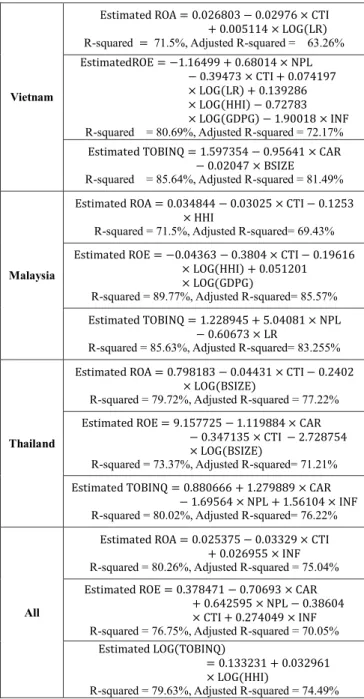
This section presents the results of 12 final regression models to determine the quantitative correlation between the regressands (i.e. ROA, ROE and Tobin‟s Q) and 08 regressors (i.e. CAR, NPL, CTI, LR, BSIZE, HHI, GDPG and INF) based on secondary data of four entities including 10 Vietnamese commercial banks, eight Malaysian commercial banks, nine Thai commercial banks as well as overall 27 commercial banks in these three countries over 5-year-period from 2012 to 2016.

Considering 12 new regression models (i.e. three FEMs in each case of four entities) stated above, it is clearly seen that the model of Vietnam (ROA) and model of Thailand (TOBINQ) are required to run through Wald Test to drop several statistically insignificant variables whereas all FEMs with data of eight Malaysian banks and 27 commercial banks of all nations are regarded as final

regression models because all independent variables in each model are statistically significant at a certain level of significance (1%, 5% or 10%).

4.1. Vietnamese Commercial Banks

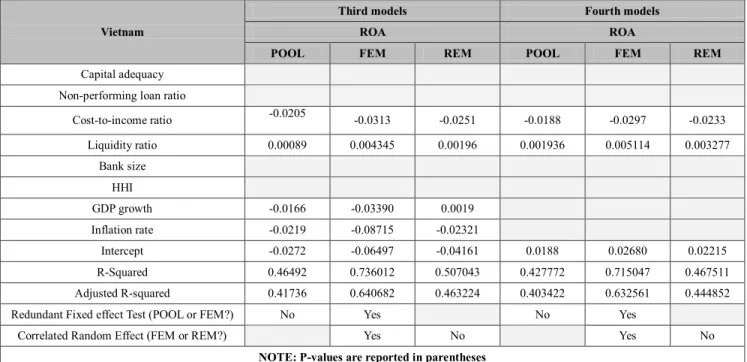
The third models are drawn from regression–ROA and significant independent variables. Three techniques are conducted step by step. After running Redundant Fixed Effect Test and Hausman Test, the appropriate model is proved to be FEM with greater value of Adjusted R-squared.

However, due to the existence of two insignificant variables in the third model including GDPG and INF, the fourth models are continuously built and tested to determine the relatively appropriate model through two mentioned tests.

The result reveals that Fixed Effect Model is the fourth model, also the final model, of Vietnamese commercial banks with dependent variable–ROA (see Table 5).

Table 5: Summary result of Third and Fourth Regression Models of Vietnamese commercial banks with dependent variable – ROA Vietnam

Third models Fourth models

ROA ROA

POOL FEM REM POOL FEM REM

Capital adequacy Non-performing loan ratio

Cost-to-income ratio -0.0205 -0.0313 -0.0251 -0.0188 -0.0297 -0.0233

Liquidity ratio 0.00089 0.004345 0.00196 0.001936 0.005114 0.003277

Bank size HHI

GDP growth -0.0166 -0.03390 0.0019

Inflation rate -0.0219 -0.08715 -0.02321

Intercept -0.0272 -0.06497 -0.04161 0.0188 0.02680 0.02215

R-Squared 0.46492 0.736012 0.507043 0.427772 0.715047 0.467511

Adjusted R-squared 0.41736 0.640682 0.463224 0.403422 0.632561 0.444852

Redundant Fixed effect Test (POOL or FEM?) No Yes No Yes

Correlated Random Effect (FEM or REM?) Yes No Yes No

NOTE: P-values are reported in parentheses

4.2. Thai and Malaysian Commercial Banks Similar steps are conducted gradually like those regarding Vietnamese banks. After running Wald Test to drop an insignificant variable, Log (GDPG) in second regression model (FEM) with regressand-TOBINQ, the third models are drawn from TOBINQ and the rest of significant independent variables including CAR, NPL, Log (HHI) and INF. The results of Redundant Fixed Effect Test and Hausman Test both support FEM as a relatively

appropriate third model thanks to greater value of Adjusted R-squared.

However, due to the existence of an insignificant

variable in the third model, Log (HHI), the fourth models

are continuously built and tested to determine the relatively

appropriate model through two mentioned tests. The result

reveals that Fixed Effect Model is the fourth model, also the

final model, of Thai commercial banks with dependent

variable-TOBINQ In a nutshell, the paper contains 12 final

regression equations which are gathered as follows (see

Table 6).

(8)

Table 6: Regression equations

Vietnam

Estimated ROA = 0.026803 − 0.02976 × CTI + 0.005114 × LOG(LR) R-squared = 71.5%, Adjusted R-squared = 63.26%

EstimatedROE = −1.16499 + 0.68014 × NPL

− 0.39473 × CTI + 0.074197

× LOG(LR) + 0.139286

× LOG(HHI) − 0.72783

× LOG(GDPG) − 1.90018 × INF R-squared = 80.69%, Adjusted R-squared = 72.17%

Estimated TOBINQ = 1.597354 − 0.95641 × CAR

− 0.02047 × BSIZE

R-squared = 85.64%, Adjusted R-squared = 81.49%

Malaysia

Estimated ROA = 0.034844 − 0.03025 × CTI − 0.1253

× HHI

R-squared = 71.5%, Adjusted R-squared= 69.43%

Estimated ROE = −0.04363 − 0.3804 × CTI − 0.19616

× LOG(HHI) + 0.051201

× LOG(GDPG)

R-squared = 89.77%, Adjusted R-squared= 85.57%

Estimated TOBINQ = 1.228945 + 5.04081 × NPL

− 0.60673 × LR

R-squared = 85.63%, Adjusted R-squared= 83.255%

Thailand

Estimated ROA = 0.798183 − 0.04431 × CTI − 0.2402

× LOG(BSIZE)

R-squared = 79.72%, Adjusted R-squared = 77.22%

Estimated ROE = 9.157725 − 1.119884 × CAR

− 0.347135 × CTI − 2.728754

× LOG(BSIZE)

R-squared = 73.37%, Adjusted R-squared= 71.21%

Estimated TOBINQ = 0.880666 + 1.279889 × CAR

− 1.69564 × NPL + 1.56104 × INF R-squared = 80.02%, Adjusted R-squared= 76.22%

All

Estimated ROA = 0.025375 − 0.03329 × CTI + 0.026955 × INF R-squared = 80.26%, Adjusted R-squared = 75.04%

Estimated ROE = 0.378471 − 0.70693 × CAR + 0.642595 × NPL − 0.38604

× CTI + 0.274049 × INF R-squared = 76.75%, Adjusted R-squared = 70.05%

Estimated LOG(TOBINQ)

= 0.133231 + 0.032961

× LOG(HHI)

R-squared = 79.63%, Adjusted R-squared = 74.49%

The above equations already tested the two kinds of error including Multicollinearity and Autocorrelation. The former is tested based on Auxiliary Regressions while the latter is examined in light of Durbin-Watson d test.

4. Discussion

Both similarities and differences are found among empirical results on the models of four entities.

Firstly, the most outstanding result is that all entities record the significantly negative relationship between operational risk and banking profitability. This finding is completely consistent with the paper‟s hypothesis and economic expectation since the raise in cost to income ratio implies the weak internal management of expenses and hence operating cost per amount of income may increase.

In other words, the higher the operational risk, the lower the banking profitability. Moreover, this negative relationship is consistent with the findings of Muriithi and Muigai (2017), Mathuva (2009), who studied Kenyan commercial banks, and Francis and Hess (2004), who researched a New Zealand-based retail bank.

Secondly, both Vietnamese and Thai commercial banks showed that bank size is negatively correlated with bank profitability, whereas the results from models of Malaysia and All three countries reveal there is no relationship between bank size and profitability as the proxy variable nature log of total assets is statistically insignificant. The empirical results on models of Vietnamese and Thai banks about the relationship between bank size and bank profitability are consistent with the findings of Redmond and Bohnsack (2007) and Kosmidou et al. (2006), in which their studies revealed that smaller banks showed own more outstanding performance than larger ones.

In terms of capital adequacy-profitability relationship, the opposite results are recorded in Thai models;, of which the model of ROE indicates the significantly negative relationship while the model of TOBINQ concluded to the a significantly positive association. Similar findings with the former model of Thailand are found in models of Vietnam and All three nations. By contrast, three models of Malaysia reveal that there is no relationship between capital adequacy and profitability of Malaysian commercial banks.

It can be clearly seen that the results arrived at from models of All three 03 nations, Vietnam and Thailand (ROE) completely contradict to the paper‟s hypothesis and the majority of traditional theories. To be more specific, the negative capital adequacy-profitability relationship is only supported by capital structure irrelevance theory of Modigliani and Miller (1958), in which Berger (1995b) explained that when the proportion of debt is substituted by equity, CAR increases leading to risks reduction and hence market rate of return on securities will lower. However, it is only true for perfect capital market. Under the imperfect capital market, this relationship is proved to be positive by several theories including expected bankruptcy cost hypothesis, signaling theory, franchise-value hypothesis and buffer theory which are all stated in Literature Review.

Next, three models of Vietnam (ROE), Malaysia

(TOBINQ) and All three countries (ROE) realize the

positive association between credit risk and bank

profitability while only model of Thailand (TOBINQ) does

(9)

imply the negative relationship between them. The findings of Noman et al. (2015), Kolapo et al. (2012) and Ruziqa (2013) are consistent with the conclusion of the Thai model rather than the three formers. It was proved that the main income stream of a bank comes from credit-granting activities, therefore, when a bank is exposesd to credit risk, the gross profit of a bank will be affected adversely.

When it comes to liquidity risk-profitability relationship, there are three different results. While the significantly negative relationship is found in models of Vietnam (ROA and ROE), model (TOBINQ) of Malaysia reveals the inverse relationship. No relationship is implied in models of Thailand and All three 03 nations. Supporting the results on model of Vietnam, Bourke (1989) who researched on 90 banks from 1972 to 1981 over 12 countries in Europe demonstrated that the more the liquidity risk is, the less the bank‟s profitability. Conversely, the findings of Malaysia‟s model is consistent with a lot more researchers including Molyneux and Thornton (1992) as well as Demirgüç-Kunt et al. (2003), whose samples were on thousands of banks in a wide range of countries. They argued that highly liquid banks with high amount of cash and government securities may receive relatively low interest income under competitive market for deposits.

Likewise, the opposite results about the market concentration-bank profitability relationship are recorded between model of Vietnam (ROE), All 03 nations (TOBINQ) and two models of Malaysia (ROA and ROE).

With the conclusion of positive relationship, the finding on the model of Vietnam and All three nations is absolutely consistent with both the paper‟s expectation and SCP paradigm. The collusion hypothesis in SCP paradigm stated that a small number of banks may collude in order to gain greater interest rate charged on loans and lower cost paid on clients deposit. Thus, as the market tends to be more concentrated, the bank can be more profitable. However, a great number of researchers, for instance, Berger (1995a) and Athanasoglou et al. (2008) proved that SCP hypothesis is vague and came up with the insignificantly negative relationship between market concentration and bank profitability. They argued that when market is less concentrated (i.e. more competitive), profitability should have decreased; however, with the improvement in management, the profitability is enhanced. As a result, the findings on model of Malaysia is not totally consistent with those of Berger (1995a) and Athanasoglou et al. (2008) because it reveals the significantly negative relationship between HHI and both ROA and ROE.

The negative relationship between business cycle and bank profitability is found on the model of Vietnam (ROE) while the inverse is recorded on the model of Malaysia (ROE). All models of Thailand and All three nations reveal no correlation between them. The finding of Vietnam‟s

model is consistent with the paper‟s expectation, which assumes that the reduction in return from investment of a bank is followed by the stability in economic environment due to strong growth in GDP. Conversely, the positive relationship between GDP growth and profitability indicators found in the model of Malaysia is consistent with the empirical results of Demirgüç-Kunt and Huizinga (2000) who studied on all OECD and developing countries. They explained that as business cycle is in upper phase, the coefficient of cyclical output is considerable and vice versa.

Finally, the empirical results for significantly positive inflation-profitability relationship is captured on models of Thailand and All thee nations, whereas the negative association is recorded on the model of Vietnam (ROE), of which the the formers are supported by both the paper‟s hypothesis and a number of studies. To be more specific, Athanasoglou et al. (2008) revealed some evidence that, when inflation is well-anticipated by bank management, abnormal profits can be obtained since there is an asymmetric information between bank and customers leading to the fact that a bank can regulate properly interest rate charged on loans and deposits.

5. Conclusion

Profitability is considered as the key objectives of every organization in order to survive and develop in the competitive world. Thus, the studies of determinants affecting profitability are getting more and more vital since they are served as the references not only for management of a business, but also for regulatory entities in conducting proper policies to become a profitable enterprise.

The paper provides three outcomes, which are also three main objectives. Firstly, it provides an overview of banking structures in Vietnam, Malaysia and Thailand. In general, despite the complexity in the banking structures, these three nations share the most outstanding similarity, which is the dominance of commercial banks, accounting for over three quarters of total assets of each banking sector on average, especially domestic-incorporated commercial banks.

Moreover, the whole financial market in each country is led by the biggest commercial banks. At the end of 2016, the top four Vietnamese commercial banks were Agribank, BIDV, Vietinbank and Vietcombank, while the “Big 4”

banks in Malaysia are Maybank, Public Bank, CIMB Bank

and RHB Bank. Likewise, the Thai financial system also

possesses “Big 4” banks, namely, Bangkok Bank, Krung

Thai, Kasikornbank and Siam Commercial Bank. Next, the

study presented a the comparison of 5-year-performance of

commercial banks among three countries from 2012 to

2016, in which Vietnamese banks are assessed to be

(10)

relatively immature and underdeveloped compared to commercial banks of the other two nations.

Secondly, the paper identifies the factors driving profitability in commercial banks of Vietnam, Malaysia and Thailand as well as analyzes the descriptive statistics of those factors. Particularly, ROA, ROE and TOBINQ are defined as profitability indicators which are impacted by three main variables, namely bank-specifics which include CAR, NPL, CTI, LR and BSIZE, industry-specific variable- HHI and macroeconomic-specific variables which consist of GDPG and INF. The descriptive statistics show that commercial banks in Vietnam own minimum rates of ROA, ROE, CAR, Bank size and maximum rates of NPL, CTI, INF which demonstrates that profitability, efficiency and soundness of Vietnamese banks are relatively low compared to Thailand and Malaysia.

The final outcome, which refers to the evaluation of the relationship between profitability and those determinants on panel data of four entities, namely, 10 commercial banks in Vietnam, eight banks in Malaysia, nine Thai commercial banks and all 27 commercial banks from 2012 to 2016, is obtained by applying three estimation techniques including Panel Ordinary Least Square, Fixed Effect Model and Random Effect Model as well as several necessary tests.

Eventually, similarities and differences are identified among empirical results on the models of four entities, of which several are consistent with traditional theories and this paper‟s expectation while some of the findings contradict to either or both of them.

The most outstanding similarity is that all entities record the significantly negative relationship between operational risk and banking profitability which is also consistent with the evidences from other researchers. Therefore, it can be implied that profitability of banking sector in different part of the world is affected adversely by the increase in operational exposure. Meanwhile, the most controversial result comes up with the negative relationship between CAR and profitability indicators which are found on the models of Vietnam (TOBINQ), Thailand (ROE) and All three 03 nations (ROE). This negative relationship contradicts to almost of traditional theories and recent studies.

From those findings, it is recommended that management in commercial banks of each country should control operating expenses properly so that operational exposure can be minimized and hence the objective of being a profitable bank can be reached. Besides, Vietnamese commercial banks should consider the sufficient amount of liquid assets; otherwise, the profitability will be adversely affected. Last, but not least, despite the contradiction between empirical results and traditional theories, and the evidences from other regions in the world, the negative relationship between capital

adequacy and profitability imply that commercial banks in three countries should maintain capital just adequate at the level that regulatory entities require so that no longer does breaching cost exist; moreover, a bank can take advantage of capital to invest in profitable projects.

References

Athanasoglou, P., Brissimis, S., & Delis, M. (2008). Bank-specific, Industry-specific and Macroeconomic Determinants of Bank Profitability. Journal of International Financial Markets, Institution and Money, 18(2), 121-136.

Barnor, C., & Odonkor, T. A. (2012). Capital Adequacy and the Performance of Ghanaian Banks. Journal of Business Research, 6(2), 105–117.

Baxter, N. D. (1967). Leverage, the Risk of Ruin and the Cost of Capital. Journal of Finance, 22(3), 395-403.

Berger, A. (1995a). The Profit–Structure Relationship in Banking:

Tests of Market Power and Efficient Structure Hypotheses‟.

Journal of Money, Credit and Banking, 27(2), 404–431.

Berger, A. (1995b). The Relationship between Capital and Earning in Banking. Journal of Money, Credit, and Banking, 27, 432- 456.

Berger, A., & Bonaccorsi, D. (2006). Capital structure and firm performance: A new approach to testing agency theory and an application to the banking industry. Journal of Banking &

Finance, 30, 1065-1102.

Bourke, P. (1989). Concentration and Other Determinants of Bank Profitability in Europe, North America, and Australia. Journal of Banking and Finance, 13(1), 65–79.

Calem, P. S., & Rob, R. (1999). The Impact of Capital-Based Regulation on Bank Risk-Taking. Journal of Financial Intermediation, 8(4), 317–352.

Demirgüç-Kunt, A., & Huizinga, H. (2000). Financial structure and bank profitability (Policy Research Working Paper No.2430). Retrieved from the World Bank website:

http://documents.worldbank.org/curated/en/364151468749353 823/Financial-structure-and-bank-profitability

Demirgüç-Kunt, A., Laeven, L., & Levine, R. (2003). The Impact of Bank Regulations, Concentration, and Institutions on Bank Margins (Policy Research Working Paper No. 3030).

Retrieved from the World Bank website:

http://documents.worldbank.org/curated/en/405981468739488 058/The-impact-of-bank-regulations-concentration-and- institutions-on-bank-margins.

DeYoung, R. (1997). A diagnostic test for the distribution-free efficiency estimator: An example using US commercial bank data. European Journal of Operational Research, 98(2), 243–

249.

Eichengreen, B., & Gibson, H. (2001). Greek Banking at the Dawn of the New Millennium (Discussion Paper 2791).

Retrieved from CEPR website:

https://cepr.org/active/publications/discussion_papers/dp.php?

dpno=2791.

Francis, G., & Hess, K. (2004). Cost Income Ratio Benchmarking

in Banking: A Case Study Benchmarking. International

Journal, 11(3), 303-319.

(11)

Goddard, J., Molyneux, P., & Wilson, J. O. S. (2004). The Profitability of European Banks: A Cross-Sectional and Dynamic Panel Analysis. The Manchester School, 72(3), 363–

381. https://doi.org/10.1111/j.1467-9957.2004.00397.x.

Islam, M., & Nishiyama, S. (2016). The Determinants of Bank Profitability: Dynamic Panel Evidence from South Asian Countries. Journal of Applied Finance & Banking, 6(3), 1-6.

Kolapo, T. F., Ayeni, R. K., & Oke, M. O. (2012). Credit risk and commercial banks‟ performance in Nigeria: A panel model approach. Australian Journal of Business and Management Research, 2(2), 31-38.

Kosmidou, K., Pasiouras, F., Doumpos, M., & Zopounidis, C.

(2006). Assessing Performance Factors in the UK Banking Sector: A Multicriteria Approach. Central European Journal of Operations Research, 14(1), 25-44.

Mathuva, D. (2009). Capital Adequacy, Cost Income Ratio and the Performance of Commercial Banks: The Kenyan Scenario.

The International Journal of Applied Economics and Finance, 3(2), 35-47.

Mathuva, D. (2016). Revenue Diversification and Financial Performance of Savings and Credit Co-Operatives in Kenya.

Journal of Co-Operative Organization and Management, 4(1), 1–12. DOIDoi: 10.1016/j.jcom.2015.11.001.

Modigliani, F., & Miller, M. H. (1958). The Cost of Capital, Corporation Finance and the Theory of Investment. The American Economic Review, 49(4), 655-669.

https://www.jstor.org/stable/1812919.

Molyneux, P., & Thornton, J. (1992). Determinants of European bank profitability: A Note. Journal of Banking and Finance, 16, 1173–1178.

Muriithi, J., & Muigai, R. (2017). Quantitative analysis of Operational Risk and Profitability of Kenyan Commercial Banks using Cost Income Ratio. IOSR Journal of Economics and Finance, 8(3), 76-83.

Nguyen, T. N. L., & Nguyen, V. C. (2020). The Determinants of Profitability in Listed Enterprises: A Study from Vietnamese Stock Exchange. Journal of Asian Finance, Economics and

Business, 7(1), 47-58.

https://doi.org/10.13106/jafeb.2020.vol7.no1.47

Noman, A., Pervin, S., Chowdhury, M., & Banna, H. (2015). The Effect of Credit Risk on the Banking Profitability: A Case on Bangladesh. Global Journal of Management and Business

Research, 15(3). Retrieved from

https://globaljournals.org/GJMBR_Volume15/5-The-Effect-of- Credit-Risk.pdf.

Ochei, I. (2013). Capital adequacy, management and performance in the Nigerian commercial bank (1986 - 2006). African Journal of Business Management, 7(30), 2938–2950. DOIoi:

10.5897/AJBM09.258.

Ramlall, I. (2009). Determinants of Capital Structure among Non- Quoted Mauritian Firms under Specificity of Leverage:

Looking for a Modified Pecking 88 Order Theory.

International Research Journal of Finance and Economics, 31, 83-92.

Redmond, J., & Bohnsack, L. (2007). Bank size and profitability:

one nation, one bank. International Journal of Business Research, 8(1), 162-172.

Shim, J. (2010). Capital-based Regulation, Portfolio Risk and Capital Determination: empirical evidence from the U.S.

property liability insurers

수치

Table  1  gives  statistics  on  10  commercial  banks  in  Vietnam over five years, thus a number of 50 observations
Table 3 presents statistics on nine commercial banks in  of  Thailand  from  2012  to  2016,  a  number  of  45  observations
Table 5: Summary result of Third and Fourth Regression Models of Vietnamese commercial banks with dependent variable – ROA  Vietnam
Table 6: Regression equations

참조

관련 문서

Fourth, as the information technology is developed due to the fourth industrial revolution and the proportion of information technology in the commercial

Programs such as the Retail Product Program in the midstream sector , the Home Energy Efficiency Program in the household sector, and the EnergySmart Grocer Program in

The proposal of the cell theory as the birth of contemporary cell biology Microscopic studies of plant tissues by Schleiden and of animal tissues by Microscopic studies of

It considers the energy use of the different components that are involved in the distribution and viewing of video content: data centres and content delivery networks

After first field tests, we expect electric passenger drones or eVTOL aircraft (short for electric vertical take-off and landing) to start providing commercial mobility

1 John Owen, Justification by Faith Alone, in The Works of John Owen, ed. John Bolt, trans. Scott Clark, "Do This and Live: Christ's Active Obedience as the

Therefore, the main contributions of this paper can be summarized as the following. 1) This paper focuses on the manned SNs receive information from RMHs through the

The concentration of the dissolved metal as well as that of the adsorbed to solid particles depends mainly on the concentration of the metal in the inflow water