pISSN 1738-6640 eISSN 2234-4020 http://dx.doi.org/10.6114/jkood.2016.29.4.024
Original Article / 원저
Anti-Inflammatory Effects of Tongbi-san (通痺散) Extract on RAW264.7 Macrophages
Yong-Min Kim
1)·Hee-Taek Kim
2)·Ee-Hwa Kim
3)1
School of Oriental Medicine and Bio Convergence Sciences, Semyung University
2
Dept. of Korean Medical Ophthalmology & Otolaryngology & Dermatology, College of Korean Medicine, Semyung University
3
Dept. of Meridian & Acupoint, College of Korean Medicine, Semyung University
통비산(通痺散) 열수추출물의 항염증반응 및 항산화활성에 대한 연구
김용민
1)·김희택
2)·김이화
3)1 세명대학교 한방바이오융합과학부
2 세명대학교 한의과대학 한방안이비인후피부과학과
3 세명대학교 한의과대학 경락경혈학교실
Abstract
Objectives : This study is to investigate the anti-inflammatory and anti-oxidant effects of Tongbi-san extract (TS) on RAW264.7 macrophages using by cell cytotoxicity, Nitric Oxide (NO) and Prostaglandin E
2(PGE
2) production and 1,1-diphenyl-2-picryl ghdrazyl (DPPH) free radical scavenging capability.
Methods : Cell cytotoxicity was measured by 3-(4,5-dimethylthiazol-2-yl)-2,5-diphenyltetrazolium bromide (MTT) assay. The production of NO was measured by Griess assay. The production of PGE
2was measured by immunoassay. And the anti-oxidant activity was measured by the DPPH method.
Results : TS did not increased significantly compared to the TS untreated group in the cell cytotoxicity. TS inhibited NO and PGE
2production in lipopolysaccharide-stimulated RAW 264.7 cells. TS had the DPPH free radical scavenging capability.
Conclusion : The anti-inflammtory and anti-oxidant effects of TS may be use for a treatment of anti-inflammatory diseases.
Key words : Anti-inflammation; Anti-oxidant activity; Nitric Oxide; Prostaglandin E
2; reactive oxygen species;
Tongbi-san
ⓒ 2016 the Society of Korean Medicine Ophthalmology & Otolaryngology & Dermatology
This is an Open Access journal distributed under the terms of the Creative Commons Attribution Non-Commercial License (http://creativecommons.org/license/by-nc/3.0/) which permits unrestricted non-commercial use, distribution, and reproduction in any medium, provided the original work is properly cited.
Ⅰ. Introduction
Traditional medicine is an important natural source of phytochemical compounds with substantial therapeutic effects and represents the primary health resource to many people
1). World Health Organization (WHO) estimates that 80 % of people indeveloping countries use traditional medicine as primary healthcare
2). Therefore, it is important to assess and validate the traditional effects of plants to assure people that consume them
3).
Inflammation is a local, protective response of the immune system. Excessive inflammatory responses can be harmful, as in diseases such as rheumatoid arthritis, Alzheimer’s disease and septic shock syndrome
4). Lipopolysaccharide (LPS), a component of the cell wall of Gram-negative bacteria, stimulates macrophages to produce pro-inflammatory mediators such as tumor necrosis factor alpha, interleukin-6, and inducible nitric oxide synthase, which trigger a cascade responsible for the inflammatory response
5). Antioxidants can protect against the damage caused by free radicals that have been implicated in the etiology of large number of major diseases
6).
Nitric oxide (NO) is synthesized from amino acid, arginine, by nitric oxide synthase (NOS). NO plays an important role as a vasodilator, neurotransmitter and in the immunological system as a defense against tumor cells, parasites and
bacteria
7). However, NO production is increased by the inducible isoform of NOS (iNOS), subsequently, brings about cytotoxicity and tissue damage
8). Therefore, much attention has focused on how to decease the NO production generated by iNOS.
In addition, cyclooxygenase 2 (COX-2) is the rate limiting enzyme and responsible for the catalysis of prostaglandin E
2(PGE
2) from arachidonic acid
9). Chang et al. noted that the induction of COX-2 activity and subsequent generation of PGE
2are closely related to the NO production
10). Thus, reduce the levels of PGE
2and the levels of COX-2 may be an effective strategy for inhibiting the inflammation and carcinogenesis.
Tongbi-san (TS) has been used in pain control, improve blood circulation, and mediate injury healing. It is consistently used in the clinical treatment of pain and bone injury
11). In the present study, protective effect of Tongbi-san on the effects of anti-inflammation and and-oxidation by modulation of nitric oxide and PGE
2production in LPS-stimulated RAW264.7 macrophages were investigated.
Ⅱ. Materials & Methods
1. Cell culture
Cells of the murine macrophage RAW 264.7 were purchased from the Korean Cell Line Bank (KCLB, Seoul, Korea). Cells were cultrued in Dulbecco’s Modified Eagle Medium (DMEM) (Gibco BRL, Grand Island, NY, USA) supplemented with 10% heat-inactivated fetal
Corresponding Author : Ee-Hwa Kim, Dept. of Meridian & Acupoint, College of Korean Medicine, Semyung University, 65 Semyung-ro, Jecheon, Chungbuk, Korea.
(Tel : 043-649-1348, E-mail : [email protected])
∙
Recieved 2016/9/26∙
Revised 2016/11/3∙
Accepted 2016/11/10bovine serum (FBS) (Gibco BRL) at 37℃ in 5%
CO
2, 95% O
2in a humidified cell incubator. Cells were plated in culture dish (Corning Incorporated, Corning, NY, USA) at a density of 1 × 10
6cells per dish, and the media was changed once every 2 days.
2. Preparation of extract
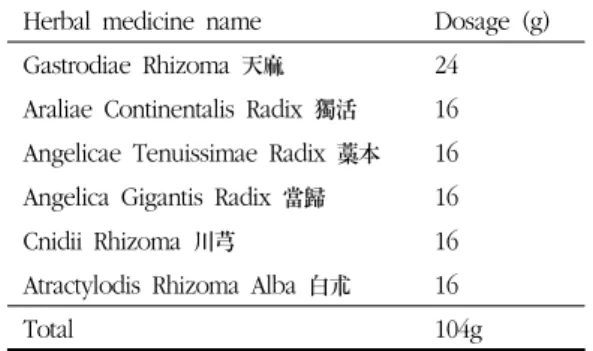
Tongbi-san (TS) were obtained from Semyung Korean medical hospital (Chungbuk, Korea). The procedure in brief is as follow: each medicinal plants were performed reflux extraction with distilled water (D.W) for 3 h at 100℃. Filtration and evaporation were performed with rotary vacuum evaporator (N-N series, EYELA, Japan) at 60℃. The solution was freeze dried for 24 h at 80℃ and lyophilized to yield. The composition and dosage of Tongbi-san (TS) are epitomized in Table 1.
Herbal medicine name Dosage (g) Gastrodiae Rhizoma 天麻 24 Araliae Continentalis Radix 獨活 16 Angelicae Tenuissimae Radix 藁本 16 Angelica Gigantis Radix 當歸 16
Cnidii Rhizoma 川芎 16
Atractylodis Rhizoma Alba 白朮 16
Total 104g