• 검색 결과가 없습니다.

A Case of Severe Hypercalcemia Causing Acute Kidney Injury: An Unusual Presentation of Acute Lymphoblastic Leukemia

N/A
N/A
Protected

Academic year: 2021

Share "A Case of Severe Hypercalcemia Causing Acute Kidney Injury: An Unusual Presentation of Acute Lymphoblastic Leukemia"

Copied!
5
0
0

로드 중.... (전체 텍스트 보기)

전체 글

(1)

DOI: https://doi.org/10.3339/jkspn.2017.21.1.21 ISSN 2384-0250 (online)

A Case of Severe Hypercalcemia Causing Acute Kidney Injury: An Unusual Presentation of Acute Lymphoblastic Leukemia

Severe hypercalcemia is rarely encountered in children, even though serum calcium concentrations above 15-16 mg/dL could be life-threatening. We present a patient having severe hypercalcemia and azotemia. A 14-year-old boy with no significant past medical history was referred to our hospital with hypercalcemia and azotemia. Laboratory and imaging studies excluded hyperparathyroidism and solid tumor. Other laboratory findings including a peripheral blood profile were unremarkable. His hypercalcemia was not improved with massive hydration, diuretics, or even hemodialysis, but noticeably reversed with administration of calcitonin. A bone marrow biopsy performed to rule out the possibility of hema- tological malignancy revealed acute lymphoblastic leukemia. His hypercalcemia and azotemia resolved shortly after initiation of induction chemotherapy. Results in this patient indicate that a hematological malignancy could present with severe hypercalcemia even though blast cells have not appeared in the peripheral blood.

Therefore, extensive evaluation to determine the cause of hypercalcemia is ne- cessary. Additionally, appropriate treatment, viz., hydration or administration of calcitonin is important to prevent complications of severe hypercalcemia, including renal failure and nephrocalcinosis.

Key words: Hypercalcemia, Acute kidney injury, Azotemia, Leukemia

Hye Sun Hyun, M.D. 2 Peong Gang Park, M.D. 2 Jae Choon Kim, M.D. 2 Kyun Taek Hong, M.D. 2 Hyoung Jin Kang, M.D., Ph.D. 2 Kyung Duk Park, M.D., Ph.D. 2 Hee Young Shin, M.D., Ph.D. 2 Hee Gyung Kang, M.D., Ph.D. 1 Il Soo Ha, M.D., Ph.D. 1

Hae Il Cheong, M.D., Ph.D. 1

Departments of Pediatrics

1

, Seoul National University Children’s Hospital, Department of Pediatrics

2

, Cancer Research Institute, Seoul National University College of Medicine, Seoul, Korea

Corresponding author:

Hee Gyung Kang, M.D., Ph.D.

Department of Pediatrics, Seoul National University Children’s Hospital, 101 Dea hangno, Jongno-gu, Seoul, 03080, Republic of Korea

Tel: +82-2-2072-0658 Fax: +82-2-2072-0274 E-mail: [email protected] Received: 24 November 2016 Revised: 3 March 2017 Accepted: 8 March 2017

This is an open-access article distributed under the terms of the Creative Commons Attribu tion Non-Commercial License (http://

crea tivecom mons.org/licenses/by-nc/4.0/) which permits unrestricted non-commercial use, distribution, and reproduction in any medium, provided the original work is properly cited.

Copyright © 2017 The Korean Society of Pediatric Nephrology

Introduction

Severe hypercalcemia is anuncommon problem in children. It is defined as serum calcium (Ca) concentration higher than 12 mg/dL and is often associ­

ated with nonspecific symptoms such as lethargy, depression, anorexia, nau­

sea, vomiting, polyuria and polydipsia. Patients with serum Ca concentra­

tions >15 mg/dL can develop renal failure or cardiovascular abnormalities

with arrhythmias and coma. Most of the Ca in the body is stored in the bone,

and serum Ca levels are regulated mainly by parathyroid hormone (PTH),

vitamin D, and calcitonin via bony uptake of Ca (increased by PTH and

vitamin D, decreased by calcitonin) or resorption of the bone, and renal Ca

reabsorption (increased by PTH, decreased by calcitonin) along with intestinal

uptake of Ca (vitamin D). Therefore when there is hypercalcemia, impairment

of bone uptake of the Ca, an increase inbone resorption or impairment of renal

(2)

handling of Ca should be suspected

1,2)

. The most common cause of hypercalcemia is primary hyperparathyroidism in the outpatient clinic and malignancy in hospitalized patients

3,4)

.

Malignancy­associated hypercalcemia can be attributed to three mechanisms; osteolysis from direct invasion of the skeleton by tumor cells, increased osteoclastic bone resorption via tumor production of circulating (humoral) factors, and absorptive hypercalcemia from excessive vita­

min D activation by the neoplasm

5,6)

. While the incidence of malignancy­associated hypercalcemia is about 10­20%

in adults, hypercalcemia is rare in pediatric cancer patients with incidence less than 1%. Malignancy­associated hyper­

calcemia in children has been reported with rhabdomyo­

carcoma, leukemia, lymphoma, multiple myeloma, neuro­

blastoma, hepatocellular carcinoma, and brain tumors. In pediatric acute lymphoblastic leukemia (ALL), hypercal­

cemia has been reported as the initial manifestation of the malignancy, before the appearance of blasts in the peri­

pheral blood smear

7)

. We reported a case of acute leukemia, where the initial presentation was markedly elevated serum Ca levels and acute renal injury.

Case report

A 14­year­ old boy was referred to our hospital with hy­

percalcemia and azotemia. For last three months, the pati­

ent had complained of fatigue, headache, polyuria and polydipsia, which had gradually worsened. During this period, the patient had lost 9 kg of body weight. On physical examination, his height was 177 cm (>97 percentiles) and his body weight was 54 kg (25­50 percentiles). His blood pressure was 133/67 mmHg, pulse rate 186 per minute, re­

spiratory rate 20 per minute, and body temperature 36.3℃.

The patient was lethargic and he showed pale conjunctivae without lymphadenopathy or hepatosplenomegaly. On mental status examination, he was very irritable and unco­

operative while his orientation was intact. Initial laboratory evaluation revealed severe hypercalcemia (Ca, 16.5 mg/dL;

ionized Ca, 1.93 mmol/dL), azotemia (BUN, 39 mg/dL; crea­

tinine, 2.05 mg/dL) and mild pancytopenia (white blood cell, 2,350/mm

3

; hemoglobin, 9.1 g/dL; platelet, 115,000/uL).

Serum phosphrous level was 4.9 mg/dL and 25­hydroxy­

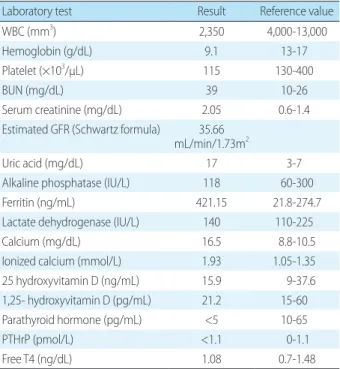
vitamin D level was 15.9 ng/mL. PTH level (<5 pg/mL) was adequately suppressed and Parathyroid hormone­related peptide (PTHrP) was not elevated (<1.1 pmol/L, reference level; <1.1 pmol/L). Laboratory data shown in table 1. On peripheral blood smear, nonspecific findings were reported except mild leukopenia and thrombocytopenia. Chest ra­

diograph was normal. In abdominal ultrasono graphy, no remarkable findings were observed in abdominal organs in cluding bothkidneys. Despite severe hypercalce mia, there were no significant electrocardiograhic changes.

Bone X­ray showed rarefaction along the metaphyseal line suggesting osteopenia.

He was treated with massive intravenous normal saline hydration of 200 mL per hour and furosemide. He had an adequate urine output (4.5 cc/kg/hr). After 12 hours of treatment, serum ionized Ca level was stillelevated (1.87 mmol/L). Hemodialysis was performed using a low­Ca dialysate to relieve hypercalcemia. However, serum Ca level did not decrease and surged up to 18.0 mg/dL. On the fifth day of hospitalization, intravenous calcitonin (2 IU/

kg/dose, every 12 hours) was administered, which reduced Ca levels progressively (Fig. 1). His irritability markedly improved with stabilization of Ca level and his azotemia was also ameliorated. Imaging evaluation revealed increased

Table 1. Laboratory Findings on Hospitalization

Laboratory test Result Reference value

WBC (mm

3

) 2,350 4,000-13,000

Hemoglobin (g/dL) 9.1 13-17

Platelet (×10

3

/µL) 115 130-400

BUN (mg/dL) 39 10-26

Serum creatinine (mg/dL) 2.05 0.6-1.4

Estimated GFR (Schwartz formula) 35.66 mL/min/1.73m

2

Uric acid (mg/dL) 17 3-7

Alkaline phosphatase (IU/L) 118 60-300

Ferritin (ng/mL) 421.15 21.8-274.7

Lactate dehydrogenase (IU/L) 140 110-225

Calcium (mg/dL) 16.5 8.8-10.5

Ionized calcium (mmol/L) 1.93 1.05-1.35

25 hydroxyvitamin D (ng/mL) 15.9 9-37.6

1,25- hydroxyvitamin D (pg/mL) 21.2 15-60

Parathyroid hormone (pg/mL) <5 10-65

PTHrP (pmol/L) <1.1 0-1.1

Free T4 (ng/dL) 1.08 0.7-1.48

Abbreviations: WBC, white blood cells; BUN, blood urea nitrogen; PTHrP,

parathyroid hormone-related peptide.

(3)

uptake in the left 9th rib and right distal tibia on bone scan (Fig. 2) and focal cortical discontinuity at the left 9th rib on chest CT. Abdominal CT and brain MRI were unre­

markable. On 6th day, bone marrow aspiration and biopsy were performed and bone marrow smear revealed acute lymphoblastic leukemia (ALL). Leukemia marker study was also consistent with early precursor B cell type ALL.

On the eighth day of hospitalization, induction chemothe­

rapy for ALL was started. His hypercalcemia and azotemia were completely resolved on the third day of chemotherapy.

Discussion

Here we report a case of severe hypercalcemia accom­

panying azotemia as initial manifestation of ALL. Com­

monly, increase in bone resorption leads to hypercalcemia, primarily from hyperparathyroidism and malignancy

1,2)

.

Our case had appropriately suppressed PTH levels, indica­

ting that his hypercalcemia was not PTH­dependent.

There fore, other causes such as malignancy should be suspected,and bone imaging studies for malignancy, bone marrow examination, PTHrP measurement were done.

PTHrP is the most commonly identified humoral factor that causes hypercalcemia of malignancy, accounting for that approximately 80% of malignancy­associated hyper­

calcemia is due to the effect of PTHrP

4,8)

. However, our pa­

tient had a normal PTHrP level suggesting that osteolytic factors other than PTHrP might lead to hypercalemia, since eventually the patient was diagnosed with malignacy, and chemotherapy targeting leukemia of this case resolved his hypercalcemia along with hypercalcemic symptoms. At presentation, our case had osteopenia, therefore, osteolysis from direct invasion by leukemic cells might be the primary cause of hypercalcemia in this case, rather than humoral factor. The first symptoms of leukemia are usually non­

Fig. 1. Serum calcium levels during hospitalization: black bars, hemodialysis; dotted line, serum calcium reference value.

Fig. 2. Bone scan findings: Increased uptake in the lateral arch of left ninth rib, with blunting

growth palate in distal right tibia.

(4)

specific. Bone pain, arthritis and limping can occur in leu­

kemia children without blats on peripheral blood. It can lead to delayed diagnosis.

Our case also showed mild azotemia along with poly­

dipsia and polyuria (3 L/day) at presentation as a symptom of severe hypercalcemia. Polyuria by hypercalcemia results from suppression of aquaporin­2 at the apical plasma mem­

brane of the collecting duct and resorption of sodium and chloride in the loop of Henle via Ca sensing receptor of the kidney, reducing urinary concentrating ability

9,10)

. Thus, patients with hypercalcemia are usually volume­depleted, which might lead to a reduction in the glomerular filtration rate (GFR) and Ca clearance.Therefore, the initial goal of therapy is restoration of extracelluar fluid volume and GFR, with 0.9% saline by intravenous at 200­500 mL per hour

5)

. In our case, initial hydration was not effective, par­

tially because loop diuretics was also administered along with hydration. Although loop diuretics can ameliorate mild hypercalciuria via increased Ca loss through tubule, it can cause dehydration, leading to a decline in GFR and the filtered load of Ca. Thus, loop diuretics should be ad­

ministered after full hydration has been achieved.

To ameliorate severe hypercalcemia and azotemia, he­

modialysis was applied in this case. However, removing serum Ca using dialysis was transient, insufficient effect;

while dialysis using low­Ca dialysate is a reasonable option for patients with acute hypercalcemia and significant acute kidney injury, dialysis is not a fundamental therapy in a setting of ongoing resorption of bone

11)

. Rapid reduction in bone resorption can be achieved by calcitonin, inhibiting osteoclast bone resorption and increasing urinary excre­

tion of Ca, resulting in reduction of serum Ca levels within six hours after dosing, as shown in our case (Fig. 1). How­

ever, the effect of calcitonin is transient, with a mean dura­

tion of effect of from two to 4 days

12)

. Therefore, either long­

acting therapy such as bisphosphonates or elimination of primary cause of hypercalcemia, namely ALL for our case, is indicated along with calcitonin. After the confirmation of ALL, our patient was treated with chemotherapy, and­

high­dose corticosteroid. Hypercalcemia was completely resolved, and renal function was also normalized. Cortico­

steroids are known to inhibit 1α­hydroxylase conversion of 25­hydroxyvitamin D to calcitrio

l5)

, therefore,especially effective in hypercalcemia associated with vitamin D

excess. On the other hand, bisphosphonates, a common treatment agent of malignancy­associated hypercalcemia, act by binding to Ca phosphate and inhibiting osteoclast activity, requiring two to four days for achieving signifi­

cant effect

13,14)

. In addition, bisphosphonates are eliminated unchanged by renal excretion and have potential to induce glomerulosclerosis, physicians are reluctant to use bispho­

sphonates in patients with renal impairment, and their dosing must be adjusted for impaired renal function to avoid toxicity

15)

. In our case, bisphosphonates were con­

sidered but eventually not necessary.

We report one patient with ALL, where severe hyperc­

alcemia associated with acute renal failure was the unusual presentation.

Conflicts of interest

No potential conflict of interest relevant to this article was reported.

Acknowledgement

This study was supported by a grant (HI12C0014) from the Korean Health Technology Research &Development Project, Ministry of Health & Welfare, Republic of Korea.

References

1. Mundy GR, Guise T a. Hormonal control of calcium homeostasis.

Clin Chem 1999;45:1347-52.

2. Ravi C, Assunta A, Disorders of calcium homeostasis. In; Elzouki AY,Harfi HA, Nazer H, William OH, Stapleton FB, Whitley RJ, editors, Textbook of Clinical Pediatrics. 2nd ed. NewYork: Springer, 2012;

3611-6.

3. Makras P, Papapoulos SE. Medical treatment of hypercalcaemia.

Hormones 2009;8:83-95.

4. Stewart AF. Hypercalcemia associated with cancer. N Engl J Med 2005;352:373-9.

5. Rosner MH, Dalkin AC. Onco-nephrology: The pathophysiology and treatment of malignancy-associated hypercalcemia. Clin J Am Soc Nephrol 2012;7:1722-9.

6. Shu ST, Dirksen WP, Weibaecher KN, Rosol TJ. Mechanisms of

Humoral Hypercalcemia of Malignancy in Leukemia/Lymphoma.

(5)

In; olga B, Sinia D, kimberly JP, editors. T-cell Leukemia. 3rd ed.

Croatia: InTech, 2002;181-94.

7. McKay C, Furman WL. Hypercalcemia complicating childhood malignancies. Cancer 1993;72:256-60.

8. Takami H. Hypercalcemic crisis. Textb Endocr Surg 2005:543-8.

9. Hasler U, Leroy V, Martin PY, Feraille E. Aquaporin-2 abundance in the renal collecting duct: new insights from cultured cell models. AJP Ren Physiol 2009;297:F10-8.

10. Riccardi D, Brown EM. Physiology and pathophysiology of the calcium-sensing receptor in the kidney. Am J Physiol Ren Physiol 2010;298:F485-99.

11. Argilés a, Kerr PG, Canaud BJM, Flavier JL, Charles Mion. Calcium

kinetics and the long-term effects of lowering dialysate calcium concentration. Kidney Int 1993;43:630-40.

12. Wisneski LA, Croom WP, Silva OL, Becker KL. Salmon calcitonin in hypercalcemia. Clin Pharmacol Ther 1978;24:219-22.

13. Davies JH, Shaw NJ. Investigation and management of hypercal- caemia in children. Arch Dis Child 2012;97:533-8.

14. Rogers MJ, Gordon S, Benford HL, Coxon FP, Luckman SP, Monk- konen J, et al. Cellular and molecular mechanisms of action of bisphosphonates. Cancer 2000;88:2961-78.

15. Toussaint ND, Elder GJ, Kerr PG. Bisphosphonates in chronic

kidney disease; balancing potential benefits and adverse effects

on bone and soft tissue. Clin J Am Soc Nephrol 2009;4:221-33.

수치

Table 1. Laboratory Findings on Hospitalization
Fig. 1. Serum calcium levels during hospitalization: black bars, hemodialysis; dotted line, serum  calcium reference value.

참조

관련 문서

It considers the energy use of the different components that are involved in the distribution and viewing of video content: data centres and content delivery networks

After first field tests, we expect electric passenger drones or eVTOL aircraft (short for electric vertical take-off and landing) to start providing commercial mobility

1 John Owen, Justification by Faith Alone, in The Works of John Owen, ed. John Bolt, trans. Scott Clark, &#34;Do This and Live: Christ's Active Obedience as the

Surface characteristics and structure of anodic oxide films containing Ca and P on a titanium implant material.. Preperation of bioactive metal via anodic

(2003), Nosocomial Infection of Malnourished Patients in an Intensive Care Unit. Anal ysis of Nutritional Support Status in the Intensive Care Unit. Korean J crit Ca re Med.

(d) displays the CA curves of the Ni2P2O7 electrocatalyst at an applied potential of 1.47 V (vs. • The steady-state CA curve acquired by the Ni 2 P 2 O 7 microsheets

Frequency and clinical significance of the expression of the multidrug resistance proteins MDR1/P-glycoprotein, MRP1, and LRP in acute myeloid leukemia: a

The main body of the study examines the linguistic origin and meaning of prāṇa as it is very important in yoga training and the meaning of prāṇāyāma in