• 검색 결과가 없습니다.

A Study on Comparison Analysis of the System Quality Factors between Korea and China Shopping mall Websites

N/A
N/A
Protected

Academic year: 2021

Share "A Study on Comparison Analysis of the System Quality Factors between Korea and China Shopping mall Websites"

Copied!
10
0
0

로드 중.... (전체 텍스트 보기)

전체 글

(1)

A Study on Comparison Analysis of the System Quality Factors between Korea and China Shopping mall Websites

Young-Jik Kwon

, Jun Cui

††

, Donghwoon Kwon

†††

ABSTRACT

This paper mainly focuses on the system quality factors of a website targeted at shopping mall web- sites in China and Korea. We categorized six system quality factors and formulated hypotheses regarding how those six factors are different. We also conducted an empirical study to verify hypotheses. Statistical data for an empirical study targeted at undergraduate students in Korea and China, having filled in a questionnaire. Reliability of the collected data was measured, and a T-test of the established hypotheses was carried out. The following describes the results that were found. While the shopping mall websites of two countries showed a difference in terms of quick transition of the web pages or images, ease of use, reliability, and accessibility, they did not show the difference in term of accuracy and the short cut function. We analyzed the causes of the verified results and suggested a strategy to implement the effective shopping mall web sites.

Key words: System quality of web sites, quick transition of the web pages or images, ease of use, reliability, accessibility, accuracy, short cut function

※ Corresponding Author : Donghwoon Kwon, Address : Corressponding Author, Doctorate of Applied Infor- mation Technology Department, Towson University, USA, TEL : +82-53-850-6581, FAX : +82-53-850-6589, E-mail : [email protected]

Receipt date : Apr. 12, 2013, Revision date : Sep. 10, 2013 Approval date : Oct. 8, 2013

†††

Professor, School of Computer & Information Technol- ogy Engineering, Daegu University, Korea

(E-mail: [email protected])

†††

Doctorate of Computer & Information Engineering Department, Daegu University, Korea

†††
Corressponding Author, Doctorate of Applied Infor- mation Technology Department, Towson University, USA

※This research was supported by the Daegu University Research Grant, 2012

1. INTRODUCTION

Web development techniques have improved rapidly as a result of the recent Internet environ- ment. There are various quality factors of the shopping mall websites, but system quality factors are considered the most important success factor among them. For this reason, it is required to im- plement shopping mall websites with consideration

of the best system quality factors that a customer wants in order to gain a competitive advantage.

Yet, the problem is that a level of the techniques and functions about the system quality factors of the currently running shopping mall websites is aimed at a developer rather than a customer so that there are various problems in terms of accessi- bility, error occurrence, ease of use, and so on.

Therefore, we conducted a questionnaire of the system quality factors targeted at the shopping mall websites in Korea and China. We also per- formed a difference analysis between system qual- ity factors through statistical analysis and sug- gested the strategies to implement the effective shopping mall websites.

2. RELATED WORK

2.1 Overview

Delon and Mclean (1992) suggested system

quality, information quality, and service quality as

the successful model of the information system [1].

(2)

System quality means the level of user awareness in terms of technical and functional quality of the website. They also pointed out that the shopping mall website should support user’s purchase activ- ity by providing quick response speed and con- venience functions as well as running reliably and accurately [2].

2.2 Literature research about the system quality factors of the shopping mall websites

DeLone and McLean suggested usability, func- tionality, reliability, flexibility, quality of data, in- tegrate, availability, adaptability, and response time as the technical and functional factors regard- ing system quality of the shopping mall websites [3]. Mckinney et al. (2002) introduced accessibility, usability, and navigation as technical factors, and system and transmission speed, immediate acces- sibility, ease of use, etc. as other technical factors.

While speed, reliability, and accessibility were im- portant in the early study of system quality, ease of usability is considered as the most important technical factor among them. It is therefore im- portant that users should choose the right system quality factors of the website [2]. Olsina (1999) used accessibility, speed, navigability, contents for assessing website quality [5]. Madu and Madu (2002) considered convenient website architecture, visual attraction, reliability, information storage, system integrity as website quality factors. Here, reliability means continuous update of the website and accurate information [6]. Liu and Amett (2000) proposed accuracy, completeness, appropriacy, re- liability, customization, interaction, usability, sys- tem speed, search function, and so on as website quality factors [7]. Misic and Johnson (1999) sug- gested information accessibility, website accessi- bility, system speed, functional creativity, ease of navigate, accuracy, webpage style and color, and so on as website quality factors [8]. Donthu (2001) categorized site related factors and supplier related factors as website quality factors in the empirical

study of SITEQUAL. Site related factors consisted of ease of use, esthetic design, system processing speed, reliability and security of personal in- formation, and so on [10]. Szymanski and Hise (2000) suggested website design, the convenience of the website structure, finance security, and so on. Huizingh (2002) introduced four factors of website success such as website accessibility, website design, visuality, and feasibility [10].

Liang and Chen (2009) suggested customization,

interactivity, cultivation, care, community, choice,

convenience and character, content, context and

infrastructure quality, complexity, novelty, inter-

activity, connectivity, information quality, playful-

ness and learning, technical adequacy, website de-

sign, order fulfillment, communication, merchan-

dising, security/privacy, promotion, transaction

speed, user-friendliness, and so on as website

quality factors [11]. Bai et al. (2008) considered re-

sponse time, ease of terminal use, content of the

database, aggregation of details, human factors,

system accuracy, data currency, turnaround time,

data accuracy, reliability, completeness, system

flexibility, ease of use, etc. as website system qual-

ity factors [12]. Jones and Kim (2010) proposed

fast, easy to navigate and easy to search for perti-

nent information, secure for monetary and in-

formation exchanges, consumer’s satisfaction,

emotions, communication, and so on as website

system quality factors [13]. Hartmann et al. (2008)

focused on usability to conduct a research about

information biases of website quality judgment

[14]. Gregg and Walczak (2010) identified numer-

ous website quality dimensions including infor-

mation quality, ease of use, usability, aesthetics,

and trust building technologies and emotional ap-

peal [15]. Lin (2010) defined accessibility, navi-

gability, response time, and learnability as system

quality factors [16]. Chou and Cheng (2012) cate-

gorized website quality as system quality, in-

formation quality, and service quality. Users with

more convenience, privacy, and faster responses

(3)

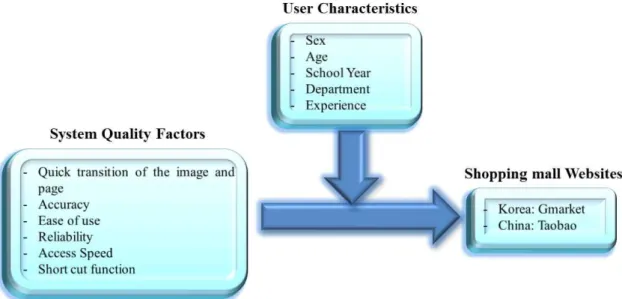
Fig. 1. The overall research model were considered for system quality, and especially,

they proposed accessibility, navigability, usability, and privacy [17]. Other researches have been also conducted for website quality [18-21]. Based on the references above, we selected a total of six: quick transition of the image and page, accuracy (error occurrence), ease of use, reliability, access speed, and short-cut function and conducted an empirical study.

3. EMPIRICAL STUDY

3.1 Overview

We first conducted a survey to verify how the system quality factors of the website were differ- ent bewteen shopping mall websites in Korea and China. The survey was filled out by 519 voluntary participants for 5 Chinese and 8 Korean websites from September, 2011 to December, 2011, and we conducted comparison analysis using the collected data. The targeted Chinese websites were www.

taobao.com, www.amazon.cn, www.dangdang.com, www.paipai.com, www.china.alibaba.com, and so on, and the targeted Korean websites were www.

lotteshopping.com, www.ehyundai.com, www.auc- tion. com, www.gmarket.com, www.interpark.com,

www.11st.co.kr, and so on. Since the numbers of respondents of the G market (www.gmarket.com, total 120 respondents) and the taobao website (www.taobao.com, total 96 respondents) were more than other websites, we selected both web- sites. At first, we conducted comparison analysis of both websites but realized that statistical analy- sis and types should be improved. For this reason, we supplemented them from March, 2012 to May, 2012 and used the SAS 9.2 package tool.

3.2 Research Model

The research model is shown in Figure 1.

3.3 The Frequency of User Characteristics

The number of respondents in the questionnaire survey were 120 for Gmarket (www.gmarket.com) and 96 for Taobao (www.taobao.co.kr). The fol- lowing Table 1 shows the frequency of user characteristics.

3.4 Reliability Coefficient

Since the alpha value of Cronbach is 0.8449

(higher than 0.70), the reliability of the ques-

tionnaire is very high. The following Table 2

(4)

Table 1. Detailed Statistical Analysis Results

User Characteristics Frequency (Persons) Missing Value

(Persons)

Gmarket Taobao

Sex Men

Women 63

57 52

41 3

Age <20

21~25 26~30

74 42 4

81 2

12 1

School Year

Freshmen Sophomore

Junior Senior Grad. Students

79 25 10 6 0

10 5 36 27 8

1

Dept.

Info. & Comm. Eng.

Econ. & B.A Admin.

Rehab. Sciences etc.

13 22 33 21 10 21

10 12 31 0 41 1

1

Experience Yes

No 116

4 91

3 2

The period of purchasing a product (Month)

1~2 3~4 Over 6 5~6

etc.

59 22 15 8 12

25 8 41 5 17

4 (2)

Table 2. The Value of the Correlation Coefficient

Pearson Correlation Coefficient

M1 M2 M3 M4 M5 M6

M1 1 0.46245 0.46084 0.40969 0.42854 0.44545

M2 N/A 1 0.41461 0.40741 0.51228 0.32328

M3 N/A N/A 1 0.53382 0.51429 0.49963

M4 N/A N/A N/A 1 0.58106 0.51346

M5 N/A N/A N/A N/A 1 0.63121

M6 N/A N/A N/A N/A N/A 1

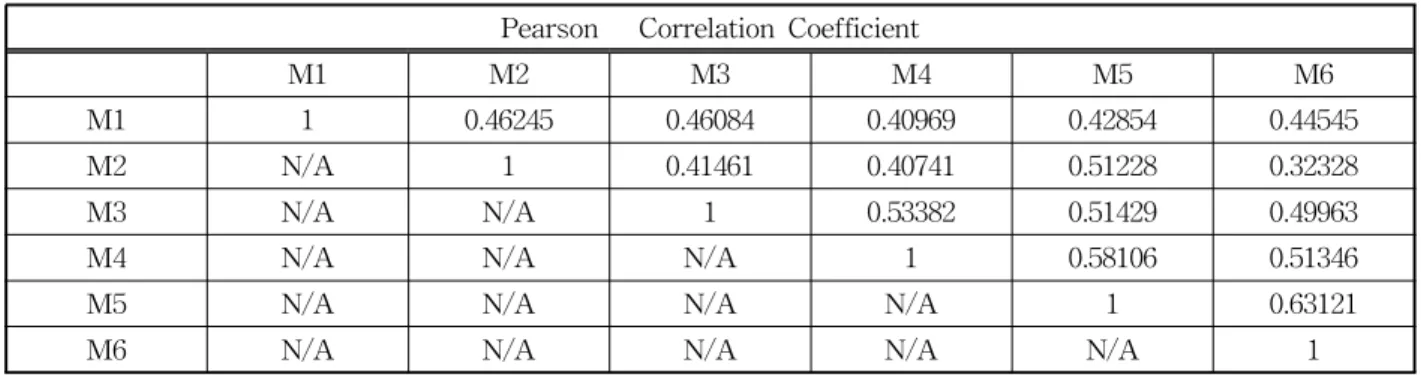
shows the correlation coefficient between system quality factors of the questionnaire. According to Table 2, the correlation coefficient of the system quality factors is less than or around 0.5, we think there is no correlation.

3.5 Hypotheses Formulation

The following is the main hypothesis to achieve our study objectives.

3.5.1 Main Hypothesis

The main hypothesis (H0) is “The system qual- ity factors of the shopping mall websites between Korea and China are different”; that is, {SQi} → {WSTj}. SQ is system quality factors and WST is a type of the shopping mall website. The follow- ings are the meaning of the number of i and j.

i = 1: Quick transition of the image or page.

i = 2: Accuracy

(5)

Table 3. Detailed Statistical Analysis Results

Shopping mall websites Quality factors

Gmarket and Taobao

Pr (T or T value) Ha or Hr

The verification results of all system

quality factors (6 factors) 0.0001<0.01 Ha

The verification results of the sub hypotheses

H1 0.0001<0.01 Ha

H2 0.0202>0.01 Hr

H3 0.0028<0.01 Ha

H4 0.0001<0.01 Ha

H5 0.0105<0.01 Ha

H6 0.0866>0.01 Hr

(Pr: Probability, Ha: Hypothesis accepted, Hr: Hypothesis rejected) i = 3: Ease of use

i = 4: Reliability i = 5: Access speed i = 6: Short cut function

j = 1: Korean shopping mall website j = 2: Chinese shopping mall website 3.5.2 Sub Hypothesis

The followings are sub hypotheses of the main hypothesis. a) H1: There is a difference in terms of quick transition of the image or page between Korean and Chinese shopping mall websites. b) H2:

There is a difference in terms of accuracy between Korean and Chinese shopping mall websites. c) H3:

There is a difference in terms of ease of use be- tween Korean and Chinese shopping mall websites.

d) H4: There is a difference in terms of reliability between Korean and Chinese shopping mall websites. e) H5: There is a difference in terms of access speed between Korean and Chinese shop- ping mall websites. f) H6: There is a difference in terms of a short cut function between Korean and Chinese shopping mall websites.

3.6 Hypotheses Verification

3.6.1 Statistical Analysis Results

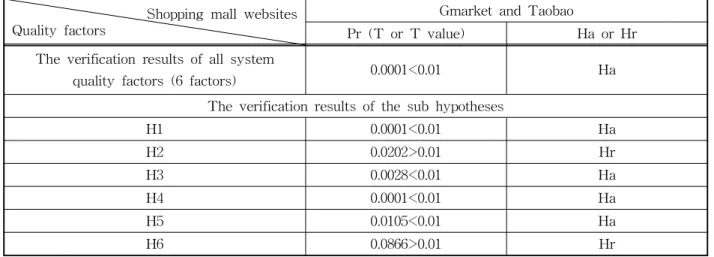
The detailed statistical analysis results are sum-

marized in Table 3.

3.6.2 Main hypothesis verification

As explained, the main hypothesis is “The sys- tem quality factors of the shopping mall websites between Korea and China are different”. According to our statistical analysis, this hypothesis is ac- cepted because of α=0.0001<0.01 with 99% sig- nificance level; in other words, it shows that there is a difference between Korean and Chinese shop- ping mall websites in terms of system quality factors.

3.6.3 Sub Hypothesis Verification

According to the results of Table 3, it shows that four hypotheses (H1, H3, H4, and H5) are accepted and two hypotheses (H2 and H6) are rejected. The first sub hypothesis H1 is accepted because of α

=0.0001<0.01 with 99% significance level so that there is a difference between Korean and Chinese shopping mall websites in terms of quick transition of the image or page. The second sub hypothesis H2 is rejected because of α=0.0202>0.01 with 99%

significance level; that is, there is not a difference

between Korean and Chinese shopping mall web-

sites in terms of accuracy. The third sub hypoth-

esis H3 is accepted because of α=0.0028<0.01 with

99% significance level, so it means that there is

(6)

a difference in terms of ease of use between Korean and Chinese shopping mall websites. The forth sub hypothesis H4 is accepted due to the fact that the value α is 0.0001 which is less than 0.01 and there is 99% significance level. The interpretation of this result is that there is a difference in terms of reli- ability between Korean and Chinese shopping mall website. The fifth sub hypothesis H5 is accepted because of α=0.0105<0.01with 99% significance level so that access speed is different between Korean and Chinese shopping mall websites. The last sub hypothesis H6 is rejected because the val- ue α is greater than 0.01 (0.0866), so there is no difference in terms of the short cut function be- tween Korean and Chinese shopping mall websites.

4. ANALYSIS OF HYPOTHESES VERIFIC- ATION AND STRATEGY TO IMPLE- MENT THE EFFECTIVE SHOPPING MALL WEB SITES

4.1 Analysis of Hypotheses Verification 4.1.1 Comparison Analysis of H1

Since the shopping mall website in Korea con- sisted of many pages, it showed that page tran- sition speed was slow. Yet, it was not actually slow compared to the number of images. It was possible to traverse pages quickly in China because they did not have many images. One benefit of the Korean shopping mall website was that it was possible to transit a page using only one tab as well as the forward and backward button. For this reason, it reduced the number of tabs and memory usage. However, when a customer wanted to com- pare with products, it was pretty uncomfortable if they used the forward or backward button. The China shopping mall website enabled the customer to traverse a page by creating a new tab so that it increased the number of tabs and memory usage.

4.1.2 Comparison Analysis of H2

There were no error occurrences for both coun-

tries, but if many users participated in events, the Korean shopping mall website showed that access speed was slow. Besides, there were many users every day in China, and it caused damage to im- ages or server down.

4.1.3 Comparison Analysis of H3

The Korean shopping mall website enabled users to purchase a product easily because of ap- propriate pop up messages and various options.

However, the Chinese shopping mall website caused inconvenient shopping because of frequent pop up messages. We also observed ease of mem- ber registration and ease of the procedure. The guideline of member registration and the type of the members on the Korean shopping mall website were exactly categorized so that it leaded to effi- cient member registration, and users could get ap- propriate information and authority. However, the Chinese shopping mall website provided general member registration and mobile member registra- tion only. The procedure of member registration was simpler than the Korean shopping mall web- site, but the guideline of member registration was not enough. The Korean shopping mall website provided the overview category view function, so users could easily see all items. It also provided convenience of the search function for users by providing a step by step form. On the other hand, the Chinese shopping mall website displayed the each product category, but it did not provide a step by step form. As a result, users experienced a diffi- culty in searching products because they clicked the other pages and searched products.

4.1.4 Comparison Analysis of H4

We verified the reliability of the shopping mall

websites in both countries using the McAfee Site

Advisor [22] tool and realized that there were no

issues of reliability. Yet, we found out that there

were 24 secure download items on the Korean

shopping mall website and seven secure download

(7)

items on the Chinese shopping mall website. The problem was that the more download items, the bigger capacity of the website was required. For this reason, it could affect website reliability.

Moreover, we found that 2 out of 8 secure website links of the Korean shopping mall website were not verified, so they could be potential risks for website reliability. The Chinese shopping mall website had eight secure links, and reliability of them was verified.

4.1.5 Comparison Analysis of H5

We measured average time of the Korean and Chinese websites on the website, http://

webwait.com. We calculated average loading time by measuring once per 5 seconds (total 5 times).

The Korean shopping mall website showed aver- age 2.58 seconds, and the Chinese shopping mall showed average 1.45 seconds. Therefore, we real- ized that the access speed of the Chinese shopping mall website was faster than the Korean shopping mall website due to that fact that the Chinese shopping mall website had a smaller number of im- ages compared to the Korean shopping mall website.

4.1.6 Comparison Analysis of H6

It was possible to move anywhere on the Korean Website because it provides the short-cut function.

Since the Korean shopping mall website arranged the buttons separately according to each category, users could find the desired shopping mall website easily. Moreover, users on the Korean shopping mall website could see the history of transaction, return and cancellation, and so on using the “My Shopping” menu. However, the Chinese shopping mall website did not provide those functions.

4.2 Strategy to Implement the Effective Shopping Mall Web Sites

4.2.1 Quick transition of the image and page It is obvious that many images or pages are not

required for quick transition of the image and page.

Our recommendation is to make each page which consists of less than 5 images based on the 7±2 rule. It is also required to consist of an appropriate number of links between images. We also suggest that use only one tab for page transition and pro- vide the forward and backward button because it is necessary to supplement any inconvenience when a customer wants to compare with products simultaneously.

4.2.2 Accuracy

When running the shopping mall website, it is required to consider the number of users for an event. It is also required to comprise images and servers by considering the access time frame as well as the number of users who access to the shopping mall website every day; in other words, we suggest that implement the shopping mall web- sites by considering trade-off in terms of the num- ber of access users, time frame, image composition and purchasing costs of the server.

4.2.3 Ease of use

There should not be many pop up messages in order for users who want to use the shopping mall website conveniently. It is better to provide various options for one single item than providing options for each item. It is also required to explain details about the guideline of member registration and the type of the members as well as assigning appro- priate information and authority. To implement the effective shopping mall website, the overview cat- egory view function should be provided in terms of ease of the procedure, and enable users to search the product easily through the step by step form.

4.2.4 Reliability

All other related websites should be linked to-

gether, and constant update of the website and the

provided information on the website must be accu-

rate to implement the effective shopping mall

website.

(8)

4.2.5 Access speed

It is required to reduce the number of images to increase speed on the shopping mall website.

Besides, using a touch screen and mouse is much better than using a keyboard.

4.2.6 The short cut function

The recently searched items should be located in a conspicuous place; that is, the best place is the right upper side. Moreover, enable users to move anywhere by activating a short cut button.

Each category should have its own button, and en- able users to check their information easily through a menu like my shopping information.

5. CONCLUSION

5.1 Summary of Research Results

This study conducted an analysis of the system quality factors of the website targeted at the Korea shopping mall website and the Chinese shopping mall website, and suggested strategies to imple- ment the effective shopping mall website. The above are the results of our research. Quick tran- sition of the image or page, ease of use, reliability, and access speed were different between both shopping mall websites, but there was no differ- ence in terms of accuracy and the short cut function. We also conducted a comparison analysis of each system quality factor based on the result of hypotheses verification and suggested strategies to implement the effective shopping mall websites.

5.2 Research Limitation and Future Study

The limitation is that we conducted a research about system quality factors only so that it is re- quired to consider website quality factors such as information quality, system quality, and service quality. While we conducted T-test, we would also like to conduct regression analysis and a structural equation model in the future.

REFERENCES

[ 1 ] W.H. DeLone and E.R. McLean, “Informa- tion Systems Success: The Quest for the Dependent Variable,” Information System Research , Vol. 3, No. 1, pp. 60-950, 1992.

[ 2 ] K.J. Lee, C.S. Kim, H.I. Ryu, and Hei-In, “An Empirical Study of the Factors Affecting the Usage of the Mobile Commerce, ” J ournal of KECRA , Vol. 12, No. 1, pp. 62, 2011.

[ 3 ] W.H. DeLone and E.R. McLean, “The DeLone

& McLean Model of Information Systems Success: A Ten-Year Update,” J ournal of Management Information Systems , Vol. 19, No. 4, pp. 9-30, 2003.

[ 4 ] V. Mckinney, K. Yoon, and F. Zahedi, “The Measurement of Web-Customer Satisfaction:

An Expectation and Disconfirmation Approach,”

Information System Research , Vol. 13, No. 2, pp. 296-315, 2002.

[ 5 ] L. Olsina, D. Godoy, G.J. Lafuente, and G.

Rossi., “Specifying Quality Characteristics and Attributes for Websites,” Paper Present- ed at the First ICSE Workshop on Web Engineering , pp.266-278, 1999.

[ 6 ] C.N. Madu and A.A. Madu, “Dimension of e-Quality,” International Journal of Quality

& Reliability Management , Vol. 19, No. 3, pp.

246-258, 2002.

[ 7 ] C. Liuand and K.P. Arnett, “Exploring the Factors Associated with Web Site Success in the Context of Electronic Commerce,”

Information and Management , Vol. 38, No. 1, pp. 23-33, 2000.

[ 8 ] M.M. Misic and K. Johnson, “Benchmarking:

A Tool for Web Site Evaluation and Improve- ment,” Internet Research , Vol. 9, No. 5, pp.

383-392, 1999.

[ 9 ] N. Donthu, “Does Your Web Site Measure Up?,” Marketing Management , Vol. 10, Issue.

4, pp. 29-32, 2001.

[10] Elko K.R.E. Huizingh, “The Content and

(9)

Design of Web Site: An Empirical Study,”

Information and Management , Vol. 37, No. 3, pp. 123-134, 2000.

[11] C.J. Liang and H.J. Chen, “A Study of the Impacts of Website Quality on Customer Relationship Performance,” Total Quality Management & Business Excellence , Vol. 20, No. 9, pp. 973, 2009.

[12] B. Bai, R. Law, and I. Wen, “The Impact of Website Quality on Customer Satisfaction and Purchase Intentions: Evidence from Chinese Online Visitors,” International Journal of Hospitality Management , Vol. 27, Issue. 3, pp.

392, 2008.

[13] C. Jones and S. Kim, “Influences of Retail Brand Trust, Off-Line Patronage, Clothing Involvement and Website Quality on Online Apparel Shopping Intention,” International Journal of Consumer Studies Vol.34, Issue. 6, pp. 630, 2010.

[14] J. Hartmann, A.D. Angeli, and A. Sutcliffe,

“Framing the User Experience: Information Biases on Website Quality Judgement,” Proc.

CHI 2008 , pp. 856, 2008.

[15] D.G. Gregg and S. Walczak, “The Relationship between Website Quality, Trust and Price Premiums at Online Auctions,” Electron Commer Res, Vol. 10, No. 24, pp. 5, 2010.

[16] H.F. Lin, “An Application of Fuzzy AHP for Evaluating Course Website Quality,” Computers

& Education , Vol. 54, Issue. 4, pp. 878, 2010.

[17] W.C. Chou and Y.P. Cheng, “A Hybrid Fuzzy MCDM Approach for Evaluating Website

Quality of Professional Accounting Firms,”

Expert Systems with Applications, Vol. 39, Issue. 3, pp. 2784, 2012.

[18] L.A. Ho, T.H. Kuo, and B. Lin, “The Mediat- ing Effect of Website Quality on Internet Searching Behavior”, Computers in Human Behavior , Vol. 28, Issue. 3, 840-848, 2012.

[19] A. O’Cass and J. Carlson, “An E-Retailing Assessment of Perceived Website-Service Innovativeness: Implications for Website Quality Evaluation, Trust, Loyalty and Word of Mouth,” Australasian Marketing Journal , Vol. 20, Issue. 1, pp.28-36, 2012.

[20] W.S. Fan and M.C. Tsai, “Factors Driving Website Success-the Key Role of Internet Customization and the Influence of Website Design Quality and Internet Marketing Strategy,” Total Quality Management &

Business Excellence , Vol. 21, No. 11, pp.

1141-1159, 2010.

[21] R. Connolly, “Website Service Quality in Ireland: A Consumer Perspective,” UK Academy for Information Systems Conference Proceedings 2010 , pp.1-18, 2010.

[22] A. Obied and R. Alhajj, “Fraudulent and Malicious Sites on the Web,” Applied in- telligence , Vol. 30, No. 2, pp. 112-120, 2009.

[23] Y.Y. Park and H.W. Byun, “Efficient Develop-

ment and Quality Evaluation of Online Library

System using Framework,” Journal of Korea

Multimedia Society , Vol. 13, No. 5, pp. 627-

640, 2010.

(10)

Young-Jik Kwon Life member

Feb. 1976.: Kyungpuk National University, Dep. of Mathe- matics, (B. Sc.)

Feb. 1980. : Yeungnam Univer- sity, Dep. of Business &

Administration, (Ms.) Feb. 1991. : Keimyung University, Dep. of Business

& Administration, (Phd.)

Jan. 2000.∼Jan. 2001 Washington State University, Exchange Professor, USA

Mar.1983.∼Present : Professor of School of Computer

& Information Technology, Daegu University.

Field of Study : Software Engineering, Web Engineering

Jun Cui

Jun. 2008. : yunnan normal uni- versity, China, (B. Sc.) Feb. 2011. : Daegu University,

Dep. of Computers & Infor- mation, (Ms.)

Mar. 2011.~Present : Doctorate of Computer & Information Engineering Department, Daegu University, Korea Field of Study : Software Engineering

Donghwoon, Kwon

Feb. 2008. : Major of Computer Engineering, School of Com- puter & Information Technol- ogy

Engineering, Daegu University.

(B. Sc.)

May. 2010. University of Alaska Anchorage, USA, Master of Science Project Management

Nov. 2010.∼Present. Applied Information Technology Department, Towson University, USA, D.Sc Field of Study : Project Engineering, Software

Engineering

수치

Fig. 1. The overall research modelwere considered for system quality, and especially,
Table 2. The Value of the Correlation Coefficient
Table 3. Detailed Statistical Analysis Results

참조

관련 문서

In a statement to Kuwait News Agency (KUNA) on the sidelines of a meeting of the Arab Parliament's Foreign Affairs Political and National Security

The meeting was attended by Assistant Foreign Minister for GCC Affairs, Ambassador, Nasser Al-Muzayyen, and Deputy Assistant Foreign Minister for the Office of the

“ Sheikh Nasser has a written message from HH the Amir, Sheikh Sabah Al-Ahmad Al-Jaber Al-Sabah to the Chinese President, Chi Gen Beng related to enhancing mutual

On his part, CEO of Express Roads Authority, Saud Al-Naqqi said that the heavy rains of the previous day led to clogging parts of the express

Kuwait will celebrate on Sunday the fourth anniversary of the UN honoring and proclamation of His Highness the Amir, Sheikh Sabah Al-Ahmad Al-Jaber Al-Sabah as

• 이명의 치료에 대한 매커니즘과 디지털 음향 기술에 대한 상업적으로의 급속한 발전으로 인해 치료 옵션은 증가했 지만, 선택 가이드 라인은 거의 없음.. •

The proposal of the cell theory as the birth of contemporary cell biology Microscopic studies of plant tissues by Schleiden and of animal tissues by Microscopic studies of

웹 표준을 지원하는 플랫폼에서 큰 수정없이 실행 가능함 패키징을 통해 다양한 기기를 위한 앱을 작성할 수 있음 네이티브 앱과