IPL 처리를 통한 고분자 나노구조의 기계적 특성 향상 연구
김도아1·김두인2,‡·정명영1,†
1부산대학교 광메카트로닉스공학과
2부산대학교 광메카트로닉스연구소
A Study of Mechanical Property Enhancement of Polymer Nanostructure using IPL Treatment
D. Kim1,D.-I. Kim2,‡, and M. Y. Jeong1,†
1Department of Opto-Mechatronics Engineering, Pusan National University, 2, Busandaehak-ro 63beon-gil, Geumjeong-gu, Busan 46241, Korea
2Opto-mechatronics Research Institute, Pusan National University, 2, Busandaehak-ro 63beon-gil, Geumjeong-gu, Busan 46241, Korea (Received December 24, 2020: Corrected December 28, 2020: Accepted December 30, 2020)
초 록: 논문에서는 고분자 나노구조 필름의 기계적 물성을 향상하기 위하여 광열효과를 이용한 열처리 공정을 응용 하여 나노임프린트로 제작된 고분자 나노구조 필름의 기계적 물성에 미치는 영향을 규명하였다. Hybrid resin과 UV 나 노임프린트을 이용하여 저반사 나노구조를 성형하고 IPL (intense pulsed light)를 이용하여 열처리를 수행한 뒤, 제작된 나노구조 필름의 투과율과 내스크래치성을 평가하여 나노구조의 성형성과 기계적 물성의 변화를 관찰하였다. 나노패턴 의 특성에 의해서 나노구조의 투과율은 550 nm 파장에서 97.6%로 고투과율의 기능을 확인하였으며, IPL을 이용한 열처 리를 진행한 경우 Hotplate를 이용한 열처리보다 경도는 0.51 GPa로, 0.27 GPa로 열처리한 시편에 비해 1.8배 향상하였 으며, 동일 실험 조건에서 탄성율은 Hotplate 이용 시 4 GPa에서 IPL 이용 시 5.9 GPa로 1.4배 증가하였다.
Abstract: In this paper, We investigated the effect of heat treatment process using photo-thermal effect in order to improve mechanical properties of nanostructure on polymer films made by nanoimprint process with hybrid resin.
Nanostructures which have a low refractive characteristic were fabricated by UV nanoimprint and after that heat treatment was performed using IPL (intense pulsed light) under process condition of 550 V voltage, pulse width 5 ms, frequency 0.5 Hz. The transmittance and mechanical property of fabricated nanostructure films were evaluated to observe changes in the pattern transfer rate and mechanical properties of nanostructures. The transmittance of the nanostructure was measured at 97.6% at 550 nm wavelength. Nanoindentation was performed to identify improved anti-scatch properties.
Result was compared by the heat source. In case of post treatment with IPL, hardness was 0.51 GPa and in the case of hotplate was 0.27 GPa, resulting the increase of hardness of 1.8 times. Elastic modulus of IPL treated sample was 5.9GPa and Hotplate treated one was 4GPa, showing the 1.4 time increase.
Keywords: organic-inorganic hybrid resin, IPL, UV-NIL
1. 서 론
나노/마이크로 패턴 기술은 자연에서 특수한 기능성을 가지는 표면을 모사하는 것에서 시작되어 표면에 나노 패 터닝을 함으로서 특수기능을 가지는 기능성 나노 표면을 응용하는 연구가 많이 진행 중에 있다.1) 나노임프린트 리
소그래피(Nanoimprint Lithography, NIL)는 수 나노급의 몰드를 열 혹은 빛을 이용하여 몰딩함으로서 몰드의 형 상을 직접적으로 전사해 낼 수 있는 공정이므로 대면적 의 나노 패턴을 저비용으로 생산하는 것이 가능하다.2) 나 노임프린트 리소그래피는 크게 UV 나노임프린트(UV- NIL)와 열 나노임프린트(Thermal- NIL)로 구분할 수 있
†
Corresponding author E-mail: [email protected]
‡
Corresponding author E-mail: [email protected]
© 2020, The Korean Microelectronics and Packaging Society
This is an Open-Access article distributed under the terms of the Creative Commons Attribution Non-Commercial License(http://creativecommons.org/
licenses/by-nc/3.0) which permits unrestricted non-commercial use, distribution, and reproduction in any medium, provided the original work is
properly cited.
으며, UV 나노임프린트는 UV 경화 레진을 모재 위에 도 포하고 패턴이 형성되어있는 몰드를 위치시킨 후 UV를 조사하여 레진을 경화시켜 패턴을 전사하는 공정이다.
기능성 나노구조를 성형하기 위해 고분자 레진을 이용 하여 UV-NIL 방식으로 제작하기 위해서는 나노임프린트 를 위한 성형성과 기능성을 위한 굴절율, 투과율, 젖음성 등이 고려되어야 한다. UV 나노임프린트 공정에는 주로 광경화형 아크릴계 레진 혹은 우레탄 아크릴레이트 레진 이 이용된다.3,4) 이러한 레진들은 고분자 고유의 기계적 물성 때문에 내구성이 취약한 한계를 가진다.5)
이러한 재료의 한계를 극복하기 위해 이종 재료들을 혼 합하여 각 소재의 단점을 보완하는 방법이 연구되어 오 고 있다.6,7) 무기 나노 입자를 충전재로 사용한 유무기 하 이브리드 코팅제를 사용하여 내마모성과 경도를 크게 향 상할 수 있음이 보고된 바 있다.8,10) 특히, 실리카 나노입 자가 함유된 특정 레진의 경우 열처리를 통해 레진층의 나노입자를 치밀화 시켜 경도를 더욱 높일 수 있다.11,12) 그러나 범용 및 Engineering Plastic인 고분자 필름을 모재 로 나노임프린팅을 할 경우, 고분자 모재의 낮은 유리 전 이온도(Tg)로 인해 열처리 온도에 제한된다. 열처리 온도 가 Tg 보다 높을 경우 모재의 열변형이 발생하므로 열처 리 공정온도는 고분자 모재의 Tg보다 낮아야 한다. 나노 실리카 입자가 첨가된 조성에 따라서는 최소 200oC까지 의 열처리 온도가 필요한 경우도 있다.12) 따라서, 나노입 자를 포함하는 레진의 경우 Hotplate나 오븐 등을 이용하 여 열을 직접적으로 가하는 열처리 공정을 진행하는데 한 계가 존재한다.
최근 IPL(intense pulsed light)을 이용한 금속 나노입자 를 상대적으로 낮은 온도에서 고속으로 photo sintering 혹 은 어닐링 연구가 다양하게 진행되고 있다.13-15)나노입자 및 혹은 표면부의 열처리에 사용되는 IPL 에너지는 SPR(surface plasmon resonance)효과로 인하여 특정한 광 파장에 전자들이 충돌하여 빛에너지가 열에너지로 전환 되는 것으로 알려져 있다.16,17) 광열 효과는 열의 전도가 우수한 금속 소재 뿐만 아니라 상대적으로 높은 온도로 우수한 재료의 특성의 손상을 최소화가 가능하므로 의학 과 나노공학 및 반도체 소자 분야에서 주목받고 있다. 특 히, 의학 분야에서는 발색단(chromophore)의 종류와 열이 완시간에 따라 펄스 시간을 달리하여 선택적 광열 융해 를 통해 조직의 손상 없이 병변을 치료한다.18-21) 또한, 폴 리비닐페놀 소재의 유기 게이트 절연층을 저온 공정으로 제작하는 데 활용되기도 하였다.22) 이와 같이 IPL 조사는 표면 또는 국부적 영역을 고온으로 가열할 수 있다. 따라 서 IPL을 이용하여 열처리를 진행할 경우 모재의 손상 없 이 Tg 이상의 온도에서 나노입자가 포함된 레진의 열처 리가 가능하다.
본 연구에서는, 나노실리카 입자가 10% 포함된 UV 경 화 하이브리드 레진을 이용하였으며, PMMA (poly(methyl- methacrylate)) 필름을 모재로 하여 저반사 나노구조를 성
형하였다. IPL 조사 조건을 달리하여 열처리를 수행하였 으며, 성형된 나노구조의 저반사 특성과 내스크래치성을 평가하였다.
2. 실 험
저반사 나노구조의 니켈몰드를 이용하여 UV 임프린트 공정으로 나노패턴이 표면에 형성된 필름을 제작하였 다. 니켈몰드는 moth-eye 패턴을 모방한 구조이며 높이 330 nm, 지름 280 nm, 패턴 간 간격 300 nm의 parabolic 한 구조이다. 니켈몰드는 실리콘 기판에 반도체 공정을 통해 형성한 나노패턴의 전주 도금 공정으로 제작한 몰 드를 이용하였다.23)
모재로써 98oC의 Tg를 가지는 250 µm 두께의 PMMA 필름 (C210A, Sejin tech, Korea)을 선택하였으며, Moth- eye like pattern을 가진 몰드로 Fig. 1와 같은 공정을 통 해 나노임프린팅을 진행하여 저반사 구조를 형성한 샘 플을 제작하였다. UV 경화는 UV imprinter (UV light source at 375-395 nm wavelength, main wavelength: 365 nm, Mercury lamp, Lab made)로 진행하였다. 열경화로 인 한 나노구조의 경도 향상을 확인하기 위해서 (i) UV 경 화 최적 시간 판별, (ii) Hotplate로 열 경화 온도 및 최적 시간 판별, (iii) IPL(HI-PULSE, PSTEK, Korea)로의 열처 리 세 단계의 실험을 진행하였으며, IPL을 이용한 열처리 로 UV 경화까지 진행한 시편의 경도가 UV 경화만 진행
Fig. 1. Overall process for fabricating high-hardness nanostructure using organic/inorganic hybrid resin contained nanosilica particle.
한 시편보다 향상되었고, Hotplate를 이용한 열경화에 준 하는 효과를 가졌음을 검증하고자 하였다.
IPL을 이용한 열처리의 경우 Fig. 2와 같이 550 V 전 압, Pulse width 5 ms, 2 s 간격으로 10회, 15회, 20회 조사 후, 4 H와 5 H의 연필로 경도 테스트를 진행하였다.
3. 실험 결과 및 토론
3.1 UV-NIL 성형성
실험 과정 중 중요한 요소로 나타난 공정 중 하나는 Prebake로서 이를 선행하지 않은 경우 나노임프린팅 시 Fig. 3과 같이 나노실리카 입자가 제대로 함입되지 않은 양상을 보였다. 실리카 입자가 함유된 레진을 이용할 시 실리카 입자로 인해 조도가 높아져 표면에서의 반사광 산 란으로 haze가 나타날 수 있다. Prebaking 단계에서 용매 를 온전히 날리고 레진을 일축 방향으로 가라앉게 하여 고분자 간의 밀도를 높인 후 준비된 나노구조를 가진 몰 드를 이용해 molding을 진행하면 나노실리카 입자의 함 입이 제대로 이루어져 패턴 전사율이 높게 나타났다.
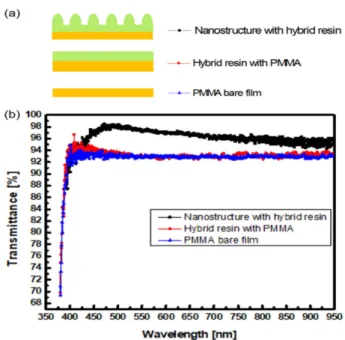
패턴이 제대로 전사 되었음을 관찰하기 위해 SEM과 투과율을 측정하였다. Moth-eye 나노패턴은 Fig. 4와 같 이 표면에 형성되었다. Moth-eye like pattern 형성 시 나 타나는 현상인 광투과율의 향상을 확인하기 위하여 Thin film analyzer (F20-EXR, Filmetrics, USA)을 이용하여 투 과율을 측정하였다. Fig. 5에서 볼 수 있듯이 광투과율은 PMMA 필름의 투과율인 92.6%에 비해, 하이브리드 레진 으로 패턴 없이 만든 샘플의 경우 나노실리카에 의해 향
상된 표면 조도로 93%로 증가하였으며, 나노패턴 형성 시 97.6%로 향상되었다.
3.2 IPL을 이용한 열처리
UV-NIL을 진행한 나노구조 필름 제작 후 기존의 열처 리 방식인 Hotplate을 이용한 모재 하부로부터의 열전달 로 열처리를 진행한 샘플을 연필경도테스트기(SB-196, SB science, Korea)를 이용하여 경도측정 하였다. UV 경 화 3 분, PMMA의 열변형이 일어나지 않는 최대 온도인 85oC에서 30분의 공정에서 가장 높은 경도를 보였으며, Fig. 5에서 알 수 있듯이 열처리 전의 경우 연필경도 H, Hotplate를 이용한 열처리를 거친 샘플의 경우 연필경도 3H의 경도를 보였다.
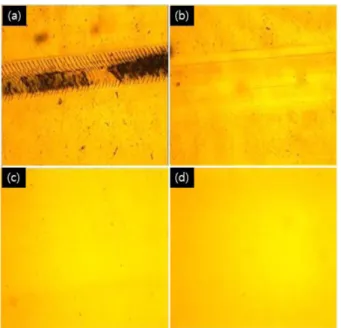
Fig. 6은 앞서 말한 공정으로 IPL로 펄스 횟수 10회 열 처리한 샘플이 기존의 경화 공정으로 UV-NIL까지 제작 하고 열처리를 진행하지 않은 샘플에 비해 연필경도가 H 에서 4H로 증가하였음을 OM(Optical microscopy)으로 확 인한 결과이다. Fig. 7은 Hot plate와 IPL을 이용하여 유무 기 하이브리드 레진을 열처리 시킨 후의 나노인덴테이션
Fig. 5. (a) Schematic of samples measured, (b) Transmittance of sample measured.
Fig. 4. SEM image of sample heat-treated with IPL after UV-NIL.
(a) Surface image with moth-eye pattern (b) Sample scratched with 3H hardness pencil.
Fig. 2. Waveform of pulse generated by IPL system
Fig. 3. SEM (Scanning electron microscopy) image of nano- patterned surface fabricated without prebaking. Image shows poor tranfer rate due to the exposure of silica nanoparticle which should be imbedded.
결과로 Hotplate를 통해 하부로부터 열처리를 한 시편의 경도는 깊이에 따라 상부와 하부의 균일한 경도를 보였 다. IPL을 통한 열처리의 경우, 표면과 하부의 경도 차이 는 0.2 GPa로 높게 나타났다. 열처리 방식에 따른 두 시 편의 Elastic modulus는 4 GPa에서 5.9 GPa로 IPL 방식이 1.4배, Hardness는 0.27 GPa에서 0.51 GPa로 hot plate를 이
용한 열처리 방식보다 IPL 방식이 1.8 배 크게 향상된 것 을 알 수 있었으며 이는 인성이 우수하면서 경도를 향상 한 결과로 볼 수 있다.
IPL 조사로 인한 경도를 향상 요인은 크게 두 가지로 보여진다. 첫 번째는 강한 빛의 세기이다. IPL은 200 nm 에서 1,100 nm의 넓은 파장대역의 빛을 수 µs ~ ms의 짧 은 시간 동안 수 MV의 큰 전압을 통해 방출한다. 이러한 강한 노광량은 UV 경화 고분자의 중합률을 향상할 수 있 다.24 두 번째는, 광열효과로의 잔존 용매와 실리카의 수 분 제거를 통한 고분자 표면의 치밀화이다. 이러한 방식 으로 모재 선택의 제한을 극복하였고, 나노인덴테이션으 로서 상용 레진 대비 인성의 향상과 경도의 향상이 모두 갖추어졌음을 확인하였다. 표면에서 더욱 우수한 경도를 보이는 경도의 gradient는 스크래치에 취약한 나노패턴의 기계적 물성을 보완하면서도 필름 자체의 유연성을 유지 하여 주는 것으로 보인다.
또한, 투과율을 측정하여 UV-NIL을 통한 패턴 전사로 원하는 특성이 IPL 노광 방식이 표면에서의 광열효과로 인해 경화가 일어남을 확인하였다.
Fig. 6. OM(Optical microscopy) image of pencil-traced sample depending on pencil hardness (a), (c) : 3H and (b), (d) : 4H. (a), (b) is a sample only took up to the UV curing stage. (c) and (d) is a sample which was treated thermal curing.
Fig. 7. OM image of pencil-traced sample which is heat-treated using IPL system for 10 times ((a), (c)) and 25 times ((b), (d)) of pulse. Scraped with pencil with pencil hardness (a), (b) : 4H and (c), (d) : 5H.
Fig. 8. Comparison of (a) Elastic modulus (GPa) and (b) Hardness (GPa) value between samples thermally treated with IPL and Hotplate.
4. 결 론
나노실리카 입자가 함유된 레진은 기존의 고분자 소재 의 UV 경화성 레진에 비하여 향상된 경도를 가지지만 잔 존 용매 제거, 광경화성 레진의 안정화, 수분 제거를 위 해서는 상대적으로 높은 온도의 열처리를 요구된다. 그 러므로 기능성 나노패턴 필름 제작공정에 UV NIL 사용 은 모재의 선택 및 제작공정에 상당한 제한을 야기할 뿐 아니라 레진의 기계적 물성을 정확히 구현하지 못한다는 단점이 있다. 따라서, 본 연구에서는 나노실리카를 함유 한 유무기 이브리드 레진을 이용하여 UV-NIL 공정으로 기능성 필름을 제작하고, 이후 IPL의 광열효과로 열처 리 를 진행하였다. UV-NIL로 제작한 시편에 서로다른 열원 인 Hotplate와 IPL로 경화 처리를 실시한 뒤 경도변화를 검토하였다. IPL실시한 시편에서 0.24 GPa의 우수한 경 도값을 나타내었다. 또한, 패턴 없는 코팅만 실시된 시편 에 비하여 나노패턴이 형성된 시편의 광투과율이 97.6%
로 약 4.6% 이상 향상된 투과율을 달성하였다.
향후 최적의 IPL열처리를 공정을 확립하기 위하여 IPL전압의 영향, pulse width, 노광 횟수에 따른 heat distribution 조사의 영향 및 레진의 경화열 분석에 관한 추가적인 연구가 요구되고 있다.
Acknowledgments
이 논문은 2017년도 정부(교육과학기술부)의 재원으로 한국연구재단의 기초연구사업 지원을 받아 수행된 것임 (NRF-2017R1D1A3B04036458).
References
1. A. R. Parker and H. E. Townley, “Biomimetics of photonic nanostructu res”, Nat. Nanotechnol., 2(6), 347 (2007).
2. C.-J. Ting, M.-C. Huang, H.-Y. Tsai, C.-P. Chou, and C.-C.
Fu, “Low cost fabrication of the large-area anti-reflection films from polymer by nanoimprint/hot-embossing technol- ogy”, Nanotechnology, 19(20), 205301 (2008).
3. Z. Jia, J. Choi, and S. Park, “Selection of UV-resins for nano- structured molds for thermal-NIL”, Nanotechnology, 29(36), 365302 (2018).
4. Y. H. Sung, Y. D. Kim, H. J. Choi, R. Shin, S. Kang, and H.
Lee, “Fabrication of superhydrophobic surfaces with nano-in- micro structures using UV-nanoimprint lithography and thermal shrinkage films”, Applied Surface Science, 349, 169 (2015).
5. N. Kim, J. Kim, H. S. Lim, and S. H. Kim, “Technological Trend of Special Coating Materials for Surface functionalisa- tion”, Journal of Adhesion and Interface, 18(2), 82 (2017).
6. S. Sprenger, “Nanosilica-Toughened Epoxy Resins”, Poly- mers, 12(8), 1777 (2020).
7. X. Chen and K. E. Gonsalves, “Synthesis and properties of an aluminum nitride/polyimide nanocomposite prepared by a nonaqueous suspension process”, Journal of materials research, 12(5), 1274 (1997).
8. S. Amberg-Schwab, E. Arpac, W. Glaubitt, K. Rose, G.
Schottner, and U. Schubert, “Materials Science Monographs- High Performance Ceramic Films and Coatings”, Ed., P. Vin- cenci, pp.203, Elsevier, Amsterdam (1991).
9. J. S. Jr. Humphrey, “Polycarbonate article coated with an adherent, durable, silica filled organopolysiloxane coating and process for producing same”, U.S. Patent No. 4,188,451.
(1980).
10. C. J. Brinker and G. W. Scherer, “Sol-gel science: the physics and chemistry of sol-gel processing”, Academic press, (2013).
11. Sunhan M&T Co. Ltd., and KITECH, “Coating composition for forming scratch resistant silica thin layers containing silica nano-particles of different sizes, method of preparing the same”, KR101302720B1 (2013).
12. Y. Y. Yu, C. Y. Chen, and W. C. Chen, “Synthesis and char- acterization of organic–inorganic hybrid thin films from poly (acrylic) and monodispersed colloidal silica”, Polymer, 44(3), 593 (2003).
13. E. K. Lee, K. Eun, Y. S. Ahn, Y. T. Kim, M. W. Chon, and S.
H. Choa, “Alternative sintering technology of printed nanopar- ticles for roll-to-roll process”, J. Microelectron. Packag. Soc., 21(4), 15 (2014).
14. H. S. Kim, S. R. Dhage, D. E. Shim, and H. T. Hahn, “Intense pulsed light sintering of copper nanoink for printed electron- ics”, Applied Physics A, 97(4), 791 (2009).
15. D. J. Lee, S. H. Park, S. Jang, H. S. Kim, J. H. Oh, and Y.
W. Song, “Pulsed light sintering characteristics of inkjet- printed nanosilver films on a polymer substrate”, Journal of Micromechanics and Microengineering, 21(12), 125023 (2011).
16. J. Chen, C. Glaus, R. Laforest, Q. Zhang, M. Yang, M. Gid- ding, M. J. Welch, and Y. Xia, “Gold nanocages as photo- thermal transducers for cancer treatment”, Small, 6(7), 811 (2010).
17. J. Qiu and W. D. Wei, “Surface plasmon-mediated photother- mal chemistry”, The Journal of Physical Chemistry C, 118(36), 20735 (2014).
18. S. Thomsen, “Pathologic analysis of photothermal and pho- tomechanical effects of laser–tissue interactions”, Photochem- istry and photobiology, 53(6), 825 (1991).
19. S. L. Jacques and S. A. Prahl, “Modeling optical and thermal distributions in tissue during laser irradiation”, Lasers in sur- gery and medicine, 6(6), 494 (1987).
20. S. Rastegar, M. Motamedi, A. J. Welch, and L. J. Hayes, “A theoretical study of the effect of optical properties in laser ablation of tissue”, IEEE Transactions on Biomedical Engi- neering, 36(12), 1180 (1989).
21. B. R. Kamat, S. V. Tang, K. A. Arndt, R. S. Stern, J. M. Noe, and S. Rosen, “Low-fluence CO2 laser irradiation: selective epidermal damage to human skin”, Journal of Investigative Dermatology, 85(3), 274 (1985).
22. S. J. Kim, M. Jang, H. Y. Yang, J. Cho, H. S. Lim, H. Yang, and J. A. Lim, “Instantaneous pulsed-light cross-linking of a polymer gate dielectric for flexible organic thin-film transistors”, ACS Applied Materials & Interfaces, 9(13), 11721 (2017).
23. N. E. Yeo, W. K. Cho, D. I. Kim, and M. Y. Jeong, “Dura- bility Improvement of Functional Polymer Film by Heat Treatment and Micro/nano Hierarchical Structure for Display Applications”, J. Microelectron. Packag. Soc., 25(4), 47 (2018).
24. Y. Du, B. A. Williams, L. F. Francis, and A. V. McCormick,
“Pulsed irradiation for high-throughput curing applications”, Progress in Organic Coatings, 104, 104 (2017).