논문 2011-5-18
스마트 카드 기반 사용자 인증 스킴의 보안 개선
Security Improvement of Remote User Authentication Scheme based on Smart Cards
주영도*, 안영화**
Young-Do Joo, Young-Hwa An
요 약 최근에
Lin
[9] 등은 패스워드와 스마트 카드를 이용하여 원격지에 있는 사용자를 인증할 수 있는 스킴을 제안 하였다.
그러나Lin
등에 의해 제안된 시킴은 패스워드 기반 스마트 카드를 이용한 사용자 인증 스킴에서 고려해야 하 는 보안 요구사항을 만족하지 못하고 있다.
본 논문은 공격자가 사용자의 스마트 카드를 훔치거나 일시적으로 접근할 수 있는 경우에Lin
등의 스킴은off-line
패스워드 추측공격에 취약하다는 것을 증명한다.
따라서 이와 같은 보안 취 약점을 해결하기 위해 해쉬함수와 랜덤nonce
기반의 개선된 인증 스킴을 제안한다.
본 연구에서 제시하는 사용자 인 증 스킴은 패스워드 추측공격 및 위조공격과 재생공격이 불가능하도록 구현되고,
또한 사용자와 인증서버 간 상호인증 을 제공한다.
따라서 제안된 인증 스킴은Lin
등의 스킴에 비해 상대적으로 효율적이고 보안성이 강화된 스킴임을 알 수 있다.
Abstract Recently Lin et al.
[9]proposed a simple remote user authentication scheme using smart cards. But the proposed scheme has not satisfied security requirements which should be considered in the user authentication scheme using the password based smart card. In this paper, we show that Lin et al.'s scheme is insecure against off-line password guessing attack. In their scheme, any legal user's password may be derived from the password guessing when his/her smart card is stolen and the secret information is leaked from the smart card by an attacker. Accordingly, we demonstrate the vulnerability of their scheme and present an enhancement to resolve such security weakness. Our proposed scheme can withstand various possible attacks including password guessing attack. Furthermore, this improved scheme can provide mutual authentication to improve the security robustness.
Performance evaluation shows that the proposed scheme is relatively more effective than Lin et al.'s scheme.
Key Words : Authentication, Smart Card, Password Guessing Attack, Replay Attack
*정회원, 강남대학교 컴퓨터미디어공학부
**정회원, 강남대학교 컴퓨터미디어공학부 접수일자 2011.4.22, 수정일자 2011.8.29 게재확정일자 2011.10.14
I. Introduction
With the rapid growth of computer networks, the achievement of secrecy and authentication has become increasingly important. In untrustworthy public network, a user authentication which can prevent
unauthorized network access is the most important part
as far as security is concerned. A remote user
authentication scheme allows a server to check the
authenticity of a remote user through insecure channels
like Internet. The identities of the communication
parties must be verified before they start a new
connection to make sure that no harm is done. A
variety of password-based authentication schemes
have been developed
[1–11].
Since Lamport
[1]proposed his remote authentication scheme in 1981, several schemes have been proposed to improve the security, the cost or the efficiency. One of the features of these schemes is that a verification table should be securely stored in the server. If the verification table is stolen by an attacker, the system will be partially or totally broken.
In 2006, Lin et al. proposed a new remote user authentication scheme
[9]using smart card that can withstand many possible intrusions including a stolen-verifier attack, based on Lin-Shen-Hwang’s protocol
[5]. In this paper, however, we show that Lin et al.'s scheme is vulnerable to the password guessing attack, and forgery attack/impersonation attack. In addition, Lin et al.'s scheme is insecure because the authentication server stores the user's password verifier and authenticates only the user. To remedy these flaws, we propose an improvement of Lin et al.'s remote user authentication scheme whereby the user's password verifier is not stored in the server side and mutual authentication between the server and the user is implemented to provide higher security.
The rest of this paper is organized as follows. we review and analyze Lin et al.'s scheme in section II.
In section III, we present an improved protocol to enhance Lin et al.'s scheme. The security analysis and performance evaluations of our scheme is provided in section IV. Finally, brief conclusions are given in section V.
II. Review of Lin et al.'s Scheme
1. Lin et al.'s scheme
Lin et al.'s scheme is composed of two phases;
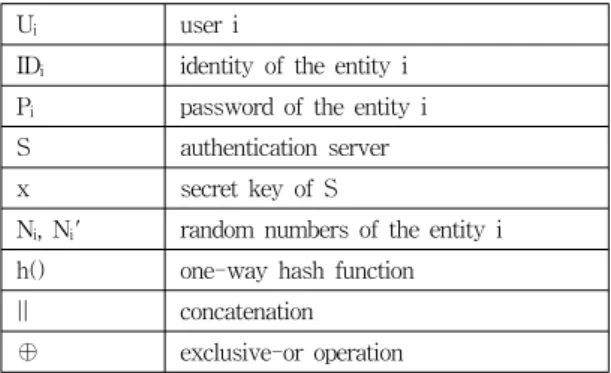
registration phase and the authentication phase. The detailed procedures of each phase are described as follows. In their scheme, there are a server S and a set of users U. For readers' understanding, the abbreviations and notations used through this article are summarized in Table 1.
표 1. 약어 및 표기
Table 1. Abbreviations and Notations
U
iuser i
ID
iidentity of the entity i P
ipassword of the entity i S authentication server x secret key of S
N
i, N
i' random numbers of the entity i h() one-way hash function
|| concatenation
⊕ exclusive-or operation
■ Registration Phase
Suppose a new user, U
iwants to register with the server, S for accessing services.
(1) The user sends a message (ID
i,h(P
i||N
i)) to the server for registration through a secure channel.
(2) The server stores the message h(P
i||N
i) into the database after the identity of the user is verified.
Then, the server calculates K by equation (1).
K=h(x||ID
i)⊕h(P
i||N
i) (1) where x is a secret value and is maintained by the server.
And then the server, S issues the smart card written by the computed value of K to the user, U
i.
■ Authentication Phase
To access a server, U
iinserts his/her smart card in to a login device and keys in the password, P
i.
(1) The user sends a message (ID
i,C
2,C
3) to the server for authentication. Here, C
2and C
3are calculated according to the following equations.
C
1=K⊕h(P
i||N
i) (2) C
2=h(K)⊕h(P
i||N
i') (3) C
3=h(C
1⊕h(P
i||N
i')) (4) where N
i' is a new random nonce used against a replay attack.
(2) Upon receiving the login request (ID
i,C
2,C
3) from U
i, the server performs the following operations to identify the login user.
(i) First, checks the format of ID
i. If it does not pass
the test, then disconnect this connection.
(ii) Check the identity of the login user by verifying C
2. The server may derive h(P
i||N
i') by XORing h(h(x||ID
i)⊕h(P
i||N
i)) with C
2.
Then, compute C
3' as follows:
C
3'=h(x||ID
i)⊕h(P
i||N
i') (5) If C
3equals C
3', U
iis authenticated and gains the right to access the server. Finally, update the stored verifier h(P
i||N
i) with h(P
i||N
i') for the next login.
2. Security Analysis
To evaluate the security of smart card based user authentication, we assume that an attacker may possess the capabilities to thwart the security schemes.
(1) An attacker has total control over the communication channel between the users and the server in the login and authentication phases. That is, he may intercept, insert, delete, or modify any message across the communication procedures.
(2) An attacker may (i) either steal a user's smart card and then extract valuable information from the smart card, (ii) or steal a user's password, but can not commit both of (i) and (ii) at a time.
Obviously, if both of the user’s smart card and his password was stolen at the same time, then there is no way to prevent an attacker from impersonating a valid user. Therefore, a remote user authentication scheme should be secure if only one case out of (i) and (ii) is happening.
In this section, we will show that the Lin et al.'s scheme is vulnerable to the password guessing attack.
As pointed out in references
[12][13], all existing smart cards contain security weakness in that the secret values stored in it could be extracted by monitoring the power consumption. Easily, an attacker can make another card digitally identical to the original card by obtaining the secret keys from the smart card. The attacker's next movement is to launch an off-line password guessing attack to seek the user's password.
Now the attacker U
awho obtained the values K
iand N
ifrom U
i’s smart card by monitoring the power consumption, can find out P
iby employing the off-line password guessing attack, in which each guess P
i' for P
ican be verified by the following procedures.
Step 1. The legal user, U
icalculates C
2,C
3for login to the authentication server as usual and send the login request message (ID
i,C
2,C
3) to the authentication server.
Step 2. At that time, the attacker U
aintercepts the login request message and gets the C
2, and C
3.
Step 3. Finally, U
acan catch the user’s password by employing the off-line password guessing attack. The attacking scenario is as follows.
(1) The attacker U
aguesses P
i' as the user’s password P
i.
(2) And calculates C
1'=K⊕h(P
i'||N
i), B'=C
2⊕h(K), and C
3'=h(C
1'⊕B').
(3) And verifies the correctness of P
i' by checking C
3'=C
3.
(4) Repeats steps above (1) through (3) until a correct password P
i' is found. Finally, the attacker can devise the correct password, P
i. Therefore, we emphasize that the Lin et al.'s remote user authentication scheme using smart card is vulnerable to the off-line password guessing attack. In their scheme, the attacker can successfully masquerade as the legitimate user with the user's password and the smart card in hand.
III. Improvement of Lin et al.'s Scheme
In this section, we propose an enhancement of Lin et al.'s scheme which not only can withstand the off-line password guessing attack, but authenticate the user and the server each other.
Our scheme is divided into three phases: registration
phase, login phase and authentication phase. The
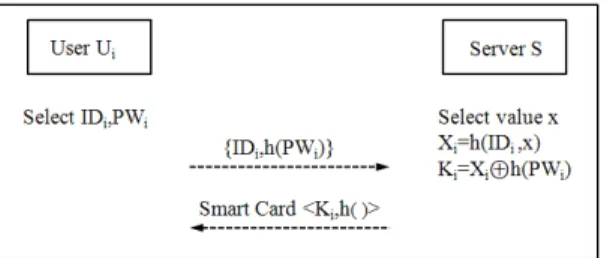
registration phase is illustrated in Fig. 1. The login
phase and the authentication phase are depicted in Fig. 2.
그림 1. 제안하는 스킴의 등록 단계
Fig. 1. Registration Phase of the Proposed Scheme
그림 2. 제안하는 스킴의 로그인 단계와 인증 단계
Fig. 2. Login Phase and authentication Phase of the Proposed Scheme
■ Registration Phase
Suppose a new user U
iwants to register with the server S for accessing services.
(1) The user, U
icalculates a verifier h(PW
i) and sends it along with his/her identifier ID
ito the server S. These private data must be sent over a secure channel.
(2) S calculates and writes K
iinto a smart card and issues it to U
i, by equations (6) and (7)
X
i=h(ID
i, x) (6) K
i=X
i⊕h(PW
i) (7) where x is a secret key maintained by the server.
■ Login Phase
To access a server, U
iinserts his/her smart card into the smart card reader and keys in his/her ID
iand password PW
i. Then, the smart card performs the
following operations.
(1) The smart card chooses a random nonce N
i. (2) Calculates X
i=K
i⊕h(PW
i) and C
i=X
i⊕N
i. (3) Calculates V
i= h(ID
i, C
i, N
i) for authenticating the
user to the server.
(4) Then, U
isends a message (ID
i,V
i,C
i) to S.
■ Authentication Phase
Upon receiving the login request message (ID
i,V
i,C
i) from U
i, the server executes the following steps to identify the login user.
(1) The authentication server checks the format of ID
i. If it does not pass the test, then disconnect this connection.
(2) Then, the server calculates N
i'=C
i⊕X
iand V
i'=h(ID
i,C
i,N
i').
(3) Checks the equality: V
i'=V
i. If it holds, U
iis authenticated and allowed to access the server.
(4) Chooses a random nonce N
sand calculate C
s=X
i⊕N
s.
(5) Calculates V
s=h(ID
i,C
i,C
s,N
s) for authenticating the server to the user.
(6) Then, sends a message (V
s,C
s) to the user.
Upon receiving the message (V
s,C
s) from the server S, the user’s smart card performs the following operations.
(7) The user’s smart card calculates N
s'=C
s⊕X
iand V
s'=h(ID
i,C
i,C
s,N
s').
(8) Then, checks the equality: V
s'=V
s. If it holds, the server is authenticated and allowed to access the smart card.
Ⅳ. Security Analysis and Performance Evaluation
1. Security Analysis
The proposed scheme suggests an enhancement to
Lin et al.'s scheme in order to eliminate the security
risk described in the previous section. We examine the
security robustness of our scheme to endure the
well-known attacks such as password guessing attacks, replay attacks and forgery attacks.
■ Password Guessing Attack
Assume that an attacker intercepts a login request (ID
i,V
i,C
i) over a public network and K
ifrom the user’s smart card. However, the attacker cannot derive the password PW
iof the login user from V
i, C
iand K
i. This is because the attacker does not know N
iand x, where x is stored in private within the server.
■ Replay Attack
The user’ smart card updates the random nonce to resist the replay attack at each login. As U
iregenerates the random number N
iand the consequent computation of C
i, the server's response during the previous session can not be replayed for any upcoming next session.
That is, replaying the previous login request by the eavesdropper is infeasible due to the freshness of the random nonce.
■ Forgery Attack
An attacker U
amay impersonate the legitimate user U
iby forging a login request (ID
i,V
a,C
a) and sending it to the server. The server will execute the authentication phase for identifying the login user.
However, the forged login request (ID
i,V
a,C
a) cannot pass, because the verifying equation does not hold (V
a≠V
a'). Therefore, an attacker has no chance to login by launching an impersonation attack. Similarly, an attacker is also unable to masquerade the server to the user.
■ Security Comparison
The analysis of security properties of Lin et al.'s scheme and the proposed scheme is summarized in Table 2. In contrast to Lin et al.'s scheme, the proposed scheme is relatively more secure. In addition, the proposed scheme provides mutual authentication between the user and the server.
표 2. 안전성 분석
Table 2. Security Analysis Security Properties Lin et al.'s
Scheme
Proposed Scheme password-guessing attack Yes No
replay attack No No forgery attack Yes No mutual authentication not supported supported
2. Performance Evaluation
In this section, we evaluate the performance of the proposed scheme and Lin et al.'s scheme. Table 3 shows the computational complexities of both schemes.
As you see, the proposed scheme is more efficient than Lin et al.'s scheme. In the login and authentication phase, our scheme requires only six THs and five TEs.
This computation includes four THs and three TEs for the mutual authentication between the user and the server.
표 3. 성능 평가
Table 3. Performance Evaluation Phase Lin et al.'s
Scheme
Proposed Scheme Registration 2TH+1TE 2TH+1TE Login and Authentication 7TH+6TE 6TH+5TE <TH: time for performing a one-way hash function>
<TE: time for performing an exclusive-OR operation>