http://dx.doi.org/10.7236/JIWIT.2012.12.1.231
JIWIT 2012-1-30
스마트 카드를 이용한 생체인식 기반 원격 사용자 인증 스킴의 보안성 개선
Security Enhancement of Biometrics-based Remote User Authentication Scheme Using Smart Cards
안영화 * , 주영도 **
Young-Hwa An, Young-Do Joo
요 약 2011년에
Das
는Li-Hwang
의 스킴의 보안 문제점을 개선하면서 강력한 인증과 상호 인증을 제공할 수 있는 효율적인 생체인식 기반 원격사용자 스킴을 제안하였다.
본 논문에서는Das
의 인증 스킴이 여러 가지 공격들에 대해 안전하지 않으며 상호 인증도 제공하고 있지 않음을 증명하였다.
또한,
본 논문에서는 비록 스마트 카드에 저장되어 있는 비밀정보가 누출된다 하더라도 이와 같은 보안 문제점들을 해결할 수 있는 개선된 스킴을 제안하였다.
보안성 분 석 결과,
개선된 스킴은 사용자 위장 공격,
서버 위장 공격, off-line
패스워드 추측 공격 그리고 내부자 공격에 안전하 고 사용자와 서버 사이에 상호인증을 제공함을 알 수 있다.
Abstract In 2011, Das proposed an effective biometrics-based remote user authentication scheme using smart cards that can provide strong authentication and mutual authentication, while eliminating the security drawbacks of Li-Hwang’s scheme. In this paper, we have shown that Das’s scheme is still insecure against several attacks and does not provide mutual authentication. Also, we proposed the enhanced scheme to overcome these security weaknesses, even if the secret information stored in the smart card is revealed. As a result of security analysis, the enhanced scheme is secure against user impersonation attack, server masquerading attack, off-line password guessing attack, and insider attack. And we can see that the enhanced scheme provides mutual authentication between the user and the server.
Key Words : Authentication, User Impersonation Attack, Server Masquerading Attack, Mutual Authentication
*
정회원, 강남대학교 컴퓨터미디어공학부**
정회원, 강남대학교 컴퓨터미디어공학부 접수일자 2012.1.8, 수정일자 2012.2.3 게재확정일자 2012.2.10Received: 8 January 2012 / Revised: 3 February 2012 / Accepted: 10 February 2012
*
Corresponding Author: [email protected]Dept. of Computer and Media Engineering, Kangnam University, Korea
Ⅰ. Introduction
With the rapid development of network technology, user authentication scheme in e-commerce and m-commerce has been becoming one of important security issues. However, the security weaknesses in
the remote user authentication scheme have been exposed seriously due to the careless password management and the sophisticated attack techniques.
Several schemes [1-5] have been proposed to improve security, reliability, and efficiency.
In traditional identity-based remote user
Notation Description C
i
R
i
S
i
PW
i
ID
i
B
i
h() X
s
R
c
R
s
A∥B A⊕B
User i
Trusted registration centre i Server i
Password of the user i Identity of the user i
Biometrics template of the user i A secure hash function
A secret information kept by the server A random number chosen by the user A random number chosen by the server A concatenates with B
XOR operation of A and B
authentications, the security of the remote user
authentication is based on the passwords, but simple passwords are easy to break by simply dictionary attacks. Furthermore, both passwords and cryptographic keys are unable to provide non-repudiation because they can be forgotten, lost. Therefore, several biometrics-based remote user authentication schemes [6-10]
have been designed to resolve the single password authentication problems. Compared with the traditional password authentication, biometrics-based remote user authentication is inherently more secure and reliable, and it can withstand even professional attacks. There are some advantages of using biometrics key (e.g.
fingerprints, faces, irises, hand geometry, and palm-prints etc.) as compared to traditional passwords.
• Biometric keys cannot be lost or forgotten.
• Biometric keys are very difficult to copy or share.
• Biometric keys are extremely hard to forge or distribute.
• Biometric keys cannot be guessed easily.
• Someone’s biometrics is not easy to break than others.
In 2010, Li-Hwang [9] proposed an efficient biometrics -based remote user authentication scheme using smart cards. They claimed that their scheme not only keeps good properties (e.g. without synchronized clock, freely changes password, low computational costs, mutual authentication) but also provides non-repudiation. But Das [10] in 2011 pointed out that Li-Hwang’s scheme does not resolve flaws in login and authentication, flaws in password change phase, and flaws in verification of biometrics. Then, Das proposed more efficient biometrics-based remote user authentication scheme using smart cards which is secure against the user impersonation attack, the server masquerading attack, the parallel session attack, the stolen password attack, etc. and provide mutual authentication.
In this paper, we analyze the security weaknesses of Das’s scheme and we have shown that Das’s scheme is
still vulnerable to some attacks. In addition, we show that Das’s scheme does not provide mutual authentication between the user and the server. To analyze the security analysis of Das’s scheme, we assume that an attacker could obtain the secret values stored in the smart card by monitoring the power consumption [11-12] and intercept messages communicating between the user and the server.
This paper is organized as follows. In section II, we briefly review Das’s scheme. In section III, we describe security weaknesses of Das’s scheme. The enhanced scheme and security analysis are presented in section IV, and the conclusions are given in section V.
Ⅱ. Reviews of Das’s Scheme
In 2011, Das [10] proposed an improved biometrics- based remote user authentication scheme using smart cards. This scheme is composed of three phases:
registration phase, login phase, and authentication phase. The notations used in this paper are as follows:
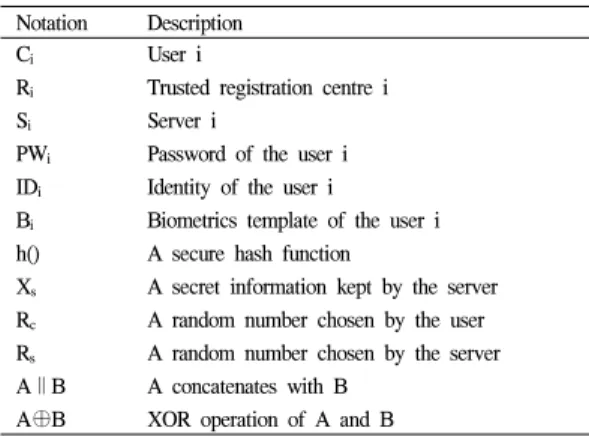
표 1. 표기법
Table 1. Notations
1. Registration Phase
Before logging in the remote server, a user C i
initially has to register to the trusted registration centre
R i as the following steps.
1) C i submits his identifier ID i and password PW i to R i through a secure channel. Also the user inputs his biometrics B i on the specific device to R i . 2) R i computes f i =h(B i ), r i =h(PW i )⊕f i and e i =h(ID i ∥
X s )⊕r i , where X s is a secret value generated by the server.
3) R i stores (ID i , h(), f i , e i , r i ) on the user’s smart card and sends it to the user via a secure channel.
2. Login Phase
When the user C i wants to login the remote server S i , the user has to perform the following steps.
1) C i inserts his smart card into a card reader and inputs the personal biometrics B i on the specific device to verify the user’s biometrics. If the biometrics information matches the template stored in system, C i passes the biometrics verification.
2) C i inputs the ID i and PW i , and then the smart card computes r i ’=h(PW i )⊕f i . If r i ’=r i , the smart card computes M 1 =e i ⊕r i ’, M 2 =M 1 ⊕R c , M 3 =h(R c ), where R c is a random number generated by the user.
3) Finally, C i sends the message {ID i , M 2 , M 3 } to S i .
3. Authentication Phase
After receiving the request login message, S i has to perform the following steps with C i to authenticate each other.
1) S i checks the format of ID i .
2) If the ID i is valid, S i computes M 4 =h(ID i ∥X s ), M 5 =M 2 ⊕M 4 and verifies whether M 3 =h(M 5 ) or not. If they are equal, S i computes M 6 =M 4 ⊕R s , M 7 =h(M 2 ∥M 5 ), M 8 =h(R s ), where R s is a random number generated by the server.
3) Then S i sends the message {M 6 , M 7 , M 8 } to C i . 4) After receiving the message, C i verifies whether M 7 =h(M 2 ∥R c ) or not. If they are equal, C i
computes M 9 =M 6 ⊕M 1 and verifies whether M 8 =h(M 9 ) or not.
5) If they are equal, C i computes M 10 =h(M 6 ∥M 9 ) and sends the message {M 10 } to S i .
6) After receiving the message, S i verifies whether M 10 =h(M 6 ∥R s ) or not. If they are equal, S i
accepts the user’s login request.
Ⅲ. Security Weakness of Das’s Scheme
In this section, we will analyze the security weaknesses in Das’s scheme, biometrics-based remote user authentication scheme. To analyze the security weaknesses, we assume that an attacker could obtain the secret values stored in the smart card by monitoring the power consumption [11-12] and intercept messages communicating between the user and the server. Under this assumption, we will discuss several attacks, such as the user impersonation attack, the server masquerading attack, the off-line password guessing attack, and the mutual authentication between the user and the server.
1. User Impersonation Attack
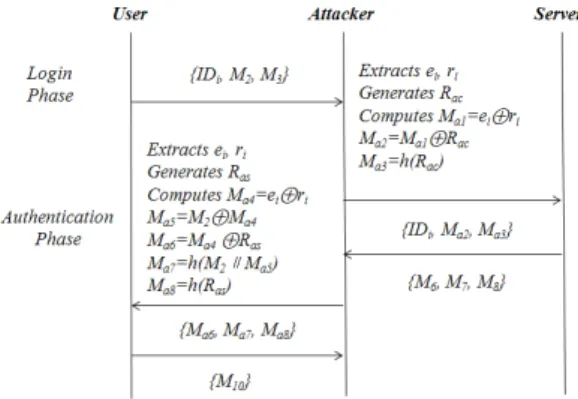
As described the above, the attacker can extract the secret values (e i , r i ) from the user’s smart card illegally by some means and intercept the message {ID i , M 2 , M 3 } in the login phase. The procedure of the user impersonation attack with the secret values is as the following steps. And the user impersonation attack is illustrated in Fig.1.
1) The attacker computes easily M a1 =e i ⊕r i , M a2 =M a1
⊕R ac and M a3 =h(R ac ), where R ac is a random number generated by the attacker.
2) Then, the attacker sends the forged message {ID i , M a2 , M a3 } to the remote server S i . 3) Upon receiving the forged message, S i checks the
format of ID i . If it holds, S i computes M 4 =h(ID i ∥
X s ), M 5 =M a2 ⊕M 4 and verifies whether M a3 =h(M 5 )
or not. If they are equal, S i will be convinced the
message {ID i , M a2 , M a3 } sent from the legitimate
user. Then, S i makes the reply massage {M 6 , M 7 , M 8 } by computing M 6 =M 4 ⊕R s , M 7 =h(M a2 ∥M 5 ), M 8 =h(R s ) in the authentication phase.
그림 1. 사용자 위장 공격 및 서버 위장 공격
Fig. 1. User Impersonation Attack and Server Masquerading Attack
2. Server Masquerading Attack
As described the above, the attacker can extract the secret values (e i , r i ) from the user’s smart card illegally by some means and intercept the message {M 2 } in the login phase, {M 6 , M 7 , M 8 } in the authentication phase.
The procedure of the server masquerading attack with the secret values is as the following steps. And the server masquerading attack is illustrated in Fig.1.
1) The attacker computes easily M a4 =e i ⊕r i , M a5 =M 2
⊕M a4 , M a6 =M a4 ⊕R as, M a7 =h(M 2 ∥M a5 ), M a8 =h(R as, ), where R as, is a random number generated by the attacker.
2) Then, the attacker sends the forged message {M a6 , M a7 , M a8 } to the user C i .
3) Upon receiving the forged message, C i checks whether M a7 =h(M 2 ∥R c ) or not. If they are equal,
C i computes and M 9 =M a6 ⊕M 1 and verifies whether M a8 =h(M 9 ) or not. If it holds, C i will be convinced the message {M a6 , M a7 , M a8 } sent from the legitimate server. Then, C i makes the reply massage {M 10 } by computing M 10 =h(M a6 ∥M 9 ) in the authentication phase.
3. Password Guessing Attack
We assume that an attacker can extract the secret values (r i , f i ) from the legitimate user’s smart card by some means. With these secret values, the attacker can easily find out PW i by performing the off-line password guessing attack, in which each guess PW i *
for PW i can be verified by the following steps.
1) The attacker computes the secret parameter r i *
=h(PW i *
)⊕f i from the registration phase.
2) The attacker verifies the correctness of PW i *
by checking r i =r i *
.
3) The attacker repeats the above steps until a correct password PW i *
is found.
Thus, the attacker can perform the off-line password guessing attack, and can successfully impersonate the legal user with the guessed user password.
4. Mutual Authentication
Generally, if an authentication scheme is insecure against user impersonation attack, server masquerading attack, the authentication schemes cannot provide mutual authentication between the user and the remote server. Thus, Das’s scheme fails to provide mutual authentication as described the above subsection.
Namely, if the attacker can extract the secret values (e i , r i ) from the legitimate user’s smart card illegally by some means and intercept the messages communicating between the user and the server, the attacker can make the modified message easily by computing M a1 =e i ⊕r i , M a2 =M a1 ⊕R ac and M a3 =h(R ac ) in the login phase. Also, the attacker can make the modified message easily by computing M a6 =M a4 ⊕R as , M a7 =h(M 2 ∥M a5 ), M a8 =h(R as ).
Hence, we can see that Das’s scheme fails to provide mutual authentication between the user and the server.
Ⅳ. The Enhanced Scheme and Security Analysis
In this section, we propose an enhanced Das’s
scheme which can withstand the various attacks with
providing mutual authentication.
1. The Enhanced Scheme
The proposed scheme is divided into three phases:
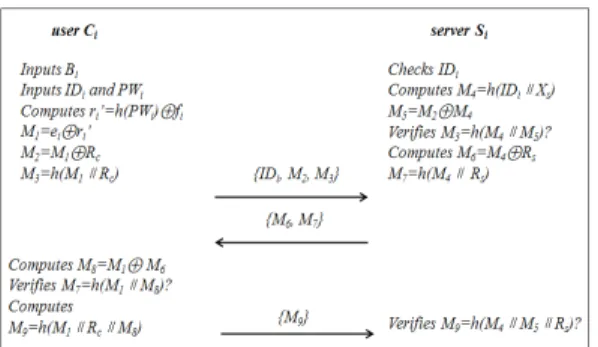
registration phase, login phase and authentication phase. The login and authentication phase are illustrated in Fig. 2.
■ Registration Phase
Before logging in the remote server, a user C i
initially has to register to the trusted registration centre R i as the following steps.
1) C i submits his identifier ID i and password information (PW i ⊕K) to R i through a secure channel. Also the user submits his biometrics information (B i ⊕K) via the specific device to R i . 2) R i computes f i =h(B i ⊕K), r i =h(PW i ⊕K)⊕f i and e i =h(ID i ∥X s )⊕r i , where X s is a secret value generated by the server and K is a random number generated by C i .
3) R i stores (ID i , h(), f i , e i ) on the user’s smart card and sends it to the user via a secure channel. And C i stores random number K into the smart card issued by R i .
■ Login Phase
When the user C i wants to login the remote server S i , the user has to perform the following steps.
1) C i inserts his smart card into a card reader and inputs personal biometrics B i on the specific device to verify user’s biometrics. If the biometrics information matches the template stored in system, C i passes the biometrics verification.
2) C i inputs the ID i and PW i , and then the smart card computes:
r i ’=h(PW i ⊕K)⊕f i
M 1 =e i ⊕r i ’ M 2 =M 1 ⊕R c
M 3 =h(M 1 ∥R c )
where R c is a random number generated by the user.
3) C i sends the login request message {ID i , M 2 , M 3 } to S i .
그림 2. 개선된 스킴의 로그인 단계 및 인증 단계
Fig. 2. Login Phase and Authentication Phase of the Enhanced Scheme