Security Improvement to a Remote User Authentication Scheme for Multi-Server Environment *
Lee, Young SookㆍKim, Jee YeonㆍWon, Dong Ho
Multi-Server 환경에서의 사용자 인증 스킴의 안전성 향상
이 영 숙**ㆍ김 지 연***ㆍ원 동 호****
<Abstract>
Recently, Tsai proposed a remote user authentication scheme suited for multi-server environments, in which users can be authenticated using a single password shared with the registration center. Our analysis shows that Tsai et al’s scheme does not achieve its fundamental goal of password security. We demonstrate this by mounting an undetectable on-line password guessing attack on Tsai et al.’s scheme.
Key Words : Authentication Scheme, Smart Card, Password, Undetectable On-line Password Guessing Attack, Multi-server Environments
Ⅰ. 서론
1)
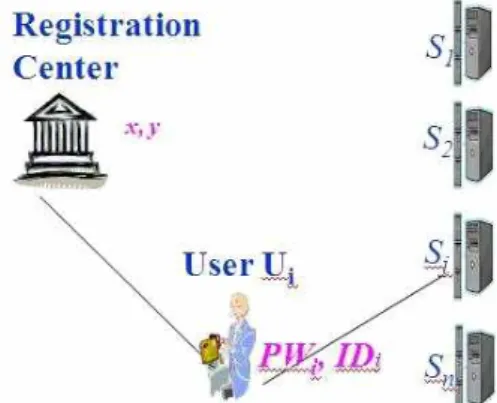
Tsai[1] proposed an efficient remote user authentication scheme suited for multi-server environments[1-12]. Multi-sever environments consist of four participant: a registration center, a remote user, and multiple service provider servers. The registration center and all system servers are assumed to be trustworthy. In their article, they claim that the user can be authenticated by all servers included in multi-server environments using a single password
* 이 논문은 2011년 호원대학교 연구비 지원을 받은 것임.
** 호원대학교 사이버수사 경찰학부 조교수(제1저자)
*** KISA ISMS, PIMS 인증 심사원
****성균관대학교 정보통신공학부 교수(교신저자)
shared with the registration center and establishes the session key to be shared with between the server and the user. In addition to making this claim, Tsai claims to exhibit various merits with its scheme: (1) it allows the user to register only once with the registration center and then he/she is able to gain access to all servers included in multi-server environments without registering with every single server; (2) it does not require any server and the registration center to maintain a password table for verifying the legitimacy of login users; (3) it allows users to choose and change their passwords according to their liking and hence gives more user convenience; (4) it does not require synchronized clocks between in the network by using
Fig 1. Consist of multi-server environment
random numbers called nonces; (5) it is extremelyefficient in terms of the computational cost since the protocol participants perform only a few hash function operations.
However, in this article, we uncover that Tsai's scheme does not guarantee its main security goal of password security. We show this by mounting an undetectable on-line password guessing attack on Tsai's scheme. What we do in this work is to report this security vulnerabilities of Tsai's scheme and to show how to eliminate them.
The remainder of this paper is organized as follows.
Section 2 reviews Tsai's remote user authentication scheme. Section 3 presents our attacks on Tsai‘s scheme and offers a security patch for the scheme.
Finally, we conclude this work in Section 4.
II. Review of Tsai’s Authentication Scheme
This section reviews a remote user authentication scheme[5, 6, 9, 13-18] proposed by Tsai[1]. The scheme participants include a registration center, a remote user, and multiple service provider servers. For simplicity, we denote the registration center by
RC
, the remote user byU
i, and the servers byS
1,S
2, ...,S
n. The scheme assumes that the registration centerRC
is a trust party responsible for securely delivering the secret keys to be shared with betweenU
i andS
j.Tsai‘s scheme consists of four phases: initialization phase, registration phase, login phase, and authentication phase. The initialization phase is processed when the sever who wants to join to the system registers with the registration center. The
registration phase is performed only once per user when a new user registers itself with the registration center. The login and the authentication phases are carried out whenever a user wants to gain access to each server included in multi-server environments.
Before the registration phase is performed for the first time, the registration center
RC
decides on the following system parameters: a one-way hash functionh
and two cryptographic keysx
andy
. The keysx
andy
are shared securely with the registration center.2.1 Initialization Phase.
This phase is invoked whenever a server wants to join this group. During this phase, the registration center
RC
and the serverS
j perform the following running:Step 1. A server
S
jwho wants to registration with the system submits it`s identitySID
j to the registration centerRC
via a secure channel.Step 2. After receiving
S
j's identitySID
j,RC
computesρ
j asρ
j =h(x, SID
j)
and sends〈ρ
j〉
toRC
through a secure channel.2.2 Registration Phase
This is the phase where a new registration of a user takes place. The registration proceeds as follows:
Step 1. A user
U
i, who wants to register with the registration centerRC
, chooses its passwordPW
iat will and submits a registration request, consisting of its identityID
i andPW
i,
to the registration centerRC
via a secure channel.Step 2. Upon receiving the request 〈
ID
iPW
i〉,RC
computesZ
i =h(ID
i||x) K
i =Z
i ⊕h(PW
i)
and issues a smart card containing〈
K
ih(ㆍ)
〉 toU
i.2.3 Login Phase
When
U
i wants to log in to the system, he inserts his smart card into a card reader and enters his identityID
iand passwordPW
i. GivenID
iandPW
i,
the smart card generates the random nonceN
i and computesZ
i= K
i ⊕h(PW
i) and C
1= Z
i ⊕N
i:The smart card then sends the login request message 〈
ID
i, C
1〉 to the serverS
j.2.4 Authentication Phase
With the login request message〈
ID
i, C
1〉, the scheme enters the authentication phase during whichS
j, RC
, andU
i perform the following steps:Step 1. When the login request arrives〈
ID
i, C
1〉, the serverS
j first chooses the random nonceN
s1and computes
C
2 =ρ
j ⊕N
s1. ThenS
j sends〈
ID
i, SID
j, C
1,C
2〉 to the registration centerRC
.Step 2. After receiving 〈
ID
i, SID
j, C
1,C
2〉fromS
j,
the registration center generates the random nonceN
rcand computesN`
s1=h
(SID
j||y
)⊕C
2andC
3=
N
rc ⊕h
(SID
j||y
).RC
then sends the response message 〈C
3〉to the serverS
j.Step 3. When the server receives
C
3,S
jcomputesN`
rc=
C
3 ⊕ρ
jandC
4=h
(ρ
j||N
s1)⊕N`
rcand sends〈
C
4〉toRC
.Step 4. Having received
C
4fromS
j,RC
computesC`
4=h
(h
(SID
j||y
)||N`
s1) ⊕N
rcN`
i=h
(ID
i||x
) ⊕C
C
5=h
(h
(SID
j||y
)||N`
s1||N
rc)C
6 =h
(h
(SID
j ||y
)||N`
s1 + 1||N
rc + 2) ⊕h
(h
(ID
i||x
)||N`
i).Now
RC
verifies the correctness ofC
4by checking thatC`
4 equalsC
4. If correct,RC
accepts as the authentic server and sends〈C
5,C
6〉otherwise, stops executing the scheme.Step 5. After receiving〈
C
5,C
6 〉,S
j chooses the random nonceN
s2and computesC`
5=h
(ρ
j||N
s1||N`
rc)C
7=C
6⊕h
(ρ
j||N
s1+ 1||N`
rc+ 2)C
8=C
1⊕C
7V
s=C
7⊕N
s2C
9 =h
(C
7||N
s2) ⊕C
8.The server
S
jchecks thatC`
5equalsC
5. If they are not equal,S
j believes that he is talking to illegal registration center and aborts the scheme. Otherwise,S
jsends 〈V
s,C
9〉 to the userU
i.Step 6. Upon receiving the message 〈
V
s,C
9〉,U
icomputes
C`
7=h
(Z
i||N
i)N`
s2= C`7⊕V
sD
8=C`
7⊕C
1C`
9=h
(C`
7||N`
s2) ⊕D
8C
10=h
(C`
7||D
8||N`
s2).Then user
U
iverifies that C`9equalsC
9. If they are equal,U
i believesS
j as authentic and sends the response message 〈C
10〉. Otherwise,U
i aborts its login attempt.Step 7. After receiving the message〈
C
10, S
j〉 computesC`
10 =h
(C
7||C
8||N
s2) and checks that whetherC`
10equalsC
10or not. If the two variables are not equal,S
j rejects the login request. Otherwise,S
j computes the session keysk = h(C
7+ 1
||C
8+ 2
||N
s2+ 3)
which is used to encrypted all following communications between the serverS
jand the remoter userU
i.Ⅲ. Cryptanalysis of Tsai’s Scheme
Unfortunately, Tsai's scheme Tsai[1] described above is completely insecure in the presence of an active adversary. To show this, we present an undetectable on-line password guessing attack that exploits password security weaknesses in the scheme.
3.1 Undetectable on-line password guessing attack
An attacker also may try to verify a guessed password in an on-line transaction; he verifies his guess using responses of a server. If his guess fails, he starts a new transaction with the server using another guessed password. However, in successful attack, a failed guess cannot be detected and logged by the server, as the server is not able to distinguish an
honest request from a malicious one. In Tasi's protocol, assume that an attacker has stolen the
U
i's smart card or gained access to it and extracted the secret values stored in it by monitoring its power consumption[19, 20]. Now the attackerU
a has obtained the valueK
istored in the
U
i's smart card. Then the following description represents our undetectable on-line password guessing attack mounted by the attackerU
aagainst
U
i's
password: The attackerU
a,
who wants to find outPW
i,
now guesses possible passwords and checks them for correctness.1. The attacker
U
a,
who has obtainedK
i stored in its smart card, chooses the random nonceN
aand computesC
a =K
i ⊕h
(PW
`i) ⊕Nausing guessed passwordPW`
i. Then,U
a posing asU
i, sends〈
ID
i,C
a〉to the serverS
j2.. After receiving 〈
ID
i, C
a〉,
the serverS
jcomputes
C
2 and sends the message〈ID
i,SID
j,C
a,C
2〉 to the registration centerRC.
3. Since, from
RC'
s point view,ID
iSID
j,C
a,C
2 are indistinguishable fromID
i,SID
j,C
i.,C
2 of an honest execution,RC
believes that the message〈
ID
i, C
a〉is fromU
i.
Hence,RC
operates as specified in protocol using the received messages fromS
j. The registration centerRC
computesC
3and sends
C
3 to the serverS
j.4. After receiving the value of
C
3, S
j computesC
4and sends the value to
RC.
5. The received message from
S
j will pass the verification test ofRC
since the computation valueC
4 will be successful proceeding the received value fromS
j.RC
proceeds to computeC
5 andC
6 and sends the message 〈C
5, C
6〉
. 6. SinceC
5 is valid, everything proceeds as usual.In response to
U
a's login message,S
j computesTable 1. Comparison of countermeasure between Tsai’s scheme and Our proposed scheme
Tsai's scheme Our proposed scheme Need for countermeasure C1= Zi⊕Ni C1= (Zi||SIDj)⊕Ni
To verify “C1is indeed fromUi” N's1=h(SIDj||y)⊕C2 N'i= (h(IDi||x)||SIDj)⊕C1
C6=h(h(SIDj||y)||N's1+1||Nrc+ 2)⊕h(h(IDi||x) C6=h ( h ( S I Dj| |y ) | | N `s1+ 1 | |Nr c+ 2 )⊕ h(h(IDi||x)||SIDj||N'i)
C'7=h(Zi||Ni) C'7=h(Zi||SIDj||Ni)
C
7= C
6 ⊕h((ρ
j||N
s1+ 1
||N
`rc+ 2) C
8= C
1 ⊕C
7V
s= C
7 ⊕N
m2C
9= h(C
7||N
s2)
⊕C
8.Then
S
j sends 〈V
s,C
9〉toU
aposing asU
i.
7. Now, an attackerU
a upon receivingV
s andC
9from
S
j, computesC`
7 =h(K
i ⊕h(PW`
))||N
a) N`
S2 =C`
7 ⊕V
sD
8 =C`
7 ⊕C
aC`
9 =h(C`
7 ||N`
s2) ⊕D
8.U
athen verifies the correctness ofPW`
i by checking the equality C`9 =C
9.
Notice that ifPW`
i andPW
i are equal, thenC`
9 = C9 ought to be satisfied.8.
U
a repeats a new transaction with the server using another guessed password until a correct password is found.3.2 Preventing the attack
We now figure out what is wrong with the scheme and how to fix it. The fixed scheme is given mainly to provide a better insight into the failure of Tsai's scheme. Flaws in the scheme The main flaw in Tsai's scheme is that there is no way for the registration center to check whether the received message 〈
C
1〉 is correctly sent or not. The registration center can be sure of is thatC
1 is from the legitimate userU
i. Thisoversight allows the attacker in our attack to send the forged message 〈
ID
i, C
a〉without being detected by the registration center.This flaw exploited by the attacker is that the scheme does not provide
RC
with any proof necessary to verify thatC
1 is indeed formU
i. Notice that checking the correctness ofC
9 ≟h(K
i ⊕h(PW`
i)
||N
a)
||N`
s2)
⊕D
8 gives no proof that such is the case; for example, by checking the correctnessC
9,U
i is assured only that guessed passwordPW`
i is legitimate userU
i's password. These flaws together allow the adversary to completely compromise the password security of the protocol.Countermeasure : The simple way to resolve the security problem with Tsai's scheme would be to change the computations of
C
1,N`
i,C
6andC`
7to:C
1= (Z
i||SID
j) ⊕N
iN`
i= (h
(ID
i||x
)||SID
j) ⊕C
1α
=C
1 ⊕N`
iα
≟h
(ID
i||x
)||SID
j)C
6=h
(h
(SID
j||y
)||N
`s1+1||N
rc+2)⊕h
(h
(ID
i||x
)||SID
j||N`
i )C`
7=h
(Z
i||SID
j||N
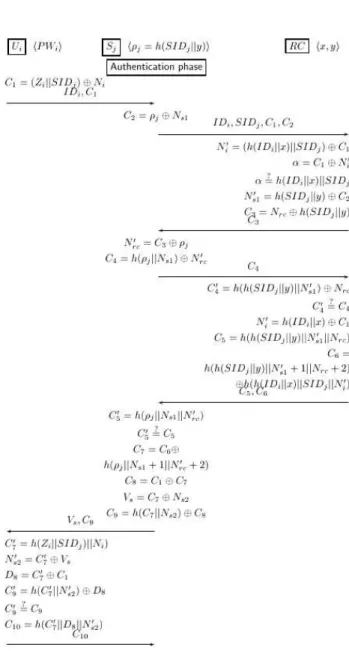
i).A high level depiction of the scheme is given in Fig. 2 and a more detailed description follows:
In the Table 1, we compare our proposed scheme with previously published Tsai's scheme. It is easy to
Fig 2. A countermeasure on Tsai's scheme:
see that our proposed authentication scheme can provide
RC
with the proof necessary to verify thatC
1is indeed from
U
i.Ⅳ. Conclusion
This work has considered the security of Tsai's authentication scheme[1] for multi-server environment.
We demonstrate this by an undetectable on-line
password guessing attack that completely compromises the password security of the scheme. In addition, we have recommended a small change to the scheme that can address the identified security problem.
Reference
[1] Tsai J. -L. Efficient multi-server authentication scheme based on one-way hash function without verification table, Computers & Security 27, 2008, pp.115-121.
[2] Y. Chen, C. -h. Huang, J. -s. Chou, “A Novel multi-server authentication protocol”, http://
eprint.iacr.org/2009/176, Cryptology ePrint Archive, 2009.
[3] Chang C. and Kuo J. Y. An efficient multi-server password authenticated keys agreement scheme using smart cards with access control, IEEE Proceeding of the 19th International Conference on Advanced Information Networking and Applications 2, 2005, pp.257-260.
[4] Chang C. and Lee J. S., An efficient and secure multi-server password authentication scheme using smart cards, IEEE Proceeding of the International Conference on Cyberworlds, 2004.
[5] Juang W. S. Efficient multi-server password authenticated key agreement using smart cards, IEEE Transaction on Consumer Electronics 50(1), 2004, pp.251-255.
[6] Ku W. -C., Chang S. -T., and Chiang M. -H.
Weaknesses of a remote user authentication scheme using smart cards for multi-server architecture, IEICE Transactions on Communications E88-B(8), 2005, pp.3451-3454.
[7] Li L. -H., Lin I. -C., and Hwang M. -S. A remote password authentication scheme for multi-server architecture using neural networks, IEEE Transaction on Neural Networks 12(6), 2001, pp.
1498-1504.
[8] Lin I. -C., Hwang M. -S., and Li L. -H. A new remote user authentication scheme for multi-server internet environments, Future Generation Computer System 19, 2003, pp.13-22.
[9] Sun H. -M. An efficient remote user authentication scheme using smart cards, IEEE Transaction on Consumer Electronics 46(4), 2000 pp.958-961.
[10] Tsuar W. -J. An enhanced user authentication scheme for multi-server internet services, Applied Mathematics and Computation 170, 2005, pp.258-266.
[11] Tsuar W. -J., Wu C. -C., and Lee W. -B. A flexible user authentication for multi-server internet services, Networking-JCN 2001 LNCS 2093, 2001, pp.174-183.
[12] Tsuar W. -J., Wu C. -C., and Lee W. -B. A smart card-based remote scheme for password authentication in multi-server Internet services, Computer Standards & Interfaces 27, 2004, pp.39-51.
[13] Chang C. -C. and T. -C. Wu Remote password authentication with smart cards, IEE Proceedings E -Computers and Digital Techniques 138(3), 1991, pp. 165-168.
[14] Chien H. -Y., Jan J. -K., and Tseng Y. -M. An efficient and practical solution to remote authentication: smart card, Computers & Security 21(4), 2002, pp.372-375.
[15] Hsu C. -L. Security of Chien et al. 's remote user authentication scheme using smart cards, Computer Standards and Interfaces 26(3), 2004,
이 영 숙
Lee, Young Sook
2009년 3월~현재
호원대학교 사이버수사경찰학부 조교수
2011년 7월 ~현재
호원대학교 사이버수사경찰학부 학부장
2010년 1월~2011년 6월 호원대학교 기획조정처 경영평가실장
2008년 8월 성균관대학교 컴퓨터공학과 (공학박사)
2005년 2월 성균관대학교 정보보호학과 (공학석사)
1987년 2월 성균관대학교 정보공학과(공학사)
관심분야 : 암호프로토콜 암호이론, 네트워크 보안, 스마트폰 보안 E-mail : [email protected]
김 지 연
Kim, Jee Yeon
2007년 9월~현재
KISA ISMS, PIMS 인증 심사원 1996년 12월~2007년 1월
한국정보보호진흥원 선임연구원 2006년 2월 성균관대학교
전기전자및컴퓨터공학과(공학박사) 2007년 2월 성균관대학교 정보공학과(공학석사) 1995년 2월 성균관대학교 정보공학과(공학사)
관심분야 : 암호프로토콜 암호이론, 정보보호관리체계 인증 E-mail : [email protected]
원 동 호
Won, Dong Ho
현재 성균관대학교 정보통신공학부 교수, 한국정보보호학회 명예회장 2002년~2008년
대검찰청 컴퓨터범죄수사 자문위원, 감사원 IT 감사 자문위원 2002년~2003년
한국정보보호학회장 1996년~1998년
국무총리실 정보화추진위원회 자문위원 1988년~2003년
성균관대학교 교학처장, 전기전자 및 컴퓨터공학부장, 정보통신대학원장, 정보통신기술연구소장, 연구처장 1985년~1986년
일본 동경공업대 객원연구원 1978년~1980년
한국전자통신연구원 전임연구원 1976년~1988년
성균관대학교 전자공학과(학사, 석사, 박사)
관심분야 : 암호이론, 정보이론, 정보보호 E-mail : [email protected]
논문접수일 : 2011년 8월 20일 수 정 일 : 2011년 10월 04일 게재확정일 : 2011년 10월 20일 pp. 167-169.
[16] Hwang M. -S. and Li L. -H. A new remote user authentication scheme using smart cards, IEEE Transaction on Consumer Electronics 46(1), 2000, pp. 28-30.
[17] P. Kocher, J. Jaffe, B. Jun, Differential power analysis, in Advances in Cryptology-CRYPTO99, 1999, pp.388-397.
[18] M. Kim, K. Lee, S. Kim, D. Won, Efficient and Secure Authentication Scheme Preserving User Anonymity, The Korea-Society of Digital Industry&
Information Management, 2010, 6(3), pp.69-77.
[19] T. S. Messergers, E. A. Dabbish, R. H. Sloan, Examining smart card security under the threat of power analysis attacks, IEEE Trans. Comput. 51 (5), 2002, pp.541-552.
[20] P. Kocher, J. Jaffe, B. Jun, Differential power analysis, in Advances in Cryptology{CRYPTO 99}, 1999, pp.388-397.
▪저자소개▪