Vol. 38, No. 2, 222–226(2010)
김치로부터 담즙산 분해능이 우수한
Lactobacillus plantarum CIB 001의 분리 및 동정
차상도1·김태운2·이동희1
*
1(주)셀인바이오 생물소재연구소, 2경희대학교 식품공학과
Isolation and Identification of Lactobacillus plantarum CIB 001 with Bile Salt Deconjugation Activity from Kimchi. Cha, Sang Do1, Tae Woon Kim2, and Dong Hee Lee1*. 1Biomaterials Research Center, Cellin- bio, Suwon 443-734, Korea, 2Institute of Life Science & Resources and Graduate School of Biotechnology, Kyung Hee University, Yongin 446-701, Korea − This study was carried out to isolate and characterize the Lactobacil- lus plantarum with bile salt deconjugation activity that was isolated from Kimchi. Some isolates were selected and identified as L. plantarum by 16S rRNA gene sequence and sodium dodecyl sulfate-polyacrylamide gel electrophoresis (SDS-PAGE) analysis of whole cell protein patterns. They were assayed to determine their capacities to express bile salt hydrolase (BSH) activity. Among the identified strains, L. plantarum CIB 001 showed the highest level of BSH activity. Then, resistance to gastric acidity and bile condition were analyzed for further characterization. This strain was able to maintain viability for 1h at pH 2.0 and to survive in a MRS (deMan, Rogosa, and Sharpe) broth with 1.0% of bile acids. L. plantarum CIB 001 would potentially be useful in the food industry as probiotics.
Key words : Lactobacillus plantarum, bile salt hydrolase
유산균은 다양한 식품에 첨가되어 섭취함으로써 건강기능 성 식품으로 활용되고 있는 유익균으로 장내 세균수의 안정 화[18], 피부염의 개선[30], 혈중 콜레스테롤의 저하[1, 2, 9, 10, 12, 20, 22, 27, 29], 충치균의 감소[3, 4, 5], 박테리오 신 생성[17], 장내 병원균 성장 저해[21] 효과가 알려져 있 다. 유산균은 300~400여 종류가 알려져 있으며, 유제품 발 효의 starter로 이용될 뿐만 아니라 오래전부터 김치, 치즈, 육류, 과일 및 곡류를 포함한 다양한 발효식품의 제조에 관 여하여 왔다. 유산균 발효식품을 섭취 할 경우 발효과정 중 생성된 대사산물의 복합적인 작용으로 인해 인체에 해로운 병원성세균, 식품부패균의 증식을 억제하여 장을 튼튼하게 향상시키며 장의 연동운동 증가, 면역기능 증강 효과를 나 타낸다[22, 25]. 하지만 유산균이 사람의 장에 도달하여 생 균제(probiotics)로써 효과를 나타내기 위해서는 위에서 분비 되는 pH 3 이하의 위액과 췌장에서 분비되는 담즙산이 존 재하는 인체 소화기관의 열악한 환경을 극복해야 한다. 이 러한 미생물의 생존 저해환경에서 내성을 갖는 유산균을 분 리하고자 많은 연구자들이 내산성과 내담즙성에 대한 연구 를 지속적으로 수행해 왔으며, 이들 중 장내 상피세포 부착 능이 우수한 균주를 선별하여 생균제에 사용함으로써 높은 효율을 얻고자 하였다.
최근에는 유산균 연구가 활발해지면서 유산균의 특수기능 인 담즙산 탈포합활성을 갖는 미생물을 분리하여 혈중 콜레 스테롤을 저하시킬 수 있는 기능성식품으로 응용하려는 시 도가 증가하고 있다. 담즙산은 소장에서 taurine 또는 glycine 과 결합되어 포합담즙산(conjugated bile acid)으로 존재하는 데 지질 용해도가 높아 소장에서 콜레스테롤의 흡수를 용이 하게 한다. 그러나 유산균의 담즙산 분해효소에 의해 담즙 산의 탈포합이 진행되면 담즙산은 유실되고, 새로운 담즙산 을 합성하기 위한 전구물질로 콜레스테롤을 소모시켜 혈중 콜레스테롤을 낮추게 된다[13, 23, 28]. 이와 같이 담즙산 탈 포합활성을 갖는 균주로는 bacteroides, bifidobacteria, fusobacteria, clostridia, peptostreptococci, lactobacilli, en- terococci 그리고 streptococci가 알려져 있으며[8, 11, 19], 이들 균 중 Lactobacillus의 경우 생균제로 많이 쓰이고 Lactobacillus plantarum의 담즙산 탈포합활성은 이미 여러 선행연구가 이루어져 잘 알려져 있다[6, 7, 14].
따라서 본 연구에서는 GRAS(Generally Recognized As Safe)로 오래전부터 식용되어온 한국의 대표적인 전통 발효 식품인 김치에서 담즙산 탈포합활성이 증명된 L. plantarum 을 분리하여 이들 중 활성이 우수한 균주를 선발 및 동정 하고 특성을 조사하여 향후 산업적인 이용에 적용하고자 하 였다.
유산균을 분리하기 위하여 한국의 전통 방식으로 제조된 무김치 국물을 수거하여 멸균수로 105~107까지 희석한 뒤, MRS 평판배지(Difco, Becton Dickinson and Co., Sparks,
*Corresponding author
Tel: 82-31-695-7955, Fax: 82-31-695-7986 E-mail: [email protected]
MD., USA)에 도말하여 37oC에서 혐기적으로 배양하였다.
24시간이 경과한 후 형성된 유백색의 단일 콜로니를 분리하 여 획선 도말하고, 이를 MRS 배지에서 수 회 계대배양하여 순수하게 얻어진 균주를 선발하였다. L. plantarum의 선발에 는 Kim 등[16]이 사용한 방법에 따라 무김치에서 분리한 균 주와 표준균주를 20 mL의 MRS 배지에서 37oC에서 16시 간 동안 배양한 후, 12,000×g, 4oC에서 3분간 원심분리를 수 행하였다. 멸균 증류수로 세척한 후, 원심분리를 수행하고 pellet을 50 mM Tris-HCl(pH 8.0) 50 µL에 부유시켰다.
50mg의 glass bead(Sigma, St, Louis, MO, USA)를 첨가한 후 5분간 교반하고, 동량의 sample buffer [2×SDS sample buffer; 5% 1M Tris-HCl(pH 6.8), 20% glycerol, 4%
SDS, 4% 2-mercaptoethanol, 0.3% bromophenol blue, 66.7% H2O]를 넣고 단백질 변성을 위해 95oC에서 5분간 가 열하였다. 원심분리 후 상층액을 취하여 12% SDS-PAGE gel을 2시간동안 0.05% Coomassie brilliant blue R-250 (Bio-Rad Laboratories, Richmond, USA)에서 염색하였고, 10% acetic acid와 30% methanol solution의 혼합용액으로 30분간 탈염색을 수행한 후 비교분석을 실시하였다(Fig. 1).
이들 중 생물자원센터의 분양균주인 L. plantarum KCTC 3104와 whole cell protein pattern이 유사한 균주를 선별하 였다. 16S rDNA 염기서열 분석을 위해 27F(5'-AGA GTT TGA TCM TGG CTC AG-3')와 1492R(5'-TAC CTT GTT ACG ACT-3') 16S universal primer를 이용하여 증폭된 PCR 산물을 3730XL DNA analyzer(Applied Biosystems, Renton, WA., USA)를 사용하여 염기서열을 결정하였고, 이
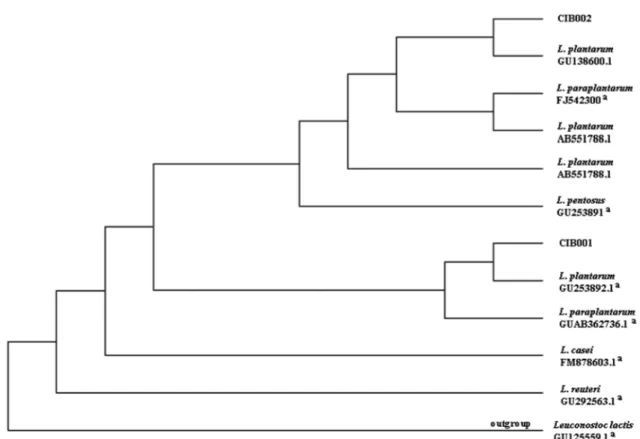
염기서열을 GenBank database와 비교하여 유사성을 분석한 결과 분리균주는 L. plantarum으로 동정되었다(Fig. 2). 분리 된 L. plantarum 균주들은 그람 양성 간균으로 호기적 조건 에서도 생육이 가능하였고 각각 L. plantarum CIB 001, L.
plantarum CIB 002 등으로 명명되었다. 그러나, 최근 L.
plantarum group 이라 불리는 L. plantarum, L. pentosus, L. paraplantarum이 김치에서 분리 및 검출된 바 있고, 99%
이상의 높은 16S rDNA 염기서열 상동성을 지니고 있어 이 에 대한 더욱 깊고 체계적인 연구가 필요할 것으로 보인다 [26].
이들 분리균들 중에서 담즙산 분해능인 BSH활성이 우수 한 균주를 분리하기 위해 Dashkevics[7] 등의 방법을 변형 하여 시험하였다. 포합담즙산으로 sodium taurodeoxycholic acid(TDCA; Sigma, St, Louis, MO, USA)를 시험에 사용 하여 0.5%의 농도로 TDCA가 함유된 MRS 액체배지를 제 조한 후, 24 well plate에 5mL씩 분주하고 CIB 001, CIB 002와 대조군들을 105 CFU/mL 수준의 농도가 되도록 접종 하였다. 37oC 진탕배양기에서 16시간 동안 배양한 배양액 1mL를 취하여 동량의 ethyl acetate를 처리 후 free bile acids가 함유된 organic phase와 반응하지 않은 TDCA가 용 해되어 있는 aqueous phase로 분획하였다. Organic phase를 분리하여 동결건조 후 얻어진 시료를 500 µL의 ethyl acetate에 용해시켜 silica gel plates(Merck, Darmstadt, Germany)위에 각각의 시료 5 µL를 로딩한 후 전개시켜 thin layer chromatography(TLC)를 수행하였다(Fig. 3A). Silica gel plate에서 이동속도의 차이로 분리되어진 deoxycholic acid(DCA)영역을 Image J(Version 1.42, National institute of health, USA)프로그램을 사용하여 농도를 분석한 결과 (Fig. 3B), CIB 001의 경우가 가장 높은 수치를 나타내었다.
Kim 등[14]은 L. rhamnosus와 L. plantarum의 콜레스테롤 저하 효과 연구에서 taurocholate을 탈포합하여 생성된 cholic acid의 양을 조사하였는데, 24시간 배양동안 L. rhamnosus 가 7%정도 증가하였고, L. plantarum이 10%정도 증가하였 다고 보고하였다. 이러한 결과는 유산균에 의해 포합된 담 즙산이 탈포합되면서 배지 내에 cholic acid가 해리된 결과 이다. 이들의 결과와 비교해 볼 때 측정방법의 차이는 있으 나 배지내에 해리된 CIB 001의 DCA영역 측정값이 70,595 로 CIB 002 균주의 측정값인 13,175 보다 약 5배 이상 높 았고 대조군인 KCTC 3104의 측정값 5,965보다 약 11배 이 상, KCTC 3108의 측정값 23,630보다 약 3배 이상 높은 수 치를 나타내었다. 따라서 CIB 001은 포합된 담즙산인
TDCA를 탈포합시키는 활성이 대조균주보다 우수한 것으
로 관찰되었고, 선발균주로 L. plantarum CIB 001를 선택 하였다.
L. plantarum CIB 001의 산성조건에서의 내성을 분석하 기 위해 pH 7.0, pH 3.0, pH 2.0의 0.1 M 인산완충용액에 유산균 배양액을 초기 균수가 108 CFU/mL가 되도록 접종 Fig. 1. SDS-PAGE patterns of whole cell proteins of reference
strains tested. Indicated as follows: M, protein molecular weight marker (kDa); 1, L. plantarum KCCM 11322; 2, L. plantarum KCTC 3104; 3, CIB 001.
하여 1시간동안 37oC에서 반응시킨 후 생균수를 측정하여 생존율[(반응 후 CFU/mL ÷ 접종시 CFU/mL)×100]을 측정 하였고, 대조군으로는 L. plantarum KCTC 3104와 L.
acidophilus KCTC 3164균주를 사용하였다. CIB 001 균주 는 pH 3.0에서 79%, pH 2.0에서는 30% 생존율을 보여 동 종인 L. plantarum KCTC 3104와 비교하여 우수한 내산성 을 나타내었으며 L. acidophilus KCTC 3164와는 유사한 내 산성을 나타내었다(Table 1). Kim 등[15]은 콜레스테롤 저하 유산균의 연구에서 내산성을 조사하였는데 L. rhamnosus, L.
casei의 경우, pepsin이 1000 unit/mL 첨가된 MRS 액체 배 지에서 초기 균수가 108 CFU/mL가 되도록 접종하여 pH 2.0의 산성 조건으로 37oC에서 1시간 반응하여 102 CFU/mL 이상의 균주 생존을 관찰하였고, pH 3.0에서 처리한 경우 약 106 CFU/mL 이상의 생존율을 관찰하였다고 보고하였다. 이 들의 결과와 비교해 볼 때 내산성 측정 배지의 조성물이 약 간 차이는 있으나 CIB 001의 경우 pH 2.0와 pH 3.0에서 107 CFU/mL 이상의 균주 생존을 보임으로서 내산성이 우 수한 것으로 관찰되었다.
또한, 담즙산에 대한 내성을 분석하기 위하여 0.5%와 1.0%
의 ox-bile(Fluka Biochemika, Sigma-Aldrich, Buchs, Switzerland)이 포함된 MRS 액체배지에 초기 균수가 107 CFU/mL가 되도록 접종하여 내산성 실험과 동일한 배양조 Fig. 2. A cladogram inferred from 16S rRNA gene sequence of the isolate CIB 001. Phylogenetic relationships tree of the 16S rRNA gene sequences were referenced Lactobacillus species. Trees were rooted using sequences from the outgroup. aAccession number in Gen- Bank.
Fig. 3. Thin-layer chromatogram (A) and integrated density (B) of ethyl acetate-extracted 0.5% TDCA MRS broth. Indi- cated as follows: TDCA, Taurodeoxycholic acid; 1, CIB 001; 2, CIB 002; 3, L. plantarum KCTC 3104; 4, L. plantarum KCTC 3108. B, pooled results showing the mean change of Integ. R Max.
Bars indicate mean ± S.E.; **p<0.01; ***p<0.001 (compared with CIB 001).
건으로 실험하였다. L. plantarum CIB 001 균주는 0.5%의 담즙산 조건에서 86.6%의 생존율을 나타냈으며, 1% 담즙산 조건에서도 63.3%의 생존율을 보여 담즙산에 내성이 있다 고 알려진 L. acidophilus보다 담즙산에 강한 내성을 나타내 었다(Table 1). 이들 결과를 고려해 볼 때 선발 균주는 산성 과 담즙이 존재하는 인공적 환경에서 높은 생존력을 나타내 어 생균제로 사용될 수 있는 가능성을 보였다. 현재 우수한 담즙산 탈포합능을 보인 L. plantarum CIB 001 균주의 고 콜레스테롤 동물모델실험의 적용을 계획하고 있으며 동물실 험을 통한 콜레스테롤 저하효과의 규명이 이루어진다면 향 후 유용한 기능성 소재로 활용이 가능할 것으로 기대된다.
R
EFERENCE1. Akalin, A. S., S. Gonc, and S. Duzel. 1997. Influence of yogurt and acidophilus yogurt on serum cholesterol levels in mice. J. Dairy Sci. 80: 2721-2725.
2. Beena, A. and V. Prasad. 1997. Effect of yogurt and bifidus yogurt fortified with skim milk powder, condensed whey and lactose-hydrolyzed condensed whey on serum chole- sterol and triacylglycerol concentrations in rats. J. Dairy Res.
64: 453-457.
3. Caglar, E., S. U. Kavaloglu, O. O. Kuscu, N. Sandalli, P. L.
Holgersson, and S. Twetman. 2007. Effect of chewing gums containing xylitol or probiotic bacteria on salivary mutans streptococci and lactobacilli. Clin. Oral. Investig. 11: 425- 429.
4. Caglar, E., S. U. Kavaloglu, N. Sandalli, and S. Twetman.
2006. Salivary mutans streptococci and lactobacillus levels after ingestion of the probiotic bacterium Lactobacillus reuteri ATCC 55730 by straws and tablets. Acta. Odontol.
Scand. 64: 314-318.
5. Caglar, E., N. Sandalli, S. Twetman, S. Ergeneli, and S.
Selvi. 2005. Consumption of yogurt with Bifidobacterium DN-173010 and its effect on dental caries risk factor. Acta.
Odontol. Scand. 63: 317-320.
6. Christiaens, H., R. J. Leer, P. H. Pouwels, and W. Verstraete.
1992. Cloning and expression of a conjugated bile acid hydrolase gene from Lactobacillus plantarum by using a direct plate assay. Appl. Environ. Microbiol. 58: 3792-3798.
7. Dashkevicz, M. P. and S. D. Feighner. 1989. Development of a differential medium for bile salt hydrolase-active Lactobacillus spp. Appl. Environ. Microbiol. 55: 11-16.
8. Floch, M. H., H. I. Binder, B. Filburn, and W. Gershengoren.
1972. The effect of bile acids on intestinal microflora. Am. J.
Clin. Nutr. 25: 1418-1426.
9. Fukushima, M. and M. Nakano. 1996. Effects of a mixture of organisms, Lactobacillus acidophilus or Streptococcus faecalis on cholesterol metabolism in rats fed on a fat- and cholesterol-enriched diet. Br. J. Nutr. 76: 857-867.
10. Gilliland, S. E., C. R. Nelson, and C. Maxwell. 1985.
Assimilation of cholesterol by Lactobacillus acidophilus.
Appl. Environ. Microbiol. 49: 377-381.
11. Hentges, D. J. 1983. Biotransformation of bile acids and cholesterol by the intestinal microflora. Human intestinal microflora in health and disease. Academic Press, New York, USA.
12. Hepner, G., R. Fried, St. S. Jeor, L. Fusetti, and R. Morin.
1979. Hypocholesterolemic effect of yogurt and milk. Am. J.
Clin. Nutr. 32: 19-24.
13. Jones, B. V., M. Begley, C. Hill, C. G. M. Gahan, and J. R.
Marchesi. 2008. Functional and comparative metagenomic analysis of bile salt hydrolase activity in the human gut microbiome. Proc. Natl. Acad. Sci. 105: 13580-13585.
14. Kim, D. W., D. H. Yang, S. Y. Kim, K. S. Kim, M. G.
Chung, and S. M. Kang. 2009. Hypocholesterolemic effect of lyophilized, heat-killed Lactobacillus rhamnosus and Lactobacillus plantarum. Kor. J. Microbiol. Biotechnol. 37:
69-74.
15. Kim, J. H., M. K. Oh, Y. H. Rhee, K. C. Choi, Y. K. Lee, and S. Y. Shin. 1999. Selection and physico-chemical characteristics of lactic acid bacteria which had cholesterol lowering activities. J. Korean Soc. Agric. Chem. Biotechnol.
42: 83-90.
16. Kim, T. W., S. H. Jung, J. Y. Lee, S. K. Choi, S. H. Park, J.
S. Jo, and H. Y. Kim. 2003. Identification of lactic acid bacteria in Kimchi using SDS-PAGE profiles of whole cell proteins. J. Microbiol. Biotechnol. 13: 119-124.
17. Lavermicocca, P., F. Valerio, A. Evidente, S. Lazzaroni, A.
Corsetti, and M. Gobetti. 2000. Purification and chracteriza- tion of novel antifungal compounds from the sourdough Lactobacillus plantarum strain 21B. Appl. Environ.
Microbiol. 66: 4084-4090.
18. Lidbeck, G. J and C. E. Nord. 1987. Impact of Lactobacillus acidophilus on the normal intestinal flora after admini- stration of two antibiotic agents. Infection 16: 329-335.
19. Macdonald, I. A., V. D. Bokkeheuser, J. Winter, A. M.
Mclernon, and E. H. Mosbach. 1983. Degradation of Table 1. Acid tolerance and bile acid tolerance of L. plantarum CIB 001 isolated from Kimchi.
Strain
Viable cell count (CFU/mL)/Survival rate (%)
pH Oxgall
7.0 3.0 2.0 0 0.5 % 1.0 %
L. plantarum CIB 001 1.0×10⁸(100) 7.9×10⁷(79) 3.0×10⁷(30) 1.5×10⁷(100) 1.3×10⁷(86.6) 9.5×10⁶(63.3) L. plantarum KCTC 3104 2.5×10⁸(100) 5.5×10⁷(22) 1.0×10⁵(0.04) 1.2×10⁷(100) 9.0×10⁶(75.0) 8.2×10⁶(68.3) L. acidophilus KCTC 3164 1.0×10⁸(100) 8.5x10⁷(85) 3.5×10⁷(35) 1.0×10⁷(100) 6.5×10⁶(65.0) 3.0×10⁶(30.0)
steroids in the human gut. J. Lipid. Res. 24: 675-700.
20. Mohan, B., R. Kadirvel, A. Natarajan, and M. Bhaskaran.
1996. Effect of probiotic supplementation on growth, nitrogen utilization and serum cholesterol in broilers. Br.
Poult. Sci. 37: 395-401.
21. Murry, A. C., A. Hinton, and H. Morrison. 2004. Inhibition of growth Escherichia coli, Salmonella typhimurium, and Clostridium perfringens on chicken feed media by Lacto- bacillus salivarius and Lactobacillus plantarum. Poult. Sci.
9: 603-607.
22. Nakajima, H., Y. Suzuki, and T. Hirota. 1992. Cholesterol- lowering activity of ropy fermented milk. J. Food Sci. 57:
1327-1329.
23. Ramasamy, K., N. Abdullah, M. Wong, C. Karuthand, and Y. W. Ho. 2010. Bile salt deconjugation and cholesterol removal from media by Lactobacillus strains used as probiotics in chickens. J. Sci. Food Agric. 90: 65-69.
24. Sartor, R. B. 2004. Therapeutic manipulation of the enteric microflora in inflamatory bowel disease: antibiotics, probi- otics and prebiotics. Gastroenterology. 126: 1620-1633.
25. Shanahan, F. 2005. Physiological basis for novel drug therapies used to treat the inflammatory bowel diseases. I.
Pathophysiological basis and prospects for probiotic therapy in inflammatory bowel disease. Am. J. Physiol. Gastrointest.
Liver Physiol. 288: G417-G421.
26. Shim, S. M. and J. H. Lee. 2008. Evaluation of lactic acid bacterial community in Kimchi using terminal-restriction fragment length polymorphism analysis. Kor. J. Microbiol.
Biotechnol. 36: 247-259.
27. Suzuki, Y. and H. Kaizu. 1991. Effect of cultured milk on serum cholesterol consentration in rats which were fed highcholesterol diets. Anim. Sci. Technol. 62: 565-576.
28. Tanaka, H., K. Doesburg, T. Iwasaki, and I. Mierau. 1999.
Screening of lactic acid bacteria for bile salt hydrolase activity. J. Dairy Sci. 82: 2530-2535.
29. Thompson, L. U., D. J. Jenkins, M. A. Amer, R. Reicher, A.
Jenkins, and J. Kamulsky. 1982. The effect of fermented and unfermented milks on serum cholesterol. Am. J. Clin. Nutr.
36: 1106-1111.
30. Weston, S., A. Halbert, P. Richmond, and S. L. Prescott.
2005. Effects of probiotics on atopic dermatitis: a randomis- ed controlled trial. Arch. Dis. Child. 90: 892-897.
(Received February 18, 2010/Accepted May 5, 2010)