무청의 항균, 항산화 및 항혈전 활성
이예슬, 권경진, 김미선, 손호용*
안동대학교식품영양학과
Received : February 19, 2013 / Revised : April 4, 2013 / Accepted : April 5, 2013
서 론
무(Raphanus sativus L.)는쌍떡잎식물, 양귀비목, 겨자 과에속하는한해살이또는두해살이초본으로, 품종에따라 비대한지하부뿌리(무)와지상부엽채(무청)를함께식용으 로사용하기도하고, 뿌리만또는무청만식용하기도한다. 한국에서는지역에따라무우, 무수, 무시등으로불리기도 하며, 주로 3종류가재배되고있다. 중국을통해들어온재
래종(조선무)은김치, 깍두기, 무말랭이등으로주로생산소 비되며, 중국에서일본을거쳐들어온일본무계통은주로 단무지로, 유럽을통해들어온샐러드용무는주로샐러드로 이용된다. 우리나라대표채소중의하나인무는수분함량이 93%, 조단백 1%, 당질 3%를함유하며, 다량의비타민C와미
네랄을포함하는것[12, 14]으로알려져있어겨울철비타민
공급원으로주요한역할을해왔다. 또한무씨는내복자, 나복 자등으로불리며, 한방에서는약용으로사용하기도한다. 한 편무청은건조하여국이나나물로조리하여이용하였으며, 실제과거채소가귀했던겨울철에단백질, 비타민, 미네랄, 식이섬유등을공급해온주요식품이었다[14]. 그러나, 최근 도시와농촌의격리, 산업화의정착, 식생활습관의변화등 Antimicrobial, Antioxidant and Anticoagulation Activities of Korean Radish (Raphanus sativus L.) Leaves. Lee, Ye- Seul, Kyung-Jin Kwon, Mi-Sun Kim, and Ho-Yong Sohn*.Dept. of Food and Nutrition, Andong National University, Andong 760-749, Korea
Radish (Raphanus sativus) is a common cruciferous vegetable, and its aerial parts, called Mu-chung in Korean, have plentiful nutritional components such as vitamins, minerals and dietary fibers. Mu-chung has been used as a kimchi, a traditional Korean fermented dish, and dried Mu-chung is an important component of soups commonly consumed during winter in Korea.
Since the advent of the mass production of radish in Korea, with the segregation of farm areas and towns and changing diets, Mu-chung has mostly been discarded instead of utilized. In addition, studies concerning the efficient utilization and useful bio- activities of Mu-chung are still lacking worldwide. In this study, we prepared the ethanol extract of Mu-chung and its subsequent solvent fractions. Antimicrobial, antioxidation, and anticoagulation activities were then evaluated in the hopes of developing a functional biomaterial from Korean radishes’ aerial parts. The ethanol extraction yield for hot-air dried Mu-chung was 5.6%, and the fraction yields of n-hexane (H), ethylacetate (EA), butanol (B) and water residue were 25.3, 3.6, 19.4, and 51.7%, respec- tively. Analysis of total polyphenol and total flavonoid contents showed that the EA fraction had the highest content (97.57 and 152.91 mg/g) amongst the fractions. In antimicrobial activity assays, the H and EA fractions were effective against gram posi- tive bacteria (Staphylococcus aureus, Listeria monocytogenes, and Bacillus subtilis), but not effective against gram negative bacteria (Escherichia coli and Pseudomonas aeruginosa). The B fraction also exhibited moderate antibacterial activity, sug- gesting that the extract of Mu-chung has various antibacterial components. In antioxidation activity assays, the EA fraction showed strong DPPH, ABTS and nitrite scavenging activities (69-222 µg/ml of IC50), including reducing power. In anticoagula- tion activity assays, the EA fraction demonstrated strong inhibition activity against human thrombin and prothrombin. Prominent anticoagulation activity was found in aPTT assays; the aPTT of the EA fraction was extended 15-fold compared than that of the solvent control. Our results suggest that Mu-chung is an attractive nutritional food material possessing useful bioactivities, and the EA fraction of Mu-chung could be developed as a functional food ingredient.
Keywords: Antimicrobial, antioxidant, anticoagulation, radish leaves, Raphanus sativus L.
*Corresponding author
Tel: +82-54-820-5491, Fax: +82-54-820-7804 E-mail: [email protected]
© 2013, The Korean Society for Microbiology and Biotechnology
으로인해무가대량생산되는시기에무청은제대로이용되 지못하고폐기되고있는실정이다. 그러나무청을말린우
거지의경우 35% 이상이식이섬유이고 20%의높은단백질
함량과미네랄을가지고있음[16]이알려지면서점차무청의 효율적인이용에관심이증가되고있다.
무에대한연구로는, 무재배, 저장, 가공등에대한연구 가주로이루어져왔으며, 생리활성으로는무추출물의항산 화활성[3], 항세균활성[6], 인간암세포에대한성장억제활 성[4, 24], 무식이섬유에의한배변촉진활성[18], 및항염증
활성 [19] 등이알려져있다. 한편무청에대한연구로는조
리방법에따른미네랄함량변화[9], 열풍건조에따른품질
특성변화[16], 무청의건조방법에따른미생물변화[15] 등 이알려져있으며, 생리활성에대한보고로는무청의항고혈 압활성[7, 12], 유방암세포성장억제활성[13], 폐암세포생 육억제효과[24], 항산화활성[5, 14, 17], 콜레스테롤축적억 제효과[17], 장기능개선및혈중지질개선효과[10], 및위 장자극저하및자궁수축활성[8] 등이있다. 그러나, 재래 종조선무의무청에대한항균활성및항혈전활성에대한 보고는없으며활성분획물및활성물질에대한연구는아 직미미한상태이다[4, 7]. 따라서, 본연구에서는무청을이 용한새로운건강식품소재개발을목표로, 국내에서가장많 이생산되면서도효율적으로이용되지못하고있는재래종
조선무의무청을대상으로 ethanol 추출물및이의순차적
유기용매분획물을조제하여, 이들의유용생리활성들을검 토하였으며, 그결과무청 ethanol 추출물, 특히 ethylacetate 분획물에서매우강력한항균, 항산화, 및항혈전활성을확 인하였다. 본연구결과는, 대부분폐기되고있는무청이영 양적인면에서뿐만아니라유용생리활성면에서도매우가 치있는식품소재이며, 향후건강식품개발의새로운소재로 활용될수있음을제시하고있다.
재료 및 방법
무청 추출물의 제조 및 수율
2011년경북안동에서생산된조선무의무청을구입하여
이를 50oC 건조기에서 2일간건조한후, 추출에적합하도록 분쇄하여 95% ethanol (Daejung Chemicals & Metals Co., Ltd., Korea)을 10배가하여상온에서 3회추출하였다. 이후 추출액은 filter paper (Whatsman No. 2)로거른후감압농 축(Eyela Rotary evaporator N-1000, Tokyo Rikakikai Co., Ltd., Japan)하였다. 무청추출물의유기용매분획물제 조를위해서는, ethanol 추출물을물에현탁한후 n-hexane, ethylacetate 및 butanol을이용하여순차적으로분획하고물 잔류물을회수하였으며[21], 각각의분획물들은감압건조하 여분말화하였다. 각각의시료분말은 DMSO에녹인후, 적
당한농도로희석하여항균, 항산화및항혈전활성평가에 사용하였다. 기타사용한시약은시약급이상으로 Sigma Co.
(USA)의제품을구입하여사용하였다. 실험에사용한무청
건조물은 안동대학교 식품영양학과에서 보관하고 있다 (voucher specimen 2011-RS1).
무청 추출물의 항균 활성
조제된무청의 ethanol 추출물및이의분획물의항균활
성을 평가하기 위해 그람 음성균으로 Escherichia coli KCTC 1682, Proteus vulgaris KCTC 2433, Salmonella typhimurium KCTC 1926, Pseudomonas aeruginosa KACC 10186를, 그람양성균으로는 Staphylococcus aureus KCTC 1916, Listeria monocytogenes KACC 10550, Bacillus subtilis KCTC 1924를사용하였다. 한편항진균활 성평가를위해서는 Saccharomyces cerevisiae IF0 0233 및 캔디다증진균감염증원인균 Candida albicans KCTC 1940 를사용하였다. 먼저, 항세균 활성 평가의경우, Nutrient broth (Difco Co., USA)에각각의세균을접종하여 37oC에서 24시간 동안배양한후, 각균주를 O.D.600 0.1로조정하여 Nutrient agar (Difco Co., USA) 배지를 포함하는 멸균 petri dish (90×15 mm, Green Cross Co., Ltd., Korea)에 100 µl 도말하고, 각각의시료 5 µl를멸균 disc-paper (지름 6.5 mm, Whatsman No.2)에가하여, 37oC에서 24시간동안 배양하였으며, 진균 경우에는 Sabouraud dextrose (Difco Co., USA)를이용하여동일한방법으로 30oC에서 24시간동 안배양후, 생육저지환의크기를측정하여항균활성을평가 하였다[21, 22]. 대조구로는항세균제인 ampicillin과항진균 제인 miconazole (Sigma Co., USA)을각각 1 µg/disc 농도 로사용하였으며, 생육저지환의크기는육안으로생육이나 타나지않는부분의지름을 mm 단위로측정하였고, 3회이 상평가후대표결과로나타내었다.
무청 추출물의 항산화 활성
무청추출물및이의분획물의항산화활성은 DPPH (1,1-
diphenyl-2-picryl hydrazyl) 음이온 소거능, ABTS [2,2- azobis(3-ethylbenzothiazoline-6-sulfonate)] 양이온소거능, nitrite 소거능및환원력측정으로평가하였다[2, 11, 21]. 먼
저 DPPH 음이온소거능측정의경우, 다양한농도로희석
한 시료 20µl에 99.5% ethanol에 용해시킨 2×10⁻⁴M DPPH 용액 380 µl를넣고혼합하여 37oC에서 30분동안반 응시킨 후, 516 nm에서 microplate reader (Asys Hitech, Expert96, Asys Co., Austria)를사용하여흡광도를측정하
였다. DPPH 음이온소거능은시료첨가구와비첨가구의백
분율로표시하였다[2]. ABTS 양이온소거능측정의경우, 7 mM ABTS (Sigma Co., USA) 5 ml와 140 mM potassium
persulfate 88 ml를섞은후상온에서 16시간빛을차단하여 ABTS 양이온을형성시켰으며, 이후이용액을 414 nm에서 흡광도값이 1.5가되도록 ethanol로희석하였다. 조제된희 석용액 190 µl와시료 10 µl를혼합한후상온에서 6분간반
응시킨후 734 nm에서흡광도를측정하고다음의식에의
해 ASA를결정하였다[21].
ASA (%) = [(C−S)/C]×100
C: DMSO 첨가시흡광도
S: 시료첨가시흡광도
한편 nitrite 소거능측정의경우, 아질산염용액(1 mM)에 시료용액을가하고여기에 0.1 N HCl을가해 pH 1.2로조 정한 후, 37oC에서 1시간 반응시킨 후 Griess reagent (Sigma Co., USA)를가하고혼합하였다. 이후 15분간실온 에서방치후 520 nm에서흡광도를측정하여잔존 nitrite 양을측정하였다. NSA (%)는다음의식에의해계산하였다 [21].
NSA (%) =[1−(A−C)/B] × 100
A: 1 mM nitrite 용액에시료를첨가하여 1시간반응시킨 후의흡광도
B: 1 mM nitrite 용액의흡광도
C: 무청시료의흡광도
환원력평가의경우 Oyaizu등의방법을변형하여측정하
였다[11]. ethanol에 용해한 시료 2.5 ml에 0.2 M sodium phosphate buffer (pH 6.6) 2.5 ml와 10% potassium ferricyanide 2.5 ml를첨가하고 50oC에서 20분간반응시킨 후, 10% trichloroacetic acid 2.5 ml를첨가하여반응을종
료하고 4000 rpm에서 10분간원심분리하여상등액을회수
하였다. 회수한상등액은증류수로 2배희석한후, 신선하게 조제된 0.1% ferric chloride 용액과 5:1 (v/v) 비율로혼합하
고 700 nm에서흡광도를측정하여평가하였다. 상기의항
산화실험에서대조구로는 vitamin C (Sigma Co., USA)를 사용하였으며, 용매대조구로는 DMSO를사용하였다. 각각 의활성평가는각각 3회이상반복한실험의평균과편차 로표시하였으며, 소거능평가에서 50%의소거능이나타나 는시료농도를 IC50로나타내었다[21].
무청 추출물의 항혈전 활성
무청추출물및이의분획물시료들을 DMSO (dimethyl-
sulfoxide)에녹인후적당한농도로희석하여 coagulation parameter인 Thrombin time (TT), Prothrombin time(PT) 및 activated partial thromboplastin time (aPTT)를 측정 하였다[11, 21]. 사용된인간혈장은최근 1개월동안약물투
여를받지않은지원자의전혈로부터조제하였으며, 채혈후 4oC에서 5,000 g로 5분동안원심분리하여혈장을분리하 고냉동보관하였으며(신선동결혈장), 필요시상온에서해동 하여 사용하였다. PT와 aPTT는 MD Pacific Hemostasis (MD Pacific, China)의분석시약을사용하여측정하였다. 트
롬빈 저해 활성은 기존의 보고한 Amelung coagulometer
KC-1A (Japan)를이용하여혈액응고시간을측정하여평가
하였다[21]. 37oC에서 0.5 U 트롬빈(Sigma Co., USA) 50 µl 와 20 mM CaCl2 50 µl, 다양한농도의시료추출액 10 µl를 coagulometer의튜브에혼합하여 2분간반응시킨후, 혈장
100 µl를첨가한후혈장이응고될때까지의시간을측정하
였으며, 시료대조군으로는아스피린(Sigma Co., USA)을, 용 매대조군으로는 DMSO를사용하였다. 트롬빈저해활성은 3회이상반복한 TT 실험의평균과편차로나타내었다. PT 측정은표준혈장(MD Pacific Co.) 70 µl와다양한농도의시 료액 10 µl를 Amelung coagulometer KC-1A (Japan)의튜 브에 첨가하여 37oC에서 3분간 가온 후, 130 µl의 PT
reagent를첨가하고혈장이응고될때까지의시간을 3회반
복한실험의평균과편차로나타내었다. aPTT 측정의경우 에는, 표준혈장 70 µl와 다양한 농도의 시료액 10 µl를 Amelung coagulometer KC-1A (Japan)의튜브에첨가하여 37oC에서 3분간가온후, 65 µl의 aPTT reagent를첨가하고 다시 37oC에서 3분간반응하였다. 이후 65 µl CaCl2 (35 mM) 을첨가한후혈장이응고될때까지의시간을 3회반복한실 험의평균과편차로나타내었다. aPTT 연장활성은 3회이
상반복한 aPTT 실험의평균치를용매대조구인 DMSO의
aPTT 평균치의비율로나타내었다.
영양 및 성분분석
무청의 수분함량은 적외선 수분측정기(HG53 Halogen Moisture Analyzer, Mettler-Toledo International Inc., Zurich, Switzerland)로측정하였으며, 조단백, 조지방, 및회 분함량은 AOAC 방법[1]에따라분석하였다. 즉조단백질 은 Kjeldahl법, 조지방은 soxhlet 추출법, 회분은 550oC 직접 회화법으로분석하였다. 총 flavonoid의함량측정은기존의
보고한방법[20, 23]에따라측정하였으며, 각각의시료를
18시간메탄올교반추출하고여과한추출검액 400 µl에 90%
diethylene glycol 4 ml를첨가하고다시 1 N NaOH 40 µl 를넣고 37oC에서 1시간반응후 420 nm에서흡광도를측정 하였다. 표준시약으로는 rutin을사용하였다. 총 polyphenol 함량은추출검액 400 µl에 50 µl의 Folin-ciocalteau, 100 µl 의 Na2CO3 포화용액을 넣고 실온에서 1시간 방치한 후
725 nm에서 흡광도를 측정하였다[20]. 표준시약으로는
tannic acid를사용하였다. 총당정량의 경우에는 phenol- sulfuric acid법을, 환원당정량의경우에는 DNS 변법을이
용하였다[21]. 각각의분석결과는 3회반복한실험의평균과 편차로나타내었다.
결과 및 고찰
무청 추출물 및 순차적 유기용매 분획물의 제조 및 성분분석 조선무지하부가수분함량 94.3%, 조단백질, 조지방, 탄 수화물 및 회분 함량이 각각 0.8±0.2%, 0.1±0.01%, 4.4±0.1%, 및 0.4±0.03%로나타난것에비해, 조선무무청 의경우수분함량은 90.5±1.3%이었으며, 조단백질, 조지질, 탄수화물 및 회분 함량은 각각 2.3±0.3%, 0.2±0.05%, 4.5±0.2% 및 1.5±0.1%로나타나, 무의지하부에비해무 청이영양적으로우수함을확인하였다. 무청을 2일간 50oC 에서열풍건조한경우, 바삭거리며쉽게부숴지는상태였으 며수분함량은 7.5±0.5%로감소하였다. 열풍건조무청의 ethanol 추출수율은 5.6%이었다. Ku 등[14]은무청의추출 수율을 26-35%로보고한바있으나, 추출용매로물또는 50%
물이포함된 ethanol 및 methanol을사용하였으므로, 이러 한차이는사용용매의차이, 사용무청및무청건조방법의 차이등에기인하리라판단된다. 무청 ethanol 추출물의순
차적분획물의수율및이들의성분분석결과는 Table 1에
나타내었다. n-hexane, ethylacetate 및 butanol 분획물의 수율은각각 25.3%, 3.6% 및 19.4%이었으며, 물잔류물은 51.7%를차지하여 ethanol 추출물의 50% 이상이수용성물 질임을알수있었다. 한편총폴리페놀및총플라보노이드 함량분석결과 ethanol 추출물에서 25 mg/g 및 29.5 mg/g으 로높은함량을보였으며, 이는건강식품으로알려진참나물 보다는낮은함량이나, 산약이나체리보다높은함량을나타 내었다[2, 11]. 특히무청의분획물중 ethylacetate 분획물의 경우총폴리페놀및총플라보노이드함량이각각 97.5 mg/
g 및 152.9 mg/g으로매우높음을확인하였으며, butanol 및 n-hexane 분획물에서도각각 20-45 mg/g 및 49-71 mg/g의 높은 함량을 나타내었다. 한편 총당의 경우 물 잔류물 >
butanol 분획> ethylacetate 분획> n-hexane 분획순으로나
타냈으며, 환원당의경우도유사한패턴으로나타났다. 이러 한결과는무청이영양적으로도생리활성적으로도우수한 식품소재임을의미한다.
무청 추출물 및 분획물의 항균활성
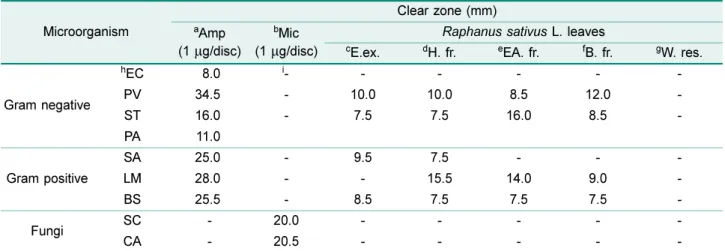
무청추출물및분획물의항균활성평가결과는 Table 2
에나타내었다. 먼저항세균활성대조구로사용된 ampicillin (1 µg/disc)의경우 8.0-34.5 mm의생육억제환을나타내어강 력한항세균활성을확인하였으며, 항진균제인 miconazole (1 µg/disc)의경우 C. albicans에대해 20 mm의생육억제환 을나타내었다. 무청 ethanol 추출물(500 µg/disc)의경우그 람음성균중에서는 P. vulgaris와S. typhimurium에대해 서는 7.5-10.0 mm의생육억제환을나타내었으나, E. coli와
P. aeruginosa에대해서는항세균활성이나타나지않았다.
그러나 그람양성균에 대해서는 실험균주 S. aureus, L.
monocytogenes, B. subtilis에대해모두양호한항균활성을 나타내었다. Ethanol 추출물의분획물중항세균활성은 n- hexane, ethylacetate 및 butanol 분획물에서확인되어무청 추출물이다양한항세균활성물질을포함하고있음을알수 있었다. 특히 ethylacetate 분획물의경우 S. typhimurium 및 L. monocytogenes의 식중독 유발균에 대해 14.0-16.0 mm의강력한생육억제환을나타내어(Table 2), 향후이의
활성성분규명및 ethylacetae 분획물을이용한생물소재개
발연구가필요하다고판단된다. 한편무청추출물및이의 분획물에서항진균활성은모두나타나지않았다.
무청 추출물 및 분획물의 항산화 활성
무청추출물및이의분획물을대상으로다양한농도에서 의 DPPH 음이온소거능을평가한결과는 Fig. 1(A)에나타 내었다. 대조구로사용된 vitamin C의경우 50 µg/ml 농도 에서 79.9±1.6% DPPH 소거능을나타내어강력한항산화 능을확인하였다. 무청시료중에서는 ethylacetate 분획물 이 500 µg/ml 농도에서 76.6±0.5% DPPH 소거능을나타내 어가장우수한소거능을나타내었으며, 그다음으로 butanol
Table 1. The yields of ethanol extract and its organic solvent fractions of Raphanus sativus L. leaves and their component analysis.
Extract/Fractions Yield (%)
Content (mg/g)
Total polyphenol Total flavonoid Total sugar Reducing sugar
Ethanol extract. 5.6 25.00± 0.05b 29.53± 3.01 114.77± 3.14 60.72± 12.91
n-Hexane fr.a 25.3 20.04± 0.72 71.29± 2.84 53.85± 1.72 37.89± 0.62
Ethylacetate fr. 3.6 97.57± 0.86 152.91± 12.21 96.98± 4.29 37.64± 2.39
Butanol fr. 19.4 45.32± 0.72 49.64± 0.33 118.21± 2.29 74.59± 0.88
Water residue. 51.7 12.12± 0.19 07.99± 0.00 155.32± 0.00 82.28± 3.27
afr.: fraction, bValues are mean± SD of triplicate determinations.
Fig. 1. Radical scavenging activity and reducing power of the ethanol extract and its organic solvent fractions of Raphanus sativus L. leaves
(A) DPPH scavenging activity, (B) ABTS scavenging activity, (C) nitrite scavenging activity, and (D) reducing power.
Symbols : ●: ethanol ex., ○: hexane fr., ▼: ethylacetate fr., ▽: butanol fr., ■: water residue and □: vitamin C.
Table 2. Antimicrobial activity of ethanol extract and its organic solvent fractions of Raphanus sativus L. leaves against different pathogenic and food-spoilage bacteria and fungi.
Microorganism
Clear zone (mm)
aAmp (1 µg/disc)
bMic (1 µg/disc)
Raphanus sativus L. leaves
cE.ex. dH. fr. eEA. fr. fB. fr. gW. res.
Gram negative
hEC 8.0 i- - - -
PV 34.5 - 10.0 10.0 8.5 12.0 -
ST 16.0 - 7.5 7.5 16.0 8.5 -
PA 11.0
Gram positive
SA 25.0 - 9.5 7.5 - - -
LM 28.0 - - 15.5 14.0 9.0 -
BS 25.5 - 8.5 7.5 7.5 7.5 -
Fungi SC - 20.0 - - - - -
CA - 20.5 - - - - -
aAmp: ampicillin, bMic: miconazole, cE. ex.: ethanol extract of R. sativus L. leaves. dH. fr., eEA. fr., fB. fr. and gW. res.: hexane fraction, ethylacetate fraction, butanol fraction and water residue of the ethanol extract of R. sativus L. leaves, hEC: Escherichia coli, PV: Proteus vulgaris, ST: Salmonella typhimurium, PA: Pseudomonas aeruginosa, SA: Staphylococcus aureus, LM: Liste- ria monocytogenes, BS: Bacillus subtilis, SC: Saccharomyces cerevisiae, CA: Candida albicnas, i-: No inhibition.
The concentrations of ethanol extract and organic solvent fractions used were 500 µg/disc, respectively. The clear zone expressed was included a size of disc-paper (6.5 mm of diameter). The data represent a classical result of three independent determinations.
분획은동일농도에서 51.5±1.5% 소거능을나타내었다. 그 외 n-hexane 분획 및 물 잔류물은 11.9-14.1%의 미약한 DPPH 소거능을나타내었다(Fig. 1A). 또한 ABTS 소거능의 경우, DPPH 소거능과동일하게 ethylacetate 분획, butanol 분획 500 µg/ml 농도에서각각 74.7±0.6% 및 48.6±3.3%
소거능을나타내었다. 대조구로사용된 vitamin C의경우 12.5 µg/ml 농도에서 91.8±0.2% ABTS 소거능을나타내었 다(Fig. 1B). Nitrite 소거능의경우, ethanol 추출물, n-hexane 분획, ethylacetate 분획, butanol 분획및물잔류물이각각 100µg/ml 농도에서 31.8±2.8, 30.7±0.3, 63.5±3.9%, 46.4±5.2% 및 11.1±0.3% 소거능을나타내어, 무청이다양
한지용성및수용성성분의 nitrite 소거물질을함유하고있
음을알수있었다(Fig. 1C). 환원력의경우에도 ethylacetate 분획> butanol 분획 > n-hexane 분획>물잔류물의순으로
나타나, ethylacetate 분획이다양한항산화력평가에서가
장우수함을알수있었다(Fig. 1D). 전체적인활성 radical 소거능의 IC50는 Table 3에나타내었으며, ethylacetate 분 획물에서 DPPH 소거능, ABTS 소거능, nitrite 소거능의 IC50는각각 222.12, 130.84 및 69.44 mg/ml를나타내어분
획물중가장우수한항산화능을나타내었다.
무청 추출물 및 분획물의 항혈전 활성
항혈전활성은트롬빈활성도에의한혈전생성까지소요
되는시간을나타내는 TT, 외인계응고인자의결핍및이상
을검출하는검사로혈장에조직트롬보플라스틴과칼슘을 첨가하여피브린이생성될때까지의시간을나타내는 PT(외 인성혈전생성), 혈장내응고인자의결핍이나저해정도에
따라혈전생성이나타나는시간을의미하는 aPTT(내인성
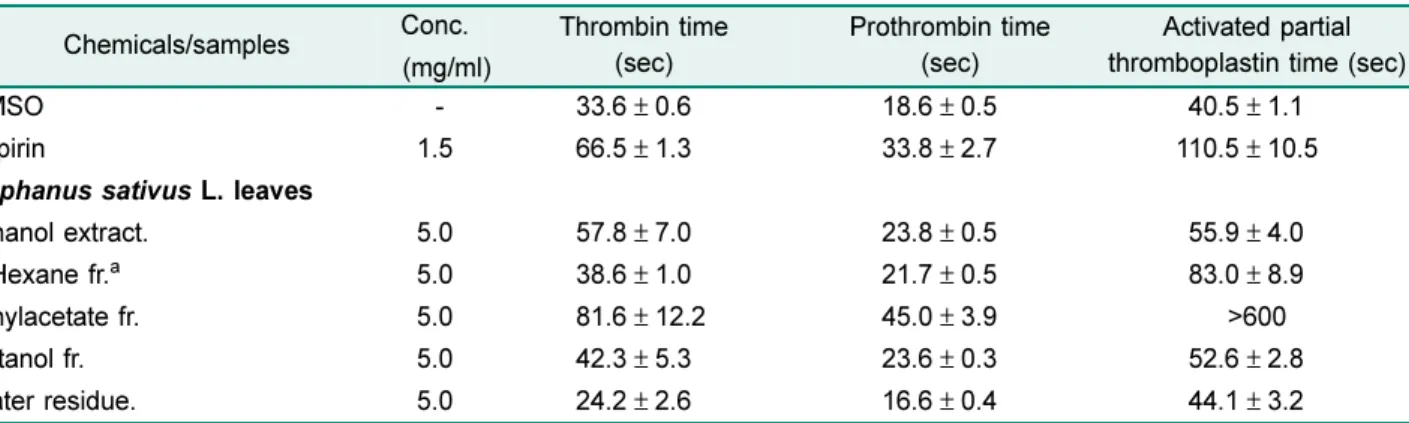
혈전생성)로평가하였다. 본실험에서는용매대조구로사용 된 DMSO의경우, 33.6초의 TT, 18.6초의 PT 및 40.5초의 aPTT를나타내었다(Table 4). 현재항혈전제로사용되고있 는아스피린(상품명: 프로덱트)의경우 1.5 mg/ml 농도에서 66.5초의 TT, 33.8초의 PT 및 110.5초의 aPTT를나타내어 우수한 항혈전 활성을 보였다. 한편 무청 추출물의 경우 5.0 mg/ml 농도에서, 무첨가구에비해 1.7배의연장된 TT, 1.28배연장된 PT 및 1.38배연장된 aPTT를나타내어항혈 전활성을확인하였다. 분획물중에서는 ethylacetate 분획 물에서무첨가구에비해 2.43배연장된 TT, 2.42배연장된 PT를나타내어아스피린에필적하는우수한항혈전활성을 확인하였으며, 특히내인성혈전생성을나타내는 aPTT의 경우무첨가구에비해 15배이상연장된응고시간을나타내 어, 무청 ethylacetate 분획물이내인성혈전생성을매우강 력하게저해함을알수있었다. 향후활성물질분리및이의 혈전생성억제기작에대한추가적인연구가필요하리라판 단된다. 또한무청의항고혈압활성이무청의 ethylacetae 추 출물에서 나타난다는 최근의 보고[7]를 고려하여, 무청 ethanol 추출물중 ethylacetate 분획물의항혈전, 항고혈압 기능성식품소재로의개발도필요하다고판단된다. 본결과 는, 버려지고있는무청이영양적으로우수할뿐만아니라, 항세균, 항산화및항혈전활성을가지고있음을제시하며, 무청을이용한새로운식품소재개발가능성을제시하고있다.
Table 4. Anticoagulation activities of ethanol extract and its organic solvent fractions of Raphanus sativus L. leaves.
Chemicals/samples Conc.
(mg/ml)
Thrombin time (sec)
Prothrombin time (sec)
Activated partial thromboplastin time (sec)
DMSO - 33.6± 0.6 18.6± 0.5 40.5± 1.1
Aspirin 1.5 66.5± 1.3 33.8± 2.7 110.5± 10.5
Raphanus sativus L. leaves
Ethanol extract. 5.0 57.8± 7.0 23.8± 0.5 55.9± 4.0
n-Hexane fr.a 5.0 38.6± 1.0 21.7± 0.5 83.0± 8.9
Ethylacetate fr. 5.0 81.6± 12.2 45.0± 3.9 >600
Butanol fr. 5.0 42.3± 5.3 23.6± 0.3 52.6± 2.8
Water residue. 5.0 24.2± 2.6 16.6± 0.4 44.1± 3.2
Values are mean± SD of triplicate determinations. afr.: fraction.
Table 3. The radical scavenging activities of the ethanol extract and its organic solvent fractions of Raphanus sativus L. leaves.
Chemical/
samples
Radical scavenging activity: IC50 (µg/ml)
DPPH ABTS Nitrite
Vitamin C 19.17 7.40 12.05
Ethanol extract. >500 >500 >100 n-Hexane fr.a >500 >500 >100 Ethylacetate fr. 222.12 130.84 69.44
Butanol fr. 482.97 >500 >100
Water residue. >500 >500 >100
afr.: fraction.
요 약
우리나라대표채소중의하나인무의지상부는과거채소 가귀했던겨울철주요한단백질, 비타민, 미네랄, 식이섬유 공급원으로이용되어왔으며, 무청김치및우거지등으로식 용되어왔다. 그러나, 최근의도시와농촌의격리, 산업화의 정착, 식생활습관의변화등으로인해, 무청은대부분폐기 되고있는실정이며, 무청의효율적인이용및유용생리활성 에대한연구는미미한상태이다. 본연구에서는무청을이 용한새로운건강식품소재개발연구의일환으로조선무의
무청을대상으로 ethanol 추출물및이의순차적유기용매
분획물들을조제하여, 이들의항균, 항산화및항혈전활성 들을검토하였다. 그결과무청의 ethanol 추출물의수율은 5.6%이었으며, 이들의 n-hexane, ethylacetate 및 butanol 분획효율은각각 25.3, 3.6, 19.4%로나타났으며, 물잔류물
은 51.7%를나타내었다. 총폴리페놀및총플라보노이드함
량분석결과 ethylacetate 분획에서 97.57 및 152.91 mg/g 의매우높은함량을나타내었으며, ethylacetate 분획물은 매우강력한항균, 항산화, 및항혈전활성을나타내었다. 먼 저항균활성의경우무청 n-hexane 및 ethylacetate 분획물 은그람양성균(S. aureus, L. monocytogenes 및 B. subtilis) 에대해양호한항균활성을나타내었으며, 그람음성균에 서는 E. coli 및 P. aeruginosa를제외한 P. vulgaris와 S.
typhimurium에대해생육억제활성을나타내었다. 즉, 물잔 류물을제외한모든분획물에서부분적인항세균활성이나 타나, 무청추출물이다양한항세균활성물질을포함함을확 인하였다. 항산화활성평가결과, ethylacetate 분획물에서 우수한 DPPH 소거능, ABTS 소거능, nitrite 소거능및환원 력을확인하였다. 또한항혈전활성평가에서도 ethylacetate 분획물에서양호한트롬빈및프로트롬빈억제활성과함께, 강력한내인성혈전생성억제를확인하였다. 본연구결과는 무청이영양적측면및유용생리활성측면에서매우우수한 식품소재임을제시하고있으며, 무청을이용한기능성식품 개발및 ethylacetate 분획을이용한유용소재개발의기본 자료로활용될것이다.
Acknowledgement
This research was supported by Basic Science Research Pro- gram through the National Research Foundation of Korea (NRF) funded by the Ministry of Education, Science and Technology (2011-0002798).
References
1. A. O. A. C. 1990. Official methods of analysis. 15th ed. Associ-
ation of official analytical chemists. Washington D.C.
2. Ahn, S. M., H. Y. Ryu, D. K. Kang, I. C. Jung, and H. Y. Sohn.
2009. Antimicrobial and antioxidant activity of the fruit of Pru- nus avium L. Korean J. Microbiol. Biotechnol. 36: 195-200.
3. Beevi, S. S., L. N. Mangamoori, and B. B. Gowda. 2012.
Polyphenolics profile and antioxidant properties of Raphanus sativus L. Nat. Prod. Res. 26: 557-563.
4. Beevi, S. S., L. N. Mangamoori, M. Subathra, and J. R. Edula.
2010. Hexane extract of Raphanus sativus L. roots inhibits cell proliferation and induces apoptosis in human cancer cells by modulating genes related to apoptotic pathway. Plant Food Hum. Nutr. 65: 200-209.
5. Beevi, S. S., M. L. Narasu, and B. B. Gowda. 2010. Polyphe- nolics profile, antioxidant and radical scavenging activity of leaves and stem of Raphanus sativus L. Plant Food Hum.
Nutr. 65: 8-17.
6. Beevi, S. S., L. N. Mangamoori, V. Dhand, and D. S.
Ramakrishna. 2009. Isothiocyanate profile and selective anti- bacterial activity of root, stem, and leaf extracts derived from Raphanus sativus L. Foodborne Pathog. Dis. 6: 129-136.
7. Chung, D. H., S. H. Kim, N. Myung, K. J. Cho, and M. J.
Chang. 2012. The antihypertensive effect of ethylacetate extract of radish leaves in spontaneously hypertensive rats.
Nutr. Res. Pract. 6: 308-314.
8. Ghayur, M. N. and A. H. Gilani. 2005. Gastrointestinal stimula- tory and uterotonic activities of dietary radish leaves extract are mediated through multiple pathways. Phytother. Res. 19:
750-755.
9. Han, J. S., J. S. Kim, M. S. Kim, and Y. H. Choi. 1999.
Changes on mineral contents of vegetable by various cooking methods. Korean J. Soc. Food Sci. 15: 382-387.
10. Jang, H. S., J. M. Ahn, K. H. Ku, S. J. Rhee, S. K. Kang, and J. H. Choi. 2008. Effect of radish leaves powder on the gas- trointestinal function and fecal triglyceride and sterol excretion in rats feed a hypercholesterolemic diet. J. Korean Soc. Food Sci. Nutr. 37: 1258-1263.
11. Kim, J. I., H. S. Jang, J. S. Kim, and H. Y. Sohn. 2009. Evalua- tion of antimicrobial, antithrombin, and antioxidant activity of Dioscorea batatas Decne. Korean J. Microbiol. Biotechnol. 37:
133-139.
12. Kim, B. R., J. H. Park, S. H. Kim, K. J. Cho, and M. J. Chang.
2010. Antihypertensive properties of dried radish leaves pow- der in spontaneously hypertensive rats. Korean J. Nut. 43:
561-569.
13. Kim, W. K., J. H. Kim, D. H. Jeong, Y. H. Chun, S. H. Kim, K. J.
Cho, and M. J. Chang. 2011. Radish (Raphanus sativus L.
leaf) ethanol extract inhibits protein and mRNA expression of ErbB(2) and ErbB(3) in MDA-MB-231 human breast cancer cells. Nutr. Res. Pract. 5: 288-293.
14. Ku, K. H., K. A. Lee, and Y. E. Kim. 2008. Physiological activ- ity of extracts from radish (Raphanus sativus L.) leaves. J.
Korean Soc. Food Sci. Nutr. 37: 390-395.
15. Ku, K. H., K. A. Lee, Y. L. Kim, and M. G. Lee. 2006. Effects of
pre-treatment method on the surface microbes of radish (Raphanus sativus L.) leaves. J. Korean Soc. Food Sci. Nutr.
35: 649-654.
16. Ku, K. H., K. A. Lee, Y. L. Kim, and Y. W. Lee. 2006. Quality characteristics of hot-air dried radish (Raphanus sativus L.) leaves. J. Korean Soc. Food Sci. Nutr. 34: 780-785.
17. Rhee, S. J., J. M. Ahn, K. H. Ku, and J. H. Choi. 2005. Effect of radish leaves powder on hepatic antioxidative system in rats fed high-cholesterol diet. J. Korean Soc. Food Sci. Nutr.
34: 1157-1163.
18. Shimotoyodome, A., S. Meguro, T. Hase, I. Tokimitsu, and T.
Sakata. 2001. Sulfated polysaccharides, but not cellulose, increase colonic mucus in rats with loperamide-induced con- stipation. Digest. Dis. Sci. 46: 1482-1489.
19. Sim, J. G., J. H. Lee, T. Y. Shin, S. H. Jeong, M. H. Kim, H. H.
Ku, and J. S. Park. 2010. Anti-inflammatory effects of vegeta- ble soup in murine macrophage RAW 264.7 cells. J. Korean Soc. Food Sci. Nutr. 39: 1097-1101.
20. Singleton, V. L., R. Orthofer, and R. M. Lamuela-Raventos.
1999. Analysis of total phenols and other oxidation substrates and antioxidants by means of Folin-Ciocaleau reagent. Meth- ods Enzymol. 299: 152-178.
21. Sohn, H. Y., H. Y. Ryu, Y. J. Jang, H. S. Jang, Y. M. Park, and S. Y. Kim. 2008. Evaluation of antimicrobial, antithrombin, and antioxidant activity of aerial part of Saxifraga stolonifera.
Korean J. Microbiol. Biotechnol. 36: 195-200.
22. Sohn, H. Y., K. H. Son, C. S. Kwon, G. S. Kwon, and S. S.
Kang. 2004. Antimicrobial and cytotoxic activity of 18 preny- lated flavonoids isolated from medicinal plants: Morus alba L., Morus mongolica Schneider, Broussnetia papyrifera (L.) Vent, Sophora flavescens Ait and Echinosophora koreensis Nakai.
Phytomedicine 11: 666-672.
23. Valentina, U., J. Fabcic, and F. Stampar. 2007. Sugars, organic acids, phenolic composition and antioxidant activity of sweet cherry (Prunus avium L.). Food Chem. 107: 185-192.
24. Yim, H. B., G. Lee, and H. J. Chae. 2004. Cytotoxicity of etha- nol extract of Raphanus sativus on human lung cancer cell lines. J. Korean Soc. Food Sci. Nutr. 33: 287-290.