- 919 -
Antioxidant and Antimicrobial Activities of Korean Mistletoe ( Viscum album var. coloratum ) Extracts against Food Poisoning Bacteria
Seo-Jin Kang
1, Shin-Kyo Chung
1,2†1
School of Food Science and Biotechnology, Kyungpook National University, Daegu 702-701, Republic of Korea
2Food and Bio-industry Research Institute, Kyungpook National University, Daegu 702-701, Republic of Korea
한국산 겨우살이 (
Viscum album
var.coloratum
) 추출물의 식중독 세균 증식 억제 및 항산화 활성강서진
1․정신교
1,2†1
경북대학교 식품공학부,
2경북대학교 식품생물산업연구소
Abstract
This study was conducted to investigate the antimicrobial activities and antioxidant activities of the Korean mistletoe extract and its solvent fractions (e.g. n-hexane, ethyl ether, ethyl acetate, butanol). Ethyl ether fraction against Bacillus cereus showed stronger activities than benzoic acid (2.5 mg/mL). The MIC of korean mistletoe extract and slovent fractions were in the range of 6.25-25 mg/mL. The MIC (6.25 mg/mL) of ethyl acetate fraction onto Staphylocossus aureus was the lowest among them. Ethyl ether fraction which showed the strongest antioxidant activities by DPPH (1,1-diphenyl-2-picryl-hydrazyl) and FRAP (ferric ion reducing antioxidant power) methods had the highest total phenolic contents. It is suggested that Korean mistletoe could be utilized as natural preservative material through the study of the active compounds from ethyl ether fraction.
Key words :Korean mistletoe, antimicrobial activity, antioxidant, total phenolic contents
서 론
1)
국제교역과 해외여행의 급속한 증가로 국가와 민족 사이 의 식생활이 다양하게 변하고 있으며, 이로 인하여 각종 대장균을 비롯하여 Salmonella, Vibrio, Listeria 속 등의 식중 독세균이 광범위하게 오염 및 분포하면서 인류의 건강을 위협하고 있다. 식품부패미생물이나 병원성미생물의 발육 을 억제하기 위해 사용되는 합성보존료 중 일부는 지속적으 로 사용될 경우, 체내에 축적되어 돌연변이나 기형 유발 등의 안정성이 문제가 되고 있어 그 위험성이 우려되고 있다(1). 따라서 위생적인 식품의 보존과 유통을 위해 안정 성이 확인된 천연 보존제의 개발과 이용에 대한 소비자들의 요구가 증대되고 있으며 최근에는 향신료와 한약재와 같은 천연물을 대상으로 식중독 세균을 비롯하여 병원성 세균에 대한 항균활성에 관한 연구가 진행되고 있다(2-4). 한국산
†
Corresponding author. E-mail:[email protected] Phone:82-53-950-5778
겨우살이 (Korean Viscum album var. coloratum )는 겨우살이 과 ( Loranthaceae )에 속하며 참나무, 팽나무, 물오리나무, 밤나무 및 자작나무 등에 기생하는 늘푸른떨기나무이다.
또한 한국산 겨우살이는 단백질, 탄수화물, 지질, 알카로 이드 등의 다양한 성분으로 구성되어있으며 특히 당단백 성분인 lectin을 함유하고 있어서 강한 항암활성 및 면역증 강활성을 나타내고 있으며(5), 잎과 줄기 이외에도 열매 추출물에서 마우스의 대식세포에 대한 면역활성화 효과가 보고된 바 있다(6). 겨우살이의 생리활성 성분은 lectin 이외 에도 viscotexin (7), flavonoid (8)등이 알려져 있으나, 한국 산 겨우살이에 대하여는 alkaloid 성분(9)에 대한 연구가 있을 따름이다. 식품으로서 겨우살이의 활용에 관하여는 추출물의 항돌연변이 효과(10), 추출 용매에 따른 생리활성 효과(11) 및 마이크로웨이브 추출 특성에 관한 연구(12) 등이 있다.
본 연구에서는 한국산 겨우살이의 메탄올 추출물 및 용
매분획물에 대하여 주요 식중독세균의 증식 억제 효과 및
항산화 효과를 조사하여 식품 소재로서의 활용을 증진하 고 나아가 천연보존료 개발 관련 연구에 도움이 되고자 하였다.
재료 및 방법
실험재료 및 시약
실험에 사용한 겨우살이는 2008년도에 지리산 일대에서 채취하여 실온에서 건조하여 냉암소에 보관하면서 사용하 였다. Benzoic acid, 1,1-diphenyl-2- picrylhydrazyl (DPPH), Folin-Ciocalteau's phenol reagent, gallic acid, 2,4,6-Tris(2-pyridyl)-1,3,5-triazine (TPTZ), trolox는 Sigma chemical Co (St. Louis. Mo, USA) 제품을 사용하였고, 추출 용매로 사용한 butanol, ethyl acetate, ethyl ether, n -hexane, methanol, dimethylsulfoxide (DMSO)는 분석용 일급 시약 (Merck Co, Darmstadt, Germany)을 사용하였다.
추출 및 분획
분쇄한 겨우살이(40-60 mesh) 30 g에 10배 량의 methanol 을 첨가하여 30℃에서 24시간 동안 2회 반복 추출하여 여과 하고, rotary vacuum evaporator (Eyela N-1000, Tokyo, Japan)로 감압 농축하여 조추출물(10.8 g)을 얻었다. 조추출 물 일부(5.40 g)를 10% methanol 용액에 현탁하여 극성에 따라 순차적으로 용매분획하고 감압 농축하여 n -hexane (1.23 g, 22.7%), ethyl ether (0.25 g, 4.4%), ethyl acetate (0.31 g, 5.6%), butanol (1.30 g, 24.6%) 및 water 분획 (2.31 g, 42.7%) 시료를 얻었다(13).
사용균주
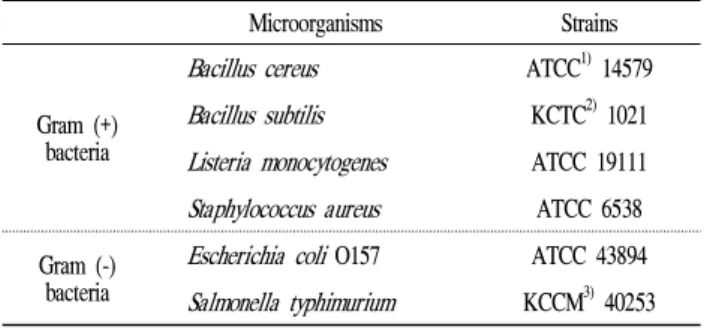
항균성 실험에 사용한 균주는 그램 양성균인 Bacillus cereus, Bacillus subtilis, Listeria monocytogenes, Staphylococcus aureus 4종, 그램 음성균인 Escherichia coli O157, Salmonella typhimurium 2종을 사용하였다 (Table 1). 각 균 주의 생육과 보존을 위해 brain heart infusion, nutrient broth,
Table 1. List of microorganisms used for antimicrobial activity test Microorganisms Strains
Gram (+) bacteria
Bacillus cereus
ATCC1)14579Bacillus subtilis
KCTC2)1021Listeria monocytogenes
ATCC 19111Staphylococcus aureus
ATCC 6538 Gram (-)bacteria
Escherichia coli
O157 ATCC 43894Salmonella typhimurium
KCCM3)402531)ATCC: American Type Culture Collection
2)KCTC: Korean Collection for Type Culture
3)KCCM: Korean Culture Center of Microorganism.
tryptic soy broth에 agar (Difco, USA)를 첨가한 배지를 사용 하여 B. cereus , B. subtilis 는 30℃, E. coli O157, L.
monocytogenes, S. typhimurium, S. aureus 를 37℃에서 18∼
24시간 동안 배양하여 사용하였다.
항균활성의 측정
항균활성의 측정은 paper disc를 이용한 agar diffusion method(3,14)를 사용하였다. 실험을 위해서 각 broth에 균주 를 접종하여 Bacillus 2종은 30℃, 나머지 균주들은 37℃
incubator에서 배양하여 활성화 시킨 균을 UV/Vis- spectrophotometer (UV/Vis 1601 PC, Shimadzu Co., Kyoto, Japan)를 이용하여 660 nm에서 흡광도를 0.4로 조절한 후 각 평판배지에 200 µL씩 접종 도말하였다. 멸균된 paper disc (Toyo Roshi 27, 8 mm)를 평판배지 표면에 밀착시키고 시료를 50 µL 만큼 흡수시켜 건조한 후, 30℃와 37℃
incubator에서 12∼24시간 배양하여 캘리퍼스 (Dial calipers, Alltrade, US)를 이용하여 paper disc 주위의 inhibition zone 의 직경(mm)을 측정하였다. 대조군으로는 benzoic acid를 사용하였다. 최소저해농도 (minimum inhibitory concentration, MIC) 측정은 96-well plate를 이용한 액체배지희석법으로 측정하였다. 준비한 plate에 각각의 broth와 일정한 농도의 시료를 각각 0.5 mL 넣고 각 2 배씩 순차적으로 희석한 다음 660 nm에서 흡광도가 0.4가 되도록 조절한 균주를 50 µL씩 접종하였다. Bacillus 2종은 30℃, 나머지 균주들은 37℃ incubator에서 18∼24시간 배양한 후 탁도를 나타내지 않는 농도를 MIC로 하였다.
총페놀화합물 (Total phenolic content)의 측정
Folin-Ciocalteu reagent 시약을 이용하여 시료 중의 총페 놀화합물 함량을 분석하였다(15). 시료 100 µL에 2 N Folin-Ciocalteau’s phenol reagent 50 µL와 20% Na
2CO
3300 µL를 가하여 실온에서 15분간 방치한 후 증류수 1 mL을 넣고 10,000 rpm으로 원심분리하고 그 상등액을 725 nm에 서 흡광도를 측정하였다. 표준물질로 gallic acid를 사용하 여 얻은 표준곡선의 회귀식에서 시료 중의 총페놀화합물의 함량을 환산하였다.
D P P H ( 1 , 1 - d i p h e n y l - 2 - p i c r y l - h y d r a z y l ) r a d i c a l 소거 활성 측정
겨우살이 추출물과 분획물의 항산화 효과는 DPPH radical 소거 활성으로 측정하였다(16). 시료 100 µL와 DPPH 용액 900 µL를 혼합하고, 암실에서 30 분 간 반응시킨 후 517 nm에서 흡광도를 측정하였다.
FRAP (Ferric ion reducing antioxidant power) 활성 측정
FRAP 활성은 시료 중의 항산화 물질에 의해 Fe
(Ⅲ)-TPTZ가 Fe(Ⅱ)-TPTZ 혼합물로 환원되는 원리에 의한
Benzie등(17)의 방법으로 측정하였다. 반응용액 (cocktail solution)을 acetate buffer (pH 3.6, 23 mM), 10 mM TPTZ (2,4,6-tripyridyls-triazine) 및 20 mM FeCl
3·6H
2O를 10 : 1 : 1의 비율로 섞어 37℃를 유지하면서, 시료 25 µL와 cocktail solution 175 µL를 혼합하여 암실에서 30분간 방치한 후, 590 nm에서 흡광도를 측정하였다. 환원력은 표준물질로 사용한 trolox 농도에 상당하는 TE (trolox equivalent) µM로 환산하였다.
통계처리
실험은 3회 반복하여 수행하였으며 측정한 결과를 평균 치±표준편차로 나타내었다. 또한 SAS (statistical analysis system, version 8.0, 2004)를 이용하여 Duncan의 다중검정 법으로 유의차를 검정하였다( p <0.05).
결과 및 고찰
겨우살이 분획물의 식중독세균 증식 억제 활성
겨우살이 추출물 및 용매분획물의 항균활성을 B. cereus, B. subtilis, E. coli, L. monocytogenes, S. typhimurium, S.
aureus 의 6 종의 식중독세균에 대하여 paper disc diffusion method를 이용하여 항균활성을 측정하고 간장, 청량음료 등의 식품보존제로 사용되는 benzoic acid와 비교하였다.
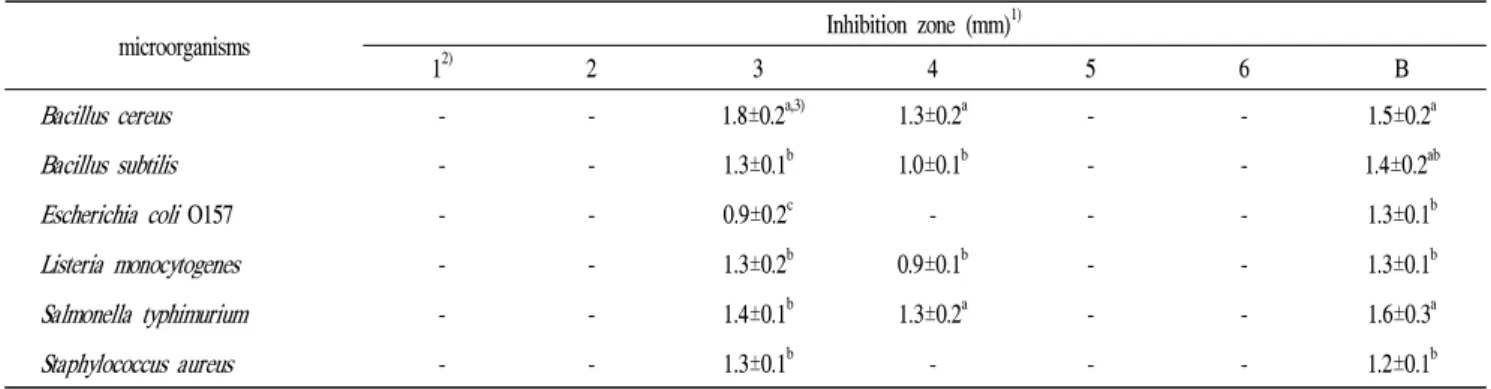
Table 2에서 보는 것과 같이 겨우살이 methanol 추출물은 n -hexane, butanol, water 분획물과 같이 15 mg/disc 농도에서 는 공시 균주에 대하여 항균활성을 나타내지 않았다. 반면, ethyl ether 분획물과 ethyl acetate 분획물은 항균작용을 가 지고 있는 것으로 나타났으며 특히 ethyl ether 분획물이 억제 효과가 우수하였다. 겨우살이 ethyl ether 분획물은 B. cereus 에 대해 inhibition zone이 1.8±0.2 mm로서 공시 균주 중에서 가장 우수한 항균력을 보였고, E. coli 를 제외하 고 나머지 균주에서도 1.3∼1.4 mm의 저해환을 나타내어서
Table 2. Antimicrobial activites of the solvent fractions from Korean mistletoes by agar diffusion method
microorganisms Inhibition zone (mm)1)
12) 2 3 4 5 6 B
Bacillus cereus
- - 1.8±0.2a,3) 1.3±0.2a - - 1.5±0.2aBacillus subtilis
- - 1.3±0.1b 1.0±0.1b - - 1.4±0.2abEscherichia coli
O157 - - 0.9±0.2c - - - 1.3±0.1bListeria monocytogenes
- - 1.3±0.2b 0.9±0.1b - - 1.3±0.1bSalmonella typhimurium
- - 1.4±0.1b 1.3±0.2a - - 1.6±0.3aStaphylococcus aureus
- - 1.3±0.1b - - - 1.2±0.1b1)The concentration of sample and benzoic acid were 15, 2.5 mg/disc, respectively
2)1; methanol extracts, 2; n-hexane fraction, 3; ethyl ether fraction, 4; ethyl acetate fraction, 5; butanol fraction, 6; water fraction, B; benzoic acid.
3)All values are expressed as mean±SD of triplicate determinations. Means with different superscripts in a same column are significantly different by Duncan's multiple range test (p<0.05).
대조구로 사용된 benzoic acid (2.5 mg/mL)보다 높거나 비슷 한 항균활성을 나타내었다. Ethyl acetate 분획물은 E. coli 와
S. aureus 에 대하여는 항균활성이 나타나지 않았지만 그
외의 균주에 대하여서는 ethyl ether 분획물보다 낮은 항균 효과를 보였다. 또한 Paper disc 방법에 의하여 조사한 B.
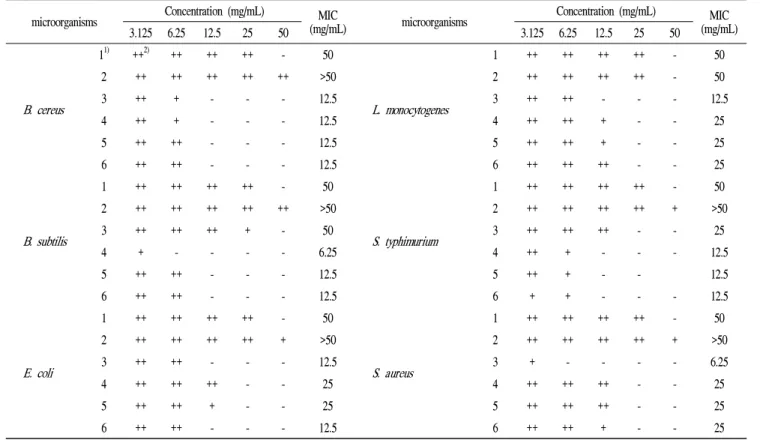
cereus, B. subtilis, L. monocytogenes, S. typhimurium 의 생육 억제 환을 Fig. 1 에 나타내었다. Ethyl ether 분획이 다른 분획에 비하여 B. cereus, B. subtilis, L. monocytogenes 의 생육 억제 환의 크기가 확연하게 크고 S. typhimurium 에 대하여는 ethyl acetate 획분과 비슷하였다. 그리고 이들 식 중독세균에 대한 겨우살이 추출 및 분획물의 최소저해농도 를 측정한 결과를 Table 3에 나타내었다. 겨우살이 methanol 추출물 및 헥산분획물의 최소저해농도는 실험에 사용한
〔A〕
B. cereus
〔B〕B. subtilis
〔C〕
L. monocytogenes
〔D〕S. typhimurium
Fig. 1. The food poisoning bacterial growth inhibition zones by the solvent fractions from Korean mistletoes.1; n-hexane, 2; ethyl ether, 3; ethyl acetate, 4; butanol, 5; water.
Table 3. MIC of the solvent fractions from Korean mistletoe on food poisoning bacteria microorganisms Concentration (mg/mL) MIC
(mg/mL) microorganisms Concentration (mg/mL) MIC
(mg/mL)
3.125 6.25 12.5 25 50 3.125 6.25 12.5 25 50
B. cereus
11) ++2) ++ ++ ++ - 50
L. monocytogenes
1 ++ ++ ++ ++ - 50
2 ++ ++ ++ ++ ++ >50 2 ++ ++ ++ ++ - 50
3 ++ + - - - 12.5 3 ++ ++ - - - 12.5
4 ++ + - - - 12.5 4 ++ ++ + - - 25
5 ++ ++ - - - 12.5 5 ++ ++ + - - 25
6 ++ ++ - - - 12.5 6 ++ ++ ++ - - 25
B. subtilis
1 ++ ++ ++ ++ - 50
S. typhimurium
1 ++ ++ ++ ++ - 50
2 ++ ++ ++ ++ ++ >50 2 ++ ++ ++ ++ + >50
3 ++ ++ ++ + - 50 3 ++ ++ ++ - - 25
4 + - - - - 6.25 4 ++ + - - - 12.5
5 ++ ++ - - - 12.5 5 ++ + - - 12.5
6 ++ ++ - - - 12.5 6 + + - - - 12.5
E. coli
1 ++ ++ ++ ++ - 50
S. aureus
1 ++ ++ ++ ++ - 50
2 ++ ++ ++ ++ + >50 2 ++ ++ ++ ++ + >50
3 ++ ++ - - - 12.5 3 + - - - - 6.25
4 ++ ++ ++ - - 25 4 ++ ++ ++ - - 25
5 ++ ++ + - - 25 5 ++ ++ ++ - - 25
6 ++ ++ - - - 12.5 6 ++ ++ + - - 25
1)1; methanol extract, 2; n-hexane fraction, 3; ethyl ether fraction, 4; ethyl acetate fraction, 5; butanol fraction, 6; water fraction
2)++; more growth, +; less growth, -; no growth.
모든 식중독 세균에 대하여 50 mg/mL으로 낮은 억제 효과 를 보였다. 그러나 용매분획물 중 ethyl ether, ethyl acetate분 획물은 모든 균주에 대하여 최소저해농도가 보다 낮은 6.25
∼25 mg/mL로 나타났다. Ethyl ether 분획물은 L.
monocytogenes, E. coli, S. aureus 에 대하여 낮은 MIC 값을 나타내었으며 B. subtilis, S. typhimurium 에 대하여는 ethyl acetate 분획물이 보다 낮은 억제 효과를 나타내었다. 특히, ethyl ether 분획물은 S. aureus 에 대한 MIC가 6.25 mg/mL로 200 mg/mL의 sodium benzoate 첨가로 S. aureus 증식이 억 제되었다는 보고(18)와 비교하면 상당히 우수한 항균효과 를 가지는 것으로 생각된다. 따라서 sodium propionate는 1.5∼11 mg/mL(19), sorbic acid는 3.0 mg/mL (20)에서 미생 물 증식 억제효과가 있었다는 보고로 미루어 보면 겨우살이 의 ethyl ether 분획물은 실험에 사용한 그램(+) 및 그램(-) 식중독 균에 대하여 폭넓은 항균활성을 나타내었으므로 천연 보존제로서 이용 가능성이 있을 것으로 사료된다. 박 등(3)도 환삼덩굴의 용매획분에 대한 항균성을 조사한 결과 비교적 지용성이 강한 클로로포름과 아세테이트 분획에서 활성이 강하다고 보고한 바 있다.
겨우살이 분획물의 항산화 활성
항산화 실험에 주로 사용되는 DPPH는 안정한 radical로 서 이들이 전자를 공여할 수 있는 다른 항산화 물질과 반응
하게 되면 본래의 자색에서 무색으로 변하게 된다(16). 겨우 살이 추출물 및 분획물의 DPPH radical 소거 활성을 조사한 결과를 Fig. 2에 나타내었다. 겨우살이의 ethyl ether 분획물 이 84% 정도로 가장 높은 DPPH radical 소거능력을 보였다.
다음으로는 ethyl acetate와 butanol 분획물이 비슷하게 51%
정도의 활성을 나타내었으며 이는 표준물질로 사용한 gallic acid (100 µM)
Fig. 2. DPPH radical scarvenging activities of the solvent fractions from Korean mistletoes.
Gallic acid; 100 µM, extracts; 1.0 mg/mL, fractions; 2.0 mg/mL.
Means with the different letter on the bars are significantly different (P<0.05).
의 약 2 배 이상의 높은 수준이었다. 산화 및 환원 반응을 이용하는 FRAP 방법으로 겨우살이 추출 및 분획물의 항산 화 활성을 조사한 결과는 Table 4와 같다. 겨우살이의 물 분획물과 n -hexane 분획물의 항산화 활성이 아주 낮게 나타 난 것에 비하여, ethyl ether 및 ethyl acetate 분획물의 항산화 활성은 표준물질인 trolox 기준 활성으로 비교할 때 거의 10 배 이상 높게 나타났다. 이러한 결과는 앞 부분에서 서술 한 DPPH radical 소거 활성의 경향과 거의 유사하였다. 따라 서 상업적으로 사용되는 표준물질과 비교하여 식중독세균 에 대한 증식억제 활성과 항산화성이 확인된 겨우살이의 ethyl ether 및 ethyl acetate 분획물은 가공 식품의 품질 수명 을 연장할 수 있는 첨가물 및 식품 보존제로서 활용이 가능 한 소재로서 향후 더욱 연구가 필요할 것으로 사료된다.
Table 4. FRAP activities of methanol extracts and solvent fractions from Korean mistletoes
TE (µM) Methanol extract 99.535 ± 0.65c,1)
n
-Hexane fraction 22.870 ± 0.668d Ethyl ether fraction 261.698 ± 4.075a Ethyl acetate fraction 180.648 ± 1.697b Butanol fraction 98.302 ± 2.501cWater fraction 17.562 ± 0.283d
The test concentration were 0.5 mg/mL.
1)All values are expressed as mean±SD of triplicate determinations. Means with the different superscripts are significantly different by Duncan's multiple range test (p<0.05)
겨우살이 분획물의 총페놀화합물의 함량
식물 중의 페놀성 화합물은 산소라디칼을 포촉하거나 산화 반응의 촉매 작용을 하는 Cu와 같은 금속이온을 환원 하는 능력을 가지므로 생체 내에서 항산화 활성을 나타내거 나, 또한 단백질 등의 거대 분자와 결합하여 미생물 세포의 성장저해를 유발하거나 효소 활성을 저해하여 항균효과 등의 생리활성을 나타낸다(21, 22). 본 연구에서 겨우살이 추출 및 분획물에 대한 총페놀화합물의 함량을 조사한 결과 를 Table 5에 나타내었다. 겨우살이의 총페놀화합물의 함량 은 ethyl ether 획분에서 가장 높았으며 그 다음이 ethyl acetate, n -hexane, butanol 및 methanol 조추출물과 물 획분 의 순으로 낮게 나타났다. Clark 등(23)은 식물체 중의 페놀 성 물질이 항균작용을 나타낸다고 보고하였으며, 암대극 추출물에서 페놀성 화합물의 함량이 높을수록 항산화 및 항균활성이 높게 나타났다(24)는 보고가 있다. 따라서 ethyl ether 획분이 식중독 세균에 대한 증식 억제 활성과 항산화 활성이 높게 나타난 것은 획분 중에 풍부한 총페놀화합물이 활성인자로 작용하는 것으로 생각될 수 있다. 한국산 겨우 살이의 ethyl acetate 가용성 분획으로부터 항산화 활성이 있는 homo-flavoyadorinin-B가 분리된 보고(25)는 있으나,
ethyl ether 획분 중의 활성 물질에 관하여는 보고된 바가 없으므로 항균 및 항산화 활성이 높은 페놀성 화합물의 분리가 후속 연구로서 기대된다.
Table 5. Total phenolic contents of methanol extracts and each solvent fractions from Korean mistletoes
Contents (mg%) Methanol extracts 8.64 ± 0.04e,1)
n
-Hexane fraction 16.8 ± 0.32c Ethyl ether fraction 28.17 ± 0.27a Ethyl acetate fraction 19.70 ± 0.44bButanol fraction 12.54 ± 0.49d
Water fraction 2.57 ± 0.15f
The concentration of sample was 2.0 mg/mL.
1)All values are expressed as mean±SD of triplicate determinations. Means with the different superscripts are significantly different by Duncan's multiple range test (p<0.05)
요 약
국내산 겨우살이를 천연소재 및 천연 보존료로서 활용가 능성을 탐색하기 위하여 겨우살이의 methanol 조추출물과 n -hexane, ethyl ether, ethyl acetate, butanol 분획물의 식중독 세균 억제 활성과 항산화활성을 조사하였다. Ethyl ether와 ethyl acetate 분획물은 공시균주에 대하여 0.9∼1.8 mm의 inhibition zone을 나타내었으며 특히 ethyl ether는 B. cereus 에 대하여 가장 강한 항균효과를 보였다. 또한 겨우살이의 ethyl ether 분획물은 S. aureus 에 대하여 가장 낮은 6.25 mg/mL의 MIC를 나타내었다. 겨우살이 추출물 및 용매분 획물의 항산화 활성은 ethyl ether 분획물에서 가장 높게 나타났다. 겨우살이의 총 페놀함량은 ethyl ether 획분에서 가장 높았으며 ethyl acetate, n -hexane, butanol 및 methanol 조추출물과 water 획분의 순으로 낮게 나타났다. 따라서 ethyl ether 획분의 강한 항균활성과 항산화 활성은 획분 중에 풍부한 총페놀화합물과 상관이 있으므로 향후 이 획분 중의 활성물질의 분리 연구가 한국산 겨우살이의 기능성 소재화에 필요하다고 생각된다.
감사의글
이 논문은 2011학년도 경북대학교 학술연구비에 의하여 연구되었음.
참고문헌
1. Lee SH, Lim YS (1998) Antimicrobial effects of
Schizandra chinensis extract on pathogenic microorganism. J Korean Soc Food Nutr, 27, 239-243 2. Lee BW, Shin DH (1991) Antimicrobial effect of some plant extract and their fractionates for food spoilage microorganism. Korean J Food Sci Technol, 23, 205-211 3. Park SW, Woo CJ, Chuhg SK, Chung KT (1994) Antimicrobial and antioxidant activity of solvent fraction from Humulous Japonicus . Korean J Food Sci Technol, 26, 464-470
4. Lee IE, Cho SH (2000) Antimicrobial Effect of Aristolochia contorta Bge. Extract on the growth of pathogenic and putrefactive microorganism. Kor J Food Sci Technol 29, 1107-1111.
5. Her SM, An H, Kim DK, Kim YH, Yoon JT, Kim BJ (2011) Immunoadjuvant activity of Korean mistletoe lectin B-chain. Kor J Pharmacogn, 42, 246-252 6. Lee J, Jeon YH, Yang HS, Lee KB, Song KS, Kang
TB, Kim JB Yoo YC (2010) The immunostimulatory activity of the water-extract of Korean mistletoe fruit to activate murine peritoneal macrophages. Kor J Pharmacogn, 41, 122-129
7. Pfuller U (2000) Chemical constituents of European mistletoe ( Viscum album L.). Med Aromatic Plants- Industrial Profiles, 16, 101-122
8. Ohta N, Tagishita K (1970) Isolation and structure of new flavonoids, flavoyadorinin A, flavoyadorinin B, and homoflavoyadorinin B, in the leaves of Viscum album var, coloratum epiphyting to Pyrus communis . Agric Biol Chem 34, 900-907
9. Khwaja TA, Varven JC, Pentecost S, Pande H (1980) Isolation of biologically active alkaloids from Korean mistltoe Visum album , coloratum . Experienta 36, 599-600.
10. Ham S, Kang S, Choi K, Park W, Lee D (1998) Antimutagenic effect of Korean mistletoe extracts. J Korean Soc Food Sci Nutr, 27, 359-365
11. Ju MJ, Do J, Kwon J, Kim HK (2009) Physiological activities of mistletoe extracts from Viscum album L. J Korean Soc Food Sci Nutr 38, 529-534
12. Lee HJ, Do JR, Kwon JH, Kim HK (2011) Physiological properties of oak mistletoe ( Loranthus yadoriki ) extracts by microwave extraction condition. Korean J Food Preserve, 18, 72-78
13. Lee SJ, Lee MK, Choi GP, Yu CY, Roh SK, Kim JD, Lee HY, Lee JH (2003) Growth enhancement and cytotoxicity of Korean mistletoe fractions on human cell lines. Korean J. Medicinal Crop Sci. 11, 62-70 14. Davidson PM, Parish ME (1989) Methods of testing the
efficacy of food antimicrobials. Food Technol, 43, 14-155 15. Singleton VL, Orthofer R, Lamuela-Raventos RM (1999) Analysis of total phenolic and other oxidation substrates and antioxidants by means of Folin-Ciocalteu reagent.
Methods Enzymol, 299, 152-178
16. Blois MS (1958) Antioxidants determination by the use of a stable free radical. Nature, 181, 1199-1200 17. Benzie IFF, Strain JJ (1996) The ferric reducing ability
of plasma as a measure of antioxidant power, the FRAP assay. Anal Biochem, 239, 70-76
18. Kwak YS, Yang JW, Lee KS (1993) Screening of herb drugs showing antimicrobial activity against some pathogenic microorganisms. Kor J Food Hygiene, 8, 141 19. El-Shenawy MA, Marth EH (1989) Behavior of L.
monocytogenes in presence of sodium propionate. J Food Microbiol, 8, 85-89
20. El-Shenawy MA, Marth EH (1988) Inhibition of inactivation of L. monocytogenes by sorbic acid. J Food Prot, 51, 842-847
21. Lee JH, Lee SR Some physiological activity of phenolic substances in plant foods. Korean J Food Sci Technol, 26, 317-323
22. Shin SJ, Kwon SK, Lee KH, Sung ND, Choi WY (1994) Extraction and characterization of antibacterial components from the roots evening primrose ( Onenothera odarata Jacquin ). J Agric Sci, 23, 54-59
23. Clark, AM, El-Feraly, F.S, Li W.S (1981) Antimicrobial activity of phenolic constituents of Magnolia grandiflora L. J Pharm Sci, 70, 951-952
24. Kim JY, LEe JA, Yoon WJ, Oh DJ, Jung YH, Lee WJ (2006) Park SY. Antioxidative and antimicrobial activities of Euphorbia jolkini extracts. Korean J Food Sci Technol, 38, 699-706
25. Choi S, Chung S, Kim S, Yoo Y, Lee K, Kim J, Kim J, Song K (2004) An antioxidant homo-flavoyadorinin-B from Korean mistletoe ( Viscum album vac. coloratum ), J Korean Soc Appl Biol CHem, 47 279-282
(접수 2012년 8월 6일 수정 2012년 11월 9일 채택 2012년 11월 14일)