Vol. 37, No. 4, 371–376(2009)
체리(Prunus avium L.)의 항균 및 항산화 활성
안선미·류희영·강동균1·정인창·손호용*
안동대학교 식품영양학과, 1경상북도 농업기술원
Antimicrobial and Antioxidant activity of the Fruit of Prunus avium L. Ahn, Seon-Mi, Hee-Young Ryu, Dong-Kyoon Kang1, In-Chang Jung, and Ho-Yong Sohn*. Dept. of Food and Nutrition, Andong National University, Andong 760-749, Korea, 1Agricultural Research & Extension Services of Agricultural Environmental Research, Daegu 702-708, Korea − The fruits of sweet cherry are highly appreciated by the consumer due to their precocity and quality, such as their sweetness, color and sourness. In this study, the hot-water extract and its sequential organic solvent fractions were prepared from domestic Napoleon sweet cherry (Prunus avium L.) to investigate antimicrobial and antioxidant activity. The hot-water extract contained about 40% sugars, and the solvent fraction yields for hexane, ethylacetate (EA), butanol, and water residue were 0.01%, 3.45%, 16.30%, and 80.24%, respectively. Contents of total polyphenol and total flavonoid of the fractions were 1.24~5.24%, and 0~3.76%, respectively. Among the fractions, EA fraction showed the highest total polyphe- nol and total flavonoid concentrations. Evaluation of antimicrobial activity of the extract and fractions revealed that EA fraction and butanol fraction contained strong antibacterial activity against Listeria monocy- togenes, Staphylococcus aureus, and Salmonella typhimurium with minimal inhibitory concentration (MIC) of 0.5~1.0 mg/mL. But the extract and fractions tested were not active to Pseudomonas aeruginosa. In a while, only hexane fraction showed anti-Candida activity with 0.5~1.0 mg/mL of MIC. The fraction showed strong activity against different multi-antibiotics resistant strains such as C. albicans CCARM 14020. Antioxidative activity assay showed that EA fraction has a strong DPPH scavenging activity and a reducing power. The IC50s of vitamin E and EA fraction were 15.5 and 195.5 µg/mL, respectively. Our results suggest that the fruit of P. avium L. has high potentials with anti-Candida and antioxidative activity.
Key words: Antibacterial, anti-Candida, antioxidant, fruit of Prunus avium L.
서 론
최근 국내에서는 경제성장과 국민소득의 증대에 따라 건 강과 장수에 대한 관심이 빠르게 증대되고 있으며 안전한 먹 거리 확보에 대한 관심도 고조되고 있다. 따라서 유용 생리 활성을 가지면서 부작용이 없는 천연물 유래의 활성물질 탐 색에 연구가 집중되고 있으며, 특히 항균, 항산화, 항노화 활 성을 가진 천연 식물소재(phytochemicals) 개발 연구가 지속 적으로 이루어지고 있다[1, 2].
양앵두는 쌍떡잎식물 장미과 벚나무속 식물의 열매로 야 앵두, 양앵두, 체리, 단체리, 단벚나무, 단버찌 등의 다양한 이름을 가지며, 원종의 자생지는 카스피해에서 발칸반도에 이르는 아시아 서부와 유럽 동부로 알려져 있다. 우리나라 에서는 1920년대에 일본인에 의해 경주지역 등에 처음으로 과원이 조성되어 재배되기 시작했으며, 현재는 국내 양앵두 의 70% 이상이 경주 지역에서 생산되고 있다. 그러나 과일
자체의 약한 물성, 30%에 가까운 열과 생성 및 장기저장의 어려움 등으로 인해 수익성이 높지 않아 재배면적의 확대가 이루어지지 않고 있는 실정이다[7]. 최근에는 소비자의 소득 수준향상에 따른 식품소비의 고급화로 양앵두 소비가 증대 되어 그 생산이 증가하고는 있으나, 국내 양앵두 재배면적 은 60 ha, 생산량은 300톤 정도로 국내 양앵두 수요량의
9.7% 정도를 공급할 수 있으며 나머지는 수입에 의존하고
있다[7]. 양앵두는 전 세계 생산량의 60~80%가 생과로 이용 되고 있으며, 일부가 통조림을 만들거나 소스와 파이의 반 죽, 잼, 젤리, 쥬스 등의 가공용으로 이용된다. 당분 함량은 12.5~26.5%로 다양하며 주로 포도당, 과당 등을 함유하며, 소 량의 사과산(0.37~0.87%)과 cyanidin-3-rutinoside, cyanidin- 3-glucoside 등의 안토시아닌 색소를 함유하고 있다[4, 13, 24,
25]. 양앵두의 생리활성으로는 폴리페놀 화합물들에 의한 항
산화 활성[19, 20], 퇴행성 뇌질환 예방 활성[8], 항암 활성, LDL-콜레스테롤 경감 효과[5], 항염증활성 및 관절염 예방 효과[6] 등의 효과가 보고되어 있으며, 이러한 양앵두의 기능 성을 이용하여 다양한 종류의 빵, 떡 및 술 등의 가공식품 개 발[1, 10, 14] 및 천연 적색색소를 대체하기 위한 소재개발 연구[11]도 진행되고 있다. 그러나 현재까지 앵두류 과실 추
*Corresponding author
Tel: 82-054-820-5491, Fax: 82-054-820-7804 E-mail: [email protected]
출물의 유용 생리활성이 일부 보고된 바 있으나, 양앵두 분 획물에 대한 항균 및 항산화 활성이 보고된 바는 없다.
본 연구에서는 국내산 양앵두의 유용 생리활성 연구의 일 환으로 국내에서 재배된 나폴레옹 양앵두의 열수 추출물 및 이의 순차적 유기용매 분획물을 조제하여 이들의 항세균, 항 캔디다 활성을 평가하였으며, 아울러 DPPH 소거활성, 환원 력 평가, superoxide 제거능을 평가하여 양앵두 분획물의 항 산화 활성을 평가하였다. 그 결과 양앵두 추출물의 헥산 분 획물에서 우수한 항캔디다 활성을, 에틸아세테이트 및 부탄 올 분획에서 우수한 항세균 활성을 확인하였으며, 에틸아세 테이트 분획물에서 강력한 항산화 활성을 확인하였다. 이러 한 결과는 양앵두를 이용한 천연항균제 및 건강기능성 식품 소재 개발 연구의 기초자료로 활용될 것이다.
재료 및 방법 실험재료 및 시료의 조제
본 실험에 사용한 양앵두는 2009년도 경주지역에서 재배 한 양앵두(나폴레옹 종) 이다. 시판 양앵두의 경우 수입산이 대부분이며, 국내산 판매품의 경우에도 다양한 종류가 혼재 하여 판매되므로 동일 품종의 양앵두 시료 확보를 위해 양 앵두 농가에서 직접 수확, 구입하였다. 양앵두는 수세한 후 건조하여 물기를 제거하고 열수 추출물 조제에 사용하였으 며, 양앵두 5 Kg을 흐르는 물에 수세 후 정제수 1.2리터를 첨가하여 2시간 동안 100oC에서 추출하여 최종적으로 열수 추출액 1리터를 조제하였다. 이후 열수 추출물은 헥산(n- hexane), 에틸아세테이트 (ethylacetate), 부탄올(butanol)을 이 용하여 순차적으로 분획하고 물 잔류물을 회수하였으며, filter paper(Whatsman No. 2)로 거른 후 감압 건조하여 분말화 하 였다. 열수 추출물과 물 분획물은 증류수에 녹였으며, 기타 분획물들은 DMSO(dimethylsulfoxide)에 녹인 후 적당한 농 도로 희석하여 항균 활성 및 항산화 활성 평가에 이용하였다.
항균 활성 측정
열수 추출물 및 각각의 분획물의 항균 활성을 평가하기 위해 사용한 세균 및 캔디다 진균들은 한국미생물보존센터 (KCTC), 일본 Institute for Fermentation, Osaka(IFO) 및 한국농용미생물보존센터(KACC)에서 분양 받아 사용하였다 (Table 1). 한편 Candida albicans CCARM 14020 및
14021 균주는 한국 항생제 내성균주은행(CCARM)에서 분
양받아 사용하였으며, 특히 14020 균주는 amphotericin B (≤0.5 µg/mL), flucytosine(≤0.5 µg/mL), fluconazole(≤1 µg/
mL) 및 itraconazole(≤0.125 µg/mL) 에 대한 다제내성 균주 로 알려져 있다. 항세균 및 항진균 활성 평가는 기존의 보고 한 방법과 동일하게 이용하였으며, 각각 Nutrient agar (Difco Co., USA) 및 Sabouraud dextrose(Difco Co. USA) 배지상에서 다양한 시료 5 µL를 멸균 disc-paper(지름 6.5
mm)에 가한 후 세균의 경우 24시간, 진균의 경우 48시간 배 양 후, 생육저지환의 크기를 측정하여 평가하였다[15, 16, 23].
대조구로는 항세균제인 ampicillin과 항진균제인 miconazole 및 amphotericin B(Sigma Co., USA)를 각각 1 µg/disc 농 도로 사용하였으며, 육안으로 생육저지환의 지름을 mm 단 위로 측정하였고, 3회 이상 평가 후 대표 결과로 나타내었 다[9]. 항균 활성이 인정되는 경우, 시료의 최소생육억제농 도 (MIC: minimal inhibitory concentration)를 측정하였으 며, 0. 0.25, 0.5. 1.0, 및 1.5 mg/mL 농도의 시료들을 처리 하여 24~48시간 배양한 후 생육억제를 육안 판정하여 측정 하였다[23].
항산화 활성 평가
양앵두 열수 추출물 및 이의 분획물의 항산화 활성은 DPPH(1,1-diphenyl-2-picryl hydrazyl) radical 소거능, Su- peroxide제거능 및 환원력 측정에 의해 평가하였다. 먼저
DPPH 소거능의 경우, 다양한 농도로 희석한 시료 20 µL에
99.5% 에탄올에 용해시킨 2×10⁻⁴ M DPPH 용액 380 µL를 넣고 혼합하여 37oC에서 30분 동안 반응시키면서, micro- plate reader(Asys Hitech, Expert96, Asys Co., Austria,
516 nm)를 사용하여 5분 간격으로 흡광도를 측정하였다. 대
조구로는 butyl hydroxytoluene(BHT) 및 vitamin C(Sigma Co., USA)를 사용하였다. DPPH free radical 소거능은 시료 첨가구와 비 첨가구의 백분율로 표시하였으며, IC50는 50%
소거능을 나타내는 농도로 나타내었다[17]. Superoxide제거 능 평가는 superoxide와 반응하여 갈변물질을 만드는 pyrogallol 자동산화 측정방법[13]에 준해 측정하였다. 즉 시료용액 0.2 mL에 Tris-HCl buffer(50 mM tris, 10 mM EDTA, pH 8.5) 3 mL와 7.2 mM pyrogallol 0.2 mL를 가하 고, 25oC에서 10분간 반응시킨 후 1N HCl 1 mL로 반응을 정지시킨 후 420 nm에서 흡광도를 측정하였다. Superoxide 제거능은 시료 첨가군과 무 첨가군과의 흡광도비로 나타내 었으며, 대조구로는 vitamin E(Sigma Co., USA)를 사용하 였다[22]. 환원력 평가는 Oyaizu등의 방법을 변형하여 측정 하였다[9]. 에탄올에 용해한 시료 2.5 mL에 0.2 M sodium Table 1. The microorganisms used in this study.
Gram negative bacteria
Escherichia coli KCTC 1682
Pseudomonas aeruginosa KACC 10186 Salmonella typhimurium KCTC 1926
Gram positive bacteria
Staphylococcus aureus KCTC 1916 Listeria monocytogenes KACC 10550 Staphylococcus epidermidis KCTC 1917
Fungi
Saccharomyces cerevisiae IF0 0233 Candida albicans KCTC 1940 Candida albicans KACC 30003 Candida albicans CCARM 14020 Candida albicans CCARM 14021
phosphate buffer(pH 6.6) 2.5 mL와 10% potassium ferri- cyanide 2.5 mL를 첨가하고 50oC에서 20분간 반응시킨 후, 10% trichloroacetic acid 2.5 mL를 첨가하여 반응을 종료하 고 4000 rpm에서 10분간 원심분리하여 상등액을 회수하였다 . 회수한 상등액은 증류수로 2배 희석한 후, 신선하게 조제된 0.1% ferric chloride 용액과 5:1(v/v) 비율로 혼합하고 700 nm에서 흡광도를 측정하여 평가하였으며, 대조구로는 BHT 와 vitamin C를 사용하였다. Superoxide제거능 평가 및 환원 력 평가결과는 3회 반복실험 후 평균과 편차로 나타내었다.
기타 분석
총 flavonoid의 함량 측정은 Davis 방법의 변법[9]에 따라 측정하였으며, 각각의 시료를 18시간 메탄올 교반 추출하고 여과한 추출검액 400 µL에 90% diethylene glycol 4 mL를 첨가하고 다시 1 N NaOH 40 µL를 넣고 37oC에서 1시간 반응 후 420 nm에서 흡광도를 측정하였다. 표준시약으로는 rutin을 사용하였다. 총 polyphenol 함량은 Singleton 등의 방 법[21]에 따라 추출검액 400 µL에 50 µL의 Folin-ciocalteau, 100 µL의 Na2CO3포화용액을 넣고 실온에서 1시간 방치한 후 725 nm에서 흡광도를 측정하였다. 표준시약으로는 tannic acid를 사용하였다. 총당 정량의 경우에는 phenol-sulfuric acid법을 이용하였다[15].
결과 및 고찰
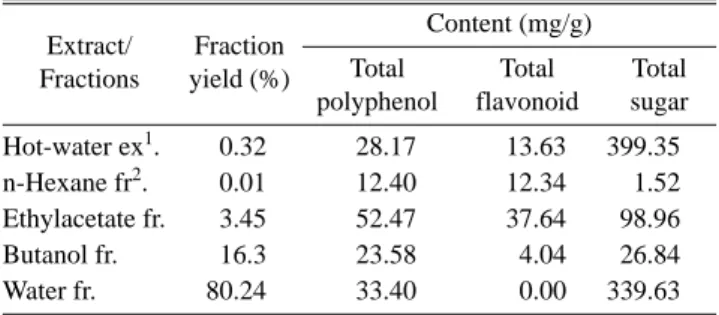
양앵두의 열수 추출물 및 이의 순차적 유기용매 분획물을 조제하고, 이들의 성분을 분석하였다(Table 2). 먼저 열수 추 출물의 경우 고형분 함량이 약 38±2.1%로, 상당량의 pectin 성분과 수용성 물질을 포함하고 있었으며 미량의 폴리페놀 및 플라보노이드 성분을 포함하였다. 열수 추출물의 헥산, 에틸아세테이트, 부탄올 분획물 및 물 잔류물의 분획효율은 각각 0.01%, 3.45%, 16.30% 및 80.24%로 나타나 양앵두
열수 추출물의 대부분이 부탄올 분획 및 물 잔류물로 이행 되었으며 지용성 성분은 상대적으로 적음을 알 수 있었다
(Table 2). 한편 각 분획물의 총 폴리페놀 및 총 플라보노이
드의 함량을 분석한 결과, 폴리페놀 함량의 경우 에틸아세 테이트 분획, 물 잔류물, 부탄올 분획, 헥산 분획 순으로 나 타났으며, 총 플라보노이드 함량의 경우에는 에틸아세테이 트 분획, 헥산 분획, 부탄올 분획 순으로 나타났다. 양앵두 열수 추출물의 대부분을 차지하는 물 잔류물의 경우 플라보 노이드는 검출되지 않았으며, 총당 함량은 약 34%로 확인 되었다. 이는 양앵두 대부분의 성분이 glucose, fructose, sucrose 및 sorbitol 등의 당류라는 보고[20, 24]와 일치하는 결 과이다. 한편 양앵두에서는 neochlorogenic acid, ρ-coumar- oylquinic acid, hydroxycinamic acids 및 epicatechin 등의 페놀 화합물[8, 24]과 quercetin, rutin, myricetin 등의 플라 보노이드가 보고[3]되어 있으므로, 총 폴리페놀 및 총 플라 보노이드 함량이 높은 양앵두의 에틸아세테이트 분획은 우 수한 항산화력을 나타낼 것으로 예상되었다[9, 22].
먼저 양앵두 열수 추출물 및 이의 분획물의 항균력을 500 µg/disc 농도에서 평가하였다. 항세균 활성 평가의 경우, 대 조구로 사용된 ampicillin은 1 µg/disc 농도에서 전반적으로 우수한 항세균 활성을 나타내었다. 양앵두의 경우 에틸아세 Table 2. The organic solvent fraction yields from the hot-water extract of Prunus avium L. and its organic solvent fractions.
Extract/
Fractions
Fraction yield (%)
Content (mg/g) Total
polyphenol
Total flavonoid
Total sugar
Hot-water ex1. 0.32 28.17 13.63 399.35
n-Hexane fr2. 0.01 12.40 12.34 1.52
Ethylacetate fr. 3.45 52.47 37.64 98.96
Butanol fr. 16.3 23.58 4.04 26.84
Water fr. 80.24 33.40 0.00 339.63
ex1: extract, fr2: fraction.
Table 3. Antimicrobial activities of the hot-water extract of Prunus avium L. and its organic solvent fractions against pathogenic bac- teria and fungi.
Extract/
fractions
Growth inhibition zone (mm)
Gram positive Gram negative Yeast
S. c
C. albicans
L. m3 S. e S. a S. t P. a E. c 1940 30003 14020 14021
Ampicillin 25.0 21.5 24.0 22.0 10.5 10.0 - - - - -
Miconazole -4 - - - - - 8.5 18.5 20.0 - -
Hot-water ex1. - - - - - - - - - - -
n-Hexane fr2. - - - - - 8.5 14.0 23.0 18.0 21.0
Ethylacetate fr. 12.0 10.5 18.0 15.0 - 18.0 - - - - -
Butanol fr. 23.0 19.0 17.0 12.0 - 17.5 - - - - -
Water fr. - - - - - - - - - - -
ex1: extract, fr2: fraction, 3L. m: Listeria monocytogenes, S. e: Staphylococcus epidermidis, S. a: Staphylococcus aureus, S. t: Salmonella typh- imurium, P. a: Pseudomonas aeruginosa, E. c: Escherichia coli, S. c: Saccharomyces cerevisiae. 4- : No activity
The concentrations of the hot-water extract and its organic solvent fractions used were 500 µg/disc, respectively. The growth inhibition zone expressed was included a size of disc-paper (6.5 mm of diameter). The data represent a representative result of three independent determinations.
테이트 및 부탄올 분획에서 항세균 활성이 우수한 인정되었 으며 열수 추출물, 헥산 분획 및 물 잔류물에서는 활성이 나 타나지 않았다(Table 3). 또한 기회감염균인 P. aeruginosa에 대한 양앵두 시료들의 항균활성은 인정되지 않았다. 한편 항 진균 활성 평가 결과 miconazole(1 µg/disc)은 항생제 내성균
주인 C. albicans CCARM 14020 및 14021 에 대해서는 항 균력을 나타내지 못하였으나 C. albicans KCTC 1940,
KACC 30003에 대해서는 강한 항균력을 나타내었다. 그러나
양앵두의 헥산 분획에서는 실험에 사용한 C. albicans 모든 균에서 강력한 항균력이 나타났으며, 특히 항생제 내성균주
Table 4. The minimal inhibitory concentration values of n-hexane, ethylacetate and butanol fractions against pathogenic bacteria and C. albicans.
Extract/
fractions
MIC (mg/mL)
Gram positive Gram negative C. albicans
L. m1 S. e S. a S. t P. a E. c 1940 30003 14020 14021
n-Hexane fr. 1.0 >1.5 >1.0 >1.5 >1.5 >1.5 1.0 0.5 0.5 0.5
Ethylacetate fr. 1.0 >1.5 >1.0 >0.5 >1.5 >1.5 ND2 ND ND ND
Butanol fr. 0.5 >1.5 >1.5 >0.5 >1.5 >1.5 ND ND ND ND
1L. m: Listeria monocytogenes, S. e: Staphylococcus epidermidis, S. a: Staphylococcus aureus, S. t: Salmonella typhimurium, P. a: Pseudomo- nas aeruginosa, E. c: Escherichia coli.
2ND: Not determined.
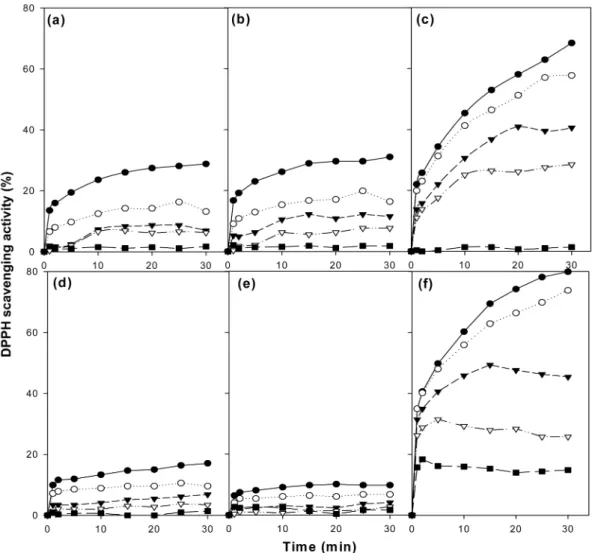
Fig. 1. DPPH scavenging activity of the hot-water extract of Prunus avium L. and its organic solvent fractions. (a) hot-water extract, (b) n-hexane fraction, (c) ethylacetate fraction, (d) butanol fraction, (e) water fractions and (f) vitamin E as a control. Symbols: ●, (a~e) 500 or (f) 50 µg/mL; ○, (a~e) 250 or (f) 25 µg/mL; ▼, (a~e) 125 or (f) 12.5 µg/mL; ▽, (a~e) 62.5 or (f) 6.25 µg/mL; ■, (a~e) 0 or (f) 3.13 µg/mL, respectively.
인 C. albicans CCARM 14020 및 14021 균주에서도 강력 한 항균활성이 나타났다(Table 3). 이러한 결과는 항생제 내 성 Candida sp.의 제어에 양앵두의 헥산 분획물이 효율적으 로 이용될 수 있음을 제시한다. 한편 항균활성이 인정되는 분 획물을 대상으로 MIC를 평가한 결과는 Table 4에 나타내었 다. 부탄올 분획물은 L. monocytogenes및 S. typhimurium에 대해 0.5 mg/mL의 MIC를 나타내었으며, 반면 헥산 분획은 다양한 C. albicans에 대해 0.5~1.0 mg/mL의 MIC를 나타내 었다. 이는 2009년 P. armeniaca L.의 열수 추출물이 C.
albicans에 대해 2.5~5.0 mg/mL의 MIC를 나타냄을 보고한
Yigit 등[26]의 결과와 비교해 볼때 양앵두 헥산 분획물이 매
우 강력한 항진균 활성물질을 포함하고 있음을 알 수 있다.
한편 양앵두 열수 추출물 및 분획물의 항산화활성을 평가 하기 위해 DPPH 소거활성을 5분 간격으로 측정한 결과는 Fig. 1에 나타내었다. 사용시료의 농도(0~500 µg/mL)가 높 을수록 DPPH 소거능이 증대되었으며, 반응시간 연장에 따 라 소거능이 증대되는 패턴을 나타내었다. 열수 추출물 및 헥산 분획물에서는 500 µg/mL 농도에서 31% 정도의 소거 능을, 부탄올 분획 및 물 분획물에서는 20% 이하의 소거능 을 나타낸 반면, 에틸아세테이트 분획은 68% 소거능을 나 타내어 우수한 항산화능을 확인하였다. 대조구로 사용된
vitamin E의 경우 사용농도 및 반응시간 의존적 소거능 증
대가 뚜렷하였으며, 50 µg/mL 농도에서 최대 80% 소거능 을 나타내었다. Vitamin E와 헥산 분획의 IC50는 각각 15.5 및 195.5 µg/mL으로 계산되어(Fig. 1), 양앵두 에틸아세테 이트 분획물은 vitamin E의 DPPH 소거활성의 1/12~1/13 정도의 활성을 나타내는 것으로 추측된다. 또한 다양한 시 료들을 대상으로 환원력 평가 결과, 250 µg/mL 농도에서 에 틸아세테이트 분획, 열수 추출물, 물 잔류물, 부탄올 분획물
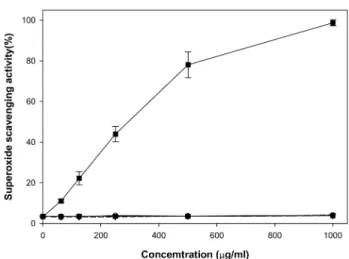
의 순으로 환원력이 강하게 나타나, 양앵두의 에틸아세테이 트 분획의 항산화능을 확인할 수 있었다(Fig. 2). 이는 분획 물 중 에틸아세테이트 분획이 가장 높은 총 폴리페놀 및 총 플라보노이드 함량을 나타냄을 고려할 때(Table 2), 주요 항 산화 활성 성분은 폴리페놀, 또는 플라보노이드 물질과 관 련 있을 것으로 추측된다. 한편 Superoxide제거능 평가 결 과, 양앵두의 열수 추출물 및 분획물은 1,000 µg/mL 농도까 지는 활성을 나타내지 않았다(Fig. 3). 이러한 결과는 양앵 두 및 양앵두 활성분획의 건강 기능성 식품으로의 활용 및 식품보존제로의 개발 가능성을 제시하고 있으며, 향후 각 분 획의 활성성분 정제와 특성 규명이 필요하다.
요 약
국내산 양앵두의 유용 생리활성 검토를 목적으로 양앵두 열수 추출물 및 순차적 유기용매 분획물을 조제하였다. 양 앵두 추출물의 약 40%는 당류 성분이었으며, 이의 헥산, 에 틸아세테이트, 부탄올 분획물 및 물 잔류물의 분획효율은 각 각 0.01%, 3.45%, 16.30% 및 80.24%로 나타나 양앵두 열 수 추출물의 대부분이 부탄올 분획 및 물 잔류물로 이행되 었다. 에틸아세테이트 분획물은 총 폴리페놀 및 총 플라보 노이드 함량이 가장 높았으며, 물 잔류물은 34%의 총당을 함유하였다. 조제된 열수 추출물과 분획물의 항세균 활성을 평가한 결과 에틸아세테이트 및 부탄올 분획에서 Listeria monocytogenes, Staphylococcus aureus, 및 Salmonella typhimurium에 대해 우수한 항세균 활성이 확인되었으며 (MIC, 0.5~1.0 mg/mL), Pseudomonas aeruginosa에는 항 균 활성이 나타나지 않았다. 항Candida 활성은 헥산 분획에 서만 확인되었으며, 항생제 내성균에 대해서도 우수한 항균 활성을 나타내었다(MIC, 0.5~1.0 mg/mL). 항산화능 평가의 Fig. 2. Reducing power of the hot-water extract and its organic
solvent fractions of Prunus avium L. Symbols: ●, hot-water extract; ○, ethylacetate fraction; ▼, butanol fraction; ▽, water fraction; ■, butylated hydroxytoluene; and □, vitamin C.
Fig. 3. Superoxide scavenging activity of the hot-water extract and its organic solvent fractions of Prunus avium L. Symbols:
●, hot-water extract; ○, ethylacetate fraction; ▼, butanol fraction;
▽, water fraction; and ■, vitamin E.
경우 에틸아세테이트 분획에서 우수한 DPPH 소거능(IC50:
195.5 µg/mL) 및 환원력을 나타내었다. 본 연구결과는, 양
앵두가 우수한 항균 활성과 항산화 활성을 가진 유용한 과 일자원으로 이용될 수 있음을 제시하고 있다.
REFERENCES
1. Chaovanalikit, A. and R. E. Wrolstad. 2004. Total antho- cyanins and total phenolics of fresh and processed cherries and their antioxidant properties, J. Food Sci. 69: 67-72.
2. Choi, O. K., Y. Kim, G. S. Cho, and C. K. Sung. 2002.
Screening for antimicrobial activity from Korean plants. Kor.
J. Food. Nutr. 15: 300-306.
3. Connor, A. M., C. E. Finn and P. A. Alspach. 2005. Geno- typic and environmental variation in antioxidant activity and total phenolic content among blackberry and hybrid berry cultivars. J. Am. Soc. Hort. Sci. 130: 527-533.
4. Gao, L. and G. Mazza. 1995. Characterization, quantifica- tion, and distribution of anthocyanins and colourless phenolics in sweet cherries. J. Agri. Food Chem. 43: 343-346
5. Goncalves, B., A. K. Landbo, M. Let, A. P. Silva, E. Rosa and A. S. Meyer. 2004. Storage affects the phenolic profiles and antioxidant activities of cherries (Prunus avium L.) on human low-density lipoproteins. J. Sci. Food Agri. 84: 1013- 1020.
6. He, Y. H, J. Zhou, Y. S. Wang, C. Xiao, Y. Tong, J. C. Tang, A. S. Chan, and A. P. Lu. 2006. Anti-inflammatory and anti- oxidative effects of cherries on Freund's adjuvant-induced arthritis in rats. Scand. J. Rheumatol. 35: 356-358
7. Kang J. K., and G. R., Cho. 2007. Production situation and demand estimates of cherry (Prunus avium L.) in Korea.
Kor. J. Intl. Agri. 19: 214-223.
8. Kim D. O., H. J. Heo, Y. J. Kim, H. S. Yang and C. Y. Lee, 2005. Sweet and sour cherry phenolics and their protective effects on neuronal cells, J. Agri. Food Chem. 53: 9921-9927.
9. Kim J. I., H. S. Jang, J. S. Kim, and H. Y. Sohn. 2009.
Evaluation of antimicrobial, antithrombin, and antioxidant activity of Dioscorea batatas Decne. Kor. J. Microbiol.
Biotechnol. 37: 133-139.
10. Kim, K. H., S. Y. Lee and H. S. Yook. 2009. Quality characteristics of muffins prepared with flowering cherry (Prunus serrulata L. var. spontanea Max. wils.) fruit powder.
J. Kor. Soc. Food Sci Nutr. 38: 750-756.
11. Kim, Y. H. 1999. The characterization of anthocyanin pigments prepared from cherry (Prunus serrulata L. var.
spontanea Max. wils) for the potential sources of red colorant. J. Kor. Soc. Agric. Chem. Biotech. 42: 134-139 12. Lee, S. A., K. H. Kim, S. Y. Lee, K. H. Joung, S. H. Cho
and H. S. Yook. 2009. Physicochemical properties of flowering cherry (Prunus serrulata L.) fruits according to cultivars. J. Kor. Soc. Food Sci. Nutr. 38: 574-579.
13. Marklund, S., and G. Marklund. 1974. Involvement of superoxide anion radical in the oxidation of pyrogallol and a
convenient assay for superoxide dismutase. Eur. J. Biochem.
47: 469-474.
14. Rødtjera A., H. L. Skibsteda and M. L. Andersen. 2006.
Antioxidative and prooxidative effects of extracts made from cherry liqueur pomace. Food Chem. 99: 6-14.
15. Ryu, H. Y., E. J. Kum, K. H. Bae, Y. K. Kim, I. S. Kwon, and H. Y. Sohn. 2007. Evaluation for the antimicrobial, antioxidant and antithrombosis activity of Korean traditional liquors. Kor. J. Microbiol. Biotechnol. 35: 310-315.
16. Ryu, H. Y., I. S. Kwun, S. J. Park. B. H. Lee, and H. Y.
Sohn. 2007. Inhibition of browning in yam fresh-cut and control of yam-putrefactive bacterium using acetic acetic or maleic acid. Kor. J. Microbiol. Biotechnol. 35: 135-141.
17. Ryu, H. Y., J. C. Heo, J. S. Hwang, S. W. Kang, C. Y. Yun, S. H. Lee and H. Y. Sohn. 2008. Screening of thrombin inhibitor and its DPPH radical scavenging activity from wild insects. Kor. J. Life Sci. 18: 363-368
18. Schwartz, K., G. Bertelsen, L. R. Nissen, P. T. Gardner, M. I.
Heinonen and A. Hopia. 2001. Investigation of plant extracts for the protection of processed foods against lipid oxidation.
Eur. Food Res. Tech. 212: 319-328.
19. Seeram, N. P., R. A. Momin, M. G. Nair and L. D. Bourquin.
2001. Cyclooxygenase inhibitory and antioxidant cyanidin glycosides in cherries and berries. Phytomedicine 8: 362-369.
20. Serrano, M., F. Guillen, D. Martinez-Romero, S. Castillo and D. Valero. 2005. Chemical constituents and antioxidant activity of sweet cherry at different ripening stages. J. Agri.
Food Chem. 53: 2741-2745.
21. Singleton V. L, R. Orthofer, and R. M. Lamuela-Raventos.
1999. Analysis of total phenols and other oxidation substrates and antioxidants by means of Folin-Ciocaleau reagent. Methods Enzymol 299: 152-178.
22. Sohn, H. Y. H. Y. Ryu, Y. Jang, H. S. Jang, Y. M. Park, and S. Y. Kim. 2008. Evaluation of antimicrobial, antithrombin, and antioxidant activity of aerial part of Saxifraga stoloni- fera. Kor. J. Microbiol. Biotechnol. 36: 195-200.
23. Sohn, H. Y., K. H. Son, C. S. Kwon, G. S. Kwon, and S. S.
Kang. 2004. Antimicrobial and cytotoxic activity of 18 prenylated flavonoids isolated from medicinal plants: Morus alba L., Morus mongolica Schneider, Broussnetia papyrifera (L.) Vent, Sophora flavescens Ait and Echinosophora koreensis Nakai. Phytomedicine 11: 666-672.
24. Valentina U., J. Fabcic and F. Stampar. 2007. Sugars, organic acids, phenolic composition and antioxidant activity of sweet cherry (Prunus avium L.). Food Chem. 107: 185-192.
25. Wang, H., M. G. Nair, G. M. Strasburg, Y. C. Chang, A. M.
Booren, J. I. Gray and D. L. Dewitt. 1999. Antioxidant and antiinflammatory activities of anthocyanins and their agly- cone, cyanidin, from tart cherries. J. Nat. Prod. 6: 294-296.
26. Yigit, D., N. Yigit and A. Mavi. 2009. Antioxidant and anti- microbial activities of bitter and sweet apricot (Prunus arme- niaca L.) kernels. Brazilian J. Med. Biol. Res. 42: 346-352.
(Received Oct. 30, 2009/Accepted Dec. 5, 2009)