• 검색 결과가 없습니다.

Size Reduction Characteristics of Yellow Poplar in a Laboratory Knife Mill

N/A
N/A
Protected

Academic year: 2021

Share "Size Reduction Characteristics of Yellow Poplar in a Laboratory Knife Mill"

Copied!
6
0
0

로드 중.... (전체 텍스트 보기)

전체 글

(1)

1. INTRODUCTION

Size reduction is one of the major pre-proc- essing operations in using biomass as a source of energy or raw materials for forest products industry. The design and choice of the grinders for the size reduction is important for reducing the energy input in preparing biomass or raw materials (Naimi et al., 2006). For instance, the size, shape, and uniformity of raw material are important quality characteristics for the manu- facturing of biomass pellets. Size reduction of

biomass is also necessary in biofuel industry such as bio-ethanol because large-size biomass cannot be converted to biofuels efficiently (Zhang, 2014). Proper ground size of corn stover for acid hydrolysis in making ethanol was found to be 20 mesh and about 6 mm for gasification (Womac et al., 2007).

Comprehensive knowledge for particle size reduction of biomass is lacking in scientific literature. The lack of studies about the effects of aperture diameter of grinder screens on en- ergy consumption in size reduction and particle

Original Article

Size Reduction Characteristics of Yellow Poplar in a Laboratory Knife Mill 1

Hyoung-Woo Lee

2,†

ABSTRACT

Size reduction is one of the major pre-processing operations in using biomass as a source of energy or raw materials for forest products industry. The grinding characteristics of dried yellow poplar wood chips were investigated using laboratory knife mill with three different screen aperture diameters to provide the basic information for the optimizing of size reduction processes in biomass industry. Average specific energy con- sumptions were 0.157, 0.137, and 0.093 Wh/g for the screen aperture diameters of 5.0, 7.5, and 9.0 mm, respectively. According to the results of size distribution analysis of ground particles, the sizes of the most of ground particles were much smaller than the aperture diameters of the screens installed on knife mill used in this study.

Keywords : size reduction, biomass, knife mill, specific energy consumption for milling, particle size distribution, Liriodendron tulipifera L.

1

Date Received November 19, 2015, Date Accepted December 28, 2015

2

College of Agriculture and Life Science, Chonnam National University, Gwangju 61186, Republic of Korea

Corresponding author: Hyoung-Woo Lee (e-mail: [email protected])

(2)

size distribution makes it difficult to decide which screen aperture diameter should be se- lected in order to minimize the energy con- sumption in size reduction and maximize the productivity in manufacturing biomass fuels or wood products.

This work was carried out to investigate the grinding characteristics of dried yellow poplar wood chips to provide the basic information for the optimizing of size reduction processes in biomass industry.

2. MATERIALS and METHODS 2.1. Material preparation

Yellow poplar (Liriodendron tulipifera L.) wood chips were provided by Korea Forestry Research Institute (KFRI). Average moisture content of yellow poplar wood chips were measured as 8% (wet based) by oven-drying method. The wood chips that could not pass the sieve with aperture size of 31.5 mm were re- jected to simulate the industrial process.

2.2. Analysis of energy consumption

A laboratory scale knife mill (Model No.

LKM2015, Drying Engineering, Inc., Korea) was used for size-reduction of wood chip. It was equipped with a three-phase 3.75 kW elec- tric motor. The rotation speed of the motor was 1720 rpm.

Fig. 1 shows experimental setup for knife milling of wood chips. Four knives (107 mm

long and 30 mm wide) were mounted on the rotor inside the milling chamber. Two cutting bars were mounted on the inside wall of the milling chamber. Wood chips were cut into par- ticles between the knives and the cutting bars.

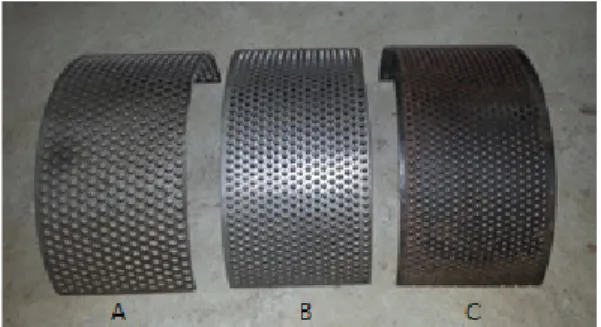
The gap between the knives and the cutting bars was set at 3 mm. Screen with three aper- ture sizes (9, 7.5, and 5 mm, respectively) were used in this study (Fig. 2). During knife mill- ing, wood particles that are smaller than the screen aperture diameter will pass through the screen. But those larger than the screen aperture diameter will be recirculated and milled further.

Energy consumption is the electricity con- sumed by the electric motor of the knife mill.

Lee et al. (2005) studied on the power con-

sumption in peripheral milling of twelve Korean

domestic wood species by measuring the elec-

tricity consumed by the planer. Electric current

to the motor was measured using a AC current

clamp (Model No. OM-PLCV, Omega

Engineering, Inc,, USA). Current data were col-

lected using software through data logger

(Model No. OM-PL, Omega Engineering, Inc.,

USA). The sampling rate was set at one read-

ing per second. Data acquisition began before

the wood chip sample was loaded into the knife

mill chamber to identify the current data during

the idling period with no load in the knife mill

chamber. In this study the currents during the

idling period ranged 5.1 ∼ 5.3 A. The current

increased immediately after the sample loading

and decreased to the current during the idling

period after all the particles were discharged

from the knife mill chamber. Therefore, it was

(3)

possible to identify the current data only for the particle loading period. Weights of sample per one charge were 100, 150, and 200 g/charge, respectively for each screen aperture diameter.

The processing time was identified and the average current during this processing time was calculated in each test. The input voltage was three-phase 380 V. The energy consumed during each test that lasted for seconds was calculated using the following equation (Zhang et al., 2012):

 



 ∙ 



∙  ∙ 

··· [1]

: energy consumption (Wh)



: average current (A)

 : input voltage (V)

 : processing time (s)

Dividing 

by the weight ( ) of the wood particles loaded into the knife mill chamber

gives the specific energy consumption (energy consumption per unit weight of sample loaded), as expressed in Equation [2]:

 

··· [2]

 : specific energy consumption (Wh/g)

 : weight of sample loaded (g)

2.3. Size distribution and moisture contents of particles

Wood particles produced by knife milling were not uniform in their sizes. Particle size distributions were determined using a sieve shaker. A stack of four sieves were arranged from the largest to the smallest in aperture size.

The aperture sizes used were 4, 2, 1, and 0.5 mm. A pan with no opening was put at the bottom of these sieves. 100 g of wood particles were loaded onto the top sieve. The sieve shaker was on for 5 minutes. Afterwards, wood particles retained on each sieves were collected and weighed. The percentage of the wood Fig. 2. Screens used in knife milling (A: aperture size 9.0 mm, B: aperture size 7.5 mm, C: aperture size 5.0 mm).

Fig. 1. Experimental setup for knife milling of wood

chips.

(4)

particles in each of the five particle size ranges (> 4.0 mm, 4.0 ∼ 2.0 mm, 2.0 ∼ 1.0 mm, 1.0

∼0.5 mm, and < 0.5 mm) was translated to particle size distribution.

The moisture contents of particles were de- termined by oven-drying method for each screen aperture size.

3. RESULTS and DISCUSSION 3.1. Energy consumption in knife milling

Fig. 3 shows the ampere curves at the sample input rate of 200 g/charge with three screen aperture diameters of 9.0, 7.5, and 5.0 mm. As expected, amperes increased instantly after wood chip samples were put into the knife mill.

Then amperes went down gradually as the mil- led wood chips were discharged.

As shown in Table 1, energy consumption in knife milling of wood chips increased dramati- cally with decrease of screen aperture diameter.

For instance, energy consumption was as high as 0.15 ∼ 0.16 (average 0.157) Wh/g for 5.0 mm screen and only 0.9 ∼ 0.10 (average 0.093)

Wh/g for 9.0 mm screen. That for 7.0 mm screen was 0.13 ∼ 0.14 (average 0.137) Wh/g.

Energy consumption increased by about 69%

as the screen aperture diameter decreased from 9.0 mm to 5.0 mm.

Zhang et al. (2012) reported energy con- sumption 0.16 Wh/g for 4 mm screen in knife-milling of poplar wood chips with mois- ture content of 10%.

As sample input rate per charge (100, 150, and 200 g/charge) increased, processing time al- so increased. However, the effect of sample in- put rate on the energy consumption per unit

Screen aperture

diameter 9.0 mm 7.5 mm 5.0 mm

 (g) 100 150 200 100 150 200 100 150 200



(A)

 (sec.)

(Wh)

 (Wh/g)

5.9 9 9.32 0.09

6.1 13 13.55

0.09

7.0 18 19.12

0.10

6.5 14 14.37

0.14 7 20 21.15

0.14

7.6 24 25.71

0.13

6.1 16 16.18

0.16

6.5 22 22.76

0.15

7.3 30 31.78

0.16 (  (g) : weight of sample loaded per charge, 



(A) : average current per charge,

 (sec.) : processing tiem per charge, 

(Wh) : total energy consumption per charge,  (Wh/g) : specific energy consumption)

Table 1. Energy consumptions in knife milling of yellow poplar wood chips with three different screen aperture diameters and at three different sample input rates

Fig. 3. Ampere curves at the sample input rate of

200 g/charge with three screen aperture diameters of

9.0, 7.5, and 5.0 mm.

(5)

weight could not recognized. This may be due to the knife mill capacity that is too big for the sample input rate per charge.

3.2. Particle size distribution

Fig. 4 shows the effect of the knife mill screen aperture diameter on the particle size distribution. Decreased screen aperture diameter resulted in decreased particle size, as expected.

Percentages of particles in the size smaller than 2.0 mm were about 67, 43, and 27% for knife mill screen aperture diameter of 5, 7.5, and 9 mm, respectively. On the other hand, percen- tages of particles in the size larger than 4.0 mm were 0, 2, and about 12% for 5, 7.5, and 9 mm, respectively. It was found that the sizes of most ground particle were much smaller than the aperture diameters of the screens installed on knife mill this study.

Particle size is very important from a flow and mechanical interlocking aspect during the pelletizing process. Although fine particles produce more durable pellets, fine grinding is undesirable because of increased cost of production due to the increase of power con- sumption in grinding and pelletizing process. A mixture of different particle sizes would give optimum pellet quality because the mixture of particles will make inter-particle bonding with nearly no inter-particle spaces (Kaliyan and Morey, 2008). However an amount of fines (particles smaller than 0.5 mm in diameter) that is too high in the raw material has a negative impact both on friction and pellet quality. As a

rule of thumb, the amount of fines should not exceed 10 to 20% unless a binding agent is added (Stelte et al., 2012). In this study the amounts of fines did not exceed 4% with all the aperture diameters of screens in the knife mill.

Optimal particle size distribution should be determined according to the diameter of pellets to be produced and the biomass species used.

Then the proper screen aperture size can be se- lected for size reduction process. It can be rec- ommended that particles from the proper grind- ing process are separated into several particle size groups and particles from each group are mixed into the optimal particle size distribution for pellet production.

Table 2 shows the average moisture contents (wet-based) of wood chips and particles produced. Ground particles showed slightly low- er moisture contents than that of wood chips.

These moisture content reductions seem to be

mainly due to the heat induced by the friction

Fig. 4. Particle size distributions of yellow poplar

wood chips through the knife mill with three screen

different aperture diameters of 9.0, 7.5, and 5.0 mm.

(6)

during grinding.

4. CONCLUSION

In this study the specific energy con- sumptions in size reduction process of dried yellow poplar wood chips were investigated with three different screen aperture diameters.

Size distributions of ground particles were also investigated.

Average specific energy consumptions were 0.157, 0.137, and 0.093 Wh/g for the screen aperture diameters of 5.0, 7.5, and 9.0 mm, respectively. Average specific energy con- sumption increased by about 69% as the screen aperture diameter decreased from 9.0 to 5.0 mm.

The sizes of the most of ground particles were much smaller than the aperture diameters of the screens installed on knife mill used this study.

ACKNOWLEDGEMENTS

This study was supported by the 2015 Academic Development Program of Chonnam National University.

REFERENCES

Kaliyan, N., Morey, R.V. 2008. Densification of

biomass. VDM Verlag.

Lee, H.W., Kim, B.N., Kim, K.Y. 2005. Study on the power consumption characteristics of Korean domestic species in peripheral milling with im- age analysis technique. Journal of the Korean Wood Science and Technology 33(5): 133∼44.

Naimi, L.J., Sokhansanj, S., Mani, S., Hoque, M., Bi. T. 2006. Cost and performance of woody bi- omass size reduction for energy production.

Proceedings of CSBE/SCGAB 2006 Annual Conference, Edmonton, Alberta, Canada.

Stelte, W., Sanadi, A.A., Shang, L., Holm, J.K., Ahrenfeldt, J., Henriksen, U.B. 2012. Recent de- velopments in biomass pelletization - A review.

BioResources 7(3): 4451∼4490.

Womac, A.R., Iggathinathane, C., Bitra, P., Miu, P., Yang, T., Sokhansanj, S., Narayan, S. 2007.

Biomass pre-processing size reduction with in- strumented mills. Proceedings of 2007 ASABE Annual International Meeting, Minneapolis, Minnesota, USA.

Zhang, M., Song, X., Deines, T.W., Pei, Z.J., Wang, D. 2012. Biofuel manufacturing from woody bi- omass: Effects of sieve size used in biomass size reduction. Journal of Biomedicine and Biotechnology, Volume 2012, Article ID 581039.

Zhang, M. 2014. Size reduction of cellulosic bio- mass for biofuel manufacturing. Ph.D. thesis, Department of Industrial & Manufacturing Systems Engineering, College of Engineering, Kansas State University, USA.

Item MC (%)

Wood chips

Particles ground with screen aperture diameter of 5.0 mm Particles ground with screen aperture diameter of 7.5 mm Particles ground with screen aperture diameter of 9.0 mm

8.00

7.76

7.23

7.83

Table 2. Average moisture contents (MC) of wood chips and ground particles

수치

Fig. 1. Experimental setup for knife milling of wood chips.
Fig. 3 shows the ampere curves at the sample  input rate of 200 g/charge with three screen  aperture diameters of 9.0, 7.5, and 5.0 mm
Fig. 4 shows the effect of the knife mill  screen aperture diameter on the particle size  distribution

참조

관련 문서

Frontal tubercle absent. Antenna yellowish dark brown, with 13 segments; AR 1.5. Clypeus brownish yellow, with 11-12 setae. THORAX: Yellow in ground color. Ante-

The study derived the problems according to results of field-centered synthetic analysis on yellow croakers of fishery system currently used in Chujado, Korea

In order to investigate the characteristics of Al/CFRP using friction spot joining, plunge depth, the rotation speed, and the dwell time were selected as parameters..

In this study, the performance characteristics of a two-stage CO 2 system with two-different evaporator temperature have been analyzed according to outdoor

mould with rapid and uniform cooling characteristics using the deposition of the multi-materials based on the direct metal rapid tooling process.. In order

A laboratory experiment was performed to investigate the removal of nitrogen and phosphorus from plating factory effluent using the soil column.. Soil,

Objectives : The purpose of this study was to investigate the effects of general characteristics, health characteristics, mental health characteristics, suicidal

Seed germination, cutting propagation and early growth characteristics were investigated in order to develop the method of cutting propagation and to find