한국컴퓨터정보학회 동계학술대회 논문집 제21권 제1호 (2013. 1)
133
공급사슬관리시스템에 대한 비즈니스가치의 효율적 성과에 관한 연구
김경우○
○을지대학교 중독재활복지학과 e-mail: [email protected]
The Study on the Efficient Performance of Business Value for Supply Chain Management System
Kyung-Woo Kim○
○Dept. of A.R. with Social Welfare, Eulji University
● 요 약 ●
본 논문에서는 오늘날의 경쟁적인 경영환경은 기업들이 공급사슬을 어떻게 관리할 지에 더욱더 관심을 기울이고 있다. 고객들은 제품을 구매하는 데 있어 보다 큰 가치, 보다 빠른 주문여행, 그리고 보다 적극적인 서비스를 강조하고 있다.
공급사슬 관리 응용시스템의 실행과 성과측정을 알아보고 수요주도의 공급사슬 방식을 통하여 공급사슬관리시스템의 비즈니스 운영과 그 가치를 도출하고자 하였다.
키워드: SCM(Supply Chain Management; 공급사슬관리), Push-Based Model(푸시기반모델), Pull-Based Model(풀 기반모델), Business Value(기업가치)
I. Introduction
A corporate's supply chain is a network of organizations and business processes for procuring raw materials, transforming these materials intermediate and finished products, and distributing the finished products to customers. It links suppliers, manufacturing plants, distribution centers, retail outlets, and customers to supply goods and services from source through consumption. Materials, information, and payments flow through the supply in both directions. Goods start out as raw materials as they move through the supply chain, are transformed into intermediate products and finally, into finished products.
The finished products shipped to distribution centers from there to retailers and customers. Returned items flow in the reverse direction from the buyer back to the seller. Nike's contract suppliers do not manufacture sneakers- the laces, eyelets, uppers, and soles-from other suppliers and then assemble them into finished sneakers. These suppliers in turn have their own suppliers. For sample, the suppliers of soles have suppliers for synthetic rubber, suppliers for chemicals used to melt the rubber for molding and suppliers for the molds into which to pour the rubber. Suppliers of laces would have suppliers for their thread, for dyes, and for the plastic tips.
II. Information Systems and Supply Chain management
Inefficiencies in the supply chain, such as parts shortages, underutilized plant capacity, excessive finished goods inventory, or high transportation costs, are caused by inaccurate or untimely information, For example, manufactures may keep too many parts in inventory because they do not know exactly when they will receive their next shipments from their suppliers. Suppliers may order too few raw materials because they do not precise information on demand. These supply chain inefficiencies as much as 25 percent of a company's operating costs. If a manufacturer had perfect information about exactly how many units of product customers wanted, when they wanted them, and when they could be produced, it would be possible to implement a highly efficient just-in time strategy. Components would arrive exactly at the moment they were needed and finished goods would be shipped as they left the assembly line.
In a supply chain, however, uncertainties arise because many events cannot be foreseen-uncertain product demand, late shipments from suppliers, defective parts or raw materials, or production process breakdowns. To satisfy customers, manufacturersoften deal with such uncertainties and unforeseen events by keeping more material or products in inventory than
한국컴퓨터정보학회 동계학술대회 논문집 제21권 제1호 (2013. 1)
134
what they think they may actually need. The safety stock acts as a buffer for the lack of flexibility in the supply chain. Although inventory is expensive, low fill rates are also costly because business may be from canceled orders.
One recurring problem in supply chain management is the bullwhip effect, in which information about the demand for a product gets distorted as it passes from one entity to the next across the supply chain. A slight rise in demand for an item might cause different members in the supply chain-distributors, manufactures, suppliers, suppliers, and tertiary suppliers-to stockpile inventory so each has enough "just in case." These changes ripple throughout the supply chain, magnifying what started out as a small change from planned orders, creating excess inventory, production, warehousing and shipping costs.
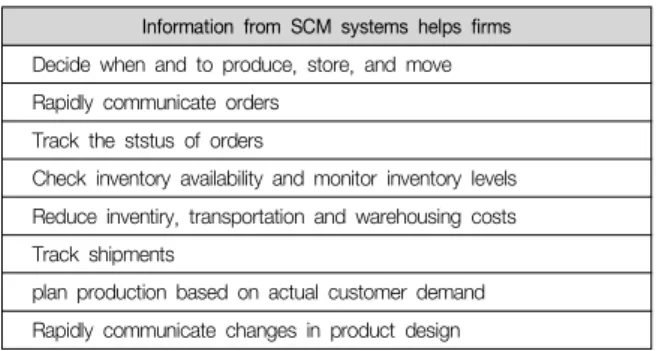
The bullwhip is tamed by reducing uncertainties about demand and supply when all members of the supply chain have accurate and up-to-date information. if all supply chain members share dynamic information about inventory levels, schedules, forecasts, and shipments, they have more precise knowledge about how to adjust their sourcing, manufacturing, and distribution plans. Supply chain management systems provide the kind of information that helps members of the supply chain make better purchasing and scheduling decisions Table 2-1 describes how firms benefit from these systems.
Table 2-1. How information systems facilitate supply chain management
Information from SCM systems helps firms Decide when and to produce, store, and move Rapidly communicate orders
Track the ststus of orders
Check inventory availability and monitor inventory levels Reduce inventiry, transportation and warehousing costs Track shipments
plan production based on actual customer demand Rapidly communicate changes in product design
III. Global Supply Chains and the Internet
Before the internet, supply chain coordination was hampered by the difficulties of making information flow smoothly among disparate internal supply chain systems for purchasing, materials management, manufacturing, and distribution. It was also difficult to share information with external supply chain partners because the systems of suppliers, distributors, or logistics providers were based on incompatible technology platforms and standards.
Enterprise systems supply some integration of internal supply
chain processes but they are not designed to deal with external supply chain processes. Some supply chain integration is supplied inexpensively using Internet technology. Firms use intranets to improvecoordination among their internal supply chain processes, and they use extranets to coordinates supply chain processes shared with their business partners. Using intranets and extranets, all members of the supply chain are instantly able to communicate with each other, using up-to-dateinformation to adjust purchasing, logistics, manufacturing, packagibg, and schedules. A manager will use a Web interface to tap into suppliers' systems to determine whether inventory and production capabilities match demand for the the firm's products. Business partners wil use Web-based supply chain management tools to collaborate online on forecasts.
Sales representatives willaccess suppliers' production schedules and logistics information to monitor customers' order status.
1. Global Supply Chain Issues
More and more companies are entering international markets, outsourcing manufacturing operations and obtaining supplies from other countries as well as selling abroad. Their supply chains extend across multiple countries and regions. There are additional complexities and challenges to managing a global supply chain. Global supply chains typically span greater geographic distances and time differences than domestic supply chains and have participants from a number of different countries. Although the purchase price of many goods might be lower abroad, there are often additional costs for transportation, Inventory, and local taxes or fees. Performance standards may vary from region or from nation to nation. Supply chain management may need to reflect foreign government regulations and cultural differences. All of these factors impact how a company takes orders, plans distribution, sizes warehousing, and manages inbound and outbound logistics throughout the global markets it services.
The Internet helps companies manage many aspects of their global supply chains, including sourcing, transportation, communications, and international finance. Today's apparel industry, for example, relies heavily on outsourcing to contract manufactures in China and other low-wage countries. Apparel companies are starting to use the Web to manage their global supply chain and production issues. For example, Koret of California, a subsidiary of apparel maker Kellwood Co., uses e-SPS Web-based software to gain end-to-end visibility into its entire global supply chain. E-SPS features Web-based software for sourcing, work-in progress tracking, production routing, product-development tracking, production routing, product-development tracking, problem identification and collaboration, delivery-date projections, and production-related
한국컴퓨터정보학회 동계학술대회 논문집 제21권 제1호 (2013. 1)
135 inquiries and reports.
2. Demand-Driven Supply Chains From Push to Pull Manufacturing and Efficient Customer Response In addition to reducing costs, supply chain management systems facilitate efficient customer response, enabling the workings of the business to be driven more by customer demand.
Earlier supply chain management systems were driven by a push-based model. In a push-based model, production master schedules are based on forecasts or best guesses of demand for products, and products are "pushed" to customers. With new flows of information made possible by Web-based tools, supply chain management more easily follows a pull-based model. In a pull-based model, also known as a demand driven model or build-to -order, actual customer orders or purchases triggerevents in the supply chain. Transations to produce and deliver only what customers have ordered move up the supply chain from retailers to distributors to manufacturers to manufacturers and eventually to suppliers. Only products to fulfill these orders move back down the supply chain to the retailer. Manufacturers use only actual order demand information to drive their production schedules and the procurement of components or raw materials, as illustrated in Figure 3-1. Wal-Mart's continuous replenishment system and Dell Computer's build-to-order system, are examples of the pull-based model. The Internet and Internet technology make it possible to move from sequential supply chains, where information and materials flow sequentially from company to company, to concurrent supply chains, where information flows in many directions simultaneously among members of a supply chain network.
IV. Conclusion: Business Value of Supply Chain Management Systems
As noted above, Supply chain management systems enable firms to streamline both their internal and external supply chain processes and provide management with more accurate
information about what to produce, store, and move. By implementing a networked and integrated supply chain management system, companies match supply to demand, reduce inventory levels, improve delivery service, speed product time to market, and use assets more effectively. Total supply chain costs represent the majority of operating expenses formany business and in some industries approach 75percent of the total operating budget. Reducing supply chain costs may have a major impact on firm profitability. In addition to reducing costs, supply chain management systems help increase sales. If a product is not available when a customer wants it, customers often try to purchase it from someone else. More precise control of the supply chain enhances the firm's ability to have the right product available for customer purchases at the right time. the future internet-driven supply chain operates like a digital logistics nervous system. It provides multidirectional communication among firms, networks of firms, and e-marketplaces so that entire networks of supply chain partners can immediately adjust inventories, orders, and capacities. 한국컴퓨터정보학회 발전방안 을 위한 관련연구로서 다양한 의견들이 제시되고 있다. 먼저, 발전방 안의 기술을 살펴보면 이해그룹의 장점과 단점을 살펴보며, 이를 통하여.
References
[1] Anderson, James C., and James A. Narus, “Selectively Pursuing More of Your Customer's Business,” MIT Sloan Management Review 44, No.3, pp.68-73, Spring 2003.
[2] Davanzo, Robert, Hans von Lewinski, and Luk N. Van Wassenhove, “The Link between Supply Chain and Financial Performance,” Supply Chain Management Review, Nov. 2003.
[3] Day, George S. “Creating a Superior Customer Relating Capability,” MIT Sloan Management Review 44, No.3, Spring 2003.
[4] Ferrer, Jaume, Johan Karlberg, and Jamie Hintlian, “Integration:
The Key to Global Success,” Supply Chain Management Review, March 1, 2007.
[5] Garther, Randy and Suman Sarkar, “Want a More Flexible Supply Chain?” Supply Chain Management Review, January 1. 2007.
[6] Goodhue, Dale L., Barbara H. Wixom, and Hugh J.Watson,
“Realizing Business Benefits through CRM: Hitting the right Target in the Right Way,” MIS Quarterly Executive 1, No.2, Jane 2002.
[7] Guinipero, Larry, Robert B. Handfield, and Douglas L.
Johansen, “Beyond Buying,” The Wall Street Journal, March 10, 2008.
한국컴퓨터정보학회 동계학술대회 논문집 제21권 제1호 (2013. 1)
136
[8] Kanakamedala, Kishore, Glenn Ramsdell, and Vata Srivatsan,
“Getting Supply Chain Software Right,” Mckinsey Quarterly No.1, 2003.