온도 및 숙성기간이 마늘의 화학적 성분변화에 미치는 영향
조강진1†․차지영2․임주혁1․김재현1
1
국립농업과학원 농식품자원부 기능성식품과
2
한국식품공업협회 시험평가부
Effects of Aging Temperature and Time on the Conversion of Garlic ( Allium sativum L.) Components
Kang-Jin Cho1†, Ji-Young Cha2, Joo-Hyuk Yim1, and Jae-Hyun Kim1
1Functional Food & Nutrition Division, National Academy of Agricultural Science, Rural Development Administration, Gyeonggi 441-707, Korea
2Experiment and Evaluation Bureau, Korea Foods Industry Association, Seoul 137-060, Korea
Abstract
Some thermally processed foods have higher biological activities due to their various chemical changes during heat treatment. Especially, 5-hydroxymethylfurfural (HMF) is derived from dehydration of sugars and has been identified in processed garlic. The biological function of HMF have revealed as antisickling agent and thyrosinase inhibitor. This study was carried out to examine the formation of HMF and free sugars from the aged garlics when it is treated at 60 and 75
oC and different incubation periods from 7 to 35 days. HMF and free sugars from the hot-water extracts of aged garlics were analyzed with GC/MS, LC/MS, and HPLC. The amount of HMF was higher than at 75
oC and increasing incubation period. Among free sugars, the only fructose except glucose and sucrose was formed and converted to HMF at high temperature and long incubation period. However, fructose formed in low temperature during making of aged garlic was rarely converted to HMF. This result indicates that formation of HMF can be dependent on the temperature and incubation period for making aged garlic.
Key words: aged garlic, 5-hydroxymethylfurfural, bioconversion, fructose
†
Corresponding author. E-mail: [email protected]
†
Phone: 82-31-299-0530, Fax: 82-31-299-0504
서 론
식품에 있어 열처리 가공은 일반적으로 저장기간의 연장 과 품질 및 맛의 개선을 위하여 적용하고 있다. 그러나 고온 숙성 및 열처리 가공 중 영양소의 파괴 및 활성물질의 손실 등도 일어나지만, 농산물에 따라서는 고온숙성 혹은 열처리 시 체내 성분들의 화학적 변환이 일어나면서 생리활성물질 의 증가 및 새로운 물질의 생성된다고 보고되고 있다(1,2).
대표적인 예로 토마토의 lycopene과 당근의 β-carotene은 열처리 시 생체에 비하여 증가하였다고 보고하였다(3).
최근 특유의 맛과 향기뿐만 아니라 각종 생리활성물질이 함유되어 있어 예로부터 우리나라 식생활에 필수적인 조미 료 및 강장식품으로 애용되어 온 마늘을 고온 숙성시켜 제조 한 흑마늘이 건강식품으로 공급과 수요가 늘어나고 있다.
백합과(Lilliaceae)의 파속(Alliium)에 속하는 마늘(
Allium sativumL.)에는 다량의 유기 황 화합물이 존재하는데 이는 마늘의 주요 생리활성 기능에 관여함과 동시에 강한 향과 매운맛을 유발하는 물질들로 식용함에 있어 거부감을 줄 수
도 있다(4,5). 이처럼 마늘에 기인하는 맛과 향을 억제하기 위해 고온숙성 혹은 열처리를 하게 되는데 이는 열에 의해 효소 활성도가 떨어져 allicin이 감소되어 마늘 특유의 독특 한 맛과 향은 부드러워지며 단맛이 강해진다(6,7). 이러한 성질을 이용하여 마늘을 고온에서 저장하면서 적절한 습도 를 유지할 경우 갈변반응으로 인하여 색이 검게 변하며, 단 맛이 증가하고 향기성분이 감소되어 식감이 좋아진다(8). 또 한 폴리페놀류의 함량이 증가하며, 생마늘에는 존재하지 않 는 S-아릴시스테인(S-allyl-cystein)이라는 수용성의 유황 아미노산이 생성되어 생마늘보다 항산화력이 상승하고, 암 예방, 콜레스테롤 저하, 동맥경화 개선, 심장질환의 예방 등 의 효과가 있는 것으로 보고되고 있다(8-11).
이처럼 온도 및 저장 조건 등에 따른 마늘의 성분 중 함황
화합물의 변화에 대한 연구보문은 많으나 유리당의 생성과
더불어 일어나는 물질의 화학적 변환에 대한 연구는 미비한
실정이다. 따라서 본 실험은 생마늘을 온도, 기간별로 숙성
시켰을 때 일어나는 물질의 생성과 변화에 대하여 조사한
결과를 보고하고자 한다.
Table 1. 5-Hydroxymethyl-2-furfural determination con- ditions of HPLC analysis
Items Conditions
Instrument Detector Column Column temp/
Sample temp Injection vol Mobile phase Flow rate
Waters Alliance M2695
Waters 2998 Photodiode Array Detector YMC ODS-AM 303, 250×4.6 mm i.d.
30
oC/5
oC 20 μL
Water : Acetonitrile=90:10 1.2 mL/min
재료 및 방법
재료 및 숙성 처리
2009년에 의성지역에서 재배된 의성 통마늘을 의성 영농 조합을 통하여 구입하였으며, 통마늘을 polyethylene 팩에 넣어 밀봉하여 60
oC와 75
oC에서 상대습도 50%로 조절한 항 온항습기에 각각 보관하면서 마늘을 숙성시켰으며, 7일, 14 일, 21일, 28일 및 35일차에 각 시료를 취하여 본 실험에 이용 하였다.
마늘 추출물의 조제
숙성한 마늘을 각각 300 g과 증류수 1,500 mL을 혼합하여 Philips blender(HR2000, Eindhoven, The Netherlands)로 분쇄하여 round bottom flask(3 L)에 넣은 후 환류냉각관을 부착하여 heating mantle에서 100
oC로 3시간 동안 추출하였 다. 추출액을 원심분리기(Supra 25K, Hanil Sci. Industrial, Incheon, Korea)에서 7,000 rpm으로 10분간 원심분리 하여 상등액을 Whatman No. 2 여과지로 여과한 후 감압농축기 (N-1000, EYELA, Tokyo, Japan)를 이용하여 농축한 다음 동결건조기(PVDF20R, IlshinBioBase Co., Yangju, Korea) 에서 건조하여 분석용 시료로 사용하였다.
숙성마늘 열수 추출액의 분획 및 화합물의 분리·동정 75
oC에서 14일간 숙성한 마늘(흑마늘)의 열수 추출액을 감압농축기로 농축한 다음 물층을 ethyl acetate로 3회 추출 하여 분획을 모아서 농축한 후에 100% 메탄올에 재용해시 켜 GC/MS(CP3800-Saturn 2200, Varian, Santa Clara, CA, USA)로 분석하였다. 시료의 이온화는 electron impact ion- ization(EI) 방법으로 행하였다. 분석용 칼럼은 silica capil- lary column(DB-5, 30 m length×0.25 mm i.d.×0.25 μm film thickness, J&W Scientific, Folsom, CA, USA)이 사용 되었고, column oven 온도는 50
oC에서 5분간 유지한 후, 110
oC까지 분당 5
oC로 승온시킨 다음, 다시 220
oC까지 분당 10
oC로 올린 후 5분간 유지하였다. Injector와 detector의 온 도는 각각 250
oC와 300
oC였고 carrier gas는 helium을 사용 하여 유속은 1.0 mL/min으로 하였으며, 시료 주입은 1 μL를 split ratio 1:10으로 하였다. Ion source temperature는 250
o
C, ionization voltage는 70 eV, 그리고 분석할 분자량의 범 위는 40~500(m/z)으로 하여 분석하였다. GC/MS 분석에 의해 total ion chromatogram(TIC)에 분리된 peak의 확인은 mass spectrum library(Willy 139, NIST 62)와 비교하여 동 정하였다.
유리당 함량 분석
온도와 숙성기간에 따른 마늘의 유리당 함량은 온도별 각 기간별 시료 10 g에 증류수 100 mL을 넣고 15분 동안 균질화 시킨 후 95
oC 수욕상에서 3시간 동안 환류․냉각하여 추출 하였다. 방냉 후 3500 rpm에서 5분 동안 원심분리 시킨 후 상등액을 취하고, 잔사에 증류수 20 mL을 넣고 같은 방법으
로 2회 반복하여 상등액을 모았다. 이렇게 모아진 상등액은 감압농축기를 이용하여 완전건조 시키고, 이 농축액을 3차 증류수를 이용하여 10 mL로 정용, 이것을 membrane filter (0.22 μm) 및 sep-pak C
18cartridge에 차례로 통과시킨 후 HPLC(Alliance 2695, Waters, Milford, MA, USA)로 측정 하였다. 이때 칼럼은 Carbohydrate analysis column(4 μm, 4.6×250 mm, Waters)을, 검출기는 Waters 2424 ELS De- tector를 사용하였다. 이동상 용매는 acetonitrile : water=
83:17로 하고 유속은 1.0 mL/min으로 하여 분석하였다. 유리 당 함량은 시료 중의 각 유리당과 동일한 표준물질(Sigma Co., St. Louis, MO, USA)을 이용하여 작성한 검량선으로부 터 계산하였다.
5-Hydroxymethyl-2-furaldehyde(HMF) 함량 분석
숙성 온도와 기간에 따른 마늘의 5-HMF 함량은 Lee 등 (12)의 방법을 변형하여 측정하였다. 즉 온도별 각 기간별 시료 10 g에 증류수 100 mL을 넣고 Philips blender(HR2000) 로 분쇄하여 500 ml round bottom flask에 넣은 후 환류냉각 관을 부착하여 100
oC heating mantle에서 3시간 동안 추출하 였다. 방냉 후 6000 rpm에서 5분 동안 원심분리 시킨 후 상등 액을 분액여두에 모아 ethyl acetate 300 mL로 3회 분획을 실시하여 얻은 ethyl acetate 층을 감압농축기로 용매를 제 거하고 methanol로 용해하여 정확히 4 mL로 만들어 0.45 μ m PVDF membrane filter로 여과한 여액을 검액으로 사용 하였다. 이때 분석조건은 Table 1과 같으며, 표준물질로는 5-HMF(Sigma Co.)을 사용하였다.
통계처리
모든 분석은 3회 반복 측정하였으며 분석 결과의 통계처 리는 SAS(Statistiical Analysis System) package를 이용하 여 각 처리군의 평균치와 표준편차를 구하였고, 각 처리군에 대한 유의성 검정은 분산분석을 한 후 p<0.05 수준에서 Duncan's multiple test에 따라 분석하였다.
결과 및 고찰
고온숙성 마늘에서 HMF 분리 및 동정
고온숙성 마늘에서 열수 추출물을 조제한 다음 ethyl
acetate로 분획한 용액을 GC/MS로 분석한 결과 Fig. 1에서
Fig. 1. The ion current chromatogram analyzed by GC/MS. The sample was prepared from ethyl acetate fraction of hot-water extract of aged black garlic incubated for 14 days at 75
oC with 80% humid condition. The formation of hydroxymethylfurfural (HMF) in the hot-water extraxt was identified (the peak indicated with an arrow).
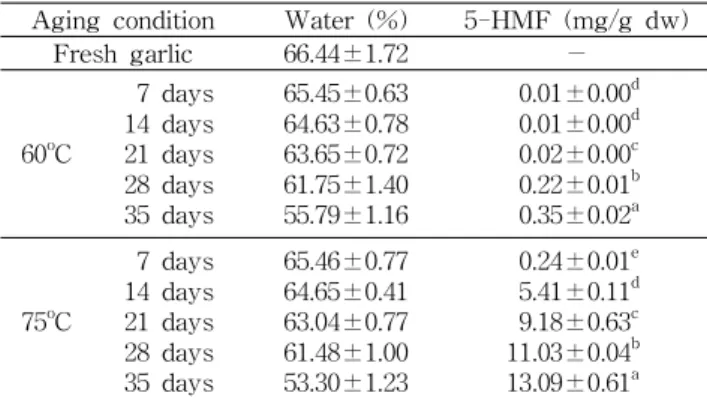
Table 2. Formation of 5-hydroxymethyl-2-furaldehyde (5- HMF) and moisture content of garlics according to the aging time and temperature
Aging condition Water (%) 5-HMF (mg/g dw)
Fresh garlic 66.44±1.72 -
60
oC
7 days 14 days 21 days 28 days 35 days
65.45±0.63 64.63±0.78 63.65±0.72 61.75±1.40 55.79±1.16
0.01±0.00
d0.01±0.00
d0.02±0.00
c0.22±0.01
b0.35±0.02
a75
oC
7 days 14 days 21 days 28 days 35 days
65.46±0.77 64.65±0.41 63.04±0.77 61.48±1.00 53.30±1.23
0.24±0.01
e5.41±0.11
d9.18±0.63
c11.03±0.04
b13.09±0.61
aResults are means±SD of triplicate data. Means within col- umns followed by the same letter are not significantly different at the 5% level by DMRT.
보는 바와 같이 주된 화합물의 peak가 HMF로 동정되었다.
HMF는 환원당과 아미노산을 함유하는 식품을 가공하거나 살균하는 과정에서 열처리에 의해 일어나는 일련의 비효소 적 갈색화 반응인 maillard 반응의 중간 산물로 알려져 있다 (13-16). 또한 이 물질은 과일즙, 벌꿀, 우유, 커피 등 다양한 식품들에서 저장 및 가공 중에 생성되는 것으로 알려져 있으 며(17-21), 최근 연구 보고에 의하면 HMF는 혈구성 빈혈 (sickle cell anemia)을 유발시키는 적혈구 세포의 겸상화를 억제하는 기능뿐 아니라(22), tyrosinase 활성을 억제하는 특성이 있기 때문에 피부 미백 효능을 갖는 화장품 성분으로 사용 가능하다는 연구결과도 보고되어 있다(23).
온도 및 숙성기간별 HMF 및 유리당 생성량 변화 온도별로 숙성시킨 마늘의 수분함량과 HMF의 생성량은 Table 2에서 보는 바와 같이 변하였다. 생마늘에 비하여 숙 성 21일차까지는 온도 조건에 관계없이 수분 감소률이 큰 차 이가 없었으나 28일차부터는 약 20% 정도 감소되었다.
마늘을 온도조건별로 습도를 유지하면서 일정기간 숙성 하였을 때 생성되는 HMF의 함량은 75
oC에서는 7일 이후부 터 급격히 증가하기 시작하였으며 28일차부터는 증가율이 둔화되긴 하였으나 35일차에는 13.09 mg/g dry weight까지 계속 증가하는 경향이었다. 그러나 60
oC에서는 HMF의 생 성은 거의 일어나지 않았으며, 28일차부터 생성되긴 하였으 나 35일차에도 0.35 mg/g dry weight로 그 양은 75
oC 조건에 비하여 매우 적었다. 그리고 숙성마늘의 흑색화 정도도 60
oC 에 비하여 75
oC에서는 매우 빠르게 진행되었다. 이로서 마늘 에서 HMF의 생성은 온도와 시간에 크게 영향을 받음을 알 수 있었다. Kwon 등(24)도 마늘을 고온고압처리 시간에 따 라 HMF 생성량이 영향을 받음을 보고한 바 있으며, 숙지황,
천문동, 진피 등 생약제의 제조 및 가공 처리 시에도 190
oC 정도의 고온에서 처리 시 HMF의 생성량이 최대로 증가하였 다는 보고도 있다(12,25,26).
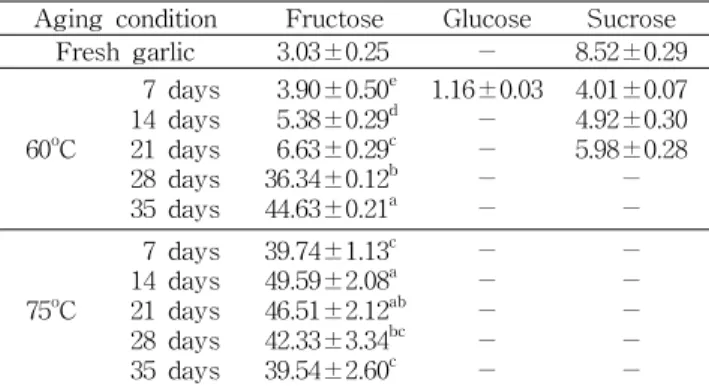
HMF의 생성은 당 화합물중 과당(fructose)이 탈수되어
생성된다. 따라서 마늘 중 유리당의 생성량을 조사해 본 결
과 Table 3에서 보는 바와 같이 75
oC에서 숙성된 마늘에서는
7일차부터 과당이 39.7% 정도 생성되기 시작하여 14일차에
49.6% 정도 생성됨을 볼 수 있었다. 그러나 이후 점차 과당
함량이 감소되는 것을 볼 수 있는데 이는 생성된 과당이
HMF로 변환된 것으로 추정된다. 그리고 60
oC에서는 21일
차까지 과당의 생성량이 6.6% 정도였으나 이후 28일 경에는
급속히 증가하여 35일경에는 44.6% 정도 생성되었다. 이로
써 마늘에서 HMF의 생성은 마늘 원래의 탄수화물이 고온
Table 3. Changes of free sugar contents of aged garlics de- pending on the aging time and temperature (%/dw)
Aging condition Fructose Glucose Sucrose Fresh garlic 3.03±0.25 - 8.52±0.29 60
oC
7 days 14 days 21 days 28 days 35 days
3.90±0.50
e5.38±0.29
d6.63±0.29
c36.34±0.12
b44.63±0.21
a1.16±0.03
- -
- -
4.01±0.07 4.92±0.30 5.98±0.28
- -
75
oC
7 days 14 days 21 days 28 days 35 days
39.74±1.13
c49.59±2.08
a46.51±2.12
ab42.33±3.34
bc39.54±2.60
c- -
- -
-
- -
- -
- Results are means±SD of triplicate data. Means within col- umns followed by the same letter are not significantly different at the 5% level by DMRT.
(75
oC)에서 과당으로 변환된 후 탈수반응을 거쳐 생성됨을 알 수 있었다. Antal 등(13)은 과당에서 HMF의 생성은 산 촉매 하에서 250
oC에서 최대로 생성된다 하였으며, Ni 등 (26)은 진피(
Aurantii nobilisPericarpium)를 190
oC에서 30 분간 roasting 처리하였을 때 HMF가 생성되었음을 확인하 고 최대 생산조건은 225
oC에서 30분간 처리하였을 때 함량 이 가장 높았다 하였다. LeBlanc 등(27)은 벌꿀과 과당함량 이 높은 옥수수 시럽을 가열하였을 때 HMF가 생성됨을 보 고하였고, Fan(28)은 탄수화물과 단당류 등을 열처리 및 pH 3으로 조절시 furan계 화합물의 생성이 증가함을 보고하였 다. Ameur 등(29)은 쿠키(cookies) 제조 시 설탕이나 포도당 에 비하여 과당 첨가와 굽는 온도가 200에서 300
oC로 높을수 록 HMF의 생성량이 증가하였음을 보고하였다. 또한 Kwon 등(24)은 마늘을 고온고압 처리 시 5-HMF의 함량은 110 및 120
oC에서는 변화가 작았지만 130
oC에서는 고온고압처 리 시간의 증가에 따라 급격한 증가를 보였고, 150
oC 2시간 에서 가장 높은 함량을 나타내었다고 하였다. 이로써 당 함 량이 높은 식품을 100
oC 이상의 고온에서 장시간 처리하면 HMF가 생성될 수 있음을 알 수 있다. 그러나 Table 2와 3에서 보는바와 같이 일반적인 maillard 반응이 일어나는 온도보다 낮은 온도인 75
oC에서 마늘의 탄수화물은 과당으 로 변환되었으며, 과당이 다시 HMF로 변환됨을 알 수 있었 다. Burdurlu과 Karadeniz(30)도 사과주스를 5
oC와 37
oC에 저장했을 때, 온도가 높을수록 저장기간에 비례하여 HMF의 생성량이 증가함을 보고하였다. 또한, Zhao 등(31)은 과당이 HMF로 변환되는 촉매제로서 metal halides가 매우 우수함 을 보고하였으며, Chun 등(32)은 참깨 뿌리 등 바이오촉매를 이용한 HMF 생산 가능성을 보고한 바 있다. 따라서 마늘 성분 중에서 금속이온의 종류와 함량이 과당의 생성과 HMF 의 변환에 미치는 영향은 추후 구명되어져야 할 과제이다.
요 약
생마늘을 온도별로 숙성시켰을 때 일어나는 물질의 생성
과 변화에 대하여 조사한 결과, 고온숙성 마늘(흑마늘)의 열 수 추출물에서 5-hydroxymethyl-2-furaldehyde(HMF)가 생성됨을 확인하였으며, HMF의 생성은 75
oC에서는 7일 이 후부터 급격히 증가하기 시작하였으며 35일차에는 13.09 mg/
g dry weight까지 계속 증가하는 경향이었다. 그러나 60
oC 에서는 HMF의 생성은 거의 억제되었으며, 28일차부터 생성 되긴 하였으나 35일차에도 0.35 mg/g dry weight로 그 양은 75
oC 조건에 비하여 매우 적었다. HMF의 생성은 당 화합물 중 과당(fructose)이 탈수되어 생성된다. 마늘 중 유리당의 생성량을 조사해 본 결과 75
oC에서 숙성된 마늘에서는 7일 차부터 과당이 39.7%/dw 정도 생성되기 시작하여 14일차에 49.6%/dw 정도 생성되었으나, 이후 과당 함량이 감소되는 것을 볼 수 있는데 이는 생성된 과당이 HMF로 변환된 것으 로 추정된다. 그리고 60
oC에서는 21일차까지 과당의 생성량 이 6.6%/dw 정도였으나 이후 28일 경에는 급속히 증가하여 35일경에는 44.6% 정도 생성되었다. 이로써 마늘에서 HMF 의 생성은 마늘 중의 탄수화물이 고온(75
oC)에서 과당으로 변환된 후 탈수반응을 거쳐 생성됨을 알 수 있었다.
감사의 글
본 연구는 농촌진흥청 15대 어젠다 연구개발사업(과제번 호: PJ0077142010)의 지원에 의하여 이루어진 것이며, 이에 감사드립니다.
문 헌