JOURNAL OF AGRICULTURAL SCIENCE
Vol. 37, No. 3, pp. 367-371, DECEMBER 2010, CHUNGNAM NATIONAL UNIVERSITY
Molecular Cloning and Characterization of cDNA Encoding Farnesyl Diphosphate Synthase in Garlic ( Allium sativum )
Pham Anh Tuan
1․ Nam Il Park
1․ Haeng Hoon Kim
2․ Sang Un Park
1*마늘의 Farnesyl Diphosphate Synthase 유전자 클로닝 및 분자생물학적 특성규명
Pham Anh Tuan
1․ 박남일
1․ 김행훈
2․ 박상언
1*ABSTRACT
Farnesyl diphosphate synthase (FPS) catalyzes the biosynthesis of farnesyl diphosphate, a precursor for many important terpenoid products. A cDNA encoding FPS was first isolated from Allium sativum (AsFPS) using rapid amplification of cDNA ends (RACE) PCR. The sequence of AsFPS contains an open reading frame encoding a protein of 341 amino acids with a predicted molecular mass of 39.61 kDa. Alignment of AsFPS deduced amino acid revealed high identities with other plants ranging from 79% to 85% and showed 2-high conserved aspartate-rich motifs known to be important for FPS activity.
Furthermore, AsFPS expression was stronger in the green organs such as bulbils, scapes, leaves, stems, but weaker in bulbs and roots than on-green organs of A. sativum.
Key words: Allium sativum, Farnesyl diphosphate synthase, Gene expression
Ⅰ. Introduction
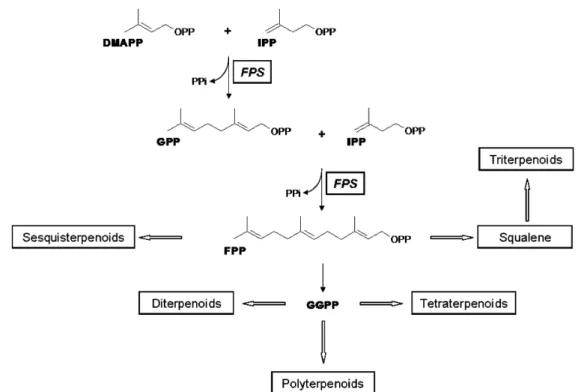
1)Terpenoids are the most abundant group of natural products including more than 30,000 known compounds (Lange et al., 2000). They not only play important roles as growth hormones, photosynthetic pigments, membrane component in plants but also useful in agriculture and medicine such as taxol (anti-tumor) and artemisinin (anti- malarial). Farnesyl diphosphate (FPP) serves as the precursor in the biosynthesis of many terpenoid products including sesquiterpenoids and squalene to produce triterpenoids (Fig.
1). FPP was synthesized by the condensations of two isopentenyl diphosphate (IPP) with dimethylallyl diphosphate (DMAPP) and the resulting gerany diphosphate (GPP).
These reactions are catalyzed by farnesyl diphosphate synthase (FPS) and considered to be rate-limiting steps in terpenoid biosynthesis (Cunillera et al., 1997; Croteau et al., 2000)). Because of its crucial function, FPS has been
1충남대학교 응용식물학과 (Department of Crop Science, Chungnam National University, 220 Gung-Dong, Yuseong-Gu, Daejeon 305-764, Korea)
2농촌진흥청 국립농업과학원 농업유전자원센터 (National Agrobiodiversity Center, National Academy of Agricultural Science, Rural Development Administration (RDA), 249 Suin-Ro Kweonseonku, Suwon 441-857, Korea)
* Corresponding author: 박상언(Sang Un Park) Tel.: +82-42-821-5730 Fax: +82-42-822-2631 E-mail: [email protected]
2010년 11월 17일 투고 2010년 12월 2일 심사완료 2010년 12월 13일 게재확정
extensively studied and isolated from various plants such as Arabidopsis thaliana (Delourme et al., 1994), Zea mays (Li and Larkins, 1996) and Artemisia annua (Hemmerlin et al., 2003).
Garlic (Allium sativum), a worldwide culinary plant, has been used for along time as a medicine against oxidant, microbial, inflammatory, heart diseases, and cancer (Bhagyalakshmi et al., 2005). Herein, the first cloning and characterization of cDNA encoding FPS (Genbank accession number: bankit 1409653) in garlic were reported.
Ⅱ. Materials and Methods 1. Materials
Garlic plants were grown in the field under natural conditions for 6 months. Plants materials were excised from mature plants and dissected into bulbils, scapes, leaves, stems, bulbs and roots.
2. RNA isolation
Total RNA was extracted separately using Plant Total
RNA Mini Kit (Geneaid, Taipei, Taiwan) and store at
-80℃ until use. The quality and concentration of total
extracted RNA were measured by agarose gel electrophoresis
and spectrophotometer analysis.
Fig. 1. Farnesyl diphosphate biosynthesis and its terpenoid derivatives. DMAPP, dimethylallyl diphosphate; IPP, isopentenyl diphosphate; PPi, inorganic diphosphate; GPP, gerany diphosphate; FPP, farnesyl diphosphate; GGPP, geranylgeranyl diphosphate; FPS, farnesyl diphosphate synthase.
3. Cloning of the cDNA encoding farnesyl diphosphate synthase
High quality total RNA was used to synthesize first- strand cDNA using GeneRacer Kit (Invitrogen, Carlsbad, CA), and a 10-fold dilution of the resulting cDNA was used as template for RACE PCR. Using information of 5’end of AsFPS from website (www.pestas.kribb.re.kr), gene specific primer AsFPS_3’ (5'-TGCATTGAATGGCTTCA GGCATA-3') was designed to get the 3'-end information.
3'-RACE PCR was performed follow the manufacture’s protocol. The 950 bp expected PCR product was purified and cloned into T-blunt vector (SolGent, Daejeon, Korea) for sequencing.
4. Sequence analysis
The obtained sequence was analyzed for homology using BLAST at the NCBI Genbank database. Sequencing alignments were carried out by Bioedit Phylodraw software, and phylogenic tree was constructed by the online website (www.phylogeny.fr).
5. Quantitative real-time PCR
Total RNA from different organs of garlic was adjusted
to the same concentration and reverse-transcribed using ReverTra Ace-α-kit (Toyobo, Osaka, Japan). Using the website (www.frodo.wi.mit.edu/primer3), real-time PCR primers specific to the coding sequence of AsFPS and the Actin gene of garlic (GenBank accession number:
AY821677) was designed. The nucleotides of these primers were as follows: AsFPS_F: 5'-TACCTGGAGGAAAGCT AAATCGAG-3', AsFPS_R: 5'- ATCATCAAGCACAAG GAAATATGC-3' and AsACTIN_F: 5'-TGTTTCCTAGT ATTGCTGGTAGA-3', AsACTIN_R: 5'- AGCTCGTTGT AGAAAGTGTGAT-3'. Real-time PCR reaction was carried out using SYBR Green Realtime PCR Master Mix Kit (Toyobo), and PCR products were analyzed using a MiniOpticon real-time PCR detection system (BioRad, Hercules, CA).
Ⅲ. Results and Discussions
1. Isolation of a cDNA encoding AsFPS in garlic
A FPS cDNA was first isolated from garlic using
RACE PCR. The full-length of AsFPS was 1263 bp in
length which including 5', 3' untranslated regions, a poly
A tail and a 1023 bp open reading frame (Fig. 2). The
open reading frame of AsFPS encodes a protein of 341
amino acids with a predicted molecular mass of 39.61
Fig. 2. The complete nucleotide and deduced amino acid sequence of AsFPS. Stop codon is denoted by an asterisk.
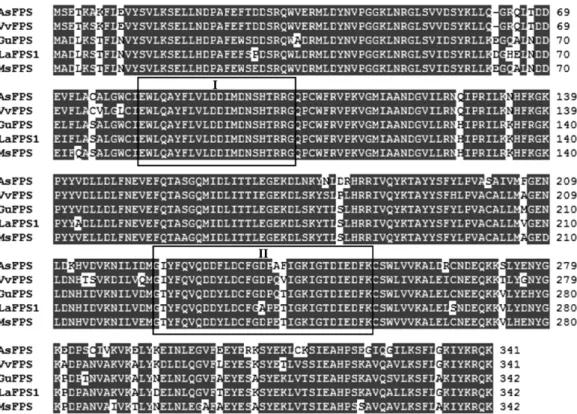
Fig. 3. Comparison of the deduced amino acid sequence of AsFPS from Allium sativum with other FPS sequences. The high conserved aspartate-rich motifs are present in domains I and II. VvFPS, Vitisvinifera (AY966012); GuFPS, Glycyrrhiza uralensis (GQ214505); LaFPS1, Lupinus albus (U15777); MsFPS, Medicago sativa (GU361537).
Sang Un Park: Molecular Cloning and Characterization of cDNA Encoding Farnesyl Diphosphate Synthase in Garlic (Allium sativum)
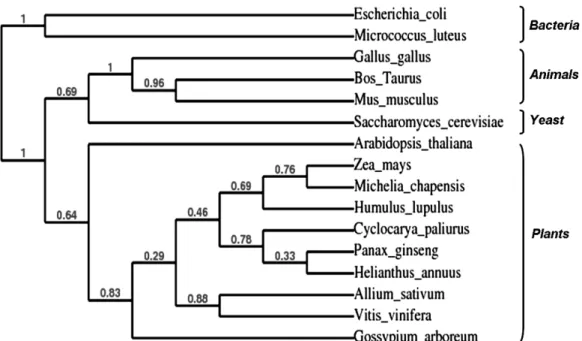
Fig. 4. Phylogenic tree analyses of FPSs from different organisms. Accession number: Escherichia coli, BAA00599; Micrococcus luteus, BAA25265; Gallus gallus, P08836; Bos taurus, AAL58886; Mus musculus, AAL09445; Saccharomyces cerevisiae, J05091; Arabidopsis thaliana, X75789; Zea mays, AY108110; Michelia chapensis, GQ214406; Humulus lupulus, AB053487;
Cyclocarya paliurus, GU121224; Panax ginseng, DQ087959; Helianthus annuus, AF019892; Vitis vinifera, AY966012;
Gossypium arboretum, Y12072.
kDa. A BLAST search on the amino acid level shows that AsFPS exhibited high homology to other FPS. AsFPS shares 85% identity and 92% similarity with Vitis vinifera FPS, 80% identity and 90% similarity with Glycyrrhiza uralensis FPS, 80% identity and 89% similarity with Lupinus albus FPS, 79% identity and 89% similarity with Medicago sativa FPS (Fig. 3). The high conserved aspartate-rich motifs known to be important for FPS activity were found in domain I and II (Chen et al., 1994). To clarify of the relationships, phylogenic tree was constructed between AsFPS and its homologs including bacteria, yeast, animals and plants (Fig. 4). As expected, AsFPS was closest to FPS from V. vinifera and belongs to the clade of the plant kingdom. In the phylogenic tree, the divergences of FPSs were seen between bacteria, yeast, animals and plants.
2. Characterization of A. sativum FPS
Expression of AsFPS was investigated in bulbils, scapes, leaves, stems, bulbs and roots of garlic by Real-time PCR. AsFPS is a constitutive gene and most abundant in bulbils where the relative quantity of transcription to Actin gene is 1.7 (RQ value) (Fig. 5). The RQ of scapes, leaves and stems are 0.85, 0.86 and 0.55, respectively. The transcriptions of AsFPS were low in bulbs (RQ 0.25) and roots (RQ 0.32). It was noticed that the expression of
Fig. 5. Relative quantities of AsFPS mRNA transcript in different organs of garlic. The values and the error bars indicated the average and the standard error from three independent reactions.
AsFPS in green organs was higher than that of non-green organs.
Ⅳ. Conclusion
In this paper, a cDNA encoding FPS from garlic was
isolated using RACE-PCR. The isolated sequence has
conserved motifs known as to be important for FPS
activity. The expression pattern of this gene showed higher
levels of gene expression in the green organs such as
bulbils, scapes, leaves and stem than those in non-green
organs like bulbs and roots. The isolation and expression
analysis of AsFPS might be helpful to understand terpenoids
Sang Un Park: Molecular Cloning and Characterization of cDNA Encoding Farnesyl Diphosphate Synthase in Garlic (Allium sativum)
biosynthesis at molecular level in garlic, which a daily food as well as a potential medicinal plant.
This work was supported by a grant (20080401- 034-060-009-03-00) from BioGreen 21 Program, RDA, Republic of Korea.
References
1. Bhagyalakshimi, N., R. Thimmaraju, L. Venkatachalam, K.N. Chidambara Murthy, R.V. Sreedhar. 2005. Applications of garlic and the intervention of biotechnology. Crit.
Rev. Food Sci. Nutr. 45: 607-621.
2. Chen, A., P.A. Kroon, C.D. Poulter. 1994. Isoprenyl diphosphate synthase: protein sequence comparisons, a phylogenetic tree and predictions of secondary structure.
Protein Sci. 3: 600-607.
3. Croteau, R., T.M. Kutchan, N.G. Lewis. 2000. Natural products (secondary metabolites). Biochemistry and Molecular Biology of Plants. edited by Buchanan, B.B., W. Gruissen, R.L. Jones. pp. 1251-1267.
4. Cunillera, N., A. Boronat, A. Ferrer. 1997. The Arabidopsis thaliana FPS1 gene generates a novel mRNA that encodes a mitochondrial farnesyl-diphosphate synthease isoform. J. Biol. Chem. 272: 15381-15388.
5. Delourme, D., F. Lacroute, F. Karst. 1994. Cloning of an Arabidopsis thaliana cDNA coding for farnesyl diphosphate synthase by functional complementation in yeast. Plant Mol. Biol. 26: 1867-1873.
6. Hemmerlin, A., S.B. Riera, H.K. Erickson, C.D. Poulter.
2003. Enzymes encoded by the farnesyl diphosphate synthase gene family in the big sagebrush Artemisia tridentata ssp. spiciformis. J. Biol. Chem. 278: 32132- 32140.
7. Lange, B.M., T. Rujan, W. Martin, R. Croteau. 2000.
Terpenoid biosynthesis: the evolution of two ancient and distinct pathways across genomes. Proc. Natl. Acad.
Sci. USA 97: 13172-13177.
8. Li, C.P., B.A. Larkins. 1996. Identification of a maize endosperm-specific cDNA encoding farnesyl pyrophosphate synthase. Gene 171: 193-196.