• 검색 결과가 없습니다.

Appearance Pattern of Figures in Commercial Domestic Hardwoods (I)

N/A
N/A
Protected

Academic year: 2021

Share "Appearance Pattern of Figures in Commercial Domestic Hardwoods (I)"

Copied!
8
0
0

로드 중.... (전체 텍스트 보기)

전체 글

(1)

*1 Received on March 10, 2010; accepted on May 15, 2010

*2 College of Design, Kangwon National University, Samcheock 245-711, Korea

*3 College of Forest and Environmental Sciences, Kangwon National University, Chuncheon 200-701, Korea

Corresponding author : Nam-Hun Kim (e-mail: [email protected])

Appearance Pattern of Figures

in Commercial Domestic Hardwoods (I)* 1

Byung-Ho Park*

2

, Sung-Min Kwon*

3

, Gu-Joong Kwon*

3

, Jae-Hyuk Jang*

3

, and Nam-Hun Kim*

3†

ABSTRACT

In this study, the figure of domestic hardwood was observed using the naked eye and the possibility of substituting imported wood with domestic one in the making woodcraft or furniture was investigated.

It was known from the investigation on 8 different hardwoods that there were various figures such as cloud-shaped figure, blister figure, crotch figure, bird’s eye figure, etc. in Zelkova serrata wood and the beautiful pigment figure in Diospyros Kaki wood. There were the unusual figures such as wavy grain fig- ure, fiddle back figure, etc. in Cedrela sinensis wood and was clear ray-fleck figure in Quercus variabilis wood. There were also various figures such as wavy grain figure, blister figure, pigment figure, etc. in Sophra japonica, Tilia amurensis, Castanea crenata, Kalopanax septemlobus wood, etc. It is thus that dis- tinguished figures appeared in each kind of wood can be used for craft, sculpture, furniture, and interior material. These kinds of figures can also be used for instrument, toy, stationery, life article material and souvenir, etc. And it can be expected that they will replace the imported wood has been mainly used to make the woodcraft or furniture until now.

Keywords : figure, hardwood, blister figure, pigment figure, fiddle back figure

1. INTRODUCTION

The figure means the all nature-shaped form appeared in three sections of wood, cross sec- tion, tangential section, and radial section. It ap- pears differently according to growth percentage gap between earlywood and latewood, dis- tribution or density of discoloration, several types of growth rings, injury by the internal/ex-

ternal effects of wood, etc. Furthermore it ap- pears variously in accordance with sawing method of wood.

The representative figure of wood appears

with combination growth ring and anatomical

characteristics. The most general types are the

figures caused by flat grain and edge grain. The

figure caused by flat grain appears in tangential

section by density of early/late wood and differ-

(2)

ence of color and the figure caused by edge grain appears in radial section by density of early/late wood, difference of color and ray.

There is the figure resemble to radial figure near to pith in tangential section and we call this bastard figure (Park et al., 1999).

In addition, there are many other types such as ribbon figure originated by interlocked grain, fiddle back figure or wavy grain figure origi- nated by wavy grain and blister figure, curly figure and bird’s eye figure caused by irregular uneven of growth layer in tangential section.

There are also silver figure or fleck figure caused by wide ray in radical section, burl figure origi- nated by lump whose tissue is partly and abnor- mally distended by injury and, stump wood fig- ure whose irregular form appears in the lower side or root part of wooden stem. And there is the spotted line figure, a kind of pigment figure generated by germ’s harm. This figure has very excellent decorative effects and is used to make wooden container or precious solid sculpture and shows ripple mark by storied sequence of cells in tangential section. In addition, there are cloud figure, uneven figure, ray-fleck figure, feather crotch figure, etc. Other several figures are reported by characteristic of section (Lincoln, 1999; Eom and Nam, 2005; Omae, 2007).

The supply of domestic wood has been grad- ually expanded in Korea. However, almost all of woods are imported from other countries.

Thus increasing Korean wood utilization can make a big difference to the wood-related industry. Especially, almost all precious woods which have excellent decorative characteristics for crafts material, furniture material, interior material have been imported until now. So it’s time to consider replacing them with domestic wood and study the possibility for this.

The value of wood is decided by several fac- tors such as size, processability, strength, abra-

sion resistance, specific gravity, shrinking and swelling, existence of abnormal tissue, color, texture of wood, grain of wood, figure, etc.

Especially, for crafts material or furniture mate- rial which emphasize decorative effects, color, figure, abrasion resistance, processability, wood surface is the most important factor.

In comparison with the research on evaluat- ing quality characteristic related with cell struc- ture and property of domestic wood till now, the research related with decoration and visual characteristic of wood surface falls relatively behind.

Therefore, in this study, the appearance pat- tern of figure which has decorative effects is in- vestigated using several domestic woods to pro- vide the basic reference which can give the in- formation of imported woods, make possible the comparison of craft characteristic of domestic hardwood of with imported imported woods, and eventually open the possibility of replacing imported woods with the domestic woods in a decorative purposed area.

2. MATERIALS and METHODS

2.1. Wood Specimen

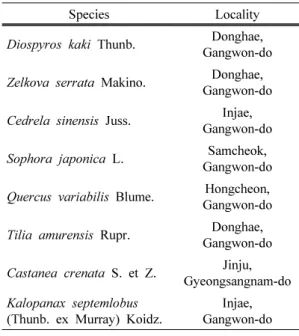
In this study, eight kinds of hardwoods grown in Korea were used, as shown in Table 1.

2.2. Figure Analysis

The wood surface figures in the tangential

section and radical section or the other sections

having various angle were analyzed. Comparison

of the wood surface figures with the examples

used for traditional wooden crafts and furniture

was made in the study.

(3)

Table 1. Sample trees

Species Locality

Diospyros kaki Thunb. Donghae, Gangwon-do Zelkova serrata Makino. Donghae,

Gangwon-do Cedrela sinensis Juss. Injae,

Gangwon-do

Sophora japonica L. Samcheok,

Gangwon-do Quercus variabilis Blume. Hongcheon, Gangwon-do Tilia amurensis Rupr. Donghae,

Gangwon-do Castanea crenata S. et Z. Jinju,

Gyeongsangnam-do Kalopanax septemlobus

(Thunb. ex Murray) Koidz.

Injae, Gangwon-do

(A) (B)

(C) (D)

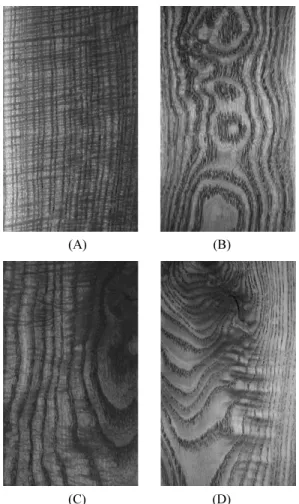
Fig. 1. Figures appeared on the radial section (A) and tangential section (B, C, D) of Dispyros kaki wood.

3. RESULTS and DISCUSSION

3.1. Diospyros kaki Wood

Diospyros kaki wood has an unique charac- teristic that differentiating between heartwood and sapwood with the naked eyes is quite diffi- cult, has a little red light grey color, and occa- sionally has the heartwood that shows black line or partial black. Also, annual ring is not clearly shown, texture of wood shows the detailed shapes, grain of wood is not clearly shown, and ripple mark can be occasionally shown in tan- gential section distinctively (Park et al., 1981).

It is used for board material of high-quality fur- niture (Lee, 2001a).

Fig. 1 is the figure of Dispyros kaki’ wood which shows various types of pigment figures (A, B, C). Heartwood is normally black and its hardness is pretty high. The pigment figure is generally formed when the abnormal pigment is deposited in wood and the pigment figure is re- ported to be shown in Red gum, Black walnut,

Zebra wood, etc (Lee, 2001b). In addition, the pigment figure-resembled figure (D) is supposed to be generated by the trespassing of germ.

3.2. Zelkova serrata Wood

Zelkova serrata wood can be clearly divided

into yellowish brown-heartwood and light yel-

lowish brown-sapwood. And the age can be

read clearly and texture of wood is tough (Park,

et al., 1981). The wood is usually yellowish and

lustrous. In case of dead tree, its color is red

(4)

(A) (B) (C) (D)

(E) (F) (G) (H)

(I) (J) (K)

Fig. 2. Figures appeared on the tangential section (A, B, C, D, J, K) and radial section (E, F, G, H, I) of Zelkova serrata wood.

purple so it is valuable for the high quality lumber. Because of hardness, heavy weight and good pattern grain, it is used widely for furni-

ture, cosmetic, sculpture materials (Lee, 2001a).

There are various uses of Zelkova serrata wood

such as sculpture material for making the statue

(5)

(A) (B)

(C) (D)

Fig. 3. Figures appeared on the radial section (A) and tangential section (B, C, D) of Cedrela sinensis wood.

of the Buddha (Lee, 1995).

There are various figures by the wood sur- face of Zelkova serrata. The cloud-shaped fig- ure (Fig. 2 A, B, C) is occasionally observed in tangential section of Zelkova serrata and gen- erated by uneven wood surface. It had the rag- ged form and a little gentle figure (Fig. 2 D, E, F) was observed which appeared in the area near to the root of Zelkova serrata wood mainly and judged as the blister figure (Fig. 2. D, E) When processed radial section and tangential section with wood lathe, the unusual figure was formed which had craft value in beautiful sight, as shown in the G, H of Fig. 2. And the feather figure appeared in the section of branches was clearly observed. (Fig. 2 I) The feather figure has high esthetic value and been used widely by attaching each other for bilateral symmetry (Lee, 2001b). The figures (J) of Fig. 2 were due to the color-difference between heartwood and sapwood of Zelkova serrata and bird’s eye fig- ure (K) respectively.

3.3. Cedrela sinensis Wood

Cedrela sinensis wood can be divided into reddish brown heartwood and yellowish white sapwood clearly. The age can be read clearly, the texture of wood is coarse, and particular luster is shown (Park et al., 1981). The wood is heavy and hard so it was used a little for furni- ture material. But because it isn’t chapped un- der the blazing sunlight, it is used to make agri- cultural equipment and used as mast or oar of the vessel. The reason for that is that it grows rightly and quickly so the grain is huge but it's detailed and driven a nail well (Lee, 2001a).

Fig. 3 is the picture of Cedrela sinensis’ figure.

The wavy grain figure (A) developed well in radial section was observed. Also, in tangential section, blister figure (B), fleck figure (B) and fiddle back figure (D) were observed.

3.4. Sophora japonica Wood

Sophora japonica wood can be divided into yellowish white sapwood and dark brown heartwood. And the growth ring is clear, texture of wood is mostly coarse, and grain is straight.

The uses of the wood are architecture, furniture, tool, instrument and sculpture material (Jo et al., 1998). Also, it is used for furniture material (Lee in 2001a).

There was the pigment figure and the uneven

sawtooth-shaped figure in tangential section

(6)

(A) (B)

Fig. 4. Figures appeared on the tangential section (A, B) of Sophora japonica wood.

(A) (B)

(C) (D)

Fig. 5. Figures appeared on the radial section (A, B, C) and tangential section (D) of in Quercus variabilis wood.

(Fig. 4). The blister figure was frequently ob- served (A, B). The blister figure is occasionally observed in tangential section. It is known that it appeared clearly in maple, birch, etc. It gives uneven or blister cubic effect to the wood sur- face (Lee, 2001b).

3.5. Quercus variabilis Wood

Quercus variabilis wood has the clear growth ring and a little bit indefinite difference between pink graybrown heartwood and graybrown sapwood. The texture of wood is course and grain is straight. The wood is used to fancy ve- neer, furniture, architecture, tool, pulp, cultivat- ing mushroom, charcoal, etc. (Jung and Park, 2008).

Fig. 5 shows the picture of Quercus variabilis wood surface. The ray-fleck figure of Quercus variabilis wood was observed (A, B). This is the case that rays of radial section show regular gap and direction over the growth-ring and the figure of object is formed. The wood which has wide rays shows ribbon figure in wood surface irregularly. This is known as beautiful figure used for the esthetic purpose in furniture materi-

al, etc. (Lee, 2001b). In addition, unusual pig- ment figure generated by trespassing of germ was observed (C, D).

3.6. Tilia amurensis Wood

Tilia amurensis wood has a little indifference

between light yellowish brown heartwood and

light yellowish white sapwood. And the width

is wide and the texture of wood is detailed

(Park et al., 1981). The quality of this kind is

soft and it isn’t chapped so it is mostly used as

(7)

(A) (B)

Fig. 6. Figures appeared on the radial section (A) and tangential section (B) of Tilia amurensis wood.

(A) (B)

Fig. 7. Figures appeared on the tangential section (A, B) of Castanea crenata wood.

board, honey-cake mold or sculpture material.

This is soft so cannot be used for architecture material (Lee, 2001a).

Fig. 6 is the picture of Tilia amurensis wood in radial section and tangential section. And wa- vy grain figure is observed in the both sections (A, B). Especially, the wavy grain figure was observed very clearly in tangential section. This is frequently shown in maple, mahogany, etc.

(Lee, 2001b).

3.7. Castanea crenata Wood

Castanea crenata wood has clear differentiation between brown heartwood and sapwood. The growth-ring is clear and texture of wood is coarse (Park et al., 1981). The wood has high hardness, great elasticity and good sense of driving so it is greatly used for railroad tie, all kinds of tool, furniture material, architecture material, etc. (Lee, 1995).

Fig. 7 is the figure of Castanea crenata wood.

The unusual pigment figure was observed by the pigment deposited irregularly at surround- ings of knot in tangential section (A). In addi- tion, the pigment feature (B) appeared by the

trespassing of germ was observed in the part of sapwood. And in the around of knot, wavy grain figure was observed weakly (A, B).

3.8. Kalopanax septemlobus Wood Kalopanax septemlobus wood is difficult to gain as lumber so used to make board or goods (Lee, 2001a). It is used to architecture, pattern board, tool, furniture, sculpture materials. Especially, the grain of wood is beautiful so it is used for wooden lacquerware material.

Fig. 8 is the figure of Kalopanax septemlobus wood and in tangential section, blister figure and partially wavy grain figure were observed (A, B, C, D). There was pigment figure which was supposed to be generated by trespassing of germ (B).

4. CONCLUSIONS

The figures in the 8 kinds of domestic hard-

wood were investigated, Zelkova serrata wood

showed various figures the most. There was unique

and beautiful pigment figures in Diospyrospyaki

wood. In Quercus variabilis and Cedrria sinsi-

(8)

(A) (B)

(C) (D)

Fig. 8. Figures appeared on the tangential section (A, B, C, D) of Kalopanax septemlobus wood.

nis wood, there are also unique beautiful figures respectively. Especially, in Zelkova serrata wood, there are various special shaped figures so it can be used for making the industrial woodcraft or interior decoration. It is expected that the fig- ure showed in tangential section and radial sec- tion of Edrria sinsinis wood can be used in sev- eral applications and widen its usage with do-

mestic wood. Various figures in Sophora japon- ica, Tilia amurensis, Castanea crenata, Kalopanax septemlobus can be applied to make toy, life ar- ticle, souvenir material as well as woodcraft and furniture material.

Since the domestic hardwoods from the result of this study have various beautiful figures, they can be applied to make woodcraft or furniture in the future. It is thus considered that domestic hardwoods having various beautiful figures can replace considerable amount of the imported woods that have been used when making the woodcraft or furniture.

REFERENCES

1. Kim, T. W. 1994. The Woody Plants of korea.

Kyo-Hak Publishing Co. pp. 399.

2. Park, S. J., W. Y. Lee, and W. H. Lee. 1999.

Tissue and identification of wood. Hyang Mun sa. pp. 49 ∼54.

3. Park, Y. G. 1982. Korea Furniture. Sam-Sung Publishing Co. pp. 328∼332.

4. Eom, Y. G. and S. H. Nam. 2005. Good wood Handbook. Translation The Korea Wood News- papers. pp. 89 ∼93.

5. Lee, Y. M. 1995. 100 Korean Trees. hueon am sa. pp. 121∼495.

6. Lee. J. S. 2001. Wood and Lacquer Art of Korea. youl hwa dang. pp. 149∼158.

7. Jung, S. H. and B. S. Park. 2008. Wood Properties The useful Tree Species Grown in Korea. Korea Foerst Research Institute.

8. Jo, J. M., S. K. Kang, N. J. Huh, and S. J. Park.

1998. Illustrated World Wood. Sunjinmunhwasa.

p. 57.

9. Lincoln, W. A. 1999. World woods in color. Linden Publishing Inc. p. 288∼291.

10. Omae, M. 2007. Grain. Bijutsu shuppan-sha.

수치

Fig. 1. Figures appeared on the radial section (A)  and tangential section (B, C, D) of Dispyros  kaki wood.
Fig. 2. Figures appeared on the tangential section (A, B, C, D, J, K) and radial section (E, F, G, H, I) of Zelkova serrata wood.
Fig. 3. Figures appeared on the radial section (A)  and tangential section (B, C, D) of Cedrela  sinensis wood.
Fig. 4. Figures appeared on the tangential section (A,  B) of Sophora japonica wood.
+3

참조

관련 문서

A and E, In control group, a small amount of new bone was observed at the margin of bone defect (40×); B and F, In experimental group 1, a large amount of new bone was formed

As a result of the study, it was confirmed that only human resource competency had a positive(+) effect on the intercompany cooperation method of IT SMEs,

Thirdly, it appeared that social support had meaningful effect on self-efficacy and the quality of life, and in the case of the difference analysis by

The expression of reporter genes driven by the ZAT1 promoter was observed in the tissues undergoing maturation such as border cell of root cap, endodermis,

The index is calculated with the latest 5-year auction data of 400 selected Classic, Modern, and Contemporary Chinese painting artists from major auction houses..

A frame size error in a frame that could alter the state of the entire connection MUST be treated as a connection error (Section 5.4.1); this includes any frame carrying a

The “Asset Allocation” portfolio assumes the following weights: 25% in the S&P 500, 10% in the Russell 2000, 15% in the MSCI EAFE, 5% in the MSCI EME, 25% in the

1 John Owen, Justification by Faith Alone, in The Works of John Owen, ed. John Bolt, trans. Scott Clark, "Do This and Live: Christ's Active Obedience as the