코발트기 초내열합금 ECY768의 고온 저주기피로 거동
양호영․김재훈 † ․하재석․유근봉 * ․이기천 **
충남대학교 기계설계공학과⋅
*
한국전력연구원⋅**
한국기계연구원 (2012. 9. 6. 접수 / 2013. 5. 23. 채택)Low Cycle Fatigue Behavior of
Cobalt-Base Superalloy ECY768 at Elevated Temperature
Ho-Young Yang․Jae-Hoon Kim † ․Jae-Suk Ha․Keun-Bong Yoo * ․Gi-Chun Lee **
Department of Mechanical Design Engineering, Chungnam National University
*
Power Generation Laboratory, Korea Electric Power Research Institute**
Reliability Assessment Center, Korea Institute of Machinery and Materials (Received September 6, 2012 / Accepted May 23, 2013)Abstract : The Co-base super heat resisting alloy ECY768 is employed in gas turbine because of its high temperature strength and oxidation resistance. The prediction of fatigue life for superalloy is important for improving the efficiency. In this paper, low cycle fatigue tests are performed as variables of total strain range and temperature. The relations between strain energy density and number of cycle to failure are examined in order to predict the low cycle fatigue life of ECY768 super alloy. The lives predicted by strain energy methods are found to coincide with experimental data and results obtained from the Coffin-Manson method. The fatigue lives is evaluated using predicted by Coffin-Manson method and strain energy methods is compared with the measured fatigue lives at different temperatures. The microstructure observing was performed for how affect able to low-cycle fatigue life by increasing the temperature.
Key Words : low cycle fatigue, co-based superalloy, strain energy method, elevated temperature
†
Corresponding Author: Jae Hoon Kim , Tel : +82-42-821-6645, E-mail : [email protected]
Department of Mechanical Design Engineering, Chungnam National University. 99 , Daehak-ro, Yuseong-gu, Daejon 305-764, Korea
1. 서 론
코발트기 초내열합금은 고온강도, 크리프 및 피로 저항 성, 내산화성, 그리고 내부식성이 우수한 초내열합금으로 터 빈블레이드, 항공기의 제트 엔진부품 재료로 널리 이용되고 있다. ECY768은 가스터빈의 터빈 블레이드로 사용되는 초내열합금으로 고온에서 크리프와 피로의 복합적 손상을 받게 되며, 이 중 저주기 피로손상은 매우 중요한 손상원 인으로 알려져 있다
1,2)
.저주기 피로에 대한 연구는 Coffin과 Manson이 피로손상 중 발생하는 반복 소성 변형률에 대한 중요성을 인식하고, 이를 정리하여 Coffin-Manson법을 만든 것을 시초로 그 후 반복 소성 변형률과 피로수명의 관계에 대한 체계적인 연 구가 수행되어 왔다
3,4)
. 일반적으로 높은 변형률 하에서 피로 손상은 반복 소성변형률에 의하여 발생하며 회복되지 않은 소성변형률은 변형에너지를 소비하므로 소성변형에 너지는 손상과정에서 중요한 역할을 하게 된다. 다양한 연 구로 소성변형에너지를 이용하여 피로수명을 예측하는 개 념이 제시되었고5)
, 이를 기초로 하여 소성변형에너지 손 상법칙을 기초로 피로파손 기준이 제안되었다6-8).
본 연구에서는 가스터빈의 효율 증대를 위해 피로수명
을 미리 예측함으로써 사고 및 경제적 손실을 예방하고 독 자적 기술 개발을 목표로 ECY768 소재에 대하여 상온 및 고온 저주기 피로 시험을 수행 하였다. 또한 저주기 피로수 명을 예측하기 위하여 저주기 피로시험 결과를 Coffin- Manson법, 소성변형률에너지법 및 전변형률 에너지법을 이용하여 비교 분석 하였다. 또한 저주기피로손상 파면은 SEM을 이용하여 관찰하였다.
2. 재료 및 시험 방법
본 연구에서 사용된 재료는 가스터빈 블레이드용 소재 인 ECY768이다. 시험편은 원소재를 정밀 주조 몰드를 이 용하여 ASTM E 606에 준하여 Fig. 1과 같은 피로시편으 로 가공하였다. Table 1은 ECY768의 화학조성을 나타내고 있다. Table 2는 MTS 810 (10 ton) 유압식 만능재료시험기를 이용하여 인장시험 결과 얻은 기계적 성질이다.
시험에 사용한 피로시험장비는 전기식 피로시험기인 INSTRON 8861로 최대 용량은 3.5톤이며, 상온 및 870, 927
o
C에서 시 험을 수행하였다. 시험편의 평행부에 12.5 mm 변위측정기 (extensometer)를 부착하여 변형률 제어 방식으로 시험을 수 행하였다. 파형은 가스터빈의 기동정지를 고려한 TrapezoidFig. 1. Dimension of specimen.
Table 1. Chemical compositions of ECY768(wt%).
C Ni Cr W Al Ta Ti Fe Co
0.57 10.66 23.1 7.04 0.21 3.51 0.17 0.47 Bal
Table 2. Mechanical properties for ECY768.
Young's modulus
(GPa) Yield strength
(MPa) Tensile strength
(MPa) Elongation
(%) Reduction of Area(%)
189.78 499.38 719.93 1.99 3.72
파형으로 인장-유지-압축-유지를 각각 1초로 하여 주파수 0.25 Hz로 일정하게하고, 전 변형률진폭이 0.6~1.6% 하에 서 저주기 피로시험을 수행하였다.
피로수명은 가스터빈 블레이드의 실제 설계조건에 적용 되는 25% 하중 감소시점으로 하였다.
3. 변형률 에너지법
저주기 피로시험 동안 발생하는 소성변형에너지는 대부 분 열로 소비되고, 나머지는 재료에 흡수된다. 따라서 피로 손상은 주기적 소성 변형률에 의하여 발생하며, 소성변형에 너지는 균열의 진전에 중요한 역할을 하게 된다. 사이클 당 소성변형에너지, ΔWp는 Massing 형태의 재료 거동을 보 이는 경우 Fig. 2와 같은 히스테리시스 선도(hysteresis loop) 의 면적과 같다. 본 연구에 사용한 ECY768의 경우, 안정 화된 수명 사이클인 반 수명(half cycle)에서 반복적인 히 스테리시스 선도를 관찰한 결과 대칭 되는 거동을 보이고 있어 본 이론을 적용하는데 적합함을 알 수 있었다. 소비 되는 총 에너지는 히스테리시스 선도의 면적의 합으로 나 타낼 수 있으며, 재료에 따라 에너지를 흡수할 수 있는 일 정용량을 가지고 있어 이 한계치에 도달하면 재료는 파손된
Fig. 2. Definition of plastic and elastic strain energy density.
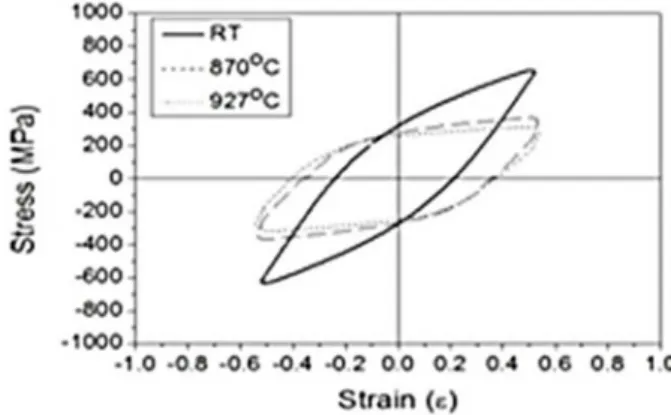
Fig. 3. Hysteresis loop for Δε=1.0%.
다. Fig. 3와 같이 재료가 피로하중을 받게 되어 한 사이 클당 소비되는 소성변형에너지는 아래의 식과 같이 나타낼 수 있다
5,9,10)
.
(1)
식 (1)에 식 (2)와 같은 경계조건을 대입하여 다시 정리 하면, 식 (3)과 같다.
(2)
(3)
Morrow는 응력-변형률 관계가 식(4)와 같은 power low 를 따른다고 가정을 하여,
″ ″ (4)
″
″ (5)
식 (5)를 (3)에 넣어 대입하면,
″
″
(6)
이다. 여기서,
″
을 응력-변형률 관계의 경화지수n'
과 같다고 가정하고,
″
′ (7)
이므로, 식 (8)과 같은 소성변형에너지식을 얻을 수 있다.
″ ′ ′
′
′
′
(8)
(a) R.T. (b) 870℃ (c) 927℃
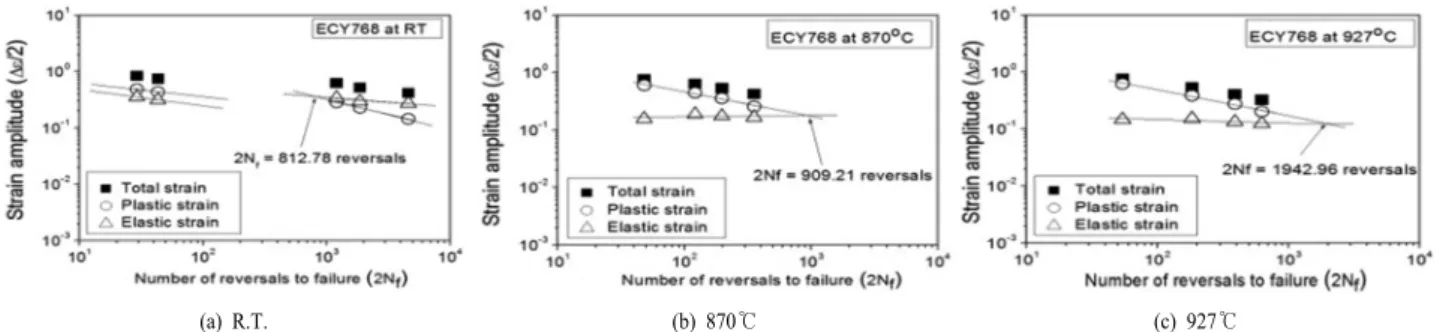
Fig. 5. Relationship of strain-life curves at various temperatures.
따라서 식 (8)의 소성변형에너지를 이용한 재료의 저주 기 피로 수명 예측식은 식 (9)와 같다.
(9)
여기서,
는 파단수명의 1/2사이클에서 소성변형에너 지량이며,
는 파단까지의 반복사이클(cycle to failure)이고, A와 m은 실험상수이다. 그런데 소성변형에너지법을 적용 시 반복하중에 의한 변형률 진폭이 작아질수록 소성변형률 진폭도 작아지므로 소성변형률 에너지밀도는 매우 작고 이 를 측정하는 것은 어려워진다. 이러한 이유로 전 수명영역 에서의 변형률에너지 밀도를 피로손상변수로 사용하기 위 하여 Fig. 3와 같이 히스테리시스 선도의 탄성 변형률에너지 (elastic strain energy)의 합으로 표현되는 전변형률에너지 밀도 (total strain energy density),
를 다음과 같이 표현하였다11,12)
.
(10)
여기서,
는 다음과 같은 식을 이용하여 계산할 수 있 다(11,12).
m axfor
m i n≤
m ax
m i n
for
m i n
(11)
즉, 총변형률 에너지 밀도,
는 식 (8)과 식 (11)에 의하여 R=-1인 경우 다음과 같이 정의된다.
″ ′ ′
′
′
′
max
(12)
식 (12)를 이용한 전변형률에너지법에 의한 피로 수명 식은 식 (13)과 같다.
(13)
4. 시험결과 및 고찰
4.1.
온도가 피로수명에 미치는 영향Fig. 3는 총 변형률 범위가 1.0%의 파단수명의 1/2 사이
Fig. 4. Variation of stress range during fatigue life for Δε=1.0%.
클의 상온 및 고온 저 사이클 피로 시험의 이력곡선을 나 타낸다. 온도가 증가함에 따라서 소성 변형량은 증가하고, 응력 폭은 감소하는 경향을 보인다. 상온의 경우 유지시 간(hold time)에 대한 영향이 거의 나타나지 않은 반면 870℃나 927℃에서는 유지시간동안 크리프 효과로 인해 응력이 시간에 따라 감소하는 응력 완화(stress relaxation) 가 발생하며, 이력곡선 내부 면적이 넓어지며 소성변형에 너지가 증가하게 된다. Fig. 4은 총변형률 범위가 1.0%의 실험에서 나타난 온도별 피로수명과 응력범위
의 변 화를 나타낸다. 온도가 증가함에 따라서 피로수명이 감소 하였으며, 응력범위의 변화는 사이클이 진행될수록 응력진 폭이 감소하는 피로연화(cyclic softening) 경향을 보인다. 이 것은 재료 내부의 성질이 전위의 이동이 쉬워지는 방향으로 변하게 되는 것이다.4.2. Coffin-Manson
법,
소성 변형률 및 전 변형률 에너지 법에 의한 피로수명 예측Fig. 5은 변형률-수명 선도 및 Coffin-Manson식의 파라미 터를 구하기 위한 탄성변형률-수명 선도, 소성변형률-수명 선도를 각각의 온도별로 나타낸 결과이다. ECY768의 경우 천이수명은 상온에서 812.78 reversals이고, 870
o
C에서 909.21 reversals 그리고 927o
C에서 1942.96 reversals로 상온에서 고 온으로 갈수록 천이수명이 길어지는 것을 알 수 있다.Fig. 6는 시험편의 파단까지의 반복 사이클수와 소성변형
(a) R.T. (b) 870℃ (c) 927℃
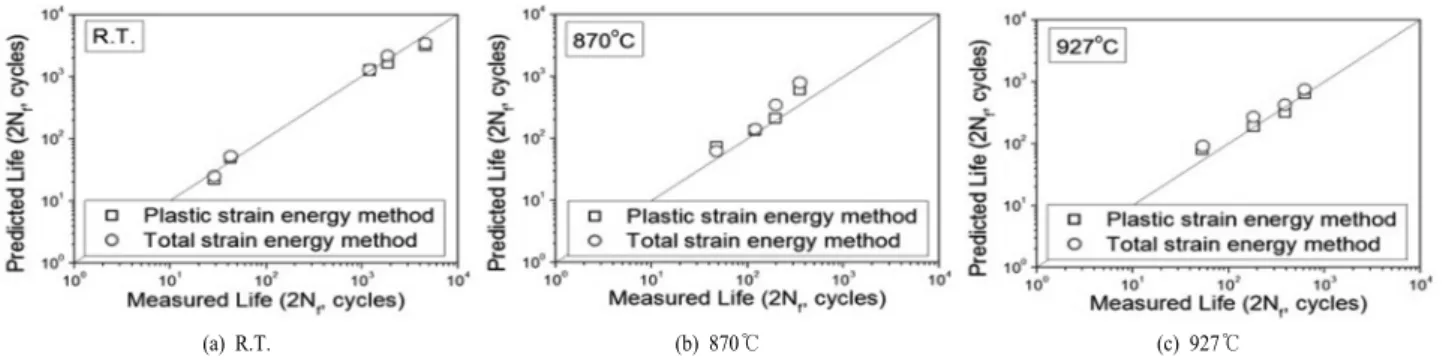
Fig. 9. Comparison between measured life and predicted life.
에너지량과의 관계를 나타낸 결과이며, Fig. 7은 시험편의 파단까지의 반복 사이클수와 전변형률 에너지량과의 관계 를 나타낸 결과이다.
Fig. 6과 7의 변형률에너지법 관계를 양 로그 좌표를 이 용하여 이 결과를 도시하면 선형으로 데이터가 분포하고, 이 들의 관계를 선형최소자승법을 이용하여 계산하여 정리 하면 Table 3과 같다.
Table 3은 각각 Fig. 7와 8의 소성변형률 에너지법과 전 변형률에너지법을 계산하여 나타낸 식이다. 상온의 경우
<1.2%에서는 고온보다 우수한 피로 수명을 갖지만,
>1.2%에서는 고온의 피로 수명과 유사한 경향을 보인다. 이
Fig. 6. Plastic strain energy versus cycles to failure of ECY768 at various temperatures.
Fig. 7. Total strain energy versus cycles to failure of ECY768 at various temperatures.
Fig. 8. Comparison between measured Mar M509 and ECY768.
Table 3. Equation of calculated results by plastic and total strain energy density.
Temp. (
oC) Plastic strain energy density Total strain energy density R.T. <1.2%
>1.2%
870℃
927℃
는 소재가 가진 특성으로 화학적 조성이 거의 유사한 MAR M50913)와 ECY768의 결과를 비교해본 결과 유사한 경향 을 보이는 것으로 나타나 소재가 가지고 있는 특성임을 알 수 있다.
Fig. 9는 실험수명과 이론을 통해 예측한 수명을 비교해 본 결과 잘 일치하여 수명 예측에 적용가능성을 확인했다.
4.3.
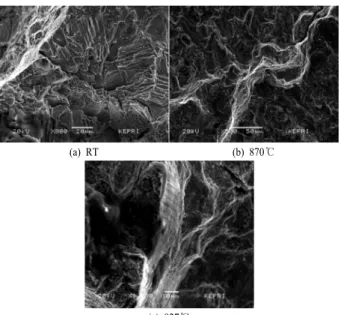
저주기 피로 파단면 특성Fig. 10은 ECY768의 저주기 피로 시험파면 사진을 총 변 형률 범위가 1.2%에서의 각 온도별로 정리한 사진이다. (a) 상온에서 입계파괴와 취성의 Cleavage 파단을 나타낸다. 고 온에서의 시험 결과인 (b)와 (c)는 고온 시험을 통해 산화된 표면에서부터 균열 진전의 스트라이에이션이 관찰되었다. 고온 시험은 표면과 접하고 있는 입계나 반복 변형 시 생기 는 intrusion과 extrusion에 취약한 산화 막을 형성된 부분 에서 피로 균열이 쉽게 생성되어 입내로 뚫고 들어가게 되 어 피로 수명이 감소된다.
(a) RT (b) 870℃
(c) 927℃
Fig. 10. SEM images from fracture surfaces for total strain of 1.2%.
5. 결 론
본 논문에서는 초내열합금 ECY768에 대하여 상온 및 고온 저주기피로시험을 수행한 결론은 다음과 같다.
1) 피로 수명은 상온에서 고온으로 갈수록 낮아지고 초기 경화현상 이후 연화현상을 거쳐 파단을 하게 된다.
2) 상온은
<1.2%인 경우 우수한 수명을 보였지만
>1.2%에서는 고온과 비슷한 수준의 피로 수명을 갖게 된다.
3) 소성변형률 에너지법으로 예측된 수명과 시험수명을 비교해본 결과 잘 일치된다.
4) SEM을 통하여 관찰한 결과 고온시험은 내부 균열 진전의 스트라이에이션이 발견되며 임계치에 도달되면 파 괴되고 있다.
감사의 글: 본 연구는 전력연구원의 연구비 지원으로 수행되었으며, 이에 깊은 감사를 드립니다.
References
1) B. Tomkins, “Creep and Fatigue in High Temperature Alloys”, J. Bresers(Ed.), Applied Science Pub., 1981.
2) J. C. Runkle and R. M. Pellous, “Fatigue Mechanisms”, ASTM STP 675. 1978.
3) J. Polak, “Cyclic Plasticity and Low Cycle Fatigue Life of Metals”, Elsevier., 1991.
4) J. A. Bannantine, J. A. Comer and J. L. Handrock, “Funda- mentals of Metal Fatigue Analysis”, Prentice Hall. 1990.
5) C. E. Feltner and J. D. Morrow, “Micro Plastic Strain Hys- teresis Energy as a criterion for Fatigue Fracture,” Journal of Basic Engineering, Vol. 1, No. 1, pp. 15-22, 1961.
6) F. Ellyin and D. Kujawski, “Plastic strain Energy in Fatigue Failure,” Transactions of ASME, Journal of Pressure Vessel Technology, Vol. 106, No. 4, pp. 342-347, 1984,
7) D. Lefebvre and F. Ellyin, “Cyclic Response and Inelastic Strain Energy in Low Cycle Fatigue,” International Journal of Fatigue, Vol. 6, No. 1, pp. 9-15, 1984.
8) F. Ellyin, “Effect of Tensile Mean Strain on Plastic Strain Energy and Cyclic Response,” Journal of Engineering Mate- rials and Technology, Vol. 107, pp. 119-125, 1985.
9) G. R. Halford, “The Energy Required for Fatigue,” Jorunal of Materials, Vol. 1, No. 1, pp. 3-18, 1966.
10) J. D. Morrow, “Cyclic Plasticity Strain Energy and Fatigue of Metals,” Internal Friction, Damping and Cyclic Plasticity, ASTM STP 378, pp. 45-87, 1965.
11) F. Ellyin and D. Kujawski, “The Energy-Based Fatigue Failure Criterion,” Microstructure and Mechanical Behaviour of Materials, Vol. 2, pp. 541-600, 1986.
12) K. Golos and F. Ellyin, “A Total Strain Energy Density Theory for Cumulative Fatigue Damage,” Transactions of ASME, Jour- nal of Pressure Vessel Technology, Vol. 110, pp.36-41, 1988.
13) D. W. Gandy, “Gas Turbine Superalloy Materials Property Handbook For Stationary Parts and Discs,” Hillview Avenue, Palo Alto, California, 2002.