Importance of relationship quality and communication on foodservice for the elderly
Sunhee Seo
1§, Ki Joon Back
2and Carol W. Shanklin
31
Department of Nutritional Sciences & Food Management, Ewha Womans University, 305 Human Ecology Building, Ewha Womans University, Seoul 120-750, Korea
2
University of Houston, 229 C N. Hilton Hotel and College Houston, TX 77204-3028, USA
3
Department of Hospitality Management and Dietetics, Kansas State University, 103 Fairchild, Manhattan KS 66506-1103, USA
Abstract
In order to promote foodservice for the elderly, foodservice managers in Continuing Care Retirement Communities (CCRCs) must identify the main factors to enhance the satisfaction and behavioral intentions with food service. The purpose of this study was to investigate the relationships between relationship quality (consisting of trust, commitment, and satisfaction) and communication in the formation of elderly’s behavioral intentions with food services at CCRCs. A survey was administered to residents in two CCRCs and a total of 327 residents participated. A tested structural equation model exhibited good model fit and explanatory power of the study construct. Satisfaction directly influenced word-of-mouth and service quality has an influence on commitment. Commitment was a significant determinant of behavioral intentions to eat more often in the dining room.
Also, communication showed positive association with trust. The results provided strong evidence for the importance of satisfaction and communication as a consequence of relationship marketing efforts. Suggestions for future research to better understand the elderly’ behavioral intention judgments were given.
Key Words: Elderly, food service, satisfaction, communication, relationship quality
Introduction
11)As the number of elderly and their percentage of the population increase, the need for services for this segment of the population also increases. This study focused on the dining experience of elderly at on-premise dining rooms in a Continuing Care Retirement Community (CCRC). A CCRC differs from other retirement options by providing a continuum of housing, services, and health care [1]. Individuals move in when they are healthy and able to live independently and change to another level of care (assisted living or nursing home care) as their health status declines [2]. Residents in independent living units of CCRCs have several dining options including eating in the dining room or other on-premise dining rooms, preparing their own meals, and dining at off-site dining rooms. The overall dining experience was likely to influence the number of times residents dine at on-premise dining rooms. Experiences associated with dining, such as taste, enjoyment, and social interactions were important to quality of life [3].
This study explored elderly’s relationship quality (consisting of satisfaction, trust, and commitment) and its effect on behavioral intentions to use the foodservices. Relationship quality was an overall assessment of the strength of a relationship [4,5].
Social relationships tended to build confidence in the trusting
parties. Elderly valued trust because intimate relationships depend on trust. Some researchers argued that elderly have difficulty in trusting others because they are less likely to take risks and identify the role of cognitive factors (e.g., confidence or trust in the ability of medical staff) as predictors of overall satisfaction with hospital inpatient service [6]. The result of previous study showed a positive relationship between increased levels of trust and the overall satisfaction of elderly inpatients [6]. Scotti and Stinerock [6] also encouraged healthcare providers to take measures to build stronger bonds of trust between elderly inpatients and their physicians.
Trust evolved from social relationships, including frequency and duration of contact (e.g., communication). These social relationships tended to build a facility’s reputation and the confidence of the trusting parties. Frequent, accurate, and open communication was required to understand other perspectives and to build trust [7]. Lewicki and Bunker [8] stated that regular communication allows the exchange of information about each party’s preferences, values, and approaches to problems, thereby leading to the development of knowledge-based trust. Morgan and Hunt [10] suggested that frequent, high-quality communication results in greater trust and that an easy flow of communication is an important characteristic of a strong relationship. The researchers postulated that if elderly perceive that past communication from
§Corresponding Author: Sunhee Seo, Tel. 82-2-3277-4484, Fax. 82-2-3277-2862, Email. [email protected] Received: July 8, 2010, Revised: February 7, 2011, Accepted: February 12, 2011
ⓒ2011 The Korean Nutrition Society and the Korean Society of Community Nutrition
This is an Open Access article distributed under the terms of the Creative Commons Attribution Non-Commercial License (http://creativecommons.org/licenses/by-nc/3.0/) which permits unrestricted non-commercial use, distribution, and reproduction in any medium, provided the original work is properly cited.
the service provider has been frequent and of high quality, good communication results in greater trust.
Residents of CCRCs needed support, recognition, and understanding, which in turn require effective communication from the employees and manager [9]. Communication was important in establishing an equal and reciprocal relationship between service providers and residents. Researchers needed to focus on relational variables (e.g., trust, commitment, and communication) that lead to stronger relationships.
Overall customer satisfaction was significantly and positively related to trust [11,12]. When customers evaluated performance that exceeded their initial expectations, their positive confidence (trust) in the competence of the service provider was likely to increase [12]. Morgan and Hunt [10] theorized that trust and commitment were mediators in the relationship marketing model and concluded that trust positively affected relationship commitment. Trust was important to relational exchange because relationships characterized by trust were so highly valued that parties would desire to commit themselves to such relationships [10].
Commitment is the enduring desire of parties to continue a relationship such that the customer willingly makes efforts at maintaining it [10]. According to Tax, Brown and Chandrashekaran [13], both trust and commitment were significant consequences of satisfaction with complaint handling. A high level of satisfaction provided a customer with repeated positive reinforcement, creating commitment-inducing emotional bonds [14]. Greater rewards (as reflected in higher satisfaction evaluations) increase the attractiveness customers feel for a relationship, as well as their commitment to the relationship [10].
Several empirical studies reported that service quality was an antecedent of customer satisfaction [15,16]. Customer satisfaction mediated between perceived service quality and behavioral intentions [17]. Customers who were highly satisfied with the performance of a service were likely to have increased intentions.
Positive word-of-mouth (WOM) behavior is one of the consequences of customer satisfaction. WOM is extremely influential when a consumer decides among a variety of services, and that service customers engage in positive WOM when they experience satisfaction. Reynolds and Beatty [18] concluded that satisfaction with a salesperson translates into positive WOM about the salesperson and the company, and long-time customers increase their WOM.
Hennig-Thurau and Klee [14] hypothesized that a high level of overall quality leads directly to commitment by the customer.
A high level of transactional quality provided the customer with repeated positive reinforcement, creating emotional bonds.
Overall quality included the fulfillment of the customer’s social needs connected with product-/service-related transactions and repeated fulfillment of these social needs leads to emotional bonds that form commitment [14].
Morgan and Hunt [10] considered commitment to be central to relationship marketing because commitment relates to trust
and can lead to positive relationship outcomes. Empirical research supported the relationship of commitment and loyalty as well as the idea that commitment was the ultimate attitudinal outcome in a relationship [14]. Studies reported that commitment positively related to a variety of constructive behaviors, including retention and propensity to stay (or not leave), acquiescence and cooperation, loyalty and participation, and future intentions for customers with a high relational orientation [4,10]. Moorman et al. [19] suggested that buyers were committed to act because they need to remain consistent with their commitment.
Several studies supported a direct positive relationship between customer satisfaction and repurchase intention [20,21]. These studies established that overall customer satisfaction with a service was strongly associated with the behavioral intention to return to the same service provider. This study supported the view that customer satisfaction did not directly influence repurchase intention, but indirectly via trust and commitment. The present study examined trust and commitment as intervening variables between customer satisfaction and revisit intentions. This study presumed a positive direct impact of customer satisfaction and emotional commitment on customer retention. In the case of satisfaction, a service encounter that fulfills the customer’s expectations positively influenced customer evaluations of the firm in general [22]. Similarly, a customer valued interaction with a partner they felt affectively committed to, and a customer tended to prefer such a partner to an alternative to whom they felt no affective commitment.
Though trust and communication were critical in services for elderly, very little research had been attempted among elderly residing in CCRCs. Thus, the relationships between trust, commitment, customer satisfaction, communication, and behavioral- intention judgments needed to be examined. This study hypothesized that enhancing satisfaction and commitment can increase positive word-of-mouth recommendations about dining experiences and behavioral intentions to eat more often in a particular dining room. This study also investigated how communication affects trust.
Subjects and Methods
Subjects
The population of the study comprised residents of independent living units of CCRCs located within a radius of 200 miles of the research institution. Two CCRCs in two midwestern U.S.
states were selected using The Consumers’ Directory of Continuing Care Retirement Communities: 1999-2000 (1999) published by the American Association of Homes and Services for the Aging.
Before administering the survey, the researcher visited the two
CCRCs to discuss procedures. The questionnaire, with a cover
letter and a return envelope were inserted into the CCRC’s
newsletter. The researcher explained the purpose of the study during foodservice in each dining room and encouraged customers to participate. Residents were asked to place completed questionnaires in a designated drop-box in their residential areas.
The CCRCs encouraged residents to complete the questionnaires by placing articles in their newsletters and information on their community closed-circuit TV. A total of 2150 surveys were distributed in the two CCRCs, and 410 surveys returned; of those, 59 were excluded from the study because of incomplete responses.
Twenty-four outliers were eliminated using Mahalanobis D
2distance measure and a multivariate normality test. The response rate for usable questionnaires was 15.2% (327/2150).
Questionnaire
This study used items that have effectively measured each construct with a high level of reliability and validity in previous studies [10,23-25]. Modifications were made to enhance the appropriateness of the items for the context of this study. All measurements except revisit intentions used a 5-point Likert scale, ranging from 1-strongly disagree to 5-strongly agree. This study measured the likelihood of positive WOM and the intention to eat more often in the dining room on a 5-point scale from 1-extremely unlikely to 5-extremely likely. Satisfaction with food served, with the service provided, and overall satisfaction with the foodservice were measured. This study adopted Morgan and Hunt’s [10] scale because of its high item-reliability in measuring trust of both dining room employees. Morgan and Hunt’s [10]
commitment scale was widely used to measure this construct.
This study used four items from Morgan and Hunt [10] and Allen and Meyer [26]. Anderson, Lodish, and Weitz [27] generated a ten-item scale to measure communication in a channel relationship. de Wulf, Odekerken-Schröder and Iacobucci [24]
developed interpersonal communication measures. This study adopted six special items from Anderson, Lodish, and Weitz [27]
and de Wulf, Odekerken-Schröder and Iacobucci [24]. The study adapted twenty-one items that measure service quality from Fu and Parks [25] and Seo and Shanklin [28]. Fu and Parks [25]
refined the SERVQUAL instrument with additional items that are important to elderly diners in casual dining rooms. Based on focus groups conducted by Seo and Shanklin [28], the attributes of personal hygiene and food handling skills were included in the instrument.
Pilot test
During the pilot test, a questionnaire was distributed to residents of one CCRC in a midwestern state in the United States.
A total of 107 questionnaires were distributed, and 74 questionnaires completed (69%). The internal consistency of service quality, satisfaction, trust, commitment, and communication was assessed to purify the initial measures using Cronbach’s alpha. The number of items was reduced based on the reliability test results,
and the wording changed to increase understanding and response rate.
Statistical analysis
Descriptive analyses were performed on all measurement items of service quality, satisfaction, communication, trust, commitment, and behavioral intentions. A reliability test was used to assess the consistency of measurement items. The value of the Cronbach’s alpha should exceed .70 [29]. After reliability analysis, a confirmatory factor analysis was conducted to explore the measurement model and assessed the construct validity. Discriminant validity was tested using average variance extracted (AVE); AVE was the most stringent test suggested by Fornell and Larker [30].
LISREL 8.54 was used to generate results for the measurement model as well as to test the following hypothesis.
H
1: Perceived service quality has a positive influence on satisfaction.
H
2: Perceived service quality has a positive influence on commitment.
H
3: Communication has a positive influence on trust.
H
4: Satisfaction has a positive influence on trust.
H
5: Trust has a positive influence on commitment.
H
6: Satisfaction has an influence on positive word-of-mouth intentions.
H
7: Commitment has a positive influence on behavioral intentions to eat more often in the dining room.
Results
Table 1 presented the description of demographics. The final sample included 226 females and 96 males. The demographics of respondents of the two CCRCs were similar. The average age was 82. Several respondents had completed some college credit (33.0 %); 15.0% had completed a bachelor’s degree and 19.9%
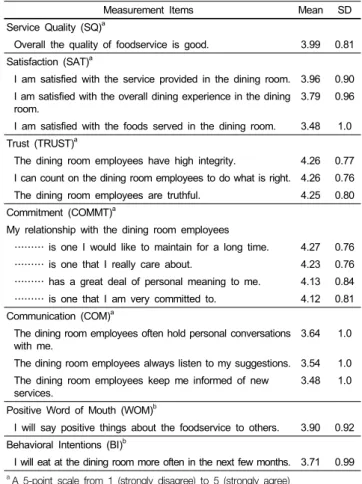
had earned graduate degrees. Table 2 presented the results of descriptive analyses of measurement items of service quality, satisfaction, communication, trust, commitment, and behavioral intentions. The residents of CCRCs rated overall service quality 3.99 indicating that they perceived overall quality of dining service good. They had higher satisfaction with the service and the overall dining experience; however, satisfaction with the foods was lower than the satisfaction with the service. They also showed high trust and commitment to their dining room employees. However, they perceive communication with dining room employees was not high compared to their trust, commitment, service quality and satisfaction. In addition, residents showed high intentions to say positive things about the foodservice to others.
As Table 3 showed, all AVEs for each construct were higher
than 0.50, which indicated that the variance accounted for by
each of the constructs was greater than the variance accounted
Total (n = 327) Number (%) Gender
Females 226 (69.1)
Males 96 (29.4)
No response 5 (1.5)
Marital Status
Single 22 (6.7)
Married 125 (38.2)
Widowed 162 (49.5)
Divorced 10 (3.1)
No response 8 (2.4)
Education
Less than high school degree 6 (1.8)
High school degree 72 (22)
Some college 108 (33)
Undergraduate degree 49 (15)
Some graduate work 19 (5.8)
Graduate Degree 65 (19.9)
No response 8 (2.4)
Age 82.14 ± 5.86
Length of residency (year) 5.49 ± 4.96
Table 1. Description of the respondents
Measurement Items Mean SD
Service Quality (SQ)a
Overall the quality of foodservice is good. 3.99 0.81 Satisfaction (SAT)a
I am satisfied with the service provided in the dining room. 3.96 0.90 I am satisfied with the overall dining experience in the dining
room.
3.79 0.96
I am satisfied with the foods served in the dining room. 3.48 1.0 Trust (TRUST)a
The dining room employees have high integrity. 4.26 0.77 I can count on the dining room employees to do what is right. 4.26 0.76 The dining room employees are truthful. 4.25 0.80 Commitment (COMMT)a
My relationship with the dining room employees
……… is one I would like to maintain for a long time. 4.27 0.76
……… is one that I really care about. 4.23 0.76
……… has a great deal of personal meaning to me. 4.13 0.84
……… is one that I am very committed to. 4.12 0.81 Communication (COM)a
The dining room employees often hold personal conversations
with me. 3.64 1.0
The dining room employees always listen to my suggestions. 3.54 1.0 The dining room employees keep me informed of new
services.
3.48 1.0
Positive Word of Mouth (WOM)b
I will say positive things about the foodservice to others. 3.90 0.92 Behavioral Intentions (BI)b
I will eat at the dining room more often in the next few months. 3.71 0.99
aA 5-point scale from 1 (strongly disagree) to 5 (strongly agree)
b A 5-point scale from 1 (extremely unlikely) to 5 (extremely likely) Table 2. Descriptive analysis of constructs
SQ SAT TRUST COMMT COM WOM RI AVE
Overall Service Quality (SQ) 1.00 N/Ab
Satisfaction (SAT) 0.77 (0.59a) 1.00 0.62
Trust (TRUST) 0.57 (0.33) 0.60 (0.36a) 1.00 0.84
Commitment (COMMT) 0.52 (0.27) 0.56 (0.31) 0.68 (0.46) 1.00 0.82
Communication (COM) 0.50 (0.25) 0.54 (0.29) 0.56 (0.31) 0.62 (0.38) 1.00 0.58
Word of Mouth (WOM) 0.67 (0.45) 0.67 (0.45) 0.44 (0.19) 0.46 (0.21) 0.43 (0.19) 1.00 N/Ab
Revisit Intention (RI) 0.38 (0.14) 0.36 (0.13) 0.27 (0.07) 0.26 (0.07) 0.38 (0.14) 0.42 (0.18) 1.00 N/Ab
aSquared correlation coefficients are estimates from LISREL. AVE: Average Variance Extracted
bSingle item is used to measure SQ, WOM, and RI.
Model measurement fit: χ2= 153.17, df = 59, RMSEA = 0.07, CFI = 0.99, NNFI = 0.98 Table 3. Correlation matrix among latent constructs
for by measurement error, indicating convergent validity [30].
Cronbach’s alpha estimates of trust, commitment, communication and satisfaction were 0.94, 0.95, 0.84, and 0.79, respectively.
These results indicated that multiple items are highly reliable for measuring trust, commitment, communication and satisfaction. Discriminant validity was evident because AVE in each construct exceeded the square of the coefficient representing its correlation with other constructs, as shown in Table 3.
The measurement model was estimated for its model fit before the structural model was estimated, based on Anderson and Gerbing’s [31] two-step approach. First, the model fit of the measurement model was tested using confirmatory factor analysis. The results for the measurement model of communication, satisfaction, trust, and commitment were very good (χ
2= 153.17, df = 59, RMSEA = 0.07, CFI = 0.99, NNFI =
0.98). All indicator loadings for constructs were significant (P
< 0.01). The results of the confirmatory factor analysis provided support for the reliable measurement of communication, trust,
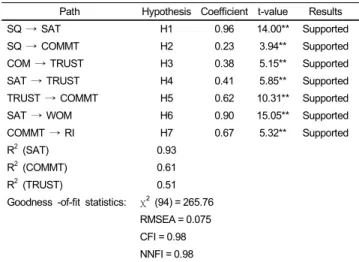
commitment, and satisfaction. Second, the structural equation model was evaluated for testing hypotheses. The proposed model resulted in a fit with χ
2= 265.76, df = 94, RMSEA = 0.075, CFI
= 0.98, NNFI = 0.97. The structural estimates from the proposed model were presented in Table 4. As predicted in Hypotheses 1 and 2, positive service quality had a strong association with satisfaction and commitment. Communication between dining room employees and elderly had a significant positive association with the trust of elderly. These results supported Hypothesis 3.
Hypothesis 4 stated that satisfaction positively related to trust;
these results supported this hypothesis. Trust also had a
Path Hypothesis Coefficient t-value Results
SQ → SAT H1 0.96 14.00** Supported
SQ → COMMT H2 0.23 3.94** Supported
COM → TRUST H3 0.38 5.15** Supported
SAT → TRUST H4 0.41 5.85** Supported
TRUST → COMMT H5 0.62 10.31** Supported
SAT → WOM H6 0.90 15.05** Supported
COMMT → RI H7 0.67 5.32** Supported
R2 (SAT) 0.93
R2 (COMMT) 0.61
R2 (TRUST) 0.51
Goodness -of-fit statistics: χ2 (94) = 265.76 RMSEA = 0.075 CFI = 0.98 NNFI = 0.98
**P< 0.01
Note. RMSEA = Root Mean Square Error of Approximation; CFI = Comparative Fit Index; NNFI = Non-Normed Fit Index
Table 4. Structural parameter estimates: Hypothesized model (n = 327)
Fig 1. Empirical model for testing hypotheses. Service quality (SQ); Communication (COM); satisfaction (SAT); Commitment (COMMT); Intentions to say positive things about foodservice (WOM); Revisit intentions to eat more often in the dining room (RI)
significant positive association with commitment, which supported Hypothesis 5. The results also proved Hypothesis 6, satisfaction positively related to the intentions to say positive things to others about the foodservice. Commitment was a significant predictor of intentions to eat more often in the dining room, which supported Hypothesis 7.
Standardized path coefficients were used to compare direct effects for a given variable. The completely standardized path coefficient from trust to commitment was 0.62, compared to the path coefficient of 0.23 from service quality to commitment (Fig.
1). This study revealed that service quality has a significant positive relationship with commitment. However, the positive association between service quality and commitment was smaller than the relationship between trust and commitment. In addition, communication showed a relationship to trust in this study. The completely standardized path coefficients from communication to trust and from satisfaction to trust were 0.38 and 0.41, respectively (Fig. 1).
Discussion
This study intended to examine the effect of relationship quality (trust, commitment, and customer satisfaction) on behavioral intentions as well as the relationship between communication and trust in foodservices for elderly. The significant results of the proposed model were consistent with the findings in the literature: the path from service quality to satisfaction [18,16,32], the path from satisfaction to trust [13,32,36], and the path from commitment to behavioral intention [10,19,33] were statistically significant. Elderly who rated service quality as high were more likely to have high satisfaction scores for foodservice and a high level of commitment. Communication between dining room employees and elderly had a significant positive association with the trust of elderly. This finding was consistent with previous studies [7,32] that indicated that frequent, accurate, and open communication was required to understand the perspectives of others and to build trust. Communication between customer and service provider was important in building and maintaining a relationship. However, communication was often infrequent because communication requires time and effort.
Trust evolved from social relationships such as frequency and duration of contact (e.g., communication). Previous satisfying experiences could develop trust, which reduced risk and increase trust. The customer could develop trust when he/she could rely on the service provider’s integrity and had confidence in the service provider’s future performance because of the level of past performance. Trust also had a significant positive association with commitment, which was consistent with previous studies showing a relationship between trust and commitment [10,31].
The relationship outcome (trust and commitment) influenced elderly’s behavioral intentions to eat more often in the dining room. CCRCs needed to spend resources to establish, maintain, and strengthen relationships with elderly. Thus, marketing strategies that establish and maintain relationships with customers should be developed if management wants to increase revisit decisions. Management should consider gaining elderly’s trust to be an important marketing task; thus, elderly become more loyal and are willing to invest in the relationship. Elderly’s commitment may significantly reduce the possibility of defection and increase the possibility of revisits.
Satisfaction influenced elderly’s intentions to say positive
things about the foodservice (direct) and to eat more often in
the dining room (indirect), which was similar to previous studies
[32,35,36]. Thus, establishing relationship outcomes (trust and
commitment), increasing elderly’s satisfaction levels by enhancing
service quality should be a priority. Strategies to improve only
trust and commitment would be incomplete if the effects of other
factors, such as satisfaction and service quality, were not
considered. The foodservice managers at CCRCs should identify
and implement strategies to enhance customer satisfaction based
on the results of customer evaluations. Foodservice managers
need to conduct focus groups to obtain insights from residents
and use regular surveys to identify areas for continuous quality improvement. Foodservice managers should take actions to manage the quality of both the service delivery process and the food itself. Such actions may involve training personnel to improve their service skills and to ensure that promises to the residents are kept so that both process quality and outcome quality are ensured.
This study is valuable from a managerial point of view and concluded that service quality had a positive association with satisfaction and satisfaction had a significant positive relationship with positive WOM. The results empirically indicated that service quality had a positive association with commitment, which Hennig-Thurau and Klee proposed in 1997, and commitment had a significant positive relationship with intention to eat more often in the dining room. A high level of service quality connected to create emotional bonds for elderly, thus high quality service leads to a continued relationship with dining room employees.
These results suggested CCRCs should continue efforts to increase their residents’ satisfaction levels with overall foodservices since satisfaction translated to increase positive WOM about the foodservice. Also, this study emphasized the need for foodservice managers in CCRCs to implement quality management efforts to increase satisfaction levels. They could implement strategies to enhance satisfaction based on elderly’s evaluations and take actions toward managing service quality.
This study delineated the process by which communication affected trust. Communication had a positive association with trust, and interpersonal interactions were important in developing trust, since elderly have difficulty in trusting others [37].
Therefore, this study suggested that the role of communication should be emphasized to develop the trust and/or the intimate relationships that elderly consider important.
The communication level between service providers and customers had a positive association with the trust level of customers. However, residents of CCRC rated their communication with dining room employees lower than their service quality and satisfaction level. Though communication requires time and effort, the managers of dining rooms that target the aging population (such as those in CCRCs) should focus on trust development through communication between customer and service provider. Foodservice managers in CCRCs need to pay attention to the fact that elderly need personal communication with dining room employees by training them to listen to the customers’ suggestions and keep them informed of new services.
This study used a cross-sectional design to test the hypothesized model and assessed causality between the constructs. In particular, satisfaction, trust, commitment, and communication are constructs that can change over time. Thus, a longitudinal study may better capture these dynamic aspects. A longitudinal study could improve the understanding of the cumulative effects of service provider- customer relationships. For example, perceived service quality and communication between customers and service providers in the past affect satisfaction and trust in the present. The other
limitation of the study was related to the selection of residents in CCRCs as the sample since the majority of respondents was Caucasian and highly educated Americans. More than two- thirds of participants were females;, however, when considering the life expectancy of the aging population, this proportion was a natural phenomenon.
An important contribution of this study is that the results reveal the impact of communication on relationship outcomes (trust), and in turn, behavioral intention judgments. Communication has had little attention from relationship marketing researchers. This study can extend the theory on the importance of communication in the service encounter by empirically testing a proposed model.
The researchers recommend that foodservice managers consider communication when they develop marketing strategies and in employee training to increase loyal customers. An analysis of the level of communication that results from relationship outcomes is recommended for future studies.
References
1. U.S. Department of Health and Human Services [Internet]. USA:
Continuing care retirement communities; c1997 [cited 2001 March 12]. Available from: http://aspe.os.dhss.gov/daltcp/Reports/
ccrcrpt.htm.
2. Administration on Aging [Internet]. USA: Housing with services:
CCRC; c2003 [cited 2009 July 13]. Available from: http://www.aoa.
dhhs.gov/eldfam/housing/housing_services/ccrc.asp
3. Amarantos E, Martinez A, Dwyer J. Nutrition and quality of life in older adults. J Gerontol 2001;56:54-64.
4. Garbarino E, Johnson M. The difference roles of satisfaction, trust, and commitment in customer relationships. J Mark 1999;
63:70-87.
5. Smith JB. Buyer-seller relationships: Bonds, relationship management, and sex-type. Can J Adm Sci 1998;15:76-92.
6. Scotti DJ, Stinerock RN. Cognitive predictors of satisfaction with hospital inpatient service encounters among the elderly: A matter of trust. J Hosp Mark 2003;14:3-22.
7. Johnson DW, Johnson RT. Cooperation and competition: Theory and research. Edina: Interaction Book Co.; 1989.
8. Lewicki RJ, Bunker BB. Developing and maintaining trust in work relationships. In Kramer RM, Tyler TR. (Eds.): Frontiers of Theory and Research, Sage, Thousand Oaks.; 1996. p.114-39.
9. Moore JR, Gilbert DA. Elderly residents: Perceptions of nurses’
comforting touch. J Gerontol Nurs 1995;21:6-13.
10. Morgan RM, Hunt SD. The commitment-trust theory of relationship marketing. J Mark 1994;58:20-38.
11. Dai Y. Overall Customer satisfaction, trust, and commitment in customer voluntary performance behaviors with travelers in lodging services. [doctor’s thesis] Pennsylvania: Pennsylvania State University; 2002.
12. Singh J, Sirdeshmukh D. Agency and trust mechanisms in consumer satisfaction and loyalty judgments. J Academy Marks Science 2000;28:150-67.
13. Tax SS, Brown SW, Chandrashekaran M. Customer evaluations of service complaint experiences: Implications for relationship marketing. J Mark 1998;62:60-76.
14. Hennig-Thurau T, Klee A. The impact of customer satisfaction and relationship quality on customer retention: A critical reassessment and model development. Psychology & Marks 1997;14:737-65.
15. Spreng RA, Mackoy RD. An empirical examination of a model of perceived service quality and satisfaction. J Retailing 1996;
72:201-14.
16. Gotlieb JB, Grewal D, Brown SW. Consumer satisfaction and perceived quality: complementary or divergent construct?. J Appl Psychol 1994;79:875-85.
17. Dabholkar PA, Shepherd CD, Thorpe DI. A comprehensive framework for service quality: an investigation of critical conceptual and measurement issues through a longitudinal study. J Retailing 2000;76:139-73.
18. Reynolds KE, Beatty SE. Customer benefits and company consequences of customer salesperson relationships in retailing.
J Retailing 1999;75:11-32.
19. Moorman C, Zaltman G, Deshpande R. Relationship between providers and users of market research: The dynamics of trust within and between organization. J Mark Res 1992;29:314-28.
20. Bolton RN. A dynamic model of the duration of the customer’s relationship with a continuous service provider: The role of satisfaction. Marks Science 1998;17:45-65.
21. Cronin Jr, Taylor SA. Measuring service quality: A reexamination and extension. J Mark 1992;56:55-68.
22. Crosby LA, Evans RE, Cowles D. Relationship quality in services selling: An integrative influence perspective. J Mark 1990;54:
68-81.
23. Anderson E, Lodish LM, Weitz BA. Resource allocation behavior in conventional channels. J Mark Res 1987;24:85-97.
24. de Wulf K, Odekerken-Schröder G, Iacobucci D. Investments in consumer relationships: A cross-country and cross-industry exploration.
J Mark 2001;65:33-50.
25. Fu Y, Parks SC. The relationship between restaurant service
quality and consumer loyalty among the elderly. J Hospitality &
Tourism Res 2001;25:320-36.
26. Allen NJ, Meyer JP. The measurement and antecedents of affective, continuance and normative commitment to the organization. J Occup Organ Psychol 1990;63:1-18.
27. Anderson E, Lodish LM, Weitz BA. Resource allocation behavior in conventional channels. J Mark Res 1987;4:85-97.
28. Seo SH, Shanklin CW. Food and service quality attributes important to residents living in continuing care retirement communities. J Am Diet Assoc 2003;103:200.
29. Nunnually, JC. Psychometric Theory (2nd ed.). New York: Mc Grow-Hill.; 1987.
30. Fornell C, Larcker DF. Evaluating structural equation models with unobservable variables and measurement error. J Mark Res 1981;18:39-50.
31. Anderson JC, Gerbing DW. Structural equation modeling in practice: a review and recommended two-step approach. Psychol Bull 1988;103:411-23.
32. Caceres RC, Paparoidamis NG. Service quality, relationship satisfaction, trust, commitment and business-to-business loyalty.
Eur J Mark 2007;41:836-67.
33. Chen ZX, Shi Y, Dong DH. An empirical study of relationship quality in a service setting: a Chinese case. Marks Intelligence
& Plan 2008;26:11-25.
34. Um S, Chon K, Ro YH. Antecedents of revisit intention. Annals Tourism Res 2006;33:1141-58.
35. Babin BJ, Lee YK, Kim E, Griffin M. Modeling consumer satisfaction and word-of-mouth: restaurant patronage in Korea. J Serv Mark 2005;19:133-9.
36. Kau A, Loh EW. The effects of service recovery on consumer satisfaction: a comparison between complainants and non-complainants.
J Serv Mark 2006;20:101-11.
37. Calhoun RE, Hutchinson SL. Decision-making in old age:
Cautiousness and rigidity. Int J Aging Hum Dev 1981;13:89-98.